
I’ve become attached to the practice of reading a few pages of a classic text first thing in the morning. À la recherche du temps perdu kept me busy for nearly two years. The Iliad and The Prelude followed. Then Middlemarch, which I finished a couple of weeks ago. Now that I’ve stopped missing Dorothea, Will, Celia, Lydgate and even Rosamond, it’s time to move on to my next morning project.
Over the protests of the Emerging Artist, who has barely tolerated my occasional morning chat about Middlemarch (I say occasional; she says far too frequent), I’ve decided to tackle St Augustine’s Confessions next. I hereby resolve to keep any enthusiasms to myself, or at least not inflict them on my nearest and dearest.
This is a book that has been around in my life for a very long time, but it hasn’t occurred to me until now to actually read it. Good Counsel College in Innisfail – which I attended aged 9 to 13 – had the Latin motto, Tolle lege, which translates as ‘Take up and read’. Regardless of what personal meaning it might have had to students – it has pretty much become my life’s motto – we were told that the phrase came from a moment in the life of Saint Augustine: when he was living a dissolute life in the fleshpots of Egypt he heard an angelic voice telling him to pick up and read a book he saw lying on a window ledge. The book was a Christian Bible, and the text that he read in obedience to the voice turned his life around. I guess I’m about to find out if that story comes from the Confessions, and if it does, how much of my childhood recollection is true to what the man himself wrote.
I’ve garnered other bits of information about Augustine and this book over the years. That’s one of the things that makes a book a classic: you don’t have to have read it to know a thing or two about it.
I feel as if I’ve always known that Augustine lived a debauched pagan life while his Christian mother wept and prayed for his conversion. His prayer is famous: ‘Lord, make me virtuous, but not yet.’
At one stage of my life his injunction, ‘Ama et fac quod vis’ (‘Love and do what you will’) was a welcome antidote to the rule-bound Catholicism of my childhood.
Augustine invented the concept of original sin, the blight of many young Catholic lives – though James Carroll, in Constantine’s Sword, an excellent book about anti-semitiism in the Catholic Church, argues that for Augustine the concept was about embracing human imperfection rather than condemning us as innately evil.
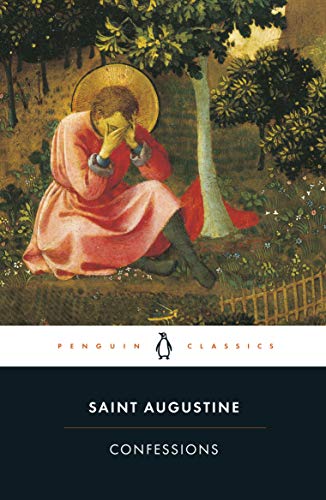
I’e bought a copy of the Penguin Classics edition, translated in 1961 by the wonderfully-named R S Pine-Coffin, and I’ve found a Latin text on line in case I decide to be linguistically adventurous. I’ll report back in a month …


 Me fail? I fly!
I’ve just finished reading Rose Macaulay’s The Towers of Trebizond, and she has quite a bit to say about St Augustine. If you can get hold of a copy, I think you would find it very interesting.
LikeLiked by 1 person
Thanks, Lisa. It seems to be in the nature of classic texts that when you start reading them, they turn up all around you. I’ve still got two Trojan War novels on my TBR shelf that got there when I was reading the Odyssey.
LikeLike
Those recent feminist rewrites? Or something more interesting than that?
LikeLike
Yes, the feminist rewrites – at least that’s what I think they are. The Song of Achilles by Madeline Miller is the one I can lay hands on without a thorough hunt
LikeLike
*musing* I quite enjoyed that one, and I loved the wickedly funny Penelopiad by Margaret Atwood… but as a subset of HistFic they’ve worn a bit thin now. They feel unnecessary. ‘Look! We were there too! We were left out of those culturally important Greek myths and now we’re taking our place in the pantheon.’
It was a good idea to do that once or twice, and preferably as Atwood does it, tongue-in-cheek, but…
I’m a bit over it now.
LikeLiked by 1 person
Ah! I read the Penelopiad a while ago and enjoyed it. And I’ve read Pat Barker’s The Silence of the Girls, which fits your description exactly and was one of the things that prompted me to read Homer
LikeLike
Yes, I read that too, but truth be told, now I’d rather re-read my Homer. (I did enjoy your posts about it!)
LikeLiked by 1 person
You are such an adventurer. Most admirable!
LikeLiked by 1 person
I’m a long way from reading Heidegger, though!
LikeLike
Too hard that Heidegger, but good to read about. In terms of philosophy I am trying to track down a recent Jurgen Habermas book on the influence of that peculiar blend of Greek thought and Christian theology which he argues still influences western thought. Shall report back if I find a copy. PS I am joining a secret cabal of locals who meet every Tuesday to share poetry. Kiama is getting more interesting.
LikeLiked by 1 person
Now that’s adventurous!
LikeLike