
Saint Augustine, Confessions (approx 400 CE, translated by R S Pine-Coffin 1961, Penguin Classics edition): pages 111–190, from start of Book VI to Book IX, chapter 6
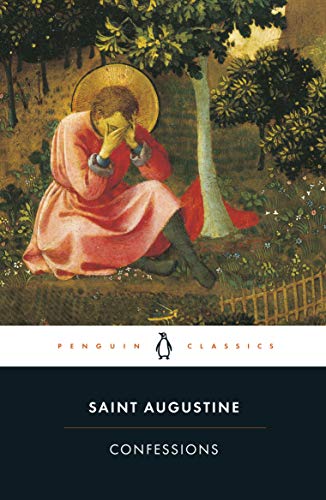
This month’s reading of Confessions included the book’s most famous prayer, ‘Give me chastity and continence, but not yet.’ Here it is in context:
As a youth I had been woefully at fault, particularly in early adolescence. I had prayed to you for chastity and said, ‘Give me chastity and continence, but not yet.’ For I was afraid that you would answer my prayer at once and cure me too soon from the disease of lust, which I wanted satisfied, not quelled.
(Book VIII Chapter 7, page 169)
at ego adulescens miser valde, miserior in exordio ipsius adulescentiae, etiam petieram a te castitatem et dixeram: da mihi castitatem et continentiam, sed noli modo. timebam enim, ne me cito exaudires et cito sanares a morbo concupiscentiae, quem malebam expleri quam exstingui.
Interestingly enough, Augustine’s struggle with sexual desire isn’t his main story. He does go on about it a bit, and he never shakes off the Manichees’ demonising of the body, but it’s not that much more interesting than his gambling addiction, which was relatively easily kicked. His true interest is in the convoluted mental and emotional process of conversion. He disentangles himself from Manicheism, comes to devalue academic success, and renounces what we might see as a perfectly decent de facto relationship, to embrace mainstream Christianity. He describes himself as wanting to go in two directions, one towards what he understands to be a life well lived, and the other to stay with what he has. It’s a beautiful anatomy of the process of getting to decide to change one’s life (‘a hundred indecisions, … a hundred visions and revisions’).
The moment when he finally makes his decision is brilliant. He is overwhelmed by an emotional storm, an ‘agony of indecision’, and goes away from his friend to weep, because ‘tears were best shed in solitude’ (so men’s conditioning has stayed constant in some regards for at least 1600 years). He has a really good cry, and then there’s the other bit I was told about in my childhood::
I heard the singsong voice of a child in a nearby house. Whether it was the voice of a boy or a girl I cannot say, but again and again it repeated the refrain ‘Take it and read, take it and read’. At this I looked up, thinking hard whether there was any kind of game in which children used to chant words like these, but I could not remember ever hearing them before. I stemmed my flood of tears and stood up, telling myself that this could only be a divine command to open my book of Scripture and read the first passage on which my eyes should fall.
(Book VIII chapter 12, page 177)
audio vocem de vicina domo cum cantu dicentis, et crebro repentenis, quasi pueri an puellae, nescio: tolle lege, tolle lege. statimque mutato vultu intentissimus cogitare coepi, utrumnam solerent pueri in aliquo genere ludendi cantitare tale aliquid, nec occurebat omnino audisse me uspiam: repressoque impetu lacrimarum surrexi, nihil aliud interpretans divinitus mihi iuberi, nisi ut aperirem codicem et legerem quod primum caput invenissem.
I got the impression from the nuns, priests and brothers of long ago that the voice was that of a disembodied spirit, an angel. But Augustine himself suggests no such thing. God’s instrument here is an actual child – otherwise why linger on the child’s indeterminate gender? I also thought this was the first time Augustine read the Christian scriptures, but he has been studying them for years, and already believes they are sound. In the actual Confessions, this is a moment of serendipity, and his going to read the first passage he sees (from Paul’s epistles, it turns out) has a lot in common with the ‘pagan’ practice of the sortes Virgilianae, in which the pages of Virgil’s Aeneid were opened at random to see the future.
This morning’s reading ended with more tears, of gladness this time as he is baptised and his life is turned around. He is accompanied by his son Adeodatus, now 15 years old, whom he clearly treasures.
I’m about two thirds of the way through the book, and I’m expecting the rest to be pious anticlimax. But these last 20 pages are brilliant and completely explain the book’s enduring status as a classic.


 Me fail? I fly!
Saint Augustine’s Confessions offers profound introspection and serves as a timeless reflection on human nature.
LikeLiked by 1 person
True that!
LikeLike
Love it. Thank you for sharing.
LikeLiked by 1 person
JS: You always bring out the delight and the humanity in your close reading of the classics – whether from more modern times or the modern times way back in more ancient history! Thanks.
LikeLiked by 1 person
Thanks, Jim
LikeLike
Given the interest in Augustine, and your vast capacity for distentangling complex texts, perhaps the next book could be Heidegger’s ‘Being and Time’ for which a belated debt to Augustine has been acknowledged (eg ‘Heidegger’s Confessions’ Ryan Coyne). To get us up to date, it offers a secular interpretation of the life worth living, or perhaps with the Christian metaphysics more carefully tucked away. I offer this suggestion with tongue firmly in cheek.
LikeLiked by 1 person
I was torn about this suggestion, Ian, tongue in cheek or otherwise, because I’d love to read a secular interpretation of the Confessions, but Heidegger is a bit out of my league.
LikeLike