Monthly Archives: Nov 2023

November verses 13 and 14

My last two stanzas for this year are a Terminal, which I believe is something developed by the late John Tranter. The last word in each line is the corresponding word in two stanzas taken pretty much at random (Chapter 4, verses 30 and 31, if you’re interested) from Babette Deutsch’s 1943 translation of Eugene Onegin, which is online at Internet Archive. I think they make a kind of sense.

Verses 13 & 14: Religion
Hell was terrifying. Hades,
though a similar abode,
was not too rude for talk with ladies
even in a jokey mode.
Ancient gods just decorated
what we knew had been created
by our one true God. The pen
was weaker than the Word. Amen!
Now neither Zeus nor Yahweh win me
over. I just don’t inscribe
them on my heart. No diatribe
from either sounds alarms within me.
No need to be satirical
nor offer hymn or madrigal.

Yet I’ve been faithful in my fashion.
I don’t fear hell now, not a bit,
but David’s psalms and Matthew’s Passion,
Priam’s grief and Dante’s wit
speak to me of things that matter.
Life without them would be flatter.
As sunlight sets fine jewels aglow
and wine makes conversation flow,
these ancient tales hold my affection.
I know I've no immortal soul,
that death is death, and lives will roll
their course. Each adds to the collection:
wisdom, folly, grace. Update:
no gods, no providence, no fate.

Normal blogging will resume shortly.

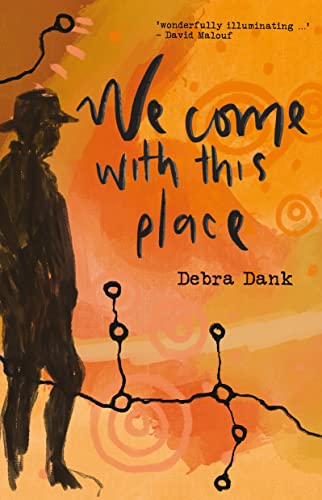
Debra Dank’s We Come With This Place at the book group

Debra Dank, We Come with This Place (Echo Publishing 2022)

Before the meeting: We Come With This Place won an amazing four prizes at the NSW Premier’s Literary Awards this year, including Book of the Year: you can read the judges’ comments here and here. They include this:

This sensational memoir is an unheralded reflection on what it is to be First Nations in Australia, and on the very deepest meanings of family and belonging.

In one of her modest acceptance speeches at the awards ceremony, Debra Dank mentioned that the book started out as part of her PhD study. In the Preface, she elaborates:

I wanted to show how story works in my community and how it has contributed to our living with country for so long. It seemed to me imperative to talk about those voices, both human and non-human, who guided Gudanji for centuries before anyone else stepped onto this land.

(page viii)

The weeks after the referendum on the Voice failed seemed a perfect time to read this book. The Uluṟu Statement from the Heart’s call for Voice, Truth, Treaty has been rejected at the political level: it’s a relief to listen to the voices of First Nations writers like Debra Dank, and participate in this form of truth-telling.

It’s a terrific book: an intimate portrait of family life, placed in the context of ancestral stories, a deep sense of connection to Country, and resilience in the face of the horrors of colonialism. The family lived ‘under the Act’ in Queensland, and managed ingeniously to hide little Debra when the Welfare came looking for light-skinned children; her father worked on a number of rural properties, where sometimes he was treated with great respect, other times not so much. She helps her father work on a windmill. There is a tactfully written scene where she stands up against family violence, and magical moments with her grandfather, and with her children and grandchildren. I love the pages where Dank’s white surfie husband (he’s saltwater, she’s dust) struggles to learn how to read the bush, to see the things that are glaringly obvious to his Aboriginal children.

Dank identifies as belonging to dry country, and she makes brilliant use of images of dust. On the very first page, ‘vague images try to speak to [her] through dust motes rising from the thick pale pages’ of a 400-year-old edition of a book by Aristotle, and a few pages later, she tells us that the stories of her people – the Gudanji kujiga – ‘grow from the fine dirt that plays around your feet and makes the dust that rolls over the the vast Gudanji and Wakaja country’. As a child she is fascinated by the way a drop of blood from a foot caught on barbed wire blends into the soil. Dust rises from the heels of a family group in the not so distant past running in terror from armed men on horseback. It memorably obliterates the Country-scarring road in the passage I versified the other day (here).

I don’t want to give the impression that the book is written in high metaphorical mode. Here’s a little passage from page 76 (for those who came in late, I like to have a closer look at that page because it’s my age). The family are driving from one place of employment to another, and appropriately enough the page starts with dust:

The wind brought dust in with it, but it was the Dry and the road wasn’t too bad. The caravan happily kicked up dust into frothing red feathers that followed us for a bit, then settled back onto the road. Long stalks of tall yellow grass formed a guard of honour as we traveled across the plains. We played games of spot the turkey and several times tried desperately to convince Dad to stop for the goannas that would run across the road and then lie still and flat in the shelter of the yellow grass and amber shadows, but we needed to get there so he didn’t stop. Besides, Mum said she refused to turn up at the new station with a dead gonna in the car.

You see what I mean: if you’re not alert to the dust motif, those frothing red feathers that follow and settle are a nice piece of decoration; if you’ve picked up on it, they’re a reassuring presence of Country. And this tiny moment embodies the way the family manages to live successfully in two worlds: goannas would be great, but not when you’re about to meet a new white boss.

After the meeting: It was our end-of-year meeting, so as well as discussing the book, we exchanged gifts – of books chosen from our bookshelves. I gave Diana Athill’s wonderful memoir, Somewhere Towards the End, and scored J M Coetzee’s 1986 novel, Foe. We also, in a three-year tradition, each brought a poem to read to the group: poems represented included Seamus Heaney, Oodgeroo Noonuccal writing as Kath Walker, Adrian Wiggins, J Drew Lanham, Rosda Hayes, and Sean Hughes.

There were seven of us. Two hadn’t read the book – it’s a busy time of year. One was ‘at about 55 percent’ on his device. One said he had read seven other books since so had difficulty recalling it with any clarity. We were in a pub rather than our usual domestic setting. None of that stopped the conversation from delving into the book, ranging widely and then finding its way back to the page. Those of us who had read it celebrated the way it presented the history from inside an First Nations point of view: even Kim Scott’s brilliant novel That Deadman Dance didn’t get to the inside story as completely as this; and it has a calm assurance that, say, Julie Janson’s Benevolence lacks, for all its other strengths (the second of these comparison came up in conversation in the car ride home).

One Covid-ed absentee emailed in some cogent comments – noting that there seemed to be a number of voices, and that the passages dealing with the author’s personal experience worked better than the narration of ancient stories. He loved, and others agreed, the bits of bushcraft such as reading shadows and catching fish with your hands in the desert, the cultural landscape connections.

I went on a bit about dust.

There was a lot of reflection on personal experiences the book reminded people of. There was also, as usual, much excellent conversation about unrelated matters, including Anna Funder’s Wifedom; the recent blockade in Newcastle and a similar one nearly 20 years ago which provoked a very different response from the police and the press; philosophy and poetry groups in a small town; behind the scenes stories from a fascinating film project; travellers’ tales.

And that’s a wrap for the Book Group for 2023.

November verse 12

Even though the Sydney Morning Herald ran a story on their website about the weekend’s Rising Tide blockade, it has maintained its silence in the print edition, except for a letter from Cathering Rossiter, of Fadden.

Verse 12: Newspaper of record?
(after the Sydney Morning Herald 
print edition, 28 November 2023)

In other news, a mass extinction
threatens unless something's done
to stop all fossil fuel extraction.
Letter on page twenty-one
thanks the thousands who blockaded 
Port Newcastle (paddled, waded,
were arrested, took a stand),
but that's the lot, the story's canned. 
A riot would have been reported,
violent death would make page one,
Pezzullo, Lehrmann, courtroom fun.
But thirty hours, no coal exported:
silence. Are they clowns or cads?
Wel, fossil fuellers run big ads*.

* See SMH, 27 November, page 9

November verse 11

I’ve been a bit busy, and will struggle to reach my quota of 14 stanzas this month. Here’s a what-I-did-on-the-weekend verse.

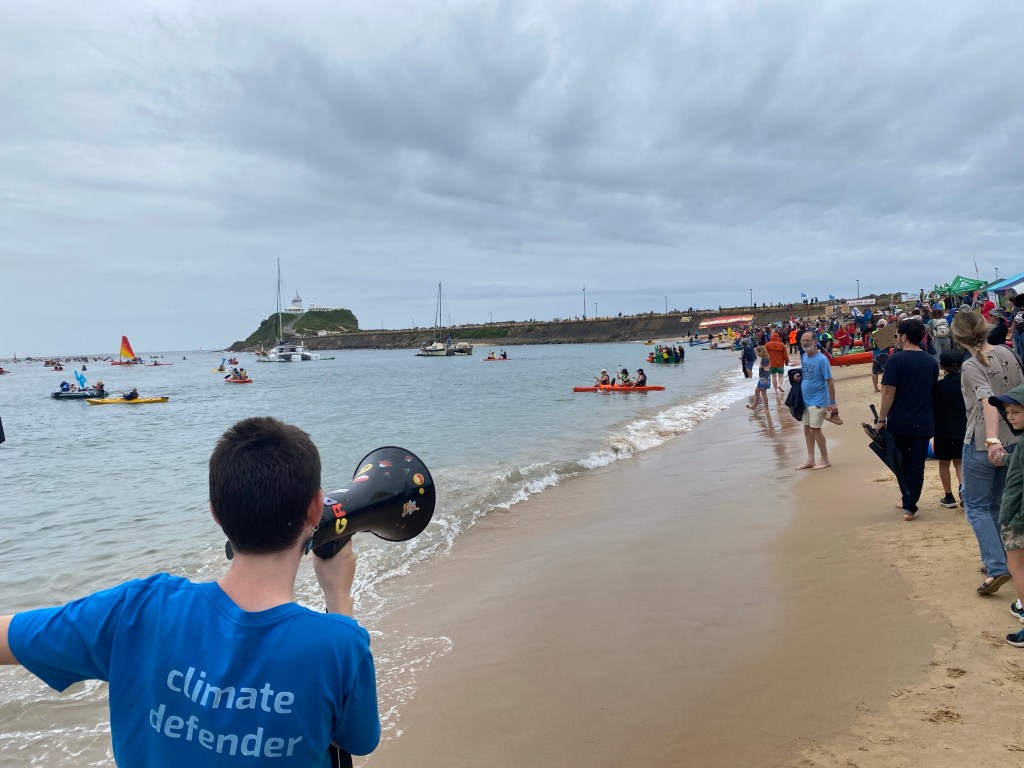
Verse 11: The Rising Tide blockade of Newcastle coal port
With face paint, dolphins, rain and thunder,
unicorn and sousaphone,
for thirty hours, a joyful wonder,
kayaks shut the coal port down. 
Face to face with climate evil,
disobedience was civil.
Some as clowns or pirates dressed
a hundred brave souls faced arrest,
while hundreds on the shore were chanting,
'No more coal, no more oil,
keep that carbon in the soil.'
Drumming, singing, waving, dancing:
'Stop the coal, stop the ships,
we say no apocalypse.'

Added Monday morning: Shockingly, today’s Sydney Morning Herald makes no mention of this huge act of civil disobedience. It carries a huge ad for ‘oil and gas giant’ Woodside.

Added Tuesday morning: The Sydney Morning Herald did run a piece on the blockade, dated 7.31 yesterday morning, so too late for Monday’s newspaper. It’s mentioned in the ‘In other news’ section of their morning email. You can read it here.

Rising Tide in Newcastle

The Rising Tide blockade of Newcastle, said to be biggest coal port in the world, kicks off. It will last for 30 hours, hundreds of kayaks on the water.

Poem may follow.

November verse 10

I don’t think this one needs any explanation.

10. Webinar
We used to meet, shake hands, rub shoulders,
curse the traffic, kiss a cheek,
queue for name tags, bags and folders, 
find a chair that didn’t squeak.
Now it’s all, ‘You’re not unmuted,’
‘Can the speaker be spotlighted?’
‘Check the webpage in the chat,’
‘Share a screen – Oh look, a cat!’
To meet up now, we all go zooming:
names attached, we fill our screens
with gallery view, and by this means
we see a score of 2-D humans.
Minds still meet, and even hearts,
but what of one another's farts?

November verse 9: From Debra Dank

I’ve just read Debra Dank’s We Come with this Place, an astonishing book that I expect to blog about soon. It won four of the prizes at the NSW Premier’s Literary Awards this year: you can read the judges’ comments here and here.

Today’s stanza is a versification of the first paragraph of the chapter ‘Yarned into Place’. It’s probably useful to say that the red dust of Gudanji Country is a powerful presence throughout the book.

Verse 9: From Debra Dank
'Nyamirniji ilinga jaburru'
'You listen first and then you'll know.'
The road ahead lies straight and narrow,
dictates where our car will go.
A line dug in the land by grader,
straight as pencil-rule on paper,
irons out what that land has lived
and seen: a scar. We'd be deceived
but there behind us all the swirling
waves and billows of red dust
erase that line, as breezes must,
defy geometry’s appalling
power. No straight line. All around
dust hides what hides the sacred ground.

Here’s the original prose, from page 239 of the book:

‘Nyamirniji ilinga jaburru,’ she said. ‘You listen first and then you will know.’ The road stretched ahead, an astonishing river of earth that we, travelling in a white troopie, moved along as if in a boat. As far ahead as we could see, the road continued straight. Someone had taken out a grader and dug a straight line across the landscape as easily as they would have used a ruler to draw a line on a paper map. And they built that road, so straight and flat that it ironed out all the history this country had lived and seen, leaving just that awful scarring mark. But, when we looked behind us, swirling and billowing waves of red dust obliterated the road, twisting and turning in eddies and breezes. There was not a straight line to be found anywhere.

November verse 8: Dum diversas

I’m not sure that my little stanzas can address truly horrible things. It’s almost a kind of blasphemy to tie up great, tragic events and concepts into a neat little rhyming package. But one of my aims in these November stanzas is to grab whatever is occupying my mind at the time and wrangle it into verse.

This issue may not be as urgently of the moment as some, but I learned some time ago that the English invaders of Australia in the late 1700s didn’t invoke the doctrine of terra nullius as justification. For at least the first fifty years of settlement, no one pretended that there was anything other than a war of occupation and resistance. Courts and governments only started talking about terra nulliius in the 1860s or later.* The moral / legal justification, if there was any, dated back to the Doctrine of Discovery, which was understood to have originated in a series of papal bulls in the 1400s. The Doctrine of Discovery has been repudiated by Pope Francis but the bulls have not been rescinded.

The first of the papal bulls, Dum diversas, was issued by Pope Nicolas V in 1452, addressed to King Alfonse of Portugal. If you have the stomach for it, you can read an English translation here. Here’s my short, rhyming version of the ghastly gist:

Verse 8: Dum Diversas
Divine Love is what animates us,
faith for which Christ shed his blood.
We must protect from all that hates us
all our flock, from lamb to stud, 
and so we grant you full, free power
wherever Christ's love does not flower:
invade, fight, conquer, subjugate,
take land, enslave, appropriate,
enrich yourselves, no mercy ever, 
leave no stone upon a stone,
destroy, heap blood-stained bone on bone.
And all who help in this endeavour,
should they die, to lose or win,
their souls shall be absolved of sin.

* I am not a historian. Please correct me in the comments if I need correcting.

November verse 7

7. On reading Burglar Bill for something 
like the thousandth time
Everything he owned was stolen:
bed, beans, teapot, teacup, tea,
the grate he heaped his stolen coal in,
helmet, handsaw, got for free
on his nightly torchlit outing,
in at windows, gaily shouting,
'That's a nice –––, I'll have that!'
(A question: Did he steal his cat?)
Then along came Burglar Betty:
being burgled isn't fun.
Betty's baby (daughter? son?)
turned them both from crime and yet he
now – a timid reader prays –
recalls with joy his wicked days.

If you’ve never read Burglar Bill, by Janet and Allen Ahlberg, you’ve got a treat in store. I probably haven’t actually read it a thousand times, but these days I can be asked to read it three times in a row. Like Maurice Sendak’s Where the Wild Things Are or Margaret Mahy’s A Lion in the Meadow, it never gets boring.

November verse 6

6. On the Belvoir Street Theatre production of
Mikhail Bulgakov's The Master and Margarita

Pontius Pilate chats with Jesus
Satan's crew puts on a show
of magic that astounds and pleases.
Heads are torn off – it's Moscow
in Stalin's time, plus naked witches,
lots of bodies without britches.
One leaps out into the street
bold as brass but less discreet.
'The worst sin is to be a coward.'
The man who wrote this rampant tale
risked more than just a night in gaol.
A message for us all post-Howard:
be bold, have fun, don't hesitate, 
and if you write poems they don't have to rhyme or scan.