
Lech Blaine, Bad Cop: Peter Dutton’s Strong Man Tactics (Quarterly Essay 93, 2024) – plus correspondence in Quarterly Essay 94
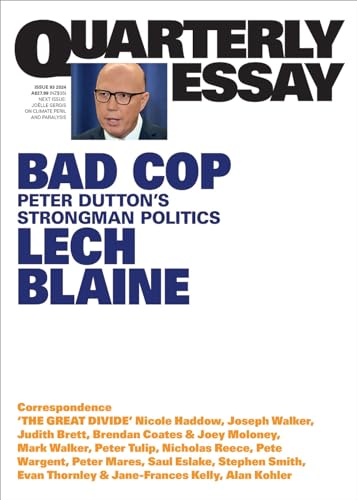
Peter Dutton eats bleeding-heart lefties for breakfast. He is tall and bald, with a resting death stare. His eyes – two brown beads – see evil so that the weak can be blind. His lips are allergic to political correctness. Peter preaches the gospel of John Howard with the fanaticism of Paul Keating. He wants to do the Labor Party slowly, slowly, slowly, and defeat the woe-is-me heroism of identity politics.
That’s the start of this Quarterly Essay, and it was nearly enough for me. Life’s too short and the times are too perilous, I thought, to indulge in another witty hatchet job on a dangerous politician. And I was grumpy with a heavy cold.
But I persevered, partly out of a QE completist compulsion but also because I’d heard Lech Blaine talking to Richard Fidler on the Conversations podcast (link here), where he said some interestingly complex things about Dutton.
Much of the essay, it turns out, is a slog. It follows the ins and outs of Dutton’s life and career, along with the vicissitudes of the Liberal Party and Queensland’s Liberal National Party and the internecine leadership struggles on that side of Parliament over the last 40 years or so, with occasional glimpses at what’s happening in the ALP. Blaine has done a shedload of research, including many interviews with key players and interested observers. There’s far too much going on to enable a coherent narrative, and that’s not counting the brief look at Dutton’s squatter ancestors who were in the tiny minority of their class who stood up for First Nations in Queensland.
The reader is never left in any doubt that Blaine doesn’t like Dutton or his politics – and Dutton has thoughtfully provided a steady stream of pithy quotes to justify those dislikes.
In Blaine’s account, everything Dutton says and does is calculated for its electoral usefulness, but at least some of his outrage has a germ of personal truth to it. His projected identity as a Queensland copper, unlike Scott Morrison’s ‘ScoMo’ persona, is based in actual experience, specifically his nine formative years in the Queensland police force. He was genuinely affronted when someone on Twitter called him a rape apologist, as his dealing with horrific instances of rape as a policeman had been a major formative experience. It’s not just a matter of convenience that he doesn’t spruik his subsequent decades as a property wheeler and dealer, even though that experience, that unacknowledged identity, lies at the back of many of his policy positions.
The correspondence in Quarterly Essay 94 kicks off with a brief, resounding endorsement from Niki Savva, the Queen of Liberal Party Coverage. Encapsulating much of Blaine’s essay, she says, ‘I call Abbott Terminator One and and Dutton Terminator Two.’ Thomas Mayo underlines Dutton’s role in defeating the Voice referendum, quoting Noel Pearson: ‘A heartless thing to do – but easy.’ Other correspondents join the argument about Dutton’s strategy to become the next Prime Minister – interesting, but largely ‘inside baseball’ discussion.
Paul Strangio, an emeritus professor in politics who is currently working on a study of ‘Australia’s best prime ministers’, add some interesting perspectives. He reminds us of that other Queensland copper who was leader of the Federal Opposition, Bill Hayden:
Despite the similarities in their back stories, the differences between Hayden and Dutton could hardly be starker. Arguably, the contrast is a disturbing marker of the degeneration of the political class across generations, of the retreat from a milieu of enlightened social-democratic optimism to irrational conservative populist pessimism, and of the decline of a political sensibility of compassion and empathy to one of stony-heartedness.
Strangio reminds us that Dutton’s strong man approach to politics is part of a planet-wide phenomenon. And he puts his finger on the thing that I experienced as a vague discontent with the essay. Blaine’s view of Dutton, summed up in his final words – ‘Tall and strong at first glance, but when you watch him for a long time, you can see that the man is small and scared’ – isn’t strongly substantiated. The reader is left with the suspicion that it ‘springs as much as anything from a distaste for his subject, a distaste that he struggles to disguise’.
I agree. This essay works brilliantly as a reminder of the many ways Peter Dutton has shown himself as the ‘strong man’ of the Australian parliamentary right-wing, there are hints of how he got to where he is, and a persuasive account of his current campaign to become prime minister, but Dutton the breathing, feeling man remains a mystery.


 Me fail? I fly!
LOL I’m glad you read it so I don’t have to.
I’m a subscriber, but this one went straight to recycling in my Little Library, and guess what, it’s still there because nobody else wants to read it either.
Seriously, *yawn* what was the point of Blaine rehashing all the stuff that’s already out there about Dutton?
And now the latest QE is *another* one about climate change. There are so many interesting and compelling current affairs issues that ought to be under the microscope but at the moment QE seems to be one disappointment after another.
The Kohler essay about housing was excellent, let’s have more of that!
LikeLiked by 1 person
I may have been unfair to this essay, Lisa, but it really didn’t make me any wiser. On the other hand, Joëlle Gergis is someone to listen to on climate change. I’ll stick to my disciplined postponement but I’m looking forward to reading her
LikeLiked by 1 person
Your post made me think of David Marr’s QE on Tony Abbott, and then Savva’s comment, “I call Abbott Terminator One and Dutton Terminator Two” – nailed it. Both seem to be big (strong, extreme?) examples of politicians who put their political ambitions ahead of any humanity that might have. I haven’t read a QE for a while but that’s just because of time.
LikeLiked by 1 person
I thought it was useful to round up a summary of Dutton and the more his background is known the better.
the comment by Paul Strangio contrasting him with Bill Hayden was well made
and the more that can be published about the climate catastrophe the better
LikeLiked by 1 person
You’re right, Suzanne. I think I quoted Paul Strangio’s line about ‘distaste’ because I stand accused of the same thing, and I imagine distaste can cloud your judgement as much as uncritical enthusiasm
LikeLike
Pingback: ‘Bad Cop: Peter Dutton’s Strongman Politics’ by Lech Blaine (Quarterly Essay #93) – Reading Matters