
Andrew O’Hagan, Caledonian Road (Faber 2024)
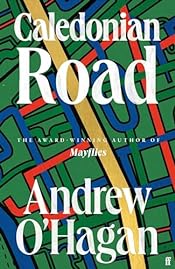
Before the meeting: Caledonian Road has a brilliant epigraph from Robert Louis Stevenson’s 1881 essay about ageing, ‘Aes Triplex’:
After a certain distance, every step we take in life we find the ice growing thinner and thinner below our feet, and all around us and behind us we see our contemporaries going through.
This quote struck a powerful chord with me, as the ice is definitely growing thinner below my feet, and I’m seeing my contemporaries ‘going through’ with increasing frequency.
Disappointingly, however, the book isn’t about courage and resilience in the face of ageing. It’s both more ambitious and less engaging than that.
Caledonian Road is a portrait of modern Britain, where criminality and corruption are the order of the day, and complicity is universal. Ranging from a Russian oligarch to a bystander at a backstreet knifing, with a distinguished art critic, a number of parliamentarians and a huge cast of characters in between, no one in the book can claim complete innocence.
The book’s first sentence introduces the main character and hints broadly at what is to happen:
Tall and sharp at fifty-two, Campbell Flynn was a tinderbox in a Savile Row suit, a man who believed his childhood was so far behind him that all its threats had vanished.
Campbell is a successful academic and art critic who dabbles in writing copy for fashion shows. He has written an essay that aims to puncture the complacency of the art world. He’s also dashed off a self-help book called Why Men Cry in Cars for which he plans to hire a handsome young actor to claim authorship and do signing tours. In the year covered Caledonian Road – in four parts named for the seasons, plus a fifth part titled ‘Realisation’ – his plans go (predictably) awry, and his own complacency is shattered. He falls under the spell of a young black student, Milo, who challenges his liberal world view and introduces him to the dubious pleasures of the dark web. Campbell’s comfortable life unravels and all around him and Milo as the outright and criminality of their friends, families and associates is laid bare.
The narrative takes us into many corners of UK society – a private gentlemen’s club, the tiny front parlour of a bereaved working class Scotswoman, a disastrous fashion shoot, a marijuana farm, a lorry full of illegal immigrants, the office of a tabloid newspaper. And weaponised social media is everywhere.
If it was a television series, I’m pretty sure I’d be addicted. As a novel, it’s not my cup of tea. There are many wonderful things in it, but the narrative just doesn’t sing, at least not to me. For instance, this is the opening of Chapter 10, which was a turning point, not in the plot, but in my non-enjoyment:
When he wasn’t in the country or at their mansion in Holland Park, the Duke was often at his old bachelor set at Albany, Piccadilly. His rooms were halfway down the rope-walk, opposite Admiral FitzRoy’s storm barometer, which that day indicated a fair wind. For some time there had been work going on above him, an ‘Oedipal struggle’, the porter said, between the young playboy Ralph Trench and his father, the decorator Hartley Trench, who had made his name, and his family ill, via a lifetime’s association with Sibyl Colefax and the Prince of Wales.
The Duke is one of the book’s main characters, but no one else in that paragraph is ever mentioned again. For an ignorant colonial commoner like me, none of the named places, things or people means anything. Google isn’t much help with Admiral Fitzroy and his storm barometer; I’m guessing the Trenches are inventions; for those in the know there’s probably a witty observation about fashion or the lifestyles of the rich and famous in the mention of Sybil Colefax and the prince. It feels as if Andrew O’Hagan worked hard at getting the details right here. And that’s so for the whole book – details for fashionistas, marijuana growers, people-smugglers and art dealers as much as for the aristocracy. And it feels like work for the reader too, with too little pleasure or enlightenment to show for it.
Andrew O’Hagan spoke with Richard Fidler about Caledonian Road at the Melbourne Writers Festival (here’s a link). He talked an excellent book.
After the meeting: We discussed the book along with Daniel Mason’s North Woods. We found a lot more to talk about in this one.
Someone brought along a book on Joan Eardley, one of whose paintings hangs in Campbell Flynn’s house. We found a painting that most fitted the description in the book, and were reminded of a feature of Flynn’s character that I’ve omitted in the earlier parts of this post: his childhood was in a poor part of Scotland, and he occasionally reflected on the disparity between his present comfort and past deprivation.
I read out the passage about Admiral FitzRoy’s storm barometer. Possibly in response to that, someone said they had read somewhere that London is a character in the book. Maybe so, was my thought, if you already know London.
Someone recognised a syndrome (my word) in Campbell’s relationship with Milo: an ageing academic who feels his grip on the zeitgeist loosening sees the prospect for continuing relevance in latching on to a student and, under the appearance of supporting the student, in effect plagiarises their work. In Campbell’s case, he employs Milo as his research assistant for a significant public lecture and, though like much else in the book this is never quite explicit, Milo in effect writes the lecture for him. When one or two scholars from outside Campbell’s comfortable British liberal arts environment dismiss the lecture as derivative, the narrator leaves it to the reader to judge whether this is just academic snark or whether something substantial is being said. We know that Milo is waging a kind of guerrilla class warfare as a hacker; is he also doing it by messing with Campbell academically?
We argued abut Campbell’s financial worries. Though his psychiatrist wife and he live pretty luxuriously, he considers himself to be in trouble – but won’t tell her about. Some of us believed he really was in trouble. Others thought it was all in his mind. Typically, the narrative voice leaves it up to the reader to figure it out.
I think we generally agreed that there is too much happening in the book. Things just happen, mostly offstage, and the action moves on. Things are generally treated superficially, so that there only a couple of moments, involving minor characters, where real emotion is being captured. In particular, the treatment of the younger characters – Campbell’s DJ son, the profligate son of the Russian oligarch, the Black gang members – is unconvincing.
This is the Book Club where we used to just swap books, with no more than 30 consecutive seconds of discussion allowed on any book. We’ve now met five times and are getting the hang of the Club’s new incarnation. Astonishingly, Trump and Biden hardly got a mention until quite late in the evening, when one who may or may not have inside knowledge predicted that Biden would withdraw from the race on Monday our time. She was right.


 Me fail? I fly!
I agree, I was disappointed by Caledonian Road. It was like O’Hagan had employed researchers to provide him with lots of relevant details and then felt he had to put them all in to justify the expense. None of the main characters were likeable. Lots of plot and I was never tempted to not finish it, but afterwards it was a bit, meh, so what.
LikeLiked by 2 people
Ha! I hope that’s not what really happened, Kathy, it’s too close to what happens in the novel itself, but that’s a terrific description of how it feels to read. I’ve just read a book of his journalism, where definitely did his own research, and it’s much more alive than this
LikeLike
I’m about 3/4 of the way through this, so read your post carefully, but was pleased/relieved to see some reservations expressed. up until now I had heard glowing reports and was wondering what I was not quite getting. It has its moments, but it’s very lumpy inbetween those moments.
I keep getting the sense that he is trying too hard (Campbell Flynn & O’Hagan).
I can help a little with the FitzRoy reference. That chapter set piece jumped out at me as well because about 20 yrs ago I read This Thing of Darkness by Harry Thompson when it was longlisted for the Booker. It’s a fictionalised story about Admiral FitzRoy, his expedition with Charles Darwin, his depression, his eventually heading of the new meteorological office where he developed weather forecasting and issued storm barometers to ships to try and improve their ability to predict storms and save lives. His guilt at helping Darwin with his new theory of evolution and his murky financial problems led him to commit suicide.
As you can see, it was a book that has stayed with me. I’d love to reread it one day.
Given how carefully O’Hagan has placed each piece of information, I assumed that this might have been his way of showing that murky, controversial and dubious dealings have been a part of English society for quite some time?
LikeLiked by 1 person
Pingback: Rebecca F. Kuang’s Yellowface and the book group | Me fail? I fly!
Pingback: Caledonian Road | Andrew O’Hagan – This Reading Life
Pingback: Andrew O’Hagan, Caledonian Road (#BookReview) | Whispering Gums
Even though I don’t fully agree with you Jonathan, I very much liked the way you have written this up. I loved paragraphs like “The narrative takes us into many corners of UK society …” That provides such a good sense of the breadth of this book. It was probably around 10-20% (Chapter 10 in 20%) that I started to flag, but it was also around then that I suddenly clapped onto what sort of novel this was, and although I already realised it was a satire of modern England, somehow recognising that it’s part of a longstanding tradition flipped something in me and I started reading it a bit differently.
I read a written interview with him – at least I read a written version – in which he talked about all the research he did. He went into factories, etc etc. He researched the dark web and all that internet stuff until he felt he understood it.
My reading group was very mixed about it, with more being lukewarm than really liking it, but there was one who loved it, and a few like me who really liked it once they felt they had its measure in some way. I didn’t write about my reading group’s reactions though, because I was so busy engaging and trying to offer some questions that I took less note of specific responses. Someone is writing up a report though, including all our “first impressions”
LikeLiked by 1 person
Thanks, Sue. We definitely read the same book, but it worked for you in a way it didn’t for me. The problem may well be that I’m becoming a lazy reader!
LikeLike
I don’t think so … it’s probably more that the style didn’t suit or the frame of mind you were in. That can make a difference with a big book in particular I think but my guess it was more the former?
LikeLiked by 1 person
I like to think that too.
LikeLiked by 1 person