
Abdulrazak Gurnah, Paradise (©1994, Bloomsbury 2004)
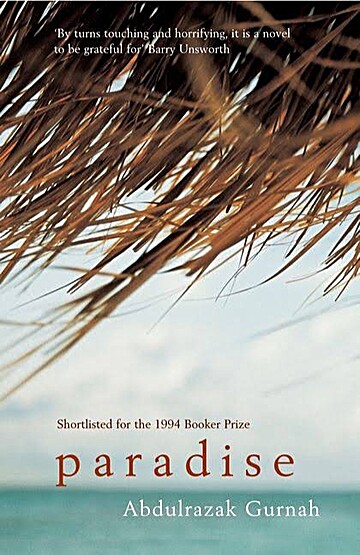
Abdulrazak Gurnah, winner of the Nobel Prize in Literature in 2021, was a wonderfully urbane guest at this year’s Sydney Writers’ Festival. In the session I attended he spoke mainly about his 2021 novel, Afterlives, but talked a lot about that book’s relationship with the much earlier Paradise. (Added much later: you can listen to the podcast of the conversation at this link.)
We read Afterlives a while ago in my all-male Book Group, and had a wonderful discussion of it. Now my predominantly female Book Club is tackling the earlier novel.
Before the meeting: Paradise is a long way from languishing in the shadow of Afterlives. Its action unfolds in the same part of East Africa, beginning a couple of decades earlier, in the years leading up to the First World War.
The book begins with a boy named Yusuf looking forward to receiving a customary gift of money from Uncle Aziz when Aziz’s brief visit comes to an end. There is no gift, and instead the boy is taken away with the uncle. Then he realises that he is not going back to his family and soon learns that he has been given to Aziz, who is not actually his uncle, as surety against his father’s debts. He has become little more than a slave in the merchant’s household.
The story unfold from there. There’s adventure, involving an arduous, perilous expedition into the unknown. There’s romance, where intimate moments, perhaps even a kiss, may be snatched in dark corners of a walled garden. There’s a gallery of rich, exuberant characters – Khalil, an older boy in a similar state of bondage to Yusuf; an older woman, infatuated by Yusuf’s beauty, who harasses him to the amusement of onlookers; an ancient gardener who long ago refused his freedom when actual slavery was abolished; a formidable, scarred man who organises Aziz’s trade expeditions and has a reputation as a sexual predator on young men; Aziz himself, a formidable commercial operator who remains calm in the most extreme situations.
Meanwhile, European powers are colonising East Africa. They are mostly peripheral, offscreen characters who threaten to destroy the whole world experienced by the main characters. German soldiers appear twice, once at roughly the midpoint and then again at the very end. Both times they function as a deus ex machina: the first time their unexpected arrival saves Aziz and his expedition, including Yusuf, from a vengeful tribal chief, but the incident leaves a nasty sense of something unresolved; the second time they provide the book’s final moment, which left me staring into space for a long time.
The book was only transated into Swahili – the official language along with English of Gurnah’s home nation Tanzania (known as Zanzibar back then) – after he was awarded the Nobel Prize.
After the meeting: At this meeting we discussed Annie Ernaux’s Une femme / A Woman’s Story along with Paradise, an odd pairing which meant we had two quite separate discussions.
All but one of us enjoyed this book a lot, and the dissenting voice meant we had an interesting conversation. The main character, she said, is completely passive: things just happen to him, one after another, and especially on the gruelling trade expedition that takes up a good slab of the book the bad things are repetitive. The book only becomes interesting once Yusuf is back in town and a powerful woman, in a complex way, is lusting after him. Though others were able to point out that Yusuf was constantly taking initiatives – a surreptitious excursion to town just for fun, offering unauthorised help to the ancient gardener, etc – I was struck by the similarity of this observation to what someone in my other Book Group said about the main character in Afterlives: because of the constraints on the characters, they don’t have the space to attend to their inner lives. When I tried to articulate this thought, someone said something beautifully concise and wise about the way trauma can alienate a young person from their own experience. Sadly I didn’t write it down, but to my mind it captured beautifully the way Yusuf does indeed move from one thing to the next, having no real say about the direction of his life, and no ability to form coherent thoughts about it.
I realised in the course of the discussion that the story is full of references to Joseph / Yusuf in the Hebrew Bible and the Quran, in particular the episode of Potiphar’s wife / Zuleikha. I just read a version of the Quran story on Wikipedia, and the parallels are even closer than I thought. It makes me wonder what other references may be hovering around this eminently readable tale. Joseph Conrad’s Heart of Darkness comes to mind. (Gurnah’s Gravel Heart includes a retelling of Shakespeare’s Measure for Measure, set in modern East Africa.)
We discussed the final paragraph, which I’d love to expand on here but, unlike some surprise revelations (see my blog post on Wole Soyinka’s Chronicles from the Land of the Happiest People on Earth, coming in a month or so), it really is a surprise.
Being of a certain age, we said goodnight a little after 10 o’clock.
I wrote this blog post in Gadigal Wangal country, where it is my great joy to live. In particular right now the days are getting warmer, the sun is rising earlier and setting later, and whenever I walk out my door I see tiny lizards scurrying for cover. I acknowledge Elders past, present and emerging for their continuing custodianship of this land.


 Me fail? I fly!