
Judith Beveridge, Tintinnabulum (Giramondo Poetry 2024)
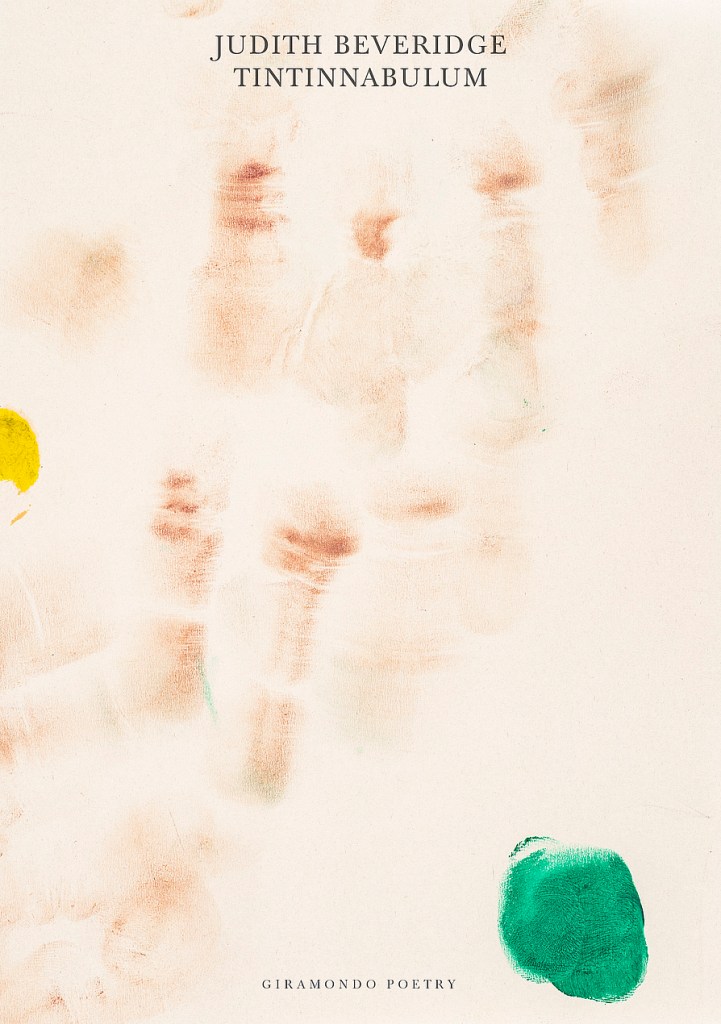
As a rule on this blog I focus on the page of a book that corresponds to my age. There’s a lot I could write about Tintinnabulum (it’s a very rich collection from one of Australia’s brilliant poets), but let’s see what happens if I skip any general discussion and go straight to page 77.
Page 77 is the second page of the poem ‘Choirwood’, the last poem in the book, which gives its name to the book’s final section. Earlier sections have dealt with the animal and human world, including a fair amount of death, danger and cruelty. So when the fourth section arrives with ten poems celebrating the natural world, it feels like the final stage of a broad conversation. Celebration has the last word:

I wouldn’t be unhappy if you stopped reading this right now, clicked on the image, and let the poem go to work on you. The speaker goes for a walk in the bush near her house one early morning and pays attention to what she sees and hears, inviting us to join her in rich, descriptive language, and then taking us further into contemplating the unseen, unheard wonders of the universe. There’s a play of metaphors to do with religion, commerce and art. It’s a gorgeous celebration of the natural world, expanding from the back yard to the cosmos.
It’s a thing about poetry that what the reader brings is an important part of how a poem works. So rather than discuss the poem line by line. I’ll tell you what I bring to it – and also some places it takes me to.
First a snippet of personal history. In early 1965, after finishing high school, I was training to be a member of a Catholic religious order. I was a postulate, the step before becoming a novice. We would rise hideously early each morning summer and winter, wash in cold water (as the wood-fired boiler wasn’t lit yet), and gather in the chapel for prayers, meditation, Mass and more prayers. All that before an eight o’clock breakfast. I was terrible at meditation – it was too easy to nod off – but loved the communal prayers, especially the call-and-response reading of psalms. I loved the bloodthirsty psalms and the whingey ones, but most of all I loved the exuberant songs of praise. This poem brings to mind a specific psalm-related memory.
There were terrible bushfires that year, and as a community of 50 or so able-bodied young men we became volunteer fire fighters. I had my turns at going out, but on this occasion I was not one of the 20 or so who had been away all night lugging their backpack sprays. Those of us who had stayed behind were in the chapel as usual when we heard the truck loaded with wearily noisy, charcoal-stained novices roaring home up the hill outside. We didn’t pause, but surely we put a little extra gusto into the resounding verses of Psalm 148. I don’t have the actual, almost singable English version we used, but here is a bit from the Jerusalem Bible:
Let earth praise Yahweh: sea-monsters and all the deeps,
_____fire and hail, snow and mist, gales that obey his decree,
mountains and hills, orchards and forests
_____wild animals and farm animals, snakes and birds,
all kings on earth and nations, princes, all rulers of the world,
_____young men and girls, old people, and children too!
No lie, we were chanting about fire praising God when that truck drove past the chapel windows.
Since that moment, any poetic celebration of nature – and ‘Choirwood’ is one – carries for me the whiff of bushfire smoke and the paradoxical joy, even exhilaration, of being young and helping to fight the fire.
It’s not odd that I should think of the psalms: the poem itself is not explicitly religious, but it has plenty of religious references – the title, the St Andrew’s Cross spider as a martyred apostle, a mandala. It’s even possible that the poet had Psalm 148 in mind. Thinking of bushfire, on the other hand, is pure idiosyncrasy …
… except …
… there’s this in the book’s acknowledgements:
The poem ‘Choirwood’ was commissioned by Judith Nangala Crispin in 2022 for the Judith Wright Regeneration Road Trip.
I looked up the Regeneration Road Trip (it has a webpage here, a facebook page here, and the album of its poetry reading for sale at this link). Organised by a group of artists who lived between Canberra and the Far South Coast of New South Wales, it took place over 10 days in September–October 2022. According to the website, that In the wake of the terrible destruction caused by bushfires the previous year, the organisers:
came together to try to find a way to help voice the emerging tidal wave of feeling and give back to the communities which are hurting. Rather than focusing on what was lost, the project began to unearth and celebrate the deep connection between the people and the landscapes, animals and plants of this special region.
So if you know its origin story, ‘Choirwood’ itself carries a whiff of smoke.
Without the origin story, there is no word in the poem of all that destruction. There has been enough of that earlier in the book, perhaps – there’s no need to name the thing being negated, the ‘what was lost’. But a closer look reveals a hint. A note tells us something that a better-read reader might have spotted off their own bat:
The phrase ‘madrigal field’ is from Denise Levertov’s poem ‘Clouds’.
That refers to the lines where the poem’s perspective widens out:
____________________________I give thanks
too for the forces and interactions running
beneath it all, the flowing, spinning, changing
dynamics, the 'madrigal field' choiring everything
into existence.
(By the way, notice how all those ‘ing’ words create a sound equivalent to the constant motion being described.) Especially when read in connection with the poems final lines, the ‘madrigal field’ is a wonderfully resonant phrase that suggests the mediaeval notion of the music of the spheres, and so invokes a sense of the awe-inspiring, beautifully ordered universe. But the knowledge that it is taken from ‘Clouds’ by US poet Denise Levertov (which you can read at this link) suggests a more nuanced reading. In that poem, the speaker is faced with the recent death of a loved one (or perhaps only a chilling intimation of their death). She forces to her mind a ‘vision of a sky’, that at first appears as a grey mist, but when looked at intently reveals ‘radiant traces’ of green. Only then ‘a field sprang into sight’:
a field of freshest deep spiring grass
starred with dandelions,
green and gold
gold and green alternating in closewoven
chords, madrigal field.
Perhaps, the poem goes on, death’s chill is ‘a grey to be watched keenly’.
I can’t say I understand Denise Levertov’s poem, but her ‘madrigal field’ is a synesthesian (synesthetic?) vision of a grassy field, quite different from Judith Beveridge’s cosmic concept. Comin from ‘Clouds’, however, it keeps its emotional connotation: the field is what you see when you turn away from death / the premonition of death / destruction, and look ‘keenly’. ‘Choirwood’ is full of keen looking and listening. This, it suggests ever so subtly, can be an important part of coping with catastrophe.
I am grateful to the Giramondo Publishing Company for my copy of Tintinnabulum.
I wrote this blog post in Gadigal Wangal country, where it is my great joy to live. I acknowledge Elders past, present and emerging for their continuing custodianship of this land.


 Me fail? I fly!
Thanks, I was not familiar with this poet
LikeLiked by 1 person
Pingback: Joëlle Gergis’ Highway to Hell | Me fail? I fly!