
Joëlle Gergis, Highway to Hell: Climate Change and Australia’s Future (Quarterly Essay 94, 2024) – plus correspondence in Quarterly Essay 95
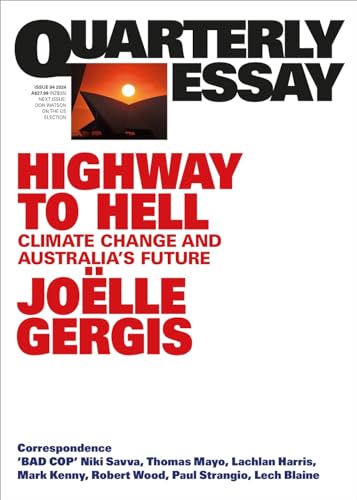
I’ve worn a Peter Dutton mask with devil horns in street theatre outside Anthony Albanese’s office. I’ve asked awkward questions at the AGMs of fossil fuel companies, scripted by Market Forces. I’ve participated with gusto in Move Beyond Coal‘s campaign targeting banks that provide financial backing to new coal mines. I joined the People’s Blockade of the coal port of Newcastle last November and plan to join again this year. Do I need to read ONE MORE BOOK on climate change?
Well, yes, I do. I had pushed out of my mind the terrible events of Summer 2021–2022. I even wrote about Judith Beveridge’s poem ‘Choirwood’ as if it offered some kind of hope after those fires (at this link). After reading Joëlle Gergis’s essay, the poem is still brilliant, but it feels like so much whistling in the dark.
Joëlle Gergis is one of the 234 lead authors of the most recent IPCC Report. She is a climate scientist who, she tells us in this essay, has become so frustrated at the way the reality of climate change is downplayed or ignored by those in power that she quit her job as an academic scientist to become a public advocate. I’d say she has become a Cassandra warning of the dangers, except that Cassandra was doomed to be ignored, a fate I hope will not befall Joëlle, for all our sakes.
After noting the relief of seeing the end of the denialist Morrison Government (remember ‘Labor’s war on the weekend’, and ‘Don’t be afraid, this is carbon’?), the essay tackles the current situation – better, but a long way from hopeful. Here’s a key paragraph, on page 7:
The scientific reality is that, regardless of political spin used to justify the continued exploitation of fossil fuel reserves, the laws of physics will keep warming the planet until we stop pumping carbon into the atmosphere and begin cleaning up the mess. The situation is too far gone for renewable energy alone to save us. Pinning our hopes on carbon capture technology to justify the continued burning of fossil fuels is a disastrous gamble the world can’t afford to take. So, as this fateful moment approaches, we need to take an honest look at the government’s climate policy and realistically assess the situation we are in. Are the climate wars really over, or has a new era of greenwashing just begun?
As she goes on to say what the laws of physics are up to and to outline a range of future scenarios, she begs us: ‘Please, don’t look away. Thee isn’t a moment to waste.’
I won’t try to summarise the science, but if you’re looking for a solid, accessible presentation, I doubt if you’ll find a better one anywhere. It’s a gruelling read, from which my main takeaway is that I need to grieve for the corals of the Great Barrier Reef that thrilled me as a child, for the thousands of cattle and millions of wild animals that have died and are yet inevitably to die as the planet heats up, for the vast tracts of forest, including rainforest, that have already been devastated. I need to grieve and I need to treasure what remains – and be prepared to fight for it.
After a blistering account of carbon offsets and carbon capture and sequestration (CCS) in a chapter headed ‘Chasing Unicorns’, she asserts that we know what needs to be done, but such is the power of the fossil fuel lobby that Australian governments won’t do it. True, there has been significant movement in State governments, and outside of government. But it’s pretty grim, when the main message to the reader about what can be done is to stress the importance of voting in the next federal election.
Almost any paragraph from this essay is worth quoting and pondering. On page 47*, there’s this:
To its credit, the Albanese government has tried to support Australia’s emergence as a renewable energy superpower. [She lists an impressive number of initiatives taken since the ALP’s election win in May 2022.] While these are all steps in the right direction, the challenge is not to undo all of this good work by allowing the interests of the fossil fuel industry to co-opt the process and weaken real progress towards reducing global emissions.
Rather than ‘net zero’, the goal must be to achieve ‘real zero’, which can only happen once we stop burning fossil fuels. In fact, the science tells us that around 60 per cent of oil and gas reserves and 90 per cent of coal must remain unextracted if warming is to be limited to 1.5°C. There is no way around having to eventually face this scientific reality.
But instead of facing facts, in December 2023, the federal government caved in to lobbying from the oil and gas company Santos.
The correspondents in Quarterly Essay 95 mostly agree with and amplify the arguments of the essay. There’s an excellent piece by David Pocock, who is probably the parliamentarian that Gergis meets with early in the essay. He describes his shock as a senator now for a little over two years to see how ‘policy is consistently shaped by political considerations ahead of evidence and research’. Often he says, politicians ‘are not looking for genuine, long-term solutions, but for the next opportunity to back their opponents into a corner’.
A stand-out exception to the generally supportive tone is a grim piece by Clive Hamilton. He’s not the only correspondent to describe Joëlle Gergis as operating on an ‘information deficit’ model: if only people, including those in power, had correct information they would do the right thing. Scientists have been trained to look for solid, verifiable facts and to base their actions on what they find. But it’s a mistake to assume that that’s how people in general function. Hamilton dismisses the essay’s hope as wishful thinking, argues that nothing Australian governments do can have much impact on climate change, and generally sees the outlook as bleak:
After two decades of research into the psychological, social and political complexities of persuading people to recognise and act on the science of climate change, it’s wearying when another scientist comes along convinced that it’s only a problem of someone with authority communicating the facts. I’d be more energised if Gergis, as an IPCC lead author, had written an essay arguing that it’s time for a campaign of industrial sabotage.
I would love to know how Joëlle Gergis responds to Clive Hamilton. Sadly, no response from her is included in QE 95. Maybe in Nº 96? Or maybe she’s already out there like the main character in the movie Woman at War.
I wrote this blog post in Gadigal Wangal country, where it is my great joy to live. I acknowledge Elders past and present for their continuing custodianship of this land.
* My usual blogging practice is to focus on the page that coincides with my age, currently 77. But as this Quarterly Essay runs to just 72 pages including notes, I’m looking at page 47, the year of my birth minus 1900.


 Me fail? I fly!
I used to feel a lot more optimistic than I do now. But from what I see around me, the generations coming after me and their wasteful behaviours and consumption levels, I think they simply don’t care. I think it’s a lost cause, but I’m still doing the things that I can (and have been doing since the 1970s when the ‘greenhouse effect’ was brought to my attention). They’re not. They’re building massive houses with no solar, they’re driving huge gas guzzlers, they shop as a hobby, they throw out clothes they’ve worn once, they complain about parking because they don’t use public transport or walk, they don’t shop local or care about food-miles and refuse to buy imported fruit & veg, they’re still buying takeaway coffee in paper cups, and they think it’s their God-given right to add to carbon emissions with reckless levels of travel.
I’ve given up reading and protesting about it, but at least if someone asks me what I’m doing, I can look them in the eye.
I’m glad I don’t have grand children to suffer in what will be a horrible future.
LikeLiked by 1 person
Oh dear, Lisa. But many of the young, or at least some of them, put us to shame. The Blockade in Newcastle last year was a reminder of that
LikeLike
A blockade does not change behaviour, theirs or anybody else’s.
Changes in behaviour and spending habits, and investment in reducing our own emissions is what’s needed. They’re not doing that, they’re just posturing.
LikeLiked by 1 person
I think we know different young people. The blockade lot seemed on the whole to be vegetarian, and there wasn’t a lot of throwaway fashion on display. I expect there’s some posturing, but there’s a lot to be said for mass action as well as widespread uptake of renewables, using public transport, reducing waste etc
LikeLiked by 1 person
You are right. I’m here in the suburbs, where the people are. Take a stroll around a shopping mall. It’s where most people shop. In the outer suburbs, they don’t have any other choice. I do. I don’t shop in our nearest which is why it shocks me whenever, needs must, I have to go there e.g. to go to an actual bank. From the type of cars in the carpark, to the type of goods on sale in the shops and the brands they sell, to the parcel bags snaking up every arm and the paper cup coffee in the hand, supermarket trolleys groaning with enough stuff in tins and packets to fill a recycling bin in one shop, it’s rampant consumerism on display. It’s what we much-reviled boomers tried so hard to rein in yet we see our children’s children consuming without restraint.
Of course there are some that care, there must be. Though I wouldn’t necessarily regard participating in mass action as an indicator. Truth be told in my younger days, we felt enjoyably virtuous going to a demo, which was an exciting social activity with like-minded people. But away from the demos, we earned our virtuous feelings by living simply that others might live.
Enough already, it’s too depressing!
LikeLiked by 1 person
I can appreciate both views. Personally, I think many young people are doing their best to try to do something about climate change and the environment.
The problem lies with the timidity and craveness of our government and its refusal to do what they know needs doing. They are so fearful of their own shadow, beholden to lobby groups and big business.
The possible election of more independent candidates is perhaps some reason to feel slightly optimistic.
I still go to protests (however, now I often only find out about them once they’re over!) write letters to pollies and so forth. What else to do? And it is a good feeling to connect with like minded people and not feel so hopeless all the time.
LikeLiked by 1 person