
Michel de Montaigne, The Complete Essays (Penguin Classics 1991, translated by M. A. Screech)
– part way through Book 3, essay 10, ‘On restraining your will’ to end Book 3, essay 13, ‘On experience’
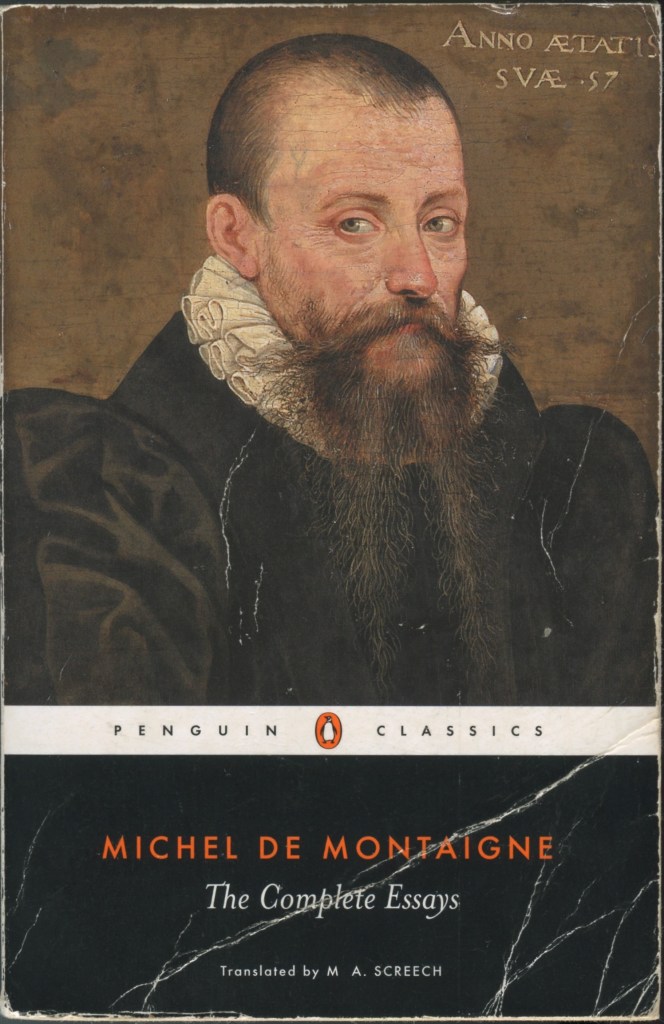
M A Creech, whose translation and edition of Montaigne’s essays I’ve been reading, a few pages a day, since March last year, says that it’s a mistake to read the Essais simply as a collection of separate pieces of varying lengths. There is a shape, he argues in his introduction, and in the final essay, ‘On experience’, Montaigne arrives at the place to which all the preceding essays have been heading.
Given the immersive task he has undertaken – not just finding English equivalents for Montaigne’s French, but also translating and identifying the sprinkling of quotes from Latin (and the few from Greek and more recent languages) – I’m not going to say he’s wrong, but I can’t see that he’s right.
But the final essay does read as a culmination, and a farewell. Its central argument is about the relationship between reason and experience, more specifically the limits of reason and the importance of giving full value to experience. There’s a long section in which he describes the mental process by which he comes to think of his extremely painful kidney stones as a good thing: the pain is intermittent so he has time to digest the experience; when the pain goes, its absence is delightful; unlike other diseases, this one doesn’t interfere with his normal life – he can spend up to ten hours in the saddle at the height of an attack; it’s an illness ‘which does not leave us guessing’ – that is, we know what it is, there’s no need to hunt for diagnoses; etc. At the end of the section, just as one is admiring his brilliant feat of mind over matter, he acknowledges that at least in part he has been whistling in the wind (page 1243):
With such arguments, both strong and feeble, I try … to benumb and delude my power of thought and to put ointment on its wounds. And tomorrow, if they grow worse, we will provide other escape-routes for them.
And then, in a twist that makes his writing as fresh now as it must have been nearly 500 years ago:
Since I wrote that, the slightest movements which I make have begun to squeeze pure blood from my kidneys again. Yet because of that I do not stop moving about exactly as I did before and spurring after my hounds with a youthful and immoderate zeal. And I find that I have got much the better of so important a development, which costs me no more than a dull ache and heaviness in the region of those organs. Some great stone is compressing the substance of my kidneys and eating into it: what I am voiding drop by drop – and not without some natural pleasure – is my life blood, which has become from now on some noxious and superfluous discharge.
Can I feel something disintegrating? Do not expect me to waste time having my pulse and urine checked so that anxious prognostics can be drawn from them: I will be in plenty of time to feel the anguish without prolonging things by anguished fear.
This last essay goes for more than 60 pages. It’s intensely personal: Montaigne describes his not entirely admirable table manners. He goes into some detail about his habits around eating, sleeping, excreting, walking, dressing, a little about sex (which at the ripe old age of fifty-something is largely in his past). He argues that what is customary for any individual or community should be maintained – it would be as wrong for a Frenchman to drink his wine undiluted as for a German to dilute his! And when he hits full stride he argues brilliantly that pleasure is a good thing, that life itself is a good thing. This is from page 1258:
When I dance, I dance. When I sleep, I sleep; and when I am strolling alone through a beautiful orchard, although part of the time my thoughts are occupied by other things, for part of the time too I bring them back to the walk, to the orchard, to the delight in being alone there, and to me. Mother-like, Nature has provided that such actions as she has imposed on us as necessities should also be pleasurable, urging us towards them not only by reason but by desire. To corrupt her laws is wrong.
And a little later:
What great fools we are! ‘He has spent his life in idleness,’ we say. ‘I haven’t done a thing today.’ – ‘Why! Have you not lived? That is not only the most basic of your employments, it is the most glorious.’ – ‘I would have shown them what I can do, if they had set me to manage some great affair.’ – If you have been able to examine and manage your own life you have achieved the greatest task of all. Nature, to display and show her powers, needs no great destiny … Our most great and glorious achievement is to live our life fittingly. Everything else – reigning, building, lying up treasure – are at most tiny props and small accessories.
How can I not love this man? All of this, of course, is interwoven with quotations from the ancients, with whom he sometimes argues robustly, even his beloved Socrates. Wonderfully, he ends with four lines from Horace:
Frui paratis et valido mihi,
Latoe, dones, et, precor, integra
Cum mentis, nec turpem senectam
Degene, nec Cythara carentem.
Which, drawing on M. A. Screech’s translation and explanatory footnote, I can paraphrase as: ‘Grant me, O Apollo god of healing, that I may enjoy the things I have prepared and, with my mind intact, I pray that I may not degenerate into a squalid old age, in which the lyre is wanting.’
It’s not age or death he feared, but the prospect of an old age when he was incapable of singing.
This blog post was written on Gadigal-Wangal land, on a fully hot, humid day when even the birds are silent. I acknowledge the Elders past, present and emerging of Gadigal and Wangal of the Eora Nation.


 Me fail? I fly!
Thank you very much for this marvelous piece! Some of what Montaigne says, such as the passage that begins about how we are great fools, reminds me of Zen (although, of course, he would not have known anything about Zen).
I am grateful to you both for your observations and for your generosity with quotations. And I admire your discipline, in reading through the entire book.
John Levy
LikeLiked by 1 person
Thanks, John. I would never have taken him on if I hadn’t figured out years ago that I could only read Proust if I took a couple of pages at a time and let it take as long as it took. That got me in the habit of reading a couple of pages of something first thing. Montaigne would probably have something to say about the relative value of habit and discipline – coming down in the side of habit.
LikeLike