
Alan Hollinghurst, Our Evenings (Picador 2024)
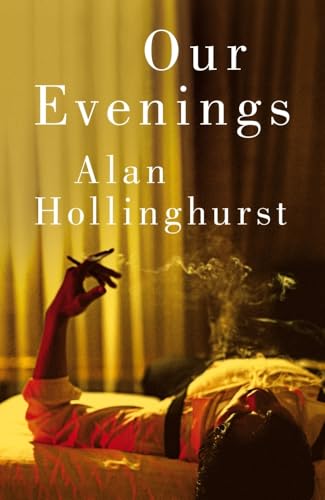
Before the meeting: About five decades ago I had to write an Eng Lit essay on Gerard Manly Hopkins’s sonnet ‘Spelt from Sybil’s Leaves’. It’s a poem that cries out to be read aloud, and on a weekend away at a beach house with friends, I found an out-of-the-way spot where I could perform the poem over and over for my own ears. It turned out that my secluded corner was actually an amplifying booth, and my sonorous renditions were heard by everyone in the house. Someone finally came and pleaded with me to stop. Embarrassment aside, I still love the poem.
So I took it as a personal gift to me when the poem is being recited, unannounced and unexplained, at the start of Chapter 15 of Our Evenings:
‘Earnest,’ I said, ‘earthless … equal … attuneable …’ Stella peered at me, tongue on lip, daring me.
‘… vaulty …’ she said.
… vaulty, voluminous … stupendous Evening strains to be time’s vast –’ (now we chanted it together) ‘womb-of-all – home-of-all – hearse-of-all NIGHT!’
‘I bet you can’t go on.’
If I hadn’t been loving the book before then, I would have been hooked.
As it happens, I was enjoying the book. The hero-narrator David Win, son of an English mother and a Burmese father he has never known, was given a scholarship to attend a prestigious boarding school, and at the start of Chapter 15 he’s studying at Oxford. The novel traces his development into a successful actor, his crushes, affairs and finally marriage with men, and his arrival at a reasonably contented late middle age (as we in our late 70s refer to the 60s).
The phrase that gives the novel its title occurs when David is in his last year at the boarding school. He is taken under the wing of Mr Hudson, his English teacher. They listen to classical music together late in the evening. These quiet times have an intimate, erotic charge, but though other boys leap to crude conclusions, ‘nothing ever “happened”, as they say’. Among the pieces they listen to is the first movement of Janáček’s ‘On an Overgrown Path’, which has its own title, ‘Our Evenings’. (You can hear it played by Rudolf Firkusny in 1986 at this link.)
The piece seemed simple and songlike, but the modulations in it made you wonder, and an agitated figure broke in higher up and then, like the scratch on the record, disappeared and left you with the song in a further change of mood, which didn’t quite replace the first one but seemed to cast the shadow of experience over it – what, I couldn’t say, but I felt it. I had no idea what we were listening to or how long it was going on – there was a very quiet passage when the agitated figure came back, but subdued and dreamlike, a trance of sadness and beauty, and soon after that the piece ended without any fuss. I glanced at Mr Hudson, but he was staring at the fire too, and then he jumped up and said, ‘Shall we hear it again?’
Apart from being an instance of the way other works – plays, poems, pieces of music – move the narrative along, this passage is a nice example of the way David as narrator shows rather than tells. ‘I couldn’t say, but I felt it.’ He never says in so many words that he has a crush on Mr Hudson, or that he believes it to be reciprocated, but in little moments like this – in Mr Hudson jumping up and suggesting a replay – readers can draw their own conclusions.
The description of Janáček’s music could be applied to the novel itself: ‘subdued and dreamlike, a trance of sadness and beauty’ occasionally interrupted by an ‘agitated figure’. The prose is elegant and unruffled, and most of the terrible things that happen – AIDS, Brexit, Covid – are offstage. David as boy, adolescent and man is unfailingly polite and helpful – we are usually left to imagine what feelings he is covering up, even perhaps from himself. He regularly encounters ‘agitated figures’ in the form of racism, but mostly it’s of the raised eyebrow or muttered phrase, micro-aggressive variety. An African-heritage lover says, ‘You’re not even Black!’ Likewise the homophobia he encounters is subtle – when he comes out to his mother and her female friend, their response is more or less, ‘Well, that’s been obvious for a long time!’ Class plays a role – David’s patrons, whom he loves to the end – are like Proust’s aristocrats in their unfailing graciousness and generosity, and the sense that nothing really touches them. The mystery of his father remains a mystery, though late in life he receives some vague information. As in real life, many mysteries remain mysterious.
I suppose sex itself might count as an ‘agitated figure’. There’s quite a lot of it but, though it’s not coy, very little is explicit. I remember only two moments when sexual body parts are named, one involving a kind rejection, the other the beginning of a solid relationship. Neither is the slightest bit prurient.
The last 10 pages depart from the mainly ‘subdued and dreamlike’ narrative in a way that came as a surprise to me, and casts a brilliant light back over the preceding pages.
After the meeting: At the Book Club, we usually have two books under discussion at each meeting. This time, there was just the one, but everyone had to report on the book they’d scored in our Kris Kringle at last meeting. So our discussion, which followed and preceded convivial conversation about other things, began with enticing rundowns of books by Bernhard Schlink, Jock Serong, Robbie Arnott and Niamh Mulvey, and an unenticing rundown of one other.
Of Our Evenings, we had a very interesting discussion. I probably liked the book most, but no one hated it. The only strong difference was about the last ten pages, which I felt gave shape and significance to the whole thing and most others experienced as a lame and unnecessary framing device. It would be too spoilerish to present the arguments here. I’ll just state the obvious: they’re entitled to their opinions, but they’re wrong.
One person had an interesting take on the title. It captured the way the book, for her, is like a series of conversations you might have in a quiet evening at home: meandering, pleasant, amiable recollections and reflections, without drama or much significance. (If that’s so, I hope I said at the time, there’s always an awareness of terrible things happening in the outside world, of which many of the tiny things that come up in those conversations are micro-effects.)
David Win as narrator and hero provoked interesting conversation, which I’ll try to summarise. He is an outsider because of racism, class and sexuality, not necessarily in that order. As an outsider, his main way of being in the world is to aim to fill other people’s expectations – to act out the scripts he is given. It’s not insignificant that he’s an actor. He rarely takes the initiative, and there’s a way he doesn’t seem to know who he is. Not just as narrator, but also as character, he doesn’t have access to his own inner life. The narrative restraint about sex, which is not so in Hollinghurst’s other books that people had read, may be part of this. I read out the only passage in the book that mentions hard-ons, and people laughed (but not at all derisively). It’s as if in this book explicit sex is a relief from always having to decode what is being communicated in tight-lipped upper-class British dialogue (see Mr Hudson’s ‘Shall we hear it again?’ above).
We discussed other characters that I didn’t mention in the first part of this blog, especially a Boris Johnsonesque blustering bully, .
Less centrally, some took an almost anthropological interest in the portrayal of Gay male relationships – and it’s true that Hollinghurst gives meticulous detail on how people make their desires known. One person felt that (minor spoiler alert) having the David’s mother become a Lesbian was just laying on the Gayness too thick. Another, on the contrary, was impressed and delighted by the nuanced portrayal of middle-class, middle-aged, post-heterosexual-marriage Lesbianism.
We didn’t discuss the Hopkins poem, the Janáček music, or the plays – notably by Racine and Ben Jonson – that turn up in the narration.
Mint-flavoured Turkish delight was on offer. Only two of us tried it. I was the only one to finish my piece. I don’t recommend it. I do recommend the book.
Our Book Club met on unceded land of the Gadigal and Wangal clans of the Eora Nation. I acknowledge the Elders past and present. I hope that our conversation was in some way in continuity with yarns that have been happening on this land for tens of thousands of years.


 Me fail? I fly!