Monthly Archives: Mar 2025

Journal Catch-up 29: Overland Nº255

Evelyn Araluen and Jonathan Dunk (editors), Overland Nº 255 (Winter 2024)
(Links are to the online versions unless otherwise indicated.)
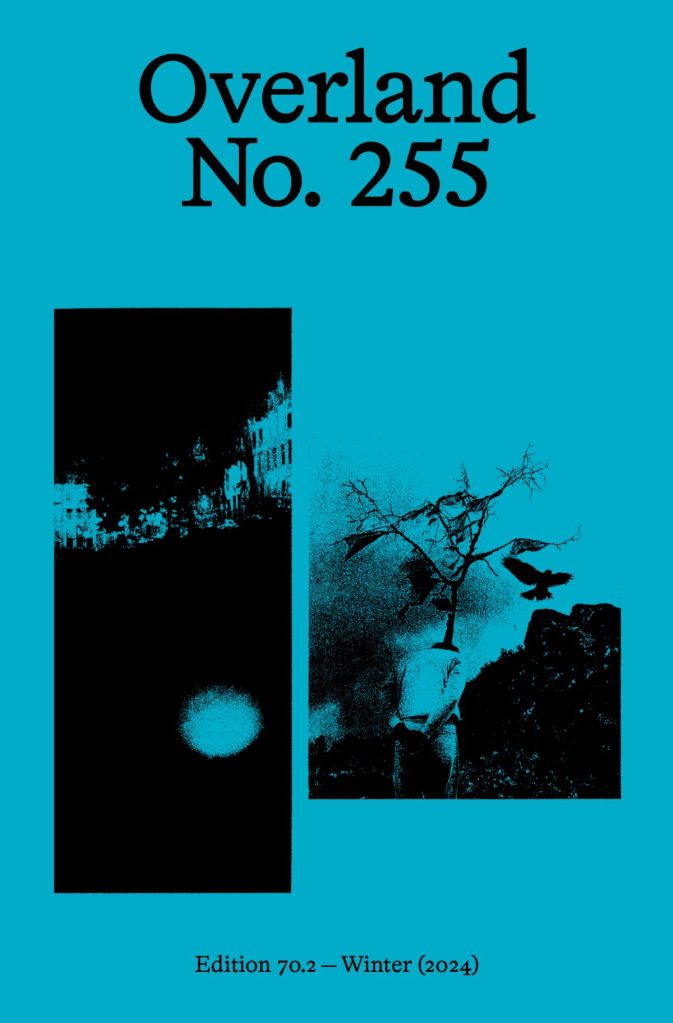
I sometime approach literary journals as if shouldering a grim obligation – doing my bit in the cultural ecology. (Added later: The morning after I uploaded this post, I read in a letter from Esther Anatolitis, editor of Meanjin, that my subscription ‘supports the ecosystem of Australian writing: that fragile yet incredibly powerful space where the finest new work is written’. Great minds draw on the same tropes.) The austere retro design of this Overland, one of four to mark a 70th anniversary, didn’t do much to dispel the grimness. Nor did the editorial, which underlines the darkness of our times. But then

The first thirty pages or so are taken up with ‘Writing from the South: an interview with Kim Scott’. It’s leisurely, full of unfinished sentences and swirling crosscurrents of thought and information – there’s no apparent attempt to tidy up the spoken conversation, and as a result you (or at least I) get to feel you’re in the room with the the living, breathing, thinking author of, among other things, That Deadman Dance, Taboo (links to my blog posts) and (what I haven’t read but now really want to) Benang. He’s in conversation with Samuel J. Cox.

I’ll mention two other non-fiction pieces: ‘The Australian media’s problem with Palestine’ by Juliet Fox, which tells about decades of government suppression of Palestinian voices on a Melbourne community radio station; and ‘“Arts funding is fucked”: Overland 1973–1975’, a plus-ça-change piece by Overland‘s digital archivist Sam Ryan about the politics of funding to the arts in Australia 50-odd years ago.

As always, there’s poetry, ranging in this issue from probably-very-good-if-you’re-motivated-to-spend-a-lot-of-time-with-it-but-today-I’m-not to a beautifully executed punch to the guts. The latter is ‘The Killer in Me’ by Ann-Marie Blanchard, in which the speaker personifies her uterus after a miscarriage. Somewhere between the two extremes is the dauntingly titled ‘Poem in asymmetric transparency’ by Shari Kocher, a meditation on a Margaret Preston painting:

Three lotus lookalikes floating in solar darkness.

As it happens, page 78* occurs in the piece of fiction that speaks most to me, Jordan Smith’s ‘Something Is Rotten’, in which a technological solution to the climate emergency goes terribly wrong, seen from the point of view of young lawyers who thought their normal work was high-pressure. At page 78, the catastrophe is beginning to unfold, though the characters stay with their usual preoccupations. Paul, one of the barristers, looks out of his high-rise window at the ‘sat-drones’ doing hi-tech stuff to the upper atmosphere:

‘Fuck knows what they’re doing but it does look good.’ The sat-drones twinkled as, one by one, they flew up then plunged down, like waves running up and down a skipping rope. The colour of each oscillated between a crystal blue and a sharp, metallic crimson. Rob felt a bit dizzy. He and Sarine looked at each other.

As required by a tight deadline, Rob puts the dizziness aside, takes ‘a few painkillers’ and gets back to work.

His phone buzzed incessantly.

Sydney 6G
Friday, 6 June 11:43
Notification centre
News alert:
PM urges calm after atmospheric pressure dr… (10+)

Rob cleared notifications and switched on do not disturb.

The reader feel the disaster happening while the character sticks to the his mundane urgencies. It’s deft storytelling. Like the poems I’ve mentioned it’s marked as ‘Online soon’ on the Overland website, and may be available by the time you read this.

I don’t usually google authors, but I did look up Jordan Smith. He’s a barrister who has an Honours degree in nuclear physics, so I guess he knows what he’s taking about on both sides of the equation.

I haven’t exactly dispelled the notion of grimness I invoked in my first sentence – colonisation, genocide, miscarriage, climate catastrophe aren’t cheery subjects. But taken along with the evocative decorations from past issues (Richard Tipping in the 1970s, Rod Shaw and John Copeland in the 1990s) there’s something exhilarating about the way Overland has survived so much change in the world and in itself, still giving a platform to new voices, still saying things that aren’t easy to hear elsewhere.


I wrote this blog post on the land of the Wangal and Gadigal clans of the Eora nation. I gratefully acknowledge the Elders past and present who have cared for this beautiful country for millennia, and lived through extraordinary changes in the land and climate over that time.


My blogging practice is focus arbitrarily on the page of a book that coincides with my age. This is first time I’ve looked at page 78.
George Herbert’s Love (III), Simone Weil and me

I’ve been suspicious of the notion that a poem is always a collaboration between poet and reader (or readers) – that each reader, even each reading, creates a different poem. My suspicion has been softened, but not completely dispelled, by taking part in the fabulous online Modern and Contemporary American Poetry course (‘Modpo’).

But I’ve realised that one of my favourite poems, ‘Love III’ by 17th Century English poet George Herbert, is a brilliant example of how that notion can hold up.

Here’s the poem:

Love (III)

Love bade me welcome. Yet my soul drew back
Guilty of dust and sin.
But quick-eyed Love, observing me grow slack
From my first entrance in,
Drew nearer to me, sweetly questioning,
If I lacked any thing.

A guest, I answered, worthy to be here:
Love said, You shall be he.
I the unkind, ungrateful? Ah my dear,
I cannot look on thee.
Love took my hand, and smiling did reply,
Who made the eyes but I?

Truth Lord, but I have marred them: let my shame
Go where it doth deserve.
And know you not, says Love, who bore the blame?
My dear, then I will serve.
You must sit down, says Love, and taste my meat:
So I did sit and eat.

If you’re interested, there’s a beautiful, scholarly account of the poem by Hannah Brooks-Motl at this link. What follows is not particularly scholarly. If you make it to the end you may even find it amusing.

I’m currently reading Wolfram Eilenberger’s The Visionaries, translated by Shaun Whiteside, a fascinating look at a decade in the parallel lives of four brilliant women – Hannah Arendt, Simone de Beauvoir, Ayn Rand and Simone Weil. The book reminded me that Herbert’s poem played a major role in the life of Simone Weil.

In 1938, Weil was suffering extreme pain. She had lost her teaching job, and doctors couldn’t find a diagnosis or offer any respite. She found relief mainly in listening to sacred music, when, to quote Eilenberger, ‘the pain receded into the background and even allowed her to feel, in her deep devotion, removed from the realm of the physically restricted here and now.’ As well as the music, she turned to poetry. ‘Love (III)’ was important to her. In her Spiritual Autobiography, quoted by Hanna Brooks-Motl, she wrote:

Often, at the culminating point of a violent headache, I make myself say it over, concentrating all my attention upon it and clinging with all my soul to the tenderness it enshrines.  I used to think I was merely reciting it as a beautiful poem, but without my knowing it the recitation had the virtue of a prayer. It was during one of these recitations that ... Christ himself came down and took possession of me.

It was a turning point in her life, and a wonderful example of how to read a poem. George Herbert would have been thrilled.

My reading was a little different.

I was 23 year old English Honours student at Sydney University in 1970. At the end of the previous year I had left a Catholic religious order where I had been ‘in formation’ for seven years, and at the time I’m talking of I was in my first intimate sexual relationship.

In my youthful enthusiasm, emerging from a world dominated by concepts like the love of Christ into one where I was experiencing the joys of sex and human connection as a different kind of sacred, I loved this poem for the way it eroticises the love of God.

No one else seems to have noticed that it can be read as a sexual encounter. (And I did my BA Honours thesis on Herbert, so I read a lot of critics.) It’s hard to spell out what I mean without seeming to snigger, but I don’t, and didn’t, feel at all sniggery. Love (the beloved), observes me ‘grow slack / When I first entered in’, and asks what the problem is. ‘It’s not you, it’s me,’ says the speaker of the poem. There’s a bit of back and forth, reassurance from the beloved and so on, and then she (because, heterosexual me, I was quite capable of letting ‘Lord’ be feminine) says, ‘You must sit down … and taste my meat.’ And the last line fills me with joy every time.

The poem spoke to me powerfully, and kindly, and with great tenderness about (to use cold 21st century words) performance anxiety, erectile dysfunction and alternatives to penetrative sex.

I don’t know what Simone Weil, or George Herbert for that matter, would think of that, but well, it’s my poem now.

V. V. Ganeshananthan’s Brotherless Night

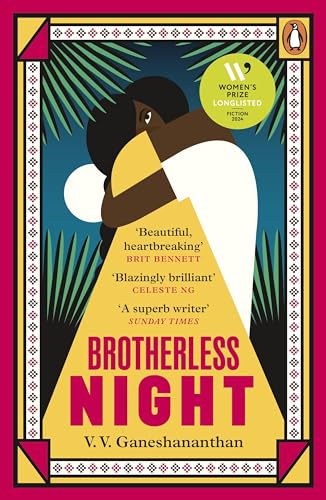
V. V. Ganeshananthan, Brotherless Night (Penguin 2024)

The main character and narrator of Brotherless Night, Sashi to her friends, is a young Tamil woman who is studying to become a doctor in the city of Jaffna in northern Sri Lanka. She lives through the beginnings of the civil war in the 1980s. Her beloved eldest brother is killed in the anti-Tamil riots of 1983 – the riots that are made so vividly present in S. Shakthidharan’s play Counting and Cracking. Two more brothers join the Tamil Tigers (the Liberation Tigers of Tamil Eelam), and K, a man she has loved since childhood, becomes a celebrated hero and martyr among the Tigers.

Sashi herself is caught between an oppressive government army and a ‘liberation’ force that ruthlessly kills many of the people they claim to be defending. Sashi deplores the tactics of the Tigers, but she works for them in a secret clinic, patching up wounded cadres and civilian casualties, and she can never renounce her love for her brothers and K.

In a pivotal sequence, K comes out of hiding to ask Sashi for her support in a dangerous undertaking: to do so will align her publicly with ‘the movement’, which would grievously misrepresent her sympathies, but not to do it would be to betray a childhood friend. I think of E. M. Forster’s much quoted line: ‘If I had to choose between betraying my country and betraying my friend, I hope I should have the guts to betray my country.’ But Sashi’s choice is not as simple as that.

As she ponders the dilemma, there’s this line (on page 238):

Before there was a movement there were six children on a lane.

It is her loyalty to the vision of themselves as children that is at the heart of the book – that is, her loyalty to a basic shared humanity, and to telling the truth from that place.

It’s a terrific story. I was invested in the characters and sorry to put the book down. Part of its strength is the way it reaches out from its fictional world to highlight elements of actual reality. I can think of three ways.

First, other texts are referred to and integrated into the narrative. The books that Sashi and her brothers read might make an interesting reading list, but most strikingly Sashi and her Anatomy professor start a book group for woman at the university, and at their first meeting they discuss Feminism and Nationalism in the Third World, a real book by Sri Lankan author Kumari Jayawardena. In lesser hands this might have felt like analysis being shoehorned into the narrative, but we share the young women’s intellectual excitement, and their sense of peril as no one can be sure things won’t be reported back to the Tigers, with potentially dire consequences.

Second, there are elements of roman à clef. The salient features of K’s life and especially death, for instance, align closely with those of Tiger leader Theelipan.(Don’t look up this link if you want to avoid spoilers.) One of the book’s epigraphs – ‘There is no life for me apart from my people.’ – signals another real-life equivalent. It’s from Rajani Thiranagama (Wikipedia page here), a human rights activist who was once a member of the Tigers but became critical of them and was eventually believed to be murdered by them. She is the model for Sashi’s Anatomy professor, and the last third of the book features a fictional version of her real-life project of gathering evidence of atrocities committed by Tigers, Indians and Sri Lankan military.

The third way may be peculiar to me.

A young woman has been viciously assaulted by an Indian soldier – nominally there as part of a peace-keeping force. Sashi treats her injuries, and she returns later in a different, devastatingly vengeful role. This young woman’s name, Priya, rang a bell for me, and for no reason I could pinpoint I felt a particular investment in her story. Then I remembered the source of the bell: Priya Nadesalingam, the subject of a huge amount of press in Australia in 2023 (here’s one link in case you need reminding). That Priya, who had sought asylum in Australia with her husband Nades Murugappan and their two daughters, had become part of the community in the tiny Queensland town of Biloela. After a dawn raid, they came close to being deported and sent back to Sri Lanka. There was a huge public outcry and, long story short, the family are now living in Biloela on permanent visas.

The two Priyas have very different stories, but the coincidence of names brings home to me with tremendous force the horrific broader reality behind the bloodless statements about refugees made by politicians in Australia (and I assume elsewhere in the West).

The book doesn’t preach or lecture, but it brings a deeper understanding, not only of the struggle for Tamil independence in Sri Lanka, but of resistance movements generally. It makes me want to be a better person living in a kinder country with broader horizons.


I wrote this blog post on the land of Gadigal and Wangal of the Eora nation. I acknowledge their Elders past present and emerging, and gratefully acknowledge their care for this land for millennia, as well as the generosity I have personally experienced from First Nations people all my life.