When I decided a couple of years ago to focus on just one page of a book when blogging about it, I intended it to be a way of cutting down on the time I spend on the blog, while still managing to have fun and hopefully say something interesting. It hasn’t always worked out that way. Too often, I’ve gone on at length about a book and then tacked on a discussion of page 76, 77, 78, 47 or, occasionally, 7.
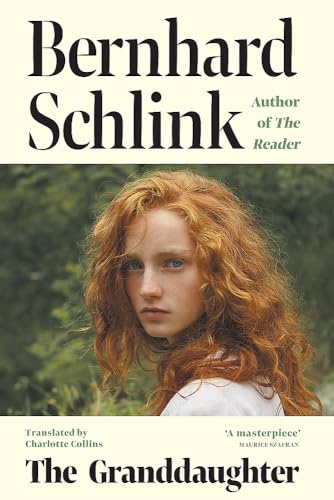
I’m turning over a new leaf, starting with The Granddaughter.
If, like me, you’d read a couple of books by Bernhard Schlink – in my case The Reader (read before blogging), Guilt About the Past and The Weekend – you might pick this up in a bookshop expecting a novel in powerfully simple prose about Germany coming to terms with its past. You’d be right. If you knew nothing, and turned for a taste of the writing to an arbitrary page, say page 78, you’d find some writing that pulls you in, possibly enough to make you buy the book:
Two young women friends are spending time in a dacha in a forest in East Germany. One of them, the narrator, is pregnant. The other, who want to be a nurse, will assist at the birth. The narrator, who I can tell you is named Birgit, dreams of escaping to the West, with or without a man named Kaspar. At the same time, she is having a blissful time, finding happiness in the moment. This is clearly a period of respite:
I listened to the rain on the roof, the initial drops, the furious pelting of a rainstorm, the soft rustle of steady rain, the last drops falling from the branches above the dacha. Sometimes Paula and I just slipped on dresses and walked through the warm rain till the wet dresses stuck to us and we laughed as we helped each other take them off again and jumped off the jetty into the water.
I learnt to love the forest. My mother never took her daughters to the forest. When we went on trips into the forest with the Young Pioneers and the FDJ, there were instructions to be followed and assignments to be completed, and we did everything busily and noisily. The forest around the lagoon was quiet.
The FDJ (Freie Deutsche Jugend/Free German Youth) was the official youth wing of the German Democratic Republic and the Socialist Unity Party of Germany.
Returning to this page having read the whole book, I’m in awe at its place in the whole. Most of the book is told from Klaus’s perspective, but this is in the middle of 60 pages in Birgit’s voice, a document written by her decades after the time in the forest and found by her husband – Klaus – after her death. He learns for the first time of her pregnancy, and gains some understanding of the long term emotional toll of her escape to the West to be with him. It’s not a spoiler to say that Brigid ends up filled with alcoholic despair – that’s how the book starts. And here, on page 78, in spare, unsentimental prose, in what seems like just a pause in the narrative, Schlink gives us a glimpse of the deep attachment to place that was to be ruptured by her move, as important perhaps as the haunting presence of the baby she decided to leave.
After reading the manuscript Klaus, now a bookseller, decides to go in search of the daughter. She turns out, after a troubled childhood and adolescence, to have joined a right-wing, Holocaust-denying, white-supremacist völkisch community. The main relationship in the book is between Klaus, good liberal Westerner, and Birgit’s granddaughter, who has taken on her parents’ ideology with the absolutism of childhood. Birgit’s tiny moment on page 78 of learning to love the forest, which transcends the political demands of her society, finds a kind of correlative in her granddaughter’s love of music, which Klaus seeks to foster. It’s also echoed in a perverse way in the völkisch elevation of ‘blood and soil’.
Bernhard Schlink is a lawyer and a retired academic. In each of his novels that I have read, individuals try to find their way with integrity in complex moral and political terrain. Complicity in the Holocaust in The Reader, left-wing guerrilla activity / terrorism in The Weekend. And here, unresolved issues from German ‘unification’ and the rise of neo-Nazi sentiment and activity. Like his hero Klaus with his granddaughter, Schlink refrains from lecturing, and approaches the people with whom he disagrees with respect, struggling to understand. Birgit’s joy in the warm rain and the silent forest ad quietly and eloquently to that struggle.
I wrote this blog post on land of Gadigal and Wangal of the Eora Nation. I acknowledge the Elders past and present of this beautiful country, never ceded. I also acknowledge the Elders past and present of the Ma:Mu nation, custodians of the land where I spent my first 13 years.
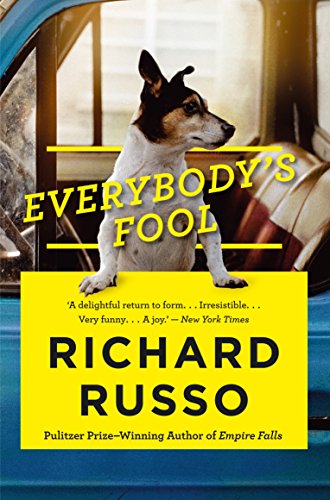
Before the meeting: This is the second book in Richard Russo’s trilogy set in the dead-end town of North Bath in rural New York: it was preceded by Nobody’s Fool (1993) and followed by Somebody’s Fool (2023). I read it as a stand-alone. At about page 80 I went to Wikipedia for a synopsis of Nobody’s Fool, and really I needn’t have. (I also watched a trailer for Robert Benton’s 1994 movie, which was probably a mistake, as the image of Paul Newman as the character Sully was seriously different from the one I’d built up for myself, even allowing for the fact that Sully has aged 20 years since the first book.)
All the same, even for those who haven’t read about the characters’ earlier lives, it’s clear that they are living in various aftermaths. It begins with a burial and returns to the cemetery again and again. One man has been given a year to live, another is stuck in grief for his wife who died in the act of leaving him, a third has been released from jail and proclaims unconvincingly that he has turned over a new leaf. One couple remain affectionate though their affair is long since over, another deal with a long history of mental illness. Friendships endure in spite of mutual irritation, enmities are maintained in spite of deep-seated fellow-feeling. It’s complex, sometimes laugh-out-loud funny, sometimes wretchedly painful, abounding in situational ironies. There are two violent deaths that we don’t witness, and one shockingly violent scene that we do. There are two villains, three if you count the out-of-town dealer in snakes and drugs. There’s a disgustingly incontinent dog. A couple of characters from the first book make cameo appearances, for no obvious reason apart from letting longterm readers know what they’re up to.
Class is ever-present. Most of the book’s characters know they have been excluded from the good things of life. They’re rough with each other, but there’s also kindness and integrity and a strong sense of belonging. At one point Sully, who has the strongest claim to be the main character, reflects that he has made sure ‘that his destination at the end of the day was a barstool among men who had chosen to be faithful to what they took to be their own natures, when instead they might have been faithful to their families or to convention or even to their own early promise’ (page 448). It’s an attitude that elsewhere might be called quiet despair, but here it includes an assertion of connection.
I enjoyed it a lot. It deals with serious themes, but it’s a lot of fun in all sorts of ways.
On page 78*, nobody is being nice to anyone, but nobody’s going anywhere. The scene is Harriet’s diner, one of the three eating and drinking establishments in the town. The characters are Ruth, owner of Harriet’s; her daughter Janey who has just come in complaining about a scene in her bathroom; Carl, a failing developer whose post-prostate-surgery incontinence (which everyone knows about) is responsibe for the bathroom scene; Roy, Janey’s violent ex-husband, fresh out of jail and claiming to have turned over a new leaf, who has just left; and Sully, one-time lover of Ruth, who now hangs around every day to be generally helpful and has just picked a fight with Roy. Ruth is speaking to Janey:
‘Sorry about the bathroom,’ she said, ‘but Carl had an accident.’ She emphasised the name ever so slightly. Remember? she seemed to be saying. What I told you about Carl? ‘Oh, right.’ Janey shrugged. ‘I guess that makes it okay.’ ‘That was my thought,’ Ruth said. ‘I’m glad you agree.’ Janey rolled her eyes to show that she most certainly did not agree but wasn’t going to go to the mat over it, either. ‘Was that my idiot ex-husband’s voice I heard earlier?’ Ruth apparently took this to be a rhetorical question, because she didn’t bother answering. ‘He’s taking that restraining order real serious.’ … ‘He hasn’t caused any trouble so far, or even tried to,’ Ruth said, glancing at Sully. ‘Unlike some people.’ ‘That’s the thing about Roy,’ Janey said, putting her now-empty mug into a plastic busing tub. ‘He won’t, until he does. But when he does, it’ll be my jaw that gets broke, like always.’ ‘He breaks your jaw because you’re always mouthing off.’ ‘No, he breaks it because he enjoys breaking it.’ ‘Like you enjoy mouthing off,’ Ruth said as Janey brushed past her. ‘Well, jeez,’ Janey mused, pausing in the doorway to her apartment. ‘Let’s think a minute. Where the fuck do I get that from?’
I could probably have picked any page in the book and found similarly alive dialogue, and a similar complexity of relationships. Notice that Sully doesn’t say a word. Ruth’s glance in his direction comes from a woman you don’t want to cross. Likewise, we know that Janey is right about her ‘idiot ex-husband’, but Ruth isn’t gong to back down meekly. It’s no spoiler to say that Ruth’s attributing Roy’s violence to Janey’s mouthiness is rich with narrative irony: what she says in the heat of mother-daughter irritation is a standard blame-shifting rationale used by perpetrators of family violence. That irony goes deep in the light of events yet to come, but my lips are sealed.
After the meeting: We read this along with Christine Dwyer Hicks’s The Narrow Land (yesterday’s blog post here).
They’re very different books, and though I tried in my post on The Narrow Land to note things they had in common, no one else was much interested in such attempts. I’d say that a couple of us enjoyed this book much more than the other, but others not so much. One got to about 20 percent (this is how Kindle readers talk) and then went no further, another read about four percent. The first, probably being polite to those of us who enjoyed it, said that while she could see that the writing was very good, she had no desire to spend any more time in the depressing world of the novel.
Two of us talked about the human warmth and humour. I fond myself laughing helplessly as I recounted one of the more macabre episodes. Others remained stony-faced. The other person who found the book funny said it was like Carl Hiaasen’s work (‘Without alligators,’ I agreed). She also made a cogent argument for the book’s acknowledgement of class in a way that isn’t common in novels from the USA. Similarly civil but unconvinced response.
When I said I could imagine a movie adaptation directed by the Cohen brothers that seemed to bridge the chasm a little.
As I’m about to hit ‘Publish’, I realise that nowhere in my ‘Before the meeting’ section did I mention the wonderful comedic energy of the writing: the book opens with a bravura description of the North Bar cemetery; the town doesn’t have alligators, but it is terrorised by a king cobra; there are terrible smells; a building collapses like something out of a Buster Keaton movie. All of this seems to have passed most of the other club members by. Maybe you have to have to temporarily suspend solemn empathy as well as disbelief.
The Book Club on the land of the Bidjigal and Gadigal clans of the Eora nation, overlooking the ocean. I wrote the blog post on Wangal and Gadigal land as rain poured down. I gratefully acknowledge the Elders past and present who have cared for this beautiful country for millennia.
* My blogging practice is focus arbitrarily on the page of a book that coincides with my age, currently 78.
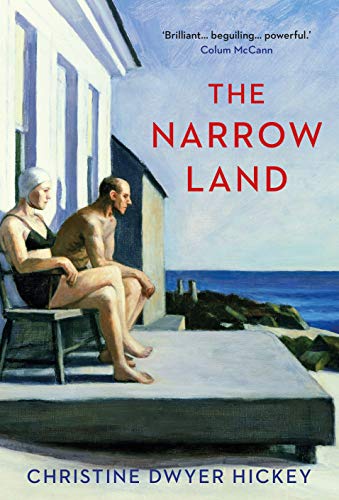
The cover of The Narrow Land features Edward Hopper’s painting Sea Watchers (1952). The back cover tells us the book is about a ten-year-old boy who forms an unlikely friendship with ‘the artists Jo and Edward Hopper’. But nowhere in the narrative itself are we told the names of the two artists, even though many of the man’s paintings are lovingly described and even a reader as ignorant about US art as I am could recognise some of them (admittedly with help from Duck Duck Go) as Hoppers. Nor is there an afterword or acknowledgement to clarify the story’s relationship to historical fact.
I don’t know what to make of that, since it looks as if a significant dimension of the book is a fictional depiction of Hopper’s practice and the Hopper marriage. In particular, to judge from Josephine Hopper’s Wikipedia entry, it’s likely that the narrative draws on her copious journals recording her bitterness and their stormy quarrels. The character’s journals are mentioned, but Josephine Hopper’s are not.
The Hoppers-not-Hoppers, she in her sixties and he quite a bit older, have a terrible relationship. They are at their Cape Cod house for the summer in the early 1950s. He is stuck, searching for inspiration. She lives in his shadow, resents his failure to support her work, nags at him to get on with his own, is hyper-alert to possibilities that he will be attracted to other women, and relentlessly picks fights with him. He is relentless right back at her. They’re not people you want to be around.
Ten-year-old Michael comes into their lives. He is a German war orphan, possibly Jewish, brought to the US and adopted by a working-class couple in New York, spending the summer with a benefactor who is the artists’ neighbour.
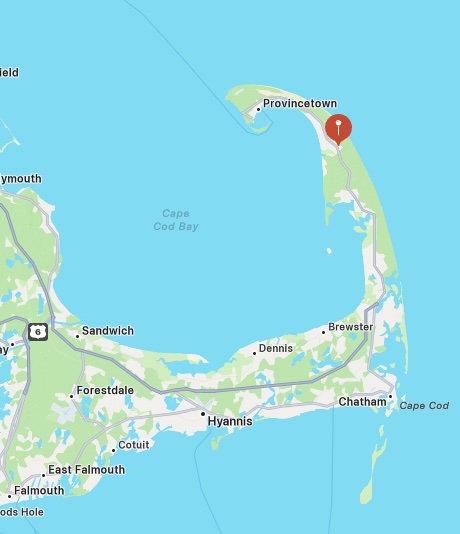
Relationships develop among these characters, including Michael’s complex host family. The narrow land of the title refers literally to Cape Cod, as in this map. It also refers, I think, to the narrowness of a non-combatant USer’s world-view: Michael’s hosts are unable to imagine the magnitude of what he has endured (which he experiences now as nightmarish flashes of memory). The narrowness is also there in the constrictions that society places on the artist, and the claustrophobia that ‘Mrs Aitch’ rails against in her marriage. Perhaps it refers also to the limits imposed on people’s lives in the wake of the Second World War – partners, parents and siblings are still being mourned, and returned soldiers wander through the narrative like wraiths.
For the most part, this isn’t a pleasant read. I found Mrs Aitch especially painful – like Pansy in Mike Leigh’s Hard Truths, her bitterness is unremitting, but she lacks Pansy’s biting wit. Unlike Pansy though, she finds temporary relief in connection with children – Michael and his obnoxious host Richie – where we get to see her in a more positive light. Also unlike Pansy, she has a moment when her intolerant discontent saves the day.
Having just described Richie as obnoxious, I feel obliged to say that even though almost all of the characters are unlikeable, most of them have moments when we see an underlying pain. We come to see Richie in particular as tragic.
Page 78* turns out to be a good example of my pervasive frustration. It’s near the start of the novel’s second section, titled ‘Venus’, in which we realise that ‘he’ – Hopper-not-Hopper – is searching for a woman he glimpsed the previous summer, as he feels that she will inspire him now. (Spoilerish note: he does find her, but it doesn’t work.) On this page he remembers the day that he found her:
She was standing in the doorway of a house, a man standing on the threshold, maybe leaving or maybe hoping to get inside. He’d driven by and pulled in further along the street. Then he walked back past the house. There had been a bush by the gate, tangled and dried up from the heat, a lawn, yellowed by neglect and the ravages of a long summer.
There’s a description of her clothes and a snippet of overheard conversation, then:
He had walked on for a couple of minutes. then crossed the road to return on the opposite side, his head tilted as if he were searching for the number of a door. As he came closer to the house, he saw her lift her hands and put them under her hair, which was a whiter shade of blonde. Then she flipped it all up, holding it for a few seconds to the back of her head. He could see the damp patches of sweat stamped into her armpits and the outline of her long neck, the soft curve where it joined her shoulders. She dropped her hair and her face lifted upwards. The blue blouse. The light on her face. He couldn’t figure out if it was pouring into her or pouring out of her. He thought she looked sanctified. Then he thought she looked the opposite.
He rushes home and drags out his easel:
He laid it down: the street, the house, the figure of the girl in the doorway, the figure of the man alongside it with one foot on the step, the lawn, the gate, the tangled bush.
This is emphatically an account of a particular artist’s creative process. It’s as if the novelist sets out to imagine for us how Edward Hopper created one of his paintings, but then – for legal reasons, perhaps, or from simple respect for the unknowability of the real man – pulls back from acknowledging that that’s what she’s doing. The understated eroticism here plays nicely into the portrait of the artist’s marriage: his wife (never named) realises that she is not the model for the woman in the painting, and is furious.
On the way to the meeting: We read The Narrow Land along with Richard Russo’s Everybody’s Fool. Just before the meeting I’m noting some things the books have in common:
they both have dogs that make a mess of cars – the disgustingly incontinent Rub in Everybody’s Fool, and Buster in this book who leaves a car ‘looking like a feathered nest’
characters read books: Sully in Everybody’s Fool remembers as a boy reading the beginning of a book we recognise as David Copperfield (Dickens), and discarding it; Michael in this book reads The Red Pony (Steinbeck) and Tom Sawyer (Twain) and takes them in his stride
Class looms large: when Michael’s working-class foster parents turn up we suddenly feel grounded in honest relationships; when Sully’s son turns up in the other book, we’re away with the abstractions of middle-class life.
After the meeting: The books had to compete with the pope’s funeral on the TV, but we still had an interesting conversation.
I think we were all a bit perplexed by A Narrow Land – not quite sure where its focus is. The person who had first proposed it, an artist herself, kicked the conversation off by saying that she was disappointed the book had so little to say about Hopper’s process, and in a way we circled around that central absence for the rest of our conversation.
One other person shared my unease about the relationship between the fictional characters and the historical persons. Others had no problem with it, and I still find it hard to say precisely what my problem is. Our host produced a hefty volume of Hopper’s work and we tried to pin down the paintings he works on in the book. No one claimed to have enjoyed the book unreservedly, though I think we all found some joy, or at least pleasure, in it. No one was much interested in trying to compare the two books.
We met on the land of the Bidjigal and Gadigal clans of the Eora nation, overlooking the ocean. I wrote the blog post on Wangal and Gadigal land. I gratefully acknowledge the Elders past and present who have cared for this beautiful country for millennia.
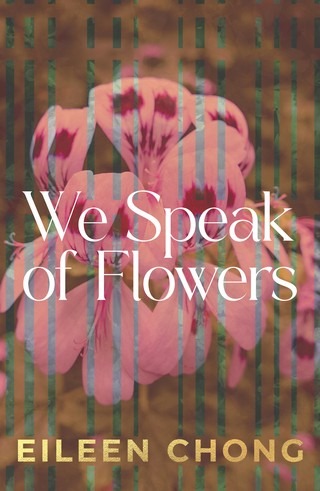
The author’s note at the start of this book begins:
We Speak of Flowers is a book-length poem in 101 fragments that can be read in any order. Each reading will construct the poem anew, and the shifting juxtapositions will give rise to innumerable permutations of the poem.
Considered as a book-length poem, the book is an elegy for the poet’s beloved grandmother. It also deals with other losses, especially those that come with being a member of the Chinese diaspora (and within that, of Hakka, Hokkien and Peranakan heritage). The dedication reads, ‘A poem for my ancestors’. But this isn’t a book with tunnel vision: there are Covid poems, childhood recollections, observations of life in Sydney, travels, meditations on artworks, and – as you expect if you’ve read any of Eileen Chong’s previous five collections – plenty of food. Images from Buddhist funerary rituals recur, and the clicking of mah jong tiles is heard more than once.
The author’s note goes on to explain that in Buddhist belief, the soul of a person who has died is reborn after 100 days, so the hundredth day ‘marks the end of the formal process of grieving the dead’. The 101st poem/fragment marks the moment of the soul’s reincarnation. The end is also a beginning. The invitation to read in any order implies that the grieving can begin and end with any one of the 101 fragments. Contrary to popular oversimplifications of Elisabeth Kübler-Ross‘s thinking, grieving is not a linear process. At the Gleebooks launch earlier this year, Eileen described the book as a choose-your-own-grief-adventure.
This sets up us for a tremendously complex – and engrossing – reading experience. I’ll limit this blog post to beginnings and endings.
In the book’s order, Fragment 1 consists of just two lines spaced widely apart on the page: ‘a singular, cracked voice // words matter, can still rise –’. In context this is the moment when a person caught in the intensity of immediate bereavement realises that they can still speak/write, and so the process of grieving can begin. It’s a perfect place for the larger poem to start. Fragment 101 begins, ‘And what did you leave me / in the end?’ I won’t quote the rest of it, just say that it brings the sequence to a perfect, heartbreaking end.
Though I found Eileen’s order very satisfying, I obediently ran the numbers 1 to 101 through a randomising program, and followed the resulting order for my second and subsequent readings.
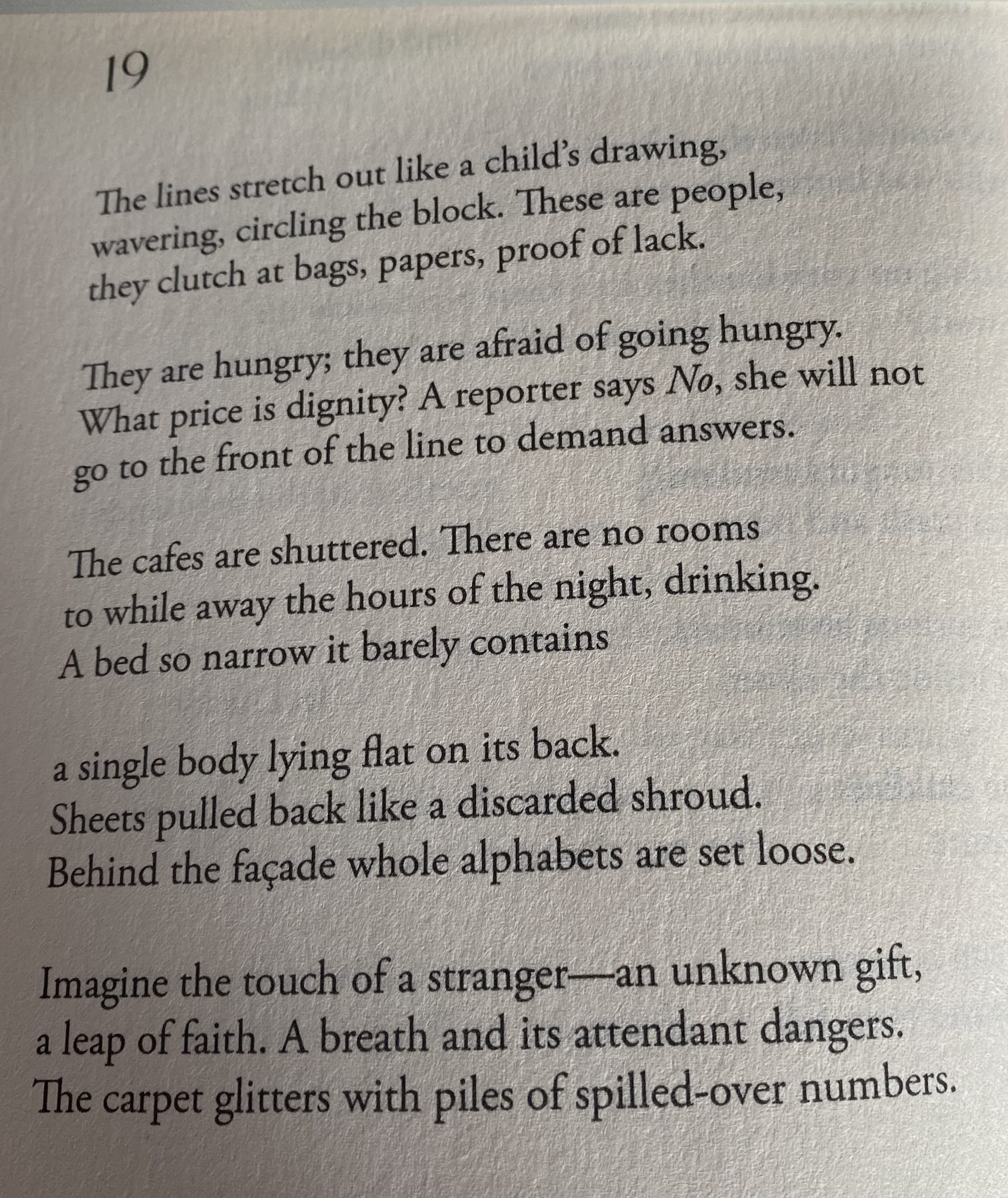
In this order, the larger poem begins with Fragment 19:
The poem consists of five three-line stanzas (triplets), a form this poet uses often. And as in many of her poems, there are some brilliant line breaks. One of several Covid poems, it captures a moment in our shared history. Beginning with a striking image of queues – for Centrelink, perhaps, or at a testing station – it goes on to evoke the loneliness, underlying dread and obsession with statistics that characterised lockdown days for many of us. I love this:
Imagine the touch of a stranger – an unknown gift,
a leap of faith. A breath and its attendant dangers.
What oft was thought but ne’er so well expressed!
The fragment works brilliantly as the beginning of the larger poem. We learn later that the poet’s grandmother died when Covid restrictions were in place, and the poet and her Sydney-based parents weren’t unable to attend the Singapore funeral. So this poem establishes the setting for the main story. And there’s something else:
Sheets pulled back like a discarded shroud.
The image suggests a resurrection – that waking and getting out of bed, perhaps after an illness, is to have avoided death. But it also reminds us that not everyone has avoided it, foreshadowing the overarching theme of bereavement.
In my ordering the poet’s grandmother doesn’t appear until the third poem (Fragment 72), where she is very much alive at the mah jong table:
She pulls a tile and runs her thumb
along its underside, over its carved
indentations.
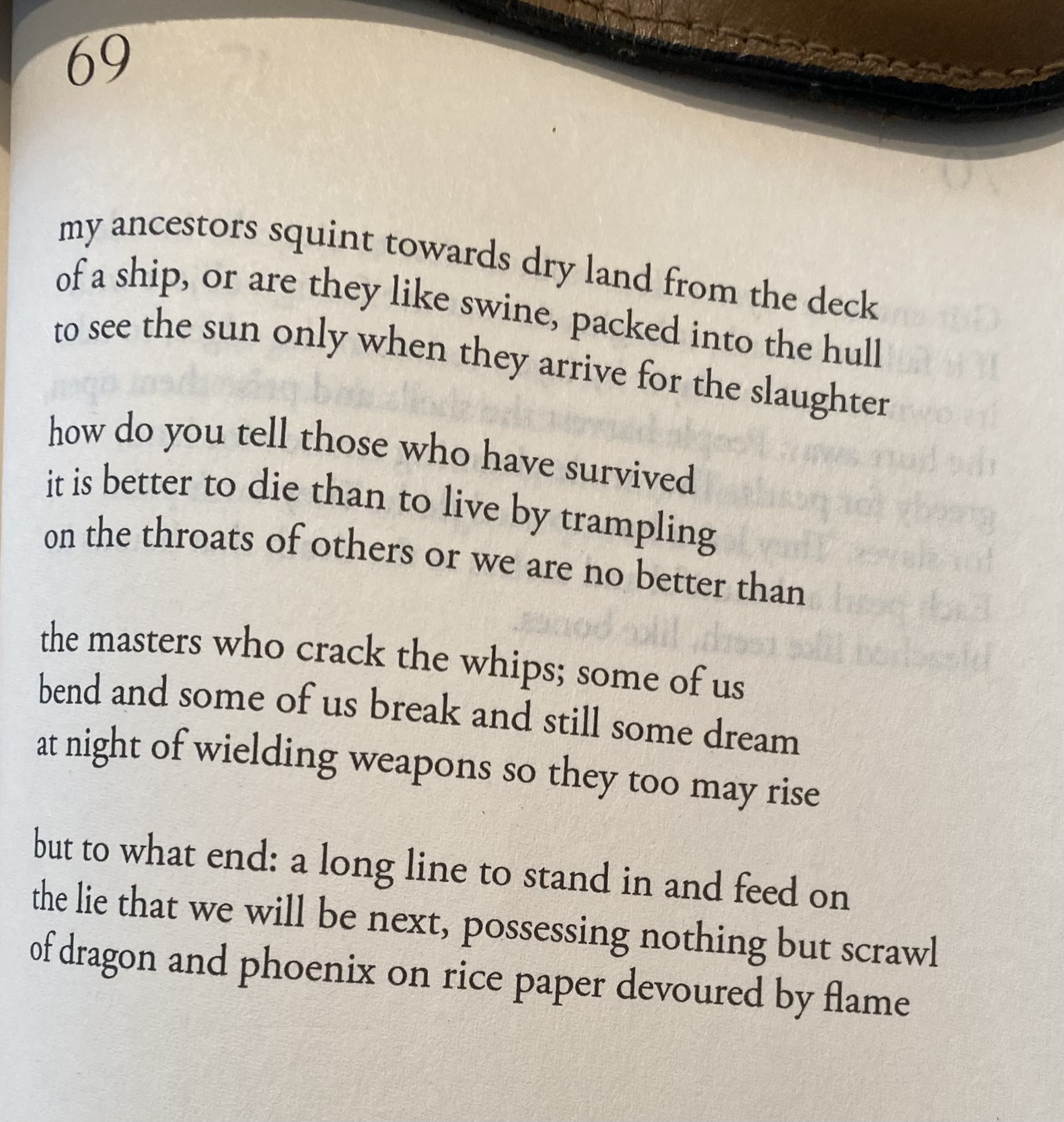
My randomised sequence ends with Fragment 69:
This is one of Eileen’s many poems exploring her family history and heritage. As often happens with these poems, I find myself thinking about my own very different heritage, but with a powerful sense of what is in common. When I blogged about her ‘Burning Rice’ (here), for instance, I brooded on the role of sugar in my life as the son of a sugar farmer. My forebears came to this country, some ‘squinting towards dry land from the deck / of a ship’, some as convicts ‘packed into the hull’. I guess that’s a way of saying that while the poem has specific historical references (about which I am vague), it somehow – as good poems do – makes a bridge to other, different experiences. This isn’t closed-off identity poetry. The ethical questions it poses aren’t just for people of Hokkien heritage.
I keep wanting the first line of the second triplet to be, ‘How dare you tell …’ That is, I want the lines to challenge anyone who passes judgment on survivors. But the actual words, ‘How do you tell …’, appear to endorse the stark ethical principle that it is better to die than to live by oppressing other people. Lines 4 to 7 ask how to communicate that principle to people who have made the choice to live in those circumstances. The question is left hanging and the poem moves on: in response to oppression, there are just three options: to bend, to break or to plot rebellion. The final triplet arrives at what is surely a doctrine of despair: no matter what we do we all end up dead. The dragon and the phoenix, traditionally paired in Chinese art and literature to represent harmony and prosperity, are possessed only as scrawled images on paper, and that paper will burn in a funeral ceremony.
How does this fragment function as the final moment in this longer poem?
Astonishingly well, as it turns out. For one thing, the image of standing in line occurs in both first and last poems. In Fragment 19, people line up around the block clutching at ‘bags, papers, proof of lack’, hoping for something. In Fragment 69, standing in line becomes a metaphor for a doomed aspirational life. We will never reach the front of the queue – it’s a ‘lie that we will be next’ – and what we possess is ‘nothing but scrawl’, paper ideals that will be destroyed at the funeral.
This fragment doesn’t end the sequence with the notion of rebirth or transcendence, but with resignation to the finality of death. The ship has reached its harbour. The funerary papers have been burned. There’s nothing left but profound sorrow.
At the launch, Eileen said, ‘I’m really a cheerful person.’ And I don’t want this blog post give the impression that We Speak of Flowers is a gloomy book. On the contrary, it deals with grief, it refuses to idealise or prettify its subject, but it’s still full of colour and light and the magic of language. Maybe I can leave you with the final couplet of Fragment 34 – which in my randomised order is Nº 78, the number that I usually blog about:
death in the afternoon
wild plants still flower
I wrote this blog post on land of the Gadigal and Wangal clans of the Eora Nation, where the earth’s processes are asserting themselves in heavy downpours followed by brilliant blue skies. I acknowledge the hundred of generations of past Elders, and present Elders, of both countries, never ceded.
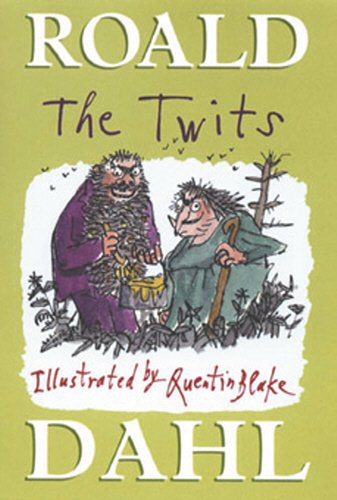
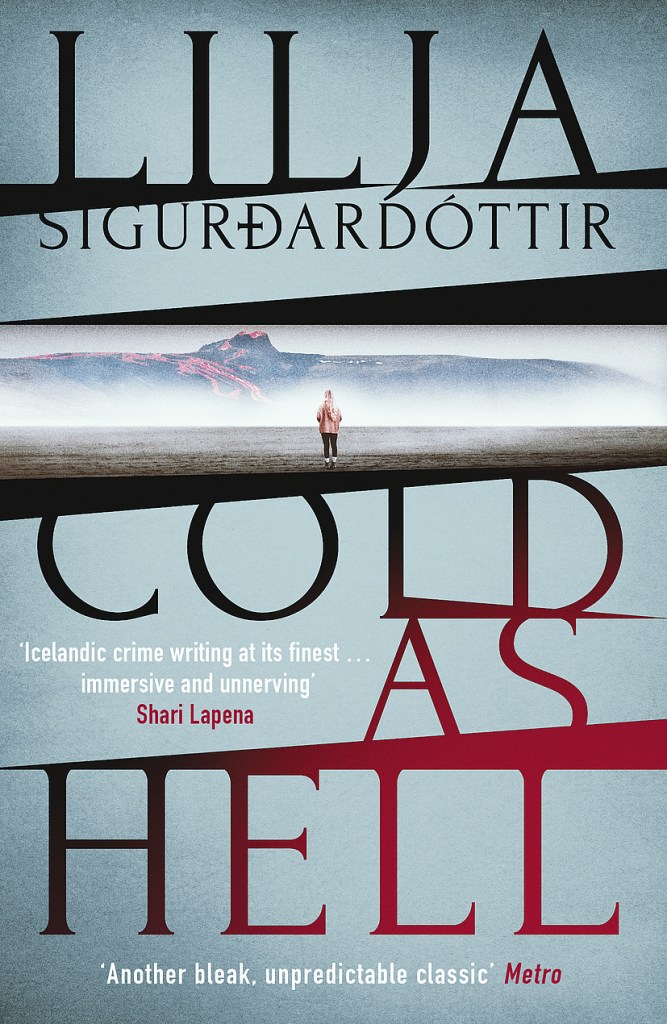
Roald Dahl, The Twits (1980) Lilja Sigurðardóttir, translator Quentin Bates, Cold as Hell (2022)
I spent the Easter weekend with family at Bawley Point on the south coast of New South Wales. The Emerging Artist and I drove there from Sydney with two grandchildren aged 4 and 7, and came home alone. On the way down we had a great time playing Car Bingo on sheets designed by the EA, and when the excitement of seeing the umpteenth cow had waned we listened on Audible to The Twits. On the way back, without grandchildren, we listened to the rest of Cold as Hell, which we had begun on a previous trip.
When I was first interviewed for a job at The School Magazine, Australia’s venerable literary journal for children, I was asked to name some children’s books that I enjoyed. Among others, I mentioned The Twits and The BFG, both by Roald Dahl. Kath Hawke, the magazine’s editor, raised a belligerent eyebrow. ‘Oh, you like them, do you?’ she asked, and went on to talk about the relish with which both books describe people humiliating and physically hurting each other. I scoffed at such concerns, identified with the relish, and didn’t get the job. (I was, however, placed on an eligibility list and eventually spent nearly two decades working there.)
Hearing The Twits again 40 decades later, I sympathise more with Kath’s view. Two repulsive individuals play mean tricks on each other and torment birds and animals in their power. The animals and birds take an appropriate revenge. End of story. It was refreshing once, and maybe still is for young people, especially those for whom ‘poo poo’ is a dependably witty response to almost anything. Maybe I’m just being all 21st century, but while I find the description of Mr Twit gleefully disgusting, I wonder if that of Mrs Twit isn’t marred by an extra layer of visceral misogyny.
According to an online bookseller juggernaut Cold as Hell is the first book in ‘an addictive, nerve-shattering new series’.
Áróra Jónsdóttir, a twenty-something freelance financial investigator, flies to her native Iceland to check on her sister Ísafold. Ísafold has been in an abusive relationship and the two sisters have recently fallen out. Áróra soon realises that Ísafold hasn’t just been avoiding her, but has disappeared.
What can I say? Iceland is cold. Áróra uncovers some financial skulduggery when on a break from searching for Ísafold. There’s a weird character called Grimur (I think), an African refugee named Omar, a police detective who is some kind of uncle to Áróra. Áróra’s mother flies in from London to share the anxiety. There’s a little bit of sex and a little bit of violence. It all turns out pretty much as you’d expect, with a slight twist, as you’d expect.
It felt like a novel equivalent of Nordic Noir TV, and given that The Áróra Investigations is a series, it may turn up soon on content-hungry streaming. It passed the time pleasantly enough, but my nerves weren’t shattered and I’m not addicted.
We listened to these books while travelling through Dharawal country. I have written the blog post on the land of Gadigal and Wangal of the Eora nation. I gratefully acknowledge Elders past and present, and thank them for their custodianship of these lands over millennia.
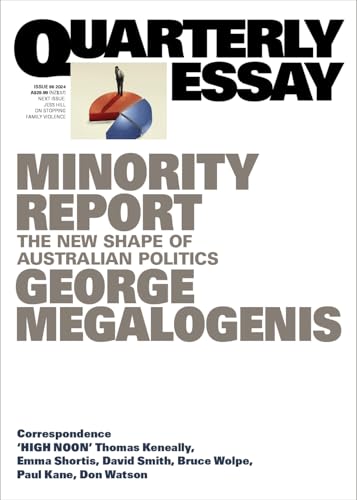
George Megalogenis takes Australia’s federal polling statistics and renders them into readable, even enjoyable prose. In this Quarterly Essay, he reads the data from elections since John Howard’s time up to the present moment, and attempts to make sense of the current political landscape.
The global financial crisis, the coming of the teals, Covid, the defeat of the Voice referendum, the genocide in Gaza, housing, the climate emergency, the hollowing out of the ABC: all are grist to the mill of this nuanced inside-baseball analysis.
The essay and the correspondence in Quarterly Essay 97 probably make a significant contribution to our general understanding of Australian electoral politics. But as I was reading it, I couldn’t help but be aware that it was written at the end of 2024, and if a week is a long time in politics, then the four months that have passed between then and now amount to an epoch. Even the correspondence was written before Donald J. Trump’s ‘Independence Day’. Who knows if, as Megalogenis projects, there will be a hung parliament in May? And if there is, who knows if he is right that it ‘offers perhaps our last best chance to restore purpose to our politics – and policymaking’?
Still, I admire and enjoy Magalogenis’ ability to communicate complex matter in a readable way. Page 47, which begins a section on the level of trust in government, includes an example:
In the wake of the 2010 federal election, I pinpointed the 2001 campaign as the turning point to a more trivial politics. John Howard responded to warnings of electoral doom with a panic of handouts in the first half of that year. … None of the bribes offered to voters in this period came with offsetting savings for the budget. They left a maze of entitlements and distorted market signals which stored up problems for the future, most notably in the housing sector, where prices boomed beyond the reach of the middle class, and in public infrastructure, which could not keep up with population growth. Labor’s unforced policy errors on climate change and the mining tax in 2010 felt like the culmination of a decade-long trend which reduced the relationship between government and citizen to the question: how can I buy your support?
That general trend to trivialisation was interrupted first by the global financial crisis which, Megalogenis argues, created ‘a bubble of trust in our leaders and institutions, which burst once the existential threat passed’, triggering what he calls a ‘new super-cycle in our politics – pro-incumbent in the crisis and anti-incumbent in the recovery’.
There’s pleasure in discerning patterns of this sort. There may also be some usefulness.
In the correspondence, the stand-out for me is Judith Brett. She observes that the major political parties have been hollowed out, as their membership has declined and they have become ‘professional electoral machines’. When memberships were much larger, debate, negotiation and compromise took place within the parties. These debates connected with the lived experience, interests and prejudice of a range of electors. And when the legislation reached the parliament it was assured safe passage by the government’s majority:
What is happening, I think, is that the debate, negotiation and consensus-building is shifting from inside the parties back to the parliament, where they were for most of the nineteenth and early twentieth centuries … The conflicts of interest will be more publicly visible than they are when the resolution takes place inside the parties. This will be a magnet for media speculation and give the impression of dysfunction, but in my opinion it is no cause for alarm. The public will have a clearer view of the interests and arguments at play, and the government will have to negotiate. But it does not mean the end of effective legislation.
We’ll see.
I wrote this blog post on land of Gadigal and Wangal of the Eora Nation, where the day started out with rich blue sky, turned to heavy rain, fined up, and as I press ‘Publish’ is beginning to rain once more.. I acknowledge the Elders past and present who have cared for this land for millennia.
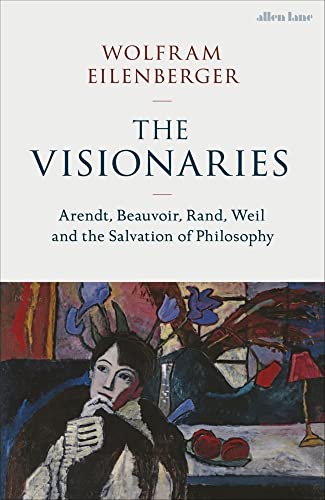
Before the meeting: It’s unlikely that the group would have read The Visionaries if we chose books by consensus. But The Chooser has spoken and we’re out of our comfort zones.
It’s a hard book to describe. Without anything by way of preamble or general argument, it plunges straight into its story. The first chapter, ‘Sparks: 1943’, introduces the book’s four subjects: four quite different women writers, each heroic in her own way, poised to take a major leap forward In the midst of the horrors of the Second World War. As with each of the book’s eight chapters and Coda, the chapter is subtitled:
Beauvoir is in the mood, Weil in a trance, Rand in a fury, and Arendt in a nightmare.
And the four philosophers are introduced:
Simone de Beauvoir, aged 35, is in occupied France in her famously unconventional ‘family’ with Jean-Paul Sartre, with ‘better things to do than worry about the judgment of that petit-bourgeois fascist’ (that is, Adolf Hitler): she is on the brink of ‘a new definition of man (sic!) as an acting creature. And one that was neither empty of content, as in Sartre’s latest work, nor bound to remain absurd, as in Camus’s writing.’
Simone Weil, 34, is in London, desperately ill and in pain, but lobbying for the creation of ‘a special unit of French nurses at the front who would be deployed only in the most dangerous places, to provide first aid in the middle of battle’. She would head this unit personally, in what looks awfully like a plan to commit suicide by altruism. De Gaulle dismisses the proposal out of hand: ‘She is mad!’ Instead she writes urgently and copiously, including ‘a 300-page redesign of the cultural existence of humanity in the modern age’ before collapsing in exhaustion.
After ten years as a freelance writer in New York City, Ayn Rand, 37, sees the publication of her 700-page novel, The Fountainhead, and launches her passionate espousal of independence, her worldview that saw altruism as the great destructive force.
Hannah Arendt, 36, also in New York, has been driven out of Hitler’s Germany, and is now finding in herself the courage to face the reality of the industrialised murder of millions of Jews. What mattered was ‘to be entirely present’, or, as paraphrased by Eilenberger, ‘to philosophise’.
In the following chapters, Eilenberger tells us the story of the life and work of each of these four women over the preceding decade. It’s left to the reader to discern any unifying theme or concern. In my reading, the closest he comes to articulating a central theme is on page 69:
The philosophising person seems to be essentially a pariah of deviant insights, the prophet of a life lived rightly, whose traces can be found and deciphered even in the deepest falsity. At least this is one way to understand the role that Ayn Rand as well as her contemporaries Weil, Arendt and Beauvoir assumed with ever greater confidence. Not that they had expressly made a choice. They simply experienced themselves as having been placed fundamentally differently in the world from how other people had been. And deep inside they remained certain of who or what the problem needing treatment was: not themselves, but the Others. Possibly, in fact – all the Others.
If one were to pursue that view, the actual impulse of astonishment at the beginning of all philosophising is not the surprise that there is ‘something and not nothing’, but rather, honest bafflement that other people live as they do.
If I understand this correctly, part of what he is saying is that whereas their male colleagues were interested in the individual human being in relation to the world, these four women were interested in human beings in relationship to each other.
It may be that what you find in any book depends on what you bring to it. A reader well-versed in 20th century philosophy would read this one differently from me: it seems that each of these women was pushed to the margins of political and philosophical thinking, and this book is part of a movement to rectify that. But I’m not that well-versed reader. I haven’t read a whole work by any of them, but I’ve known about all four in a general way.
In my mental landscape, Simone Weil is a weirdly saintly figure who embraced suffering (and loved one of my own favourite poems, as I blogged recently), a Jew who was lived her own intense version of non-Church Christianity; Ayn Rand is a demonic figure who celebrated and justified libertarian capitalism; Simone de Beauvoir is Jean-Paul Sartre’s devoted lover who wrote The Second Sex, a key text of second-wave feminism; and Hannah Arendt is a woman of extraordinary integrity who coined the phrase ‘the banality of evil’ and wrote about totalitarianism.
This book leaves those thumbnail sketches pretty much in place, but I now have a much richer understanding of the people and their works. I didn’t know, for instance, that Simone Weil had worked as a trade union organiser and had brilliant political insights, that Simone de Beauvoir had such a complex set of intimate relationships, that Ayn Rand was married and counted on her husband Frank O’Connor while she wrote fiercely about independence (and that ‘Ayn’ rhymes with ‘fine’), or that Hannah Arendt was quite so marvellous a human being as she appears in these pages.
Their stories are told independently, but Eilenberger makes occasional telling comparisons, and sometimes the women’s paths cross. I love the meeting between the two Simones on page 55, quoted from Simone de Beauvoir’s Memoirs of a Dutiful Daughter:
I managed to get near her one day. I don’t know how the conversation got started; she declared in no uncertain tones that only one thing mattered in the world: the revolution which would feed all the starving people of the earth. I retorted, no less peremptorily, that the problem was not to make men happy, but to find the reason for their existence. She looked me up and down: ‘It’s easy to see you’ve never been hungry,’ she snapped. Our relations ended right there.
And on page 190, the moment that has stayed with me as a piece of wisdom to live by – far from the self-abnegation of Simone Weil or the grand existentialist abstraction of de Beauvoir. Hannah Arendt, Eilenberger writes, is ‘laying the foundation of her own ethics of true self-determination in the face of the Other’:
Gratitude, for the existence of other people in the world, and active concern, for their always given vulnerability, are for Arendt the two true sources of our moral life. And it is no coincidence … that these two predispositions are the very ones that are essentially alien to Ayn Rand’s superhuman ideal figure, Howard Roark.
Amid all the egotism, altruism, self-sacrifice, angst, ambition, bitterness, sweetness, ruthlessness, pain, of those brilliant young adult lives, the notion that gratitude and concern are central went straight to my heart.
After the meeting: Usually, we spend quite a bit of time chatting before turning to the book of the night, but this time we were into it before we even sat down. The food was, as always, excellent. Our host had done a huge tray of roast vegetables and the contributions of the other five of us, with minimal advance coordination, worked well. He Who Usually Brings Dessert was on the other side of the continent, but it was someone’s birthday, and we had cake.
Though the book took us well outside our collective comfort zone, I think we were all glad to have read it. Most enjoyed it for the history, and tended to skip the philosophy. One of us is doing a philosophy course with the University of the Third Age, and had read Wolfram Eilenberger’s previous book, Time of the Magicians, about four male 20th century philosophers. He gave a couple of mini-lectures that cast light, gratefully received, on some of our dark places.
We had three different readings of ‘the Salvation of philosophy’ in the subtitle: these four women were saved by philosophy in times of extreme hardship; they saved philosophy from the dried-up mainstream by focusing on the connections among people; in the terrible time of the Second World War and Nazi atrocities, they kept the flame of philosophical thinking alive. Maybe all three are correct. (I’ve just seen the subtitle of the original is Die Rettung der Philosophie in finsteren Zeiten (1933-1943), literally The Salvation of Philosophy in Dark Times (1933–1943). And the title itself is Feuer der Freiheit – Fire of Freedom. It’s kind of intriguing that the four woman aren’t named, and there’s not even a hint that the book focuses on particular women. I wonder how much that change of packaging influences out reading.)
A couple of guys took against Simone de Beauvoir. I tried to defend her, and was supported by someone drawing a comparison between her and one of the participants in Australian Survivor that was as obscure to me as the extracts from Simone Weil’s journals. Incidentally, I now know how to pronounce Weil (it’s VAY).
We were in awe at how young the four women were in the years covered by the book. Some were pretty sure that Simone de Beauvoir’s entanglement with a student would get her fired and publicly shamed these days. It was a revelation that for de Beauvoir the war at times barely disturbed her way of life (someone had been to see the Anne Dangar exhibition in Canberra and had a similar revelation – ‘Oh yes, Hitler’s doing all that stuff,’ the artists in France said to each other, ‘but cubism is so interesting.’) It was pointed out that two of the four women were novelists rather than philosophers as such. Someone thought Hannah Arendt was a bit dull (I was shocked). Some were surprised to find themselves feeling sympathy for Ayn Rand (I was ashamed).
We barely talked about Donald Trump. I hope he noticed the lack of attention.
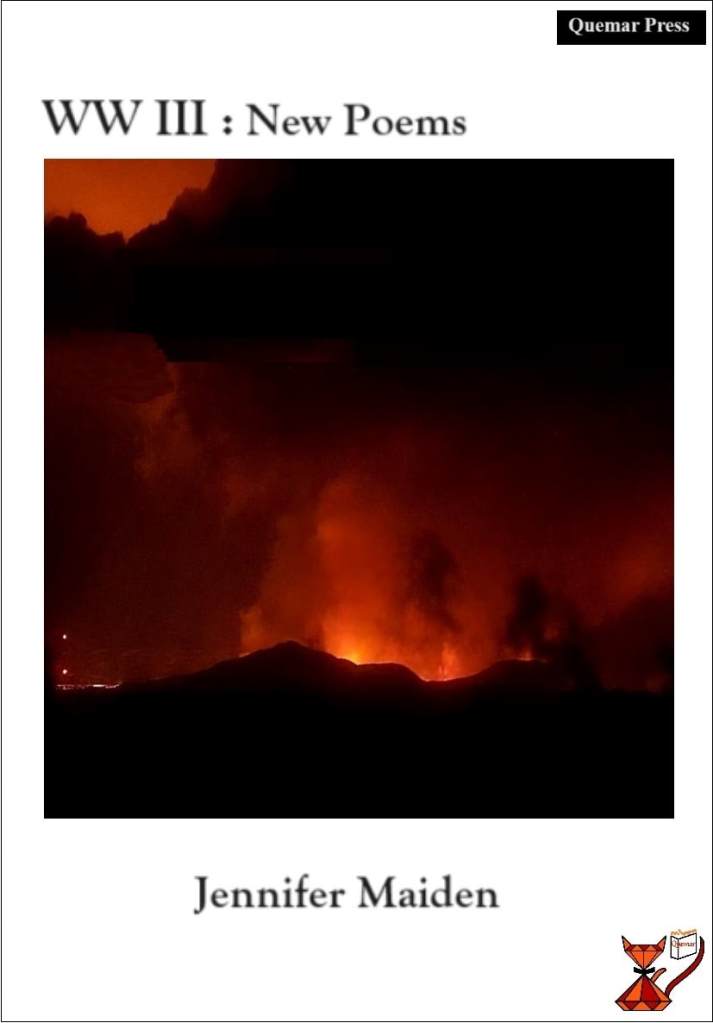
You don’t go to Jennifer Maiden’s poetry for a comfort read. For almost a decade now she has announced the title and theme of a forthcoming book early each year, and uploaded sample poems as they were written over the following months, generally relating to violence, political hypocrisy, and villainy from the headlines. The book has appeared, as promised, early the next January. It’s as if a fragmentary epic poem of our times is unfolding in real time.
WW III: New Poems is the latest instalment. As the title suggests, violent conflict, especially in the Ukraine and Gaza, features prominently, behind it the looming threat of global war. For a proper review, I recommend Geoff Page in the ABRat this link. This blog post isn’t so much a review as a disjointed reflection on just page 47*.
Before going there, a personal note. My blog post about Maiden’s previous book – The China Shelf: New Poems (Quemar Press 2024) – focused on the poem, ‘It’s an odd thing, pity’, and included this:
Not everyone will grasp how US imperialism can be seen as ‘falling’. If anything, some would say it’s on the verge of exploding and bringing the rest of us down with it, terrifying rather than poignant.
The title poem of WW III includes this:
Reviewing The China Shelf, a kind critic worried
that my reference to the falling Empire could
lessen the idea that it wasn't just falling
but exploding, and possibly dragging
its allies hellward with it, but he was only
considering one poem and of course the book
and others before it always took
often a stance of sharper warning
I may have got it wrong, but at least I’m kind, and as a humble blogger I’m flattered to be called a critic.
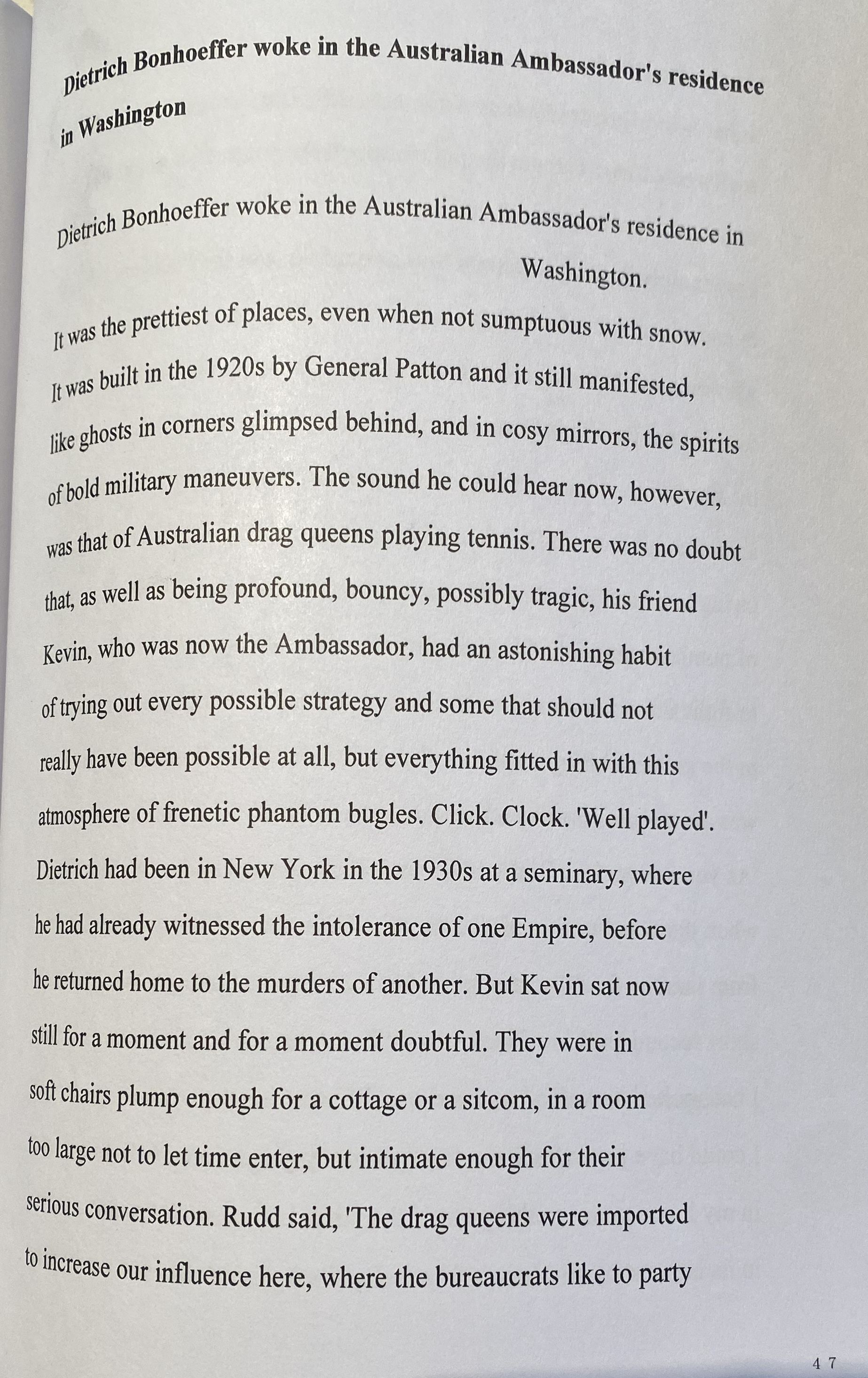
Page 47 of WW III is the first 19 lines of ‘Dietrich Bonhoeffer woke up in the Australian Ambassador’s residence in Washington’.
This page sets the scene for a much longer poem. The ‘serious conversation’, foreshadowed in the second-last line, could be summarised as, ‘Dietrich Bonhoeffer tells Kevin Rudd that it’s not wise to set Australia up to be the US’s proxy in a future war with China.’ The poem could be summarised abstractly: ‘With Dietrich Bonhoeffer as mouthpiece, Jennifer Maiden repeats her warning that the USA is not to be trusted as an ally to Australia.’ Luckily, as with any poem worth its salt, that summary tells you almost nothing and is pretty misleading. You can buy the book to read the whole poem, or you can hear Jennifer Maiden performing it at this link.
The poem belongs to Maiden’s personal tradition of poems where a famous person, historical or fictional, ‘wakes up’ to interact with a living person. In 2009 her fictional character George Jeffreys woke up in a number of global hotspots to see George W Bush on television. Kevin Rudd is one of a number of Australian politicians who have figured since then in delicious conversations: Tony Abbott with Queen Victoria, Julia Gillard with Aneurin Bevan, Malcolm Turnbull with Jessica Fletcher from Murder She Wrote, Tanya Plibersek with Jane Austen. (Beyond these shores, pairings have included Mother Teresa and Diana Spencer, Gore Vidal and Julian Assange, Eleanor Roosevelt and Hillary Clinton.) Usually the pairings are based on something the politician has said or written. In Kevin Rudd’s 2006 essay, ‘Faith in Politics’, published in The Monthly (link here, if you want to refresh your memory), he named Bonhoeffer as an inspiration. The pair made their maiden Maiden appearance in Drones and Phantoms (2014).
It’s interesting to notice just how much information is either given or assumed in these lines. It wouldn’t be a crime to read without googling. As Magdalena Ball said in her review of The China Shelf (link here), ‘You don’t have to have the kind of encyclopaedic knowledge of Australian history and command of current affairs that Jennifer Maiden does to read her books.’ But it helps, and there’s always the invitation to learn more.
First, Dietrich Bonhoeffer. I’ve vaguely heard of him as a pastor who spoke out against the Nazis and was murdered by them. So I know he brings a kind of moral integrity to the conversation. The poem give me a little more:
Dietrich had been in New York in the 1930s at a seminary, where
he had already witnessed the intolerance of one Empire, before
he returned home to the murders of another.
I might not have gone googling if I wasn’t blogging about the poem, but I did, and found that while studying theology in New York in 1930, Bonhoeffer engaged with African-American churches, and became strongly anti-racist. I don’t know that he used the term ‘empire’ about either the USA or Nazi Germany, but it wouldn’t be a poem without that kind of editorialising.
Second, Kevin Rudd. You’d probably know that he was the Australian Ambassador to the USA, but for those who know him there’s a deft evocation of his persona: ‘profound, bouncy, possibly tragic’. (Further on in the conversation, Kevin asks a question ‘and answered himself, as was his custom’.)
Third, the setting. Here’s a pic from the building’s facebook page – ‘the prettiest of places’. Who knew it was associated with the notoriously belligerent US general George Patton? (For readers of my generation no explanation needed: George C Scott in the movie Patton leaps to mind.) According to my googling, Patton rented the house rather than built it, but the association is still there.
DJ Kity Glitter with Rudd. Photo from Sydney Morning Herald 5 June 2023
Fourth, the headlines. Kevin Rudd did host a party featuring drag queens at the ambassador’s residence in June 2023. As far as I can tell, the tennis party was a different occasion, but who’s to say there wasn’t tennis at the Pride party as well? The fabulous image of drag queens playing tennis is an example of a news items seized on for poetic purposes, in this case with what looks like glee.
Given recent events in the USA, the mention of drag queens suggests that the poem will be about culture wars. But it’s actually a piece of misdirection. Over the page, the poem’s real subject is revealed, when Kevin asks:
____________________________________ But I suppose
really you are here about the police force?
And the poem’s key news item is identified: a hot-mic moment in August 2024 in which a US official, talking to Prime Minister Anthony Albanese,
_________________________ named Rudd as the schemer
who dissuaded America from proposing their own police
force in the Pacific in favour of one organised and paid for
by Australia.
All this information, of course, doesn’t lie inert on the page, but is woven into engaging poetry. For instance, one of Maiden’s themes is the way the US, behind its benign façade, is a ruthless military power. The residence, with its link to Patton, could have been built to her specifications. The prettiness and cosiness of the residence is haunted by bold military maneuvers (note the US spelling), yet the sensuous reality is also there:
still for a moment and for a moment doubtful. They were in
soft chairs plump enough for a cottage or a sitcom, in a room
too large not to let time enter, but intimate enough for their
serious conversation.
We are given enough of Kevin and Dietrich’s histories and personal quirks for them to be more than simply avatars for positions or points of view (like, say, the characters in Plato’s dialogues). On the other hand, neither on the page nor when performing the poem, does Maiden make any attempt to give them different voices. (Maiden-Trump has none of real-life-Trump’s incoherence.) They are not fully-rounded dramatic characters (it’s not a sitcom) but they have enough independent reality that you feel the poet herself is curious to hear what they have to say in their ‘serious conversation’. I think that’s why this long run of imaginary conversations doesn’t feel tired or repetitive – they are still part of a process of discovery. (There’s an underlying question that this poem goes on to address: What are we to make of Kevin Rudd’s current incarnation as Ambassador? What’s happened to his irritability, his love of China, his social awkwardness, any bitterness about being ousted by Julia Gillard? It doesn’t address Trump’s hostility to him … that would be a different poem.)
It’s easy to be caught up in Maiden’s subject matter. Her poems can be contentious – over the page, Kevin says, as if it’s plain fact, ‘the Americans replaced me with Gillard’, and even on this page there may be an implied equivalence between Nazi Germany and 1930s USA. (If ever there was a poet who didn’t expect her readers to agree with her sentiments a hundred percent, it is Jennifer Maiden.) But this is poetry, and what is said isn’t necessarily more important than the way it is said.
Weaving isn’t a bad metaphor for how these lines progress. The reader’s attention moves back and forth like the shuttle on a loom: the residence with and without snow, General Patton then and now, corners and mirrors, military manoeuvres and drag queens, Kevin’s contrasting qualities, a room large but intimate, the shift from drag queens to the Pacific police force. Maybe it’s not so much a shuttle as a tennis ball. ‘Click. Clock.’
The way the poem sounds is interesting. Some of Maiden’s poems have sustained rhymes that you barely notice on first reading. That’s not so in this one, but especially in the opening lines there’s a lot of alliteration, especially of sibilants (‘prettiest of places’, ‘still manifested, / like ghosts in corners’, ‘every possible strategy and some that should not’). The long lines often break in mid sentence, even mid phrase (‘his friend / Kevin’, ‘should not / really have been’, ‘where / he had already witnessed’, ‘before / he returned’, ‘they were in / soft chairs’, ‘their / serious conversation’). To my ear, these result in a kind of clutter, a feature rather than a bug, that adds an odd urgency to the voice, an urgency that’s all too fitting in poems that predict war.
Since WW III: New Poems was published, Dietrich and Kevin have had a further conversation in the Residence. Click on this link to the Quemar Press website and search for “Rare Earths”.
I wrote this blog post on land of Gadigal and Wangal of the Eora Nation. I acknowledge the Elders past and present of this country, never ceded.
* My blogging practice is focus arbitrarily on the page of a book that coincides with my age, currently page 78. As WW III: New Poems only has 76 pages, I’m reverting to the year of my birth, ’47.






 Me fail? I fly!