
Ferdia Lennon, Glorious Exploits (Fig Tree 2024)
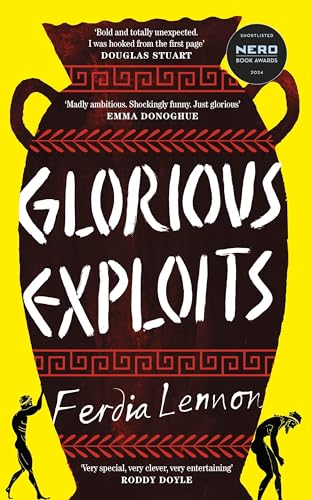
Before the Book Club meeting: I’ve recently been reading a lot by Irish writers who travel beyond their native shores. What Happened to Nina? by Dervla McTiernan is set in Vermont. The Narrow Land of Christine Dwyer Hickey’s novel is Cape Cod, Massachusetts in the 1950s. Sean Whiteside’s eminently readable translation made Wolfram Eilenbecker’s The Visionaries available to English readers from 1930s Germany. Now Ferdia Lennon’s Glorious Exploits goes even further afield in space and time. It’s set in Sicily in the fifth century BCE, during the Peloponnesian War.
Athens has invaded Sicily and been soundly defeated. A large number of Athenians are imprisoned in a quarry outside the city of Syracuse (this really happened). Some of the prisoners are given slightly better conditions if they can quote lines from Euripides (this also really happened). Two unemployed potters, Lampo and Gelon, stage a double bill of two Euripides tragedies, Medea and The Trojan Women, performed in the quarry by Athenian prisoners (this is made up). The Syracusans, including Lampo the natrrator, have Irish accents (why not?).
The novel, Ferdia Lennon’s first, has been a big success. You can read the Observer review here, and Kirkus Reviews here. Apart from saying that I enjoyed it, laughed out loud a number of times, was shocked at the shocking moments and came to like and care about the characters, I’ll stick to page 78*, whose action is neither at the quarry with the Athenian actor-prisoners, nor at the pub with the Syracusans, but at the docks.
On this page Lampo meets the collector, a man of great wealth that is almost certainly ill-gotten. Gelon has gone alone to the collector’s ship to negotiate a deal on a pile of armour stripped from Athenian corpses. At the start of page 78 Lampo has told the collector’s piratical crew that he’s there to see his friend, and that he’s unarmed.
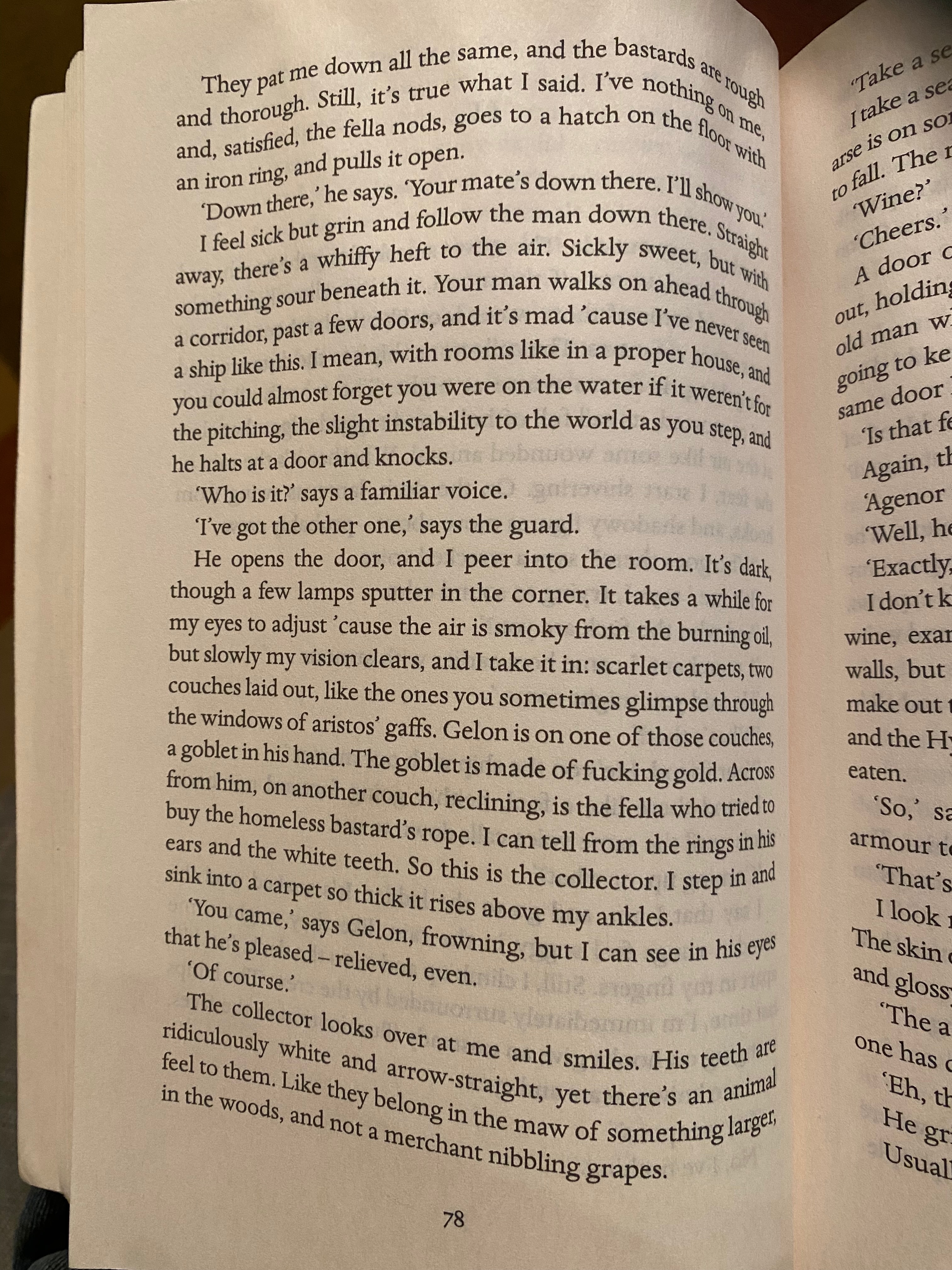
They pat me down all the same, and the bastards are rough and thorough. Still, it’s true what I said. I’ve got nothing on me, and, satisfied, the fella nods, goes to a hatch on the floor with an iron ring, and pulls it open.
‘Down there,’ he says. ‘Your mate’s down there. I’ll show you.’
Straight away, there’s a whiffy heft to the air. Sickly sweet, but with something sour beneath it. Your man walks on ahead.
There’s no attempt at faux-antique or heroic-Greek prose here. It’s straight into the ‘bastards’, ‘fellas’, ‘mates’ and ‘your mans’ of contemporary Irish vernacular. And, as everywhere in this novel, there’s a lot to smell. I don’t know if a specific source of the smell is being suggested, but there’s a clear metaphor: the collector, as we are about to see, is urbane and courteous, but with something ominous beneath the urbanity. At the end of the page, his teeth provide another metaphor:
The collector looks over at me and smiles. His teeth are ridiculously white and arrow-straight, yet there’s an animal feel to them. Like they belong in the maw of something larger in the woods, and not a merchant nibbling grapes.
If I’d set out to write a plot summary, I might easily not have mentioned the collector. He has a function in the plot – I don’t think it’s a spoiler to say that he provides financial backing for the production, and later a potential means of escape for some characters. But there are at least two other things to notice.
First, he has a sadistic, ghoulish quality. There’s the bloodstained armour he’s buying from our heroes. Then on this page Lampo recognises him as ‘the fella who tried to buy the homeless bastard’s rope’ – referring back to a homeless man’s story of a threadbare length of rope he treasures as his only memento of childhood, which he refuses to sell it a vast sum to a stranger we now know to be the collector. (The rope later turns up on the collector’s wall, leaving the reader to deduce that it was taken from its owner by force.) So his involvement highlights the macabre dimension of Gelon and Lampo’s project. Gelon’s desire to stage plays by the great Euripides is surely a good thing, fuelled by his passionate love of high Greek culture, and the potters and their performers develop relationships of mutual respect and even affection. Their art gives them respite from the horrors of their situation. But for the other Athenian prisoners that situation is unchanged, and even for the performers there is only the briefest respite.
There’s another thing. The collector’s name is later revealed to be Tuireann, a name he shares with a figure from Celtic mythology. At a literal level this might suggest that he has come to Sicily from far-off Ireland. But I think it’s a little authorial joke. If the language of the book is Irish, why not give one of the characters an Irish name?
I had to do a web search on “Tuireann” to get that joke (if it is one). It’s the kind of book where there are plenty of things to look up if the spirit moves you. The Peloponnesian War and the two plays by Euripides are the big ones. Did it add to my enjoyment that I saw an amateur production of The Trojan Women in Darlinghurst four decades ago? Probably. Would I have felt the lack if I hadn’t? I doubt it.
After the meeting: We discussed this book alongside Han Kang’s We Do Not Part and apart from the person who had read only 10 percent of it, we all enjoyed it a lot more. The ten-percenter said she had stopped reading because of time constraints, but I wouldn’t be surprised if some readers put the book aside after the terrible brutality that comes in the first couple of pages.
One of us had been to Syracuse and visited the quarry, though the guide didn’t talk about the imprisoned Athenians. None of us had felt the need to read up on Ancient History – the book doesn’t depend on specialist background knowledge. Two of us had heard Ferdia Lennon speak at the Sydney Writers’ Festival, so could add a little bit of news about him and what went into the making of the book.
I can’t talk about the way the book ends, but it’s probably OK to say that it’s with a kind of coda. When someone said she loved the ending, two of us thought she meant the bitter-sweet, though mostly bitter, conclusion of the main narrative. Once we were reminded of the actual final moments of the book, we agreed. The other person who had got that far disagreed. She thought it was unnecessary and a bit of a stretch. ‘The whole book is a stretch’, three of us replied in unison.
The Book Club met in Gadigal land, close to the great harbour Warrane. I wrote this blog post beneath a cloudless sky on land of Gadigal and Wangal of the Eora nation. I acknowledge their Elders past present and emerging, and gratefully acknowledge their care for this land for millennia. I welcome any First Nations readers of this blog.
* My blogging practice is focus arbitrarily on the page of a book that coincides with my age, currently page 78.


 Me fail? I fly!