
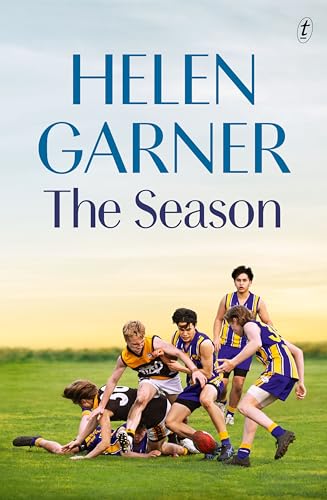
Helen Garner, The Season (Text Publishing 2024)
Before the Book Group Meeting:
While she was writing The Season, Helen Garner described it to friends as ‘a nana’s book about footy’. Her youngest grandson Amby was fifteen, on the cusp of manhood. Being witness to his football games and training sessions was, among other things, a way of enriching and maybe holding onto that precious relationship.
I came to the book with a lot of baggage. For a start I didn’t have a benign experience of fifteen-year-old boys when I was one. My boarding school’s focus on football made skinny, physically inept, nerdy Jonathan something of an outcast, and fifteen year old boys, however sweet they may look to a nana’s eyes, can be brutal to the designated outcasts. (Full disclosure: because the school also prized academic achievement, which I was quite good at, I wasn’t the worst abused.)
What’s more, Aussie Rules is pretty much a closed book to me. I don’t know a mark from a behind, let alone a torp, and nana Helen, who says she knows very little about the sport, is sufficiently steeped in AFL culture to feel no need to explain such terms. My whole family watched my big brother play League on Saturdays, my father yelling at the ref in cheerfully confected outrage. And the footballs I myself played at school, badly, were League, Union and soccer. We referred to AFL, then Victorian Rules, as aerial pingpong.
So, even though I’m a member of the vast Helen Garner fan club, I would happily have skipped The Season.
But what the Book Group wants …
I can’t say it completely won me over, but it’s beautifully written. While Garner’s intense desire to know her grandson – ‘what’s in his head, what drives him’ – is the heart of the book, it broadens out to look at aspects of masculinity, and aspects of being an old woman, and aspects of the role of football in Melbourne social life, in an engagingly impressionistic way. I doubt if any other book uses words like ‘sweet’, ‘delicate’, ‘graceful’ or ‘beautiful’ about men young and old with as much frequency. In the opening pages, she writes about becoming an engaged grandmother to two boys:
Never having raised a son, I now began to learn about boys and men from a fresh angle, to see their delicacy, their fragility, what they’re obliged to do to themselves in order to live in this world, the codes of behaviour they’ve had to develop in order to discipline and sublimate their drive to violence
In a recent Big Ideas podcast, Tim Etchells from the British theatre group Forced Entertainment talked about learning by finding rather than by searching. He could have had this book in mind. Garner depicts herself as going to training sessions and games and seeing what happens – no agenda, no conclusions, just acute, self-aware, finely articulated observation. Maybe this is why she kept her first husband’s family name: she garners.
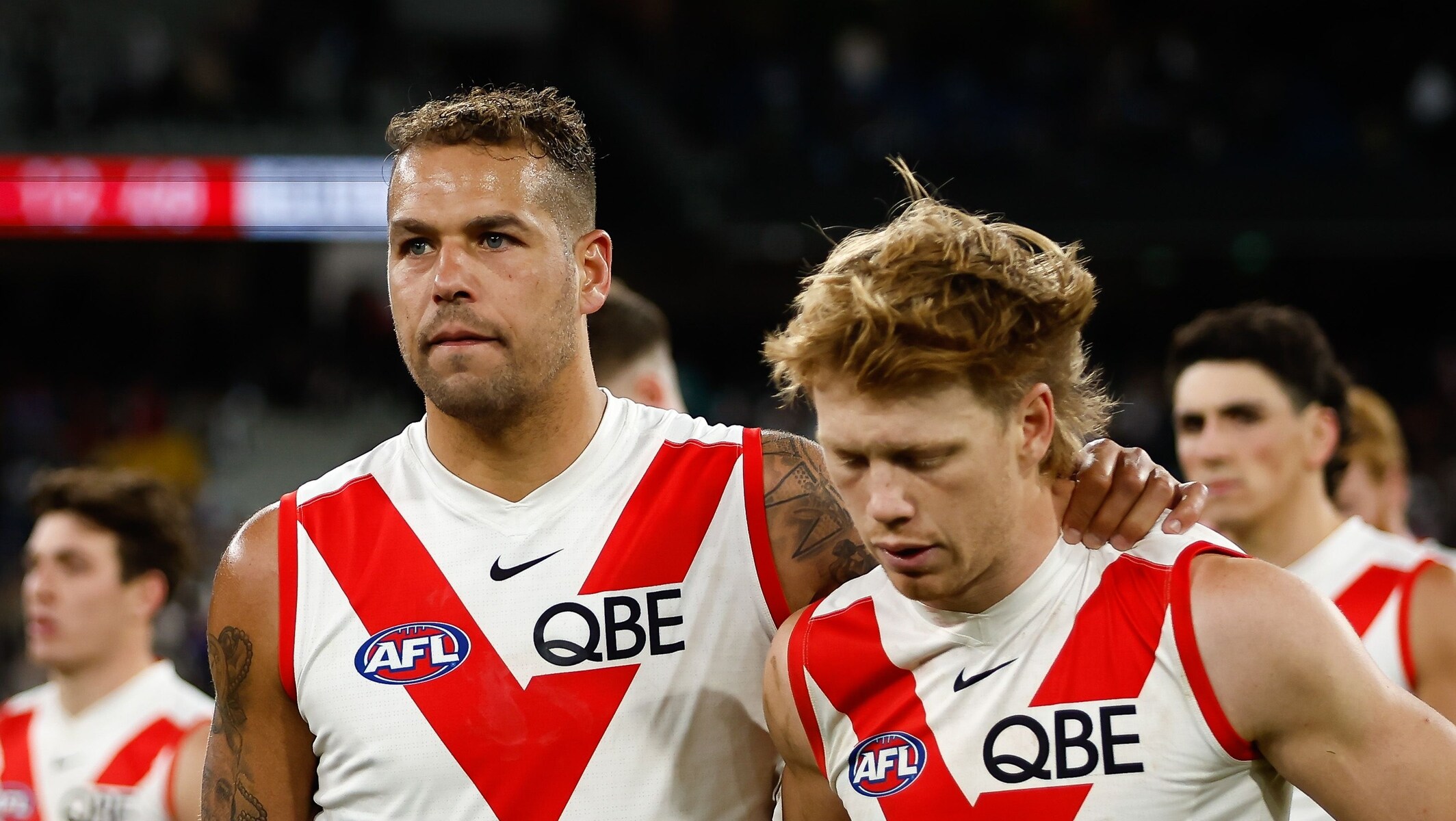
The book moves through footy season from February to August. On page 78*, it’s May, and Garner has had Covid. Watching a lot of football on TV, she has surmised that Virgil and Homer would recognise the ‘hulking airborne men’ she sees in those games. After two weeks ‘reading, dozing, reading again, forgetting everything I’ve read’, she opens a newspaper to the sports pages, where she sees a photo of Buddy Franklin, a Sydney Swans player she describes as ‘a hero of the game, a dancing god of the game in his last season’, whom a Collingwood crowd has booed:
Franklin is thirty-six, battle-hardened. His face, in this photo, is calm, composed; but it is also as soft as a boy’s. It’s a wounded face, with that wiped look of someone who’s copped a ringing slap across the cheek: all his expression lines are gone. In my fortnight of isolation I must have lost a couple of skins: I shock myself by bursting into tears.
I found the photo at this link, or maybe it’s this one. To look at them and read Garner’s description of them is to recognise what a fine writer she is. Even when putting herself front and centre, bursting into tears, she communicates elegantly about the observed world.
The next sentence is a rare moment in this book when Garner allows an explicit moral judgement into the text. Elsewhere, when she narrates the attitudes of Amby and other men to physical injury – they almost seem to relish it – she maintains a kind of awed incomprehension. Even here, she doesn’t voice her own opinion, but goes into journalist mode for a moment and quotes someone else.
The Guardian doesn’t hold back: ‘It’s about the internalised hatred that men – who are the dominant force in shaping and sustaining AFL culture – have for themselves and each other. The Great Southern and Ponsford Stands merely provide a haven for the boozed up, brittle and broken to project their own self-hatred and insecurities on to others.’
I don’t read this as Garner using ‘the Guardian‘ as a mouthpiece for her own opinion. It’s as if some judgement is needed once the booing has been mentioned, but to make a moral judgement would be to disrupt her role as witness seeking understanding. All the same, she does let the harsh judgement stand, more endorsed than rejected, and returns to her primary focus.
Thursday, on the way to training.
‘I still haven’t heard about the game I missed.’
‘Okay. Because of the pain all down my leg I told Archie I wouldn’t be able to go hard, so he kept me on full-back and full-forward. It was horrible. I was so cold. I only touched the ball twice. I was on this huuuuuge guy.’
‘But you kicked a goal, didn’t you?’
‘Yes, but I didn’t get any of my anger out. And the goal wasn’t very … nice.
‘You mean it wasn’t sort of heroic?’
‘No.’
‘But nevertheless it was a goal?’
He shrugs and runs off.
The book is full of these wonderful nanna–grandson chats. Throughout, there’s a tension between Helen the invisible old woman who comes to training sessions or chats with other parents during matches, and Hel the grandmother who is almost a confidante. He puts his big arm around her, rebuffs her attempts to fuss over his injuries, lets her tease him about his mullet, is oblivious to her shock when she realises her grandson has turned into a six-foot man, ‘his surfer’s legs covered in golden hair’.
OK, so maybe those front-row forwards who threw their weight around back when I was 15 were also just boys, far from their mums and dads and nanas, and only smaller, vulnerable boys to get their anger out on. The book has enough AFL in it to have made me want to give up on it a number of times, but I stayed to have my perspective shifted by Helen Garner, a meticulous, wide-eyed, sometimes self-mocking, always loving witness.
After the meeting: This is an all male book group. We kicked off our discussion of the book with a round of ‘position statements’ vis à vis sport in general and AFL in particular. From my point of view this round and the conversation that grew from it was at least as interesting as the book.
I was pretty much the only one who both loathed sport at school and was ignorant about AFL. There was only one total AFL tragic – all but two of us grew up with different codes. For most of us, team sport had played an overwhelmingly positive role. One had played second row forward in the same scrum as a future prime minister. Another is directly related to ‘Rugby League royalty’. One, who came to Sydney from a country town as a young man to go to university, found refuge in the football team, and felt it pretty much saved his life. For another, from an non–English speaking background, the different codes signified different relationships to mainstream Australia – and as a young person he had avoided soccer, which his father loved, so as not to be seen as an outsider. There was much more.
When we came to the book, it’s probably fair to say we all enjoyed it, but there were lots of reservations. ‘She doesn’t get football,’ one man said a number of times. Someone explained to me (and by implication to Helen) that the full-on bodily contact of football isn’t violence. Mostly it doesn’t hurt unless, paradoxically, you don’t fully commit, and any injury is incidental. There was general scepticism about the book’s underlying assumption that men have an ‘underlying drive to violence’ which team sports exist to address – there was quite a bit of chat about women’s sport, some but not all of it on this point. We all, especially the grandfathers among us, admired and envied the relationship between ‘Hel’ and Amby – the relative openness of communication, his physical ease, her tact.
Someone said the book read like a diary – proposing no particular thesis and coming to no conclusion. Only one of us had read Helen Garner’s diaries (Yellow Notebook, One Day I’ll Remember This and How to End a Story), and said they were wonderful. Alas, he confessed at the end of the meeting that he’d only read 10 pages of The Season, so he couldn’t compare it with the more substantial work.
This post may be too much about me and too little about the book, but I came away from the discussion feeling that just as writing the book gave Helen Garner gained some access to arcane rituals and tenets of sporty masculinity, so did I in our conversation, from a different outsider perspective. Long live the Book Group.
The Book Group met on Gadigal land and I wrote this blog post on land of Gadigal and Wangal of the Eora Nation, where we’re fast approaching the shortest day of the year. I acknowledge the Elders past and present of this country, never ceded and welcome any First Nations readers of this blog. The sport of AFL, like much that is distinctive in Australian settler culture, owes much to First Nations influence: some historians believe that it owed a lot to marn grook, a game played by First Nations people.
* My blogging practice is focus arbitrarily on the page of a book that coincides with my age, currently page 78.


 Me fail? I fly!
There’s way too much here in this wonderful post Jonathan for me to comment on, but I’ll say that Mr Gums is with you on his experience of being a nerdy, weedy 15 year old (at a Canberra co-ed state school). He said football – and I’m guessing it was mostly League but I’ve never really confirmed that – was an opportunity for all the sportos to take their frustrations out on the academic ones. The only sport he got any pleasure out of was hockey. He could play that well enough, and I guess a stick is a stick is a stick ie, one stick isn’t bigger than another’s!
I didn’t ming Garner’s use of words like “fragility” etc for boys and men because I think there is an awful truth to that. But, I do think – as a woman, I guess – that there’s a “underlying drive to violence in men” that most manage because it’s not needed in modern society. If there’s not an underlying drive, then men are still being taught that it’s a valid answer because men and boys are still violent (more than women are). So which is it? Nature or nurture?
Loved your “garners” joke, and I do like that idea of “finding” rather than “searching”. This is a very enjoyable post – report on your reading of the book, and on your book group’s discussion of it.
LikeLiked by 1 person
Thanks, Sue. There is a Canberra-origin in the group who also played mainly hockey, at an impressive level. (I pretty much hated hockey – my nerdiness was thorough!)
About the underlying drive to violence: I guess it’s the word ‘drive’ that I resist – I think the violence is nurture, or more accurately lack if nurture. I think of all those studies of how boy babies are cuddled less than girls, etc. in my own case, we were 400 boys aged roughly 13 to 17, with a group of less than 10 celibate men responsible for us. We got to see mothers only on visiting afternoons or in term holidays. There were some who’d been in that set-up since they were eight. I fervently hope this is all in the past
LikeLike
I hear you Jonathan but I’m still not convinced that it is all nurture, from the children I’ve seen. Which is not to say there aren’t exceptions as our natures do vary.
LikeLiked by 1 person
It’s a big issue, Sue. Maybe I’m just caught in wishful thinking, but I agree that boys seem to naturally be more physically active / assertive, and relish roughness more than girls. But that’s not the same as a drive to violence, or an innate wellspring of anger that must be ‘disciplined’ lest it erupt into violence. I’m now in the middle of Jess Hill’s recent Quarterly Essay, which is about the pointy end of the conversation! She seems to be arguing so far that the roots of violence lie in trauma. I wish it was just an academic argument.
LikeLike
It sure is a big issue … and I sure don’t know the answer … I have read Jess Hill’s book but not the quarterly essay. If the roots of violence lie in trauma, I have to ask about all the women who have experienced trauma? But, we are not going to answer here what no one has answered yet, are we? I’m keeping my mind open …
LikeLiked by 1 person
I loved this piece Jonathan – your personal response is what makes reading HG so interesting I think – she almost demands a personal response, at least I find that I cannot read her books judgement-free. Stuff I’ve experienced or witnessed always creeps in.
I understand her remarks about beautiful though. When my stepsons were at the height of the football (soccer) careers in their late teens, the sudden sprint they would do down the sideline was so graceful and balletic, I was moved beyond words each time – and grateful that I managed to capture a few of these moments on camera. And we have certainly seen both boys/young men fragile at different times.
Perhaps the telling thing is that we accepted any fragilty that they showed us, gave hugs, talked it through etc. We didn’t shut them down or make fun of them or tell them to ‘man up’.
Mr Books was not really a sportsman either (his dad owned a boat shop so he was a windsurfer instead), but he was determined that both boys would play a sport of some kind as he saw how much easier it was for a boy at school who was sporty.
LikeLiked by 1 person
Thanks for this comment, Brona. I meant to reply immediately and then was distracted. I love your observation that Helen Garner’s writing demands a personal response. And I admire you and Mr Books as parents of teenagers. I’m hoping to better as a grandparent!
LikeLiked by 1 person
No need to apologise – I am regularly distracted from my blog by life! We are hoping that some of those distractions might be grandchildren one day soon too 🙂
LikeLike