
Steve MinOn, First Name Second Name (University of Queensland Press 2025)
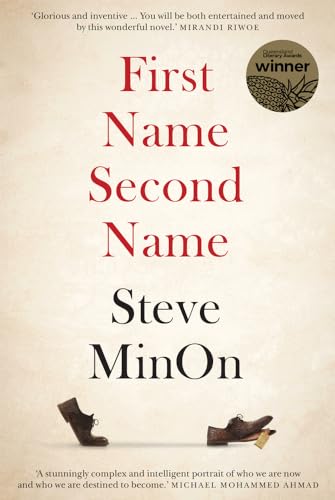
A friend told me about this book: ‘A man dies in Brisbane leaving a note that he wants his body to be taken to Innisfail to be buried. When his relatives ignore the note, his dead body rises from the grave and walks there.’
As I may have mentioned once or twice on this blog, I come from Innisfail, Ma:Mu land. Point me in the direction of a book or work of art that features it – a note from a Chinese shopkeeper, a poem by David Malouf, a social realist novel by Jean Devanny, a memoir by Rebecca Huntley, a TV series by Anthony LaPaglia – and I’ll come running. So I borrowed First Name Second Name from the library.
My friend’s description of the book omitted a couple of key points. The man who dies, Stephen Bolin, is mixed race Chinese, and the note that he leaves asks not just that his body be taken to Innisfail, but that it be strapped to two bamboo poles and then carried there by his sisters, one at either end of the poles. The other key thing my friend didn’t mention is that interspersed with the story of the reanimated corpse’s journey is the history of his family, beginning with his great grandfather Tam Bo Lin on the North Queensland goldfields.
The book progresses in alternate chapters.
The family history chapters progress by leaps and bounds. Tam Bo Lin marries an Irish woman who decides that his personal name, ‘Bo Lin’, will become their family name, ‘Bolin’ (‘First name second name,’ she says, pointing to the marriage papers). After many years he is kicked out of the marital home when his wife discovers that he has been sending money to a wife back in China, married before he came to Australia. His descendants live through Federation, the World Wars, the Depression, the Bjelke-Petersen era and the coming of Pauline Hanson, mostly marry non-Chinese partners, and over the generations they become less and less comfortable in their Chinese heritage. Stephen, who is to become the walking corpse, is a Gay man who hates what he sees as the fetishing of Asian bodies – of his body seen as Asian.
The corpse’s chapters, each titled ‘Jiāngshī’, are told from the corpse’s point of view. He has an irresistible drive to continue walking north, even as his body is decaying, and bits fall off, or are nipped off by a dog or eaten away by worms and insects. Every now and then he is compelled to leap on a living person and suck their life force from them. A couple of chapters in, I googled “Jiāngshī”, and found an ancient Chinese tradition of ‘hopping vampires’ that has inspired a genre of modern books and movies in Hong Kong and elsewhere. I haven’t read or seen any of those works, but I doubt if any of them depict the Jiāngshī as unwilling, agonising characters like Stephen, who takes absolutely no joy from his condition and only dimly understands it.
As the family history approaches the present and Stephen’s corpse nears Innisfail, a question arises: what does it all mean?
Of course, as zombie filmmaker George Romero said, ‘Sometimes a zombie is just a zombie,’ or he may have said, ‘A zombie is always just a zombie.’ (If you can find the actual quote please tell me in the comments.) Sure, a jiāngshī is also just a jiāngshī. It’s hard enough being compelled to walk a thousand miles while dead without having to mean something. All the same, as I read on, a number of metaphorical possibilities hung over the narrative. As a Gay man who had cut ties with his family to live first in Sydney then in London, Stephen as a corpse is compelled to do what his living self needed to do at some deep, unacknowledged level, and reconcile himself with his family, in this case symbolised by the place of his birth. Maybe, stretching it, as a settler Australian he has been deeply influenced by First People’s sense of the importance of Country. Maybe, stretching it in another direction, anyone who comes from Innisfail in particular can’t resist its call, living or dead. Or – and this metaphor is spelled out in the final chapter – having wanted so much to pass as white, he now must return to the Innisfail joss house and be reclaimed by his Chineseness. (Incidentally, the joss house, lovingly described in the relevant chapter as the somewhat neglected building I remember from my 1950s childhood, has been restored in real life and has a notice out the front asking that we not call it a joss house but ‘the Innisfail Temple’. It has a website.)
If you picked up a copy in a bookshop and turned to page 78*, you would have no idea you were looking at a zombie-adjacent genre novel. William in this extract is Tam Bo Lin’s son, Stephen’s grandfather. Christina, née Lo, is perhaps the only other Chinese heritage person a Bolin has married.
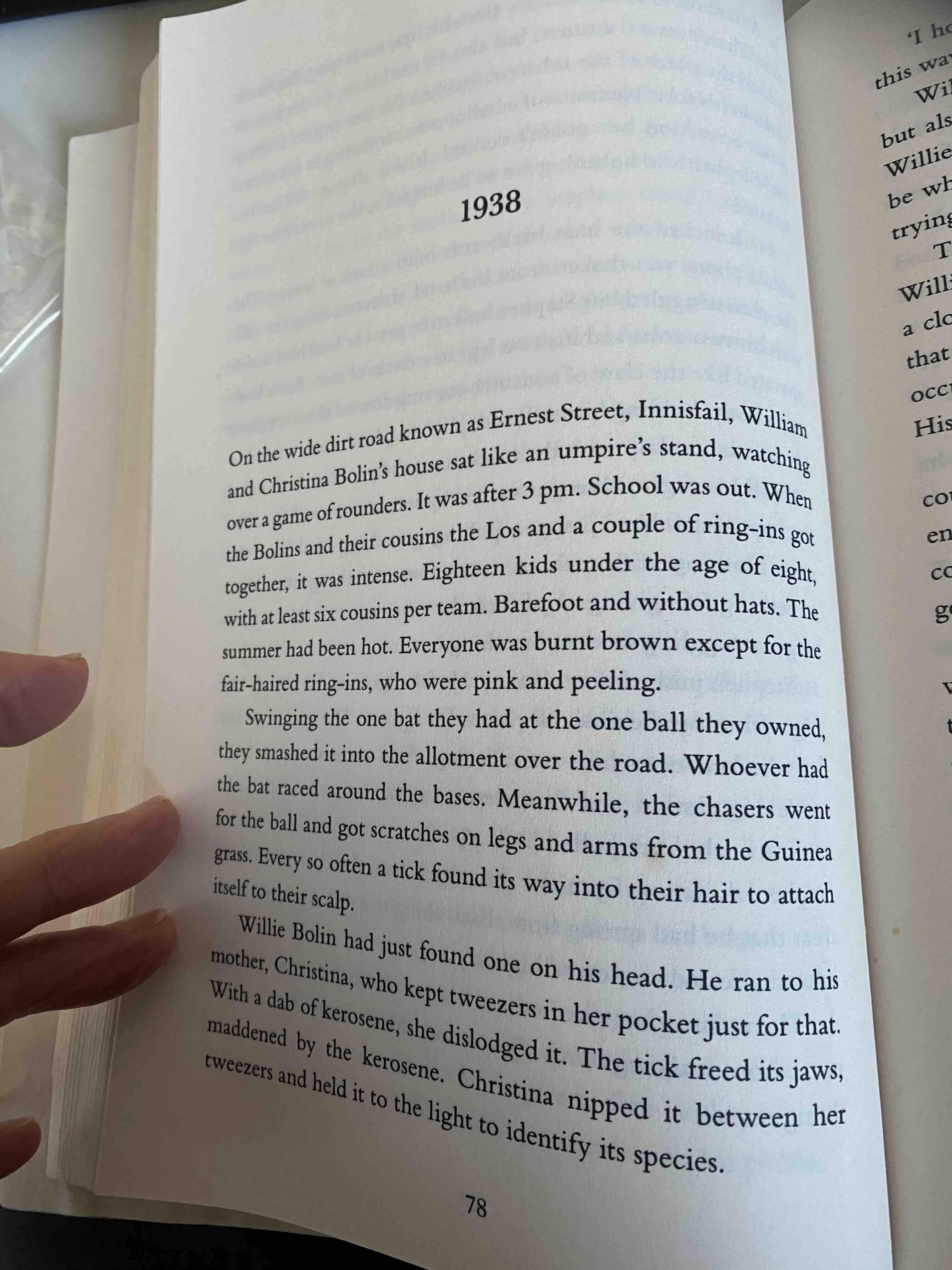
The chapter begins like all the family history chapters, with the year, and like all the chapters evokes the period and the place with a deft touch:
1938
On the wide dirt road known as Ernest Street, Innisfail, William and Christina Bolin’s house sat like an umpire’s stand, watching over a game of rounders. It was after 3 pm. School was out. When the Bolins and their cousins the Los and a couple of ring-ins got together, it was intense. Eighteen kids under the age of eight, with at least six cousins per team. Barefoot and without hats. The summer had been hot. Everyone was burnt brown except for the fair-haired ring-ins, who were pink and peeling.
Swinging the one bat they had at the one ball they owned, they smashed it into the allotment over the road. Whoever had the bat raced around the bases. Meanwhile, the chasers went for the ball and got scratches on legs and arms from the Guinea grass. Every so often a tick found its way into their hair to attach itself to their scalp.
Willie Bolin had just found one on his head. He ran to his mother, Christina, who kept tweezers in her pocket just for that.
With a dab of kerosene, she dislodged it. The tick freed its jaws, maddened by the kerosene. Christina nipped it between her tweezers and held it to the light to identify its species.
You don’t need to come from Innisfail to enjoy this, but it helps. Ernest Street is still a wide road now, part of the main north-south highway. Guinea grass is an invasive weed in North Queensland, which we used to call blady grass – I have stories about those scratches. Rounders, a poor relation of baseball, was played by the young at least as much as cricket. I would have thought ticks in the hair were less likely than on other parts of the body in those circumstances, but ticks were still an issue, if not on Ernest Street, in the 1950s.
Willy, seen here running to his mother, will fall in love with a white woman and marry her in spite of her abusive father’s racist opposition. He becomes manager of a department store in Proserpine further south, a domineering father deeply disappointed in his effeminate son Stephen.
The page gives you a sense of the quiet, assured story of the family. Add gruesome undead action and who could resist?
I was born and spent my first 13 years on beautiful Ma:Mu country. I wrote this blog post on land of Gadigal and Wangal of the Eora Nation,. I acknowledge the Elders past and present of both countries, never ceded.
* My blogging practice is to focus on the page that coincides with my age, currently 78.


 Me fail? I fly!
I loved it too! Especially of course all the bits about Innisfail 🙂 Steve’s got a wonderful piece in Queersland – coming out in September about watching Saturday Night Fever in the Proserpine cinema as a kid. Can’t believe you’re 78!! Nooo!
LikeLike
I’m looking forward to Queersland. But you know what’s more alarming than being 78 is having a niece who’s almost 60!
LikeLike
Freaky!! And my daughter is almost 30!!! Eeek!! 😘❤️❤️❤️
LikeLiked by 1 person
Because we moved around a bit during my childhood years I have a few such small country towns in NSW that would make me want to read anything that was set in them, so I understand your desire completely.
Although it is a double-edged sword – I was HUGELY disappointed in the Thomas Keneally book set in Cowra, mostly because he fictionalised the name, even though there is only town in NSW that had a Japanese camp and break-out during WWII.
LikeLiked by 1 person
I sympathise. I’m irritated when a novelist changes the name of a town or a historical personage when in all other respects the place or person is identifiable. In The Lieutenant, Kate Grenville gave Australia’s first governor a made-up name. The effect is to tell the reader not to take the story seriously as an attempt to imagine the past, but to read it as fantasy. But that’s clearly not Grenville’s intention, nor Tom Keneally’s. I was at a talk by him this week when he referred to the book as being about the Cowra break-out. It’s a recent development. Keneally didn’t call his book about Schindler Whosit’s Ark, or have a character called President Smith negotiating the armistice in the carriage in Gossip from the Forest. On the other hand, Keneally’ didn’t write a book called The Chant of Jimmie Governor, and I don’t object to the change of name there! End of rant.
LikeLike