
Susan Hampton, Anything Can Happen (Puncher and Wattmann 2024)
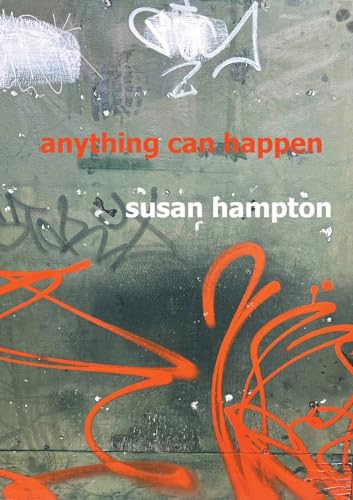
We decided on this book before checking on availability. All was good for the Kindle readers, but there was a long queue at the library and it was out of stock in Sydney bookshops, pending reprint. Nor did we have any luck at Avid Reader in Brisbane on our travels. In the end, the Emerging Artist bought it for the Kindle app and we read the book to each other.
So that is how I experienced Anything Can Happen: being read to or reading it aloud on beaches, in cafes, under the benign tropical winter sun. I recommend it.
Before the meeting: Susan Hampton is a poet. She has ghost written a celebrated memoir with a First Nations person, and The Kindly Ones, a novel in verse, but this book is the first long prose work of her own making. It’s not an autobiography, but memoir. She makes that distinction in the first pages:
Whereas in autobiography ‘everything’ is told, often in chronological order, the memoir is partial, with the capacity for time loops … The scenes of your childhood, the river, the back lane, the silo, rise up to replace your mother’s arm. That dissolves and you find you’re hearing or in fact making up a conversation.
Anything Can Happen isn’t in chronological order, and it doesn’t attempt to tell everything. It gives us accounts of key relationships: Hampton’s Slovenian husband, Joe, whom she left after a very few years but who was an important part of her life until his death in Slovenia decades later; her mother and grandmother; her son Ben; Tommy, a woman in her thirties on whom she had a crush when she was a teenager and who stayed in her life until Tommy died in her 80s, by then a close friend of the Susan’s mother; a number of romantic and/or toxic entanglements and other friendships with women.
There are glimpses of a working-class childhood in the Hunter region; of life as an academic single mother in the Inner West of Sydney (she and I had children at different schools in the same suburb in the 1980s); of a number of years living in a rural area and becoming a kind of hub for a Lesbian community; of later married life in the beautiful mid-north coast of New South Wales (she married her partner Charlotte in the British embassy in Canberra before same-sex marriage became legal in Australia).
And there’s an impressionistic account of her development as a writer. A main thread of this account is a novel project, which remains on the go for decades and still exists only as a series of unsatisfactory drafts and many books full of notes. One of the many pleasures of this book is the dawning realisation that it is an extended piece of prose from a writer who says she is incapable of writing such a thing.
In a memoir of a life that has seen so many wildly different phases, you could open up any page and get a different sense of what kind of book it is. At page 78, Susan joins the Gay and Lesbian Mardi Gras. She walks alone among the Dykes on Bikes. One or two women sat on each bike, and often one of the side-car:
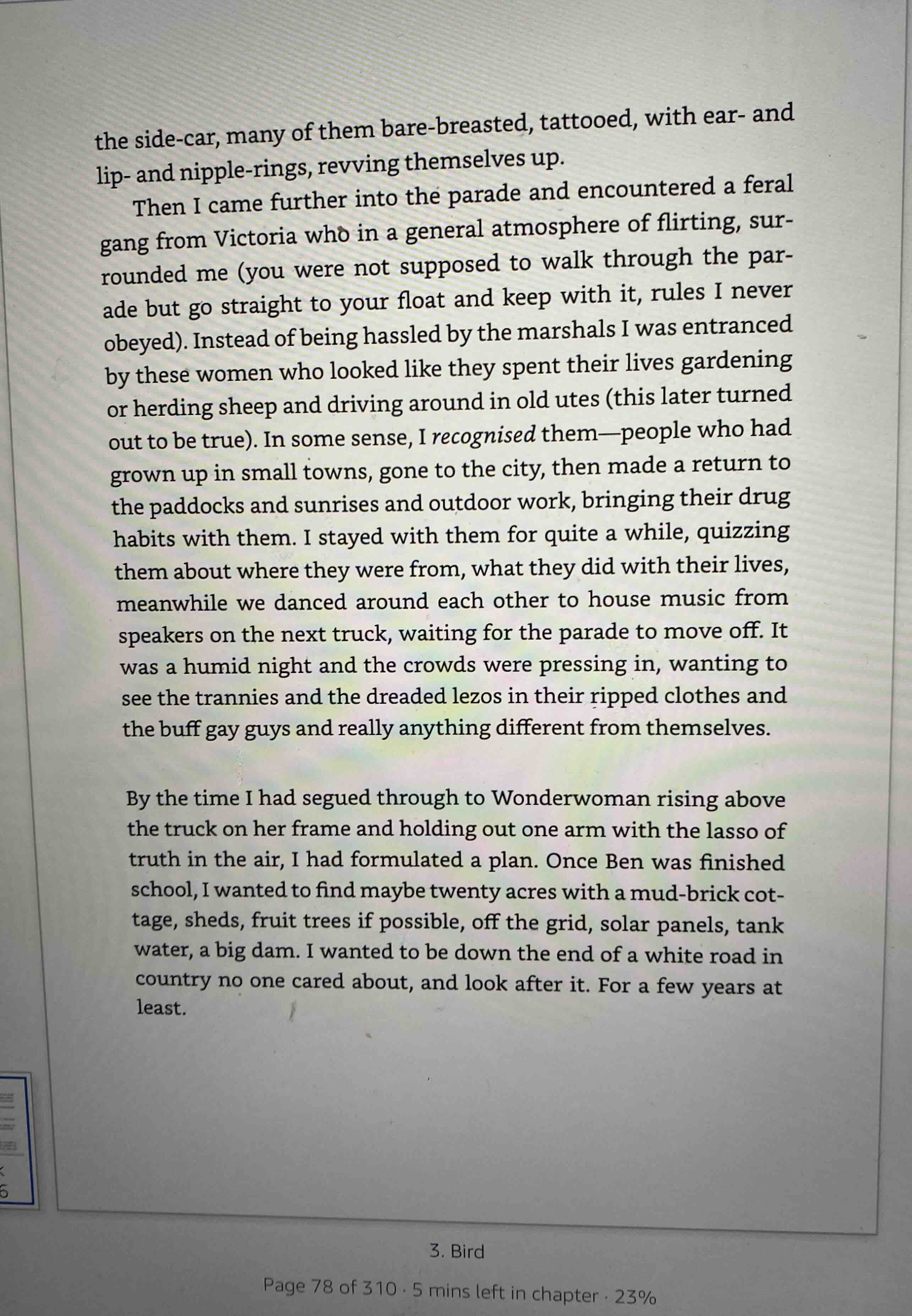
Then I came further into the parade and encountered a feral gang from Victoria who in a general atmosphere of flirting, surrounded me (you were not supposed to walk through the parade but go straight to your float and keep with it, rules I never obeyed). Instead of being hassled by the marshals I was entranced by these women who looked like they spent their lives gardening or herding sheep and driving around in old utes (this later turned out to be true). In some sense, I recognised them – people who had grown up in small towns, gone to the city, then made a return to the paddocks and sunrises and outdoor work, bringing their drug habits with them. I stayed with them for quite a while, quizzing them about where they were from, what they did with their lives, meanwhile we danced around each other to house music from speakers on the next truck, waiting for the parade to move off.
Just a few pages earlier, Hampton has reflected that her autobiographical writing is ‘partially confected, altered, made more symbolic, exaggerated, even invented’ because after all, ‘you wanted the reader to be swept along in the story, to turn the page’. I don’t at all doubt the truthfulness of this paragraph, but it’s also a nice example of detail being selected in order to serve the longer story. The Dykes on Bikes are colourful context, but the ‘feral gang from Victoria’ are there to foreshadow the years in which Hampton was to own a small property in rural Victoria and, even while she did scholarly and poetic work indoors, became one of just such a feral gang. And there’s recurring motif of Hampton ignoring rules – here she disobeys the Mardi Gras rule; elsewhere she climbs fences into private property, snoops in people’s bedrooms, even pilfers personal items. These details may be ‘partially confected’, or they may be part of a ruthless honesty about her own failings – either way they do keep us turning the pages (or swiping the screen).
Then there’s this sentence, easy to miss among all the colour and movement:
It was a humid night and the crowds were pressing in, wanting to see the trannies and the dreaded lezos in their ripped clothes and the buff gay guys and really anything different from themselves.
There’s a gentle challenge to the reader here. The Gay and Lesbian Mardi Gras parade is an event primarily for the LGBTQI+ community (a term Hampton doesn’t use) but it’s also a spectacle enjoyed by the mainstream, possibly voyeuristically she suggests. Could something similar happen with this book? Unlike, say, Kerryn Higgs’s excellent novel All That False Instruction, this book doesn’t set out to ‘explain’ Lesbian experience to mainstream readers. If anything, the author is seeking to understand her own story, of which Lesnianism is a major part but not the whole. But, she suggests indirectly here, some readers may be here for the inside story on ‘the dreaded lezos’ – as at the Mardi Gras, they may not be unwelcome, but they are on the outside pressing in.
By the time I had segued through to Wonderwoman rising above the truck on her frame and holding out one arm with the lasso of truth in the air, I had formulated a plan. Once Ben was finished school, I wanted to find maybe twenty acres with a mud-brick cottage, sheds, fruit trees if possible, off the grid, solar panels, tank water, a big dam. I wanted to be down the end of a white road in country no one cared about, and look after it. For a few years at least.
And that is more or less where the story soon goes.
We read this book along with Debra Oswald’s 100 Years of Betty. Where that book feels as if it grew from a treatment for a TV series, and never quite shook off its origins, this one may well have started out as a collection of prose poems, and has kept some of the compressed, elliptical, elements of that beginning.
After the meeting: We met in a pub, and had a lot of catching up to do. Two of the five of us had met Susan Hampton, one just briefly, and one for some time when they both lived in Canberra (where in the book she says she made a number of good friends). So our book conversation was a little more gossipy than usual – though not at all nasty or juicy. I had hoped someone would know the identities of the women known as the Gardener and the Radiographer with whom Hampton had an unsettling relationship, but that wasn’t to be.
We all enjoyed the book, partly because so many of its places were familiar to at least some of us, and it was pleasurable to have them described from a different point of view. One person felt that there was an almost sociological tone to the chapters about Hampton’s family background, and that seemed to spread in some way to a kind of distance or detachment in the telling as a whole. (I don’t know what I think about that.It didn’t strike me that way, but I don’t think it’s wrong.) We noted that there are gaps in the story, but realise they may have been necessary to protect other people’s privacy.
One of the many rules of the Book Club has been ‘No Lesbian novels unless the Lesbianism is incidental to the plot.’ The club’s membership is majority Lesbian, and the rule was there because (I’m told) novels about Lesbianism tend to be badly written. With The Safekeep and Anything Can Happen, the prohibition has gone the way of Mardi Gras rules on page 78.
We read Anything Can Happen to each other on Wulgurukaba land, beneath an intense blue sky on the island of Yunbenun. The Book Club met on Gadigal Wangal country, which is where I have written the blog post. I acknowledge the Elders past and present of those Nations, and welcome any First Nations readers of this blog.
* My blogging practice is to focus on the page that coincides with my age, currently 78.


 Me fail? I fly!