
Carys Davies, Clear (Granta 2024)

Before the meeting: On a remote island to the north of Scotland, the population has shrunk to just one man, plus a cow and a number of domestic animals. The man, Ivar, is the sole surviving speaker of the island’s language. The island is owned by a wealthy mainlander, and this is 1843, during the time of the Clearances, when tenants all over Scotland were evicted to make way for more profitable sheep. An idealistic clergyman, John Ferguson, an impoverished member of the newly formed Free Scottish Church, agrees to take on the errand of travelling to Ivar’s island to prepare him for his removal. The errand turns out not to be all that simple: John Ferguson (he is always referred to by both names) has a near-fatal fall, Ivar tends him, and as he recovers they learn to speak each other’s language.
I love this book. It’s a story well told, with genuine suspense (what will become of the gun that John Ferguson brings with him to the island?) and an implausible final twist that I found delightful. What I especially love is its resonance with Australian history. As the relationship between the two men develops and Ivar shares his knowledge of knowledge of language and place with John Ferguson, I am reminded insistently of the relationship in the early settlement of Sydney between Lieutenant Dawes and the young Cammeraygal women Patyegarang – as fictionalised by Kate Grenville in The Lieutenant and explored by Ross Gibson in 26 Views of the Starburst World (links are to my blog posts – if you’ve got time to spare I recommend the comments on the second one for some splendidly irrelevant Canadian humour). There is a similar sense of a small piece of light against the gathering gloom of genocide and language extinction.
It’s a short novel, and page 78* comes just after the halfway mark. Perhaps it marks a turning point:
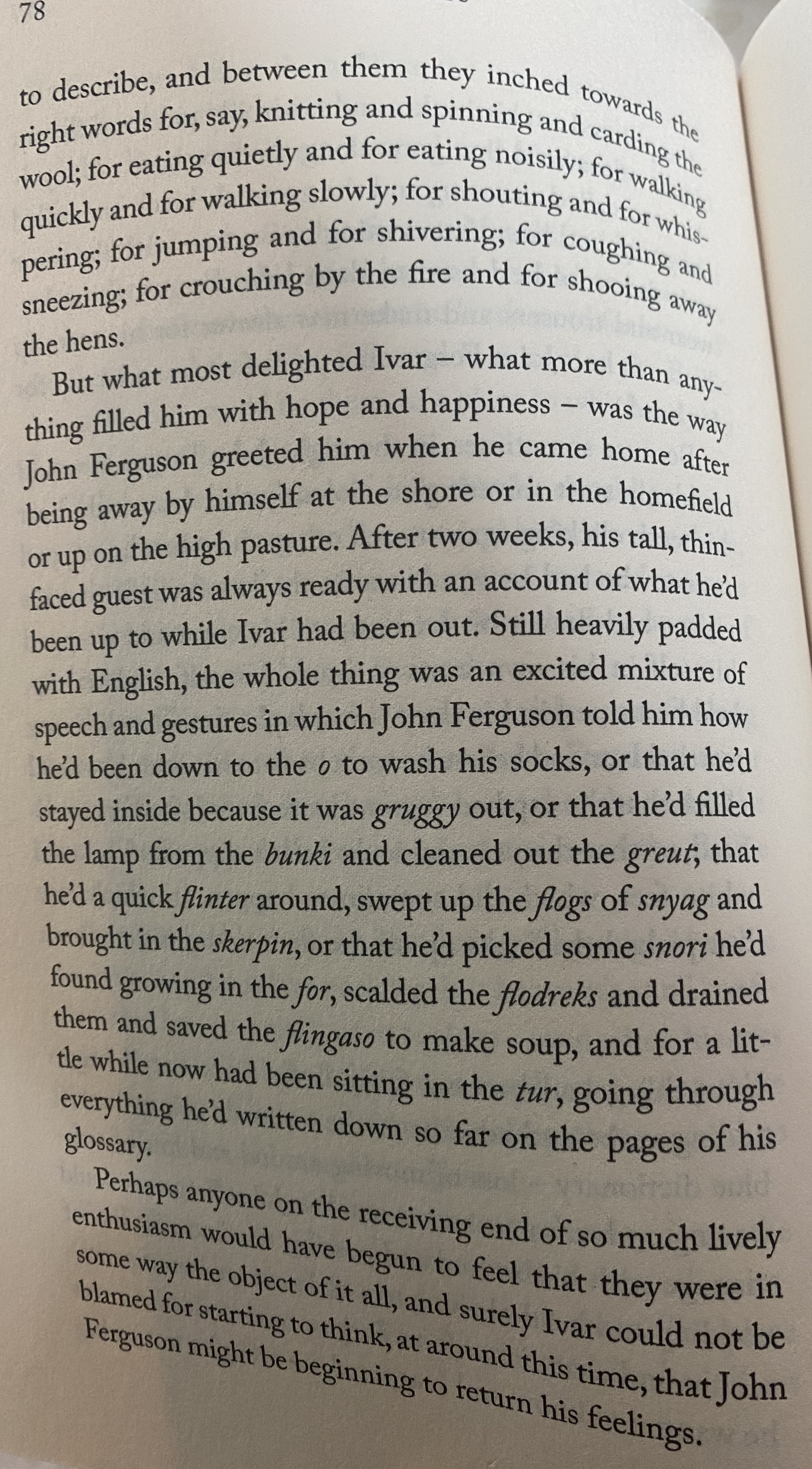
It’s two weeks since John Ferguson has been dropped off on the island and fallen from some rocks. He is recovering well in Ivar’s hut and the language lessons are well under way:
John Ferguson mimed what it was he wanted to know, and Ivar acted out what he was trying to describe, and between them they inched towards the right words for, say, knitting and spinning and carding the wool; for eating quietly and for eating noisily; for walking quickly and for walking slowly; for shouting and for whispering; for jumping and for shivering; for coughing and sneezing; for crouching by the fire and for shooing away the hens.
In the next paragraph, the reader is drawn into the process, as words from Ivar’s language are incorporated into the text:
Still heavily padded with English, the whole thing was an excited mixture of speech and gestures in which John Ferguson told him how he’d been down to the o to wash his socks, or that he’d stayed inside because it was gruggy out, or that he’d filled the lamp from the bunki and cleaned out the greut; that he’d a quick flinter around, swept up the flogs of snyag and brought in the skerpin, or that he’d picked some snori he’d found growing in the for, scalded the flodreks and drained them and saved the flingaso to make soup, and for a little while now had been sitting in the tur, going through everything he’d written down so far on the pages of his glossary.
I so appreciate Carys Davies’ good judgement in not giving us footnotes. They are absolutely not necessary – we are allowed to have a faint taste of learning the language by immersion. An interested reader, as I definitely am, can turn to the Author’s Note to find that, unsurprisingly, Ivar’s language is not Carys Davies’ invention. It is a version of Norn, now extinct but once spoken on the islands of Orkney and Shetland – and on Ivar’s fictional island which lies further north than either of those. The Author’s Note includes a glossary, including all the words in italics/purple on page 78 – flodreks, for example, are ‘limpets’ and flingaso is ‘water in which limpets have been scalded’.
Beneath this excited learning to communicate, and in the process learning about Ivar’s solitary way of life, there is a dark undercurrent. Over this idyllic scene there lies the shadow of John Ferguson’s mission. John Ferguson has allowed himself to forget about it for now, and Ivar is blissfully unaware of it. John Ferguson has been warned that Ivar, generally ‘placid and obedient’, was also large and strong and might not take kindly to being uprooted.
Perhaps anyone on the receiving end of so much lively enthusiasm would have begun to feel that they were in some way the object of it all, and surely Ivar could not be blamed for starting to think, at around this time, that John Ferguson might be beginning to return his feelings.
Just as, with genocide looming in Sydney, Lieutenant Dawes and Patyegarang developed an intimate relationship, so here Ivar has a growing emotional attachment to the messenger of his eviction. And at this point in the novel who can say if he’s right about John Ferguson returning his feelings? Certainly not the oblivious clergyman.
After the meeting: Astonishingly, while everyone agreed that the writing was excellent there were sharply divergent views about this book. The most negative version was that the book is completely silly. Nothing made sense: why did the owners need Ivar off the island, why had he stayed there in the first place, how unlikely is it that a clergyman would have taken on such an errand, how boring is all that stuff about language, how ho-hum is the inexorable movement towards the two men having sex, how implausible is the sex when it finally happens, and above all who would ever buy the final resolution? All of these questions could be answered satisfactorily by those of us who enjoyed the book, but our answers cut very little mustard. Mind you, I don’t think anyone saw the final resolution as completely realistic (see how careful I’m being about spoilers!): the difference is that some of us didn’t mind, and even enjoyed the improbability.
The Most Negative didn’t feel, as others of us did, an underlying dread: as the two men are building mutual trust and affection, we know that the moment will come when John Ferguson will have to reveal his true mission. And we know there is a concealed gun. Ivar has a secret ass well, so the elements were in place for an explosive climax. The book delivers that climax, but clearly not in ways that satisfied all readers.
I was pretty much alone in having loved the language lessons. But I think the world of the island felt real and substantial to us all, was in fact the book’s saving grace, even for the MN.
We read this book along with Ian MacEwan’s What we Can Know, which also prompted very different responses. Both books have islands and dificult sea voyages in small vessels.
I am a man of settler heritage who has been alive for almost a third of the time that has elapsed since Arthur Phillip claimed this continent for the British crown. The book club met on Gadigal land, and I wrote this blog post on the land of Gadigal and Wangal of the Eora Nation, where the nights are lasting longer and small lizards seem to be everywhere. I acknowledge the Elders past and present of all those clans and welcome any First Nations readers of the blog.
* My blogging practice is to focus on the page that coincides with my age, which was 78 when I wrote that part of this blog post.


 Me fail? I fly!