Category Archives: Books

Megan Davis’s Voice of Reason

Megan Davis, Voice of Reason: On Recognition and Renewal (Quarterly Essay 90, 2023)
– plus correspondence in Quarterly Essay 91
As we approach voting day on the Indigenous Voice to Parliament, bad-faith arguments multiply and I don’t intend to add to the clamour. But I can recommend this Quarterly Essay by Megan Davis, one of the architects of the consultation process that led to the Uluṟu Statement from the Heart.

It’s short – just 66 pages. It’s personal – Ms Davis gives enough of her story that we know who she is. It’s instructive – she tells how the proposal for the Voice evolved through several official processes under several Prime Ministers. It’s respectful – it understands why some First Nations people might vote against the proposal, and argues the case with them. It has heroes and villains – John w Howard and Tony Abbott feature as wreckers; Yunupingu as a leader. It’s not into blame and rage. It has hope. And it’s utterly convincing.

If the referendum fails, as current polls suggest, this essay will bear re-reading for decades to come, though it will have to be read through tears.

You don’t have to buy a copy. At least for now you can read it on the Quarterly Essay website, beginning at this link.

My blog practice is to look a little closely at a single page. Usually it’s page 76 (my age). As there is no page 76 in this essay, here’s a little about page 47 (I was born in 1947).

In 2015, there was apparently bipartisan parliamentary support for constitutional change acknowledging that Australia was first occupied by Aboriginal and Torres Strait Islander peoples, recognising their continuing relationship to the lands and waters, and expressing respect for their ‘cultures, language and heritage’. That is to say, it looked like all systems go for symbolic recognition: nothing about non-discrimination, and no structural change. A group of 40 First Nations leaders met with Prime Minister Tony Abbott and Opposition leader Bill Shorten, and explained that such a change ‘would not be acceptable to Aboriginal and Torres Strait Islander peoples’ (the quote is from the Kirribilli statement). This meeting led to the consultation process that produced the Uluṟu Statement from the Heart and the proposal for an Indigenous Voice to Parliament. (It also proposed a Makaratta / Treaty and a truth telling process, but those aren’t on the table just yet.)

On page 47, Megan Davis hits the pause button in her recount of the history:

The thing I could not shake from my head was watching the prime minister and Opposition leader sit at the head of the table while forty people from forty communities spoke about the structural problems their communities faced. What is it like to be the leader of a nation and encounter a polity that is profoundly unhappy?
At this time, as one of the main Indigenous lawyers working on constitutional reform, I found it difficult to understand why politicians failed to hear what First Nations leaders and community members were saying. I had a textbook idea about how political and law reform work, but none of it applied to our people.
There were two challenges I saw. One is that politicians meet with Aboriginal leaders on a myriad of issues, but often First Nations do not feel heard and politicians and advisers do not listen.
The second is the impact of telling your story over and over again and not being heard – what effect does this have on health and wellbeing?

Which comes close to being the heart of the argument for a constitutionally enshrined Indigenous Voice: it’s not that First Nations people haven’t been speaking, it’s that the necessary people haven’t been listening – because, as Megan Davis argues elsewhere in the essay, they don’t have to.

That’s just a tiny part of the essay. The whole thing is worth reading.


The correspondence in QE 91 includes some big names, in particular historians Mark McKenna and Henry Reynolds, and some brilliant fleshing out of the issues by First Nations and other writers. Megan Davis acknowledges them all as ‘worthy and inclusive commentary on the essay and on this historic moment that we are barrelling towards’. She singles out the joint contribution from Sana Naka and Daniel Bray, a Torres Strait Islander woman and a man of European heritage who write about the way their family is constantly negotiating intercultural complexity. She gives them the last word in her response. Following her lead, I’ll end the blog post with the same quote from them:

Structural injustice exists because that is how our political system is structured. We are getting exactly what the system was designed to deliver. A Voice to Parliament alone cannot specifically redress every injustice, but it will connect people to power in a way that currently does not happen. Democracy demands nothing less.
The Confessions of Saint Augustine, third and final report

Saint Augustine, Confessions (approx 400 CE, translated by R S Pine-Coffin 1961, Penguin Classics edition): pages 191–347 , from Book IX chapter 6 to Book XIII chapter 38

A month ago, when Augustine finally gave himself over to God, I was half expecting the remaining third of his Confessions to be pious anticlimax. I was partly right.

There’s a moving account of the death of his mother, which makes a point of her not wishing to be buried in her homeland. I wonder if this marks a point in the history of the west when people stopped seeing themselves as inextricably bound up with their place of origin, their Country – a disjunct that in the anthropocene we may be trying to reverse.

The rest of the book is given over to philosophical and theological argument – about the virtuous life, the nature of time and memory, the nature of God and eternity, the creation of the world, the meaning of faith. I let a lot of this go through to the keeper, happy to half-understand the intricate arguments. My impression is that his overarching project is to reconcile Platonist philosophy with the Christian scriptures and the doctrines of the Church – a major contribution to the development of Western thought, but not exactly a barrel of laughs.

Some bits grabbed my attention.

There’s a long passage where Augustine goes through the five senses and talks about how to best renounce the pleasures associated with them, or at least not enjoy them for their own sake (because after all you have to eat, and you can’t help but smell nice things). It’s a pretty perverse project that cast a long shadow – my own Catholic childhood and adolescence fairly bristled with notions of self-denial and discipline of the senses, and the ‘examination of conscience’ we were taught to perform from the age of seven could have been based on Augustine. I was struck by the hard intellectual work he puts into it. As he says:

I am working hard in this field, and the field of my labours is myself. I have become to myself like land that a farmer works with difficulty and with much sweat.
Ego certe, domine, laboro hic et laboro in me ipso: factus sum mihi terra difficultatis et sudoris nimii.

(10:16, pages 222–223)

I love it that he clearly had experienced the pleasures which he was renouncing. He protests a bit too much about the awfulness of sensual pleasure, but lesser pleasures can be acknowledged. For instance:

What excuse can I make for myself when often, as I sit at home, I cannot turn my eyes from the sight of a lizard catching flies or a spider entangling them as they fly into her web? Does it make any difference that these are only small animals? It is true that the sight of them inspires me to praise you for the wonders of your creation and the order in which you have disposed all things, but I am not intent upon your praises when first I begin to watch. It is one thing to rise quickly from a fall, another not to fall at all. And my life is full of such faults.
quid cum me domi sedentem stelio muscas captans vel aranea retibus suis inruentes inplicans saepe intentum me facit? num quia parva sunt animalia, ideo non res eadem geritur? pergo inde ad laudandum te, creatorem mirificum atque ordinatorem rerum omnium, sed non inde intentus esse incipio. aliud est cito surgere, aliud est non cadere. et talibus vita mea plena est

(10:35, page 243)

It’s interesting, by the way that where the translation has ‘such faults’ at the end there, the Latin has ‘such things’, leaving the possibility open that it may not be a fault at all.

Possibly because I’m currently doing an online course in modern and contemporary American poetry (‘ModPo‘) which has a focus on close reading, I’m fascinated by Augustine’s extended discussion of the first verses of the book of Genesis. Some readings, he argues – probably against his former companions the Manichees – are just wrong. But there is room for different interpretations: the text is open, as the ModPo teachers would say, and it’s impossible for anyone to know what was in the mind of the human author (whom he takes to be Moses). There’s something wonderfully modernist about this, for example:

For my part I declare resolutely and with all my heart that if I were called upon to write a book which was to be vested with the highest authority, I should prefer to write it in such a way that a reader could find re-echoed in my words whatever truths he was able to apprehend. I would rather write in this way than impose a single true meaning so explicitly that it would exclude all others, even though they contained no falsehood that could give me offence.
ego certe, quod intrepidus de meo corde pronuntio, si ad culmen auctoritatis aliquid scriberem, sic mallem scribere, ut, quod veri quisque de his rebus capere posset, mea verba resonarent, quam ut unam veram sententiam ad hoc apertius ponerem, ut excluderem ceteras, quarum falsitas me non posset offendere.

(12:31, page 308)

Mind you, quite a lot of Augustine’s readings are so tortuously allegorical as to surpass the most fanciful offerings of today’s poetry readers. He somehow manages, for instance, to make ‘God made the birds of the air’ signify something about God allowing ideas to float in humans’ minds.

It’s a shame that towards the very end he says that, although ‘in mind and rational intelligence’ women have a nature the equal of men’s (‘in mente rationabilis intellegentiae parem naturam‘), ‘in sex’ they are physically subject to men (‘sexu tamen corporis ita masculino sexui subiceretur‘). Perhaps it was a mercy to the women of his time that he chose a life of celibacy.

But I don’t want to leave on such a sour note. Here’s a passage from Book XIII chapter 9, which illustrates both the way his reasoning works and the way he presents himself:

A body inclines by its own weight towards the place that is fitting for it. Weight does not always tend towards the lowest place, but the one which suits it best, for though a stone falls, flame rises. Each thing acts according to its weight, finding is right level. If oil is poured into water, it rises to the surface, but if water is poured on to oil, it sinks below the oil. This happens because each acts according to its weight, finding its right level. When things are displaced, they are always on the move until they come to rest where they are meant to be. In my case, love is the weight by which I act. To whatever place I go, I am drawn to it by love.

Yumna Cassab’s Australiana

Yumna Cassab, Australiana: A Novel (Ultimo Press 2022)

I came to this book with inappropriate expectations. I had just read Dean Ashenden’s Telling Tennant’s Story and Julianne Schultz’s The Idea of Australia, and the title Australiana seemed to suggest a similar attempt to speak to the state of Australian culture – possibly, given the author’s name, from a non-Anglo perspective. If those other books hadn’t been in my mind I might have expected an ironic treatment of clichés of national identity, like kangaroos, slouch hats, or Big Things.

But neither of those expectations was met. As far as I can tell there is no attempt at a grand unifying statement about Australia, and there’s no cute wildlife or cultural kitsch. Nor is the book a novel, as proclaimed in small print on the cover (but not on the title page, which makes one suspect that it was the cover designer who added the descriptor). It’s a number of short fictions.

There are five stories, all more or less presenting grim sketches of life in rural New South Wales, up Tamworth way. The first and longest, ‘The Town’, is the most interesting. It consists of roughly 30 short pieces – ranging from half a dozen lines to seven pages in length. Most pieces pick up a detail of the previous one – a character, an action, a piece of furniture – and place it in a different story, as if the writer’s attention is caught by a detail in one story and lets it lead her (and us) where it will. What emerges is not so much a mosaic of country town life as a meander through parts of it: there’s flood, fire, and drought, so maybe a hint of a grand national panorama in the background.

In the first piece, an unnamed character has his house broken into a number of times, and on the fourth time he has a weirdly amicable chat with the intruders. Subsequent pieces introduce us to the intruders, and then to other people in their lives. The pattern repeats: asomething happens, then we see it from another perspective, and what had seemed arbitrary, weird or perhaps insane, becomes comprehensible – or vice versa. The writing is spare, and trusts the reader to make the connections – even sometimes to make them up.

If you picked the book up in a bricks-and-mortar bookshop and turned to page 76 to check it out, you would be in the midst of the section ‘The Knife and the Axe’, featuring a man consumed with anxiety when his nine-year-old daughter invites a friend home from school. The friend, we know from the previous story, has set fire to his father’s fields in reaction to something his father did that enraged him:

Would you believe it? No, he did not believe it. His own daughter was nine years old and he tried to imagine her burning their home or even the fence and he couldn’t. She would never do it. She had pigtails and ribbons and went around in a dress and polished shoes. His little Mia would never do that.

He truly believed that until she brought Jayden around after school. She told her dad that Jayden was in her class and he was afraid to go home, could he stay a while, please.

That’s all we hear about the aftermath of the boy’s arson in his own home. This story stays resolutely with the point of view of the girl’s father, and becomes a tale of parental paranoia:

He hid the matches and the lighter before they entered the house and he worried about the fireplace giving Jayden ideas. So he seated then at the dining table with their backs to where the fire could have been.

Not to spoil the episode for you, but his anxiety cranks up when the children go to Mia’s bedroom and Mia asks for a candle. ‘The Knife and the Axe’ ends with a classic horror-movie cliffhanger (I should mention that the fragments in this and the other stories move in and out of a range of genres, including fairy tale and prose poem and micro fiction), as the children, armed with a knife and an axe, come towards him demanding that he give them candles:

He turned and ran for the door but he didn’t make it that far. As he fell to the ground he thought: I never imagined my life would end like this.

(Page 79)

And the next section, ‘Lost’, picks up the story from his wife’s point of view. I won’t disclose why he failed to reach the door beyond saying that the story isn’t lacking in sardonic humour.

As befits such a set of linked episodes, the final one returns to an object that was stolen in the first.

Each of the other four stories is similarly made up of short, sometimes very short sections. Three of them are grim contemporary tales, and the fourth, ‘Captain Thunderbolt’, is a mix of narrative, verse, and reflective essays inspired by the lingering presence of the titular bushranger in the New Englandregion.

I still don’t understand the book’s title. I suppose ‘Tamworthiana’ or ‘New Englandiana’ don’t have much of a ring to them.

If you don’t know … ask! (Really)

Has there ever been a more infuriatingly pro-stupid slogan than ‘If you don’t know, vote no’?

I want to shout, ‘If you don’t know, find out!’ or, ‘My mother used to say that wilful ignorance is a sin!’

I’ve just trawled through nearly 20 years of posts on this blog and see that, by good luck as much as by virtue, I’ve been doing quite a lot of finding out. I haven’t read any books specifically about the Voice referendum, though Megan Davis’s Quarterly Essay, Voice of Reason, is my next cab off the rank. Not all my learning has made it onto the blog, but here – for anyone interested – is a retrospective tour. There’s a lot, and I’m pretty sure I’ve missed some.

The Uluru Statement from the Heart needs to be first named. It’s a tremendously weighty document that’s worth reading and re-reading, then reading again.

There’s a scattering of personal reminiscence about non-book learning:

  • In The Two Mrs Williamses (10 February 2006), I describe my mother’s friendship with an Aboriginal woman as I observed it as a small child. It turns out that what I thought I remembered of the contents of their conversation can’t actually have happened, but I do recall the relaxed, respectful back and forth of their talk.
  • In March 2009, discussing my niece Paula Shaw’s book, Seven Seasons in Aurukun, I reminisced about my brief time in Willowra, a Warlpiri community in the Northern Territory, and how it unsettled my sense of what it means to be Australian: Australia is not a European country, but an Aboriginal country where a European outpost was established.
  • In I didn’t go to the Vigil today … (June 2020) I recalled the March to La Perouse in 1970 on the anniversary of Cook’s landing, and the poem read on that day by Oodgeroo Noonuccal (then known as Kath Walker)

There are moments at Sydney Writers’ Festivals:

  • In 2010 the extremely charming Boori Monty Prior struck home when he said, ‘This is the only country in the world that mines a culture and sells it off to the world but doesn’t want to know about the people who produce it.’
  • in 2016 Zelda la Grange described how working for Nelson Mandela i South Africa dissolved the bubble of white privilege that had so terribly narrowed her world; and right on topic, mother and daughter Tammy and Lesley Williams described the huge undertaking it was to reclaim wages taken from Lesley under the Queensland Act
  • in 2019, Nayka Gorrie reminded a packed Sydney Town Hall that White lies about Black truths have been repeated in curriculums, literature and political speeches until they have become generally accepted as truths
  • In 2021, Tony Birch and Evelyn Araluen talked about the way language constrains the way non-Indigenous people can see and respond to Australian realities; and there was a brilliant a panel of Nayuka Gorrie, Melissa Lucashenko and Nardi Simpson, from which my takeaway was the contrast between extraction and reciprocity as ways of relating to Country
  • Again in 2021, Bruce Pascoe and Tagalaka man Victor Steffensen spoke about the danger of losing traditional First Nations knowledge that may be crucial in the age of climate change
  • This year (2023) Alexis Wright and Nardi Simpson, in separate sessions, talked about First nations ideas of time as quite different from western ideas.

I’ve blogged about non-fiction by First Nations people:

  • In Southerly Volume 74 Nº 2 (2014), Jim Everett, a plangermairreener man of north-east Tasmania, explains why he refuses to identify as an Australian citizen
  • Lesley and Tammy Williams’ Not Just Black and White (2015) tell the story of Lesley’s exploitation under the Act in Queensland: Lesley is about my age!
  • Alexis Wright, Tracker (2017) is a multi-vocal portrait of a great man
  • In Overland 230 (2018), Tony Birch’s column sheds a powerful light on the concept of Aboriginal sovereignty. Sovereignty in general, he writes, ‘is an imposed colonial concept’. Then he cites Jack Charles with a possible understanding of what true Aboriginal sovereignty might mean: ‘He could not walk by a person in need – any person in need – as an Aboriginal man claiming the right to Country.’
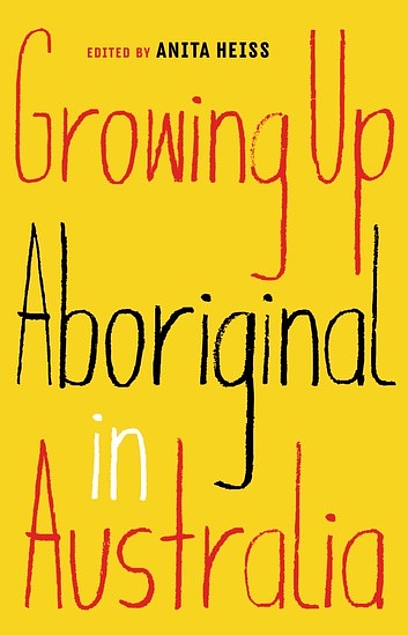
  • Growing Up Aboriginal in Australia (2018), a collection of essays edited by Anita Heiss, showcases a huge diversity of First Nations voices, experiences and stories
  • A swathe of articles in Overland Nº 240 amount to an impressionistic history of First Nations activism from the 1960s Referendum campaign and the Gurindji walk off from Wave Hill to Blak Lives Matter and Indigenous hip-hop
  • Chelsea Watego’s Another Day in the Colony is a powerful contribution to the conversation about First Nations relationship to institutional power in Australia
  • Ruby Langford Ginibi is best known for her memoir, Don’t Take Your Love to Town. The book I’ve read, Haunted by the Past (1999), could have been written to expand on the paragraph oof the Uluru Statement from the Heart’s paragraph on the incarceration of First Nations youth. I had the good fortune to share a table with this extraordinary woman at the 2005 NSW Premier’s Literary Awards (blog post here).

I’ve read a lot of history:

  • T G H Strehlow, Journey to Horseshoe Bend (1969) is a personal account of a major incident in the life of a whiteman who spent his life working with the Arrenrnte people of Central Australia – how much settler Australians don’t understand!
  • Heather Goodall’s Invasion to Embassy (1996) spells out the long, painful process of dispossession of First nations people in New South Wales, and deafness to Aboriginal arguments up to and including the Mabo and Wik judgements
  • Kay Anderson’s Race and the Crisis of Humanism (2007) brings a coldly analytic eye to 18th and 19th century humanist European writing that set out, shockingly to our ways of thinking, to define colonised peoples as less than human
  • Marilyn Lake and Henry Reynolds’ Drawing the Global Colour Line (2008) introduced me to the horror story of the racism around Australia’s foundation as a nation, and in particular the role Prime Minister Billy Hughes played in preventing the League of Nations from including a clause on racial equality in its covenant
  • Grace Karskens The Colony (2009) is a fabulously readable book that leaves its readers in no doubt that at its heart the settlement of New South Wales was a genocidal project, acknowledged as such at the time in all but the actual word (which wasn’t coined until more than 150 years later)
  • Mike Smith, The Archaeology of Australia’s Deserts (2013) is full of technical discussions of dating techniques, but it gives substance to often-repeated statements about how very long people have lived in Australia, and the conditions they dealt with
  • Tom Griffiths, The Art of Time Travel (2016) tells the fascinating story of how the mainstream understanding of Australia has been transformed over the last three quarters of a century, mainly through the acknowledgement and inclusion of First Nations voices and perspectives
  • Historian Humphrey McQueen’s essay in Overland 233 (2018) it gleefully explodes the false outrage over proposals to change the date of Australia Day
  • Cassandra Pybus Truganini (2019) had my Book Group ‘staring into the abyss of our nation’s foundation story’. I also heard it discussed in a session of the 2020 Sydney Writers’s Festival, where Jakelin Troy a Ngarigu woman from south-eastern Australia offered an approving First Nations perspective on it
  • Mark McKenna Return to Uluru (2021) is a wonderful study in how the settler versions of history can be turned upside down by evidence, and no one loses from the process
  • Dean Ashenden’s Telling Tennant’s Story (2022) is history at its passionate best, written partly in response to the Uluru Statement from the Heart.

Other non-fiction:

  • Ross Gibson Seven Versions of an Australian Badland (2002), a meditation on the so-called horror stretch, country north of Rockhampton in central Queensland that has a reputation as the setting for terrible events, forced my ears and eyes open to the horrific history of Native Police and enslavement of Melanesians in my North Queensland home. ‘Sooner or later,’ he writes, ‘any society that would like to know itself as “post-colonial” must confront an inevitable question: how to live with collective memories of theft and murder. Sooner or later, therefore, acknowledgement and grieving must commence before healing can ensue.’
  • Deborah Bird Rose’s Reports from a Wild Country (2004), includes this: ‘Reconciliation draws our attention to the war against Indigenous people, and shows us the legacy of conquest: this great divide on one side of which are the survivors of this undeclared and untreatied war, and on the other side of which are the descendants of those who waged the war … The project of reconciliation demands of us that we acknowledge the divide and the violence, but it simultaneously demands that we explore the entanglements of memory, connection, and commitment.’
  • Eve Vincent and Timothy Neale (editors), Unstable Relations (2016) is a collection of essays about the relationship between First Nations people and environmentalists, insisting on the complexity of forming alliances between the two groups. Monica Morgan, Yorta Yorta activist, is quoted: ‘However much non-Indigenous people say they are committed, in the long run they are committed to their society.’
  • Saltwater (2016) is Kathy McLennan’s memoir of her time as a lawyer for the Townsville and Districts Aboriginal and Torres Strait Islanders Corporation for Legal Aid Services. More than any other book I’ve read and discussed on this blog, It has become the subject of controversy – In an article by Russell Marks in Overland 237 (2019), and then in Chelsea Watego’s Another Day in the Colony (2021)
  • Mark McKenna, Moment of Truth (Quarterly Essay 69, 2018) is one of the first sustained responses to the Uluru Statement from the Heart that I read. It’s still worth reading
  • Jess Hill See What You Made Me Do (2019) is a brilliant book about domestic abuse. One insight in particular is relevant here. She argues, with evidence, that domestic abuse was more prevalent and tolerated to a greater extent in eighteenth- and nineteenth-century England than in pre-invasion Australia
  • An excellent summary-essay by Jeff Sparrow, ‘That’s what drives us to fight’: labour, wilderness and the environment in Australia‘, in Overland 246 (2022) is a solid account of the relationship between settlers and First Nations people in Australia with an eye to environmentalist concerns

Of course I’ve read novels:

  • Alexis Wright’s Carpentaria (2006), The Swan Book (2013) and Praiseworthy (2023) are vast, challenging works from a First Nations perspective
  • Kim Scott, That Deadman Dance (Picador 2010). I was struck by his description of the desecration a a grave as ‘deliberate and careless all at once’. (‘If you don’t know, vote no’ is surely an exhortation to be deliberately careless.) His Taboo (2017) may be less revelatory, but it’s also a brilliant novel.
  • Melissa Lucashenko, Too Much Lip (2018) is just wonderful.
  • Tara June winch, The Yield (2019) ends with an appeal to the reader to make the effort of hearing a First Nations word, and to say it
  • Julie Janson Benevolence (2020) brings a knockabout theatre quality to the early days of colonisation

And lots of poetry:

  • When I blogged about Lisa Bellear’s Aboriginal Country in 2019, I did a brief round-up of First Nations poets I had read, including Oodgeroo Noonuccal, Kevin Gilbert, Lionel Fogarty, Ali Cobby Eckermann, Samuel Wagan Watson and Evelyn Araluen. Since then I’ve read:
  • Two books by Ellen van Neerven – Comfort Food and Throat. For me, her poetry is solidly grounded in a common humanity, and then takes the reader with her to what is specific about her experience as a First Nations person
  • Australian Poetry Journal, Volume 10, Number 1: modern elegy has a whole section edited by Ellen van Neerven featuring the work of First Nations poets

Added a day later: As I expected, there were some big omissions in that list. The Emerging Artist reminded me of:

  • Kim Mahood’s Position Doubtful (2016), which, I said in my blog post, ‘will grip anyone interested in Western Desert art, or the question of how to live awarely as a non-Indigenous Australian’.
  • Archie Roach’s warm, generous autobiography, Tell Me Why (2019)

There are sure to be others. I’d welcome your additions and recommendations in the comments section.

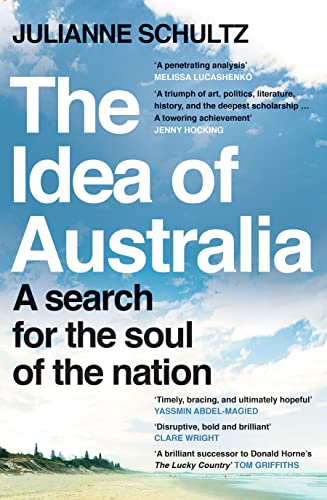
Julianne Schultz’s Idea of Australia

Julianne Schultz, The Idea of Australia: A search for the soul of the nation (Allen & Unwin 2022)

Julianne Schultz is best known as the founding editor of Griffith Review, where she made a substantial contribution to Australian literary culture over 15 years, publishing and engaging with the work of a vast array of writers (including more than one piece by my niece Edwina Shaw), facilitating a rich and complex conversation about things that matter.

The Idea of Australia was originally imagined, according to Schultz’s Acknowledgements, as a meditation, a short volume about Australia, ‘one that floated lightly over the past to make sense of the present to distil a rich, multilayered identity’. That’s not how it turned out. It’s a shaggy, baggy monster of a book, part history, part memoir, part polemic, part reportage, part Covid opus. It’s as if the process of writing that short, light mediation was disrupted by the hundreds, even thousands of voices from the Griffith Review days, each of them with a compelling case for inclusion. Add the sound journalistic and academic practices of quoting sources meticulously, and the project got right out of hand.

There are wonderful things. The twenty-page chapter on the Australian Constitution, ‘Small Brown Bird’ (as opposed to the American eagle) is a brilliant account of how the Constitution was created, and why it is so little read and so hard to change. The impact of John Howard’s time in office on the national consciousness is rendered with heartbreaking vividness in the chapter ‘Soul Destroying’. If you’re looking for a concise and engaging account of Rupert Murdoch (for whom Schultz worked for a time as a journalist) you’d have trouble finding better than the chapter ‘Power Players’. Schultz has interesting things to say about Yassmin Abdel-Magied, Kath Walker, Henry Reynolds, Bernard Smith, Alexis Wright, Mary Gilmore, Galarrwuy Yunupingu and more.

The book turns a critical eye on the idea of Australia as the land of the fair go, including well known stories of exclusion (the White Australia Policy, the dictation test, the ‘offshore solution’ and so on), and doesn’t turn away from the monstrous history of genocidal white supremacy. It is full of riches.

But too often digressions pile upon digressions; there are alarming time switches – from the early days of the Sydney colony to the late 20th century in a single sentence; the elements of memoir and family history aren’t well integrated. It looks as if the book began with the idea of Covid producing an X-ray that shows up the fault lines of our society, but that idea pretty much disappears after a couple of pages to resurface occasionally like the ghost of a discarded structure. And – this may be just me – there are some strange tics in the language: Australia is assigned the pronouns ‘she/her’; and eighty-three years, say, is regularly phrased as ‘four score years and three’. Either the copy editor was overwhelmed or her/his suggestions were overruled. The effect is weirdly alienating.

I’d be lying if I said this book is a must-read. If you know nothing about the history of Australia it is more likely to bewilder than illuminate. If you are already well-informed, depending on who you are, it will either infuriate because of its left-liberal point of view or frustrate because of the its out-of-control elements – or both.

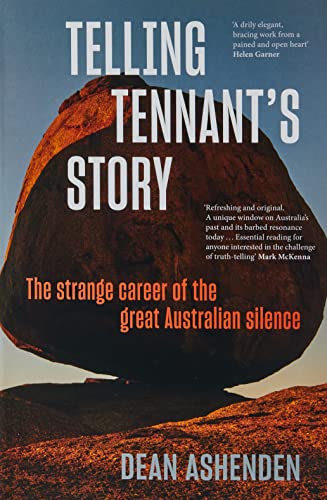
Dean Ashenden’s Telling Tennant’s Story

Dean Ashenden, Telling Tennant’s Story: The Strange Career of the Great Australian Silence (Scribe 2022)

A friend recommended Telling Tennant’s Story as his number one pick for anyone wanting to inform themselves before the Voice referendum.

My own number one pick would be Patrick Dodson’s article, ‘A firelight stick on the hill’ in the Monthly July 2023 (online here), which tells the agonising story of one representative body after another created and then destroyed, and includes this:

We are on the cusp of building a true foundation for our rich and diverse nation, upholding unity, and demonstrating respect for the First Peoples of this country while honouring our Western traditions. These aims are entirely compatible. Australia’s First Peoples are holding a firelight stick on the hill, beckoning us all to build a reconciled, healed and proud nation, where their unique position is recognised and respected.

Dean Ashenden’s book was published before the referendum was announced, but it tells the same story of First Nations voices going largely unheard for more than 200 years. In terms of the Uluru Statement from the Heart, it is about Truth rather than Voice or Treaty, but my friend’s recommendation is right on target. It’s hard to imagine anyone reading this book and then voting No.

Ashenden is a non-Indigenous historian, who spent several years as a child living in Tennant Creek in the Northern Territory. The book is framed as his quest to understand what was going on in the relationships between First Nations and settler people in the town back then. Who were those Aboriginal kids who sat at the side of the picture theatre during the Saturday matinee? Where did they come from? What was this ‘Mission’ that he heard spoken of? He ties this local quest to an account of the Great Australian Silence, anthropologist W E H Stanner’s name for the way Australian mainstream culture – politicians, journalists, historians, novelists, visual artists – ignored First Nations people for so long, relegated them, their concerns and their perspectives to the margins, and turned resolutely away from the terrible violence the settlers have inflicted on them from the earliest days of settlement.

It’s an enormous topic. The book adopts a number of strategies that ease the reader’s path.

First, there’s the personal element. Ashenden begins with his own experience in Tennant Creek, both as a child and on returning as an adult historian. We’re invited to witness him revising the version of the world he was given as a child – a process of revision that all of us settler Australians need to undertake (and incidentally, I’m looking forward to David Marr’s Killing for Country, about his forebears’ involvement in the Queensland Native Police).

Second, the book has a clear structure. Its ten chapters are divided into two parts: ‘Constructing the Silence’ and ‘The Struggle to Dismantle the Silence’. There’s a clear narrative line. Within it, after a prologue placing himself in relation to Tennant Creek, each chapter is organised around a particular year:

  1. 1860: The first contact of non-Indigenous people with the Waramungu of the area now occupied by Tennant Creek John McDouall Stuart’s passing-through was far from benign, but worse it was the harbinger of devastation and violence that was to accompany the building of the overland telegraph line 15 years later.
  2. 1901: This chapter is a nuanced account of anthropologists Frank Gillen and Baldwin Spencer, who visited Tennant Creek to ‘do’ the Waramungu in this year. Ashenden argues that their main contribution to the Great Australian Silence was to ignore the violence suffered by Aboriginal people and call attention to shiny ‘scientific’ studies of their customs and beliefs.
  3. 1933: This is the year that W H Stanner, in some ways the book’s hero, visited Tennant Creek, but the chapter deals mainly with other anthropologists, especially Adolphus Peter Elkin, who proposed the policy of assimilation that in effect meant elimination of First Nations cultures.
  4. 1958: Alongside the story of increasing disruption of the lives of Waramungu people, is the presence of Paul Hasluck in the Federal government, making assimilation official policy. Stanner attacked him with cutting irony in 1958, calling him ‘the Noble Friend of the Aborigines’.
  5. 1967: One of the many surprises of this book is that the 1967 referendum, which many saw at the time as a decisive step forward in Aboriginal affairs, rates barely a paragraph. Instead, the chapter focuses on an equal pay case, which was victorious but which led to widespread unemployment on Aboriginal workers; and Harold Holt’s establishment of the Council for Aboriginal Affairs.
  6. 1971: The first chapter of the second part begins with W H Stanner’s milestone 1968 Boyer lectures, which named the Great Australian Silence. After an excellent, critical account of the lectures, Ashenden moves on to the main subject of the chapter: the courtcase in which Yolngu elders claimed rights over land that the government was about to lease to a mining company. The case was lost, but Yolngu witness appeared alongside ‘expert anthropological opinion’ and their voices were heard. Not much later, Gough Whitlam introduced a bill that was passed by the Fraser government to become the Aboriginal Land Rights (Northern Territory) Act 1976.
  7. 1885: Tennant Creek is again front and centre, ‘on its way to becoming Australia’s most notorious dystopia’. In 1985, the Waramungu won a significant land rights claim.
  8. 1992: This was the year of the Mabo decision. The chapter focuses on the way historians and lawyers replaced anthropologists as the main allies of First Nations people. There’s a terrific account of Eddie Koiko Mabo, including his friendship with Henry Reynolds.
  9. 2000: Three years after the Bringing Them Home report on the stolen generations (whose main author Hal Wootton emerges as a model of someone who was willing to listen and learn), a court case found that a woman who had been taken from her family as a small child was not entitled to compensation. The chapter covers John Howard’s stance on Aboriginal matters and Kevin Rudd’s 2008 apology.
  10. 2005: Ashenden visits Tennant Creek again, sees ‘winners’ history’ on display everywhere, and First Nations stories now at last being told, but in a dauntingly beautiful building that is off the beaten track.

That list barely touches the surface of what the book covers. It’s a terrific read. Then there’s an Afterword, where Ashenden laments the way the heirs of John Howard’s History Wars continue to turn us away from the reality of our history, and argues eloquently for the importance of truth-telling. I’ll finish this blog post with the book’s final words

We might have got away with the silence had Aboriginal people not declined to disappear from history, as they were once expected – in both senses – to do. The past should indeed be ‘put behind us’ but it won’t be until it has been properly acknowledged, not by fessing up, or by telling just those parts of the story that suit particular purposes, but by telling our shared story as fully and truthfully as possible. How to persuade those with control over our institutions of that case? We’re on an offer to make it joint business.

(Page 244–245)

Winter reads 9: Richard James Allen’s Text Messages from the Universe

This is my ninth and last post on books I took with me on my escape from Sydney’s winter, focusing as usual on page 76. I’ve been home for a while, but it takes a while for the blog to catch up with life.

Richard James Allen, Text Messages from the Universe (Flying Island Books 2023)

Like the other titles in Flying Island’s ‘minor works / Pocket Poets’ series, Text Messages from the Universe is a physically tiny book – just 152 x 102 mm. But it’s part of a broader multi-media project.

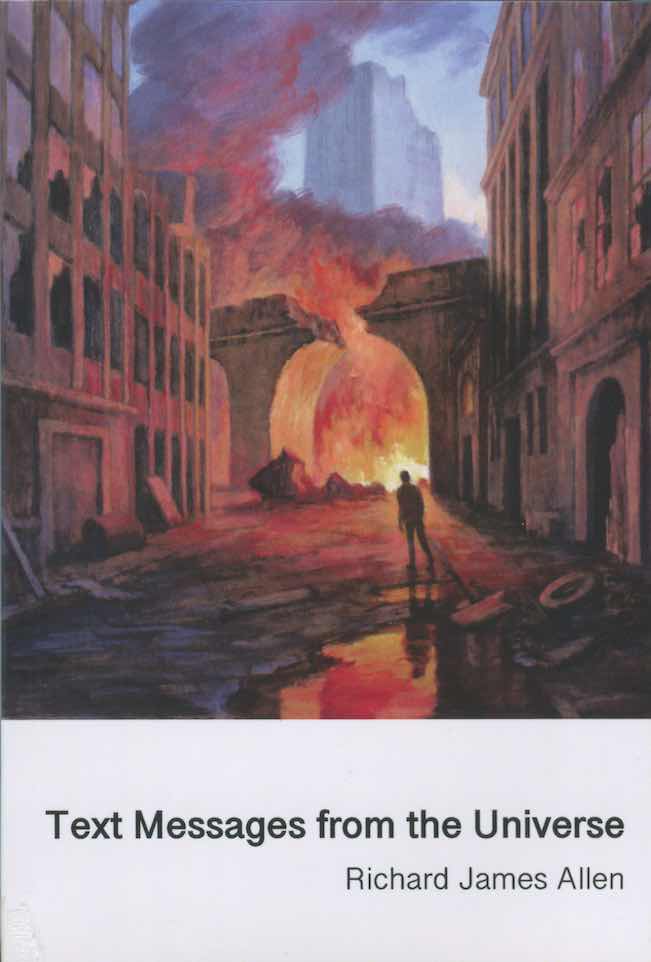
There’s a movie of the same name directed by Richard James Allen, which is the source of the lavish images of dancing figures that accompany the text (or perhaps, depending on how you see things, that are accompanied by the text). The front cover is from a painting created for the book by 2023 Archibald finalist Michelle Hiscock. The text itself, a single prose poem, is the final work in the multi-volume The Way Out At Last Cycle, which has been three decades in the making (Hale & Ironmonger published The Way Out At Last and other poems in 1985).

The poem is inspired by the Tibetan Book of the Dead. The first, shorter section is addressed to a person who dies in a car accident. In the second section, made up of 49 short parts, the person is lost in a state between death and rebirth, the bardo, in a cycle of dreaming and waking, bewildered, disoriented and panicking. The poetry takes on a weirdly insubstantial quality that is beautifully enhanced by the billowing drapery of the dancers on every page. I haven’t read the Tibetan Book of the Dead – that part of 1960s enthusiasm passed me by – so I don’t know if the poem follows it with any precision, but there’s a wonderful sense of being carried along on a current leading to detached oblivion and then, perhaps, to a new beginning.

No spoiler intended, but the text messages of the title are revealed towards the end of the poem, in part 46: ‘This is your last moment,’ closely followed by, ‘This is your first moment.’ Part 47 adds this gloss:

As for the rest, Your text messages from the universe 
seem to be happy to take any form and any language 
they please.

Some of them aren't even text messages, just 
whispers inside your head.

Speaking as someone who is currently reading Saint Augustine’s Confessions, I’d add they may also come in the form of a child chanting on the other side of a wall.

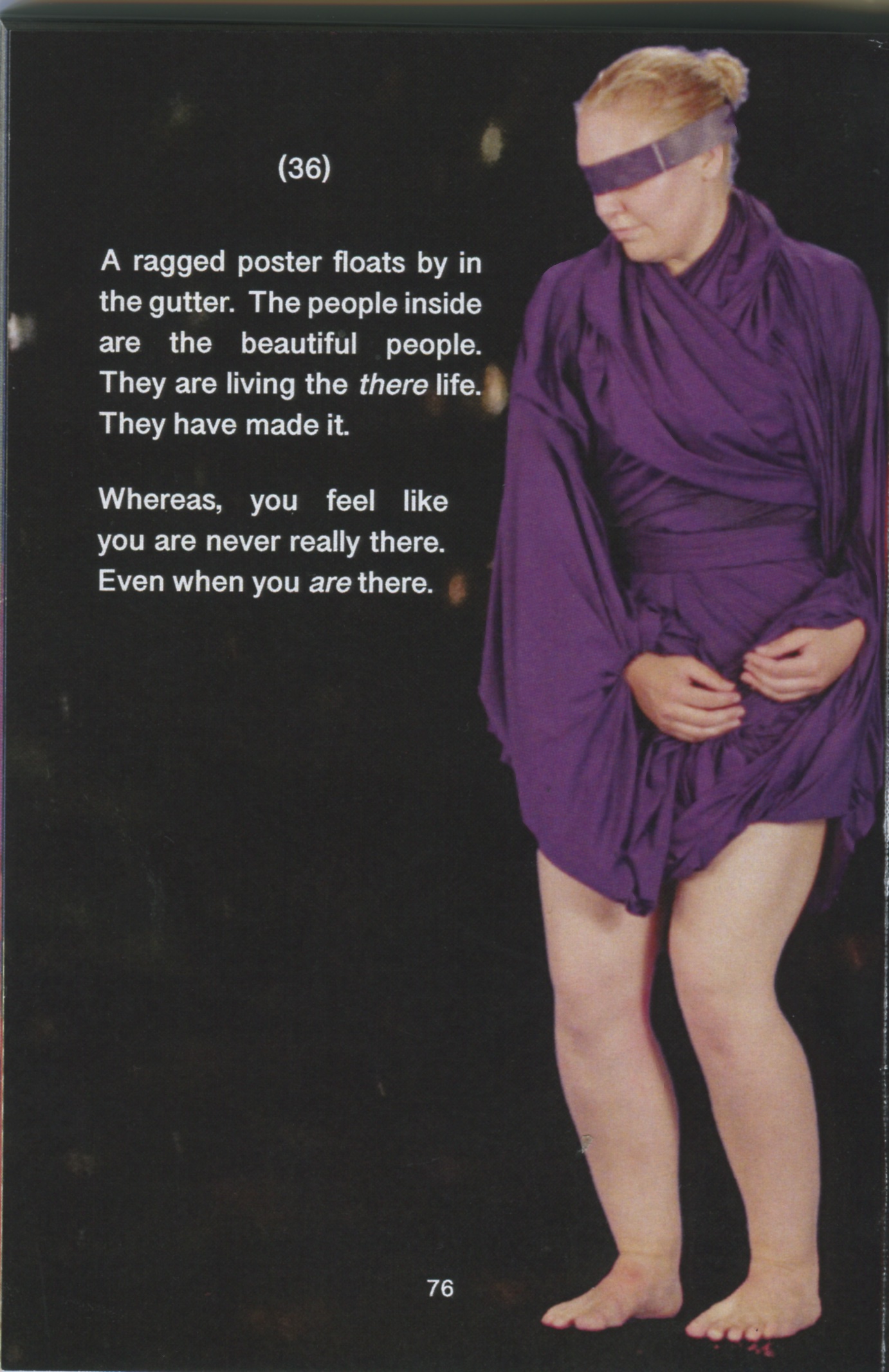
Even while I’m enjoying the poem’s journey in an invented universe (apologies to any of my readers for whom the bardo is as real as purgatory is to some Catholics), my tendency as a reader is to cast around for the kind of actual experience that the invention draws on and possibly illuminates. The short poem on page 76, section 36, rewards this tendency:

(36)
A ragged poster floats by in 
the gutter. The people inside 
are the beautiful people.
They are living the there life.
They have made it.

Whereas, you feel like 
you are never really there.
Even when you are there.

Incidentally, this is the only image in the book where the dancer is less than elegant, where the fabric is not floating in an ethereal breeze. It signals that, as so often happens, page 76 is a kind of turning point, in this case a low point.

The text offers one of the poem’s many noir-ish images – one of many alleys, gutters and empty lots. The poster is a piece of detritus from the life left behind. In the dream world of the poem, it asserts the substantiality of that life, its thereness. These lines reward my penchant for literalness by drawing on a moment of a kind I imagine we’ve all had: you see a poster for some event and reflect fleetingly that the life represented in the poster is unreal – either that, or it’s part of a reality that you have no part of. This is the moment in the bardo when the newly-dead person is closest to nothingness: it’s the rubbish poster that’s real.

In the years that this poem was fermenting, the bardo attracted the attention of a number of other creators. I’m aware of George Saunders’s multivocal novel Lincoln in the Bardo (2017), which I haven’t read, and Laurie Anderson’s movie Heart of a Dog (2015), for which I just couldn’t stay awake. I had no trouble staying awake on the journey with Text Messages from the Universe.


I’m grateful to Flying Islands Books for my copy of Text Messages from the Universe.

The Confessions of Saint Augustine, second report

Saint Augustine, Confessions (approx 400 CE, translated by R S Pine-Coffin 1961, Penguin Classics edition): pages 111–190, from start of Book VI to Book IX, chapter 6

This month’s reading of Confessions included the book’s most famous prayer, ‘Give me chastity and continence, but not yet.’ Here it is in context:

As a youth I had been woefully at fault, particularly in early adolescence. I had prayed to you for chastity and said, ‘Give me chastity and continence, but not yet.’ For I was afraid that you would answer my prayer at once and cure me too soon from the disease of lust, which I wanted satisfied, not quelled.
at ego adulescens miser valde, miserior in exordio ipsius adulescentiae, etiam petieram a te castitatem et dixeram: da mihi castitatem et continentiam, sed noli modo. timebam enim, ne me cito exaudires et cito sanares a morbo concupiscentiae, quem malebam expleri quam exstingui. 

(Book VIII Chapter 7, page 169)

Interestingly enough, Augustine’s struggle with sexual desire isn’t his main story. He does go on about it a bit, and he never shakes off the Manichees’ demonising of the body, but it’s not that much more interesting than his gambling addiction, which was relatively easily kicked. His true interest is in the convoluted mental and emotional process of conversion. He disentangles himself from Manicheism, comes to devalue academic success, and renounces what we might see as a perfectly decent de facto relationship, to embrace mainstream Christianity. He describes himself as wanting to go in two directions, one towards what he understands to be a life well lived, and the other to stay with what he has. It’s a beautiful anatomy of the process of getting to decide to change one’s life (‘a hundred indecisions, … a hundred visions and revisions’).

The moment when he finally makes his decision is brilliant. He is overwhelmed by an emotional storm, an ‘agony of indecision’, and goes away from his friend to weep, because ‘tears were best shed in solitude’ (so men’s conditioning has stayed constant in some regards for at least 1600 years). He has a really good cry, and then there’s the other bit I was told about in my childhood::

I heard the singsong voice of a child in a nearby house. Whether it was the voice of a boy or a girl I cannot say, but again and again it repeated the refrain ‘Take it and read, take it and read’. At this I looked up, thinking hard whether there was any kind of game in which children used to chant words like these, but I could not remember ever hearing them before. I stemmed my flood of tears and stood up, telling myself that this could only be a divine command to open my book of Scripture and read the first passage on which my eyes should fall.
audio vocem de vicina domo cum cantu dicentis, et crebro repentenis, quasi pueri an puellae, nescio: tolle lege, tolle lege. statimque mutato vultu intentissimus cogitare coepi, utrumnam solerent pueri in aliquo genere ludendi cantitare tale aliquid, nec occurebat omnino audisse me uspiam: repressoque impetu lacrimarum surrexi, nihil aliud interpretans divinitus mihi iuberi, nisi ut aperirem codicem et legerem quod primum caput invenissem.

(Book VIII chapter 12, page 177)

I got the impression from the nuns, priests and brothers of long ago that the voice was that of a disembodied spirit, an angel. But Augustine himself suggests no such thing. God’s instrument here is an actual child – otherwise why linger on the child’s indeterminate gender? I also thought this was the first time Augustine read the Christian scriptures, but he has been studying them for years, and already believes they are sound. In the actual Confessions, this is a moment of serendipity, and his going to read the first passage he sees (from Paul’s epistles, it turns out) has a lot in common with the ‘pagan’ practice of the sortes Virgilianae, in which the pages of Virgil’s Aeneid were opened at random to see the future.

This morning’s reading ended with more tears, of gladness this time as he is baptised and his life is turned around. He is accompanied by his son Adeodatus, now 15 years old, whom he clearly treasures.

I’m about two thirds of the way through the book, and I’m expecting the rest to be pious anticlimax. But these last 20 pages are brilliant and completely explain the book’s enduring status as a classic.

Tove Ditlevsen’s Childhood, Youth, Dependency and the Book Group

Tove Ditlevsen, Childhood, Youth, Dependency: The Copenhagen Trilogy, 1968–1971 (Penguin 2020)
First two books translated by Tiina Nunnally 1985; the third by Michael Favala Goldman 2009

Before the meeting: In January this year as part of a series of belated obituaries, The New York Times published an article on Tove Ditlevsen, 47 years after her death. You can read the whole thing at this link (you might have to sign up for a free account to get access).

The short version: Tove Ditlevsen (1917–1976) was one of Denmark’s most popular authors. Her published works included 11 books of poetry, seven novels and four story collections, as well as the three short memoirs, Childhood (Barndom in Danish), Youth (Ungdom) and Dependency (Gift) that have been collected here as The Copenhagen Trilogy. She didn’t enjoy critical success during her lifetime and was virtually unknown outside Denmark. None of her books of poetry were translated into English. Then in 2016 translator Michael Favala Goldman picked up a copy of Gift in an airport, considered it to be a masterpiece, and set the snowball in motion for a critical discovery in the English-speaking world and elsewhere.

I was prompted to go looking for that background by something about the book itself. Perhaps because I’ve recently read two brilliant memoirs by Annie Ernaux (blog posts here and here), not to mention Proust’s vast À la recherche du temps perdu, I felt that the first book (Barndom/Childhood) and much of the second (Ungdom/Youth) were too neat, too confident in their detail to be trusted as memoir.

The first book begins with Ditlevsen as a small child trying unsuccessfully to avoid triggering her mother’s anger, and observing the life of their apartment block. ‘Childhood is long and narrow like a coffin, and you can’t get out of it on your own.’ She goes to school, and has an ambivalent relationship with the cool girls who gather at ‘the trash-can corner’. She thinks of herself as unattractive and no one contradicts her. She is hospitalised with diphtheria. She reads a lot and writes poetry that she keeps in a secret album.

In Youth, still living at home, she has a series of terrible jobs, is befriended by the worldly Nina, and enters the world of boys and kissing goodnight at the door. She continues to write and, encouraged by her older brother and Nina, dares to show her poems to a literary gent who offers qualified encouragement of her writing and allows her to borrow from his well stocked bookshelves, then disappears without explanation. Another older man becomes a mentor and publishes one of her poems in his literary journal. She fantasises becoming his wife. At the end of this volume, she has had a book of poems published.

Rather than memoirs, these books read as novelisations of the writer’s early life, and as novels they have an almost generic quality. I was so lulled into thinking of them as fiction that I was taken aback when, in Dependency, Piet Hein turns up as a character. Piet Hein, as you probably know, was a Danish polymath (1905–1996) who wrote little poems he called grooks, of which probably the most famous is

The road to wisdom? Well, it's plain
And simple to express:
Err
and err
and err again,
but less
and less
and less.

He was a real person, who would have been known to the book’s first readers at least as well as Ditlevsen herself, and he was very much alive when the book was published. He is portrayed mockingly as a charming but callous serial monogamist. Maybe, I thought, all the other people named – and to varying degrees shamed – were real as well. I did a little duck-duck-going, and sure enough the people given full names mostly did exist. So I’m guessing that part of the books’ original appeal may have been their gossip value – a popular writer was spilling the beans.

In the third book, things get much worse for Tove, and as a result (I’m sorry to confess this of myself as a reader) the book is much more interesting. Its Danish title, Gift, means ‘poison’ but it’s also some form of the word for ‘marriage’. Michael Favala Goldman’s title, Dependency, suggests both Ditlevsen’s approach to marriage and relationships, and her harrowing experience of drug addiction. In this book, Ditlevsen marries, divorces, and has a child with a new lover (not Piet Hein). When she falls pregnant a second time she has an illegal and traumatic abortion, which leads to her first experience of the opioid painkiller Demerol. The book comes fully alive and gripping in the detailed account of the abortion and her subsequent addiction to Demerol. The harrowing process of drying out, relapsing, drying out again, is described with tremendous force.

I’m not sure I needed the first two books, but I was shaken and stirred by the third.

There’s not a lot of lightness – her relationships with men are terrible and mainly explicitly transactional, though (spoiler alert) that changes at the very end. One snippet of literary gossip is an exception that’s worth mentioning as a moment that makes her (and us) realise how grim her life has become in the grip of addiction and of the controlling lover who administers her ‘shots’. It also casts a somewhat benign light on her ambivalence about her children. She accepts a rare invitation to dinner:

During the dinner I sat next to Evelyn Waugh, a small, vibrant, youthful man with a pale face and curious eyes. … Kjeld Abell asked Evelyn Waugh if they had such young and beautiful female authors in England. He said no, and when I asked what brought him to Denmark, he answered that he always took trips around the world when his children were home on vacation from boarding school, because he couldn’t stand them.

(Page 334)

After the meeting: It was a long time between meetings – I wrote the previous paragraphs a couple of months ago – and my memories of the book had faded when at last we met. In the days leading up to the meeting there were ominous rumblings on our WhatsApp group giving advance notice that many group members either disliked the book intensely or couldn’t finish it for reasons other than lack of time. A lone voice said it was brilliant. It was promising to be an interesting evening.

But then, one chap was attacked by an unruly plate-glass door on his way here and had to be taken to a hospital emergency, which would have been bad enough, but the man who drove him to hospital was the book’s main advocate and – I learned later – he himself had just finished the book and thought it was a masterpiece.

Because of the accident itself and the absence of advocacy, discussion was fairly muted. One chap who had also just finished reading the book gave a spirited account of why he loved it (making it three out of 11 definite thumbs up; maybe three definite thumbs-down). He read it quickly. He couldn’t put it down, he said, and then at time he had to put it down. My sense was that a number of people got to the moments when you have to put the book down and just didn’t want to pick it up again – some would say they were lily-livered.

Someone pointed out that a good deal of the action takes place in Denmark occupied by the Germans, and it’s a revelation that for Ditlevsen and her literary pals the occupation was little more than a dark shadow on the edges of their lives.

But it wasn’t long before conversation moved to other pressing matters: the Women’s Football World Cup – the Matilda’s had beaten France, but not yet been defeated by England, and many of us were in love; the Voice referendum, Peter Dutton’s dastardliness and Anthony Albanese’s alleged lack of statesmanship; the mushroom dinner; parental dementia; and far too much food.

No one was interested in my recitation of the above grook.

Winter reads 8: Sophia Wilson’s Sea Skins

This is my eight post on books I took with me on my brief escape from Sydney’s winter, focusing as usual on page 76. (I’ve actually been home for a while, but the blog is still catching up.)

Sophia Wilson, Sea Skins (Flying Island Books 2023)

Sophia Wilson was joint winner of the inaugural Flying Islands Manuscript Prize for Emerging Poets in 2022. Originally from Australia, she now lives in Aotearoa New Zealand.

The poems in this collection reflect her attachment to both countries: there are poems based in her Australian childhood, and a number about the fraught history of colonisation in Aotearoa, as well as evocations of its land. There are also poems that bear witness to her experience as health professional (one poem mentions ‘the unbearable silence of asystole’), translator (most notably in ‘En Cas d’Urgence’, which switches among English, German, French, Spanish, Greek and Chinese), and manager of a wildlife refuge. That is to say they deal with an astonishing range of subjects.

If I had to generalise, I’d say the book’s central concern is the assertion of the human as part of nature as opposed to abstraction and mechanisation. But as soon as I’d written that sentence I read four short poems that only fit this description with quite a bit of mental contortion.

As with a lot of contemporary poetry, a key feature is a compression of meaning, which means that precise meaning is often elusive.

The poem on page 74 comes with a dedication: ‘for Valeria’. It’s an elegy for a friend who has died:

Nello Specchio d'Acqua
You were a glass blower, un soffiatore di vetro 
hands of silica and carmine
You lifted a globe, il tuo capolavoro
Within it two dancers cast crumbs to pigeons
A window opened to the sea

You were the blind man crossing a piazza
I was your white-tipped cane
On the bridge, at the centre, above the grey 
you were the singer, the song

I was the street sweeper, gathering dust
You were a magician, un pagliaccio intossicato 
dancing across the square

I was the guide in a maddened crowd
You were a tramp passing by - 
a mirage in a watery mirror
adrift on swelling tides

You were wasted, skeletal -
maligno il cancro, il tuo fiore in gola
You were sinking foundations, eroded façade
a stone lion slipped beneath tidelines

The sea swallowed our steps - 
you were swallowed in steps
invaded through doors, the walls of your neck 
your mouth's floor – la tua lingua

They gave you a tube for a windpipe

I measure the loss of you in tides
You were scattered at the rate of tsunami

There was a glass blower, un sofiatore di vetro 
who lifted a globe, il suo capolavoro 
I was a street sweeper, treading water

You came dancing across the square

(for Valeria)

This is a lovely evocation of a lost friend, with references to their experiences together that are cryptic, but not so cryptic as to be frustrating. The friend was clearly Italian, a glass blower, who died of cancer of the throat. The scattering of Italian phrases is a way of honouring the friend’s cultural heritage. (A number of poems in the collection do this with Mãori words, wth a similar effect of honouring difference.)

A specchio d’acqua is usually translated as a calm expanse of water. As specchio means ‘mirror’, the emphasis is on the surface reflection rather than other watery qualities – so the phrase could also be translated as ‘watery mirror’ (as in stanza four). Most of the other Italian phrases are pretty much explained in the text: capolavoro is ‘masterpiece’; un pagliaccio intossicato is ‘a drunken clown’.

The first stanza introduces the friend as an artist, and focuses on a glass globe created by her, a glass globe containing two dancing figures.

The next three stanzas riff on that image, describing the poet’s relationship to the artist in terms of two figures in a setting that suggests Venice: the big square, a group of tourists, a bridge, water. The poet was mundane, ‘gathering dust’; the friend magical, a drunken clown, a mirage, a singer, an exotic beggar. It’s not all one-way – the ‘I’ is a white-tipped cane for the friend as blind man, perhaps implying that she brought some groundedness.

Then the poem turns abruptly to the friend’s final days, wasted and skeletal. Interestingly the key information is left untranslated: maligno il cancro, il tuo fiore in gola, ‘malignant the cancer, your flower in the throat’. It’s as if the poet can’t bear to say the words in her own language. In what follows, the images of Venice are no longer of romantic waterways, bridges and tourist-filled squares, but ‘sinking foundations, eroded façade’ and the threat of rising sea levels. The cancer invades the friend’s body like floodwaters, in steps at first – and then, in the third-last stanza, leaving all thought of Venice behind, with the overwhelming force of a tsunami.

The single-line stanza, ‘They gave you a tube for a windpipe,’ interrupts the metaphorical elaboration with a moment of brutal literalness. There’s no need to name death itself: this tube says it all.

The last two stanzas turn again. The first of them reprises the poem’s opening movement, condensing it into three lines, but now the friend is no longer addressed directly. She can only be spoke of in the third person – ‘There was a glass blower’. The poet now recalls herself, not as gathering bust but as treading water ,an alrernative way of saying the same thing, that paves the way beautifully for the final line.

And the final twist: the friend can be spoken to again – and the vital image of her as she first appeared reasserts itself: ‘You came dancing across the square.’

I so get this! A friend of mine died recently. There was a wonderful farewell gathering where her many achievements were celebrated, and her qualities as a friend eloquently evoked. I can’t think of her without a terrible sense of loss, but at the same time my mind keeps returning to an occasion when, a fifty-something woman exultant at having won a game of canasta, she leapt onto the card table to do a wild, stomping victory dance.


I’m grateful to Flying Islands Books for my copy of Sea Skins.