Category Archives: Books

SWF 2019 Sunday, Part One

I managed four sessions at the Festival on Sunday. Time is at a premium just now, so I’ll split it into two posts.

At 10 in the morning we went to A Dangerous Time to Tell the Truth in which, as the Festival web site say, ‘In conversation with ABC’s Sophie McNeill, three uniquely placed foreign writers and journalists share[d] their perspectives on the struggles and costs of reporting the truth and exposing lies under corrupt and oppressive governments.’ The three writers were Mexican Anabel Hernández (author of Narcos, about the far and deep reach of Mexican drug cartels), Iraqi-American Dunya Mikhail and Turkish Ece Temelkuran (author of How to Lose a Country).

I’d seen Dunya Mikhail in a more intimate session where she was wearing her poet hat, and this was the second of three sessions on my schedule featuring Ece Temelkuran. There was some repetition but I didn’t find any of it tedious.

We hear a lot about the noble calling of journalism these days, often from journalists whose work is deeply compromised. But from my seat in the stalls I felt something like awe, thinking that the three women on the stage were heroes of our time, exposing corruption and naming tyranny in the face of threats to their safety and even their lives. ‘Why are you here?’ Ece asked, as if having read my mind. ‘Do you want to see three martyrs? Do you want to learn about the realities of journalism?’

Quite apart from anything they said, the passion of all three women was deeply impressive. Anabel Hernández in particular delivered what was practically an aria on the importance of the truth, and the attempt to find and communicate it. In Mexico, where the institutions of society have pretty much failed, she said, journalists are currently called on to do the work of governments, investigators, prosecutors, even therapists. I think it was she (though it might have been Ece) who said, responding to a question from Sophie about the difficulty of persuading people to speak out, and picking up on the therapist tag, that people want to be heard: it takes two people to remember; if just one person has the memory it comes to feel like fantasy; an important part of the journalist’s job is to listen, even sometimes when you know that you will never be able to publish what you hear.

There was some dark humour. ‘Protect your journalists even if you hate them. We are not nice people.’ ‘Journalism is not a profession. it is a sickness in the head.’

On Julian Assange: He is not a pleasant person, but he has changed history. The impact of social media is huge, changing how we experience ourselves as human beings, and he is part of that much larger story. Social media are controlled by large companies for whom they make huge profits, and democracies are no longer strong enough to leash them.

In question time, someone asked what we could do to support good journalism. Ece gave the expected answer: Buy newspapers. Anabel picked up the baton: ‘Everything is connect,’ she said. When you take drugs in Sydney you become part of the problem for Mexico. Neoliberalism has penetrated deep into our minds to make us believe we are isolated individuals who are primarily consumers, but in reality we are all connected, and our actions have far reaching effects.

This is the first session I attended that had remote attendance. I expect it will turn up on the Festival’s podcast over the coming months. I’ll happily listen to it again.


At half past one, I joined an unexpectedly long queue (seats are allocated, so why queue?) for Simon Shama in conversation with Paul Holdengräber in Belonging: The Story of the Jews. This was the only session I attended that was all men, or even a majority of men, on stage. Simon and Paul gave the impression that they were old friends, though they had never appeared together in public before. I gleaned from the Festival program that Paul does a lot of conversing with famous people in public, and lives in the USA. He seems to be a kind of US Richard Fidler rather than a Kerry O’Brien.

Simon Shama’s recent book is the second in his intended trilogy, The Story of the Jews. This volume, Belonging, spans the period 492–1900 of the Current Era. I have had the first volume, Finding the Words 1000BCE – 492CE, beside my bed for some time, and have cracked it open since Sunday. I expect I’ll blog about it in time.

This was a remarkably entertaining, free-ranging chat, starting with Paul announcing that Simon had just told him he loved meeting and signing books for men, women, children and dogs, and would do so after the session. The very mild laughter had barely died down when he followed up with a passage from the last pages of Finding the Words, a contemporary Christian monk’s account of the sufferings and courage of Jews fleeing Spain in 1492, and we were away: two hugely intelligent, warm and mutually appreciative Jewish men going where the subject and the moment took them, interrupting each other (especially Paul interrupting Simon), telling little bits of their life stories, swatting a fly and accusing it of being anti-Semitic, telling jokes that were only marginally relevant, but funny. When asked if he was Jewish, Jonathan Miller said, ‘Well, Jew-ish‘. This joke was relevant because Simon Shama was describing himself as more a Jewish historian than a historian of the Jews (or possibly the other way round – I didn’t take notes).

They talked about the Jews who faced the choice between fleeing Spain in 1492, converting to Christianity or pretending to convert – and how neither converting or pretending to convert was any protection from the Inquisition that came soon after. They spoke of Moses Mendelssohn, 18th century intellectual who believed that the Enlightenment promised a degree of safety for the Jewish people, and how his hopes were largely dashed.

Simon said he was dreading writing the third book in the series. Asked why, he said that writing about the Holocaust is a huge challenge. So much written on it, especially fiction, is meretricious. The third volume will have to come right up to the present, given the new wave of anti-semitism sweeping Europe and elsewhere.

I came away determined to read the first volume, which covers 1500 year in 169 pages, and then this one, if the world and I last that long: just 500 years but something like 800 pages. These guys may have seemed a bit chaotic, but they knew how to whet their audience’s appetites.
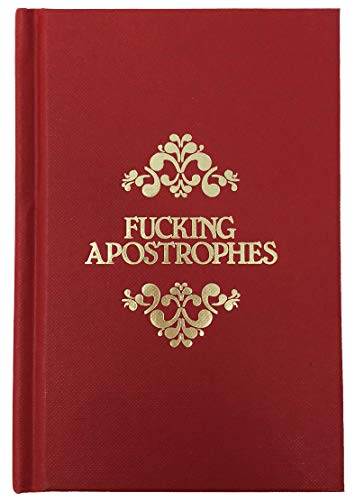
Simon Griffin’s Fucking Apostrophes

Simon Griffin, Fucking Apostrophes: A guide to show you where you can stick them (Icon Books 2016)

The inside blurb describes this as ‘the perfect gift for any pedant’, which may explain why a young friend gave it to me as a gift with a knowing look on his face.

I don’t know that I’d recommend it to pedants, but it’s a short, clear, and for my money accurate guide to the use of apostrophes in English. It doesn’t waste space by arguing that apostrophes are doomed to extinction, or telling anecdotes about guerrilla apostrophisers attacking grocers’ shops. It allows for cases where a number of possibilities are correct. In order to lighten the mood, that is, to avoid sounding like a primary school classroom, it inserts the word ‘fucking’ regularly. In fact the word ‘apostrophe’ hardly occurs in this book without that adjective attached.

It was a thoughtful gift. I learned the difference between possessive and attributive nouns – the latter are in effect adjectives and so don’t need a [fucking] apostrophe. So a farmer’s market is a market belonging to a farmer; a farmers’ market is one that belongs to more than one market; a farmers market is a market for farmers, not one that’s owned by them.

There’s a charming dedication at the end:

For Matilda and Maurice

Please remember that swearing’s

not big or clever.

The book isn’t big, but it is clever – and sweary.

SWF 2019 Saturday

My second day at the festival turned out to be fairly light on – just two events.

We had double booked for the 11.30 am session, and reluctantly chose to pass on to friends our tickets to Akala‘s sold-out session (the Festival has a no-refunds and virtually-no-exchanges policy). The Emerging Artist then went to The Kingdom and the Power: Saudi Arabia, and I went to:


Poetic Justice. This was in ‘Track 12’, a small theatre space that was only about a fifth full, but soundproof. Dunya Mikhail, Iraqi journalist and poet now living in the USA in exile was in conversation with US poet Michael Kelleher.

Dunya Mikhail’s most recent work is a non-fiction prose work, The Beekeeper of Sinjar, but for the sake of this session she was a poet. Unusually, I turned up with a question in mind. Having learned from an excellent issue of Southerly edited by Laetitia Nanquette and Ali Alizadeh that poetry occupies a central and honoured place in Iranian culture, I wondered if the same was true of Iraq. The question was given added point by the apparent discontinuation at this festival of the tradition of lively poetry events, and by Fiona Wright’s admittedly facetious defensiveness about her poet identity on Friday.

My question was answered resoundingly in the positive. Actually, it was implicitly answered in Dunya Mikhail’s whole demeanour and way of speaking. Michael Kelleher asked her to read the title poem from her first collection, The War Works Hard, which manages to be both slyly witty and devastating, and then invited her to talk about her first 15 years, the only years of her life when there has not been war in Iraq. She painted a marvellous picture: children in Baghdad lived their lives on the roofs or the streets. It’s a big city, but if a child wandered too far from home, someone would always bring them back.

She spoke of the ancient Mesopotamian practice of burying the dead with food and water to sustain their bodies and poetry to nourish their souls in the afterlife. And it is still the practice in Iraq to have poetry recited at funerals – bad poetry at her father’s funeral, she said. There is a strong oral poetry tradition of which the funeral poems are a part, and poetry is held in high esteem: when she was about to go into exile, a friend was concerned, not whether she would be able to continue working as a journalist (she hasn’t really) but whether she would sill be recognised as a poet (she has been).

Though was brought up Catholic, religious, ethnic, or linguistic differences weren’t used as pretexts for mistreatment in her childhood, she said: the oppressive regime was pretty evenhanded on those matters. And the Qur’an has a surah about poets.

Asked if the 1001 Nights had been an influence, she said not directly: she had heard many of those stories, and others, from her grandmother, and they had found their way into her poetry.

Poetry, she said, has literally saved her life: she put ‘Poet’ on her passport when she thought she was going to travel to the US as a young woman; that fell through, but much later when she was fleeing the country because it had become seriously dangerous to be a journalist, the official at the airport noted that she was a ‘Poet’, and waved her through.

She spoke interestingly about translation. Poetry, she realised when she started writing poetry in the US, was her true homeland. Now, she writes her poems in Arabic and translates them herself. She prefers to do this because she has more freedom than a translator who is not her. In effect, she produces two distinct poems.

I don’t think I mentioned that yesterday, talking about mental illness, Fiona Wright and Luke Carman agreed that writing doesn’t work terribly well as therapy. Dunya Mikhail echoed their sentiment in response to a question about the role of poetry in terrible situations such as Saddam’s Iraq or the decades of war since his overthrow. ‘My poetry,’ she said, ‘will not save. Poetry doesn’t heal a wound, but it is a way to see it and understand it.’

Michael Kelleher was an exemplary interlocutor – self effacing, well-informed, flexible, and asking questions that opened doors.


We went home for lunch etcetera, then I caught the bus back intending to go to the 3 o’clock session, Blak Brow: Blak Women Take Control, with Evelyn Araluen and other first Nations women poets. But it was a free session and I’d forgotten about the SWF queues. I arrived at 2.45 to see a queue of about 30 people, who turned out to be the ones who were left over once the room was full. So I went home and finished blogging about Friday.


After an early dinner we went downtown for Lie to Me: An Evening of Storytelling at Sydney Town Hall. Our tickets were for General Admission in the stalls, so we arrived with more than half an hour to spare. The queue that snaked around Town Hall Square must have been a thousand people long, but we eventually got decent seats, and the readers/performers all appeared on a huge screen as well as in their tiny persons, so all was well.

I hadn’t looked closely at the program, and was half expecting a fun evening along the lines of that British TV show where you have to guess whether a panellist is telling an outrageous lie or an even more outrageous truth. That’s not what I got.

Benjamin Law, warm, suave and revealing naked ankles, did a great job as host. Each of six story-tellers delivered their piece, and then had a brief chat with him.

Patricia Cornelius, whose plays I’m ashamed to say I’ve not seen any of, read the powerful opening monologue from a new play, Julia, which turned out to be about child sexual abuse and the Catholic church, and added something I didn’t understand about Julian Assange. Chatting with Benjamin, she said she didn’t care for naturalistic drama, and often wrote dialogue in a very poetic mode, but no one seemed to notice.

Turkish journalist Ece Temelkuran’s opening gambit was to say that though she knew we expected her to talk about politics, she was going to tell some long concealed truths about herself. ‘I was a concubine in Saudi Arabia for ten years,’ she said, and before we could even gasp, she went on, ‘It was fun.’ She then reeled off a string of sordid, deeply cynical and increasingly improbable confessions. All these things had been written about her, she said, and not by Twitter trolls but by prominent journalists. She went on to talk about the absence of shame about lying in public life under neo-liberalism, and not only in Turkey. The idea of freedom, she said, has been corrupted so that it now applies only to consumption and sex.

Tim Soutphommasane, former Race Discrimination Commissioner, spoke soberly of the foundational stories of Australia, about our fabled egalitarianism and commitment to the fair go, which he argued don’t stand up to scrutiny.

Nayuka Gorrie, a Gunai/Kurnai, Gunditjmara, Wiradjuri and Yorta Yorta writer, warmed us up by chatting about the Harry Potter movie where Harry is accused of lying when he has told an uncomfortable truth, and his punishment includes ‘I must not tell lies’ being magically carved into the skin of his arm. Then they spoke powerfully about the lies that colonisation depended on – White lies about Black truths, repeated in curriculums, in literature, in speeches, until they become accepted as truths.

Oyinkan Braithwaite gave a deceptively modest talk. She began with assertions young women make to each other. ‘All men are cheats,’ for example. And she talked about things she learned about the oppression of women in Nigeria when she challenged these assertions.

Scott Ludlam was the only one in my festival who spoke about climate change. Memorably, he said that the Antarctic ice shelfs haven’t even heard of Tony Abbott.

And the evening finished with a song by Megan Washington: I’m probably showing my age here, but I wish they’d managed to get Tim Minchin.

SWF 2019: Friday

I was in England when last year’s Sydney Writers’ Festival broke away from its harbourside venue, so this is my first Festival at the Carriageworks. I miss stepping out of dim rooms full of bright words into the dazzle, or sometimes drizzle, of postcard Sydney. But I can walk there and back, which is something.


My SWF this year kicked off with a 10 o’clock session on Friday: Taking Flight: Stories of Expulsion and Migration

Julian Burnside chaired a conversation with German novelist Jenny Erpenbeck, and Omid Tofighian, translator of Behrouz Boochani’s No Friend but the Mountains, which is still on my To Be Read pile.

All three participants were interesting, more than that, compelling. Jenny Erpenbeck’s most recent novel Go, Went, Gone is based on a year befriending and documenting the experiences of migrants in Berlin – the kind of migrants who would be called refugees or asylum seekers in Australia, but have been defined out of that category in Germany. It emerged that the characters in her novel are all real people with changed names, except the main character, named Richard, who she admitted is herself. Asked by Julian Burnside abut the many references to classic Greek and Roman gods, she explained that part of her goal was to make it clear that northern African peoples aren’t the Cultural Others that mainstream media would paint them – that much of that ancient culture was shared by Europe and Africa. In the very brief Q and A, asked if sessions like this and perhaps novels like hers weren’t preaching to the converted, she said that migrants are generally portrayed as millions of displaced people deserving pity or stirring dread: what fiction can do is help us realise that ‘the millions are not millions’, but each one has a story, and these stories show our connection as humans.

Omid Tofighian has an impressive CV in his own right and a scholar and activist. He was on the panel as translator of Behrouz Bouchani’s book. He was fascinating about the process of translation from Farsi to English. (Incidentally, Farsi is an Indo-European language, with many similarities to German in how its sentences are constructed.) About 40 percent English version is in verse: this is because in many passages Behrouz’s long Farsi sentences had to be broken up into smaller sentences to make them work in English, and in that process what had been beautiful Farsi prose begged to be presented as English verse. Translator and author worked closely together on the translation. Replying to an audience member who asked for a practical solution to the problem of offshore detention, ‘the key word being practical’, he said two things were necessary: first to analyse and broadcast the financial dimensions of the detention industry, in particular what he and Behrouz call the horrific surrealism of Manus, which creates vast profits for a small number of people; and second to challenge the ideology that sees refugees as passive and not fully human. On the preaching to the converted question, he said that the thing about Behrouz is that he is holding a mirror up to Australian society in general, not pleading his own case as victim or seeking a benefactor: he is calling out Australians in general to reflect on our history of harshness towards the marginalised, from the beginning of colonisation.

Julian Burnside in the chair promised at the start that we were about to hear a conversation between the two others on the stage. In the event there was very little, if any conversation between Jenny and Omid. This seemed to be mainly because there was no obvious bridge between their subjects and were both giving us information, but also because Julian Burnside, admirable activist and advocate, had his own point of view and contribution to make.

The session was marred for me bursts of laughter and applause from the adjacent hall, actually part of the same vast space separated only by thick hanging curtains. And the man next to me should be given an award of some kind. He spent a lot of the time fanning himself with a newspaper, which tended to obscure my view of the stage, send a blast of air to the woman on the other side (we talked after the show), and make creaking sounds that disturbed the people in front of him as well as us. Every now and then he would reach down to a paper bag on his lap and rustle it a bit for no obvious reason. And then his phone rang, he answered it, he left by a gap in the curtain at the front left, and after a couple of minutes came back to rejoin his paper bag and his fan. I’m pretty sure if I’d asked him to tone it down he would have done so, but I was stupidly wimpy.


At half past eleven, Christos Tsiolkas chaired An Irrevocable Condition, a conversation with Melanie Cheng, Moreno Giovannoni (my review of his The Fireflies of Autumn here) and Melina Marchetta.

The title of the session came from James Baldwin, who wrote, ‘perhaps home is not a place, but an irrevocable condition.’ I don’t know how the quote related to the conversation, but it was a brilliant conversation. Tsiolkas kicked it off by asking, ‘Where are you from?’, a question he acknowledged is often rude or hostile, but can be a way to open connection. Certainly in this case that’s how it worked. The panel members told of complex relationships with the countries of their parents’ origins – sometimes their own birth or childhood countries, others experienced only in the communities in Australia.

Christos invited each of the others to read from their work. This is always the best thing in these panels, and in this case it was beautifully integrated into the conversation, as they were also invited to reflect on how the passages they read were part of developing an inclusive Australian language.

It was a wonderfully warm, generous conversation. The four panellists had had an interesting conversation in the green room, which they referred to frequently – the mutual appreciation of each other’s writing was palpable. Christos told of a recent visit with his mother to Richmond, where he was a child. She looked around and said, ‘Christos, it’s not the same,’ namong, as he said a kind of double migration: first from Greece to Richmond, and then from Richmond to a whole other suburb. This prompted someone to say that although they had been talking about the experience of being migrants, there was something universal there as well: the childhood home no longer exists for any of us. The panel members had a fabulous range of stories about their experience of the nominal home country.

The panellists all agreed that home is where their family and friends are: the family and community that they live among now. Cosmopolitanism is great, but hard for many people, and a local community gives something that meets our deep needs.

As the lights came up, before filing out into the lunchtime crowd, I had a chat with the elderly woman who had been sitting on my left. (Elderly in this case could mean younger than me, but hey!) After we’d told each other how much we’d enjoyed the session, she said, ‘I’m fro South Africa, and I love living here. But I realise I’ve been unfair to other South Africans who complain about Australia – I’ve just thought they should appreciate what they’ve got here, but now I feel I haven’t been understanding enough about their pain.’


4.30 pm Home Truths

 This session was nominally about home, and would have made a thematic hat trick for my festival so far, but after briefly covering their discomfort at being categorised as Western Sydney Writers, Fiona Wright (click here for previous mentions in this blog) and Luke Carman (ditto here) got the bit between their collective teeth and gave us a very interesting chat about mental illness. 

Like Carman has a great gift for deadpan comedy about uncomfortable topics – in this case a psychotic episode and its aftermath. By contrast, Fiona laughs a lot, cheerfully asserting that she’s allowed to use words like ‘crazy’, at least when talking about herself. (Incidentally, I tend to be with Raimond Gaita in preferring the scary word ‘mad’ over the blandly medical ‘mentally ill’ to name a truly scary phenomenon.)

Ashley Kalagian Blunt did an excellent, self-effacing job of enabling the conversation. The Western Sydney gambit didn’t lead to much, but asking them each to name a favourite piece in the other’s book of essays and to say why was a brilliant way of setting them free to enjoy each other, their literary friendship, and their experiences with the mental health system.

Fiona said her first book of essays, Small Acts of Disappearance, was about extremes; her second, The World Was Whole, which is on the pile beside my desk, is about the ordinary, and how the ordinary must be negotiated by someone whose health is fragile. She mentioned her poetry, adding with mock defensiveness, ‘Don’t judge me!’ (I do judge, and the verdict is beyond favourable.)

Prompted by Ashley, Luke gave a wonderful account of the genesis of one of the essays in his book: he picked ‘Getting Square in a Jerking Circle’, in which he set out to write something that would enrage some people he was feuding with. It did that, as well as pretty much alienating everyone who read it. He decided to include it in the book all the same, as it fitted with the madness theme of the collection – an example of something written by a person who was off the air. (I just found the essay inits Meanjin incarnation, here.)


We went home for dinner, and watched a little tele, including Ece Temelkuran on the Drum. We’re seeing her in Sunday at the Festival.

Then we were back at the Carriageworks for Story Club at 9 o’clock.

Story Club is a monthly event that’s been running for 11 years at the Giant Dwarf in Sydney, created and hosted by Ben Jenkins and Zoe Norton Lodge. This evening’s hour was supposed to have a theme, ‘Fool Me Once’, in keeping with the Festival’s over-all theme, ‘Lie to Me’. As everywhere else I’ve seen at the Festival so far, the theme was completely ignored. Well not completely: it was named. But as Ben, then Alex Lee (a regular on the now defunct The Checkout with Ben and Zoe), journalist Jacqueline Maley and fonally Zoe took the stage to read stories from their lives from a big red book, if a theme emerged it was in two mercifully separate parts: excessive consumption of alcohol and the tribulations of early motherhood. Breasts, sleeplessness, public humiliation and family reunions gave rise to much merriment.

And so home to bed.


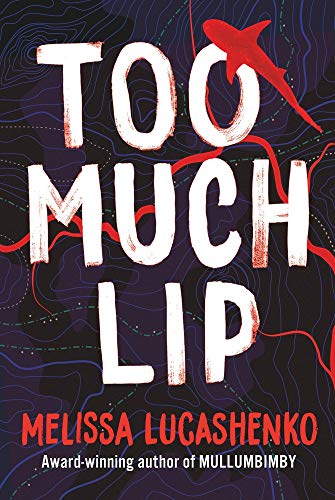
Melissa Lucashenko’s Too Much Lip

Melissa Lucashenko, Too Much Lip (UQP 2018)

Among many splendid things at the National Folk Festival in Canberra at Easter this year was the Mission Songs Project concert featuring Jessie Lloyd, Emma Donovan and Deline Briscoe. Jessie Lloyd has been researching and reviving Aboriginal songs from the mission era (roughly 1901 to 1967) from all over Australia. At the end of a terrific concert Ms Lloyd urged us – mainly non-Indigenous – audience members, to connect, learn and engage with the songs. She wants these songs dealing with the hardships, sorrows and sometimes joys of mission life – to become part of the Australian songbook alongside ‘Waltzing Matilda’ and ‘Botany Bay’. She invited us to recognise Aboriginal and Torres Strait Islander history and cultures as integral parts of mainstream Australian history and culture. (A choir songbook is available for sale at the Mission Songs Project website.)

Too Much Lip holds out a similar invitation, though with less sweet music.

It’s the story of the Salters, an Aboriginal family in northern New South Wales, a story that includes violence, petty crime, child sexual abuse, drug and alcohol abuse, poverty, neglect, dark secrets, seething resentments, alienation and general chaos. It’s what many would call a dysfunctional family, but that’s not a term that seems quite to fit. The central character, Kerry, thinks of it as a ‘grassroots family’ – as if their huge ordeals and conflicts don’t mark them out as special so much as make them representative.

I don’t want to say too much about this book. It’s very funny in places. Kerry arrives back home after a long absence – she’s been part of the Lesbian community in Brisbane and has just been dumped by her girlfriend after a failed armed robbery. Her pitiless sarcasm about white people (dugai) and men, not just white men, sets the tone for the opening sequence, and while she doesn’t exactly soften, there’s some delicious counterpoint when she falls for a … white man. This is just one of the brilliant, comic but believable transformations in the book. Sweet Mary, Kerry’s mother, is a reformed alcoholic; her older brother Ken is a pontificating drunken layabout who bullies his teenaged son; her younger brother, known only as Black SUperman, is a Gay man who lives in Sydney; Steve, the object of Kerry’s lust, is trying to set up a gym in town; Martina, a real estate agent from Sydney, has been seconded to the local office to help the mayor push through a deal that will result in a prison being built on a piece of land that has deep significance for the Salters. And there are a number of children, including the splendidly named Dr No (guess how old he is). In the course of the novel, each of these characters, including the children, reveals something completely unexpected abut themselves, or undergoes a radical transformation. To say that another way: we are invited to make judgements about every one of the characters, and by the end of the book we have revised our judgements radically.

I confess I started reading Too Much Lip with a sense of duty: as a dugai, I really ought to read writing by Aboriginal authors. Well, that’s what got me to page 1, and kept me going through Kerry’s reference to white people as normalwhitesavages, till about page 20, but after that I was there for the joys, sorrows and terrors of the ride.

There are talking birds and a talking shark, a ghost, terrible stories of white-on-black violence and of black-on-black violence (with an afterword asserting that all the incidents have occurred in the author’s extended family or, in a few cases, are drawn from the historical record or Aboriginal oral history). There’s a brilliant extended sequence where the family has a barbecue, and all the threads of the narrative twist together and apart dramatically – I’d say it was chaotic, but the reader is never confused about what is happening and what it means in the lives of each character.

It’s a brilliant book. The last pages sent me back to reread the beginning. Some of the jokes still make me laugh a week after reading them. It puts heart and body into abstract terms like intergenerational trauma, lateral violence, white supremacy. It doesn’t need my recommendation, but I recommend it anyhow.

Too Much Lip was a birthday present. It’s the eighteenth book I’ve read for the 2019 Australian Women Writers Challenge.

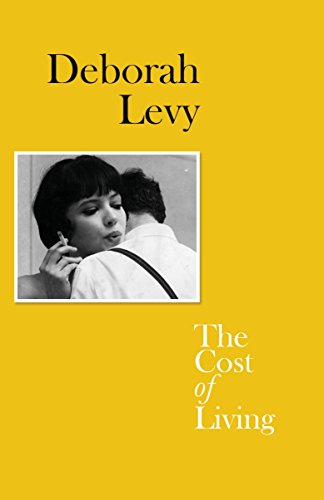
Deborah Levy’s Cost of Living

Deborah Levy, The Cost of Living (Hamish Hamilton 2018)


I’m a member of two book clubs. One of them is all men, and at each meeting we discuss one book that there’s a sporting chance a majority of us will have read. The other is all about swapping books, and there’s a rule (one of many: one club member is a high-flying lawyer) that no book may be discussed for more than 30 seconds. Generally each of us brings three books to the club, and takes a different three home. At our last meeting I borrowed Diane Athill’s Alive, Alive Oh! (my blog post here) and The Cost of Living. I loved Alive, Alive Oh!

The Cost of Living is exactly the book that some writers of genre fiction, disgruntled at being dismissed as of a lesser breed, describe as LitFic. It’s a very short, introspective first-person account of the life of a woman writer after the end of her decades-long marriage, rich with threads of metaphor and learned allusions, studded with aphorisms and beautifully described scenes. It has at least two big subjects: the end of a marriage and the death of a mother. I was half way through it when I happened to read on the dustjacket flaps that it is the second instalment of Deborah Levy’s ‘living autobiography’, the first volume of which is a ‘memoir on writing, gender politics and philosophy’.

I didn’t hate it. I read all 187 pages. But it’s not my cup of tea. Someone who really loved the book might think that’s because I’m a white, heterosexual man of a certain age, eligible for the nickname ‘the Big Silver’ which the narrator/author bestows on one of the book’s many men who patronise, ignore, disregard or otherwise deny the humanity of women. But I didn’t dislike the gender politics as such. I just kept wondering why I should be interested in this book. I got a lot of clues: the author mentions several other books she has written, and a possible movie deal, and famous people she knows (we are carefully informed, for example, that Celia – no second name – the woman who lends her a garden shed to write in, is the widow of the poet Adrian Mitchell*). And of course, the first part of the memoir – Things I don’t Want to Know – may have set the reader up to be interested.

Look, here’s a short passage. It contains a few darlings that should have been killed, though to be fair there are possibly more per square inch than in most of the book. If you like it you’ll probably find the whole book something you can enjoy and benefit from more than I did. She is writing about the gardener who tends Celia’s garden:

Sometimes he’d pick a small bunch of herbs and winter flowers from the garden and bring them to me in the shed. I could not tell him that it was flowers that triggered some of the most painful flashbacks to my old life. How can a flower inflame a wound? It can and it does if it is a portal to the past. How can a flower reveal information about minor and major characters? It can and it does. How is it that a flower can resemble a criminal. For the writer and criminal Jean Genet, the striped uniform of convicts reminded him of flowers. Both flowers and flags are required to do so much of the talking for us, but I am not really sure I know what it is they are saying.

(page 107)

*She’s Celia Hewitt for whom Adrian Mitchell wrote his wonderful poem ‘Celia Celia’ (you can read it here)

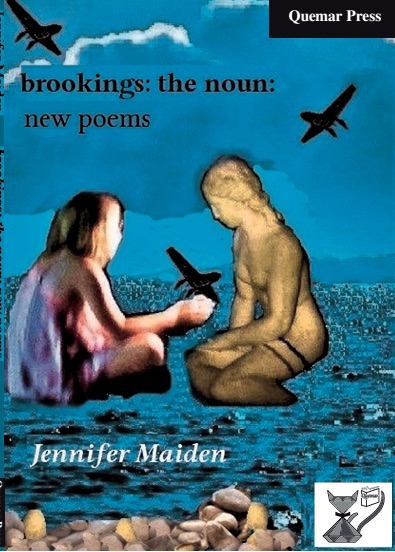
Jennifer Maiden’s brookings

Jennifer Maiden, brookings: the noun: new poems (Quemar Press 2019)

Probably more than any other of Jennifer Maiden’s books, brookings: the noun revolves around a central concept. It’s not that every poem addresses the concept directly, or that there is an overarching narrative, but the notion of ‘brookings’ weaves its way through the book, becoming explicit every so often, taking on new metaphorical form and emotional resonance as it goes.

The simplest description of the concept is in the poem ‘Brookings in Fur’ (which you can read here – you’ll need to scroll down), brookings are defined as

                            things that trickle the Overton window
to the Right by focusing on soft left topics

According to Wikipedia, the Overton window is ‘a term for the range of ideas tolerated in public discourse’: we’ve recently seen, for instance, that veganism is outside the Overton window in Australia, and offshore detention of people seeking asylum barely makes it into the frame. ‘Brookings’ are the right-wing tactic of espousing harmless, even positive policies around education, discrimination, environmental concerns and so on, in order to disguise or make more acceptable the underlying ruthless policies. However, defining the term doesn’t tell you much about the poetry. After all, a similar concept is captured in the phrase ‘lipstick on a pig’ – Maiden’s metaphors are a lot more interesting than that.

The term has at least three incarnations.

First, in ‘Concrete’, which is Jennifer Maiden’s sixteenth poem comprising a flirtatious-reproachful conversation between the re-awakened Eleanor Roosevelt and Hillary Clinton, Eleanor appropriates the name of the US think tank, the Brookings Institution, giving it the new meaning. It’s a straightforward satirical jibe at Julia Gillard, who recently joined the institution. (I have no idea about the politics of the institution, but I do know that Maiden has been caustic about Gillard in earlier poems, and is again in this volume.)

Second (though preceding ‘Concrete’ in this book), in ‘Uses of brookings: the noun’, Maiden discovers rich metaphorical possibilities in the term. This poem draws brilliantly on Henry Wadsworth Longfellow’s poem ‘Maidenhood’ (you can read it here) for the image of a virgin ‘Standing with reluctant feet/ where the brook and river meet’. Longfellow’s maiden is facing the prospect of mature adult life with trepidation; Maiden with a capital M makes something different of the contrast between brook and river:

                        The river beyond soft
brooking glints a deadly global thing.

This image of the soft brooking and the deadly global river recurs in a number of poems.

The third embodiment picks up on that ‘soft’. In ‘Brookings in Fur’ it’s a little creature:

                 soft little Brookings, a silk-nosed squeaker
too gentle for words like Global, War or Money, who
would not know the price of a gun.

The sweet creature embodies the appeal of brookings: we want to believe that those in power are benign.

The poems in this book engage with international politics, corruption and war: allegations about the White Helmets in Syria, Hillary Clinton and Julia Gillard’s dubious practices, Tanya Plibersek’s apparent support for inhumane treatment of people seeking asylum, Israeli snipers’ use of butterfly bullets against Palestinian protestors, the murder of Jamal Khashoggi. (There was a time when you needed a working knowledge of Greek myth and the Bible to be able to read English poetry; with Jennifer Maiden, you need to be reasonably well-versed in current affairs. Readers outside Australia or even outside New South Wales may need to keep Google – or Duck Duck Go if they value their privacy – handy.)

It’s poetry that includes political commentary and analysis, but it would be a mistake to read it as if that’s all it was. One reviewer has sneered at Maiden’s version of the White Helmets as agents/brookings of Daesh, saying she has offered no evidence (here, and her poem in reply here – you’ll need to scroll down). I think that misses the point. Just as people who abhor Les Murray’s politics can enjoy his poems, people who disagree strongly with Maiden’s political positions (and probably everyone disagrees with some of them – I’m agnostic about the White Helmets, for instance) can still embrace her poetry. One of the things that attracts me to her writing, and has kept me coming back for more, is her commitment to engage with the world in a big way, to figure out what she thinks and to say it without prevarication, sermonising or mumblefucking, while striving for a deeply human perspective on her characters (including – unsuccessfully in my opinion – Donald Trump).

These prayer-like lines come as close as any to articulating the impulse behind much of Jennifer Maiden’s poetry:

                          Let her protect me,
great Spirit of the Universe, my ancestral Durga,
with her many limbs, from all that's born to narrow 
the vision to a bright domestic window.
                       (from 'Brookings in Fur')

That is the temptation of ‘brookings’, and it’s a temptation that Maiden’s poetry invariably resists.

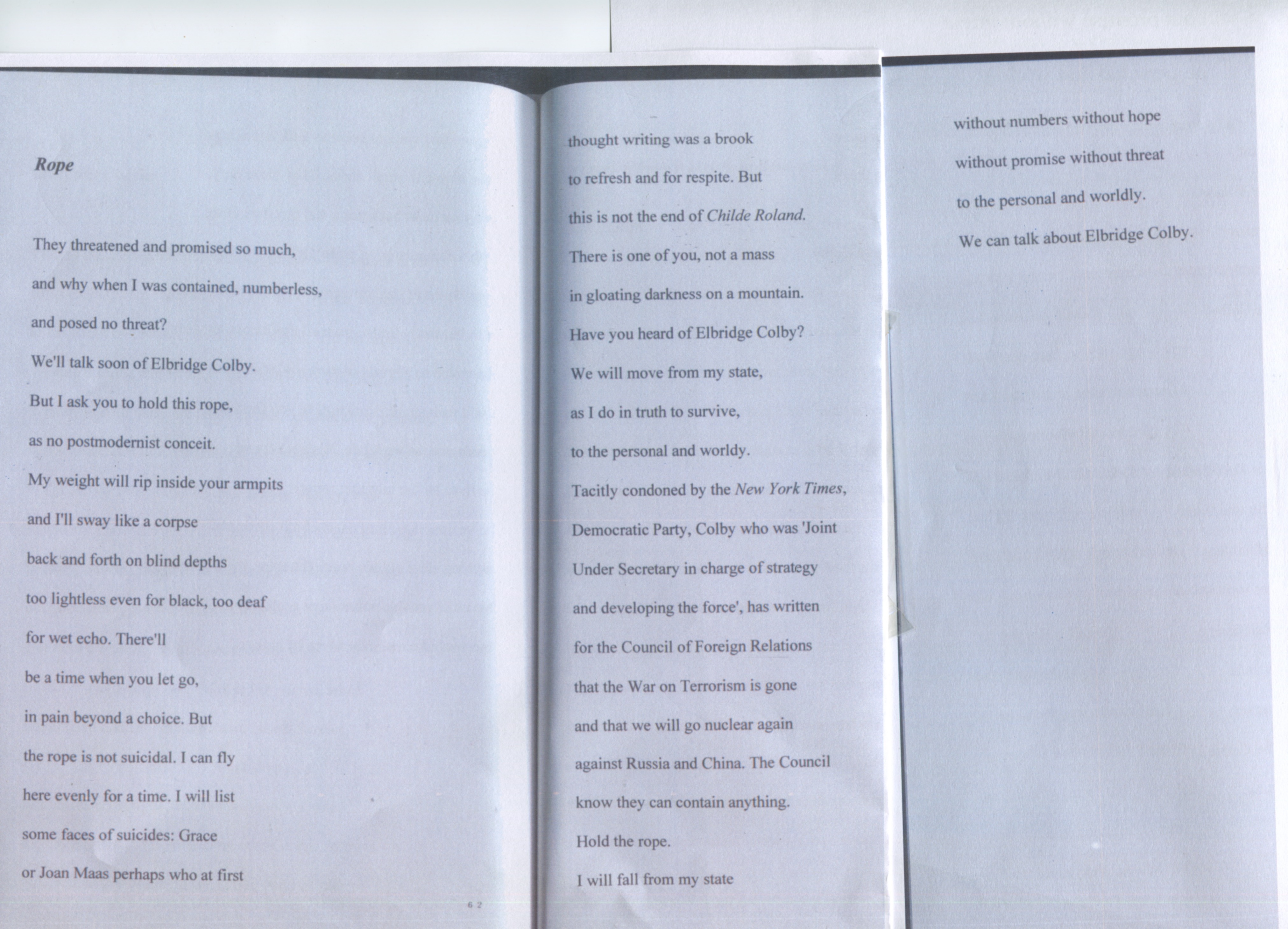
I usually single out one poem for more detailed discussion when writing about books of poetry. Here’s ‘Rope’. Click on the image to big it up, or click here and scroll down to read it in the Rochford Street Review:


If what follows is laborious. Forgive me. Actually reading the poem isn’t laborious at all.

The poem is in three parts. The first four lines set the tone: the speaker, who sees herself as harmless, has been threatened and promised much by a nameless ‘they’ – the fourth line seems to suggest that soon, with talk of Elbridge Colby, some of this will become clearer. The next eighteen lines deal with the speaker’s distressed ‘state’, the poem a rope that prevents her from plummeting into ‘blind depths / too lightless even for black’. After a four-line transition (‘We will move from my state’), there are nine lines about Elbridge Colby, which raise the spectre of nuclear war, and I guess we understand why she is so upset, and who the opening ‘they’ are. The final six lines come close to an expression of despair, though I read the final line, ‘We can talk about Elbridge Colby’, as an assertion of the power of poetry, in the spirit of T S Eliot’s ‘These fragments I have shored against my ruin.’

‘Rope’ is not a typical Maiden poem. I’ll get to that, but first here are some ways it is characteristic.

First, it’s conversational. That’s in the tone, the unobtrusive use of rhyme, and especially in the use of enjambement – many lines end in a word that launches a sentence, creating a constance sense of forward momentum. The sense of a conversation is also there in the way this poem, like many, addresses the reader as a collaborator. The ‘you’ in the fifth line, ‘But I ask you to hold this rope’, seems to imply that the imagined reader in some way helps to preserve the poet from something like deep despair. So when you or I come to it as an actual reader, something uncanny happens – in reading this poem am I somehow holding the rope that saves the poet? If I have trouble with it – have to Google Joan Maas, say – is that my armpits feeling the weight>?

Second, there are a number of kinds of allusions:

  • allusions to poetry that the reader is expected to be familiar with – ‘this is not the end of Childe Roland‘ refers to Robert Browning’s ‘Childe Roland to the Dark Tower Came‘, and a quick web search reveals (or reminds if you’re better read than me) that at the end of that poem the knight arrives at his quest’s goal and sees there all the other knights who had gone on the same quest. Maiden has just listed ‘some faces of suicides’; this line is a way of saying they are not the subject of the poem.
  • allusions to public figures. Usually the poems just assume the reader knows who the public figures are – from Jared Kushner to Dodi, mentioned by Princess Diana. Here there’s no need for a web search, as Elbridge Colby’s identity is explained, but if you want to read his argument, you can click here.
  • allusions to past and present members of Maiden’s poet community. You probably don’t need to know who Grace and Joan Maas are in this poem. But since I’m writing about it: Joan Maas (also spelled Mas) was an Australian poet who died in 1974 – she was the Joan in Roland Robinson’s autobiography, Letter to Joan; Grace is Grace Perry, who has been mentioned in a number of earlier Maiden poems. In the conversational mode of these poems the reader is expected to remember when she was last mentioned.
  • allusions to Maiden’s other poems. That Joan Maas ‘thought writing was a brook / to refresh and for respite’ only takes on its full meaning in a context where (soft, sweet) ‘brook’ implies its opposite, the deadly global river: writing is dangerous.

But the poem is atypical. Maiden’s ‘signature’ poems in recent years have been in the form of dialogues, sometimes between fictional characters, especially her own creations George Jeffreys and Clare Collins, but often between public figures and re-awakened people from the past whom in the real world they profess to admire. These dialogues always have elements of dramatic action. In this book, for example, Tanya Plibersek pours tea for Jane Austen, Donald Trump and his mother chat in the Oval Office, and Kenneth Slessor and an unnamed Australian critic meet by moonlight in the Sydney Botanic Gardens. My sense is that this staging of dialogues, where underlying questions might be, ‘What would Jane say to Tanya about this?’ or ‘What would Donald Trump’s mother say to him and John Bolton?’ opens up possibilities for fresh and unexpected thinking. Maybe it’s possible to see Tony Abbott’s humanity if you imagine him chatting with Queen Victoria (that one’s not in this book).

There’s none of that here. This poem is shockingly direct. In it, in a way, Maiden shows her workings, the puppeteer comes out from behind her curtain. Rather than move directly to Elbridge Colby, or set him up for a chat with, say Mamie Eisenhower, here she starts from her own emotional response. The transition between the two main parts is telling:

We will move from my state,
as I do in truth to survive,
to the personal and worldy.

Many of her poems are about the worldy (an excellent word**, though it may be a typo, as the Rochford Street review has ‘worldly’), and many personalise the subjects they address (as for example, when George and Clare go to Syria). But these lines suggest that there’s some deep and dangerous emotion beneath or behind the political comment and analysis, emotion that cannot easily, or even safely, be addressed directly. And looking at the state of the world, don’t we all have emotions like that?

I am always gripped by a Maiden poem. Rope helps me to understand why.


* Many of Jennifer Maiden’s poems have titles indicating that they belong to one of her sequences or types of poems. For example, the full title of the first poem of the book is ‘DiaryPoem: Uses of brookings: the noun’, and the second’s is ‘Hillary and Eleanor: 16: Concrete’. For simplicity’s sake, I’ve omitted the scaffolding when naming poems.

** I have been informed by the publisher that this isn’t a typo, but a deliberate revision of the Rochford Street Review version. The progression from ‘personal and worldy’ in these transitional lines to ‘personal and worldly’ at the end of the poem adds another level of subtle poignancy.


brookings: the noun is the seventeenth book I’ve read for the 2019 Australian Women Writers Challenge.

Ruby Reads (8): Possum Magic

Julie Vivas and Mem Fox, Possum Magic (Omnibus Boks 1983)

Possum Magic is one of the children’s books I have been most looking forward to revisiting. It was published the year Ruby’s father was born and we enjoyed it together many times over.

Julie Vivas’s images – the tiny possum Hush and elderly grandmother, the miscellaneous Australian native birds and animals who follow their adventures, and the round-bottomed children whose discarded Vegemite sandwiches are crucial to the plot – are as freshly witty and whimsical as ever. And if my experience is anything to go by they still play well with the target audience of 2019.

Early in the book, illustrating Grandma Poss’s magic, there’s a cluster of pink kookaburras. On our second read, try as I might, I couldn’t persuade my reading companion to move on, even though she had clearly enjoyed the whole book on the first pass. This time we’d turn the page, but then turn it right back, over and over. Entering into the spirit of things, I did a version of a kookaburra’s laugh. This was such a great success that I was required to repeat it for what may have been half an hour. I laughed myself hoarse, and every time I tried to change the subject, Ruby would make her wishes known, either by saying ‘Ha ha ha’ or by pointing to the pink kookaburras again.

So yes, the images are magic!

But the story is another thing. Grandma Poss has made Hush invisible, and the pair of them travel all over Australia looking for the way to reverse the magic and make the little possum visible. They discover that Vegemite, pavlova and lamingtons do the trick.

Reading it this time, it struck me that in the hands of a lesser illustrator it would have become a travelogue draped over an implausible narrative, with panoramas of the cities visited, close-ups of the ‘iconic’ white-Australian foods, and so on. Julie Vivas has lifted it to a whole other level, made the magic alive and central, and ensured the book’s longevity.

Possum Magic is the sixteenth book I’ve read for the Australian Women Writers Challenge 2019.

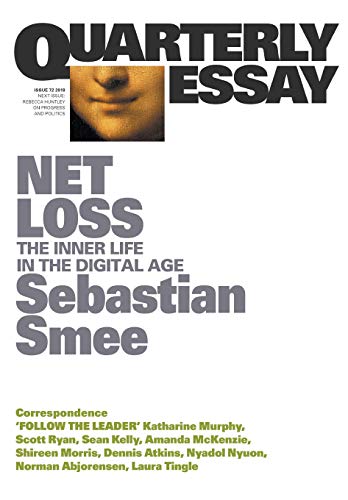
Sebastian Smee’s Net Loss

Sebastian Smee, Net Loss: The inner life in the digital age (Quarterly Essay 72), plus correspondence from Quarterly Essay Nº 73

The cover of the quarterly essay, which includes a small inset image of the  Mona Lisa's smile.

I postponed reading this Quarterly Essay for months for a couple of reasons. First, I didn’t think I’d be able to stand the guilt if I read one more well articulated argument about the dangers of social media. And second, I’ve discovered that I prefer to read a Quarterly Essay after its successor has arrived, so that I can read the follow-up correspondence while the original essay is fresh in my mind.

The guilt factor decreased when I quit Twitter a couple of weeks ago (I haven’t missed it), and then Rebecca Huntley’s Australia Fair (to be read in a couple of months’ time) arrived in my letterbox. So there was no need for further delay. Sebastian Smee’s essay turned out to be a delightful read. If, for reasons of your own, you haven’t read it, it’s not too late for you too to change your mind.

Like many of us, Smee is attached to his fruit-based or other device and a constant user of social media, and feels uneasy about it, not just because of the emergence of what Shoshana Zuboff has called surveillance capitalism, though that looms large in the essay, but also because of how it affects his sense of himself, and his relationships to other people and to the world – what he calls his inner life. ‘Can we protect ourselves,’ he asks

from corporate incursions into our private life by telling ourselves we have some hidden, impregnable inner life to which the algorithms can never gain access? Is this even realistic? It’s very hard to say. One thing we do know is that individual reality is beyond quantification. And cause and effect are always more complex than we like to think. That’ in part because perception itself is almost infinitely fluid.

(page 24)

In a nutshell, that’s the question the essay addresses and the response it comes up with.

The most startling single phrase in the essay is ‘the commodification of our attention’. It’s not Smee’s coinage – a quick web search finds the phrase cropping up in many places. But it encapsulates the way we are being influenced and exploited to contribute to the unimaginably large profits of Facebook, Google and the like.

What Smee does is to embody the kind of attention that has not been whittled down and shaped by social media. He’s a self-described arty type, and here he elucidates the subtleties of passages from Chekhov, explains how a particular painting by Cézanne represents a revolution in ways of seeing, describes and spells out the implications of video works by contemporary artists Ryan Trecartin and Lizzie Fitch. He uses language in a way that invites thoughtful consideration, and stands as a living contradiction to his argument that we have entered an age of distraction.

The correspondence up the back of QE73 is, as always, excellent. The closest thing to a disagreement is a beautiful piece of writing by Fiona Wright, a string of cameos illustrating how her life is enriched by social media. There’s some heavy-duty philosophy from Raimond Gaita. Imre Salusinszky indulges some high-level nostalgia for, of all things, John Hughes’s movie Planes, Trains and Automobiles. Smee responds with the same grace and generosity that permeates the essay itself.

Added 18 April 2019: I’ve just listened to the podcast of David Gillespie talking with Richard Fidler the effects of iPhone and social media on especially teenage brains. It amplifies and makes urgent the gist of Sebastian Smee’s essay. You can get it here.

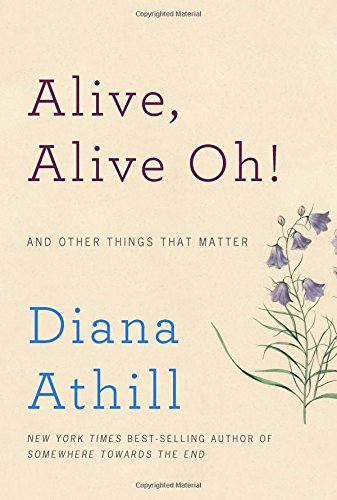
Diana Athill’s Alive, Alive Oh!

Diana Athill, Alive, Alive Oh!: and other things that matter (Granta Publications 2016)

I’m one of the many readers who first met Diana Athill’s work near the end of her long career as editor and writer. The title of her 2008 essay collection, Somewhere Towards the End (link is to my blog post), accurately describes the feel of the book. They were lucid ruminations in the shadow of approaching death.

Eight years later when Alive, Alive Oh! was published, death was still imminent, and in fact Diane Athill died in February this year. If we can judge by this book, she was ready to go – not because life had become unbearable, far from it, but because she had achieved a marvellous sense of equanimity in the face of the inevitable.

You may have to be of a certain age and ethnicity to recognise that the book’s title is from the song ‘Molly Malone’. You can see a haunting version by Sinéad O’Connor / Shuhada’ Davitt on YouTube, but be advised that the eerie melancholy of that song doesn’t reflect the tone of Diana Athill’s twelve short memoir-essays. In her Introduction, she writes that somewhere in her seventies she stopped thinking of herself as a sexual being, and after a short period of shock found that very restful:

I had become an Old Woman! And to my surprise, I don’t regret it. In the course of the ninety-seven years through which I have lived I have collected many more images of beautiful places and things than I realised, and now it seems as though they are jostling to float into my mind.

(p 2)

What follows are some memories of that sort to be sure: the first essay is a loving description of her grandparents’ garden – really an estate, where she spent much of her childhood; the second rejects the common view that the post-war 40s and 50s were a dreary time, and tells of the joys of her life as a twenty-something in those years – the swinging 60s, in her experience, were just an extension of her privileged 50s; and third begins with a brilliant description of the beauties of the island of Tobago, and tells how as a young woman there she came to understand that the pleasurable existence of British tourists and expats was built on the many-faceted exploitation of locals. So the book may be full of beautiful places and things, but it also goes to dark places.

The title essay, ‘Alive, Alive Oh!’, comes fourth. I was expecting a celebration of life in one’s nineties (those essays come later). But no, it’s a vivid account of a pregnancy when she was in her 40s, unmarried but in a solid relationship with a married man. I won’t say more about this essay, other than that it’s a narrative full of suspense, and an outcome that is both expected and surprising.

After that, there are short essays on

  • the ‘peculiarly English middle-class technique for dealing with awkward facts … : if something is disagreeable let’s pretend it isn’t there’, and how it played out in her relationship with her mother
  • clothes and similar luxuries including, in her current life, a wheelchair
  • a wartime romance, which she frames by saying that two valuable lessons life has taught her are ‘avoid romanticism and abhor possessiveness’ – enough to say that the story she tells, while complex, is not an illustration of these lessons
  • favourite books – the ones she lingers on are the letters of Boswell and Byron.

There’s a substantial account of her decision to move into a home for old people (a very posh one, it turns out). This is full of elegant reflections on ageing. For instance:

Old-age friendships are slightly different from those made in the past, which consisted largely of sharing whatever happened to be going on. What happens to be going on for us now is waiting to die, which is of course a bond of a sort, but lacks the element of enjoyability necessary to friendship. In my current friendships I find that element not in our present circumstances but in excursions into each other’s pasts. A shared sense of humour is necessary, together with some degree of curiosity. Given those, we become for each other wonderfully interesting stories, which arouse genuine concern, admiration and affection.

(p 112)

And this, from the final essay ‘Dead Right’, on the prevailing attitudes to dying among her fellow residents:

Death is no longer something in the distance, but might well be encountered any time now. You might suppose that this would make it more alarming, but judging from what I now see around me, the opposite happens. Being within sight, it has become something for which one ought to prepare. One of the many things I like about my retirement home is the sensible, practical attitude towards death that prevails here. You are asked without embarrassment whether you would rather die here or in a hospital, whether you want to be kept alive whatever happens or would prefer a heart attack, for instance, to be allowed to take its course, and how you wish your body to be disposed of.

(p 159)

When I blogged about Somewhere Towards the End, I said I wouldn’t mind having a mind like Diana Athill’s when I’m 90. Make that 97.