Category Archives: Books

From my 70th birthday party

The party to celebrate my 70th birthday on Friday was, among other things, a kind of talent show: people sang, recited poetry, did classroom activities, sketched, knitted socks and conducted a blindfold taste test. (I make no bones about hating eggplant, baba ghanouj excepted, and one of my sons blindfolded me and offered me five variants of the loathsome stuff: I’m glad to report I hated them all, sight unseen.)

Most of the splendid creations were very much of the moment, but I have Tristan White’s permission to share this, which his mother read in his absence.

From Chifley to Turnbull – 70 Years of PMs

In seventy years you’ve seen many a prime minister,
the great and the average and the downright sinister.
You probably remember them but if you’re out of the loop,
let me flash back so that you can recoup.

You were born under pipe-toting Benedict Chifley,
who had his time up by far too swiftly.
The Bathurst train driver, the ‘Light on the Hill‘,
a ‘fine Aussie‘ that Labor cherish still.

Then began a Liberal fraternity,
twenty-three years was about an eternity.
For sixteen Robert Menzies took up the rein,
winning eight elections in his own name.
British to the bootstraps! English to the eye!’
And he’d love the Queen till the day he’d die.

Sir Bob finally stood down to give Harold Holt way,
to follow the lead of LBJ.
He added a new set of coins to the mix
on the fourteenth of February sixty-six.
But just as his second anniversary neared,
he went for a dip and then disappeared.
We looked for him all across the seas,
and theorised some conspiracies,
but we knew before long that his prospects were grim,
so we instead had a swimming pool named after him.

The Liberals then voted in Senator Gorton,
but just three years later they chose to deport him.

Billy McMahon had failed to impress
except for the crack in his wife Sonia’s dress.
It was definitely Time in ‘seventy-two,
the men and women of Aus needed something brand new.

Free healthcare and uni; conscription was off!
For all this and more, we can warmly thank Gough.
But things then began to go downhill from there:
the block of supply; the Loans Affair,
and on November eleventh, well may we say,
that Australia had its craziest day.
The Governor-General had Whitlam dismissed,
Kerr’s cur came in being booed, scoffed and hissed.

Yet he nonetheless won the coming election
giving Gough and his crowd a wholehearted rejection.
Despite being unloved, we kept Fraser empowered
for two more terms, with his Treasurer Howard.
Life is delightful, but not meant to be easy!
he said, making us all feel a little bit queasy.

But in eighty-three when Labor’s hope was but fadin’
they drafted in Hawke to replace Bill Hayden.
He carried the party up out of the fog
though it could have been won by a drover’s dog.
I take total responsibility,‘ wept Fraser,
as though his toughness had been cut with a razor.

Hawky, who was branded the Messiah by some,
claimed a ‘boss who sacks someone today is a bum!
The dollar was floated, we’d be reconciled,
And ‘a life in poverty would be had by no child!
He gave Labor four wins in rapid succession
but we then had to have, of course, the recession.

Bob had forged a great partnership with his Treasurer Keating,
though leadership tensions had now started heating.
After challenging once Keating said, ‘Let me be plain:
I had one shot in the locker. I won’t fire again!’

But just six months later, our leader was Paul,
whose ninety-three victory was the sweetest of all.
His ‘big picture’ vision went to the front of the screen:
Get a new flag! Get rid of the queen!’
He had a caustic tongue and declared, ‘Holy moley!
I’m going to do John Hewson slowly!
Mr. Mediocrity will never get us;
it’s like being flogged with a warm piece of lettuce!
He’s like a lizard on a rock – alive but looking dead.
Scumbags! Corporate crooks! Rust buckets!‘ he said.

But Redfern and the speech to the unknown soldier,
and Mabo and APEC and super were much bolder.
‘We excluded and murdered without asking,’ said he,
how would I feel were this done to me?’
He may have seemed arrogant but he wasn’t a coward,
though was hit out with baseball bats for Honest John Howard.

I won’t say sorry! No way will there be,
never ever!‘ he said, to a GST.
‘We’ve been welcoming to all who have travelled our way,
but we will decide who’s invited to stay.’
He followed George W. Bush into war
and acknowledged that some of his promises were non-core.

In twenty-oh-seven things eventually soured
with the WorkChoices bill, and it tore apart Howard.
We loudly responded when he did not retreat;
we threw out his party and he lost his own seat!

‘I’m Kevin,’ he said, ‘and I’m just here to help.’
‘I’m going to ensure an equal share of the wealth.’
He got us through the GFC but then
he was out of the picture by twenty-ten.

When Gillard took over we didn’t know what to say,
being told that a ‘Good government was losing its way,
but we’re going to move forward with all that we’ve got:
our seventy-two, Greens, Windsor, Oakeshott.’

She got through plenty that was a success,
BN, Gonski, the NDIS.
But there was one pledge that did not succeed:
There will be no carbon tax under my lead!
The press was hostile and tried to defame:
Ju-liar!’ ‘Ditch the witch!’ ‘Her dad died of shame!

But enough was enough and her attack unfurled
with a blistering speech that went ‘round the world.
‘Misogyny and sexism, I’m not a fan!
But I will not be lectured on it by this man!
If he wants to see it, he needs a mirror!’
For a long fifteen minutes Abbott seemed to fear her.
An easy three years and three days it was not,
but as the first lady up there she gave her best shot.

Rudd said through the chorus of faceless men,
I’m a man of my word! I won’t challenge again!
But he nonetheless managed a brief resurrection
before we kicked the mob out at the ‘thirteen election.

‘We’ll do what we say! These are the facts!
We’ll stop the boats! End the waste! Get rid of the tax!
No cuts to health or your uni degree!
No cuts to the SBS or ABC!
Polling day is soon! We need more supporters!
Remember, I’m the guy with the not-bad looking daughters!

But it wasn’t long before we saw his team drift,
because the ‘gospel truth’ statements were only those on a script.
I’ll shirtfront Vlad Putin! You bet you are!
But that infamous threat was little more than a spar.
Housewives do the ironing!’ The onion. The wink.
The suppository of wisdom!’ Did he even think?
Canadia!’ ‘Those visually awful wind farms!’
And the ‘nothing but bush‘ remark that had natives in arms.

But it wasn’t just Abbott who seemed way too cocky;
it ran through his cabinet to Treasurer Hockey,
the man being caught out chomping cigars.
Entitlement’s over! The poor don’t have cars!
Get a good job that pays you good money!’
If it weren’t so sad, it would just be plain funny.

We woke up on Aus Day to a terrible fright
to hear that Prince Philip had been made a knight
a ‘friendless decision‘, a captain’s call,
the beginning of Abbott’s dramatic downfall.
His ‘near death experience’ was survived, he would say,
On the pledge that ‘good government will now start today.’
But the Speaker, we then found out, chartered a chopper.
After three weeks of agony he was then forced to drop her.

A week short of the poll to be held in Canning
we found out what Mal and his allies were planning.
We’re not like Labor!’ Tone was heard griping,
‘But I’ll give Turnbull no undermining, wrecking or sniping!’
Mal swore that Bill Shorten would be easy to beat,
yet his Jobs and Growth mantra held him just by one seat.

It’s been hard to be PM for innovation
with scandals and Trump and a resurgent One Nation.
He claims to be strong, but it’s not the same story
as the failed plebiscite or the deflection of Cory.
Mr. Harbourside Mansion then went on a rant,
Calling Shorten a ‘parasite and sycophant‘.
How is renewable energy on a roll
when his treasurer comes in with a big lump of coal?

So now with a party divided and split
and Abbott looking for a big direct hit,
will Malcolm make it past twenty nineteen?
The jury’s still out and that’s yet to be seen.
But for now that’s the end of my little rhyme,
so let’s just enjoy this most exciting time.

Kim Mahood’s Position Doubtful

Kim Mahood, Position Doubtful: Mapping landscapes and memories (Text 2016)

pd.jpgSome time in 1997, Kim Mahood was chatting with the mother of the young manager of the Tanami Downs cattle station in the Northern Territory. A fragment of that conversation made it into this book:

– I love this country, she said. People don’t understand. There aren’t words to describe it.

One way of reading Position Doubtful is as Mahood’s attempt to find ways of communicating her love of that country, not  in any easy sense, but as the complex engagement of one who ‘feels an almost cellular affinity to a place that has been constructed by a different cultural imagination’: she spent her late childhood and early teenage years in ‘a tract of country that extends across the Tanami Desert to the edge of the East Kimberley’ and has been returning to it now for twenty years.

Though Mahood writes beautifully, words aren’t her only means of communication. Among other things the book describes a number of art projects that grapple with her relationship to the country. As well as her own works, and more interesting than them in the telling, are her collaborations with artist Pam Lofts on surreal photographic works involving high heels and a rowboat in the desert; and with people – mostly women – from Aboriginal communities to create large maps annotated with Indigenous and non-Indigenous place names, the names of people, history and Dreaming stories. The book’s first paragraphs invite us to think of the book as just such a map – ‘position doubtful’ is an annotation from an old map of the desert, a term that satellite technology has rendered obsolete, though it retains its power here to describe ‘the way in which white Australians move through and occupy the country, especially the less accessible parts of it’.

To engage with the land is to engage with the people who live there, so the book includes riveting accounts of cross-cultural relationships, in which Mahood has a ‘position doubtful’ status as insider–outsider: she’s not Aboriginal, but people who know her acknowledge that she is from that place. Sometimes the old women expect her to know things and she has to consult her GPS device surreptitiously so as not to disappoint them. Her half-in-half-out status gives a vivid intimacy to her descriptions of life at the Balgo Art Centre and the tiny community of Mulan, her accounts of a number of mapping projects, the Canning Stock Route Art Project, an archaeological expedition with (among others) Mike Smith, author of The Archaeology of Australia’s Deserts.

This is not a drop-in account of life in remote Australia. It’s in part a memoir about friendship, including a number of bereavements, in part a reflection on an artistic practice, in part a record of Aboriginal testimony. Some of the interactions with Aboriginal women are so intense – some funny, others tragic – that it’s a relief to read towards the end that Mahood read large parts of the book to people at Mulan:

I face the assembled group with my manuscript.
– I’ve been working with you for a long time, I say. I’ve written down your stories, I’ve mapped your country with you, I’ve made a radio program, I’ve helped to write books about you and for you. Now it’s my turn. I’m going to tell my side of the story.
I read everything I think might offend or upset people. Bessie is not sure about the moment on the Canning Stock Route trip when we all say we stink, but the others laugh and tell her that it’s really funny. Many of the people in the room are not literate, but the context, the animation I bring to the reading, the knowledge people have of the events and places, transcends the barrier of language….
When I stop reading they demand more. Seeing themselves through my eyes is a beguiling novelty. The ancient authority of storytelling maintains its power to captivate.

It maintains that power for me too. I think this book will engross anyone who grew up in rural Australia, and especially, I imagine, in desert regions knowing traditional Aboriginal people. It will grip anyone interested in Western Desert art, or the question of how to live awarely as a non-Indigenous Australian My one sorrow is that almost all of the reproductions of art works in the paperback edition are too small and muddy to be of much use. The book cries out for an edition with larger, full-colour illustrations.

aww2017.jpgPosition Doubtful is the third book I’ve read for the 2017 Australian Women Writers Challenge.

Cavafy for the first time

C P Cavafy: Collected Poems, translated by Edmund Keeley and Philip Sherrard (Chatto & Windus 1990)

0701136626.jpg Constantine P Cavafy (Kavafis/Kavaphes) is one of the many literary giants I haven’t read. This relatively slender volume offered a way to put that right.

Cavafy (1863–1933) lived in Alexandria for most of his life. He published little poetry while alive, mainly printing poems off privately and giving copies to friends and visitors. Though he spoke fluent English and other languages, he wrote poetry only in Greek. E M Forster was impressed: the two men’s meetings are beautifully imagined in Damon Galgut’s novel Arctic Summer. Cavafy’s quiet reputation in the literary world was solid by the time he died and grew hugely after that. Lawrence Durrell’s Alexandrian novel Justine (1957) introduced him to a wide Anglophone readership. Leonard Cohen’s beautiful ‘Alexandra Leaving’ is a loose rendering of Cavafy’s ‘The God Abandons Antony’. Martin Johnston, the most awesome intellectual of my university days in the early 1970s, referred to him, along with Borges, Seferis, Berryman and others who didn’t turn up on the Eng Lit course.

You can see why I’ve felt there was a Cavafy-shaped gap in my education.

And now there isn’t, though I think this is poetry you’d need to read in the original Greek to really read it. And you’d need to know a lot more of the history of Alexandria, from ancient times to modern decadence, to enjoy it. And it might help if nostalgia for a real or imagined youthful homoeroticism was your thing.

There are some wonderful poems: ‘Waiting for the Barbarians‘ and ‘Ithaka‘ are justly famous. And there are plenty of incidental pleasures. Of the poems set in the ancient world, ‘The footsteps’, which may have had satirical resonances in the early 1900s, certainly does in 2017:

Eagles of coral
adorn the ebony bed
where Nero lies fast asleep –
callous, happy, peaceful,
in the prime of his body’s strength,
in the fine vigour of youth.

But in the alabaster hall that holds
the ancient shrine of the Aenobarbi
how restless the household deities!
The little gods tremble
and try to hide their insignificant bodies.
They’ve heard a terrible sound,
a deadly sound coming up the stairs,
iron footsteps that shake the staircase;
and, faint with fear, the miserable Lares
scramble to the back of the shrine,
shoving each other and stumbling,
one little god falling over another,
because they know what kind of sound that is,
know by now the footsteps of the Furies.

The place where I engaged most with Cavafy is where the poetry deals with the struggle between Christian and pagan moralities. He comes down pretty clearly on the side of the pagans, th0ugh Julian the Apostate doesn’t fare much better than the grey, repressive Christian authorities. Read in that context, the many poems about young men with beautiful lips that have performed or might perform forbidden or shameful deeds come to seem less deadeningly masturbatorial. And it was one of those poems, it turns out, that Martin Johnston included in his 1973 book, Ithaka: Modern Greek Poetry in Translation, three years before the first edition of the book I’m discussing.

Because I can’t read Greek, and felt underwhelmed by the language of this poetry, I did a little triangulation, comparing Martin’s ‘On a Ship’ (MJ), Keeley and Sherrard’s ‘On Board Ship‘ (K&S) and Daniel Mendelsohn’s ‘Aboard the Ship‘ (DM). If anyone thought translation was a straightforward business, they’d surely be prompted to think again by those three titles, all faithful translations but each different from the others. When I ran the original ‘Του πλοίου‘ through Google translate, it gave a fifth version: ‘Ship’s’.

You can look up all but Martin’s at the links. Here’s his translation:

On a Ship
It looks like him, certainly, this small
pencil depiction of him.

Executed quickly, on the ship’s deck,
one magical afternoon,
with the Ionian sea all round us.

It looks like him. But I remember him more beautiful.
he was sensuous to the utmost,
and that illuminated his expression.
He seems more beautiful to me
now that my soul must call him out of time.

Out of time. All these things are very old,
the sketch and the ship and the afternoon.

Though the translations differ as much as their titles, only a handful of words seem to have been troublesome:

  • MJ’s ‘more beautiful’ is ‘better looking’ in K&S and ‘handsomer’ in DM. Each of the translators seems to have chosen a different position in the gender politics of the word. Google Translate opted out, giving ’emorfo’.
  • Where MJ has ‘sensuous to the utmost’, K&S have ‘almost pathologically sensitive’, and one suspects that while ‘pathological’ might be fine in Greek it’s in a wrong register in Engish. DM has, ‘To the point of illness: that’s how sensitive he was.’ And K&S had a second go at it: their online version has ‘sensitive almost to the point of illness’. It does seem that MJ was squibbing it to avoid any reference to illness, and ‘sensuous’ rather than ‘sensitive’ may have been simply wrong.. Google Translate offers ‘disease was a beautician’.
  • MJ’s ‘my soul must call him out of time’ compares well with DM’s ‘my soul recalls him, out of Time’, because ‘recall’ in English has lost all sense of summoning, and that does seem to be needed, as K&S have ‘my soul brings him back, out of Time’.

Comparing these translations, and Don Paterson’s looser ‘The Boat‘ (‘more handsome’, ‘so much the sensualist’, ‘my heart calls him / from so long ago’), is a way of staying with the poem long enough for it to sink in a little, to feel the care for language that has gone into it, and to catch the whiff the memento mori that emanates from it. Maybe (of course?) this will be so of much more in this book if I come back to them.


Ramapada Chowdhury’s Second Encounter

Ramapada Chowdhury, Second Encounter (Je Jekhane Danriye 1972, translation by Swapna Dutta,  Niyogi Books 2016)

9385285440.jpgIt’s easy for English-speaking readers to forget that a vast amount of writing exists in the world independent of the English language: neither written in English nor translated into it. In India, I’m told, there are a number of languages in which novels can find much greater audiences than the one we Anglophones arrogantly assume to be universal.

Bengali is one of those languages. It’s the language of the great filmmaker Satyajit Ray and Nobel laureate Rabindranath Tagore, and we Anglophones are fortunate enough to have had at lest some of their work translated for us. (Satyajit Ray was one of the names my oldest brother used to conjure up the great world of Culture when he came home from his first term at University – along with Tolstoy, Tchaikowsky and Kurosawa.)

jejakhanedanriye.jpgRamapada Chowdhury’s 1972 novella Je Jekhane Danriye is a gem that would have remained invisible to non-Bengali readers if Swapna Dutta’s love for it hadn’t led her to make it available to us. A film version was released in 1974, but there’s very little information about it on IMDB. The poster for the film seriously misrepresents the book.
It’s a story of young love revisited: two people, each married with a child, meet up again after a twenty-year separation. In their teenage years they had lived near each other and developed a mutual infatuation, which was never consummated in so much as a direct exchange of words. Each of them has cherished the thrilling memory and found solace in it in the midst of humdrum reality, and now it seems a spark has been reignited.

But this is not a Mills and Boon romance. The emotional weight of the book hangs on the question of what twenty years can mean in a person’s life. Not only do individuals mature and make choices, but social mores change: while twenty years previously young people could only gaze raptly at each other from their restricted lives, the current teenagers roam the countryside together day and night. Both main characters agonise over the meaning of their rekindled feelings, for themselves, for each other, for their spouses, and for their children (who are engaged in a teenage romance of their own).

By serendipity, I’ve been reading the poems of C P Cavafy at the same time as Second Encounter. I plan to write a little bit about Cavafy in a couple of days, but for now I just want to refer to the many poems in which a fifty year old man looks back yearningly to objects of desire from his 20s. Cavafy’s poems never test nostalgic desire against any kind of reality. He would probably have rejected Second Encounter‘s meditations as appallingly anti-romantic, but I can’t help feeling he might have been a happier human if he had read it and taken its wisdom on board.

In case you’re interested in learning more: I came across a documentary on Ramapada Chowdhury on YouTube, made, I think, by one of his grandchildren. Now in his 90s, he mentions this little book, which the English subtitles call Where One Stands, and says that it was influenced by ‘One Day after 20 Years’, a poem by Bengali poet Jibanananda Das (there’s a poem at that link called ‘After 25 Years’, which may be the one he means).

Halldór Laxness’s Independent People

Halldór Laxness, Independent People (©1934–1935, translation by James Anderson Thompson 1945, Vintage edition 1997)

ip.jpgMy Book Group read Hannah Kent’s debut novel Burial Rites – set in Iceland in 1830 – in November. A number of friends said I should read Independent People by Icelandic Nobel laureate Halldór Laxness, a book beside which Burial Rites looked shallow. It took a while for IP to become available from the library, and it’s a long book, but at last  I’ve read it.
Let me deal with the Hannah Kent comparison first: to say that a novel isn’t as good as Independent People is like saying a play isn’t as good as King Lear, or a science fiction movie pales beside Bladerunner. The book is monumental. Everything I have ever heard or read about Iceland is in its pages: the landscape, the banking system, the poetry, the weather and the sheep – mainly terrible weather and diseased or starving sheep. Grímur Hákonarson’s wonderful movie Rams could have been a postscript. The current dominance of Iceland’s conservative Independence Party suggests that the book’s satirical probing of the notion of independence is as relevant now as it ever was.

The protagonist, Bjartur, having worked for a relatively rich farmer for eighteen years, has managed to get possession of a small, unpromising and possibly cursed piece of land. He moves in with his bride, and lives a life of unremitting labour and deprivation, refusing all help in the name of independence. It’s not giving too much away to say that things go badly for him in every conceivable way, and he – inspired by the heroes of the sagas – struggles on, defiant and misanthropic. Humans and animals die hearbreakingly, some of the latter at his hand, and some of the former as a direct result of his obduracy or as a result of their resistance to it. Whenever a glimmer of hope shines through the blizzard of Bjartur’s life, the reader braces for the moment when he will sabotage it. And when prosperity comes to Iceland thanks to the First World War, it’s only a matter of time before all is once again grim.

The book was published about the same time as Steele Rudd’s On Our Selection, the once much loved collection of stories about families struggling on small farms in Australia. It’s hard to imagine a greater contrast to the way Rudd’s Dad and Dave face adversity together, with naive, cheerful resilience.

For all its grimness, the book is a delight. Bjartur is an unforgettable character. So are the young woman unlucky enough to be married off to him, and their daughter, and his youngest son, Nonni, who I read as representing the author’s point of view (not to give too much away, he escapes and we glean that his new life in America is relatively OK). There are wonderful minor characters, of whom my favourite is the Bailiff’s wife, described as pope-like, presumably with plump Pope Leo X in mind, who ceaselessly spouts romantic nonsense about the joys of rural poverty. I also love the chorus of small farmers who meet regularly and amidst their main talk of sheep disease and weather, pronounce on economics, politics and metaphysics.

The writing is wonderful. As a child of the town with the highest annual rainfall in Australia, I loved this passage (not least for the way it makes us understand that a woman wouldn’t have to be neurotic, as she is described in the last sentence, to be miserable in that place):

Shortly afterwards it started raining, very innocently at first, but the sky was packed tight with cloud and gradually the drops grew bigger and heavier, it was autumn’s dismal rain that was falling – rain that seemed to fill the entire world with its leaden beat, rain suggestive in its dreariness of everlasting waterfalls between the planets, rain that thatched the heavens with drabness and brooded oppressively over the whole countryside like a disease, strong in the power of its flat, unvarying monotony, its smothering heaviness, its cold, unrelenting cruelty. Smoothly, smoothly it fell, over the whole shire, over the fallen marsh grass, over the troubled lake, the iron-grey gravel flats, the sombre mountain above the croft, smudging out every prospect. And the heavy, hopeless, interminable beat wormed its way into every crevice in the house, lay like a pad of cotton wool over the ears, and embraced everything, both near and far, in its compass, like an unromantic story from life itself that has no rhythm and no crescendo, no climax, but which is nevertheless overwhelming in its scope, terrifying in its significance. And at the bottom of this unfathomed ocean of teeming rain sat the little house and its one neurotic woman.

There’s a lot that’s quotable, though not much that would find its way onto inspirational wall hangings. Some typical aphorisms:

Come what may and go what may, a man always has the memories of his dogs. Of these at least no one can deprive him.

The life of man is so short that ordinary people simply cannot afford to be born.

What does it matter if a man has to live in a little mud hut all his life when his life, if you can really call it a life, is so short?

The most unpleasant feature of midwinter is not its darkness. More unpleasant still, perhaps, is that it should never grow dark enough for one to forget the endlessness of which it is a symbol.

I could go on.

I just want to say a little bit about the translation. Evidently it took J A Thompson eight years to write the English version, and he did it in consultation with Haldór Laxness. The translation has a strong voice of its own, an assurance that means the tone is always absolutely clear – as in that ‘neurotic’ in the passage above. It’s a brilliant piece of writing in its own right. I was happy to find a 2014 English-language MA dissertation for the University of Iceland, The Creative Translator: Creativity and Originality in J.A. Thompson’s Translation of Halldór Laxness’ Sjálfstætt fólk by Abigail Charlotte Cooper (PDF here), that discusses some of the issues.

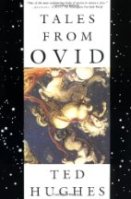
Ted Hughes’ Tales from Ovid

Ted Hughes, Tales from Ovid (Faber & Faber 1997)

0374525870.jpg

‘Why are you reading that?’ the Emerging Artist asked with genuine curiosity. Unvoiced supplementary clauses hung in the air: ‘… when you don’t have to?’  ‘… when the world is going to hell in a handcart?’

I said, ‘I bought it on impulse when I was spending my voucher at Sappho’s.’ I could have explained the impulse further. I regularly ran into Ovid’s poetry in my years of Latin at school and university, mainly in unseen passages for translation. His sometimes racy retellings of miraculous transformations have had a huge afterlife – they live on in George Bernard Shaw’s Pygmalion (source of My Fair Lady), Yeats’s Leda and the Swan, and commonplace phrases like ‘the Midas touch’ or ‘the narcissistic president’. According to Clive James, Shakespeare knew the Metamorphoses by heart. I liked the idea of reading the original – though not enough to wrestle with the Latin. So I was drawn to a book described on its back cover as ‘the best rendering of Ovid in generations’.

Ted Hughes published this version of 24 of the 250 stories from the Metamorphoses the year before he died. It doesn’t read as if it was written by someone winding down. From the urbane, orderly originals in which line after line conforms to the strict scanning requirements of epic hexameter, he produced a collection that is richly varied in form, and gives close attention to physical, even visceral sensation.

The first section, eighteen pages long, tells a creation story, followed by a flood story – a striking reminder that the Hebrew Bible stories didn’t exist in isolation from the surrounding cultures. And the next 20 pages tell the story of young, ambitious Phaethon, who rode the sun’s chariot across the sky, lost control and nearly destroyed the world, a story that reads – in Hughes’s version – as a worst-case scenario for climate change brought about by reckless abuse of natural resources. Here’s the section where the Goddess of Earth pleads with the supreme God:

She choked in a squall of ashes.
‘See my hair singed to the roots,
My eyes cauterised by your glare.
Are these my reward
For my fertility, my limitless bounty,
My tireless production?
Is this my compensation
For undergoing the ploughshare,
The pick and the mattock,
My flesh gouged and attacked and ground to a tilth
Year in and year out? Is this how you pay me
For foddering fat beasts,
For plumping the milky grain that suckles man,
For concocting the essences and rich herbs
That smoke on your altars?

And then the book settles down to less cosmic tales, but tales that are a long way from having lost their sting: Proserpina, Echo and Narcissus, Venus and Adonis (and Atalanta), Pygmalion and Galatea, Pyramus and Thisbe (darker than the Midsummer Night’s Dream version); Midas, Tiresias and Arachne; the birth of Hercules (a truly terrible labour for his mother Alcmene, who was sabotaged by the god who usually helps labour go well), the incest of Myrrha (‘Hatred for one’s father is a crime. / Myrrha’s love for her father / Was a crime infinitely worse’), Niobe (all I knew was that she wept, now I know why!), Actaeon turned into a stag for seeing Diana naked, Erysichthon condemned to starve (the most graphic story in the book, and completely new to me), and more.

There are occasional apparently anachronistic scientific terms, but Hughes generally stays true to the cosmology and geography of the original. There are many references to other classical stories, some of which I recognised from my childhood reading of Kingsley’s Heroes, many not, but it doesn’t matter. It’s a terrific read.

Now I want to geek out about translation for a while, so feel free to stop reading.

Having struggled with translation of Latin poetry in my distant youth, I was aware that this book is in no way a literal translation. Occasionally, I’d be struck by a vivid phrase or sentence and surmise that the Latin original was just two words, a noun and participle (not even a full verb).

I wanted to have a close look at a passage. Somehow I ended up with part of the story of Pygmalion. In case someone reading this doesn’t know the story, Pygmalion is a sculptor who can’t stand actual women but sculpts his ideal woman out of ivory. Besotted with his creation, he prays to Venus, and she answers his prayer by bringing the statue to life. I picked 20 lines of the original in which he falls in love (creepily) with the statue, then – deferring to my need and yours to do other things – I cut it down to five lines.

The original, Book Ten, lines 254-258:

saepe manus operi temptantes admovet, an sit
corpus an illud ebur, nec adhuc ebur esse fatetur.
oscula dat reddique putat loquiturque tenetque
et credit tactis digitos insidere membris
et metuit, pressos veniat ne livor in artus

Here’s a very literal translation:

Often he moves his hands to the work, testing whether it be
flesh or ivory; nor does he yet acknowledge it to be ivory.
He gives kisses and thinks they are returned, and he speaks, and grasps
and believes his fingers sink into the parts he has touched,
and fears that bruising may appear on the limbs when they have been pressed.

Even this isn’t word-for-word, because word order doesn’t matter in Latin the same way it does in English, and in Latin you can tell which words belong together by their endings (it is the hands/manus that are testing/temptantes, which is hard to convey in English). A thing that is kept in this translation is the absence of a pronoun for the statue after ‘it’ (illud) in the second line – important to the sense that Pygmalion is dealing with inanimate matter, but awkward in English. A lot else is lost, which is of course why non-literal translation is desirable. We’ve lost the way metre works in the original: every line ends with the same sequence of long and short syllables – long-short-short-long-long (though the last is occasionally short) – which creates a particular kind of music. We’ve also lost (and I have no idea if Ovid’s first readers cared about it) the use of rhyme and other repeated sounds: dat (gives) and putat (thinks) in the third line, say, and especially the metrically complex repetition of ebur (ivory) in the second line, echoed by livor (bruising) in the fifth.

A search on the internet found a verse translation that stays very close to the original. It’s by Rolfe Humphries (1954), in six lines of blank verse:

He would often move his hands to test and touch It,
Could this be flesh, or was it ivory only?
No, it could not be ivory. His kisses,
He fancies, she returns; he speaks to her,
Holds her, believes his fingers almost leave
An imprint on her limbs, and fears to bruise her.

This has some of the metrical formality of the original, but the other lost things stay lost, and the demands of English mean that the statue becomes a ‘she’ – anticipating the transformation that doesn’t actually happen until more than 20 lines later in Ovid.

The most famous translation by an established English poet is by John Dryden (1631-1700). Here’s the relevant passage, which throws careful word-by-word accuracy to the wind:

The Flesh, or what so seems, he touches oft,
Which feels so smooth, that he believes it soft.
Fir’d with this Thought, at once he strain’d the Breast,
And on the lips a burning kiss impress’d.
‘Tis true, the harden’d breast resists the gripe,
And the cold lips return a kiss unripe:
But when, retiring back, he look’d again,
To think it iv’ry, was a thought too mean:
So wou’d believe she kiss’d, and courting more,
Again embrac’d her naked body o’er;
And straining hard the statue, was afraid
His hands had made a dint, and hurt his maid:
Explor’d her limb by limb, and fear’d to find
So rude a gripe had left a livid mark behind:

In place of the epic hexameter, Dryden uses the heroic couplets beloved of seventeenth century English poets. It hums along OK, but it takes more than twice as many lines – possibly because English needs more words anyhow, and because English has a much bigger storehouse of synonyms, but also because the need to find rhymes meant the text had to be expanded. Dryden’s strategy was to give more titillating detail: touching becomes straining, courting, embracing and exploring; we’ve got flesh, a breast, lips, nakedness, none of which is named in the Latin. The creepiness of the set-up is much emphasised. The statue is ‘his maid’, definitely now ‘she’ rather than Ovid’s ‘it’.

Here’s Ted Hughes on page 136:

Incessantly now
He caressed her,
Searching for the warmth of living flesh,
His fingertip whorls filtering out
Every feel of mere ivory.

He kissed her, closing his eyes
To divine an answering kiss of life
In her perfect lips.
And he could not believe
They were after all only ivory.

He spoke to her, he stroked her
Lightly to feel her living aura
Soft as down over her whiteness.
His fingers gripped her hard
To feel flesh yield under the pressure
That half wanted to bruise her
Into a proof of life, and half did not
Want to hurt or mar or least of all
Find her the solid ivory he had made her.

If I hadn’t read the Dryden I would have taken this to be taking huge liberties, but it’s comparatively restrained. ‘Incessantly’ isn’t bad for saepe/often, ‘searching’ for temptantes. ‘Caress’ for admovet can’t be helped really. He does introduce flesh, and lips, and eyes, like Dryden.The ‘fingertip whorls’ are an insertion of a different order, taking the emphasis away from the creepily erotic to the original’s emphasis on the difference between ebur (ivory) and corpus (a body). ‘Kiss of life’ is apt, in spite of (or because of?) its modern connotations. The repetition of ‘ivory’ at the end of consecutive stanzas achieves a rough equivalent of the repetition of ebur. In the third stanza his fingers ‘half wanted to bruise her’. You can see where that’s grounded in the original, but Ovid’s Pygmalion touches and half believes the ivory yields. It is never explicit that he want it  to happen. That doesn’t happen until later. He fears that he will bruise the limbs, but he doesn’t even half desire it. Where Ovid can leave the emotional content partly unsaid, Hughes takes the extra time to spell it out.

Now of course, I’m tempted to go back to the Erysichthon’s terrible hunger and Myrrha’s incestuous agonising to see how much is Ovid and how much Hughes. But really I’m happy to leave it there.

Kathryn Lomer’s Night Writing

Kathryn Lomer, Night Writing (University of Queensland Press 2014)

nw.jpgKathryn Lomer has been to places I’ve been, loved music I’ve loved, had experiences similar to mine, learned things I’ve learned, and uses words about them that opens doors for me. A rural Catholic childhood, science and maths, bushwalking, parenthood, sex, the ups and downs of relationships, camping holidays, birds, cattle, several kinds of loss, several kinds of revival, surgery, music, visual art and sculpture, the quality of daylight, Brisbane and Melbourne art galleries, North Queensland tourist spots: she makes warm, intelligent, accessible poetry from all these.

An attractive feature of her work is the way it’s grounded in science and physical experience, while open to kinds of feeling generally associated with religion or fantasy. This stanza from ‘Measure’, for example:

I used to make shell necklaces on Hawley Beach,
my mother saying fairies made the shell holes
to help little children do just that.
I tell my son sea urchins
drill a hole to get at food inside.
Truth is also extraordinary

And how about this bit of taxonomical music from ‘Spyhopping’, which is addressed to humpback whales:

Your name is a parsing of the past:
animalia chordata vertebrata mammalia
cetacea mysticeti balaenopteridae
megaptera novaeangliae
;
a prayer said in Latin
that you survive.

The book is in five sections. There’s a lot to say about all of them, but I’ll start with the fourth, ‘Eclipse plumage’, which reads pretty much as a narrative. The title poem gives the set-up:

I read in my bird book of females’
changed feathers after breeding:
eclipse plumage.
They become undistinguished.
Here, my colour has come back.
It’s all the walking, I say.
The fresh air. The land.
Silly, I know, but I grin
all the way to the river.

In the next poem, ‘Paddock bull’, the bull is not distracted by cows lowing in the next paddock, ‘though I detect a little bit of pink interest’. And from there on, a narrative can be pieced together: ‘Here’ in the lines above is an artists’ and writers’ retreat at Bundanon in New South Wales, and the returning colour is the stirrings of desire, in abeyance since she became a mother, presumably some years before; a painter of birds reciprocates, they vacillate (‘we’ve said the timing isn’t right, / but all day we will wonder / What if it is?‘), go for it (as conveyed in ‘Lovers below Brasso tin’ which mainly describes the drypoint by Arthur Boyd for which it is named, in which ‘lovers are suspended in lust’), and in a final two poems ‘Men without sorrows’ and ‘Contentment’ say goodbye.

Nine of the ten poems in the section contribute at least indirectly to this narrative – which raises questions about the other poem, a double sestina at the beginning of the section, ‘The fencer and his mate’. (A sestina has six 6-line stanzas, each stanza having the same six end-words, but in a changing order, followed by a 3-line stanza using all six ‘end-words’. ‘The fencer and his mate’ does it twice, with two sets of end-words.) It’s a stunning poem in its own right. As if the complex recurrent rhymes aren’t enough, a number of other words and motifs recur, and the poem’s technical whizzery functions as a kind of homage to the fencers’ skill with their axes and saws. Nothing in it relates obviously to the main narrative of the section, but then near the end of ‘Contentment’, there’s this:

Across the Shoalhaven, a dead tree is chain-sawed for firewood,
next winter’s warmth to be stored

as comforting in its woodpile pattern
as the promise of love

That stands by itself, but it also sends us back to the final lines of that first poem, which on first reading struck an odd note by speaking of ‘love’ between the fencer and his mate (rhyme words are straight, earn, axe, true, sleep and new):

and moist and ready. To tell it straight, what they can earn
is each other’s love, that feeling like an axe, something fine and true,
like a sound sleep, two lives made new.

We’re left with the hovering notion of ‘two lives made new’ in a passing holiday affair.

Once I’ve committed myself to reading for narrative, it’s hard not to read the final section, ‘Holy Days’, as telling what happens next. There’s a rough equivalent to the earlier poem’s new plumage in ‘Shy’, which speaks of the ‘platypus of the bedroom’:

it comes in only at night,
wraps itself around my waist and thighs,
strokes my breast and buttocks,
nuzzles, sometimes settles on my belly.
Gone is the begetting,
the wearing, the faring well.
Here in the dark,
all is fine.

There’s a man who spends time with the poet and the son who was noticeably absent from the ‘Eclipse Plumage’ section. This man seems to be a keeper, and when the two of them go on a North Queensland holiday in the sequence ‘Holy Days’ (roughly a quarter of the section) there’s no need for a Boyd print to convey their physical joy in each other. Then in a couple of lines that must bring joy to the heart of anyone raised as a Catholic:

Yes, it’s an indulgence.
As a child, and in my church,
the word meant punishment was cancelled,
everything forgiven.
They’ve skipped purgatory
and sent me straight to heaven.

aww2017.jpgNight Writing is the second book I’ve read for the 2017 Australian Women Writers Challenge.

Jennifer Maiden’s Metronome

Jennifer Maiden, The Metronome (ebook, Quemar Press 2016)

metronome.jpg

Jennifer Maiden’s poetry inhabits the news cycle the way another poet’s might a particular landscape. Kevin Rudd’s pursed lips, George W Bush’s nose, Tanya Plibersek’s smile, Tony Abbott’s hurt look – all have been sharply observed and made meaningful in her poems. In The Metronome, Hillary Clinton’s ‘crazy campaign smile’ joins the list, along with

the movements of a little-marching-girl, the
drilled expansive gestures.

In many Maiden poems of the last half-dozen collections, someone – a historical or fictional personage – wakes up and engages with a contemporary political figure or another fictional character. Ten of the 15 poems in The Metronome are of this sort. I tend to read these poems naively. That is, I just enjoy the conversations: what do Eleanor Roosevelt and Abraham Lincoln have to say to Hillary Clinton; what do Jeremy Corbyn and Constance Markiewicz discuss as they stride out on the moors; and who wouldn’t want to eavesdrop on Tanya Plibersek and Jane Austen? In other poems too, whether they’re picking a fight with a critic (only one in this book, in ‘Jennifer Maiden Woke Up outside the Fourth Wall’), or reflecting on the uses of Rodin’s The Kiss or Catalonia (these two add to a substantial list of ‘uses of’ poems), the conversational mode draws one in: one reads for the argument (in this book, a recurring subject is economic austerity), the wit, the odd twists of mind and unexpected digressions. Sometimes, as in the adventures of Clare Collins and George Jeffreys, characters from her three Play with Knives novels, one reads for the story.

Like any good conversation, these poems tend to touch, glancingly or attentively, on a wide range of subjects. I found myself reading with my phone near at hand: I watched Vladimir Miller singing Veniamin Basner’s ‘Leningrad Metronome’ on YouTube (for the poem ‘Metronome’); I checked to see if Malcolm Turnbull’s middle name really is ‘Bligh’ and William Bligh really was a water-colourist (for ‘Temper’); I satisfied my curiosity about the unnamed critic; I read Wikipedia on Constance Markiewicz (for ‘The gazelle’), Dick Whittington (for ‘‘Turn Again, Whittington’’) and the brumby cull in the Australian Alps (for ‘George Jeffreys 19: George Jeffreys Woke Up in Thredbo’). I found some lovely intertextual serendipity: Clare – in ‘Clare and Nauru’ – mentions that the Nauruan government invested a lot of money in a West End Musical about Leonardo Da Vinci. A little after reading that, I heard the This American Life episode ‘In the Middle of Nowhere‘ in which, at about the 15 minute mark, a couple of lines from that musical are sung. This American Life‘s description of the Nauru landscape echoes Clare’s:

She herself had wondered: was it flammable?
The wide stripped-bare belly of the island
with its lorn coral peaks clawing up
where the pasty soil had been? One
could not plant crops here now. The lagoon
of freshwater near here shone toxic. There
generations ago young saltwater fish
had been trapped by the tribal families,
and adapted to freshwater, kept to grow
for food, like the family pigs.

All that is pleasurable (not the devastation of Nauru, but the interplay of texts), and there’s pleasure in the way the words sit on the page. I notice, though, that when I try to read a passage to a long-suffering companion, I have trouble: I can see that the lines are musical but I can’t read them aloud musically. I mention this here, because in another piece of serendipity I read Clive James’s Poetry Notebooks in rough tandem with The Metronome. I doubt if these poems are to James’s taste. They certainly lack the thing he seems to prize above all else: rigorous adherence to an established metric form which plays against the rhythms of normal speech. But nor are they the formless self expression he despises.

I want to mention two things related to that. First, Maiden’s use of enjambment: often a line ends with the first word or two of a new phrase – three of the ten lines from ‘Clare and Nauru’ above, for example – or a line break falls after a preposition or between an adjective and the noun it refers to. Something in the poetry plays against the conversational rhythms after all. It’s nothing as orderly as James’s classical model, but it keeps the reader on her/his toes.

Second, she uses rhyme a lot, though not always obviously. I was shocked to realise, for example, that all but two of the 34 lines of ‘George Jeffreys 19’ rhyme with either ‘so’ or ‘cull’. Here’s the start:

George Jeffreys woke up depressed in Thredbo.
It was too early for autumn snow.
Clare was at a meeting to organise local
resistance to the planned brumby cull
of ninety per cent of the wild horses, no
great hope to prevent it, although
she would ghost herself trying. So,
he thought, the death aura of Thredbo
– there for years after decades ago
an avalanche caused by a kill
of non-native trees crushed all
asleep in a hillside building – now
would return like the hooves of dead foals
along an icy grassy overflow.

Maybe there’s even an iambic tetrameter lurking there. Whatever, I enjoy and am challenged by my first, naive read, and then find more on each further read. As I think I’ve said before, I’m a fan.

The Metronome was published by Quemar Press as an ebook (available on the Press’s website for $5) on the night of the US presidential election – quite a feat given that in its final poem, ‘George Jeffreys 20: George Jeffreys Woke up in Washington’, Donald Trump’s ‘soft voice sounded infinitely defeated’ when he told George over the phone that he’d won the election. The publication in paper form by Giramondo is scheduled for February.

Quemar Press has reissued Maiden’s novel Play with Knives and published for the first time its sequel, Complicity, which has been around in manuscript for decades. Recently it has also published a third novel, George and Clare and the Grey Hat Hacker. All three novels are available for free from the press’s website.

aww2017.jpgEven though I started reading The Metronome last year, I think it’s legitimate to count it as the first book I’ve read for the 2017 Australian Women Writers Challenge. It’s a great start to a year’s reading.

Brian K Vaughan’s Paper Girls Books 1 and 2

Brian K Vaughan and Cliff Chiang, Paper Girls, Volume 1 and Volume 2 (Image 2016)

Yet another comic series from the brilliant and prolific Brian K Vaughan, co-creator of Y: The Last Man and Saga. This time, working with an all-male team (Cliff Chiang on pencils, Matt Wilson colorist and Jared K Fletcher as distinctive letterer), he gives us lead characters who are all female: twelve-year-old girls who deliver newspapers in a suburb of Cleveland, Ohio.

No sooner are the four bike-riding heroines introduced, doing their rounds early on the morning after Halloween in 1988, than weird, deadly dangerous things start to happen. It’s like a female Goonies or Stranger Things, only even more incident-packed and – at least at first – explanation-light. The word that came to mind as the first volume’s action progresses, complete with weird time-machines (note the plural) and pterodactyl-riding robots (I think), is ‘bonkers’, but in a good way. The second volume’s carnivorous grubs the size of four-story buildings don’t do much to restore equilibrium.

1632158957By the end of the second volume, most of the weirdness has at least a broadbrush explanation, but I have no idea what will happen next, or why these four girls are so important to the participants in the massive multi-generational multi-time-period battle that rages around them.

Any confusion doesn’t come from muddle in the artwork, which is wonderfully clear,  or for that matter in the story-telling. The teasing is deliberate. The girls are caught up in a hugely complex conflict. We are ahead of them in a couple of details – we recognise the Apple logo on an artefact dropped by an ‘alien’, for instance, and likewise a ‘Hillary for President’ poster seen on their visit to 2016 – but mostly we’re plunged into the action with hardly any more perspective than they have. For them of course it’s life and death. For us it’s fun.

Clive James’s Poetry Notebook

Clive James, Poetry Notebook 2006–2014 (Picador 2014)

1447269128.jpg

I bought this book because I felt slightly grubby after reading Play All, Clive James’s book about television. Play All brings James’s wit, clowning, extraordinary recall, clarity of judgement and contrarianism to bear on the object of an addiction – the relatively harmless one to television; this book puts those qualities, minus the clowning, at the service of a passion – his lifelong passion for poetry. The result is much more wholesome. 

The book is a series of short, free-ranging pieces written for the US journal Poetry, linked by very short ‘Interludes’, and bulked out by  equally short pieces published in sources ranging from Quadrant to the Times Literary Supplement, all between 2006 and 2014. The collection is free-ranging, but it’s not directionless. James’s mind has been concentrated wonderfully by being diagnosed with a terminal illness, and though he writes in his introduction that a lifetime of thinking about poetry has not left him with an aesthetic system to convey, in fact a pretty coherent view does emerge. James could almost have been describing this book when he wrote of  a book of Michael Donaghy’s criticism (page 138):

Many of these pieces, undertaken as journeywork at the time but always lavished with the wealth of his knowledge and the best of his judgement, are collected in this book, and it is remarkable how they coalesce into the most articulate possible expression of a unified critical vision.

James’s main thrust is to defend traditional English verse, particularly verse in rhyming stanzas  in iambic pentameter, to defend it and to explain it to an age that he fears has forgotten how to read it. 

You do have to get past his contrarianism. He’s not crude enough to say that the only poetry worth reading is the kind he favours, but sometimes he comes close. There are too many cheap cracks at the influential US poet John Ashbery or at journalists en masse, and a number of characterisations of the whole of Australia as given over to  the orthodoxy that ‘an apprehensible form is thought to be a repressive hangover from the old imperialism’. He says something vaguely positive about Francis Webb, then adds, ‘but Webb was a mental patient.’  He proclaims that Judith Wright wrote only one or two decent poems. And there are one or two breathtakingly ignorant comments on non-poetic matters, probably intended as curmudgeonly rejections of ‘political correctness’.

But once you’ve thrown the book across the room once or twice, there’s a lot to enjoy and learn from. I read it with my phone beside me, and read for the first time many of the poems referred to, from Robert Frost’s ‘The Silken Tent‘ and Louis MacNeice’s ‘Meeting Point‘ to U A Fanthorpe’s ‘Not My Best Side‘. This might not be a positive quality for readers who are better read or less interested than I am, but for the ignorant but interested it’s terrific. And it’s worth noting that his harsh judgements aren’t limited to ‘informal’ contemporary or near-contemporary poets: he gets stuck into Milton and Alexander Pope, and Ezra Pound emerges as pretty much a grandiloquent phoney.

You wouldn’t go to Clive James for illuminating comment on, say, Jennifer Maiden, Rhyll McMaster or Pam Brown. But he does a brilliant detailed exposition of a poem by Stephen Edgar, and he illuminates with a passion many other poems that he loves, or include a phrase, a line, or a passage he loves. One never doubts that Gerard Manly Hopkins, James McAuley, and a myriad others have won his love, sometimes by a complete poem but often by a single phrase or line. 

He’s concerned, as implied by the US subtitle ‘Reflections on the Intensity of Language’, with the way poetry uses language intensely: with phrases, lines, stanzas, and occasionally whole poems. Writing poetry is all very well, but to write a poem is an achievement. In among his sharp judgements, there is a deep humility about poetry itself: ‘I’m still trying to figure out just how the propulsive energy that drives a line of poetry joins up with the binding energy that holds a poem together.’

As my regular readers will know, I sometimes turn my hand to versifying. I found his discussions of the fruitful tension between metrical forms and conversational rhythms enormously instructive. Uncharacteristically, his prose in these passages becomes a little clogged with technical terms, but I for one was glad of that. And here too his gift for epigram shines through: ‘The only way to hide the tensions of a set form is to perfect it.’

Through it all, there’s a thread of farewell. In this book, James says  things he doesn’t want to die leaving unsaid. But it’s not grim or gloomy. He refers to himself as a beginner as a poet. The book’s final exclamation, ostensibly about how to write as ‘innocently’ as Shakespeare, cries out to be extracted from its immediate context to serve as a description of the book’s project:

Better to think back on all the poems you have ever loved, and to realise what they have in common: the life you soon must lose.