Category Archives: slow read

Starting the Letters of Seamus Heaney

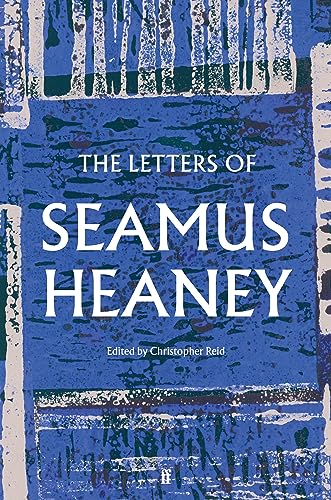
Christopher Reid (editor), The Letters of Seamus Heaney (Faber & Faber 2023)

Since reading À le recherche du temps perdu over a couple of years starting in September 2019, I’ve done a similar slow read of a number of classics: Saint Augustine’s Confessions, Wordsworth’s The Prelude, Virginia Woolf’s Mrs Dalloway, and so on.

The Letters of Seamus Heaney doesn’t quite fit the original concept – paradoxically, give that Heaney is such a fine poet, it’s too prosaic. But the book was a gift, I want to read it because I love Heaney’s poetry, and I’m pretty sure I’d have trouble staying awake if I approached it like a novel. So here goes, starting out at 7 or 8 pages a day. I’ll keep my copy of Opened Ground: Poems 1966–1996 beside me as I read the pages, so I may be able to look up poems as they are mentioned.

The first letters collected here were written when Heaney was in his mid 20s, on the verge of publication of his first book of poems, Death of Naturalist. He marries, becomes a father, worries about money and employment …

I’ll report on progress in a month or so.


I have written this blog post on the land of Gadigal and Wangal of the Eora nation. I acknowledge Elders past and present of those clans, and welcome any First Nations readers.
Mrs Dalloway, report 2

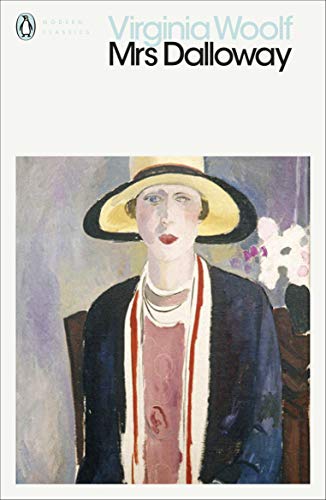
Virginia Woolf, Mrs Dalloway (1925, Penguin Classics 2020) from page 103 to end

As I expected, it took me just two months to read Mrs Dalloway three pages a day. If you haven’t read it, I recommend doing it slowly in just this way: three pages at a time seems to be just about perfect.

The book looks for the person behind the public-facing name Mrs Dalloway, to create a kind of literary cubist portrait: beneath the skin of the upper-crust English lady whose life centres on giving parties for the right people are the remains of a glorious, multi-faceted creature who once lived with grace and passion. We see her from many angles, through the eyes of her husband (who barely sees her), her daughter, a resentful working class history teacher, a maid, a man whose proposal of marriage she rejected in spite of their mutual passion, a woman who was also drawn to her when young, an older aristocratic woman of the type played so splendidly by Maggie Smith, and more

In one way the book is about the disappointment of youthful hopes and expectations. For example, Sally Seton, who once ran naked down the corridors of an country mansion, is now Lady something or other with six sons and insists that she is completely happy. Clarissa herself is married to Richard who is at best a mediocre politician. Peter Walsh, her former suitor, has spent most of his life in India, unhappily married and now caught up in an awkward affair. And quite unconnected to Clarissa until the final pages is Septimus Smith, a soldier returned from the trenches of the ‘Great War’ with what we would now call PTSD. He is haunted by the image of a friend who was killed in the War, and in the end (spoiler alert, but the book is a hundred years old after all) kills himself in desperation. When Clarissa learns of his death, she is playing hostess at her party, to which the whole book has been building. Suddenly she is alone and grapples with thoughts of her own mortality.

I came to the book expecting it to be difficult and a bit airy-fairy. Maybe it is both. The English class system is rock solid in its pages, and though Clarissa is criticised as a snob, the basic viewpoint of the novel can’t be entirely absolved of that charge. But I wasn’t prepared for how much pleasure there is in the way the narrative glides among different points of view, for the almost Whitmanesque celebration of city life, for its laugh-out-loud moments, or, in the end, for the pervading sense pathos in a society and individual souls who have survived the momentous events of a World War and a pandemic. I wasn’t prepared for just how much, sentence by sentence and page by page, I enjoyed it.

it’s hard to pluck a passage out of context, but here is a bit I love. Peter Walsh is watching Clarissa as she escorts the Prime Minister from the party:

And now Clarissa escorted her Prime Minister down the room, prancing, sparkling, with the stateliness of her grey hair. She wore ear-rings, and a silver-green mermaid’s dress. Lolloping on the waves and braiding her tresses she seemed, having that gift still; to be; to exist; to sum it all up in the moment as she passed; turned, caught her scarf in some other woman’s dress, unhitched it, laughed, all with the most perfect ease and air of a creature floating in its element. But age had brushed her; even as a mermaid might behold in her glass the setting sun on some very clear evening over the waves. There was a breath of tenderness; her severity, her prudery, her woodenness were all warmed through now, and she had about her as she said goodbye to the thick gold-laced man who was doing his best, and good luck to him, to look important, an inexpressible dignity; an exquisite cordiality; as if she wished the whole world well, and must now, being on the very verge and rim of things, take her leave. So she made him think. (But he was not in love.)

Yeah, right! He wasn’t in love!

Maybe I should give To the Lighthouse a go.


I have written this blog post in Gadigal and Wangal country. I acknowledge Elders past and present of those clans, and welcome any First Nations readers.
Mrs Dalloway, report 1, and November verse 1

Virginia Woolf, Mrs Dalloway (1925, Penguin Classics 2020)

Since taking nearly two years to read Proust’s À la recherche du temps perdu six years ago, I’ve had a classic slow-read on the go most of the time. When I’ve embarked on one of these slow-reads I regularly come across mentions of the book elsewhere. It’s like that with my current project, Mrs Dalloway.

This month, a friend sent me a link to Zora Simic’s article in The Conversation, Trauma memoirs can help us understand the unthinkable. They can also be art. Here’s an excerpt:

Of all Woolf’s novels, Mrs Dalloway is the one most often read as semi-autobiographical and as a reckoning with unresolved trauma: of England’s in the wake of the first world war, and in the novelist’s own life. <big snip> Woolf has long been a lodestar for writers grappling with trauma – in their lives, and on the page, especially women writers.

Reading the first couple of pages, when upper-class Clarissa Dalloway is out in the early morning shopping for flowers and enjoying the life of the London streets, I couldn’t see much trauma. But then the scene broadens and darkens. By page 103, I’m now reading the book as mainly about aftermaths: Clarissa is recovering from an illness and enduring an unhappy marriage; the War and pandemic are still alive in collective memory; Peter Walsh, freshly returned from a decade in India, is still wounded by having been rejected by Clarissa many years earlier; returned soldier Septimus Smith is wandering London’s streets, hallucinating, suicidal, ‘shell-shocked’ and putting his Italian wife Lucrezia through hell. There’s plenty of trauma to go round.

I’m glad I’m reading this book just a few pages a day. It cries out for sharply focused reading, which I can just about sustain for three pages at a time. Read this way, the book is exhilarating. I had thought it was going to be the stream of consciousness of one upper-class Englishwoman. In fact there’s a whole array of characters, and the narrative voice flits among them. I say ‘flits’ because feels as if the narrator is an elf-like creature (I almost see her as Tinkerbell) who slips in and out of people’s minds, sometimes staying for barely a second, sometimes for several pages. Most of the characters are aristocrats of one sort or another, but not all. Lady Bruton’s maid Milly Brush has definite likes and dislikes as she stands impassively while her mistress entertains three gentlemen for lunch. One of those gentlemen is a bluff middle-class man with pretensions – he knows how to craft a publishable letter to The Times but believes women shouldn’t read Shakespeare for moral reasons. And Richard – Mr Dalloway – makes an appearance, buying flowers for Clarissa and resolving to tell her he loves her (which the reader knows is far too little, far too late). And so on. It’s much more complex, and funnier, than I expected.

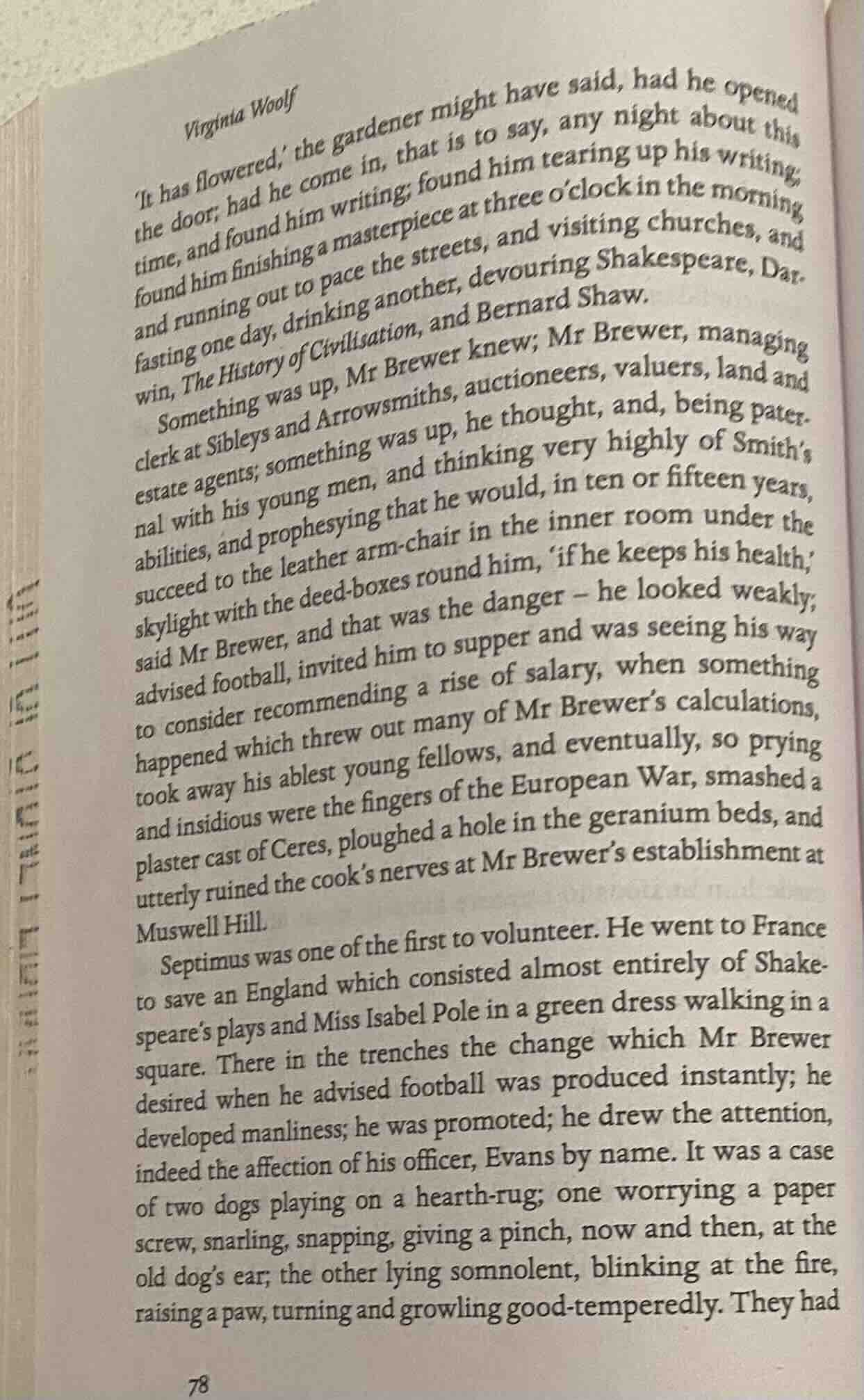
Here’s page 78*:

And because it’s November**, here’s a verse drawn from it and the next page:

November Verse 1: Septimus Smith
He might have made a great accountant
but for Shakespeare, Keats and love
that set him scribbling with his fountain
pen all night. 'You need to tough-
en up, play football,' said his mentor.
War changed everything. He went to
fight in France and made a friend,
a cheerful manly friend, whose end
in Italy was sudden, brutal.
Mrs Woolf says War had taught
him not to feel, to set at nought
such loss. Sublime the total
calm he felt. But, come next year,
the sudden thunderclaps of fear.

I have written this blog post near what was once luxuriant wetland, in Gadigal and Wangal country, where I recently saw two rosellas (mulbirrang in Wiradjuri, I don’t know the Gadigal or Wangal name). I acknowledge Elders past and present of those clans, and welcome any First Nations readers.

My blogging practice is to focus on the page that coincides with my age, currently 78.
** Each November I aim to post 14 fourteen line stanzas on this blog (see here for an explanation, though that explanation incorrectly calls my verses sonnets)

Beginning Mrs Dalloway

Virginia Woolf, Mrs Dalloway (1925, Penguin Classics 2020)

I was listening to Christopher Lydon’s Open Source podcast when he interviewed Merve Emre, editor of The Annotated Mrs. Dalloway (Ms Emre is from the US, so her book adds a period to the novel’s name). Their enthusiasm for Woolf’s book made me realise it would be ideal one of my slow reads of the classics.

My introduction to the book was Stephen Daldry’s movie The Hours, which is based on Michael Cunningham’s novel of the same name and stars Nicole Kidman with a prosthetic nose. I’ve vaguely wanted to read Mrs Dalloway ever since, but been just as vaguely reluctant because of a general impression that the writing was beautiful but difficult.

So here goes. At three pages a day, it will probably take about two months. I don’t intend to delve into annotations and footnotes. Mercifully the copy I have from the library doesn’t have a learned introduction. Bearing in mind someone’s description of a classic as a work you cannot encounter for the first time, I’ll inevitably bring preconceptions to it, but I’ll try to read it as if it’s just a novel.

At this stage, six pages in, I’m loving it. I’m also glad I’m reading a few pages at a time, because – so far at least – I’d hate to be rushing it.

Albert Camus’ L’étranger

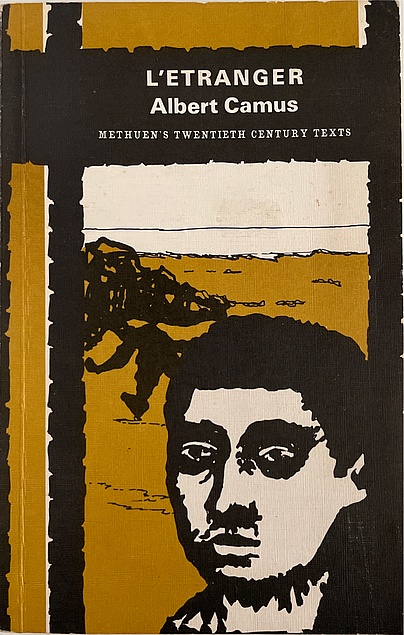
Albert Camus, L’étranger (1942, Methuen Educational 1970)

A month ago I announced that I was resuming my practice of reading a couple of pages from a classic text first thing each morning, starting with Camus’ L’étranger. The first book I did this with was Marcel Proust’s À la recherche du temps perdu, which took nearly two years. L’étranger has taken a single month.

In some ways, Camus is the anti-Proust. Look at their first sentences. Proust’s vast novel opens with his narrator yearning for his mother to come and say goodnight and then, famously, goes on marathons of introspection; Camus’ Meursault doesn’t make a big deal of his relationship with his mother, he resolutely refuses to perform emotions, and in the end pays a significant price for it. Here are their opening sentences:

Proust: Longtemps je me suis couché de bonne heure. (A long time ago I went to bed early.)

Camus: Aujourd’hui, maman est morte. (Today Mum died.)

It’s not hard to imagine that Camus had Proust’s work in mind, and deliberately did the opposite.

L’étranger is a classic, so I came to it already knowing a version of the plot. Meursault, a white man living in Algeria, shoots an Arab and when put on trial is unable to give a reason for doing it. In the trial much is made of the fact that he didn’t weep or give any sign of emotional upset at his mother’s death just a day earlier, and he is sentenced to death.

What surprised me on actually reading the text is that the murder isn’t completely arbitrary. Somehow I’d got the idea that he just pushes the man off a moving train, but it’s much more complex than that: in fact the shooting is the culmination of a series of encounters.

For me, more shocking than the murder, and more shocking than the fact that Meursault doesn’t weep at his mother’s vigil and funeral, is the way he takes it in his stride when his neighbour brutally beats a woman, and goes on an outing with the neighbour the next day as if nothing has happened.

Meursault’s lack of emotion is mystifying. We don’t like him, or empathise with him, but when his defence lawyer asks the court if he is being condemned to death for killing a man or for not weeping at his mother’s funeral we know that he’s naming something real.

I might have thought this was unrealistic, an existentialist fable, but the memory of Lindy Chamberlain told me otherwise. If not in the courtroom (and that’s debatable), then certainly in the press, she was widely condemned for not having what was deemed an appropriate display of emotion when her baby daughter went missing. Camus would have understood.

In the final moments of the book, when Meursault faces the prospect of the guillotine, he has a conversation with the prison chaplain. After Meursault has monosyllabically rejected the chaplain’s attempts to discuss the after-life, the priest says Meursault has a blind heart, and promises to pray for him. Meursault snaps. His deadpan manner is shattered, and leaping about with rage and joy he declares that nothing matters, that there is no meaning to life. In my reading the key moment comes after the outburst, when calm has been restored:

Comme si cette grande colère m’avait purgé du mal, vidé d’espoir, devant cette nuit chargée de signes et d’étoiles, je m’ouvrais pour la première fois à la tendre indifférence du monde.
[As if that great burst of anger had purged me of evil, emptied me of hope, faced with this night laden with signs and stars, I opened myself for the first time to the tender indifference of the world.]

‘The tender indifference of the world’. The absence of hope does not necessarily produce despair, but an openness to reality. And then, in case we feel that we can welcome Meursault back into the fold of people who behave ‘properly’, his final wish is that there will be a good crowd at his execution who will greet him with cries of hate – that way he will feel less alone.

I have no idea what it would have been like to read this as part of high school French. Would it have vanished from memory as surely as the book we did study, of which I remember only the title, Le drôle. The internet reveals that that is a 1933 children’s book, written by François Mauriac. I suspect that all the two books have in common is that they were written in French by Nobel laureates. Times change, probably for the better.

Beginning Albert Camus’ L’étranger

Albert Camus, L’étranger (1942, Methuen Educational 1970)

My practice of reading a couple of pages from a classic book every morning has been in abeyance since I finished reading Montaigne’s essays in January (final report at this link).

When a copy of L’Étranger turned up in a street library after Camus had cropped up in other reading – The Incorrigible Optimists Club and The Visionaries – I took it as a sign from the universe. I’ve read quite a lot about Camus, but not anything by him, except in excerpts and perhaps a play whose name I don’t remember. [Added later: I did read The Plague when I was 19, at my older brother’s bidding. I think I failed to think of it because I read it before I knew anything about Camus or existentialism, so it’s stored in a different file in my memory.]

My copy of the book has a protective plastic cover and the pencilled name of a former 6th form owner. There are pencilled notes on translation, but only on the first four pages (either her French got a lot better or she decided it wasn’t worth the effort to write). It also has some pedagogical apparatus – an introduction, a vocabulary, and a bibliography of critical studies, all of which I intend to ignore as far as possible.

I’ve just read Camus’ short avant-propos from 1955 in which he says that his protagonist, Meursault, becomes an outsider because, unlike the rest of us, he does not lie by exaggerating his feelings (‘majorer ses sentiments‘). Tomorrow morning I’ll start the text itself, and will report back in a month’s time.

Montaigne final progress report

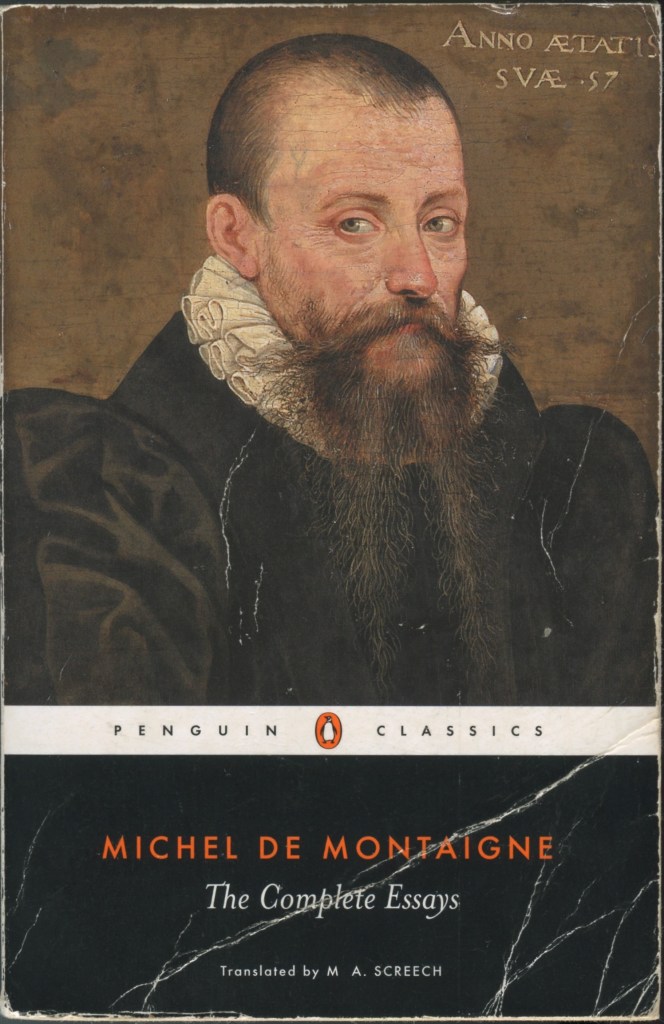
Michel de Montaigne, The Complete Essays (Penguin Classics 1991, translated by M. A. Screech)
– part way through Book 3, essay 10, ‘On restraining your will’ to end Book 3, essay 13, ‘On experience’

M A Creech, whose translation and edition of Montaigne’s essays I’ve been reading, a few pages a day, since March last year, says that it’s a mistake to read the Essais simply as a collection of separate pieces of varying lengths. There is a shape, he argues in his introduction, and in the final essay, ‘On experience’, Montaigne arrives at the place to which all the preceding essays have been heading.

Given the immersive task he has undertaken – not just finding English equivalents for Montaigne’s French, but also translating and identifying the sprinkling of quotes from Latin (and the few from Greek and more recent languages) – I’m not going to say he’s wrong, but I can’t see that he’s right.

But the final essay does read as a culmination, and a farewell. Its central argument is about the relationship between reason and experience, more specifically the limits of reason and the importance of giving full value to experience. There’s a long section in which he describes the mental process by which he comes to think of his extremely painful kidney stones as a good thing: the pain is intermittent so he has time to digest the experience; when the pain goes, its absence is delightful; unlike other diseases, this one doesn’t interfere with his normal life – he can spend up to ten hours in the saddle at the height of an attack; it’s an illness ‘which does not leave us guessing’ – that is, we know what it is, there’s no need to hunt for diagnoses; etc. At the end of the section, just as one is admiring his brilliant feat of mind over matter, he acknowledges that at least in part he has been whistling in the wind (page 1243):

With such arguments, both strong and feeble, I try … to benumb and delude my power of thought and to put ointment on its wounds. And tomorrow, if they grow worse, we will provide other escape-routes for them.

And then, in a twist that makes his writing as fresh now as it must have been nearly 500 years ago:

Since I wrote that, the slightest movements which I make have begun to squeeze pure blood from my kidneys again. Yet because of that I do not stop moving about exactly as I did before and spurring after my hounds with a youthful and immoderate zeal. And I find that I have got much the better of so important a development, which costs me no more than a dull ache and heaviness in the region of those organs. Some great stone is compressing the substance of my kidneys and eating into it: what I am voiding drop by drop – and not without some natural pleasure – is my life blood, which has become from now on some noxious and superfluous discharge.
Can I feel something disintegrating? Do not expect me to waste time having my pulse and urine checked so that anxious prognostics can be drawn from them: I will be in plenty of time to feel the anguish without prolonging things by anguished fear.

This last essay goes for more than 60 pages. It’s intensely personal: Montaigne describes his not entirely admirable table manners. He goes into some detail about his habits around eating, sleeping, excreting, walking, dressing, a little about sex (which at the ripe old age of fifty-something is largely in his past). He argues that what is customary for any individual or community should be maintained – it would be as wrong for a Frenchman to drink his wine undiluted as for a German to dilute his! And when he hits full stride he argues brilliantly that pleasure is a good thing, that life itself is a good thing. This is from page 1258:

When I dance, I dance. When I sleep, I sleep; and when I am strolling alone through a beautiful orchard, although part of the time my thoughts are occupied by other things, for part of the time too I bring them back to the walk, to the orchard, to the delight in being alone there, and to me. Mother-like, Nature has provided that such actions as she has imposed on us as necessities should also be pleasurable, urging us towards them not only by reason but by desire. To corrupt her laws is wrong.

And a little later:

What great fools we are! ‘He has spent his life in idleness,’ we say. ‘I haven’t done a thing today.’ – ‘Why! Have you not lived? That is not only the most basic of your employments, it is the most glorious.’ – ‘I would have shown them what I can do, if they had set me to manage some great affair.’ – If you have been able to examine and manage your own life you have achieved the greatest task of all. Nature, to display and show her powers, needs no great destiny … Our most great and glorious achievement is to live our life fittingly. Everything else – reigning, building, lying up treasure – are at most tiny props and small accessories.

How can I not love this man? All of this, of course, is interwoven with quotations from the ancients, with whom he sometimes argues robustly, even his beloved Socrates. Wonderfully, he ends with four lines from Horace:

Frui paratis et valido mihi,
Latoe, dones, et, precor, integra
Cum mentis, nec turpem senectam
Degene, nec Cythara carentem.

Which, drawing on M. A. Screech’s translation and explanatory footnote, I can paraphrase as: ‘Grant me, O Apollo god of healing, that I may enjoy the things I have prepared and, with my mind intact, I pray that I may not degenerate into a squalid old age, in which the lyre is wanting.’

It’s not age or death he feared, but the prospect of an old age when he was incapable of singing.


This blog post was written on Gadigal-Wangal land, on a fully hot, humid day when even the birds are silent. I acknowledge the Elders past, present and emerging of Gadigal and Wangal of the Eora Nation.

Montaigne progress report 9

Michel de Montaigne, The Complete Essays (Penguin Classics 1991, translated by M. A. Screech)
– part way through Book 3, essay 5, ‘On Some lines from Virgil’ to part way through Book 3, essay 10, ‘On restraining your will’

This post was due more than a week ago, but life in general made other plans for me. With a couple of lapses, though, I have consistently read four or five pages of Montaigne’s Essays each morning.

I won’t even try to summarise what I’ve read in the last six weeks. I’ll just mention that ‘On some lines from Virgil’ continued to be fascinating on the subject of sex and gender; in a piece with the innocuous title ‘On coaches’ Montaigne denounces the atrocities of the Spanish colonisation of Central and South America; in ‘On the disadvantages of high rank’ he pities those whose social position means no one will disagree with them, because they are deprived of the joys of conversation.

And then there’s ‘On vanity’, a long essay that made me fear age-related cognitive decline was catching up with me. As with many of the essays, ‘On some lines from Virgil’ being a prime example, this one’s title gives you no idea of its true subject. But in this case, I couldn’t tell if it even had a main subject. He writes about travel, about death (a lot about death), about how much he loves Rome. He explains why he’s glad he has no sons. He quotes at length from the document granting him Roman citizenship. He’s like a dog snapping – in slow motion – at whatever fly of an idea crosses his mental line of vision. But in the middle of it all, he has one of the passages that remind you that he is inventing the form of the personal essay – and k ows exactly what he’s doing:

There are works of Plutarch in which he forgets his theme, or in which the subject is treated only incidentally, since they are entirely padded out with extraneous matter … My God! what beauty there is in such flights of fancy and in such variation, especially when they appear fortuitous and casual. It is the undiligent reader who loses my subject, not I. In a corner somewhere you can always find a word or two on my topic, adequate despite being squeezed in tight. I change subject violently and chaotically. My pen and my mind both go a-roaming. If you do not want more dullness you must accept a touch of madness.

‘It is the undiligent reader who loses my subject, not I.’ I’ve been put in my place.

He defends his lack of coherence by applying to himself Plato’s description of a poet as someone who:

pours out in rapture, like the gargoyle of a fountain, all that comes to his lips, without weighing it or chewing it; from him there escape things of diverse hue, contrasting substance and jolting motion.

I don’t know that anyone seriously thinks that’s what poets do, but the idea that a reader needs to be ‘diligent’ to do justice to some writing has still got a lot of life in it, probably even more than it did in Montaigne’s day. He goes on to say he doesn’t stitch things together ‘for the benefit of weak and inattentive ears’:

Where is the author who would rather not be read at all than to be dozed through or dashed through? … If taking up books were to mean taking them in; if glancing at them were to mean seeing into them; and skipping through them to mean grasping them: then I would be wrong to make myself out to be quite so totally ignorant as I am. Since I cannot hold my reader’s attention by my weight, manco male [it is no bad thing] if I manage to do so by my muddle.

So, just as he’s getting tetchy with us for being lazy, he acknowledges that he’s a pretty lazy reader himself. And having claimed that his apparent incoherence is actually poetic brilliance, he now calls it a muddle.

Oh, and in the middle of all that charming back-and-forth between grumpiness and self-deprecation, there’s this lovely, enigmatic line:

Poetry is the original language of the gods.

I’m not sorry I gave up French Honours in 1968 because I found Montaigne almost as unreadable as Rabelais. I’m enjoying reading him now, in translation, much more than I possibly could have in the original when I was 22.


This blog post was written on Gadigal-Wangal land, where the days are getting hotter and more humid. I acknowledge the Elders past, present and emerging of Gadigal and Wangal of the Eora Nation.

The Essays of Montaigne, progress report 7

Michel de Montaigne, The Complete Essays (Penguin Classics 1991, translated by M. A. Screech)
– part way through Book 2, essay 17, ‘On presumption’ to part way through ‘On the resemblance of children to their fathers’

These aren’t so much progress reports as monthly snapshots from my reading of Montaigne’s Essays four or five pages a day. Last month I was part way though ‘On presumption’ and enjoying his unflattering self-portrait. That essay became even more fabulously self-deprecatory, including this (on page 730):

As for music, either vocal (for which my voice is quite unsuited) or instrumental, nobody could ever teach me anything. At dancing, tennis and wrestling I have never been able to acquire more than a slight, vulgar skill; and at swimming, fencing, vaulting and jumping, no skill at all. My hand is so clumsy that I cannot even read my own writing, so that I prefer to write things over again rather than to give myself the trouble of disentangling my scribbles. And my reading aloud is hardly better: I can feel myself boring my audience. That apart, I am quite a good scholar! I can never fold up a letter neatly, never sharpen a pen, never carve passably at table, nor put harness on horse, nor bear a hawk properly nor release it, nor address hounds, birds or horses.

Last month I snuck a look into the future and predicted that this month I would be writing about ‘Three good wives’. Fortunately I don’t have to spend time on that essay, as its version of a good wife is one who will kill herself when her husband dies. Did I mention that some of Montaigne’s views and attitudes can be pretty repulsive? The essay after that, ‘On the most excellent of men’, is hardly less repulsive: his three excellent men are Homer, Alexander the Great and Epaminondas, and in all three cases, including Homer, he seems to regard military skills as the main criterion for excellence. He also seems to take Alexander the Great’s PR at face value. (I shudder to think that essayists a thousand years from now will speak of Donald Trump as the greatest president ever.)

Today, however, I have started on the final essay of Book II, ‘On the resemblance of children to their fathers’, which is surely one of those that have endeared Montaigne to readers for nearly 500 years

Typically, the proclaimed subject of the essay is nowhere in sight in the first couple of pages. Instead, he reflects on the nature of his work and on changes that have happened in his life over the eight years he has been writing essays.

I think it’s true that Montaigne invented the essay form, and these paragraphs give a charming insight into how he went about it.

All the various pieces of this faggot are being bundled together on the understanding that I am only to set my hand to it in my own home and when I am oppressed by too lax an idleness. So it was assembled at intervals and at different periods, since I sometimes have occasion to be away from home for months on end. Moreover I never correct my first thoughts by second ones – well, except perhaps for the odd word, but to vary it, not to remove it. I want to show my humours as they develop, revealing each element as it is born. I could wish that I had begun earlier, especially tracing the progress of changes in me.

It’s probably that spontaneity and the possible vulnerability that goes with it, that makes the essays so alive even all these years later. Maybe I should be less judgemental about essays like the one on good wives – he may have thought differently on the subject on another day.

But that’s enough about the work. He needs to tell us about his health:

Since I began I have aged by some seven or eight years – not without some fresh gain, for those years have generously introduced me to colic paroxysms. Long commerce and acquaintance with the years rarely proceed without some such benefit I could wish that, of all those gifts which the years store up for those who haunt them, they could have chosen a present more acceptable to me, for they could not have given me anything that since childhood I have held in greater horror.

I’m roughly 30 years older than Montaigne was when he wrote that. Though I’m in reasonably good health, I recognise his impulse to tell the world about his bodily ills. As I turn the page, he moves on to one of his recurring topics: when it makes sense to kill oneself (see essay on good wives etcetera). Happily, he is leaning towards staying alive:

After about eighteen months in this distasteful state, I have already learnt how to get used to it. I have made a compact with the colical style of life; I can find sources of hope and consolation in it.

That’s a good thing for his readers, as there was a whole third book to come.


This blog post was written on Gadigal-Wangal land, where understandings of the universe beyond Montaigne’s imaginings were developed millennia before the Ancients he so loves. I acknowledge the Elders past, present and emerging of Gadigal and Wangal of the Eora Nation.

The Essays of Montaigne, progress report 6

Michel de Montaigne, The Complete Essays (Penguin Classics 1991, translated by M. A. Screech)
– end of Book 2 Essay 12, “An apology for Raymond Sebond’ to part way through Book 2, essay 17, ‘On presumption’

The month has flown by, and it’s time for another progress report on my project of reading Montaigne’s essays, four pages every morning. Two friends have sent me examples of Montaigne cropping up in their own reading: the first has just started reading Amor Towles’s A Gentleman in Moscow, and was reminded of my project when the confined Count finally gets to read Montaigne; the second forwarded me Nicholas Gruen’s weekly newsletter for the 18th of August, which includes Montaigne’s essay ‘On a Monstrous Child’. I’m not alone in reading him.

It’s taken much more than a month, but I’ve now finished ‘An Apology for Raymond Sebond’. Whether from shrinking attention span, lack of interest, or the nature of the essay itself, I happily confess that I had trouble following its argument. It went on and on, endlessly quoting ancient philosophers, repeating itself, and proclaiming radical scepticism. I thought it was about to discover the scientific method, but no, it seemed to end up saying you can’t trust reason or the senses, but – implied rather than stated outright – you can always trust the revealed Word of God. I’m glad that one is behind me.

Today I’m part way through ‘On Presumption’. Having discussed in the preceding essay the relative worthlessness of reputation (‘glory’) compared with actual virtue, in this one Montaigne begins by saying that one’s opinion of oneself is similar to glory – prone to wishful thinking and no real indicator of one’s real worth. He’s now in the middle of a generally unflattering – and I think intentionally funny – self-portrait. He loves poetry, but is a terrible poet. He loves fine writing but:

There is nothing fluent or polished about my language; it is rough and disdainful, with rhetorical arrangements which are free and undisciplined. And I like it that way, by inclination if not by judgement. But I fully realise that I sometimes let myself go too far in that direction, striving to avoid artificiality and affectation only to fall into them at the other extreme. … Even if I were to try to follow that other smooth-flowing well-ordered style I could never get there. (Page 725–726)

False modesty? Maybe not. It does read as a genuine attempt to describe his own writing.

Beauty, he says, is the ‘first sign of distinction among men’, and height is the only quality that determines manly beauty, but his own ‘build is a little below average’. In one of the passages that makes reading him such a pleasure, he lists the qualities that don’t count:

When a man is merely short, neither the breadth and smoothness of a forehead nor the soft white of an eye nor a medium nose nor the smallness of an ear or mouth nor the regularity or whiteness of teeth nor the smooth thickness of a beard, brown as the husk of a chestnut, nor curly hair nor the correct contour of a head nor freshness of hue nor a pleasing face nor a body without smell nor limbs justly proportioned can make him beautiful. (Page 729)

Having just told us that only height matters, he implies the counter argument: he’s at least a bit sorry that men who look good and don’t smell bad aren’t regarded as beautiful. Not that he attributes those qualities to himself. He says his build is ‘tough and thickset’ and describes (in Latin, possibly quoting someone) his bristly legs and tufty chest, etc.

So this isn’t so much a progress report as a snapshot of where I’m up to when the blog post falls due. I just flicked forward 120 pages to see that next time I may be talking about an essay entitled ‘On three good wives’!


This blog post was written on Gadigal-Wangal land, where understandings of the universe beyond Montaigne’s imaginings were developed millennia before the Ancients he discusses. The weather is warming up alarmingly early. I acknowledge the Elders past, present and emerging of the Gadigal and Wangal Nations,.