Category Archives: slow read

The Essays of Montaigne, progress report 5

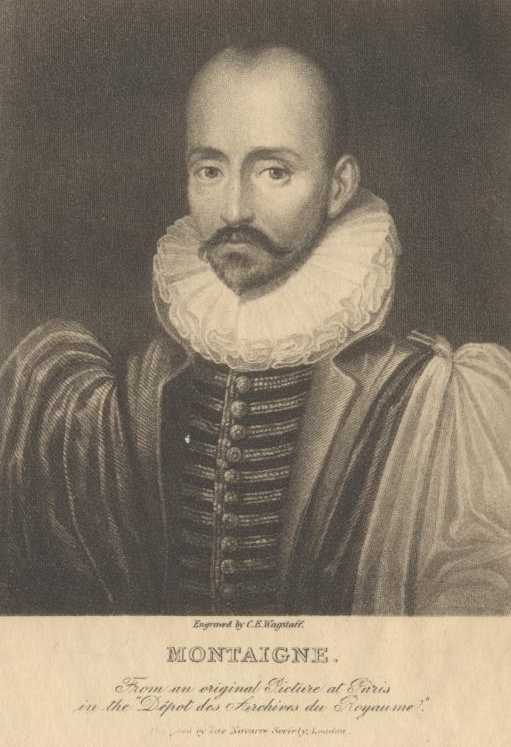
Michel de Montaigne, The Complete Essays (Penguin Classics 1991, translated by M. A. Screech)
– part of Book 2 Essay 12, “An apology for Raymond Sebond’
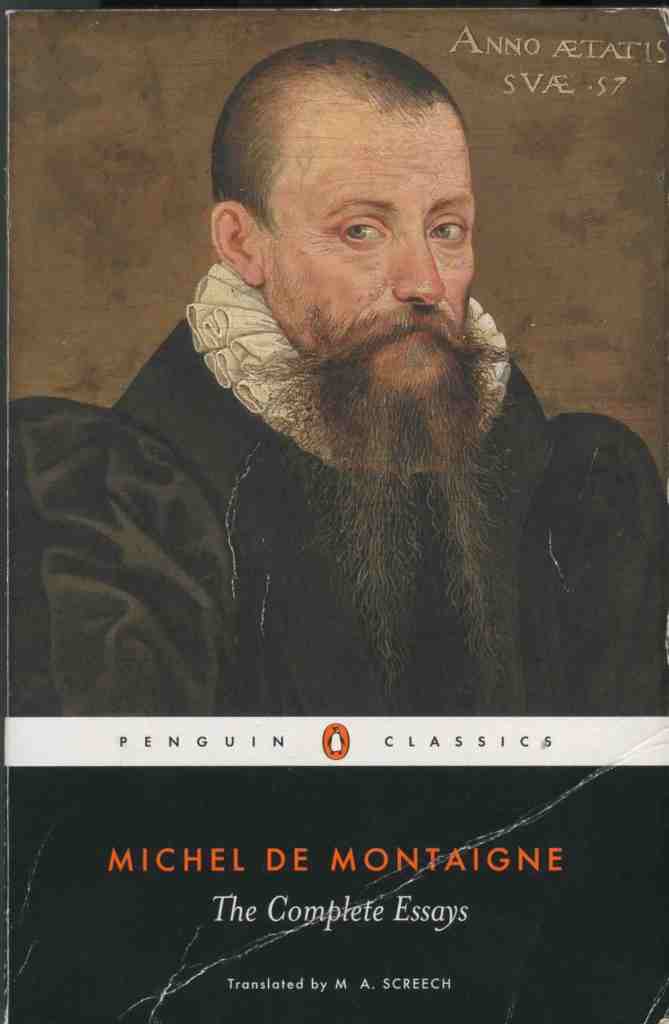
Since my last Montaigne report, I’ve been faithful to my four pages of Montaigne each morning except for two breaks – one for a fortnight and the other just a weekend. The book is too heavy to take on a plane, and travel tends to disrupt routines like this one.

Five weeks ago, I had just started reading the longest essay in the collection, ‘An apology for Raymond Sebond’. Today I still have 60 odd pages of that essay to go. As I have only the vaguest idea of who Raymond Sebond was, or in what way Montaigne is attempting an apology, I’ll spare you any attempt at a summary, and just give a couple of snapshots.

Having declared himself to be a sceptic (as opposed to a dogmatist), Montaigne sets out to establish the limits of human reason. He piles on example after example of ancient philosophical versions of God, products of the ‘fierce desire to scan the divine through human eyes’. Arguing that if reason were able to determine the nature of God, then these versions would tend to some kind of agreement. Having established that this isn’t what happened, he (at least in M. A. Screech’s translation) drops his dignified mode of discourse altogether and exclaims:

So much din from so many philosophical brainboxes! Trust in your philosophy now! Boast that you are the one who has found the lucky bean in your festive pudding!

That’s on page 577. I’ve now reached page 625. In those 48 pages he has explored (and deplored) the limitations of reason in understanding even the world of nature or the human mind itself, and has been cheerfully insulting of many ancient writers whom he clearly admires enormously (including describing Plato as sometimes ‘silly’). Now he is going on about how philosophers can’t reach any agreement about the immortality or otherwise of the soul. He has reached the transmigration of souls:

the received opinion … that our souls, when they depart from us, go the rounds from one body to another, from a lion, say, to a horse; from a horse, to a king, ceaselessly driven from one abode to another.

And he’s having quite a lot of fun with it, citing the Epicureans’ objection:

What order could be maintained if the crowds of the dying proved greater than the number being born? The souls turned out of house and home would all be jostling each other, trying to be first to get into their new containers! They also ask how souls would spend their time while waiting for their new lodgings to be got ready.

Having added some lines of Latin poetry, he then goes on:

Others make our souls remain in the body after death, so as to animate the snakes, worms and other creatures which are said to be produced by spontaneous generation in our rotting flesh or even from our ashes.

In short, I’m enjoying this essay as a kind of romp in the history of philosophy. As a settled atheist who thinks my mind is a function of my body, I have a kind of museum-piece interest in a lot of the arguments. I was taught at school that until a certain point in European history people relied on the authority of, I think it was Aristotle, for their knowledge of the world. We knew from Aristotle how many teeth a human had, and only at a certain stage did it occur to people to look in each other’s mouths and count for themselves. As I read this essay, it feels as if I’m seeing that change happen before my very eyes, and it’s riveting. (Mind you, I think the essay itself is going to end with a declaration that Christian revelation is the ultimate source of Truth, but both things can be happening at once.)

To be continued.


This blog post was written on Gadigal-Wangal land, where understandings of the universe beyond Montaigne’s imaginings were developed millennia before the Ancients he discusses. It’s raining again, and my compost bin is alive with worms. I acknowledge the Elders past, present and emerging of the Gadigal and Wangal Nations,.

The Essays of Montaigne, progress report 4

Michel de Montaigne, The Complete Essays (Penguin Classics 1991, translated by M. A. Screech)
from Book 2 Essay 7, ‘On rewards for honour’ to part way through Book 2 Essay 12, “An apology for Raymond Sebond’

Three months in and I’m loving my morning chats with Montaigne. Not so much a progress report this month, as I’m poised to fly to warmer climes any second and am squeezing this post in among house-cleaning and similar chores.

Usually as I make my way through these essays I ignore the notes and references, as I’m not making a study of Montaigne, just reading him and living with my sometime incomprehension. For the current essay, ‘ An Apology for Raymond Sebond’, I read 24 pages of M. A. Screech’s introduction to the book, and listened to a podcast from David Runciman’s ‘Past Present Future’ series (a fascinating account of the essay, which you can find here).

It’s a serious argument, tackling the relationship between revealed truth as understood in 16th century Christianity and knowledge that can be acquired by observation and reason. It’s serious, and intricate. In the passages I’ve just been reading, which is all I’m going to talk about here, it’s something else.

In this part of the essay, Montaigne is arguing against human exceptionalism. Animals (he doesn’t quite bring himself to say ‘other animals’) give signs of being able to reason, to be loyal, seek justice, have compassion, grieve, do basic arithmetic, follow the movements of the stars. In many ways, we learn from the animals, even while we believe ourselves to be infinitely superior. He notes in passing that ‘you can see some male animals falling for males of their own kind’. He tells the story that I know as ‘Androcles and the lion’ in some detail, calling the human character ‘Androdes’. He piles on example after example – mostly from antiquity and in particular Plutarch.

For the sake of his argument, just a couple of examples would have been enough, but Montaigne is like a child in a lolly shop: there are so many stories old and new, verifiable and fantastical, it’s as if he can’t bear to leave any of them out. Today’s reading ends with this (on page 534):

As for greatness of spirit, it would be hard to express it more clearly than that great dog did which was sent to King Alexander from India. It was first presented with a stag, next with a boar, then with a bear: it did not deign to come out and fight them, but as soon as it saw a lion it leaped to its feet, clearly showing that it thought such an animal was indeed worthy of the privilege of fighting against it.

Montaigne had fought in battle, and the religious wars of the 16th century were raging around him as he wrote the Essays. His casual acceptance of violence, as in this paragraph, is one of the places where we feel how different his times were from ours. But his insistence at such length on the dignity of animals has a surprisingly modern feel.

Ok, that’s all I have time for. I have a plane to catch and warmer climes to visit.


This blog post, was written on Gadigal-Wangal land in between bouts of heavy rain, which enables the ibises and magpies in the park across the road to have a great time fossicking in the soft soil. I acknowledge the Elders past, present and emerging of the Gadigal and Wangal Nations.

The Essays of Montaigne, progress report 3

Michel de Montaigne, The Complete Essays (Penguin Classics 1991, translated by M. A. Screech) from Book 1 Essay 42, ‘On the inequality there is between us’, to Book 2 Essay 7, ‘On rewards for honour’

Three months in and I’m coming to love my morning chat with Montaigne.

I was delighted to hear an echo of his voice in a session at the recent Sydney Writers’ Festival. In conversation with Felicity Plunkett (my blog post here), the poet Nam Le was struggling to describe the complex way his mind works. According to my scribbled notes, he said:

Any attribute you can attribute to yourself, the opposite can also be yours.

That morning, I had been reading Montaigne’s Book 2, Essay 1, ‘On the inconstancy of our actions’, which begins:

Those who strive to account for a man’s deeds are never more bewildered than when they try to knit them into one whole and to show them under one light, since they commonly contradict each other in so odd a fashion that it seems impossible that they should all come out of the same shop.

I don’t know if Nam Le had Montaigne even at the back of his mind, but it’s fascinating to find in Montaigne, roughly Shakespeare’s contemporary, such a pre-echo of a 21st century way of seeing things. Fascinating, but not an isolated moment. His reflections on public life, oratory, warfare, frugality, education, suicide and so on often seem tailor-made for quotation in a discussion of anything from the US ex-president to drone warfare or the culture wars. He can be horribly sexist, and his class material is also horrible; but he’s often hard to take to task, because he’s likely to disagree with himself in the next paragraph.

At four pages a day, some essays extend over several mornings. I can see one coming over the horizon that will last me nearly a month. Mostly I ignore M A Creech’s prefatory notes, but sometimes I depend on them to make sense of an argument. Sometimes Montaigne piles up the anecdotes – drawing on ancient writers, recent history, contemporary gossip and personal experience – to such an extent that I lose track of his argument, and suspect he has lost track of it himself. Some of the anecdotes are bizarre in the extreme, especially when he is reporting on sexual or dietary habits of ‘exotic’ peoples.

I’m being fairly lazy in my reading. Whenever Montaigne quotes a line or two of poetry, usually in Latin, but sometimes in Old French or other languages, I skip straight to the translation provided by Mr Screech. I know I’m missing one of the pleasures of these texts, but it’s a pleasure that demands too much work for me (and, I expect, most 21st century readers).

One of the pleasures that is still alive and well is the constant delight of watching Montaigne’s mind chase after whatever rabbit catches his eye while he’s doing something else. This morning I read the essay, ‘On rewards for honour’, a short argument against adding a monetary or other material component to an award for valour, which morphs briefly into a reflection on why ‘valour’ is seen to be mostly a martial virtue when true valour in non-military circles is so much harder to achieve, and then ends in a sentence or two wondering at the way ‘virtue’ means different things for men and women, finishing up with a jokey note which, if he had continued his thoughtful wanderings, might have led in a proto-feminist direction:

Our passion, our feverish concern, for the chastity of women results in une bonne femme (‘a good woman’), and une femme d’honneur, ou de vertu (‘a woman of honour or of virtue’) in reality meaning for us a chaste woman – as though, in order to bind them to that duty, we neglected all the rest and gave them free rein for any other fault, striking a bargain to get them to give up that one.

‘On practice’, the longer essay that precedes ‘On rewards for honour’, is an even better example of the way Montaigne’s mind moves in unexpected directions. It turns out to be about death – which, he says, is the one thing you can’t get better at by practice. Or is it? The tone changes abruptly as he tells of a horrific near-death experience of his own, including a detailed account of the aftermath as he regained consciousness, pain, and memory. Then: ‘The account of so unimportant an event is pointless but for the instruction I drew from it: for in truth, to inure yourself to death, all you have to do it draw nigh to it.’ But that’s not the final swerve of the essay. It turns to the question of talking and writing about oneself, but first there’s this brief description – one of many – of what he is trying to do (essaying) in the essays:

Here you have not my teaching but my study: the lesson is not for others; it is for me. Yet, for all that, you should not be ungrateful to me for publishing it. What helps me can perhaps help somebody else.
Meanwhile I am not spoiling anything: I am only using what is mine. And if I play the fool it is at my own expense and does no harm to anybody.

I just read on Wikipedia that William Hazlitt described Montaigne as ‘the first who had the courage to say as an author what he felt as a man’. I’m loving his courage, and his humility, in putting his own experience and his own thinking out there for all the world to read.


This blog post, was written on Gadigal-Wangal land as the nights start earlier, spiderwebs multiply, and the rain buckets down. I acknowledge the Elders past, present and emerging of those Nations, and would love to hear from any First Nations people reading this blog.

The Essays of Montaigne, progress report 2

Michel de Montaigne, The Complete Essays (Penguin Classics 1991, translated by M. A. Screech) Book 1, from part way through Essay 26, ‘On educating children’, to Essay 41, ‘On not sharing one’s fame’

I’m enjoying my morning read of Montaigne, now at the end of my second month.

As expected, his name has cropped up elsewhere. The time I noticed was on Waleed Aly and Scott Stephens’s podcast The Minefield, when talking about the recent stabbings in Sydney. Scott referred to the essay that M. A. Screech translates as ‘On Affectionate Relationships’ to illustrate something he was saying about grief.

That essay was one I read this month. Though its discussion of grief is wonderful, the thing that stands out for me in it is his exalted notion of friendship. The meeting of souls that these days tends to be identified, hopefully, as part of romantic love he sees as quite distinct, and separate, from the love of spouse (he says ‘wife’) or children. Revisiting them now, I see that the paragraphs on grief are wonderful. For example:

I drag wearily on. The very pleasures which are proffered me do not console me: they redouble my sorrow at his loss. In everything we were halves: I feel I am stealing his share from him. (Page 217)

The essays I have just read are ‘Reflections upon Cicero’ and ‘On not sharing one’s fame’. I wish my Latin teachers could have told me about the Cicero one in high school: it would have made it much more fun to study that ‘Cui bono?’ speech if I’d known how Montaigne despised its author. Speaking of Cicero and Pliny the Younger, he writes:

What surpasses all vulgarity of mind in people of such rank is to have sought to extract some major glory from chatter and verbiage, using to that end even private letters written to their friends; when some of their letters could not be sent as the occasion for them had lapsed they published them all the same, with the worthy excuse that they did not want to waste their long nights of toil! How becoming in two Roman consuls, sovereign governors of the commonwealth which was mistress of the world, to use their leisure to construct and nicely clap together some fair missive or other, in order to gain from it the reputation of having thoroughly mastered the language of their nanny! (Page 279)

Then, wonderfully, two pages later in ‘On not sharing one’s fame’, in discussing the way ‘concern for reputation and glory’ is the most accepted and most universal of ‘all the lunacies in this world’ he writes this, without a trace of his earlier disparagement:

For, as Cicero says, even those who fight it still want their books against it to bear their names in the title and hope to become famous for despising fame.

But then, he regularly says that he has a poor memory.

The very last thing I read this morning is a wonderful example of how Montaigne can surprise and delight (though it’s also an example of the violence that permeates Montaigne’s world). He has been piling on examples of people (all male) who have acted to enhance someone else’s fame and glory, often to the detriment of their own. Then, in the last couple of sentences he swerves off into a comic non sequitur:

Somebody in my own time was criticised by the King for ‘laying hands on a clergyman’; he strongly and firmly denied it: all he had done was to thrash him and trample on him. (Page 289)


This blog post, like most of mine, was written on Gadigal-Wangal land as the days grow shorter and spiderwebs multiply, even in the heavy rain. I acknowledge the Elders past, present and emerging of those Nations.

The Essays of Montaigne, progress report 1

Michel de Montaigne, The Complete Essays (Penguin Classics 1991, translated by M. A. Screech) Book 1, from beginning to part way through Essay 26, ‘On educating children’
and also
Essays of Michel de Montaigne — Complete, translated by Charles Cotton 1877 (Project Gutenberg, 2004)
Michel de Montaigne, Essays (Penguin Classics 1959, selected and translated by J. M. Cohen)
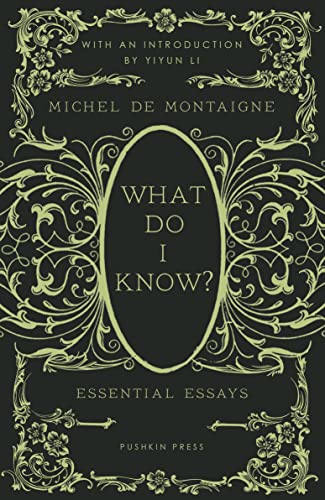
Michel de Montaigne , What Do I Know? Essential Essays (Pushkin Press 2023, selected and translated by David Coward with an introduction by Yiyun Li)

I started my slow read of Montaigne’s essays at the beginning of March. It took me until the middle of the month to settle on a text.

I began with a library copy of the Penguin Classic edition translated by J. M. Cohen, which turns out to be a selection of about a third of the essays. I began filling in the gaps from Project Gutenberg’s ponderous 1877 translation by Charles Cotton. Then for a birthday present I was given What Do I Know, a much smaller selection in a much smoother translation with a welcoming introduction by novelist Yiyun Li. At last, I don’t know why I hadn’t seen it before, I bought the Penguin Classic Complete Essays which features M. A. Screech’s 1991 translation. With occasional back and forth to compare translations, that’s the text I’m now reading, and page numbers refer to it unless I indicate otherwise.

With my slow-reads, I take it as a sign that I’ve chosen a true classic when I come across references in other reading. Montaigne cropped up at least twice this month.

On 8 March, the Guardian‘s agony aunt Eleanor Gordon-Smith ended a column with this:

Montaigne thought you only get one true friend in your lifetime. You’re allowed to decide a given person isn’t yours.

That may come from a web search for quotes on friendship rather than Eleanor’s immersion in Montaigne. In Hisham Matar’s My Friends (my blog post here), the Libyan writer Hosam knows Montaigne well enough to disagree with him:

‘Is there anything more depressing than a wall of books? But you, my dear, disagree. Like Montaigne, you believe that the very presence of books in your room cultivates you, that books are not only to be read but to be lived with.’

(Hisham Matar, My Friends, page 321)

I haven’t come across Montaigne’s belief about books yet, but one of his charms is that he doesn’t expect the reader to agree with him.

What can I report after a month of reading a little Montaigne each morning? Well, the thing that stands out most obviously, which is also for me the main obstacle to straightforward enjoyment, is his frequent reference to writers of antiquity – sometimes in direct quotations of the Greek or Latin (mercifully translated into English in all the versions I have), sometime in recounted anecdotes. I tend to get lost as these references accumulate, but on a good morning they add to the charm of the essays.

‘On educating children’, the essay I am currently reading, is the longest so far at 37 pages. In the previous essay, whose title M. A. Creech translates respectfully as ‘On Schoolmasters’ learning’, whereas others, Charles Cotton included, call it ‘Of Pedantry’, there’s a lovely moment when Montaigne, having castigated a certain kind of schoolmasterly person for quoting from the classics too much, beats the reader to the punch:

Such foolishness fits my own case marvellously well. Am I for the most part not doing the same when assembling my material? Off I go, rummaging about in books for sayings which please me – not so as to store them up (for I have no storehouses) but so as to carry them back to this book, where they are no more mine than they were in their original place.

(Page 154)

In ‘On educating children’, he characteristically takes his time getting to the subject in hand, and spends a couple of pages discussing the role of quotations, and defends himself against his own mocking self-accusation:

I  undertake to write without preconceptions on any subject which comes to mind, employing nothing but my own natural resources: then if (as happens often) I chance to come across in excellent authors the very same topics I have undertaken to treat … I acknowledge myself to be so weak, so paltry, so lumbering and so dull compared with such men, that I feel scorn and pity for myself. I do congratulate myself, however, that my opinions frequentlty coincide with theirs.

(Page 164)

Hmm, that ‘often’ is to be emphasised, but his point, even the false modesty, rings true.

I’m pretty much out of time for this post. I should mention pleasure: there’s a lot of that in these essays. I mean the pleasure of reading, but there’s also pleasure as subject matter, even one or two discreetly bawdy passages. Montaigne and I will probably be conversing in the morning for the rest of the year. I hope to bring you interesting tidbits every month

Reading the Essays of Montaigne, post 1

It’s time I started another slow read, a couple of pages a day of a work that floats around in the culture but that I haven’t read, or want to reread. It’s been deeply rewarding so far to have read Proust’s À la recherche du temps perdu, George Eliot’s Middlemarch, St Augustine’s Confessions and The Iliad. There are many books that could fill this early morning slot. The one that has successfully nudged for my attention an has been available, is the essays of Michel de Montaigne.

My only direct encounter with Montaigne was 50 years ago when I embarked on a French Honours course at university, but after a couple of weeks wrestling with Middle French, I gave up the struggle. I remember absolutely nothing of Montaigne from those weeks.

David Malouf may have sowed the seed of my desire to revisit him by quoting him at the beginning of his 2011 Quartlerly Essay, The Happy Life (my blog post). Then, most recently, David Runciman devoted an episode of his History of Ideas: Past, Present, Future podcast to Montaigne’s booklength essay, Apology for Raimond Sebon. I borrowed a copy from my local library and began reading yesterday, the 1st of March, 444 years to the day from when Montaigne signed his note ‘To the Reader’, which tries to discourage me from reading any further:

So, reader, I am myself the substance of my book, and there is no reason why you should waste yourleisure on so friviolous and unrewarding a subject

We’ll see.

I’m starting out with the Penguin Classic edition of essays selected, translated and introduced by J. M. Cohen. This book dates from 1959, and must be returned to the library before I can read it all at my slow pace, so I may switch to another edition somewhere along the line. But here goes!

The Confessions of Saint Augustine, third and final report

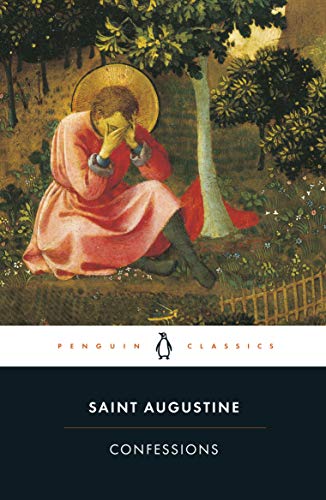
Saint Augustine, Confessions (approx 400 CE, translated by R S Pine-Coffin 1961, Penguin Classics edition): pages 191–347 , from Book IX chapter 6 to Book XIII chapter 38

A month ago, when Augustine finally gave himself over to God, I was half expecting the remaining third of his Confessions to be pious anticlimax. I was partly right.

There’s a moving account of the death of his mother, which makes a point of her not wishing to be buried in her homeland. I wonder if this marks a point in the history of the west when people stopped seeing themselves as inextricably bound up with their place of origin, their Country – a disjunct that in the anthropocene we may be trying to reverse.

The rest of the book is given over to philosophical and theological argument – about the virtuous life, the nature of time and memory, the nature of God and eternity, the creation of the world, the meaning of faith. I let a lot of this go through to the keeper, happy to half-understand the intricate arguments. My impression is that his overarching project is to reconcile Platonist philosophy with the Christian scriptures and the doctrines of the Church – a major contribution to the development of Western thought, but not exactly a barrel of laughs.

Some bits grabbed my attention.

There’s a long passage where Augustine goes through the five senses and talks about how to best renounce the pleasures associated with them, or at least not enjoy them for their own sake (because after all you have to eat, and you can’t help but smell nice things). It’s a pretty perverse project that cast a long shadow – my own Catholic childhood and adolescence fairly bristled with notions of self-denial and discipline of the senses, and the ‘examination of conscience’ we were taught to perform from the age of seven could have been based on Augustine. I was struck by the hard intellectual work he puts into it. As he says:

I am working hard in this field, and the field of my labours is myself. I have become to myself like land that a farmer works with difficulty and with much sweat.
Ego certe, domine, laboro hic et laboro in me ipso: factus sum mihi terra difficultatis et sudoris nimii.

(10:16, pages 222–223)

I love it that he clearly had experienced the pleasures which he was renouncing. He protests a bit too much about the awfulness of sensual pleasure, but lesser pleasures can be acknowledged. For instance:

What excuse can I make for myself when often, as I sit at home, I cannot turn my eyes from the sight of a lizard catching flies or a spider entangling them as they fly into her web? Does it make any difference that these are only small animals? It is true that the sight of them inspires me to praise you for the wonders of your creation and the order in which you have disposed all things, but I am not intent upon your praises when first I begin to watch. It is one thing to rise quickly from a fall, another not to fall at all. And my life is full of such faults.
quid cum me domi sedentem stelio muscas captans vel aranea retibus suis inruentes inplicans saepe intentum me facit? num quia parva sunt animalia, ideo non res eadem geritur? pergo inde ad laudandum te, creatorem mirificum atque ordinatorem rerum omnium, sed non inde intentus esse incipio. aliud est cito surgere, aliud est non cadere. et talibus vita mea plena est

(10:35, page 243)

It’s interesting, by the way that where the translation has ‘such faults’ at the end there, the Latin has ‘such things’, leaving the possibility open that it may not be a fault at all.

Possibly because I’m currently doing an online course in modern and contemporary American poetry (‘ModPo‘) which has a focus on close reading, I’m fascinated by Augustine’s extended discussion of the first verses of the book of Genesis. Some readings, he argues – probably against his former companions the Manichees – are just wrong. But there is room for different interpretations: the text is open, as the ModPo teachers would say, and it’s impossible for anyone to know what was in the mind of the human author (whom he takes to be Moses). There’s something wonderfully modernist about this, for example:

For my part I declare resolutely and with all my heart that if I were called upon to write a book which was to be vested with the highest authority, I should prefer to write it in such a way that a reader could find re-echoed in my words whatever truths he was able to apprehend. I would rather write in this way than impose a single true meaning so explicitly that it would exclude all others, even though they contained no falsehood that could give me offence.
ego certe, quod intrepidus de meo corde pronuntio, si ad culmen auctoritatis aliquid scriberem, sic mallem scribere, ut, quod veri quisque de his rebus capere posset, mea verba resonarent, quam ut unam veram sententiam ad hoc apertius ponerem, ut excluderem ceteras, quarum falsitas me non posset offendere.

(12:31, page 308)

Mind you, quite a lot of Augustine’s readings are so tortuously allegorical as to surpass the most fanciful offerings of today’s poetry readers. He somehow manages, for instance, to make ‘God made the birds of the air’ signify something about God allowing ideas to float in humans’ minds.

It’s a shame that towards the very end he says that, although ‘in mind and rational intelligence’ women have a nature the equal of men’s (‘in mente rationabilis intellegentiae parem naturam‘), ‘in sex’ they are physically subject to men (‘sexu tamen corporis ita masculino sexui subiceretur‘). Perhaps it was a mercy to the women of his time that he chose a life of celibacy.

But I don’t want to leave on such a sour note. Here’s a passage from Book XIII chapter 9, which illustrates both the way his reasoning works and the way he presents himself:

A body inclines by its own weight towards the place that is fitting for it. Weight does not always tend towards the lowest place, but the one which suits it best, for though a stone falls, flame rises. Each thing acts according to its weight, finding is right level. If oil is poured into water, it rises to the surface, but if water is poured on to oil, it sinks below the oil. This happens because each acts according to its weight, finding its right level. When things are displaced, they are always on the move until they come to rest where they are meant to be. In my case, love is the weight by which I act. To whatever place I go, I am drawn to it by love.

The Confessions of Saint Augustine, second report

Saint Augustine, Confessions (approx 400 CE, translated by R S Pine-Coffin 1961, Penguin Classics edition): pages 111–190, from start of Book VI to Book IX, chapter 6

This month’s reading of Confessions included the book’s most famous prayer, ‘Give me chastity and continence, but not yet.’ Here it is in context:

As a youth I had been woefully at fault, particularly in early adolescence. I had prayed to you for chastity and said, ‘Give me chastity and continence, but not yet.’ For I was afraid that you would answer my prayer at once and cure me too soon from the disease of lust, which I wanted satisfied, not quelled.
at ego adulescens miser valde, miserior in exordio ipsius adulescentiae, etiam petieram a te castitatem et dixeram: da mihi castitatem et continentiam, sed noli modo. timebam enim, ne me cito exaudires et cito sanares a morbo concupiscentiae, quem malebam expleri quam exstingui. 

(Book VIII Chapter 7, page 169)

Interestingly enough, Augustine’s struggle with sexual desire isn’t his main story. He does go on about it a bit, and he never shakes off the Manichees’ demonising of the body, but it’s not that much more interesting than his gambling addiction, which was relatively easily kicked. His true interest is in the convoluted mental and emotional process of conversion. He disentangles himself from Manicheism, comes to devalue academic success, and renounces what we might see as a perfectly decent de facto relationship, to embrace mainstream Christianity. He describes himself as wanting to go in two directions, one towards what he understands to be a life well lived, and the other to stay with what he has. It’s a beautiful anatomy of the process of getting to decide to change one’s life (‘a hundred indecisions, … a hundred visions and revisions’).

The moment when he finally makes his decision is brilliant. He is overwhelmed by an emotional storm, an ‘agony of indecision’, and goes away from his friend to weep, because ‘tears were best shed in solitude’ (so men’s conditioning has stayed constant in some regards for at least 1600 years). He has a really good cry, and then there’s the other bit I was told about in my childhood::

I heard the singsong voice of a child in a nearby house. Whether it was the voice of a boy or a girl I cannot say, but again and again it repeated the refrain ‘Take it and read, take it and read’. At this I looked up, thinking hard whether there was any kind of game in which children used to chant words like these, but I could not remember ever hearing them before. I stemmed my flood of tears and stood up, telling myself that this could only be a divine command to open my book of Scripture and read the first passage on which my eyes should fall.
audio vocem de vicina domo cum cantu dicentis, et crebro repentenis, quasi pueri an puellae, nescio: tolle lege, tolle lege. statimque mutato vultu intentissimus cogitare coepi, utrumnam solerent pueri in aliquo genere ludendi cantitare tale aliquid, nec occurebat omnino audisse me uspiam: repressoque impetu lacrimarum surrexi, nihil aliud interpretans divinitus mihi iuberi, nisi ut aperirem codicem et legerem quod primum caput invenissem.

(Book VIII chapter 12, page 177)

I got the impression from the nuns, priests and brothers of long ago that the voice was that of a disembodied spirit, an angel. But Augustine himself suggests no such thing. God’s instrument here is an actual child – otherwise why linger on the child’s indeterminate gender? I also thought this was the first time Augustine read the Christian scriptures, but he has been studying them for years, and already believes they are sound. In the actual Confessions, this is a moment of serendipity, and his going to read the first passage he sees (from Paul’s epistles, it turns out) has a lot in common with the ‘pagan’ practice of the sortes Virgilianae, in which the pages of Virgil’s Aeneid were opened at random to see the future.

This morning’s reading ended with more tears, of gladness this time as he is baptised and his life is turned around. He is accompanied by his son Adeodatus, now 15 years old, whom he clearly treasures.

I’m about two thirds of the way through the book, and I’m expecting the rest to be pious anticlimax. But these last 20 pages are brilliant and completely explain the book’s enduring status as a classic.

The Confessions of Saint Augustine, first report

Saint Augustine, Confessions (approx 400 CE, translated by R S Pine-Coffin 1961, Penguin Classics edition): pages 1–110, from beginning to end of Book V

If St Augustine invented the literary form of autobiography, he did it by accident. The impression I have so far is that in Confessions he is telling the story of his life as a teaching device. The message seems to be that humans depend on the mercy of God for everything, from mother’s milk to the ability to read. Secondary to that, humans are born sinful. So far at least, quite a lot of his ink is spilled in arguing with the Manichees, and a lot of that argument is pretty opaque to the casual reader, by which I mean me.

Still, it’s quite a thing to spend 10 minutes or so each morning in contact with a mind that was alive nearly two millennia ago. Two moments grabbed me in the very early chapters.

In writing about his early schooling, even while saying he was a wicked child (for wanting to play rather than study!), he argues against against harsh physical punishment as a teaching tool. After saying he hates Greek but likes Latin, he explains that he learned Latin from his mother and nurses, and Greek from his stern school teachers. He generalises:

This clearly shows that we learn better in a free spirit of curiosity than under fear and compulsion.
hinc satis elucet maiorem habere vim ad discenda ista liberam curiositatem quam meticulosam necessitatem.

(1:14)

A little further on, after arguing that the innocence of childhood is a myth, he comes face to face with Jesus’ apparently contradictory view in Matthew’s Gospel, and offers this bit of ingenious argumentation:

It was, then, simply because they are small that you used children to symbolise humility when, as our King, you commended it by saying that the kingdom of heaven belongs to such as these.
humilitatis ergo signum in statura pueritiae, rex noster, probasti, cum aisti: talium est regnum caelorum

(1:19)

If I’m just going to quote the bits that stood out for me from amid the theologising, I can’t go past this wonderful paragraph about friendship:

We could talk and laugh together and exchange small acts of kindness. We could join in the pleasure that books can give. We could be grave or gay together. If we sometimes disagreed, it was without spite, as a man night differ with himself, and the rare occasions of dispute were the very spice to season our usual accord. Each of us had something to learn from the others and something to teach in return. If any were away, we missed them with regret and gladly welcomed them when they came home. Such things as these are heartfelt tokens of affection between friends. They are signs to be read on the face and in the eyes, spoken by the tongue and displayed in countless acts of kindness. They can kindle a blaze to melt our hearts and weld them into one.

(3:2)

I had expected confessions to loose living. So far, the main wickedness he confesses to is his adherence to the Manichean heresy. He does mentions a de facto wife, but when he goes from Carthage to Rome, he doesn’t tell us if she comes with him.

This morning, his career as a teacher of literature has led him to Milan, where he is deeply impressed by the lectures of (Saint) Ambrose. He finally makes a break from the Manichees. He’s impressed by ‘the academics’, but doesn’t throw in his lot with them. Nor does he embrace the Catholic Church (which is R S Pine-Coffin’s translation of catholica ecclesia, and fair enough, though the capital letters may be a bit misleading), but he becomes a catechumen, which I understand to mean he sees himself as under instruction.

To be continued.

Beginning the Confessions of Saint Augustine

I’ve become attached to the practice of reading a few pages of a classic text first thing in the morning. À la recherche du temps perdu kept me busy for nearly two years. The Iliad and The Prelude followed. Then Middlemarch, which I finished a couple of weeks ago. Now that I’ve stopped missing Dorothea, Will, Celia, Lydgate and even Rosamond, it’s time to move on to my next morning project.

Over the protests of the Emerging Artist, who has barely tolerated my occasional morning chat about Middlemarch (I say occasional; she says far too frequent), I’ve decided to tackle St Augustine’s Confessions next. I hereby resolve to keep any enthusiasms to myself, or at least not inflict them on my nearest and dearest.

This is a book that has been around in my life for a very long time, but it hasn’t occurred to me until now to actually read it. Good Counsel College in Innisfail – which I attended aged 9 to 13 – had the Latin motto, Tolle lege, which translates as ‘Take up and read’. Regardless of what personal meaning it might have had to students – it has pretty much become my life’s motto – we were told that the phrase came from a moment in the life of Saint Augustine: when he was living a dissolute life in the fleshpots of Egypt he heard an angelic voice telling him to pick up and read a book he saw lying on a window ledge. The book was a Christian Bible, and the text that he read in obedience to the voice turned his life around. I guess I’m about to find out if that story comes from the Confessions, and if it does, how much of my childhood recollection is true to what the man himself wrote.

I’ve garnered other bits of information about Augustine and this book over the years. That’s one of the things that makes a book a classic: you don’t have to have read it to know a thing or two about it.

I feel as if I’ve always known that Augustine lived a debauched pagan life while his Christian mother wept and prayed for his conversion. His prayer is famous: ‘Lord, make me virtuous, but not yet.’

At one stage of my life his injunction, ‘Ama et fac quod vis’ (‘Love and do what you will’) was a welcome antidote to the rule-bound Catholicism of my childhood.

Augustine invented the concept of original sin, the blight of many young Catholic lives – though James Carroll, in Constantine’s Sword, an excellent book about anti-semitiism in the Catholic Church, argues that for Augustine the concept was about embracing human imperfection rather than condemning us as innately evil.

I’e bought a copy of the Penguin Classics edition, translated in 1961 by the wonderfully-named R S Pine-Coffin, and I’ve found a Latin text on line in case I decide to be linguistically adventurous. I’ll report back in a month …