Category Archives: Diary

SWF 2011: Bombs and Poetry on Thursday

After I uploaded my sketchy report on last night’s SWF event at the Town Hall I searched for #swf2011 on Twitter and saw that everything I’d quoted had been tweeted to the universe within seconds of being uttered. Undaunted, here I am again, lumbering along with my antiquated longwindedness to bring you My Thursday at the Festival Part One: 10 till 2.

10 am: The Poetry of War with Daniel Swift and A C Grayling
Daniel Swift’s grandfather flew in planes that dropped bombs on German cities in World War Two. He failed to return from a bombing mission in 1943 when Daniel’s father was four years old. The book, Bomber County, tells of Daniel and his father visiting the grave. Daniel, by my calculations now 34, wanted this small story to open out into a bigger picture. He sought out and interviewed participants in bombing missions, and people who were in the cities bombed by his grandfather on the nights of his missions All this, plus an exploration of World War Two poetry, which anyone (else) will tell you barely exists, fed into a project of considering the bombing campaign, not to praise the heroism of the men or condemn or defend the atrocity involved, but to try to imagine – resurrect was Swift’s word – the human experience.

A C Grayling , when he’s not busy being the nice one of the current crop of aggressive British atheists, is an ethicist. His book, Among the Dead Cities, deals with the ethics of those same missions. The focus of this session was on Swift’s book, which Grayling clearly loves. They claimed to disagree on the ethical question, but I couldn’t spot any disagreement. The conversation was lovely in many ways, not least for the spectacle of an eminent professor putting his considerable intellectual heft into recommending the work of a much younger man. The air fairly crackled with respect – mutual between the speakers, from both of them to the men who flew on the mission, and during question time to the rambler and the autobiographer.

11.30 am: Antipodes: Poetic Responses
Antipodes is an anthology, edited by Margaret Bradstock, of Aboriginal and non-Aboriginal poets addressing the relationship between Aboriginal Australians and settlers – the survivors of genocide in conversation with the perpetrators, descendants and beneficiaries, as it were. The facilitator, Martin Langford, said it was the first book of its kind, and warned us that some of the sentiments, especially in the early settler poems, might be repugnant to modern readers – the book is meant to be read as whole. In order of appearance we were read to by:

Anna Kerdijk Nicholson, who read a number of poems from Possession. It was good to hear them read, though my impression was that the poet was intimidated by the context. I wouldn’t have objected if she’d explained the universally cryptic titles of her poems, but she just read and then sat down.

Lionel Fogarty: again I was very glad to hear him read, as I have a copy of his New and selected poems : munaldjali, mutuerjaraera but haven’t been able to read very much of it. Now that I’ve seen and heard him I may have a better chance. He read a semi-rap, ‘True Blue, Didjeridoo’, which he and his son wrote when Nicole Kidman was culturally insensitive enough to play a didjeridoo on television.

I don’t know the work of either Margaret Bradstock or Brenda Saunders. They both read well, but I have trouble absorbing non-narrative poetry that I’m hearing for the first time. Ali Cobby Eckermann, a little of whose work I’ve read in anthologies and journals, read us excerpts from an unpublished verse novel, Killing Fields, a massacre story. ‘You’re privileged,’ she said.

Anita Heiss read last. With her brilliant control of tone she had us laughing and devastated from moment to moment. A woman of many talents, she thanked the organiserd for calling the writing in her book I’m Not racist, But poetry. ‘It’s not really poetry,’ she said, ‘but it’s not prose because it doesn’t go to the end of the line.’

I’m not sure what this anthology is. It may be intended for schools. Not that there’s anything wrong with that of course, but it does make me hesitate to rush out and buy it for myself.

1 pm: The Poetry of Three
This was Mark Tredinnick, Kim Cheng Boey and Cate Kennedy. Mark is a nature writer, and the poems that worked best in this context dealt with the nature of a parent-child relationship. I particularly liked ‘House of Thieves’. Kim Cheng, whose work I know only from his readings last year, was again delightfully urbane. Cate’s poems are narratives, and went over like a charm. I plan to buy her book.

Probably the strongest visual image from the Festival is the huge queues, all of which today seemed to have Bob Ellis in them. The queues for poetry were all short, and at each poetry session one of the readers expressed gratitude and surprise that so many people turned up.

SWF 2011: A Good Leader is Hard to Find

The reason I am not a politician is that I want to understand.

That’s what the French political scientist Raymond Aron said when asked why he hadn’t gone into politics. The remark came to mind when I saw the number of politicians and ex-politicians in this year’s Sydney Writers’ Festival line-up. Maybe there’s room for a separate Sydney Politicians’ Festival, or a Sydney Politicians’ and Political Journalists’ Festival.

Whatever misgivings I might have had, I turned up with 1600 or so others at the Town Hall last night to hear Lenore Taylor, Bob Ellis, George Megalogenis, Bob Carr, Barrie Cassidy and Kerry O’Brien chat under the heading, ‘A Good Leader Is Hard to Find’. Kerry O’B was moderator, and the first thing he did, whether deliberately or not, was to reframe the discussion. He announced the title as ‘Good Leadership Is Hard to Find’. I breathed a tiny sigh of relief, as the shift away from the personal made it a bit less likely that we’d be treated to misogyny-flavoured wit at Julia Gillard’s expense.

The composition of the panel – four political journalists, five if you count Bob ‘Sui Generis’ Ellis, and a former politician who was also once a journalist – made it inevitable that the discussion would focus on the relationship between politicians and the media. There seemed to be consensus that we lack effective or convincing leadership in the Australian parliament, that the interplay between the politicians and the relentless 24-hour news cycle is partly to blame, and that the attention both of them pay to opinion polls adds toxin to the brew. Our leaders are so busy feeding the media beast they don’t have time to think. They’re reduced to selling a message rather than advocating a case, performing rather than communicating. Political coverage is dominated by opinion polls, leadership challenges and early election speculation, with not a lot of room forin depth analytic conversation. Gone are the days when the Prime Minister would chat with journalists at the end of a long day and explain his/her thinking about proposed legislation – when Paul Keating would say to Lenore Taylor, ‘Love, this is what you need to know. The discussion was refreshingly free of blame: the way the media works has changed, and neither the politicians nor the journalists have figured out how to deal with the new reality.

There were no revelatory insights, but it was an interesting evening. Ellis and Carr stood out as phrase-makers, Carr describing himself as an amateur historian, Ellis enacting his familiar contrarian persona. For example, Carr:

In a democracy the normal relationship between people and their elected representatives is mistrust and dissatisfaction. It’s the job of the people to be disillusioned. It’s the job of politicians to disillusion.

Ellis, when asked why the ALP doesn’t adopt what he had just described as an obvious strategy

They do research instead of thinking.

It’s not that the others lacked flair, but as working journalists perhaps they were a little more willing to let the facts get in the way of a good story. So after Bob C made his fourth or fifth remark on the theme that things may be bad but they’ve been ever thus, George M said, ‘I’ve followed many election campaigns but this was the first one where the main candidates feared the electorate.’ And when Ellis spoke of the minority government as ushering in a new era of negotiation and persuasion in parliament, Lenore challenged him: ‘And you’ve seen this happen with which piece of legislation?’

The journoes have their own unrealities. George M told us how his faith in the electorate had been restored when ‘they’ decided to choose neither side of politics at the last election, but to have a hung parliament. No one on the panel said, ‘George, you’re talking nonsense. No one made that decision. All the millions of actual deciders chose one or the other. There was no “Neither” option on the ballot paper.’

There was half an hour of questions. Only one person mistook the microphone for a soapbox.

Gallery

NSWPLA Dinner, a report from the trenchers

Last year a woman premier presented the NSW Premier’s Literary Awards at the Art Gallery. Tonight a non-Labor premier, just as rare a beast in the 10 of these dinners I’ve been to, did it at the Opera Point Marquee, … Continue reading

A launch

Ursula Dubosarsky’s new book, The Golden Day, was launched yesterday with a suitable sense of occasion. I’d spent the morning as an extra in a rap video clip (about which I may blog some other time), but no one at the launch seemed to notice that my usually shiny forehead was sporting a light dusting of make-up.

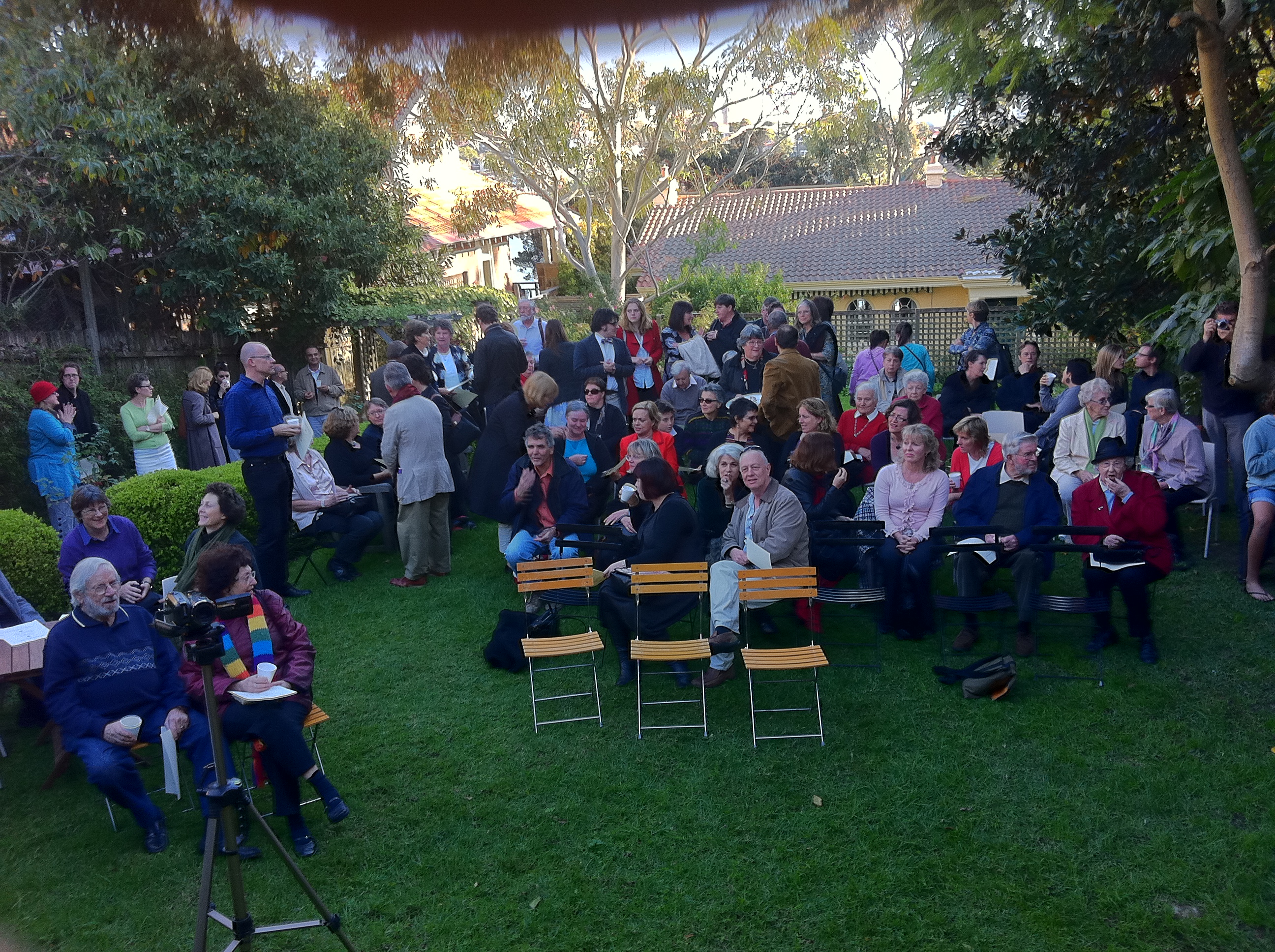
We were at Nutcote Cottage, home of May Gibbs, a lovely site for a launch. The golden light of a fine Sydney autumn afternoon, tiny muffins, cupcakes and Lamington slices would have made the mood celebratory even without a subject. As you see from the pic a new Dubosarsky book draws quite a crowd: from the publishing world, family, writers (not just for children), artists and illustrators, colleagues, Marrickville dwellers, the wife of a former Federal Minister, former students of SCEGGS Darlinghurst and even some of the book’s target audience, that is to say, children.

The Nutcote lawn

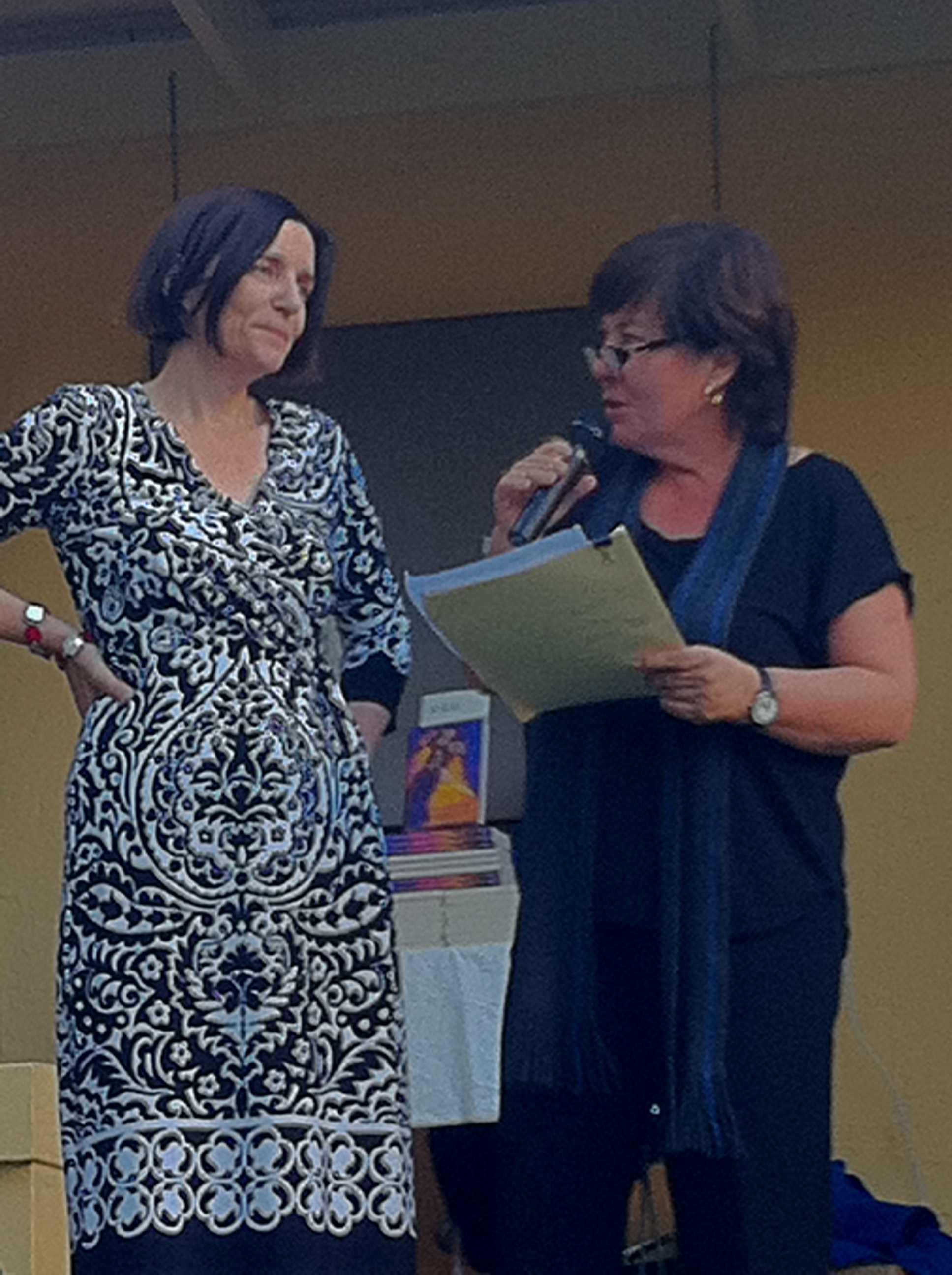
Julie McCrossin presided. Drawing on her experience as radio interviewer and stand-up comedian, she put Ursula through her paces, quizzing her about her inspiration for the book. It’s set in a genteel girls church school in the inner eastern suburbs of Sydney, a school that evidently bears an uncanny resemblance to SCEGGS Darlinghurst, of which both Julie and Ursula are alumnae. Calling on contributions from other Old Girls, they evoked a startling picture of uniformed schoolgirls making their way from the bus stop to the school gates though filthy streets where junkies and prostitutes hung out. One member of the class of ’78 was coaxed by Julie into saying that she didn’t remember much out of the ordinary, apart from an occasional flasher and the naked woman who appeared in a doorway one morning asking her to get help.

‘There are myriad kinds of writers,’ Ursula said, responding to Julie’s pressing her for the meaning of some of the incidents in the book. ‘I’m the kind of writer who lets herself go to the dream.’ I quote this because it rings so very true of Ursula’s work, but also because just a few moments later Julie referred to the ‘ ‘myriad of influences’ she detected in the book (Picnic at Hanging Rock, classical myth, etc), thereby adding a little fuel to the fire of a conversation I’ve been having recently about usage: Ursula the classicist uses ‘myriad’ as I do; Julie the journalist agrees with my journalist friend. (Are you reading this, L–?)

Julie: Might I suggest that there's an underlying theme of sexual awakening? Ursula: Oh, that's what my book's about!

Sydney Ideas: Spirited Muslim Women

We headed off before dinner last night to another well attended Sydney Ideas talk in the new Law School building: Dr Amina Wadud on ‘Spirited Voices of Muslim Women in Islamic Reform Movements’.

We hadn’t read the fine print on the web site, and didn’t realise that the talk was part of a symposium, ‘Spirited Voices from the Muslim World: Islam, Democracy and Gender Rights’, or that the talk was preceded by a performance by the University of Sydney Gamelan Orchestra. So we were pleasantly surprised to arrive at a very full auditorium that sounded like a Balinese night. Marie Bashir, the Governor of NSW, who is also the Chancellor of the University and acting Governor General, launched the Symposium before Dr Wadud took the lectern. The last time I saw her launch anything it was a book published by South Sydney Youth Services, and she brought the same respectful gravitas to that room full of pierced and tattooed young people as to this gathering of distinguished academics.

Amina Wahud is at the forefront of the ‘gender jihad’ – the struggle for gender justice within the global Islamic community. Actually, I just re-read the blurb about her on Sydney Ideas website, and realised that it gives a very adequate summary of the talk:

Dr Wadud’s writings and vision for gender equality, within an Islamic ‘tawhidic paradigm’, incorporate the wider struggle against other forms of oppression such as racism, bigotry, religious intolerance, economic exploitation and the erasure of human dignity.

She described how at the World Conference on Women in Beijing in 1995 the Muslim women met with the aim of coming up with a joint statement, but no agreement could be reached between those who talked in terms of a human rights agenda and those who talked in terms of Islam. She went away from that meeting determined to find a way of reconciling the two, of finding, as she said, epistemological, theological, and other kinds of logical grounds for a Muslim feminism. Like Professor Muhammad Abdel Hameen on the Book Show recently, she has a thoughtful, non-literalistic approach to the Qur’an and pretty much scorns the approach that would take isolated verses as prescriptions for living.  She takes the concept of ‘tahwid’, which is literally the notion that God is One, central to Islam, and argues from it that all humans are equal because each has a direct relationship to God the Transcendental.

I’m not at all engaged in Islamic theology, but it was a joy to hear this flexible alternative to the version of Islam that dominates the airwaves. Dr Wadud began her talk with an invocation of God in Arabic, and when she mentioned the Prophet she said something in Arabic, presumably the traditional ‘Upon him be peace and blessings’. It seems to me that to wage a feminist struggle from inside Islam in this way must be more fruitful in the long run than any number of feminist denunciations of Islam.

There were other, smaller joys. Dr Wadud, who was born in Maryland, USA, wore a shalwar kameez with an elaborate scarf tied over her hair, and a loose scarf over that. For the first quarter hour of the talk, this loose scarf kept trying to fall off. As we strove to follow her explanation of the background to her theoretical work, she had a struggle of her own, repeatedly hitching the back over her head. In the end, the scarf won. The other small joy only made itself known in the Q&A: Dr Wadud explained that some of her points would have been clearer if she had used her PowerPoint version of the talk, but she has moved to an iPad and wasn’t able to connect it to a projector. The joy: we had a person talking to us, instead of to a bunch of explanatory slides.

Wafu

Last night half a dozen of us had dinner at Wafu to celebrate a sixtieth birthday. Wafu is an establishment with policy. Evidently, Yukako – the owner, chef and entire wait staff – found that as her restaurant became popular some years ago she was appalled to realise she was becoming part of the great system of waste that prevails in the West. She decided to lay out some requirements. The restaurant is now open only to members and their guests, and there’s a sign near the front door asking visitors NOT to enquire how to become members. The Art Student (who insists that one newspaper article doesn’t mean she has to give up that title) and I, guests of a member, arrived before the rest of our group. Yukako welcomed us and gave us a sheet outlining the policies. Here they are, from the website:

To contribute towards creating a sustainable future we request a little more of our guests than most other restaurants. Please bear in mind the following points.

DO NOT WASTE FOOD
Please imagine people who live on the other side of the earth – every 6 seconds, one child under the age of 5 dies because they have no food”
Be mindful of the amount of food you order – try to order just the right amount, in harmony with your appetite. When eating with company, please consider sharing meals, family-style, as you would at home. We request that any dishes ordered be finished, as far as possible.

DO NOT WASTE CONTAINERS
“Please imagine wild animals”
If purchasing takeaway meals, please remember to bring your own containers. Sturdy, long-lived containers are the best. Failure to do so will result in a surcharge, and possible refusal of service.
We advocate respect for food, waste prevention and doing what is best for the environment. Help us to do what we can to shape our future!

“Please re-think”we can do more preventative things before resorting to the 3Rs
(Reuse, reduce & recycle)

Eat-in Policy
First, read our policies and mission statement on our front door or on our website. If you agree to our terms (namely, not wasting food and sharing meals as if you would at home) we will gladly welcome you to Wafu.
Please note that vegetables and salad on the side are NOT decorations; they are part of the meal too. Finishing your meal requires that everything is eaten except lemon slices, gari (sushi ginger) and wasabi.
If you think you might have trouble finishing your meal, order a little less or tell us in advance so that we might put less rice on your plate, for example. As an extra precaution, you could also bring a sturdy reusable container.
“We hope you always keep a suitable container in your bag”

Takeaway Policy
Takeaway orders are available. Please allow extra time for large orders. It is best to pr-order your takeaway meal via SMS. Please be clear in what you want to order and make sure you bring a sufficient amount of containers or plates (bring extra if you are unsure).
Please bring your own reusable storage containers or plates.
However, please ensure that the containers or plates have been well washed and dried – unclean containers will cause food to go off.

When using your own storage containers for takeaway food, we will give you a 30% discount and stamp your Wafu card towards the reward of a $20 voucher to be used for anything in the store!
Trying to order takeaway without your own containers or plates may also result in refusal of service. We advocate respect for food, waste prevention and doing what is best for the environment. Help us to do what we can to shape our future!

What this version doesn’t include is the threat of expulsion if a diner doesn’t clean up everything on her or his plate. Last night, I ate every grain of brown rice, every curl of spring onioon, every drop of sauce. When two of us ordered the salmon hotpot, Yukako recommended that they order one between them, and it turned out she was right .

At the end of the evening, I’m pleased to report, the Art Student and I were given membership cards.

Oh, and the gluten-free, dairy-free, sugar-free, egg-free, vegan friendly food was excellent, though I’ll skip the chocolate soy mousse dessert next time.

Zero Carbon by 2030 at Sydney Town Hall

Last night we went to hear Peter Harper, Coordinator of Zero Carbon Britain, speak at the Sydney Town Hall. The topic was ‘Zero Carbon by 2030 – Britain’s dream or reality?’ As the advance publicity put it, Zero Carbon Britain is

a plan offering a positive realistic, policy framework to eliminate emissions from fossil fuels within 20 years. Zero Carbon Britain(ZCB) brought together leading UK thinkers, including policy makers, scientists, academics, industry and NGOs to provide political, economic and technological solutions to the urgent challenges raised by climate science.

Governments and businesses seem paralysed and unable to plan for a rapid transition to a low-carbon economy. ZCB shows what can be done by harnessing the voluntary contribution from experts working outside their institutions. The ZCB report, released in June 2010, provides a fully integrated vision of how Britain can respond to the challenges of climate change, resource depletion and global inequity, with the potential for a low-carbon future to enrich society as a whole.

(Download the PDF here.)

The talk itself was a great mood lifter. First, the setting: it’s hard to be gloomy about the future in the elaborate colonial prettiness of the refurbished Town Hall Foyer. Then the introduction by Robyn Williams, icon of enthusiasm for scientific enquiry: after an obeisance to current ABC pusillanimity with the mantra ‘I’m from the ABC and I have no opinions of my own’, he told us that the Science Show had broadcast three programs on Peter Harper’s base, the Centre for Alternative Technology in Wales, over the years, and generated a lot of interest. The audience was great, producing a supremely lively, smart, on-topic Q & A: as one of my friends said, when an event receives this little much publicity in the mainstream media, the people who know about it are likely to know a lot about the subject.

Peter Harper is a scientist with style. He began and ended with photos of his granddaughter. ‘Why am I doing this?’ he asked at the start. ‘Because of her.’ He went on, ‘I often ask my great-great-great-granddaughter what to do next, and though she hasn’t been born yet, she’s a sharp tongued little hussy and says good things.’ He characterised the ‘leading thinkers’ who had prepared the framework as greenies and geeks, and put his argument for a strategic approach to climate change (as opposed to much frantic activity around short term projects that often turn out to be cul de sacs) with wit, warmth and a lucid slide show.

One of my take-homes is what he called the Canute Principle. For the benefit of those unfamiliar with British lore, he told the story of King Canute ordering the tide not to come in so as to demonstrate to his obsequious courtiers that there are limits to kingly power. The principle: ‘Physical reality trumps political reality.’ That is, there may be any number of political reasons not to act on climate change, or to take short term actions that lead nowhere, but any plan that aims to actually deal with the dangers needs to take account of the physical world. Let me say that again in bold: Physical reality trumps political reality. Isn’t that elegant?

Sydney Ideas: Gregory Crewsdon

Sydney Ideas is a program of public lectures presented each year by Sydney University. The Art Student* and I have attended sporadically, always to our benefit. Tim Flannery on global warming, Sara Roy on Palestine and Margaret Levi on trade unions and social justice in the US and Australia, for instance, stand out. All of those lectures were at the Seymour Centre, on the edge of the university’s sprawl. This year, the program seems to have migrated across City Road into the grounds of the University itself. On Friday night we went to see US photographer Gregory Crewsdon in the new Law School building. At least it’s new to me, and as I approached it from the west, I was gobsmacked by the way it opens out onto a view of Victoria Park and the city.

This was probably the best attended talk that we’ve been to in the series., possibly because it was co-hosted by the Power Institute and attracted Fine Art students, possibly because Gregory Crewsdon is a celebrity among those students. Certainly, it was a young crowd.

The talk was interesting, with slides of Crewsdon’s work and books on sale in the foyer. His photographs were described in the publicity for the talk as ‘disturbingly beautiful, large-scale, small-town American landscape narratives’. He chatted interestingly about them to an Art Professor and then answered questions. We left  half way through the inevitable question using words like eidos and had an animated conversation over dinner about artists and entitlement.

You see, ‘large-scale, small-town’ images require enormous resources in the making. Crewsdon started out with what he called a ‘renegade’ process. Without any kind of permit, but with the cooperation of the local people, he took images from a high crane of people doing odd things: laying turf in the main street, planting flowers like traffic calmers and so on. He moved on to creating works on sound stages, that had David Lynch or Hitchcock–like neurosis hovering in the frame. And then, he took ‘the work’ outside again, and here’s where questions of entitlement came up for us. To create the image he wants, he might need to have a house on fire – the local fire brigade supplies him with a dozen houses they are willing to burn down for his purposes. He needs snow but not enough has fallen, so he brings in a snow machine. To create a single image, he has a huge crew, including a Director of Photography. The ‘renegade’ work involved engagement with a community. Once he had official status and access to more resources (no one said where the money came from, but he is a professor at Yale), the process looks much more like big business – all the paraphernalia of a movie set. The Art Student and I had been listening earlier in the day to Naomi Klein’s TED talk about advanced capitalism’s reckless plundering of resources. It was hard not to see Crewsdon’s artistic process as part of that recklessness: ‘I want this image to show a certain psychological state of alienation, and I’ll do whatever I need to do to make it.’ Carbon footprint? Social impact? Cost–benefit ratio? Not relevant. I remember Richard Wherrett saying decades ago – yes, I am a Baby Boomer – that theatrical productions like Jesus Christ Superstar were of dubious morality because of the human cost of mounting them: more than one person died building the sets of the Sydney production. As far as I know no one has died for  a Gregory Crewsdon photograph, but houses have been destroyed in a nation where homelessness is a significant problem. But then, how do you calculate the cultural benefit created?

Sadly, the Art Student, for whom these concerns were most vividly in mind, was too cranky to put them as a question rather than an attack.
—–

* She insists that one journalist calling her an artist doesn’t change anything. She’s still a student, and arguably still in kindergarten.

A near immersive art experience

The one formerly known as the art student (TOFKATAS) and I are just back from a short weekend in Canberra – overnight in a wotif mystery hotel, and most of the rest of the time at the National Gallery.

The gallery’s new Aboriginal and Torres Strait Islander rooms are just fabulous, and I hope to spend a lot more time in them. From early Papunya boards to the work of urban Aboriginal artists, the collection is dizzyingly rich, and the presentation is superb. And occasionally it got personal. Tony Albert’s ‘Ash on Me‘, for one tiny example, consists of the words ‘Ash on me’ painted on the wall and, as you might not be able to tell from the photograph at the link,  decorated with actual ashtrays, most of them with images of Aboriginal faces or figures, some with Australian flora or fauna. It’s a powerful statement in anyone’s terms, but I was grabbed by the throat when I saw this on the S:

In  case you can’t see, it’s a kookaburra with the words ‘Innisfail Qld’. It was borne in on me that this was an object from my Innisfail childhood, that ashtrays just like these with cute, noble, comical or otherwise stereotyped Aboriginal figures were an unquestioned part of the world I grew up in. I was implicated.

We also spent time with James Turrell’s ‘skypace’ Within Without, which from the outside looks like an artificial grassy hill with a rock dome rising from the middle of it, approached by a path between expanses of water. Inside, it’s an ochre pyramid with a huge basalt stupa in the middle, surrounded by eerily turquoise water. The space is filled with the sound of water overflowing. You walk across a flat bridge to enter the stupa – around its inside wall is a bench that seats about 20 people. The bench, it turns out, is heated. There’s a large oculus (a word I know from the Pantheon in Rome) in the middle of the roof, and a patch of coloured stone in the middle of the floor. If I hadn’t been introduced to Turrell’s work on Naoshima in Japan a couple of years ago, I might have had a quick look and moved on, because nothing much was happening. But we sat for at least an hour, and watched the oculus as its patch of sky grew deeper and deeper blue until it was pitch black against the whiteness of the inner wall, which we gradually realised has its own light source, and wasn’t somehow trapping light from outside. The sky couldn’t really be as black as it looked to us, I thought, and announced that I was gong to take a stroll around the inside of the triangle. I walked out the door of the stupa and, looking up at the deep blue, starry sky, took a step to the right – up to my calves in now invisible water. Fully shamefaced, I went back to my place on the heated bench, took my shoes and socks off and endured the amiable mockery of what had become a small community of Turrellites.

If you’re in Canberra, I do recommend that you spend time in the Aboriginal and Torres Strait Islander Galleries, and that you let the James Turrell space work on you – but take seriously the signage saying that the work of art does not meet Australian Safety Standards for Buildings.

Airport interlude

Last night I spent a couple of hours at the International Airport. I was waiting for someone who had booked on a JetStar flight from New Zealand. According to the web, their flight was a couple of hours late, at 7.20, and also cancelled. When I phoned JetStar in the afternoon, the person I spoke to said that meant it was arriving at 7.20. Once I arrived at the airport it was clear that it was actually cancelled, but since I hadn’t heard from my friends since the morning it was likely that they had been bumped onto the next available Qantas flight, a surmise with which the Travel Concierge agreed. Customs couldn’t help – the rules are that information about passenger lists can be revealed only three hours after a plane arrives. Thanks for that, regulators! I went looking for someone from JetStar, but their second-floor office was closed and their first-floor check-in desks deserted. I was collecting my email regularly on my phone, and my stranded friends finally managed to get word to me that they weren’t flying out until very early this morning, hoping fervently that they’d make their connecting flight to the US.

But stories about JetStar stuff-ups are commonplace, and that’s not what I wanted to write about. (My friends are now flying across the Pacific.)

An Emirates flight arrived during my vigil, and the waiting area was filled with Middle Easterners – plenty of women in hijabs and one in a niqab, a pleasant music of spoken Arabic, much familial kissing. When I was wandering aout the near-deserted third level, no doubt with a lost and confused look on my face, three young men came bounding up the stairs. One of them accosted me, speaking in rapid, excited Arabic, gesturing for me to join them. ‘I don’t speak Arabic,’ I said. He replied with more incomprehensible syllables, but this time made a fleeting gesture, not so much miming for my information as involuntarily illustrating his meaning – a slight bow of the head and two hands patting the air in front of his torso. ‘Ah, you’re going to pray,’ I said. He had no idea what I was talking about, and rushed off with his friends on their urgent quest.

I went back to the wall map I had been consulting, this time looking for any information about a prayer room. Sure enough, there was a little icon in the legend at the bottom showing a kneeling figure. I called them back and all four of us searched for the icon on the map itself. We found toilets, lifts, a first aid room, maybe a fire extinguisher, but no prayer room. We parted company, me heading back to the arrival gates, them about to settle, I expect, for a deserted patch of corridor where they could face in the correct direction and not be disturbed.

It was a surprisingly sweet encounter. Maybe the most sweetly surprising part was having someone assume I was Muslim, and probably, pink though I am, an Arab. It must be the famous Shaw nose.