Category Archives: Diary

Another walk, another 17 syllables

Jacaranda’s green
Five bright flowers on the ground
Ten live in the leaves

A Puppet Show for George Street

Wednesday night, Yuendemu at Gleebooks. Last night Java on George Street. Or close enough to justify the alliteration.

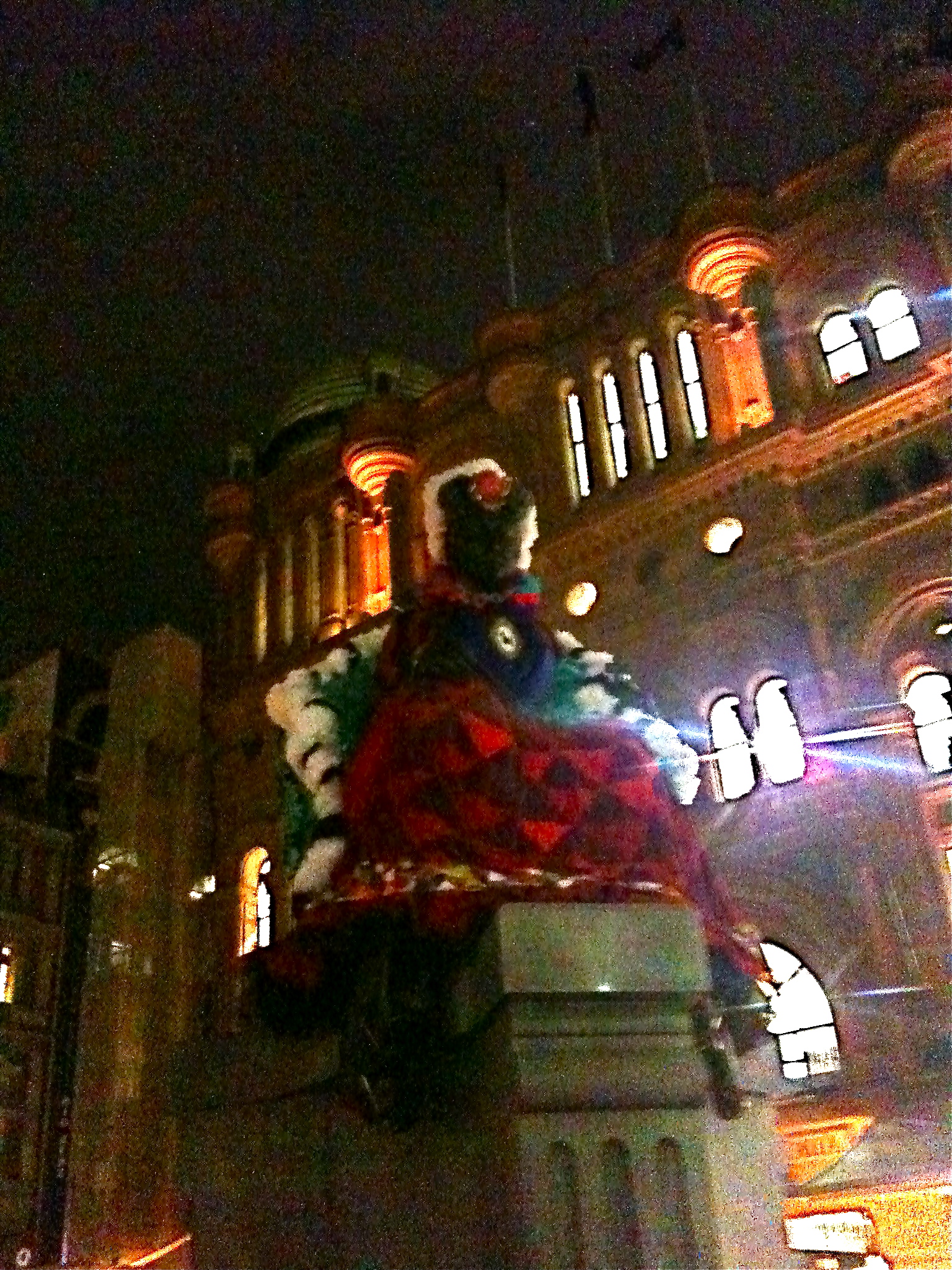
It’s Art and About time in Sydney, and among other things our civic sculptures are dressed for the occasion. Here’s Queen Victoria near the QVB, taken on my iPhone and then manipulated out of almost total blackness on iPhoto. She’s wearing a bright red quilted skirt, a white fuzzy bonnet, and, among other things, a huge cameo brooch with a dog on it slung round her neck.

Queen Victoria

Around the corner from the Queen, a number of exhibitions opened in the artist-run Gaffa Gallery last night. The one that had drawn us, and turned out to be the most interesting, was a solo exhibition by our young friend and neighbour Jesse Cox. (All but one of the others were photographic shows, with a lot of photoshopping, and about equal amounts of restrained elegance and garishly exuberant montage.)

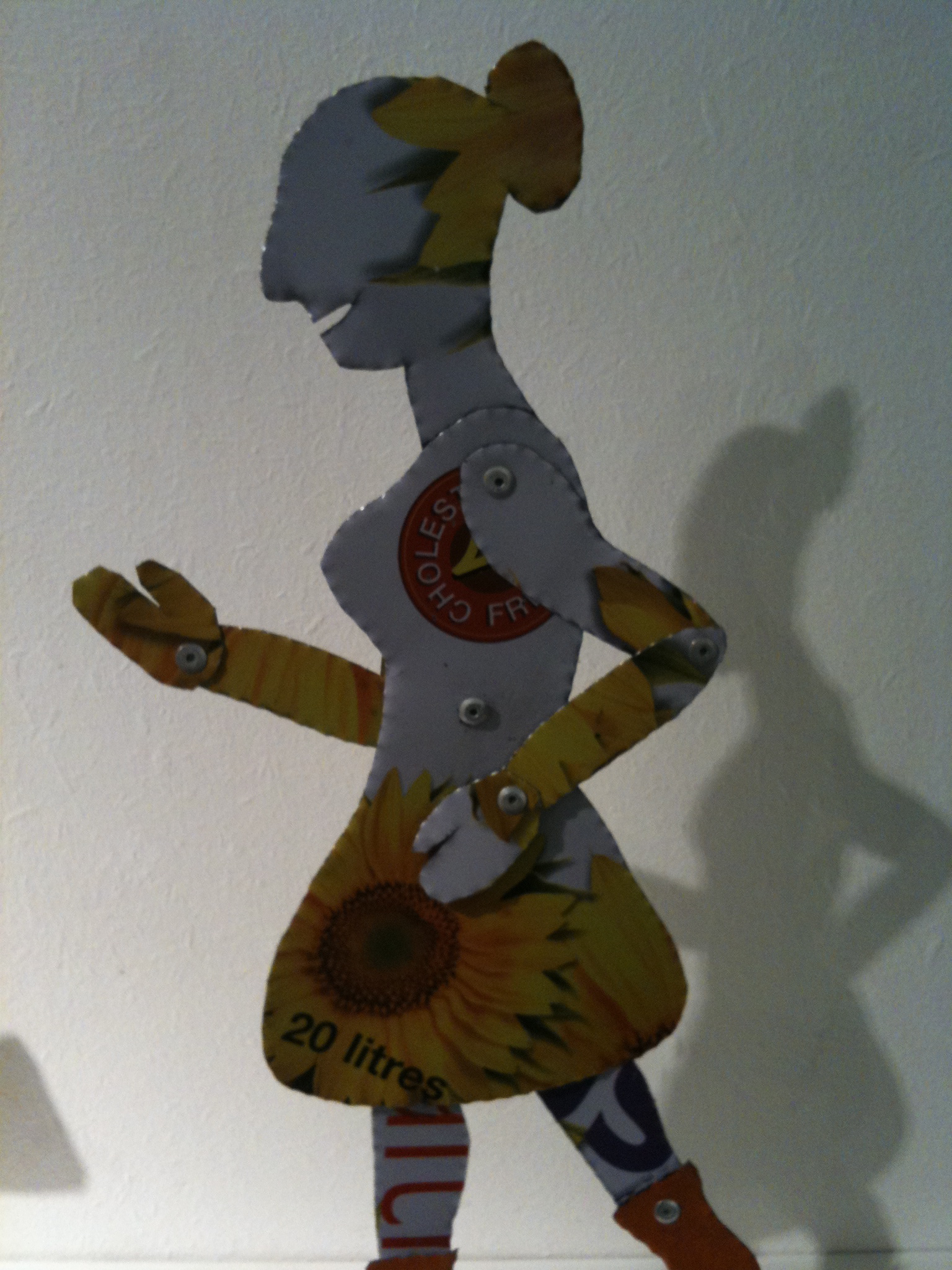
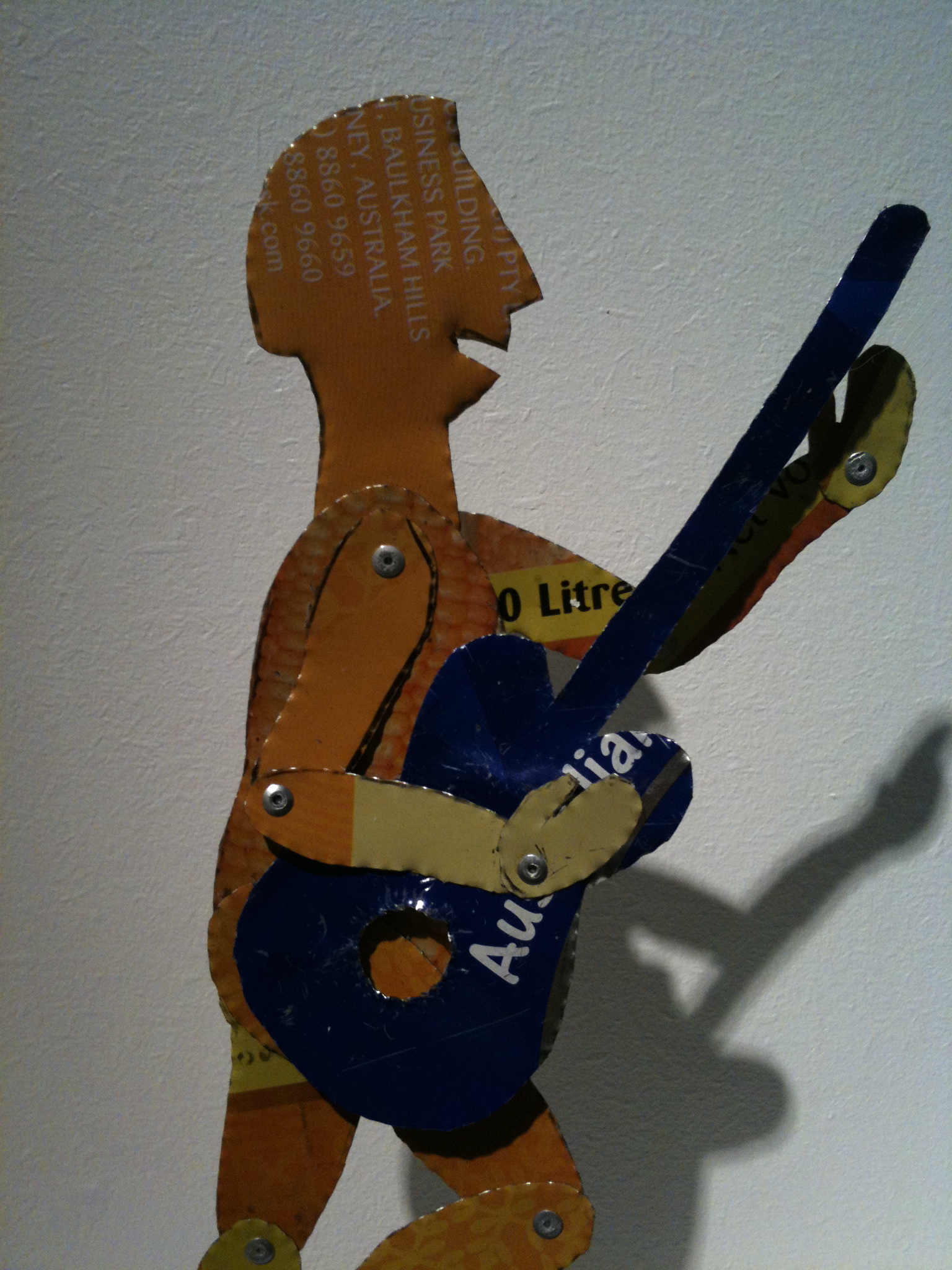
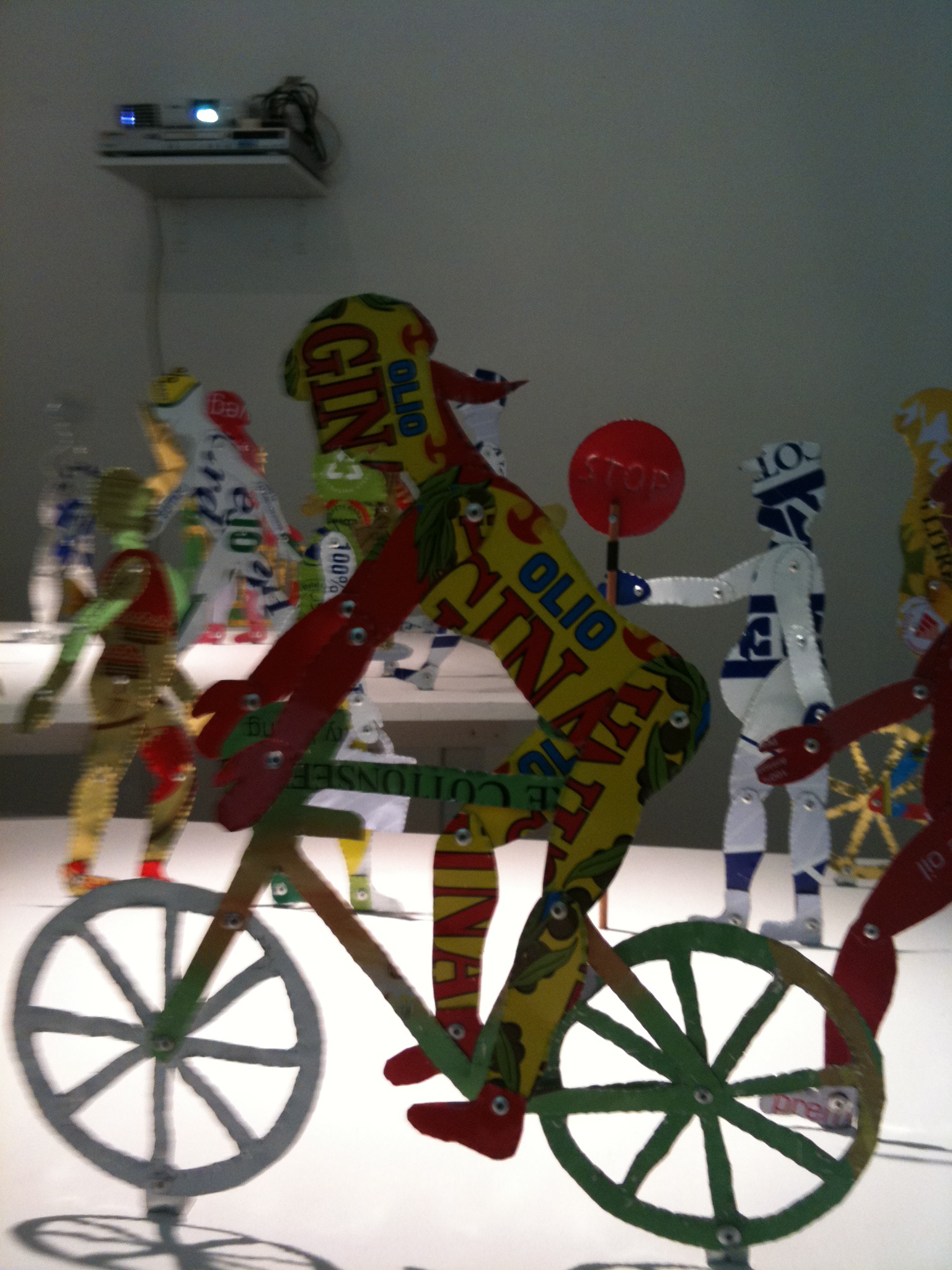
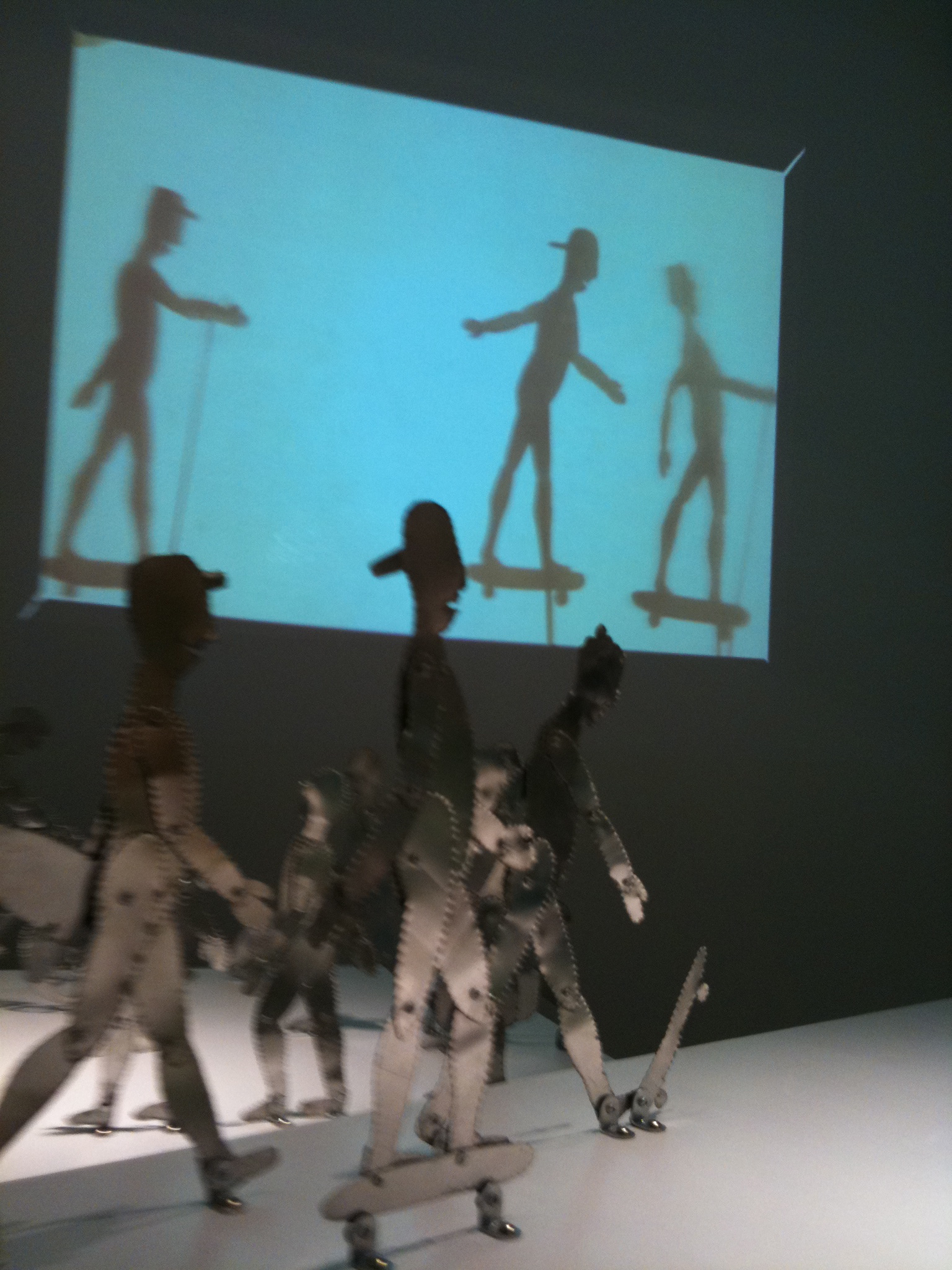
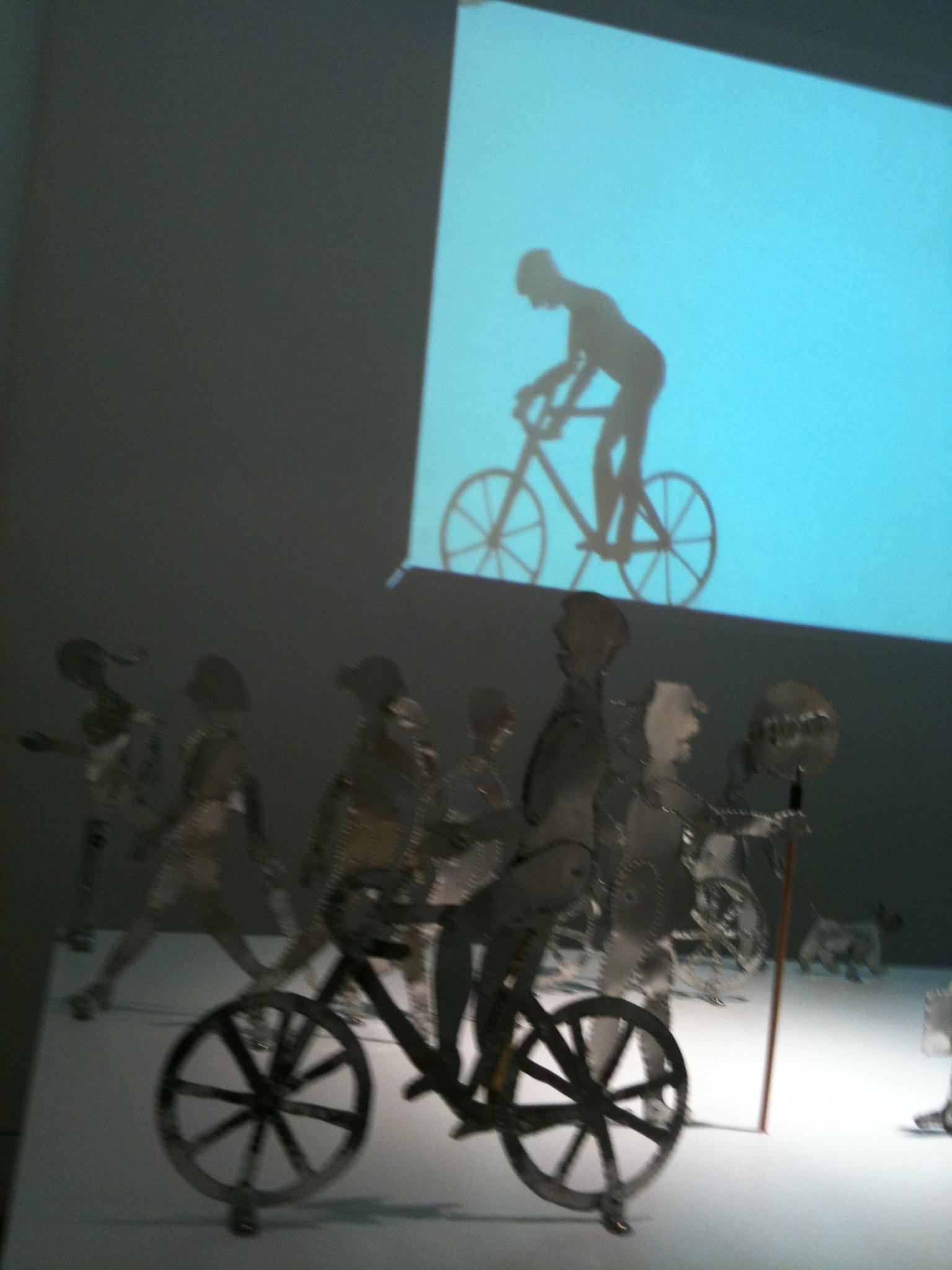
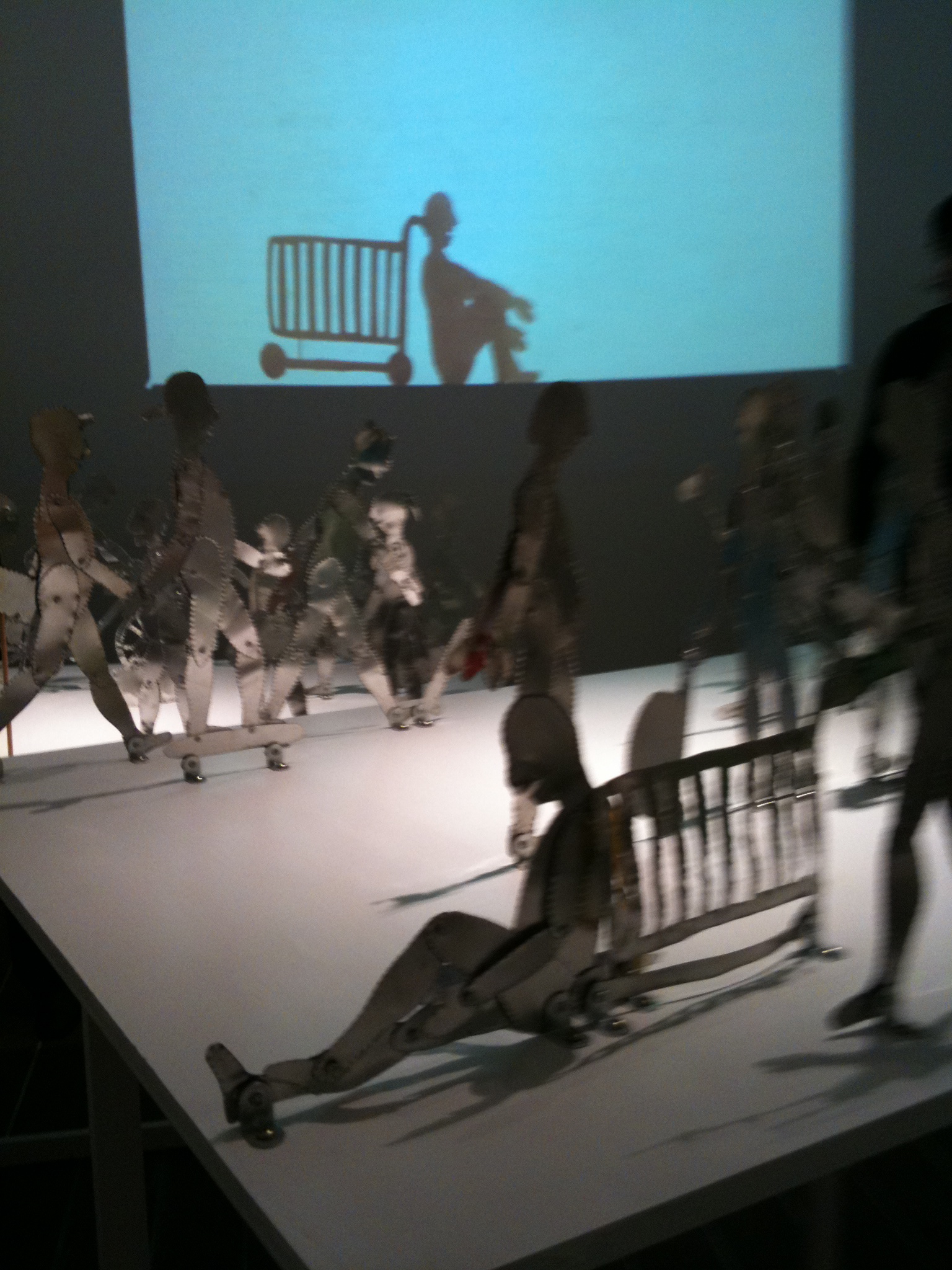
Jesse’s exhibition, A Puppet Show for George Street, is two rooms full of shadow puppets made from used oil drums scavenged from nearby restaurants. There are bicyclists, figures carrying briefcases, umbrellas, mobile phones, walking dogs, riding skateboards, wheeling shopping trolleys – two-dimensional figures cut from old tin with rivets at the joints. There’s some appealing verbal wit – the fat man walking a dog has ‘Cholesterol” printed all over him; one of the kissing lovers has a Heart Foundation tick on his chest. But the main charm is the way it refers to Javan Wayang Kulit.

As someone said, as we watched the video loop of the puppets in action, we half expected that at any moment a dragon would appear.

The other non-photographic exhibition is ‘PARK/PARK‘, a record of an event on Park(ing) Day earlier this year. According to the Park(ing) Day web site, it is ‘an annual, worldwide event that inspires city dwellers everywhere to transform metered parking spots into temporary parks for the public good’. This particular transformation involved a cardboard cut-out car and similar tree – the artists sat in the car until the meter expired, sipping tea.

All four exhibitions are open until 5 October. Art and About is all over town until 24 October.

Election night distraction fail

Because we had predicted it would be unbearable to be near a TV on this election night, we chose to join the art aficionados at the Art Gallery of New South Wales for the first night of Ken Unsworth’s ‘popera’, The House of Blue Leaves.

If this happened in the show it was after we left and would have required a transformation of the black decor.

As a distraction it was a major failure. I can’t give you a review because we left after a bit less than an hour. The image above makes it look like fun, and maybe the fun started after we left. The show involved music, dance, sculptural creations, appalling sight lines (exacerbated by sections of audience that radiated entitlement), terrible timing (long waits while clanking and scurrying behind a closed curtain weren’t quite masked by dreary chords from the piano). Much of the action happened close to the floor, and so was easily visible only to the front row of the audience. We were in the fifth row, so relied on guesswork for quite a bit of it.

Given all that, the show started promisingly. After a reverberant male voice proclaimed ‘In the beginning’ and variations, the curtain opened to the sound of heavy breathing on a more or less blank stage (there was a doll of some sort lying up the back left, but it was hard to tell if it was meant to be there), and then a further curtain opened at the back right to reveal the source of the heavy breathing, a woman in a nightie and body stocking lying on her back with her legs spread, crotch towards us. After a little while a small grotesque winged figure descended from the ceiling and rested for a moment between her legs (I think – the woman had moved around and so had people’s heads, so I could no longer see her at all). Then it rose again, and when halfway to the roof emitted a shower of fairy dust, or succubus sperm. A ripple of laughter. The only one of teh evening. The curtains closed.

There followed a song, beautifully performed by Natalie Gamsu in a shiny black frock, in German, something to do with morgen.

A man in black carried a helicopter onstage and popped three balloons by pointing it at them. There were boy sopranos, just their heads in urinal like stainless steel bowls, singing ‘See that ye love one another’. Natalie Gamsu made another appearance, her head poking out of a hole in a tall white boxy structure on wheels, this time singing in Spanish (‘Contorna‘) to a group of masked dancers. Slender wooden poles descended from the ceiling and made occasional clacking sounds that startled the dancers; after a while hands emerged from the ceiling and detached the poles, so that they fell onto the stage. Occasionally, as when a woman in a white dress floated up to land on the table holding the urinal-bowl-boys’-heads, there was a moment that seemed to promise something. But she just floated down to the floor again, helped by a man in black.

To my untutored eye, the choreography would not have disgraced a very good high school performance. The dancers were fine. Everything was done with great solemnity. There was nothing even faintly pop about the music or the decor. It was po-faced rather than pop, and not at all operatic. It was theatre without theatricality, entertainment without amusement, earnestness without seriousness.

One of the young men who made their escape at the same time as us said it was probably going to be brilliant from then on, and we’d kick ourselves when we read the reviews. He was joking.

We got home in time to see 20-year-old Wyatt Roy tell the cameras, ‘I want to be potentially the politician that is available and that gets back to people, that is connected to the community and has their pulse on the issues.’

School Holidays are almost over

School holidays are almost over and the Art Student will soon gone back to her normal routine. It has been lovely having her about the place, but it will be a relief when the holidays are over.

We’ve been up to quite a lot:

• We visited Michael Callaghan’s exhibition The Torture Memo at the Damien Minto Gallery. Text  – phrases from the ‘war on terror’, a mediaeval Arabic poem – side by side in English and Arabic, combine with images  to powerful effect: realistic water pours from a plastic bottle down the middle of the canvas with text on water boarding on either side, and a blown up woodprint showing that form of torture being carried out in the Spanish Inquisition; a hooded figure with vulnerable looking hands the only visible parts of his body against a background of text and splattered blood. Michael’s political posters have been around for at least four decades – it’s great to see this new work in a gallery, as intelligently provocative, and beautiful, as ever. Some of the large works have been bought by the Australian War Memorial.

• We got out of town for a couple of nights, stayed at Bundanoon, the small town on the southern highlands that was celebrating the first anniversary of its decision  to no longer sell bottled water. It was wet and bitterly cold (by Sydney standards – I realise that 0oC is balmy to Alaskans and others), and though the town’s Mid-winter Festival was in full swing, we mainly played Scrabble beside a wood fire, dining at the local Chinese restaurant and the Suffolk Forest pub bistro. We drove the extra ks to Canberra on our full day, to visit the National Portrait Gallery (how a newborn baby must feel, fascinated by human faces, but surrounded by far too many of them to process comfortably) and the Hans Heysen exhibition at the National Art Gallery. It turns out I can’t get enough gum trees, though the Art Student grew weary after the first hundred of so. We both loved the later, stark Flinders Ranges landscapes.

• We popped in on an Elisabeth Cummings exhibition and narrowly avoided buying a small etching – I’m not sure why we avoided it, as we both loved the painting and both thought it was probably a wise investment. And on the same trip to East Sydney we had a look at Euan Macleod’s riveting Antarctic landscapes.

• We strolled around some fetching Victoriana at the Art Gallery of New South Wales, because the A-S had to write an essay about two of the paintings. While we were there we paid good money to see Paths to Abstraction, which included any number of wonderful 19th and 20th century paintings but left me no wiser about abstraction. Between the Nabis and the Cubists, I ran into a friend I hadn’t seen for 30 years – and given that I have a bit of a reputation for vagueness I’m glad to report that I recognised her. We gratified each other by knowing bits of recent news about each other’s family. This alone made the exhibition worth the price of admission.

• I nearly forgot to mention that on the way back from Bundanoon we made a detour down Bong Bong Road at Mittagong to visit what is now The Hermitage but for three and a half years in the mid 1960s was my home when I was in training to be a Marist Brother. We’d intended to drive around the buildings and be on our way, but we bumped into one of my coevals, still a member of the order, who turns out to be Guestmaster (a church title, as he said) of what is now a retreat centre there. He showed us over the place, which of course bears no resemblance at all to the drab, chilblain inducing environment of our youth. Given that most mentions of the Marist Brothers in the mainstream media these days are to do with sexual abuse, it was a real shot in the arm to be spend time with my old friend Paddy, getting a sense of what he and the others who have stayed in the order have been up to. The place is full of ghosts, some of them still living (one of them in a tiny personal hermitage in the middle of a cow paddock), almost all of them benign.

On the home front, the Art Student’s studio has invaded the sitting room: an easels, a cheap mirrors (for self-portayal purposes), linocut gear, scanned images, scraps of paper, tubes of paint, the occasional fellow artist.

Life is good.

Itstorm

It’s a long time since the Art-Student and I have been to a Gleebooks event. Tonight we went to a discussion of a book (pic on the left leaves off the first two letters of its name) about Kevin Rudd’s handling of the Australian branch of the Global Financial Crisis. As we arrived the A-S observed that it was a different crowd –  men were wearing ties, and women were coiffed. That plus the fact that Malcolm Turnbull was chairing the discussion should have warned us to sit next to the aisle instead of right against the wall where early exit was virtually impossible.

As Upstairs at Gleebooks was filling to capacity, Malcolm Turnbull took the microphone to do a bit of a warm-up. He asked how many of us knew the original owner of Gleebooks and when only a couple of us raised a hand he said he’d give us a bit of history. After a couple of disparaging hyperboles about Tony Gallagher’s body, he told is that he had been a teacher at Malcolm’s high school, where he had produced King Lear with young Malcolm in the role of Edgar. End of history lesson, beginning of anecdote about young Malcolm getting into a scrape.

The authors of the book, an economist and a political journalist, joined Turnbull on stage. I can’t say that the conversation that followed was very enlightening. We were told, for instance, that the global financial crisis was brought about by government being too much at the centre of the US economy (it was Turnbull the corporate warrior who said that), that Rudd exaggerated the severity of the crisis (that was Turnbull the politician) and that Rudd deliberately downplayed the severity of the crisis (that was the journalist). I suppose the A-S and I had gone there naively hoping for some kind of insight into what had happened to Kevin Rudd’s government. Instead, it was the kind of crowd where every time one of the panel referred to him as the former prime minister they successfully invited widespread sniggering. The book may be interesting and insightful, and there were indications that at least one of the authors had a more nuanced view than Turnbull’s (in short: ‘Rudd did it all wrong, except overseas. and he should have listened to me’). But the evening left a bad taste in the mouth – and to judge by the questions, there were a number of people in the audience who shared out response.

I’m pleased to report that when a woman asked the panel’s response to her sense that Rudd and Co had deliberated talked up the financial crisis and swine flu to scare her, both the authors disagreed, and even Malcolm could tell that truth ought to take precedence over an opportunity to denigrate a political opponent.

For science

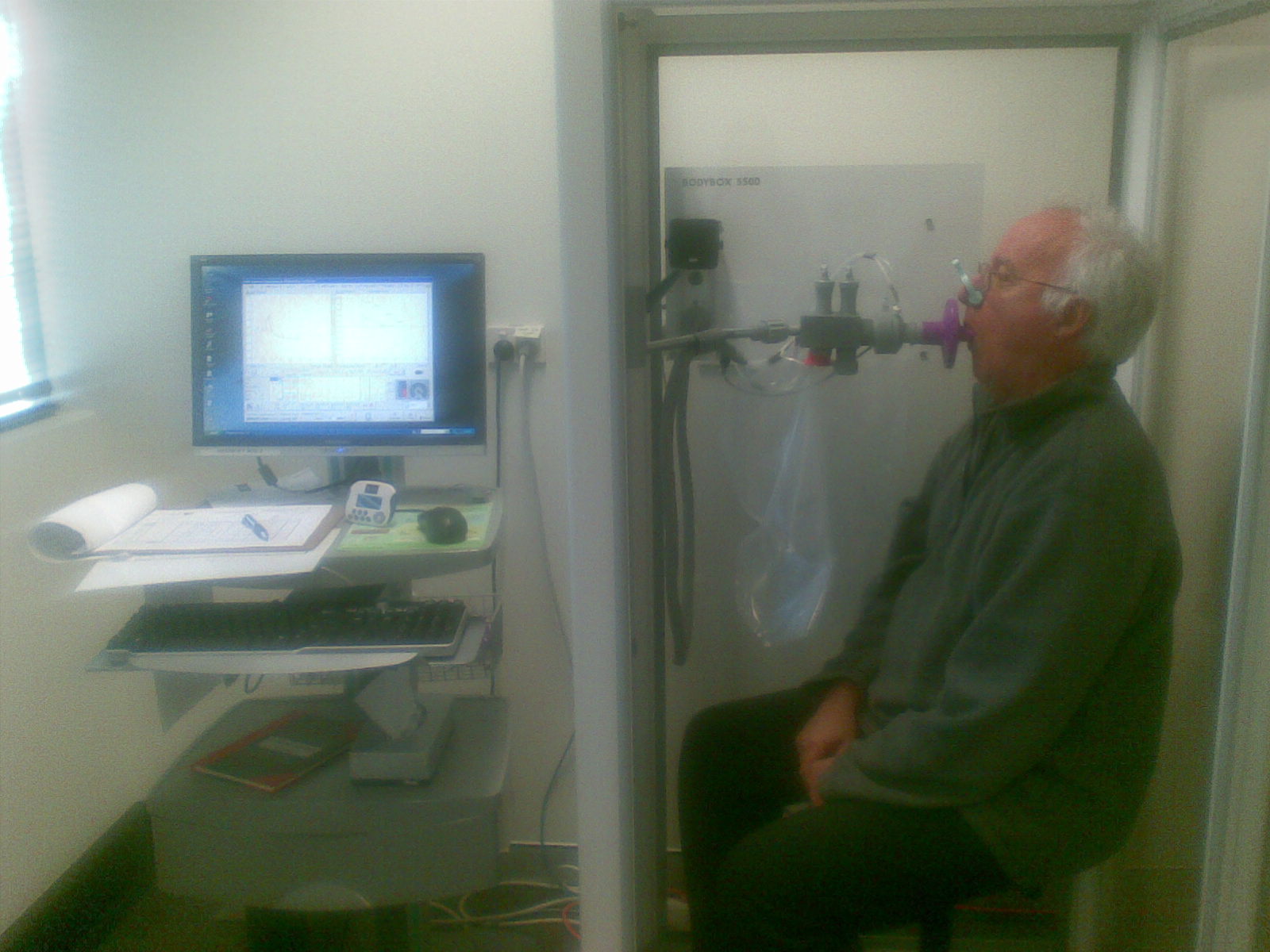
I’m mildly asthmatic, and every now and then lend my body to science. Today I spent a couple of hours in a high-tech environment doing mildly undignified things – mainly breathing into various gadgets.

Jess, the charming PhD student who told me what to do and harvested the data I generated, kindly agreed to take this photo for you, dear reader. I am in an airtight cabinet called, I think, a Body Room. There were no body bags in sight.

A neighbourhood encounter involving Emily Dickinson

When I came home on Monday evening from a long weekend away, I found a small mystery in the room where my desk lives: three poetry books in a pile on the floor. Who could have taken the selected Du Fu, the selected Emily Dickinson and the Shambala anthology of Chinese poetry from the shelves? Surely not the Art Student, who is a staunch hater of poetry (unless, she says, it was written by me)? Perhaps she was looking for something to console a sick friend. Unlikely. Then I remembered she had pulled a muscle in her back  and been in pain all Saturday, barely able to sit at her desk. The books on the floor weren’t reading material at all, but a tool for an Alexander Technique Lie-Down. Apparently they were efficacious, because by the time  I arrived the back pain had gone.

Since the Emily Dickinson book had made is way into my hands, I decided to take it for a walk the next morning. The day was brilliant, cloudless, cool and pleasantly humid.  The third poem in the book is about spring, but it chimed beautifully with my Sydney-early-winter-induced mood:

The morns are meeker than they were –
The nuts are getting brown –
The berry’s cheek is plumper –
The Rose is out of town –

The maple wears a gayer scarf –
The field – a scarlet gown –
Lest I sh’d seem old fashioned
I’ll put a trinket on!

As I strolled past a friend’s house, by this time carrying a bulky plastic bag of dog poo as well as my book, the friend happened to be in her front yard. ‘That’s charming,’ she said.

I chose to interpret her as referring to the book. ‘Yes,’ I said. ‘I studied Emily Dickinson at uni but I’ve hardly looked at this book since.’

‘I love her,’ said my friend.

‘Listen to this,’ I said, and read her the poem.

‘She could have been writing about today.’

And we went our ways, me with the dog, her to her garden, wearing invisible Dickinsonian trinkets

Sydney Biennale

Today the Art Student and I popped into town with a visiting Melburnian friend to stroll around the MCA for a couple of stimulating hours. It was our second excursion to the Biennale. We went out to Cockatoo Island a couple of weeks ago, but I didn’t make the time to blog about that, and to judge by the program we missed some of the most interesting things out there. We did see Cai Guo-Qiang’s Exploding Cars, walk on the shanty town rooftops of Kadia Attia’s Kasbah, and chortle uneasily at Shen Shaomin’s Summit. Today we were greeted at the door by two of Shen Shaomin’s bonsai works, which at first glance deliver much less punch than the realistic corpses of Communist leaders in Summit, but after we’d seen half a dozen of his tortured trees, even without being able to read the ideograms describing how they had been manipulated, we treated them with due respect.

The  walls of the first large room at the MCA are covered with big colour photographs, a hundred pairs of which one is a domestic space and the other a person standing back to camera. I imagine there are people who are capable of standing in this room and spotting the unifying motif. I looked up the program and told my companions and one or two other people – no one complained about the spoiler. (If you want to know more, you can click here.) The artists, Sun Yuan and Peng Yu, created the memorable Old People’s Home, which we saw in Tokyo last year.

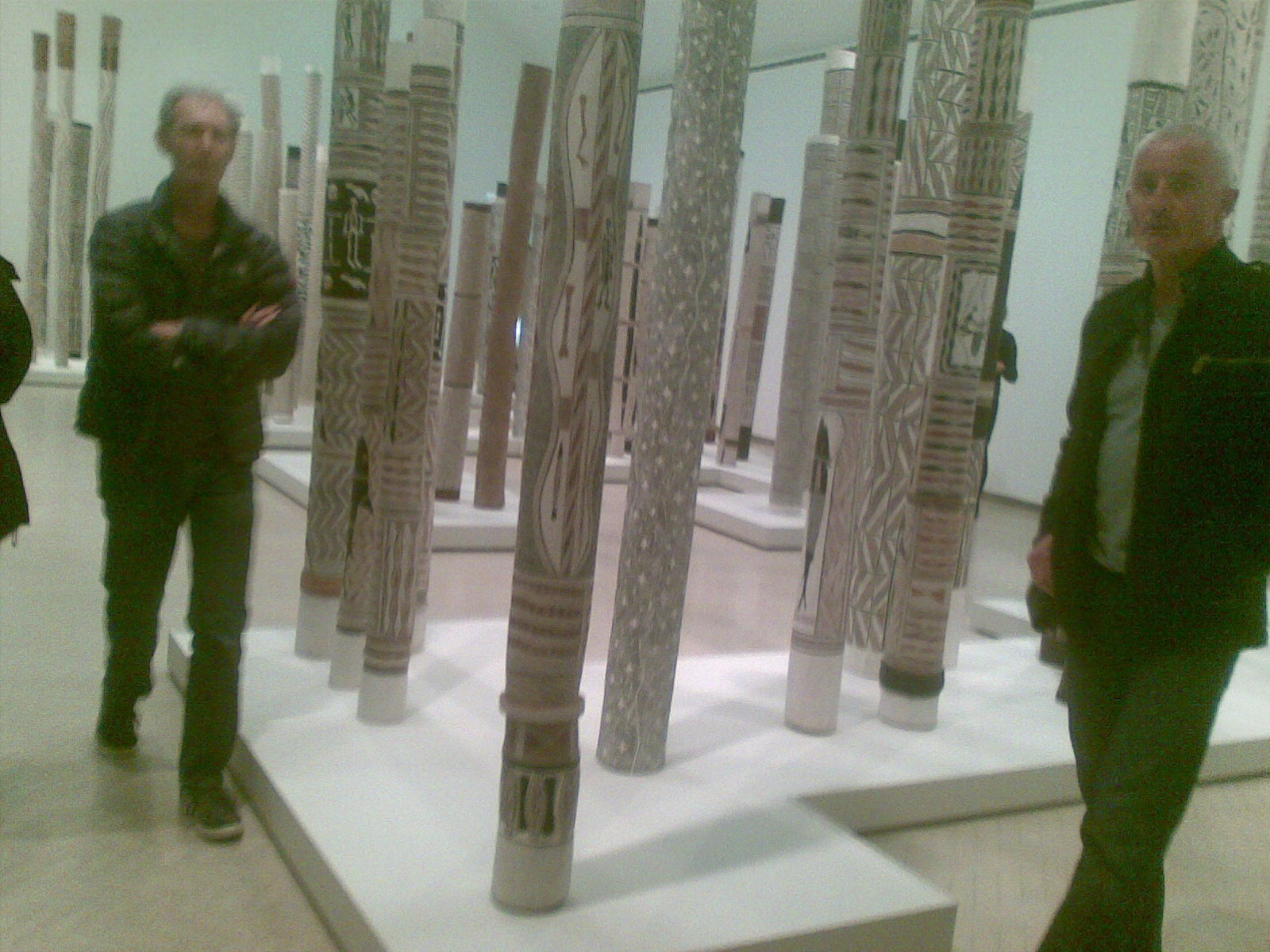
There’s far too much in this exhibition for one visit, or one blog entry. I was struck by the amount of Indigenous art – from Australia, of course, but also from New Guinea, the Arctic, the Americas and Europe. One large room on the top floor is devoted to 110 larrakitj (memorial poles) by 41 Yolngu artists from East Arnhem Land, and it’s a knockout. There’s brilliant trompe l’oeil, wonderful sculptural play, images reminiscent of the Mexican Día de los Muertos, shimmer to make your eyes water. A place to just stand and stare. I took my one phone photo there. It might give you some idea.

I tend to skip video installations in art galleries, and I saw at least two pieces today that confirmed my expectations of amateurish sound recording / acting / design, and did less than nothing for me. But Bill Viola’s Incarnation is totally magical. Two naked people walk towards the camera in slowmo, and it turns out that the graininess of the image is caused by a veil of water falling between us and them. They walk through the veil and are suddenly clear and in full colour. After a long moment, they turn around, go back through the water, and walk away until they vanish into the granularity of the screen. Araya Rasdjarmrearnsook’s video triptych is a delight of a different order. On each of three screens a life sized print of a famous nineteenth century European painting is set up in the open air in front of a group of Thai peasants, who sit with their backs to the camera and chat among themselves, mostly about the painting. We get subtitles. The naked woman sitting with clothed men in Manet’s Déjeuner sur l’herbe provoked quite a bit of anthropological speculation: ‘I suppose it’s cooler to go like that in hot weather’ ‘Is it a funeral custom?’ etc. Millet’s Gleaners and Van Gogh’s Midday Sleep were less mysterious, but there was much discussion of the exact nature of the crops and activities in each picture, the weather and the state of the fields. Not for these peasants our cringing sense of inadequacy when confronted with what we’ve been told is Great Art.

There was a lot else. Angela Ellsworth’s Seer Bonnets, beautiful to the eye, are made of pearl headed pins, thousands of them, all viciously pointing inwards to where the wearer’s head will be.  Louise Bourgeois has made fascinating sculptures from old clothes. Salla Tykkå’s video Victoria spends 10 minutes watching a waterlily bloom and grow, possibly in a greenhouse in Kew Gardens in London.

We had lunch in Glebe, and drove our friend to the airport less sure that Sydney is Philistine-ville. Then I realised I’d lost my wallet and will now draw up a list of all the cards I need to replace.

My second full day at the SWF

I was off to Walsh Bay again for the day today.

10 : 00 Marie Munkara in conversation with Irina Dunn
I first heard of Marie Munkara’s Every Secret Thing on Will Owen’s blog last December, and it’s been on my To Be read list since then. If it hadn’t been, this session would have put it there, especially when she read the opening pages, beginning most memorably, ‘It had been a shit of a day for Sister Annunciata and Sister Clavier.’ Irina (full disclosure: she’s an old and dear friend) did a lovely job of drawing out Marie’s biography in relation to the book, giving her scope to be – miraculously –  funny about her experience as a member of the stolen generations meeting up at last with her Aboriginal family:

My mother was black. I was thinking, ‘That can’t be my mother. And you know how they say all black people look the same … I’d say, ‘Hello, Auntie,’ and my mother would say, ‘Don’t talk to her, she’s rubbish.’ I’d say, ‘But isn’t that Auntie …’ ‘No!’

When she was little her class at school had to draw a picture of what they wanted to be when they grew up. She drew a figure with a red cloak and a crown. Sister Damien said, ‘Marie, you can’t be a king.’ But young Marie insisted that that’s what she wanted to be, because a king has lots of money and can do what he wants. ‘Now,’ said Marie today, ‘I haven’t got much money but I do what I want.’

11 : 30  Terrorism: How to Win a Cosmic War – Reza Aslan talking to Tony Jones about the futility of the War on Terror
I am not a Tony Jones fan. Ever since his extraordinary performance interviewing Nicole Cornes on election night 2007, I have had trouble watching him interview anyone. But Reza Aslan’s articulate confidence was a match for his combative style, and their sparring was actually enjoyable. Reza Aslan distinguished between Islamism and Jihadism. Islamism, he says, is a form of nationalism seeking to establish an Islamic state in principle no more diabolical than a Christian state like Greece or a Jewish state such as Israel. Jihadism is anti-nationalist, seeking to establish planet-wide Islamic theocracy. He went on to say that Islamism is the answer to Jihadism: that if Islamists are able to participate in normal political processes, Jihadism will lose its recruiting grounds. It was a riveting presentation, and we bought his book.

13:00 to 14:00 Three Australias: Les Murray, Ali Cobby Eckermann and Kim Cheng Boey reading their poems, chaired by Rhyll McMaster
This was the only event I attended where I had to stand in one of the monster queues and for some reason receive a “Good work” stamp on my wrist. The readings were interesting. I was especially glad to hear more of Ali Cobby Eckermann’s work, having read only her long piece on the Intervention in the Best of 2009 collection. Kim Cheng read one of the poems he read on Friday morning, and it was a pleasure to hear it again. Les Murray, who was probably the reason this event was held in one of the bigger spaces, was as always Les Murray, and a good thing too.

Ali Cobby Eckermann acknowledged the Gadigal people, as Anita Heiss and Boori Prior did yesterday. I wonder if it was by formal decision that such acknowledgements were not made at any other events, at least none of those I attended. Whether deliberate or not, I think the festival was the poorer for the absence of such acknowledgements. I also missed the PEN chairs at paid events, and the brief explanation of the imprisoned writer each chair represented. There is a roped off area in the vast Heritage Pier populated by a dozen beautifully painted chairs and a soundscape. The chairs are to be auctioned to raise money for PEN, but that’s not the same as explicit acknowledgement of named individuals.

2: 30  Who’s Interviewing Who? Alan Ramsey and John Faulkner
These two – a retired journalist famous for his take-no-prisoners opinion pieces and the Federal Minister for Defence famous for his ineluctable pursuit of corruption – have been friends for 20 years or so. They told us in all seriousness that the reason the friendship has thrived for so long is that they never discuss politics. They then moved on to discuss politics, with some tense moments. They were very funny together. At one stage Ramsey left the stage to get the quotes he’d left somewhere. Faulkner continued in the role of interviewee.

17 : 30 The Big Reading: Hanan al-Shaykh, Willy Vlautin, Dubravka Ugresic, Natasha Solomons and Rupert Thomson
This was my last event for the festival. It was, as it always is, pleasant to be read to. In particular I loved being read to again by Rupert Thomson – and the tone of the extract he read from This Party’s Got to Stop couldn’t have been further from that of the one he read on Thursday morning. It must be an intriguingly complex book.

I had been planning to stay in the general area to hear Jennifer Maiden, David Brooks and Adam Aitken read. But the reading didn’t start until 9.30, and it was in a wine bar. As a non-drinker who is very often in bed by 10 o’clock, I found the deterrents outweighed the attractions. I had heard a little of Aitken and Brooks this week (though the latter hadn’t been reading his own work), and I decided with regret that I would have to forgo the great pleasure of hearing Jennifer Maiden.

The Festival’s slogan this year was Read, Rethink, Respond. There wasn’t a lot of space at the festival itself for responding (question times just don’t do it!), and for that matter not a lot of reading got done, at least by the punters. But I’ve come away with plenty to think about, and the world is full of opportunities to respond, and far too much waiting to be read.

A full day at the SWF

My yesterday was entirely devoted to the Sydney Writers Festival, and I had a great time, starting out at Walsh Bay, where my choices seemed to keep me away from the monster queues.


10 : 00 Poetry on the Harbour: Adam Aitken, Judith Beveridge and Kim Cheng Boey, with Ivor (‘I know they’re good poets because I published them’) Indyk in the chair.

In general I prefer to hear poets read their own work over having actors deliver sonorous, deeply felt renditions, because actors’ performances tend to narrow the range of possible readings. I also prefer poets’ readings that avoid the incantatory (though I’m delighted by the over the top bits of Yeats and Tennyson I’ve heard). All the same, all three of these poets read their work with such modesty and introspection that I longed for just a touch of the rock star, just a hint that they might be able to hold us in the palm of their hands and wring our withers.

It was an excellent reading nonetheless. Adam Aitken read his ‘Pol Pot in Paris’, and a poem taken from his father’s letters (introduced with, ‘I love my father, but he had colonial attitudes’) got actual laughs. Judith Beveridge began with an anecdote from Robert Creeley: at a school reading a child asked him, ‘Mr Creeley, was that a real poem or did you just make it up yourself?’ Among the poems that JB had made up herself was a lovely piece about a man washing himself at the railway station tap just outside Delhi. Of the extraordinarily cosmopolitan Kim Cheng Boey’s poems, I particularly liked ‘Stamps’, in which the poet converses with his little daughter.


11 : 30 First Nation Stories: Richard Van Camp and Boori Monty Pryor herded ‘like cats’ by Anita Heiss.

In introducing his poets, Ivor Indyk mentioned university positions and awards. In this session, Anita Heiss talked about which Indigenous Nations/mobs people came from, including herself. Both Richard and Boori perform and tell stories in schools. Richard gave us what I took to be one of his school performances; Boori talked about his. Both men were very funny, and Boori gets the Me Fail I Fly nomination for the most charming man on the planet. Yet with all the humour and charm he managed to put some hard truths. ‘This is the only country in the world,’ he said, ‘that mines a culture and sells it off to the world but doesn’t want to know about the people who produce it.’ He told of a group of preschool teachers who asked him for advice on how to tell Aboriginal stories to their charges. ‘Do you know about the 1967 Referendum? The Gurindji campaign? The reserves?’ he asked (though he probably named different specifics). ‘You won’t be able to tell the stories until you know about the fight to keep them alive.’


13 : 00 The Politics of Storytelling: Mike Daisey and William Yang, chaired by Annette Shum Wah.

I’m told Mike Daisy’s story was shattering, but I went to sleep during the loud, bombastic opening section of his monologue, which I guess was meant to be the warm-up (a baby cried, presumably at the sheer loudness, and was incorporated into the rant, to the delight of the fans in front of me but adding to my need to absent myself). William Yang showed a number of slides, and it was reassuring to see that his style worked just as well when taken out of the tightly controlled environment of his shows. The discussion was interesting – Annette asked about their provocativeness (William’s photos can be a bit rude, and Mike uses four-letter words, hardly confronting in Sydney I would have thought, but he did mention a show where a big bloc of the audience stood up and walked out – it’s on YouTube and his response is wonderful). William said that when he first did his shows he was part of an angry community. Now he might put in an occasional naughty photo out of impishness. These were such different men, yet their mutual appreciation was lovely to behold.


16 : 00 David Wessel, Meet Paul Keating with George Megalogenis

Note to anyone doing this kind of gig: it really really helps if you read up on the person you’re appearing with and can refer approvingly to his work. Both these men did that and it was a great leavening to what could have been a dry conversation about economics. David Wessell (economic editor of the Wall Street Journal, was able to drop a number of Keating’s famous phrases into his presentation (‘The recession we had to have’, ‘A shiver looking for a spine to run up’, etc). Wessell explained the causes of the GFC memorably as resulting from two false assumptions in the US: that house prices would never fall, and that extraordinary financial innovations spread risk in such a way as to diminish it to the point of negligibility. Keating, equally memorably described Chinese reserves as a great cloud full of water and electricity floating over the world, and Alan Greenspan building a copper pipe up into the sky to draw down the water. He also talked about Spain, Portugal, Ireland and Greece as having a big one-off party made possible by converting to the Euro and suddenly enjoying German interest rates. Right now we’re seeing the morning-after crash. Questions were probably intelligent, but were well above my head.


18 : 00 Have We All Been Conned?: An Emergency Town Meeting: Bill McKibben, Ross Garnaut and Clive Hamilton, with Tim Flannery as participating Chair, discussing the politics and science of climate change.

A case of false labelling. Of course, we all knew it was a Writers’ Festival event and not a political rally, so it was no surprise that it was, as my son described them, four bald men in glasses talking to an appreciative audience about the current state of affairs. No one was really concerned to plug his own book – it was, as Tim Flannery, said, a bit of a dream team.

Was Copenhagen a success or failure? Too soon to tell, but it has meant that developing countries are now taking on climate change rather than waiting for the developing countries to do their bit first.

How come Australia is the biggest laggard in climate change action, yet it has the most to lose? Ross Garnaut spoke with transparent obliqueness of lack of political leadership. Bill McKibben, I think it was, first mentioned Kevin Rudd by name. Clive Hamilton sunk the boot: Kevin Rudd thinks science is a lobby group, and he’s a manager not a leader.

What about the Greens’ rejection of the CPRS? A lamentable strategic error, seemed to be the consensus, rather than a grievous failure of principle as we have seen from federal Labor. Bill McKibben said wise words here. Coming from afar, he said, he had the luxury of responding without knowing or needing to know the details, but what we have to remember is that any victory, however small, is to be celebrated, and any victory, however large, is only a step forward. This is a struggle that will continue for our lifetimes and beyond.

Perhaps the grimmest note of the evening was the statement from, I think, Bill McKibben, that our challenge now is no longer to prevent climate change but to take action to deal with the new world we now live in.

In question time we reaped the consequences of the false advertising. Person after person took the microphone to tell us what they thought about the subject. One woman, from an outfit called A Hundred Percent Renewable, had even brought a banner, which she trailed after her disconsolately as she left the microphone, having failed to get a taker to hold up its other end.

And I’m off to another full day today.