Category Archives: LoSoRhyMo

Brooklyn Yawp, November poem No 4

Last night – 10 November here – I took the Subway to Brooklyn for an event that had caught my eye in Time Out New York: the Brooklyn Poets Yawp. (For the benefit of those who know even less about poetry than I do, Walt Whitman referred to his poetry as his ‘barbaric yawp’.)

The first hour of the Yawp is a poetry workshop led by Jason Koo, poet and poetry teacher who must be doing it for love because he only charges $5 at the door and various categories aren’t asked to pay at all. The second hour is an open mic.

Typically I piked on the open mic, but I stayed for the whole thing and had a great time.

In the workshop Jason invited us to try our hands at seduction poems. We read poems by Marvell, Donne and two modern ports, listened to a number of versions of ‘My Funny Valentine’ and scribbled for 15 minutes. Even though what I wrote wasn’t a sonnet, and believe it or not my November sonnets generally take a lot longer than 15 minutes to write, I was quite pleased with my seduction poem and now will inflict it on you.

But first, I ought to acknowledge how much I enjoyed the open mic hour, not least for the family feeling among the 30 or so people there and Jason’s smooth, genial, kind but not too kind MCing. Not necessarily the best poem but the most daring was a verbatim reading of the text of a Viagra ad currently showing on New York TV.

No 4: Seduction Poem
When did it happen,
this line on your face,
This deep straight line down your cheek?
Did it just appear one day when we weren’t watching?
Is it a line from some future poem?
An elegy?
Let me trace it with a finger
and my lips.
So much has happened when we weren’t watching,
so many messages from after all.
Lips now thinner, hair turned grey,
and where did the thin me go?

What will have happened next?

But should we care?
How does it happen that each time we touch
it’s all new?
Sonnet No 3: Slam night at the Nuyorican Poets Cafe

Running well behind schedule on the sonnets. Sorry, will do better. Meanwhile, I’m not making this up:

Sonnet No 3: Slam Night at the Nuyorican Poets Cafe
We’re in line with a White IT consultant
who boasts two Matisse cut-out tattoos.
Someone’s shot dead in a car – the resultant
crime scene tape, marks the zone for clues.
In the street cops with Glocks are scoping a murder.
In the line a featured spoken-worder
waits. A Black poet says it’s droll
cops are called when words get out of control
in minority mouths. But speak not lightly
of poets and law. Inside the cafe
with wit and charm and rage they say
unsayable things, and say them nightly.
This may be where a new world starts
as words like bullets pierce our hearts.

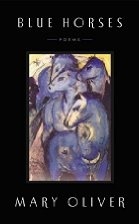
Mary Oliver’s Blue Horses and my No 2 scribble

Mary Oliver, Blue Horses (Penguin 2014)

In his justly-praised eulogy for Gough Whitlam, Noel Pearson repeatedly used the phrase ‘this old man’ as a term of high honour. Like Diana Athill, Dorothy Hewett, Jennifer Maiden and any number of others, Mary Oliver makes me wish passionately that we could say ‘this old woman’ and have it similarly understood to indicate esteem.

This is old-woman poetry. Oliver isn’t out to prove anything. In ‘I don’t want to be demure or respectable’, she says:

I’m not trying to be wise, that would be foolish.
I’m just chattering.

She’s not even out to offer obvious value for money. For $28 you get 78 pages and almost every second page is blank. But every word feels just right. The poems are personal and deeply felt, but nothing personal in a way that would be embarrassing to read on a poster on a bus. Most of them feel as if they have been around forever, or at least should have been. The recurring mode is celebration – of a new love, of connection to living things, of rhyme, of yoga lessons, of life and even of sickness and death, though in their cases it’s more a mature reconciliation than actual celebration. She stops short of being religious, as in ‘Angels’:

I don’t care how many angels can
dance on the head of a pin. It’s
enough to know that for some people
they exist, and that they dance.

Moving on to my own November task, I was struck by the poem ‘The Mangroves’, in which the speaker, who is living ‘in a warm place’ realised she has trouble loving mangroves the way she loves the black oaks and the pines of her cooler home. It’s not Oliver’s doing that oaks and pines are ‘normal’ to mainstream English literature and mangroves are exotic, but the idea of normal is inevitably there, so:

Sonnet No 2: In response to Mary Oliver’s ‘The Mangroves’
It’s fall, November, New York City.
Leaves fall, just like they do in song,
in movies, poems and all those pretty
paintings from Art History. Long
we’ve read bare ruined choirs
follow on bright autumn’s fires.
I’m coming over all Mackellar,
a not-your-field-and-coppice feller.
My heart belongs to smooth angophora,
to leaves that glisten all year round,
to roots four feet above the ground
and messy pneumatophora.
All trees are lovely when you look –
less so those growing by the book.

More of Swapna Dutta’s Juneli, plus my Sonnet No 1

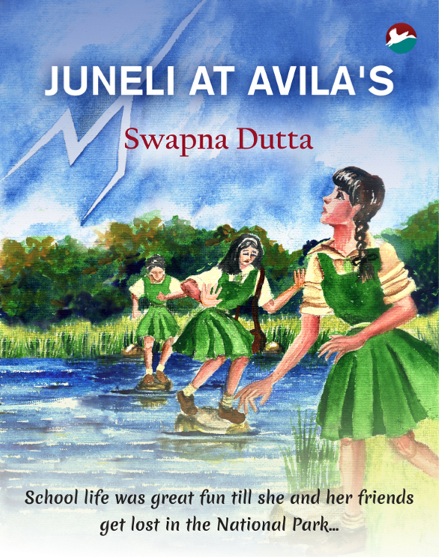
Swapna Dutta, Juneli at Avila’s (©1992, CinnamonTeal Publishing 2014)
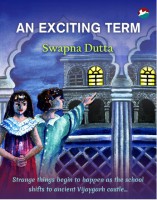
——, An Exciting Term (©1992, CinnamonTeal Publishing 2014)

1ja 1et Swapna Dutta’s serial about a girl named Juneli who goes to boarding school was first published in the English-language Indian children’s magazineChildren’s World between 1978 and 1985. The serial proved very popular with young readers, and in the early 1990s HarperCollins published three Juneli books. This year the stories have found another lease of life as CinnamonTeal brings them out in three ebooks. All three books include the illustrations that Swapna’s daughter Sawan, then still a teenager, drew for the HarperCollins books, and the cover images are also Sawan’s (which were not used as covers of the print edition).

When I wrote a blog post about the first book, Juneli’s First Term, I hope I communicated how charmed I was by Juneli’s benign experience of boarding school. That benign quality continues in these books. There are scrapes and japes, mysteries and adventures in a setting that owes equal amounts to the pre–Harry Potter boarding school genre and Swapna’s own childhood experience at an English-speaking boarding school run for Indian girls by Carmelite nuns. Juneli now knows the ropes and has earned the respect and affection of most of her classmates, and the not-quite-enmity of a couple of snobbish malcontents. A kitchen mishap from the first book is a continuing source of embarrassment and comedy, and now we hold our breath each time there is a cooking exercise.

If you have a taste for boarding-schools stories or if you’re looking for a gift for a young person with such a taste, and want to add a little Indian flavour to your/their reading, I recommend these three little books.You can buy them from http://www.dogearsetc.com/. They are very reasonably priced by Australian standards. (I received complimentary copies, and Swapna is a friend.)

Moving right along: for the last few years I have set myself the task of writing 14 sonnets for the blog in November. Here goes with Sonnet No 1 for 2014, inspired by the Juneli books, along with Sugata Mistra’s wonderful TED talks maintaining that schools are an obsolete tool of empire, and Matilda the Musical which I’ve just seen on Broadway with its monstrous Miss Trunchbull, who couldn’t be more different from Juneli’s kind Mother Benedicta.

Sonnet No 1
Knead memories to make art. Punch, pull
fold, punch again, let stand, then bake.
So Dahl’s tormentor became Trunchbull,
real nuns did Swapna’s teachers make.
Both real schools served empire’s agenda.
Both fictions, one harsh, one most tender,
resist. Matilda, Juneli,
are naughty as they need to be.
In school, by monster or sweet mother
we’re taught to play our ordained parts,
ignore the whispers of our hearts,
but if we reach for one another,
each one giving what she has,
that may be good enough for jazz.

Sonnet 14: November ends

For a while there it looked as if I wasn’t going to make my sonnet quota this year, but here’s the last one, just ahead of deadline. I was tossing up whether to write about my increasing deafness, or Yoko Ono’s exhibition at the MCA, or the way Eleanor Caron’s Booker prize-winning novel The Luminaries is getting so little promotion in the end-of-year lists in newspapers and bookshop reading guides. I settled for this:

Sonnet 14: November ends
I shopped, I read, I went to movies,
played with children, watched TV,
rode a train with weary juvies,
helped add a show to P’s CV,
stood in rain for climate action,
faced computer death distraction,
ruminated on the news,
tried to formulate some views:
all grist for my November rhyming
fourteen lines in Pushkin’s ways,
fourteen times in thirty days.
An hour to spare – precision timing –
I’ve got them done. Perhaps next year
the form of Petrarch, or Shakespeare.

Colleen Z Burke’s Splicing Air (and Sonnet 13)

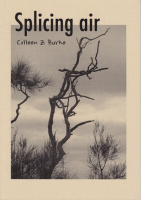
Colleen Z Burke, Splicing Air (Feakle Press, 2013)

1sa

More than 20 years ago in a pub in Glebe I heard Colleen Burke (I don’t think the Z had yet become part of her working title) read poems from which I still remember lines that move me, from what she presented as straightforward records of conversations with her children.

Many of the poems in Splicing Air capture moments with her grandchildren, and the conversations still smuggle killer lines into the poetry. Many others, in what I think of as her signature style, are short, impressionistic pieces about landscape or, especially, skyscape in and over Newtown and surrounds, or bushland. There are a number of pieces observing the social life of Newtown, past and present, and a handful of longer pieces. And some snapshots from New Zealand

Four of the longer pieces draw on the history of discovery and settlement of New South Wales: an narrative-essay on James and Elizabeth Cook, journal entries by the surgeon and an officer from the First Fleet, a biographical sketch of the early Australian poet Frank Macnamara. They lack obvious poetic embellishment, but in each of them the effect is unsettling and revelatory. There are straightforward accounts of the lives of two nineteenth-century women – ‘The publican’s daughter’ being the poet’s great grandmother, and ‘The fossil hunter – Mary Anning’ (which accounts for roughly a fifth of the book) an extraordinary Dorset woman who might easily have been lost to history because of her class and gender.

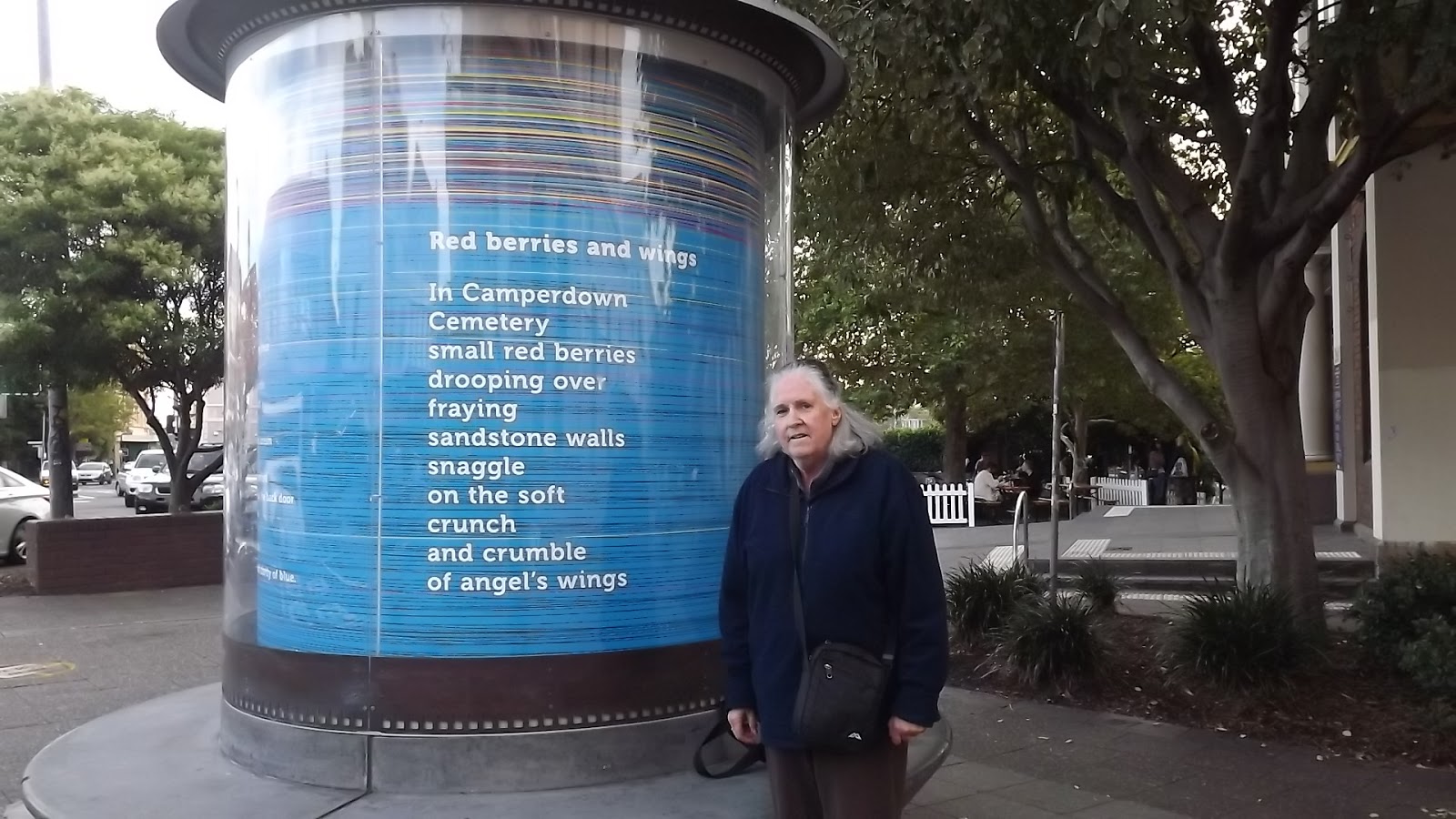
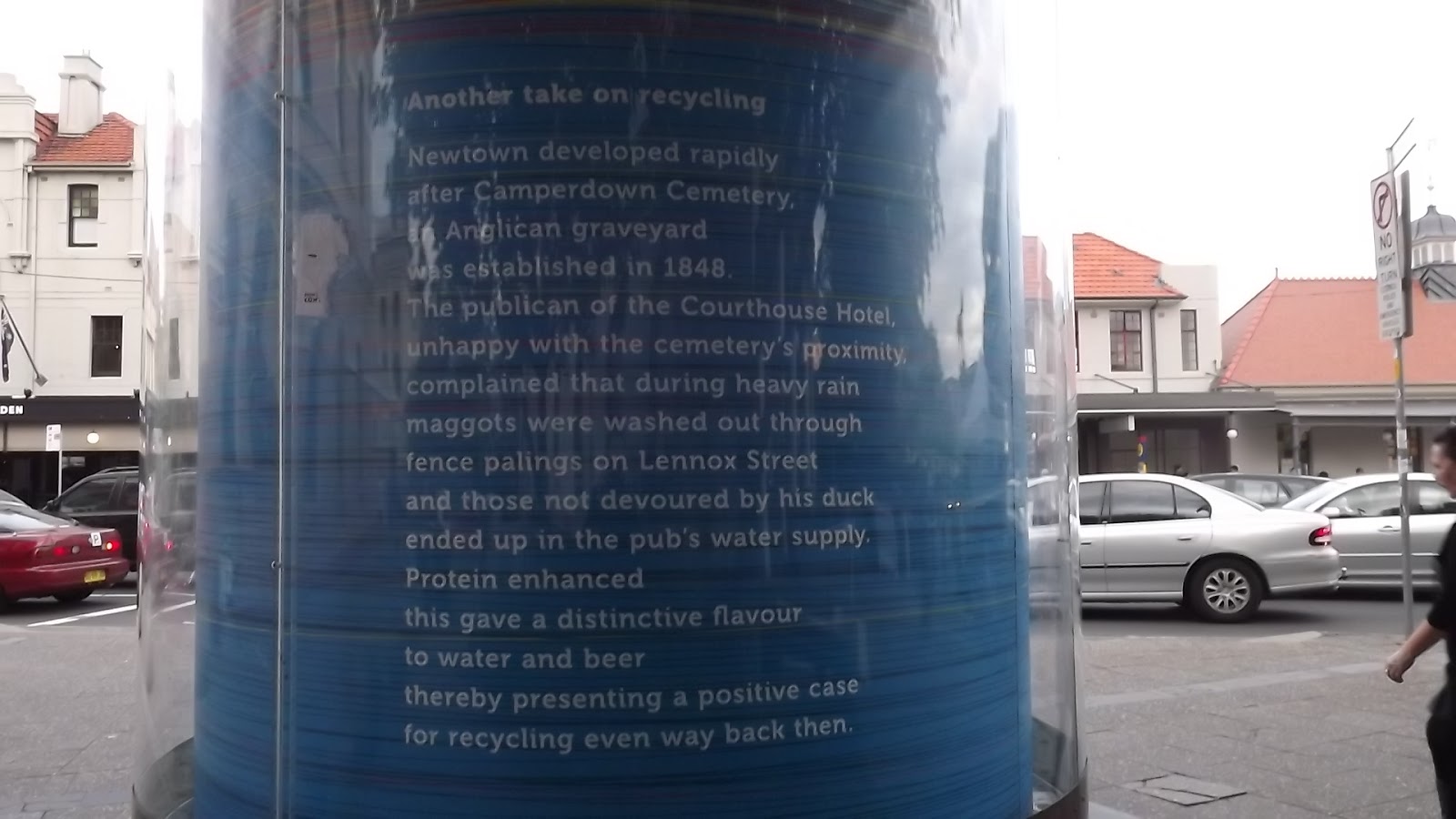
The sense of place is strong here as in all Colleen Z Burke’s work: I think of her as the poet of Newtown. Earlier books have included a number of pieces set in Camperdown Cemetery, and this book has two beauties set there too: ‘Kangaroo grasslands and my 20 month old grandson’ and the wicked ‘Another take on recycling’.

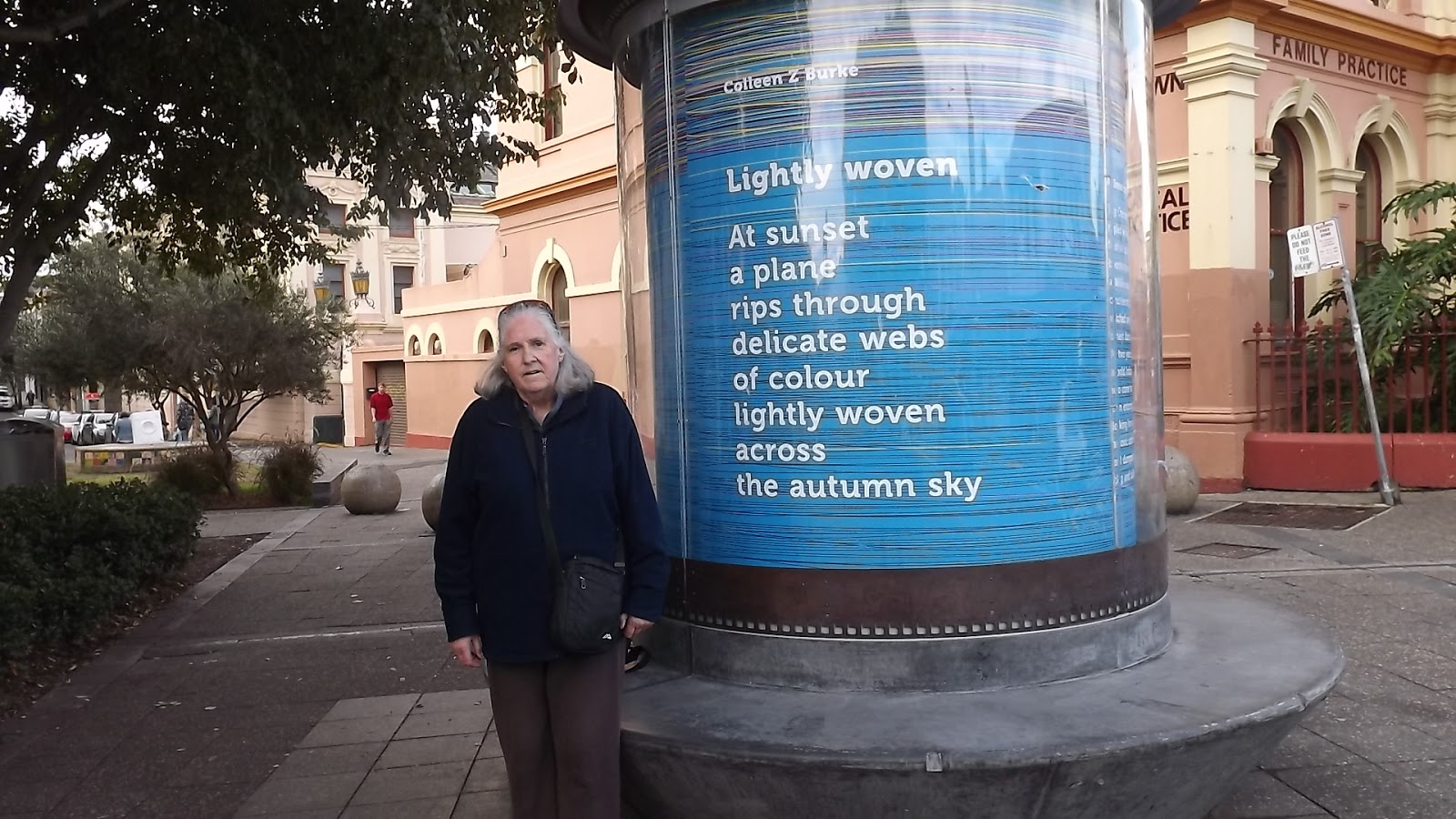
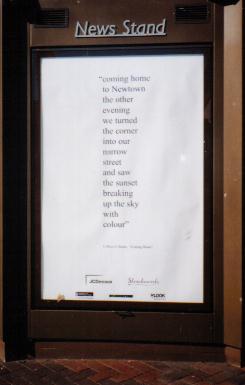
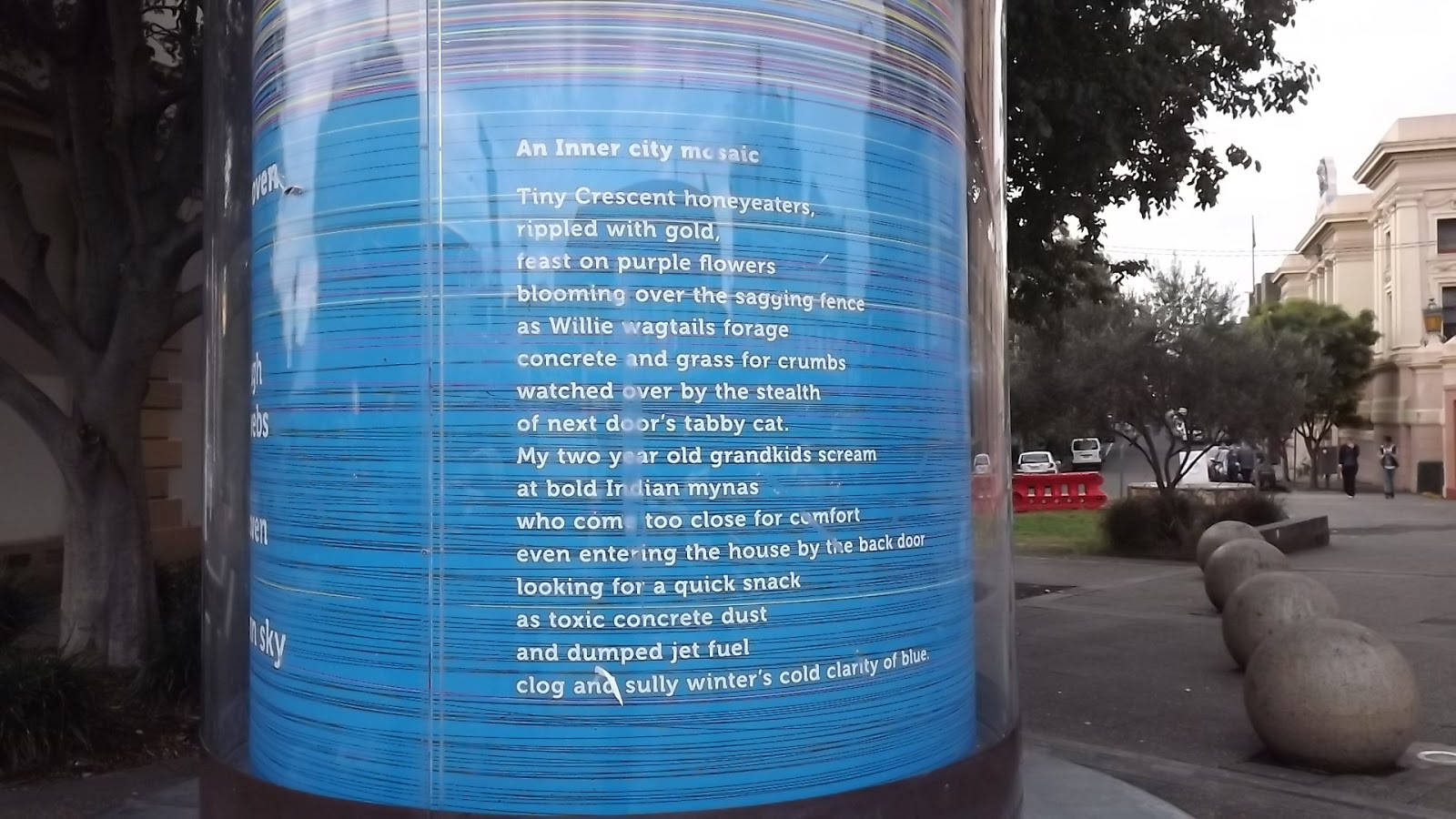
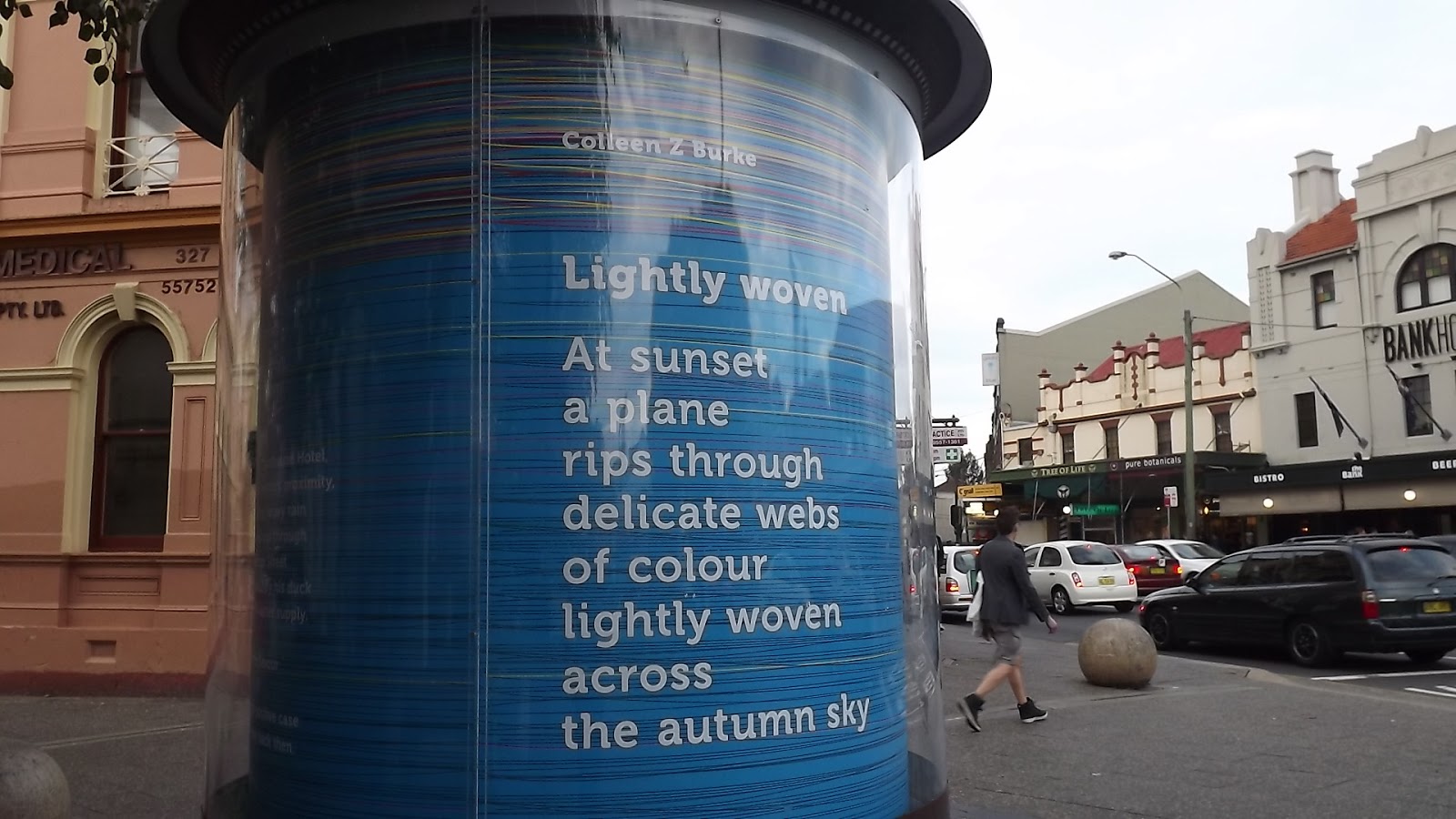
It’s November, so a sonnet is obligatory. This one draws on the last couple of times I laid eyes on the poet, and occasions when her work has featured large in the urban landscape, as illuminated posters that were part of the Sydney Festival some years ago, and more recently on the Newtown Art Seat. (there are six different links there, all to this site)

Sonnet 13: Colleen Z Burke
She reads to us beside a Whiteley –
her landscapes quiet, his lewd and loud.
I’ve seen her sunset words shine nightly,
tall amid a milling crowd.
Her tiny poems tread light, illumine;
the details of decay are human’
as she bids a friend farewell.
Human too what she can tell
of autumn air and Maralinga,
clouds, trees, coprolites, cats, birds,
muskets, trinkets, children’s words.
This poetry’s a pointing finger,
self-effacing, yet with grace
it helps to root us in this place.

Full disclosure: I published one or two of these poems in The School Magazine in my past life, and may have rejected one or two others A significant event in my mother-in-law’s pre-dementia life was a creative writing class taught by Colleen Burke.

awwbadge_2013

I think this is the 11th book I’ve read as part of the Australian Women Writers Challenge 2013.

Sonnet 12: Australia, 27 November 2013

As we headed for bed, home form a social evening, I wailed that I had to get a sonnet written but the well was dry. The Art Student, never one to let someone just moan, told me to get in touch with my inner rage about recent news headlines. So I came up with this in fairly short order:

Sonnet 12: Australia, 27 November 2013
When they were in opposition
they said no, no, no, no. No
one expects the Inquisition,
Spanish or otherwise, and so
we didn’t dream that once empowered
they’d really drag us back to Howard
and beyond, ditch Gonski, try
to bluff and bully SBY,
sack scientists, be kind to rorters,
snub climate talks, give boats to thugs,
tweet racist tweets, treat us like mugs.
As trusting lambs are led to slaughters
we chose them. They appal, amaze
the world in barely eighty days.

Sonnet 11: How I got a new tool

If I remember correctly the French for ‘crash’ in the context of computers is naufrager, which is also the word used when a ship wrecks.

Sonnet 11: How I got a new toy tool
Some virtual reef sank my computer
as it steamed on through the night.
Its kernel panic wasn’t cute or
pretty, nor its owner’s fright.
But I’d backed up, so very little
work was lost – two jots, one tittle.
I took it to a man in red,
who said the audio card was dead.
A woman in red T-shirt, Uppy,
charming smile, discreet tattoos,
helped dissipate my first-world blues.
Though I’m too old to be a yuppy
my heart leapt up when I did hold
a shiny new Mac, bought and sold.

The computer that died has featured in this blog at least once before. It survived four years after the disaster that befell it shortly before this photo was taken, and was already of a certain age then, so I guess it’s had a good innings.

Sonnet 10: Suburban travelling companions

Perhaps a snippet of narrative, which is after all what this form of sonnet was invented for:

Sonnet 10: Suburban travelling companions
Corinda, Sherwood, Graceville, Chelmer:
Tattooed boys with half shaved heads
and desperado airs that tell more
than they know use seats as beds.
One sleeps. ‘I hope he bought three tickets,’
tuts a greybeard, ‘makes me sick.’ It’s
soon Taringa, then Toowong.
Two boys share buds. A chinkling song
confirms the greybeard’s irriration.
Unplugged, they chat about the dole
and meetings to observe parole.
The sleeper wakes for Central Station,
which comes like dawn to end his night.
There tattoos, beard, and I alight.

Sonnet 9: South Bank

Enough with trying to squeeze a thought into 14 lines of roughly 8 syllables each. Today, an impressionistic moment:

Sonnet 9: South Bank
Thursday morning in the city
at the Ice-Cream-Brand-Name Beach
and Other-Brand-Name Fountains, pretty
children with one adult each –
mothers, aunts, great aunts, grandmothers
a dad or two – and sundry others
deploy the sunny Brisbane day
to better ends than making hay.
A squad of teenage girls come jogging,
uniformed, with in-ear buds.
A skateboard ollies, grinds and scuds.
I sit and eavesdrop, rhyming, blogging:
‘Mummy, sunscreen!’ ‘Splash me!’ ‘What?’
‘Oh my god, how can you not?’