Bill Willingham’s Fables 5

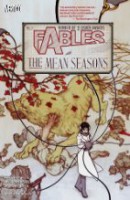
Bill Willingham (writer), Mark Buckingham, Tony Atkins, Jimmy Palmiotti and Steve Leialoha (artists), Todd Klein (letterer), Fables Vol. 5: The Mean Seasons (Vertigo 2005)

f5Another loan from one of my generous sons.

In Volume 3, Snow White got pregnant to Bigby Wolf in an encounter that embarrassed them both. In Volume 4, while the pregnancy progressed, Fabletown fought off an attack from the fairytale Homelands and endured a campaign by Prince Charming to become mayor. In this volume, Snow White gives birth, and our suspense about the species of her issue is resolved – eventually. The captured invaders from the Homelands are being interrogated in secret dungeons without noticeable benefit. Prince Charming wins the election, with not very happy results, so that by the end of this issue he is planning to go to war, always a good plan for an incompetent government to keep the electorate onside.

That’s how the main story arc develops. There’s also a two-part war story and a one-off in which Cinderella is a spy. As a ten-year-old I thought there must be something wrong with me that I didn’t enjoy war comics, but now, well, a war story is a war story is a war story, even if it incorporates a battle between a giant wolf and a Frankenstein’s monster, and I don’t mind who knows that’s how I see it. The Cinderella tale feels like a sleeper – there are plenty more volumes in which her role as spy can blossom.

Apart from the truly lovely invention (no spoilers here) of Snow White’s offspring and Bigby’s father, there’s not a lot to get excited about in this instalment, but the series will go on being a reliable source of Christmas and birthday gifts in this family for a while yet.

Saga 5, Fables 3 & 4

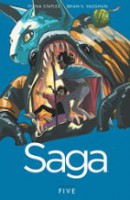
Fiona Staples (artist) and Brian K Vaughan (writer), Saga Volume Five (Image Comics 2015)
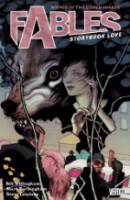
Bill Willingham (writer), Mark Buckingham, Lan Medina, Bryan Talbot, Linda Medley and Steve Leialoha (artists), Todd Klein (letterer), Fables Vol. 3: Storybook Love (Vertigo 2004)
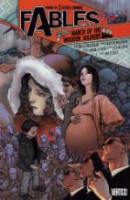
Bill Willingham (writer), Mark Buckingham, Craig Hamilton, P. Craig Russell and Steve Leialoha (artists), Todd Klein (letterer),  Fables Vol. 4: March of the Wooden Soldiers (Vertigo 2004)

One of my sons kindly went through his comics collection recently and put out a pile that I might be interested in. I passed on Swamp Thing and something about zombies (or they might have been vampires), but carried off a small swag. These are some of them.

1632154382

In Saga, Hazel, the child of parents from two different, warring species, has her father’s horns and her mother’s wings, or at least the beginnings of both. Her existence challenges the ideologies of both sides, and the little family has powerful enemies. In previous volumes they have had narrow escapes, acquired a number of bizarre allies and fellow travellers, and dealt with an apparently endless stream of weird, murderous monsters.

Though this instalment, in which Hazel is a toddler, continues to enthral and delight those of us who have the preceding four volumes under our belts, I wouldn’t recommend that you start with it. You’d still have the wit, the wonderful art, the occasional outrageous action, and even the underlying celebration of love and family, but you’d be left wondering if there was any coherent thread at all as the family members are spread across the galaxies.  I recommend reading Volumes 1, 2, 3 and 4, in that order, before this one.

The series has a bit too much explicit sex for my taste. Not that it’s pornographic: I can’t, for example, imagine many people would find the sexual behaviour of the dragons in this book anything other than disgusting. I guess I find other people’s sexual activities and fantasies mildly embarrassing. There’s a bit too much graphic violence too, come to think of it. Oh, and there’s some romanticising of drugs, though the realisation that a main character comes to as a result of his stoned dreams is hardly endorsed by the narrative. None of those misgivings stop me from already hungering for Volume 6.

f3There are no giant dragon’s genitalia in Fables, but there’s enough human-looking sex to ensure that this series about fairy tale characters in exile isn’t for the very young. The tales are dark, though not exactly in the way the original fairy tales were dark: more like childhood noir. The big bad wolf is now Bigby Wolf, a tough-guy operative on the side of good who is – mostly – in human form. Old King Cole is a figurehead mayor of Fable Town while Snow White as his deputy really runs the show.  And so on. All in the midst of unsuspecting ‘mundies’ (short for ‘mundanes’). In Volume 3, the love story between Snow White and Bigby Wolf passes a significant milestone (see cover of Volume 4 below for a spoiler), tiny police mounted on talking mice do their bit for law and order, Bluebeard turns out not to have reformed as thoroughly as he claimed,  Prince Charming moves back in with one of his ex-wives when he realises there’s more to be gained there than by conning mundy women into supporting him, and a gun wielding Goldilocks does a lot of damage. What’s not to like?

f4In Volume 4, the framing story comes back to life. The characters are in exile because someone known as the Adversary had mustered a huge army and was murdering everyone in fairyland. Those who escaped set up a clandestine community known as Fable Town in New York City, with a farm upstate for those Fables (as the fairytale characters are known) who don’t look human. These two places have been hard enough to police so far, because as everyone knows, being a fairytale character is no guarantee of decent behaviour. In this issue one of the gates dividing the worlds is breached and, after centuries of believing themselves safe, the Fables face Tarantino-esque violence at an industrial level.

In a long-lasting comic series like this, one of the pleasures is the regular appearance of guest artists. Mark Buckingham is the principal artist, and it’s his gritty vision that dominates. Then for a retelling of an American folktale or an episode involving cute miniature characters, someone else (in these cases Bryan Talbot and Linda Medley respectively) shows us the familiar characters and milieux through a different lens. The lettering, by Todd Klein throughout, almost makes one regret the less labour-intensive digitised process that (I’m assuming) is used in more recent comics such as Saga.

Wikipedia tells me that this series has continued from 2002 almost to the present – issue 150 was released in July. I’m reading it in the trade paperbacks, so far up to issue 27. I have 18 books to look forward to.

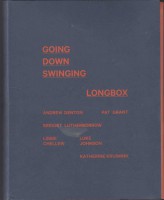
Going Down Swinging Longbox

Geoff Lemon, Katie Pase, Rhys Tate & Simon Cox (editors), Going Down Swinging Longbox (2015)

gdslbxFaced with the recurring heartache of literary-magazine editors, of having to reject excellent material because it exceeds the magazine’s word count, the Going Down Swinging crew had the bright idea of publishing a boxed set of such rejects. And here it is, a collection of five slim books (for a range of values of the word ‘book’) enclosed in a paper box. It’s a beautiful artefact – like Maurice Sendak’s Nutshell Library, but for grown-ups. The separate pieces are:

gdslb5Bridget Lutherborrow, Thirteen Story Horse (illustrated by Harley Manifold)

Thirteen short stories set in a block of flats, each story bearing the number of its characters’ flat. There’s a talking horse who makes furniture out of egg cartons, a girl called Henrietta who has a mysterious supply of eggs (and useful egg cartons), a woman who irritates her neighbours by calling her husband’s full name when they’re having noisy sex, another woman who grows big hairy man hands when she drinks too much, someone who talks almost entirely in cliches, and so on. The stories are full of apartment living’s tangential connections and mysterious glimpses into other lives, with added weirdness and the horse providing a through line. Lovely ink wash drawings add a lyrical dimension.

 alt=Andrew Denton (with a little help from Megan Herbert and David Squires), Looking a Little Drawn

Who’d have thought Andrew Denton had a whole other career in him? Yet here he is, with 30 original cartoons, each printed on a separate card, all but three executed with the skill level of a bright five year old. The resulting combination of sharp wit and primitive technique is totally disarming. The three exceptions, which are executed by Megan Herbert and David Squires (to help him, Denton says in an author’s note, ‘realise some ideas that neither the left nor right side of my brain knew how to draw’), wouldn’t be out of place in, say, the New Yorker. For example, a giant, radiant, bearded figure in a white robe sits on a throne in a supermarket with a tiny human on his lap; an onlooker says to a companion, ‘See? He really is real.’ How good it would be if The Monthly and/or the Saturday Paper started publishing such single-frame cartoons just for fun. Not that Denton totally avoids topicality: I ventured to reproduce one in my blog post on David Marr’s quarterly essay on Bill Shorten.

Version 2Luke Johnson, Ringbark

Ringbark is an excerpt from Luke Johnson’s unpublished novel On Dead Highways. It’s an elegant 74-page book with a gorgeous cover drawing by Caroline Hunter, but I can’t tell you more than that because I have a policy of  not reading excerpts from novels in newspapers or magazines. I’ll wait for the whole thing.

Version 2Pat Grant, Toormina Video

A graphic novella–memoir in which Pat Grant tells the story of his alcoholic father. It’s pretty sordid, but it’s complex, and in the end respectful and full of love. The novella was first published on the internet two years ago, and you can still see that version at Pat Grant’s web site. Here, the 44 pages of the story are printed on 11 sheets of paper, each of which unfolds to reveal a single drawing and text on the other side, filling in details, responding to comments on the internet, meditating on art, addiction, family and other maters raised: the equivalent of DVD extras. I found it deeply satisfying, and I imagine that anyone who had a non-violent alcoholic parent would find it even more so.

Version 2Version 2Katherine Kruimink, News from a Radiant Future
Libbie Chellew, Protein
(both illustrated by Anthony Calvert)

Two dystopian novellas back to back. In Protein a city (country? world?) is under threat from a mysterious epidemic that shares some features of the zombie apocalypse. From a series of vignettes, we piece together a picture of what’s happening. Many questions are left unanswered, and the panic of the situation gets under the reader’s skin. At least it did mine. And then, the end, and we’re left with it.  Katherine Kruimink’s story is likewise a patchwork – memos from a noticeboard, dialogue, what may be a diary entry by someone who is in 21st century terms illiterate. We are in the middle of things again – a small community of human survivors live in a compound, survivors of an invasion by Them (who are left undescribed apart from passing mentions of tentacles and technological superiority). Is it safe to leave the compound as the younger generation believe? Will the heroic sacrifice of two of the older generation come to anything? Will the group survive to another generation? All is left unresolved, brilliantly.

The package was produced with the help of crowd funding. My copy arrived as a fabulous surprise long after I’d made my donation. But you don’t have to have been a member of the funding crowd to own a copy. You can buy it online.

aww-badge-2015Added later: Though they are part of a bigger bundle, Thirteen Story Horse and the Protein/News from a Radiant Future pair are the seventeenth and eighteenth books I’ve read for the 2015 Australian Women Writers Challenge.

David Marr’s Faction Man

David Marr, Faction Man: Bill Shorten’s Path to Power (Quarterly Essay 59)

qe59

Some trivia to start with: Timothy Conigreve, whose memoir Holding the Man has been made into a deeply affecting film, attended the same secondary school as Bill Shorten: the Jesuits’ Xavier College in Melbourne. Congreve performed in a school production of Romeo and Juliet in the late 1970s; Shorten staffed the box office for a Romeo and Juliet in the mid 1980s.

David Marr’s Quarterly Essay doesn’t mention Tim Conigreve or Romeo and Juliet, but it paints a portrait of a man who, having functioned brilliantly behind the scenes, now stands centre stage. It also reminds us that Tony Abbott is another Jesuit old boy, and invokes the Jesuit ideal of ‘a man for others’ of Shorten, a phrase that is at the heart of a brilliant piece on Abbott by Katherine Murphy. A Jesuit education can clearly lead to very different outcomes.

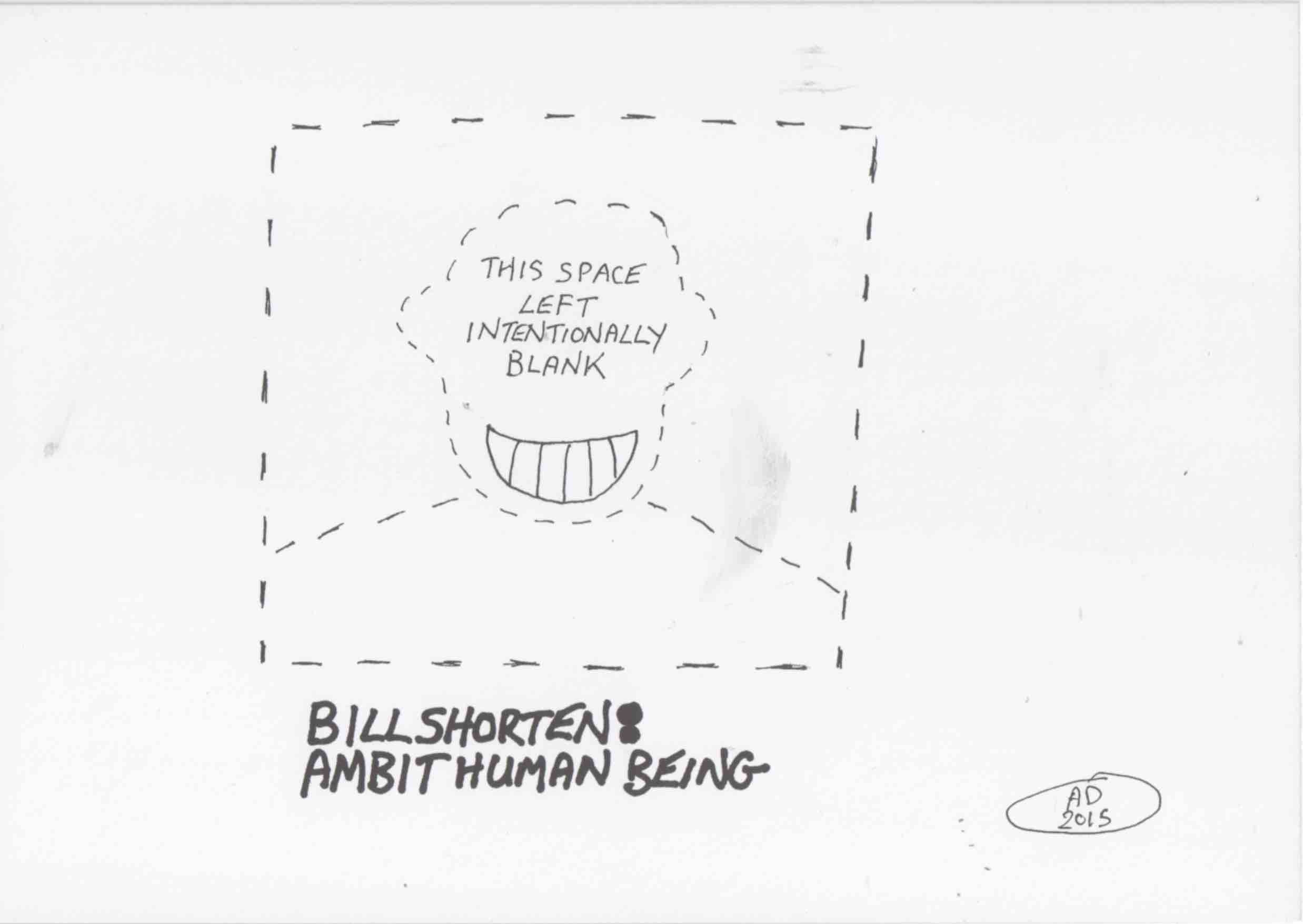
Marr asks about Bill Shorten the same question he has asked about Kevin Rudd, George Pell and Tony Abbott in previous essays: who is he? The question has a particular flavour in Shorten’s case because, as Marr says, he is ‘a man from nowhere’: ‘Where Tony Abbott is disliked quite viscerally now that he is known, Shorten is suspect because he isn’t.’ One of Andrew Denton’s cartoons in the fabulous Going Down Swinging Longbox (which I’ll blog about soon, and which I assume it’s OK to quote here), makes a similar point:

adbs

To treat politics as if it is all about personalities is to debase the public discourse. But it really does help to know something about the people who are vying for the top political job, about where they come from and – now that politicians are so intent on telling voters in marginal seats what they want to hear – what we can figure out about their agendas.

Marr’s essay gives the background – one of twins, the son of a university lecturer mother and a sailor turned small businessman father, Shorten educated in Catholic schools, including Xavier, joined the ALP while at school and threw himself into student politics at university. The story gets interesting – and incredibly intricate – when young Bill becomes an organiser for the AWU and enters what Marr calls ‘the dark world of Victorian politics’. Shorten quickly mastered the politics of the ALP right, proved to be a brilliant recruiter who, as he took on leadership, reanimated the ‘shot duck’ union.

The history is interspersed with vignettes that are closer to the present moment: Shorten’s successful management of potentially rancorous differences at the ALP National Conference this year; Shaun Micallef’s skewering of his sub-Keating wit, his ‘zingers’; his time in the witness box in Tony Abbott’s politically motivated Royal Commission; a list of his nicknames, from Lot’s Wife‘s Bill ‘Career Move’ Shorten in 1987 to Tony Abbott’s Barnacle Bill in 2014.

The picture that emerges is a man who has a phenomenal talent for union politics. Bill Shorten has been a master of the deal – all the hard work, sweet talk and hard-man tactics, betrayal and compromise happen behind the scenes. His role in the manoeuvring to replace Kevin Rudd as Prime Minister with Julia Gillard and then to replace Julia Gillard with Kevin Rudd was in that same mode, though more visible and not a good look (Marr doesn’t mention it, but the captions of newspaper photographs of him at that time called him, paradoxically, a ‘faceless man’.) Now that he is seeking to become Prime Minister, he is in new territory: this competition has to happen in the open – out of the box office and onto the stage, perhaps. When the essay was written, Tony Abbott was his opponent. With the infinitely more personable Malcolm Turnbull in the other corner, Shorten’s challenge remains much the same. This essay helps us to see who he is and the world that he comes from: he needs to find a way to show himself in a way that the electorate will take to him.

Speaking at Gleebooks last night, David Marr said this was the hardest writing assignment of his life, because ‘the terrain is so unspectacular’. Maybe, but there will be a federal election in the next 15 months, and Bill Shorten’s conservative Labor style and substance will be part of some interesting times.

—–

Up the back there are 40 pages of correspondence about the previous Quarterly Essay – that is to say, some discussion of IS, Iraq and Syria that doesn’t bristle with terms like ‘death cult’, ‘baddies and baddies’ or even ‘evil’, but is all about military strategy. I’m a pacifist, but I love the way these people can argue their cases.

Alice Walker’s Hard Times Require Furious Dancing

Alice Walker, Hard Times Require Furious Dancing: New Poems, with foreword and illustrations by Shiloh McCloud(New World Library 2013)

1htrfd
If I write
poems
just
one
or two
words
to a line,
or at least
no more than four,
you will
know
that every word
has been
weighed
carefully
in my soul

and if I say
things
that are wise
you will
read them slowly
so
they sink in

and if I say
things
that are egocentric
or silly
or banal
or even callous
they may sound measured
and wise

especially
if the book
is decorated
with drawings
of New Age
goddess figures

and editors
who pay
by the line
will give me
more money.

Actually this book isn’t as bad as that. It is, after all, by Alice Walker. ‘I will keep broken things‘ is one to remember, and ‘Sixty-five!’ is a great birthday poem. But I did feel that I was reading a devotional booklet for a New Age religion that I’m not a member of.

Penne Hackforth Jones’s Barbara Baynton and Barbara Baynton’s Bush Studies

Barbara Baynton, Bush Studies (1902, Angus & Robertson 1965, online at Project Gutenberg)
Penne Hackforth Jones, Barbara Baynton: Between two worlds (Penguin 1989)
1bs

She waited motionless, with her baby pressed tightly to her, though she knew that in another few minutes this man with the cruel eyes, lascivious mouth and gleaming knife would enter.
(The Chosen Vessel)

The man with the cruel eyes is a swagman, one of those who toted their meagre belongings in a rolled blanket (sometimes known as a Matilda) around the Australian outback in the late 19th century looking for work or handouts. In this story he successfully breaks into the woman’s hut and kills her as she flees into the night; it’s not spelled out, but he probably rapes her as well.

Along with small selectors and itinerant workers, swagmen were celebrated in the literature of the 1890s (and sentimentalised since) as good-humoured or eccentric survivors in harsh physical and economic conditions, where solidarity was a pre-eminent virtue. Think of Henry Lawson’s stories: ‘The Union Buries its Dead’, ‘The Bush Undertaker’, ‘Macquarie’s Mate’, and even ‘The Loaded Dog’. It’s hardly surprising that when A G Stephens published the Barbara Baynton story now known as ‘The Chosen Vessel’ in The Bulletin in the 1890s, he diverted attention from the murdering rapist’s identity as a swagman by naming the story ‘The Tramp’.

The six stories in Bush Studies provide an extraordinarily powerful counterpoint to the legend of the 90s: its men are vicious rather than eccentric, there’s precious little solidarity, and no one survives intact. Baynton’s women suffer appallingly, often at the hands of the men, and the men are generally twisted wretchedly out of shape – the rapist-murderer swaggie of ‘The Chosen Vessel’, the casually violent, drunken lascivious (sorry, I couldn’t think of a better word) station hands in ‘Billy Skywonkie’, the craven, lazy, opportunistic Squeaker in ‘Squeaker’s Mate’. That’s not to mention the bystanders.

I doubt if anyone could read those three stories and have the 90s legend remain intact in their minds. Of the other three stories, two share that same gothic sensibility, but don’t feature men doing women down: in ‘The Dreamer’ a woman struggles through the night in a terrifying storm – there is no malevolent human presence; ‘Scrammy ’And’ has a similar situation to ‘The Chosen Vessel’, but this time it’s an old man in the house under siege and the attacker’s motive is more economic. The remaining story, ‘Bush Church’, is a comedy of sorts, in which a minister of religion visits a small outback community and encounters remarkably energetic ignorance and amorality.

I bought my copy of Bush Studies in 1970 – Angus & Robertson had rescued it from oblivion in a 1965 edition, which included a biographical note by Baynton’s grandson H B Gullett. As a postgrad Austlit student, I wasn’t much interested in the biography – the stories had to stand by themselves, we told each other. Recently, when I read on facebook that Barbara Baynton had become an activist against women’s suffrage, my interest was piqued. How could someone who so graphically described women’s suffering actively oppose giving them the vote? When I came across Penne Hackforth-Jones’s biography, I seized it.

1bbFrom the first page Penne Hackforth-Jones’s biography differs markedly from H B Gullett’s 1965 biographical note. Barbara’s parents came out from England in 1858 (Gullett) or 1840 (Hackforth-Jones), and were either Robert and Penelope Ewart (Gullett) or John Lawrence and his wife Elizabeth Ewart (Hackforth-Jones). Both versions agree that her mother had an adulterous liaison, though they differ on who, when, where and the upshot. In both, young Barbara had a difficult childhood, one of a large family in rural New South Wales near Murrurundi. In both she had a disastrous first marriage, which Hackforth-Jones persuasively surmises provided the core material for her stories. In both, the marriage ended when her husband took off with Barbara’s younger cousin who had come to help with their three children.

From that point on there’s less confusion.  Moving to Sydney, she got a job as housekeeper to the wealthy Dr Baynton, who married her and took her children on. The new social status agreed with her. She wrote her old life out of her system. On Baynton’s death she became independently wealthy, travelled with her daughter to England to try to have her stories published, and on being successful became something of a literary phenomenon. (Hackforth Jones quotes many accolades as well as some snooty putdowns, and Thomas Hardy tells us on the 1965 dust jacket that he was ‘much struck with the strength of Bush Studies‘.) She wrote a novel, Human Toll, which no one seems to think is worth chasing up, but apart from some journalism in aid of worthy causes, she did no more writing.

Wealthy and with an entree into English and Australian society, she became a bit of a grande dame. She knew Nelly Melba and Billy Hughes, her daughter Penelope was painted by Tom Roberts. In her 60s she was briefly married to an English Lord who had converted to Islam and was offered the throne of Albania. To Barbara’s disappointment he declined, and she had to be content with being Lady Headley rather than Queen Barbara. Both Gullett and Hackforth-Jones tell family anecdotes of her eccentricities with some relish.

An answer to my question suggests itself, that is, an answer beyond her own proclaimed belief that women are too irrational to have a say in politics: Bush Studies’ powerful evocation of the mistreatment of women in outback Australia wasn’t a call to arms so much as a cry of anguish. Once she was out of there, and had confronted the horror of it in writing, she wanted to stay as far from it as possible. Who can blame her?

Penne Hackforth-Jones, who died too soon in 2013, is remembered as a television actor, but she was also a journalist and, just as relevant to this book, she was Barbara Baynton’s great great grandmotherdaughter. The book reads easily, and if at times one feels that the author is doing an actorly exercise in creating a back story from fragments of information, then at least it’s honestly done. It’s a lively version of Barbara Baynton’s life rather than a definitive biography.

aww-badge-2015These are the fifteenth and sixteenth books I’ve read for the 2015 Australian Women Writers Challenge.

The Farewell: Part Two

Concluding my versification of Tony Abbott’s farewell address. Click here for the first instalment, and here for  video of the speech on the Guardian’s site.

The Farewell (Part Two)
Video 3:11–3:36
‘I’m proud of what we’ve done against the odds.
stayed focussed right until the white-ants’ coup,
though we’ve been men, and women too, not gods
walking the earth, not perfect. Very few
can meet all expectations. [We poor sods
of course have trampled on a life or two,
protected child abusers, bent the knee
to Murdoch – yes, we’re only human, see?
]

Video 3:37–4:28
‘Politics has changed since I’ve been in it.
Commentary’s hijacked by the trolls.
Soon we’ll have a new PM each minute,
and each one sacked by colleagues spooked by polls.
It must affect our country. I’m agin it.
Don’t help self-serving traitors reach their goals,
O Media, stop conniving with dishonour:
don’t be the knife that’s plunged into a goner.’

‘[For me the press has been more like a bludgeon
– there’s Bolt, Jones, Hadley, Sheridan, Devine
and Photoshopped front pages, all high dudgeon
my office leaks, no treachery of mine
but acts of war. A pintle to my gudgeon,
the press that serves my higher ends is fine.
But steady now, I mustn’t lose my head.
Stick to the script and leaves such things unsaid.]

Video 4:30–5:32
‘I must thank many. First my family
[spot who’s missing from this paragraph],
my Margie for her grace and dignity,
my party, the armed forces, and my staff,
devoted to our country – Oh malignity
with which their chief was savaged. That’s no laugh.
I thank my country [’Tis of thee I sing]:
for being asked to lead is no small thing.

Video 5:32–6:12
‘My maiden speech, I quoted Holy Writ,
the text for the first sermon in this land:
“What shall I render to the Lord … ?” I quit
the top job, knowing I can proudly stand
and say I’ve rendered all. [If modesty permit,
I’d say my all was really rather grand,
and could have been much more with loyal ranks.
]
I love this country still. God bless it. Thanks.’

Video 6:12–6:15
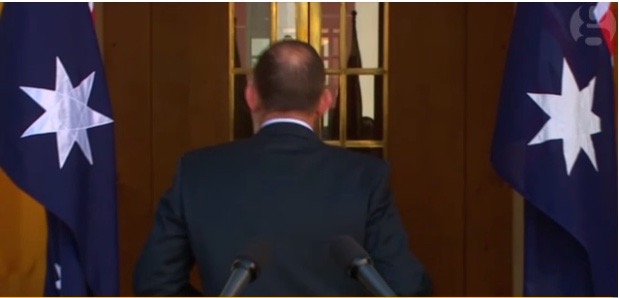
No weepie script, and read like hard De Niro:
a man for others, no tears on display.
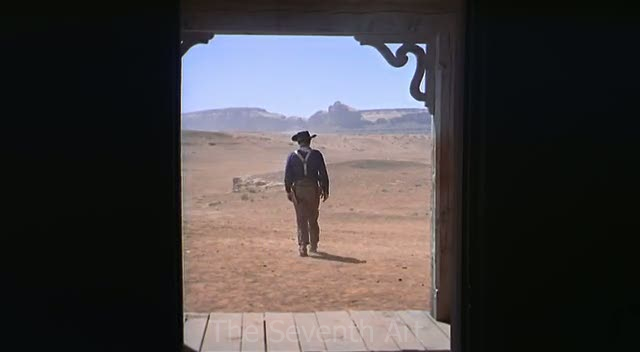
With furrowed brow, a classic Western hero
he turns and does a John Wayne walk away.

Go little poem, I hope worth more than zero,
to mark the very end of one man’s sway.
I’ve added frills to feed my rhyming habit,
but most of what you see is true to Abbott.

Tony goes

the searchers

The Farewell: a versification

On Tuesday 15 September, Tony Abbott gave his final statement to the press as Prime Minister of Australia. Video here. Having rendered Alan Jones and Scott Ludlam into verse, I feel obliged to give Mr Abbott a go. Here’s Part One of what I expect to be two parts:

The farewell
Kings and queens must die before the toast
‘Long live the King or Queen!’ is raised by folk,
but prime (and lesser) ministers can coast
from office still alive – and far from broke.
A vote is not a dagger. At the most
a mobile phone lurks in the plotter’s cloak,
and though the headlines say blood’s on the floor,
in Canberra that’s mostly metaphor.

Video 0:00–0:05
So Monday night last week, when overthrown
by secret ballot in the party room,
our ex-PM, his face as grim as stone,
went to a drunken party, not a tomb,
took fourteen hours to face a microphone.
12.30, puffy eyed beneath the boom,
he started with a frail attempt at cheer:
‘Quite-a-crowd today. Thank you for being here.’

No more ad libs. The rest came from the script
that someone had prepared while we were sleeping
and doing all the morning things he’d skipped,
or so it seemed: there may have been some weeping.
It wasn’t life-or-death, but if he slipped
he’d set a ruthless Twitter chorus cheeping.
This was a chance to dignify his exit,
to bare his statesman muscle and to flex it.

Video 0:05–0:45
‘For many here this is no easy day.
Such things are never easy for our country.
I pledge to make it easy as I may:
not wreck, snipe, undermine [my style’s effrontery
and swagger]. Leaking’s never been my way.
It’s only for our country’s good I’m hungry,
and our government’s success [not my successor’s
whom I won’t name, still less my predecessors’].

Video 0:45–1:16
‘I’ve said the top job’s no end in itself.
It’s all about the people whom you serve.
From Uluru to Continental Shelf,
this country’s wonder, more than I deserve,
I’ve seen. I want to thank [a humble elf]
the voters for this honour. [Oh the nerve
of those who took it from me!] This day’s tough,
but: join the game, play by its rules, they’re rough.

Video 1:16–1:54
‘I’ve held true to what I have believed.’
His head bobs there, a curtsey of the mind.
‘I’m proud of what in two years we’ve achieved:
more folk in jobs, and three free trade deals signed,
huge roadworks under way, and we’ve relieved
mine owners of bad Labor taxes, shined
a spotlight on bad Labor’s Union mates.’
A chopper drowns out half of all he states.

Video 1:54–2:20
‘… terror threats … deployed … the other side …
to bring our loved ones home … the boats have stopped …
compassion … refugees … [I may have lied
or bent the facts a little
] … budget mopped …
billions … without principle the tide
of opposition … [Heaven knows I’ve copped
unprincipled  hysteria for Pell,
and ‘Nope, nope, nope’, and kids in Nauru’s hell.
]

Video 2:20–3:00
‘Of course, there’s much I had still wished to do:
To move things on for Noel’s and other mobs –
bring recognition, school, work, safety too.
My photo-op weeks broke new ground, no probs.
Ice and domestic violence wait in queue.
The wider world presents us with big jobs:
Wars far away are well within our range.
[But notice I don’t mention climate change.]

To be continued …

If you want to read some real poetry on the subject of our recent change of Prime Minister, I recommend the editorial of yesterday’s Saturday Paper. It begins, ‘It is no exaggeration to say Tony Abbott is the worst prime minister Australia has had,’ and builds from there.

Hidden glory

I’m just back from the opening of the HIDDEN Sculpture Walk in Rookwood, Australia’s oldest, biggest and most culturally diverse cemetery, also the one with a sculpture exhibition showing from  sunrise to sunset from tomorrow, Friday 18 September to Sunday 18 October. Entry is free.

As I mentioned last week, the Emerging Artist is in the exhibition, and today when the prizes were announced,  she was one of the three commended works. (There are also three highly commended works, plus two that shared the $10,000 prize. Both the Emerging Artist and I were too thrilled to make  dependable notes on what the other 7 works were, but I expect they’ll be listed on the Hidden website soon.

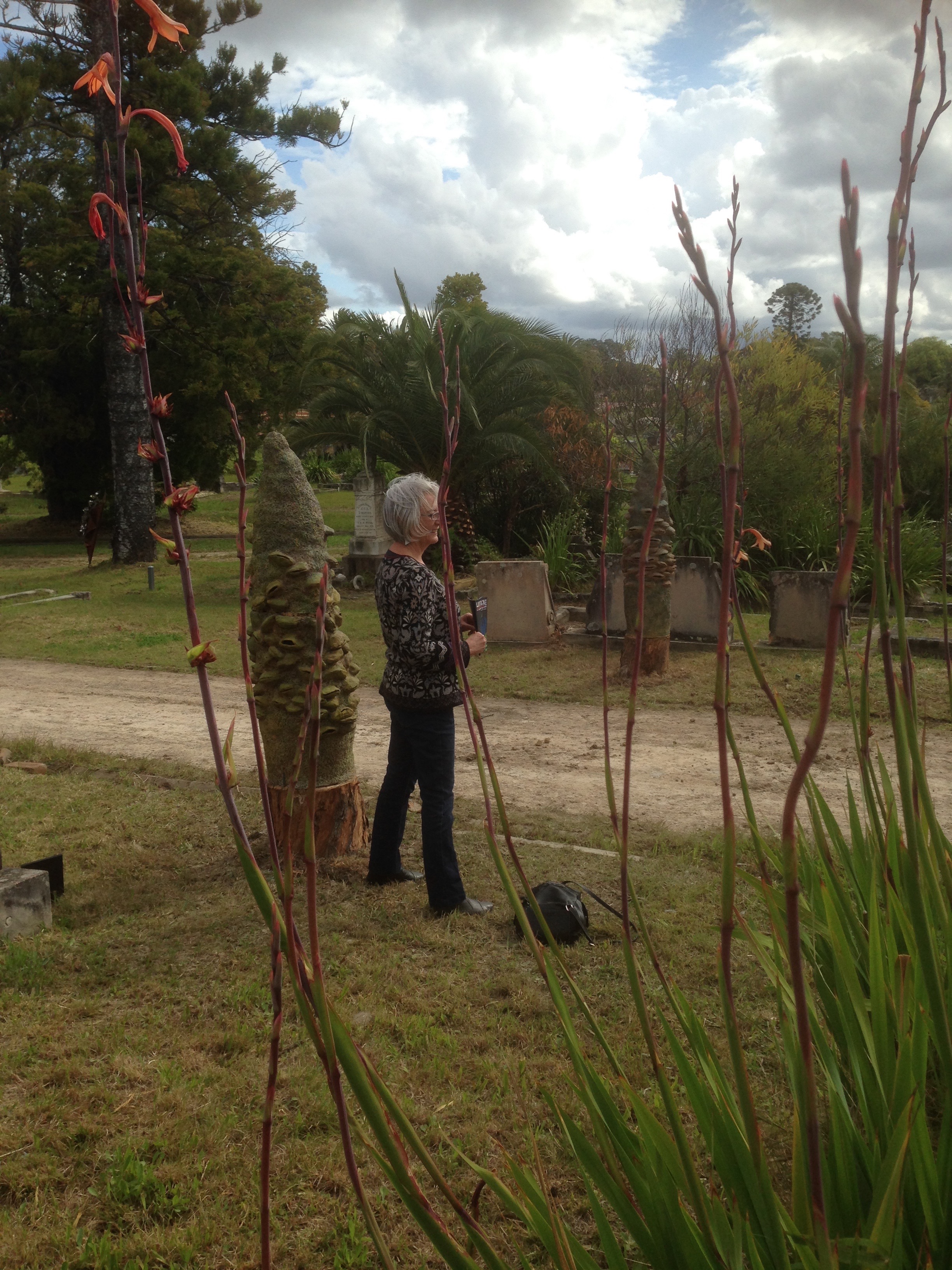
Heavy rain was forecast today, but the weather for the opening was cool, dry and very bright. Here’s yet another picture of the work and the artist:

IMG_1390

Coming Soon

If you live in Sydney, you ought to know about two fabulous things coming soon.

1.
HIDDEN: Rookwood Cemetery, from sunrise to sunset
Friday 18 September to Sunday 18 October
ENTRY IS FREE!

The Hidden website says it well:

Hidden is an outdoor sculpture exhibition that takes place amongst the gardens and graves in one of the oldest sections of [Rookwood] Cemetery. The exhibition invites artists to ponder the notion of history, culture, remembrance and love and allows audiences to witness creative expression hidden throughout Australia’s largest and most historic cemetery.

This is Hidden’s seventh year. I’ve been in previous years, and there’s something  marvellous about the sculptures placed among the tombstones. (It’s in an older part of the cemetery – no one will see the grave of someone who died recently being visited by an antic Don Quixote or a bright perspex rainbow.)

This year the Emerging Artist formerly known as the Art Student is part of the exhibition. Her piece, Bush Memorial, comprises two giant ceramic banksia seeds. Yesterday we installed it.

This slideshow requires JavaScript.

2.
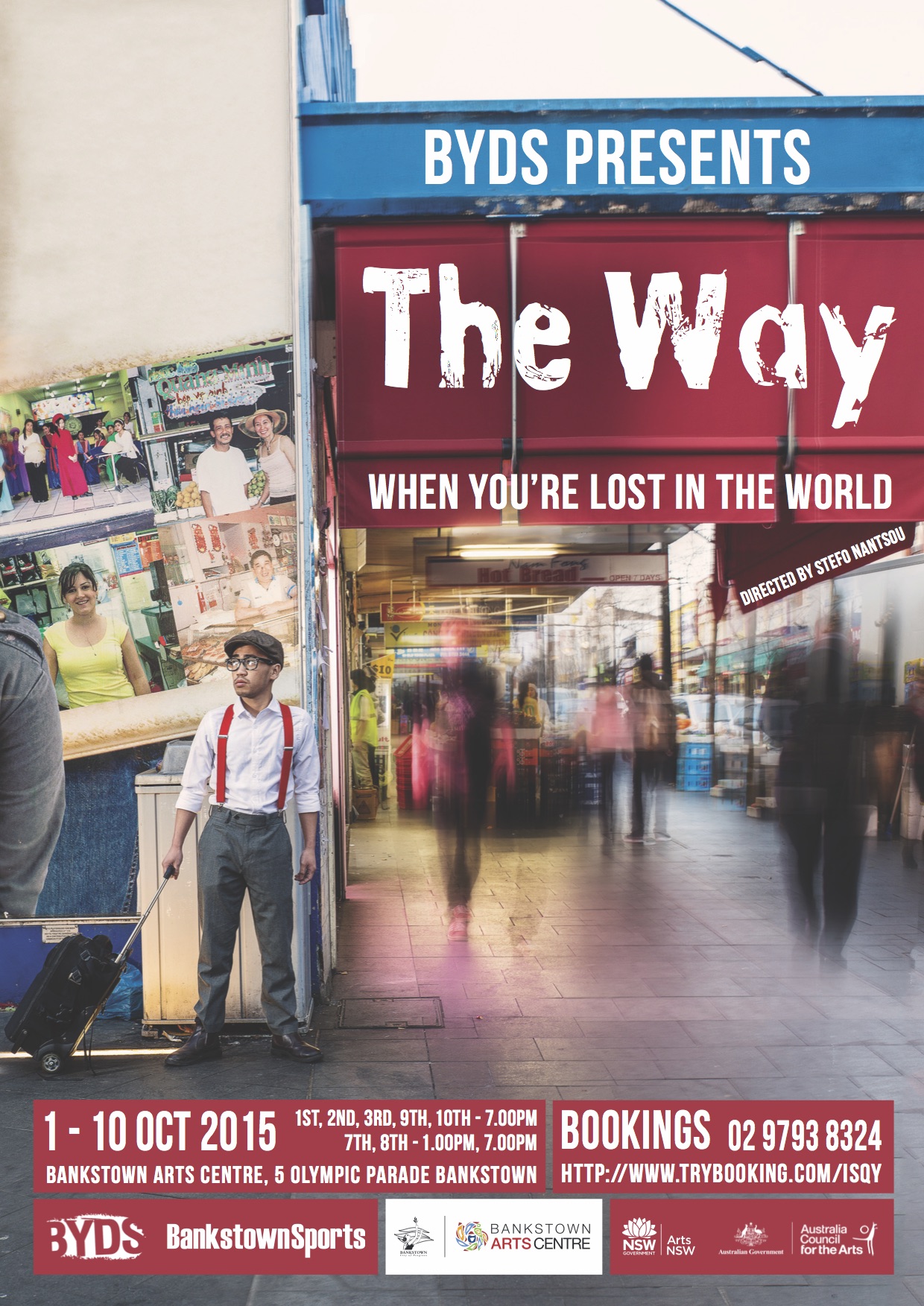
THE WAY: Bankstown Arts Centre, 1-10 October. (It’s not free but it’s unbelievably cheap)

The WayThis is the third play in a trilogy that has grown out of a collaboration between BYDS (Bankstown Youth Development Service) and the Sydney Theatre Company.  I saw the second play, The Other Way, in 2013. The collaboration of professional actors with local community members, led by actor/ writer/ director/ musician Stefo Nantsou, produced a brilliant evening of theatre. Here’s a bit from my blogging about it:

This isn’t professional/industrial theatre, where success is judged by the length of the run and size of box office takings. It’s community, where the division between audience and performers is porous, where there’s an intimate sense that people are telling their own stories and those of their neighbours.
There’s a wonderful scene where a group of boys are teasing/harassing a group of girls, who are giving back as good as they get. In the middle of the chiacking and posturing one of the girls looks one of the boys full in the face and says, ‘Hello!’ and the group falls silent. The whole thing falls apart, moves onto a different plane. Sure, it was scripted and stylised, but it felt like it was really happening right then and there.

I gather that The Way has a similar structure to its predecessors: over a single day in Bankstown, storylines intersect as people from diverse backgrounds experience their multitudinous joys and crises. I’m looking forward to it.

The Other Way was evidently seen by a relatively small total audience over its short run. The Way has eight scheduled performances. If you live in Sydney I recommend that you put it in your diary and book seats soon. You can read more about it here. Bookings: 02 9793 8324 or http://www.trybooking.com/isqy