David vs Tony

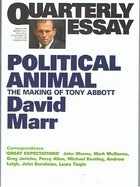
David Marr, Political Animal (Quarterly Essay N° 47)

20120914-221620.jpg When David Marr writes an essay about Tony Abbott there’s no point asking if it will be a hatchet job. The question is how well the hatchet job will be done. Abbott is the preserver of John Howard’s legacy; Marr wrote and edited a number of books laying bare Howard’s duplicitous and anti-democratic politics. Abbott is a high-identifier with old-style Catholicism; Marr has been consistently critical of the Catholic Church. Abbott is, well, not comfortable about Gay liberation issues; Marr is, well, cheerfully out as a Gay man.
Marr’s Quarterly Essay on Kevin Rudd drew a fairly long bow – on the strength of Rudd losing his temper with an arguably impertinent journalist, Marr concluded that anger was Rudd’s ‘juice in the machine’. There’s no equivalent stretch here. In fact, he paints a picture completely congruent with a clerihew I wrote some time ago:

Anthony John Abbott
has a habit
when playing for high stakes
of saying whatever it takes.

He does raise a question that could be paraphrased in another clerihew:

Tony Abbott
is making a stab at
becoming prime minister
possibly concealing intentions that are sinister.

Most discussion of the book in the mainstream media has been about an incident that Marr relates from more than 30 years ago when Abbott was a student politician. This looks to me like a clever ploy on the part of Abbott and his journalist allies, giving those who haven’t read the essay the impression that it’s mostly he-said-she-said allegations about ancient history. It’s actually much more substantial, responsible and entertaining than that.

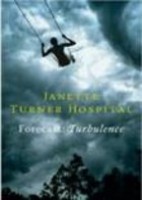
Janette Turner Hospital’s Forecast: Turbulence

Janette Turner Hospital, Forecast: Turbulence (Fourth Estate 2011)

This collection of nine short stories and a memoir has been shortlisted for a number of awards and it may have won some. Sentence by sentence it’s very well written. It is populated by a range of eccentrics, outsiders and non-neurotypicals and should have been interesting. But as far as I was concerned it didn’t touch the sides. I didn’t believe a word of it, even the memoir, which I know is truthful. Newspaper reviewers seem to have loved it, though I’m not convinced they’ve all actually read it.

That is all.

Hungry for Art indeed

In case you haven’t heard, the New South Wales government is in the process of a vigorous attack on education in this state. Judith Ridge has posted passionately and lucidly on the subject at Misrule (full disclosure: she says some nice things about me at the link, in the middle of much else). If you haven’t been noticing the headlines, you can catch up here.

Amid the carnage:

On September 11 the NSW government announced that it would stop funding art education in TAFE, leaving 4000 students without access to finishing their courses in 2013. TAFE Art courses are the main provider of art education in NSW, with many prominent artists getting their first ‘hands on’ training in TAFE. The withdrawal of funding will mean that only the wealthy will be able to afford private art education and NSW will suddenly find it no longer has emerging artists with skills coming through.

That’s right, art education in TAFE will no longer be funded as of 1 January next year. No transition – just a short sharp shock. It’s anyone’s guess what that will mean for people who started a year or two ago confident that the NSW government would honour its implied contract, let alone the hundreds of artists who survive thanks to part time or casual teaching. TAFE is of course the poor relation in art education: when the National Art School boasts of its many illustrious alumni, for example, it rarely mentions that most of them attended when the NAS was actually East Sydney Tech, part of the TAFE system. So art is vulnerable because of course the contribution that artists make to society is routinely rendered invisible, and art teaching at TAFE is double vulnerable because it doesn’t have prestige at the big end of town.

There’s an online petition at CommunityRun, which is the source of the quote above. Do have a look and, if you agree with its gist, sign it. Students at a number of TAFEs are organising, including St George, Nepean, Goulburn, Moss Vale, Meadowbank and Wollongong so far.

The Hungry for Art Festival has hardly finished attracting hundreds of people to  The Gallery School at Meadowbank than the government announces it’s in effect closing the school down. (Because where will they find alternative funding in three months, and will the school still be public, affordable and accessible if they do?) The facebook page of FAIM (Fine Arts Inc Meadowbank) is humming.

As you might guess, the Art Student is in the thick of the campaign against the cuts. Among many other initiatives, it is the subject of the final printmaking project in her Advanced Diploma.

The project is inspired by the petition sent to the Pope by the House of Lords in 1530 pleading for the annulment of Henry VIII’s marriage to Catherine of Aragon. That petition was displayed in Lux in Arcana, the exhibition of material from the Vatican Archives that we were lucky enough to see in July. As well as signatures, the petition boasted the seals of about a hundred lords and bishops hanging on leather thongs. The effect is impressive, but also beautiful.

The Art Student hopes to attract a similar number of artists to sign a petition (wording similar to the one at CommunityRun) and carve a small soapstone block with a symbol representing themselves that can be printed in sealing wax and hung from the petition.  The art student will supply the soapstone, and the artists are welcome to keep the carving once the imprint has been made..

If you know any artists who might be interested, send them this way. My email is jonathan at shawryan dot id dot au.

Lionel Fogarty’s 1995 selection

Lionel Fogarty, New and Selected Poems – Munaldjali, Mutuerjaraera (Hyland House 1995)

Lionel Fogarty is described on the Australian Poetry Library (APL) website as ‘a poet who has opened up the new space of black Australian post-surrealist writing and done much to reformulate our understanding of poetic discourse and its roles in both black and white communities’.

I bought this book years ago and it has been intimidating me from the to-be-read pile ever since. Now that I’ve finally read it I’m not so much intimidated as baffled, which, come to think of it, isn’t so unusual for me around poetry: I remember feeling that many of Frank O’Hara‘s poems might as well have been written in Icelandic for all I could make of them. But you know, even if straightforward poems aren’t all alike, every difficult poem is difficult in its own way. I experience Lionel Fogarty’s poetry as difficult in a number of interesting ways, some of them suggested by the APL quote above.

First, he writes in a version of Aboriginal English, and uses words from Aboriginal languages. The book’s glossary is some help with the vocabulary, but the syntax isn’t always easy to follow on the page, and Fogarty doesn’t go out of his way to ease the task for white readers. He writes in his introduction, ‘White man will never really fully interpret what a black man is thinking when he is writing.’ Fogarty writes as an Aboriginal man, heir to a genocidal history and survivor of continuing genocidal policies and practices; I am reading as a beneficiary of the same history and still with a world view largely conditioned by white privilege. That probably sounds dreadfully pious, but the fact is he can quite reasonably expect me to put in some work.

In a fascinating 1995 interview with Philip Mead published in the online poetry magazine Jacket, Fogarty responded to a question about his use of language:

I think what people should do is read my poetry, in an Aboriginal way, take the Aboriginal side of my language, and then reflect back on the English side. That’s the only way you’re going to get a balance of understanding. I think my most important thing, like I always say, is to revitalise or to get a full language into practice of the detribalised areas, of the urbanised, so-called, Aborigines. That’s my main thing.

I don’t know if it’s a separate thing, but there’s also what the APL calls his post-surrealism. I take this to refer to the hallucinatory element of some poems and something that’s happening in the language that isn’t just about Aboriginal English. From that same interview:

What I like to get into people’s minds, when they read my things, is that they get a picture, they get a painting from it and that’s the only way they can really understand all the mosaic, the patterns of the words I put down on paper. At the same time they can hear my voice coming through quite clearly, then they can really understand the poet.

I need to spend a lot more time with this poetry before I can do much more than struggle with it. But so as not to completely chicken out of saying something, here are the relatively unproblematic opening lines of ‘Farewell Reverberated Vault of Detentions’, a poem that imagines a day of freedom from oppression:

Today up home my people are
indeedly beautifully smiling
for the devil's sweeten words are
gone.
Today my people are quenching
the waters of rivers without grog
Today my people are eating delicious
rare food of long ago.

This isn’t difficult, if difficult means hard to understand. However, I do have difficulty with it. I don’t know if indeedly is Aboriginal English. In any other context I would have read it as a Ned Flandersism. Likewise, sweeten used as an adjective, quenching as something done to waters rather than by them, apparently erratic use of full stops and capitalisation: my copy-editor reflexes go wild. I don’t think that Fogarty has written these lines with an intention of discombobulating white pedants. This writing just doesn’t care about my concerns. It’s talking to someone else altogether, and if I want to keep up I have to let go. But then I’m at sea. I am as much at a loss to pick up on the nuances of this language as I am when I’m reading French or Italian – which is very at a loss.

It’s true, in the couple of videos I found of Fogarty reading, the poetry communicates much more effectively than when I read it for myself and hear it, inevitably, in my own white, middle-class, linear-syntax-conscious voice. This TEDxSydney 2010 video is fabulous, for example:

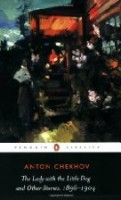
The Book Group reads Chekhov short stories

Anton Chekhov, The Lady with the Little Dog and other stories, 1896–1904 (translated by Ronald Wilks, Penguin 2002)

I was enthralled by The Brothers Karamazov when I was 16 – the Grand Inquisitor raised the hairs on the back of my Catholic neck – but have so far managed to read very little of other 19th century Russian writers. The Book Group made me read Anna Karenina a while back, and now it’s Chekhov.

Before the meeting:
Knowing that Chekhov is one of the masters of the short story, I was vaguely expecting a display of virtuosity – cleverly constructed mechanisms with twists in the tail, perhaps, like O Henry’s ‘The Gift of the Magi’ only profound. The stories in this late collection aren’t like that at all. (I don’t know about his earlier stories, and it would probably have been better to start with some of them.)

To generalise, the stories are studies in Russian provincial life at the turn of the twentieth century. It’s hard if not impossible to read them now without an awareness that the Communist revolution was on the horizon. Chekhov’s picture of the oppression of the peasants, the hand-wringing of liberal land-owners and the viciousness of others, the flailing about of the intellectuals, and the way the economic and social system stifles and corrupts everyone, clearly reflects a world ripe for revolution. Not that he calls for revolution, but he does lay out the inadequacy of anything else on offer. These are stories, not tracts. They contain a lot of argument, but they don’t push a line – or if they do, it’s in terms that have become impenetrable to this casual reader a century and a hemisphere away.

In ‘The House with the Mezzanine’, when a socially responsible woman chides the artist–narrator for having no interest in such matters as the creation of a clinic for peasants, he replies that on the contrary the question interests him a great deal, and in his opinion the peasants do not need a clinic:

‘To my mind, with things as they are, clinic, schools, libraries, dispensaries only serve to enslave people. The peasants are weighted down by a great chain and instead of breaking this chain you’re only adding new links … What matters is not Anna dying in childbirth, but that all these peasant Annas, Mavras and Pelageyas toil away from dawn to dusk and that this unremitting labour makes them ill. All their lives they go in fear and trembling for their sick and hungry children. … You come to their aid with hospitals and schools, but this doesn’t free them from their shackles.’

And he goes on. Up to the point where he starts talking about spirituality, he could be a hardline lefty of a couple of decades ago railing against reformism. In the story, the dilemma is not resolved. At the end the peasants are still suffering and the narrator, without explanation and perhaps symbolically, fails to find true love. (A while after I’d written that, I came across this quote from Chekhov’s correspondence:: ‘You … are confusing two concepts: the solution of a problem and the correct formulation of a problem. Only the second is required of the artist.’)

Or take this rant in ‘Gooseberries’, in which a character is talking about his brother, who chose to live a contented life on a small farm. It could be 21st century polemic against the self-help industry:

It’s obvious that the happy man feels contented only because the unhappy ones bear their burden without saying a word: if it weren’t for their silence, happiness would be quite impossible. It’s a kind of mass hypnosis. Someone ought to stand with a hammer at the door of every happy contented man, continually banging on it to remind him that there are unhappy people around and that however happy he may be at the time, sooner or later life will show him its claws and disaster will overtake him in the form of illness, poverty, bereavement and there will be no one to hear or see him. But there isn’t anyone holding a hammer, so our happy man goes his own sweet way and is only gently ruffled by life’s trivial cares, as an aspen is ruffled by the breeze. All’s well as far as he’s concerned.

There’s a lot of grim humour. The wedding celebration in ‘In the Ravine’ could have been the inspiration for Jack Hibberd’s Dimboola – but audiences laugh at the latter, while any laughs at the former are tinged with despair and disgust. And the stakes are raised by the peasants outside, one of whom shouts, ‘You’ve sucked us dry, you rotten bastards. You can all go to hell!’ That moment, of course, quickly passes as the peasants too join the celebratory mood. But the reader has been warned.

Chekhov isn’t one of those writers who ties everything up in a neat little bow. In ‘In the Ravine’ when a baby is murdered, his mother is blamed and the murderer goes free – but we are given no explanation for the mother’s failure to defend herself or other people’s silence about the cruel injustice. ‘The Lady with the Little Dog’ is a love story. Instead of ‘happily ever after’, it ends, ‘ And both of them clearly realised that the end was far, far away and that the most complicated and difficult part was only just beginning.’ Which is my sense of what all the stories are saying, about everything.

I’ve seen Eudora Welty quoted on the Internet as saying, ‘Reading Chekhov was just like the angels singing to me.’ That transforms my sense of what an angel can be.

The meeting: This meeting was postponed a number of times because I was hosting it and I was down with a heavy cold. As a result, most people’s recollection of the stories wasn’t very precise, but we’d had time to absorb them – in particular I had read some new Australian short stories (about which I’ll post separately), and my appreciation of the Chekhov had grown with the comparison. A big impediment to our discussion was that, as it turned out, we’d read different books: three of us had read The Lady with the Little Dog and other stories, 1896–1904. Others had read Lady with Lapdog and other stories, translated by David Magarshack, which contains a different set of stories (damn you, Penguin, for giving different books almost identical names!). The only stories in both books are ‘The House with an Attic’ aka ‘The House with the Mezzanine’, ‘Ionych’, and ‘Lady with Lapdog’ aka ‘The Lady with the Little Dog’.

We had a lively discussion. I think Chekhov was a bit of a surprise for everyone – not enough story for one chap (who thought the title of ‘A Boring Story’ said everything that needed to be said about it), a bit on the grim side for another, surprisingly modern in his discontinuities and sexual morality, surprisingly not, or not always, about the sufferings of the peasants.  At one stage, for the benefit of someone who hadn’t read it, I gave a synopsis of ‘The House with the Mezzanine’. It seemed a bit on the incoherent side, and then someone realised that I’d thrown in a key scene from another story altogether. Will I ever be trusted again?

Since the meeting, I found ‘A Dreary Story‘ on the internet in Constance Garnett’s translation (I think). There’s a wonderful passage near the beginning that could have been about me:

 I write poorly. That bit of my brain which presides over the faculty of authorship refuses to work. My memory has grown weak; there is a lack of sequence in my ideas, and when I put them on paper it always seems to me that I have lost the instinct for their organic connection; my construction is monotonous; my language is poor and timid. Often I write what I do not mean; I have forgotten the beginning when I am writing the end. Often I forget ordinary words, and I always have to waste a great deal of energy in avoiding superfluous phrases and unnecessary parentheses in my letters, both unmistakable proofs of a decline in mental activity. And it is noteworthy that the simpler the letter the more painful the effort to write it.

Jennifer Maiden in the SMH

With some notable exceptions, the Art Student hates poetry. So this conversation that happened as I was cooking breakfast on Saturday morning was a moment to be savoured.

Art Student: There’s a poem by Jennifer Maiden in the Spectrum. [That’s a supplement to the Sydney Morning Herald.]
Me: Really! Read it to me.
Art Student: You know I can’t read poetry.
Me: (wheedlingly) Go on, please …

And she did. She read ‘My heart has an Embassy’. Beautifully. Whether it was the short lines, the brevity of the poem, or the way it makes metaphor out of a situation from the headlines – Julian Assange’s seeking asylum in the Ecuadoran Embassy in London – the poem slipped effortlessly past the poetry-hating guards.

I couldn’t find ‘My heart has an Embassy’ online. Sorry!

[Added later: In a Me Fail? I Fly! exclusive, Jennifer Maiden’s daughter Katharine has posted the poem in a comment!]

Fairy tales can come to U T S

My friend Sarah Gibson has asked me to mention this, and I’m happy to oblige:

20120907-231441.jpg

Fairy Tales Re-imagined: Enchantment, Beastly Tales and Dark Mothers

A symposium to be held on 13 October, at UTS, Sydney, exploring fairy tales and the cultural imagination. Writers, artists and academics speak about their fascination with fairy tales, their motifs, themes and layers of meaning. They discuss how old stories inspire and inhabit new forms.

Of the speakers listed, in my ignorance i only know three: Sarah, who is a bit of a fairy tale polymath, and Kate Forsyth and Margo Lanagan, both billed as novelists, though I passionately hope Margo hasn’t forsaken what some see as her true calling as a writer of short stories.

The symposium has been initiated by media artist Sarah Gibson, whose interactive online project ‘Re-enchantment’ can be found at http://www.abc.net.au/re-enchantment (link opens external site).

It sounds like a fun way to spend a windy October Saturday in Sydney. If you’re interested you can find information and register at http://fass.uts.edu.au/fairy tale-symposium.html, or email Sarah.

The Poetry Train

Australian Poetry Ltd, the recently formed peak industrial body for Australian poets, has declared this to be National Poetry Week. I’ve been too preoccupied with fighting off a virus and feeling sorry for myself to pay much attention, though my impression is that NPW hasn’t been quite as big as the State of Origin week. Some days have had a theme word – one day Read, another Write, and today Buy. I dutifully rose from my tissue-bedecked bed, caught the bus to Gleebooks and bought two slim volumes. But, I hear you protest, surely you could find something more interesting than a trip to a bookshop to get out of the house for? You’re right. There was also the Poets’ Train.

From the CountryLink website:

To celebrate National Poetry Week and the joys of train travel, a group of Canberra poets are catching the train to Sydney to join forces with like-minded bards for an exciting program of social and literary events.

Those events included composing poems during the train journey today for later publication in a chapbook, a dinner and a poetry slam. The thing that caught my attention was a poetry recital on arrival at Central Station this afternoon ‘with media attending’. Gleebooks was just a stop on the way.

The country trains concourse at Sydney’s Central is a lovely space, full of light and air. As I came through the main entrance the first thing I saw was a group of about twenty people, significantly more warmly dressed than called for by the Sydney spring weather, looking like a small choir with a conductor standing in front of them. It was Train Poets, and one of them was reading to the rest. A woman who turned out to be Poets Train Coordinator, Fiona McIlroy, gestured a welcome, and I became, as far as I could tell, the only member of the public to join the audience. There was a young man taking photos – presumably he was the attending media, and if I find any pics on line I’ll add a link to them.

And you know, it was fun. Poems were read that were variously witty, comic, fanciful, and elegant, and most hot from the oven. I chatted to the people closest to me, who said that the train poets had sat working away at their notebooks, taking a break every hour (it’s roughly a four hour trip) to read the work so far. As a result, at the reading I was privileged to attend, they had already established a palpable sense of communal bardship. Contemporary poetry is often criticised as being a matter of poets writing poetry that is read only by other poets. Even if that description were accurate, if it signified the kind of warmth, generosity, mutual appreciation that featured in this event it wouldn’t be an entirely bad thing. No one seemed disappointed at the absence of TV cameras. It was culture without commodification, and I look forward to the chapbook.

I doubt if I’ll get to the slam tomorrow night, as I’m not taking my germs out after dark, but if you’re in Sydney you could do a lot worse than head for The Friend in Hand Hotel, Glebe, at 7 pm.

To cap off my participation in National Poetry Week, there was an email waiting for me when I got home to say that my pre-ordered copy of Bob Dylan’s Tempest, official launch date Tuesday 11 September, was ready to be downloaded. So I’ve been typing this up, home alone on a Friday night, listening to croaky Bob, ‘It’s soon after midnight, and I don’t want no-body but you.’

Happy National Poetry Week!

Added on 1 October: Fiona McIlroy reports on the Poets’ Train at the Australian Poetry website, with photos and the text of one of the poems.

Overland 208

Jeff Sparrow (editor), Overland 208, Spring 2012

There’s a lovely interplay among articles in this issue of Overland: one voice picks up a theme introduced by another and amplifies it or does something unexpected with it, disagreements emerge and remain unresolved, odd harmonies and counterpoints pop up. It’s like ideas music.

Longtime working journalist Jonathan Green predicts the imminent death of the quality newspaper. Responding to the commonplace that newspapers have to develop a new business model in the age of the internet, he writes:

In truth there never has been a business model for quality journalism, only a happy coincidence in papers like the Sydney Morning Herald, the Age and the New York Times in which a successful platform for the publishing of classified advertising coincided with newspaper owners who saw advantage, influence, power – and perhaps even a public duty – in fostering serious, thoughtful journalism.

‘The sad truth for journalists in a commercial construct,’ he argues, ‘is that their department is exclusively a cost. It produces no revenue … In the commercial mind, journalistic content is either the plaster between the ads or something tailored specifically at attracting them. … No one ever valued serious journalism enough to pay for it.’ He doesn’t put it this way, but he’s describing the way contradictions work in capitalism – in order to make a profit, the enterprise has to provide people with something they need, and ever since the mid 18th century some for-profit newspapers have on the one hand served the ideological and commercial needs of capital but on the other provided their readers with a significant record of events and a forum for discussion,with a huge potential for fostering resistance to capitalism.

Alex Mitchell’s ‘Fatal Obsessions‘, about aspects of Rupert Murdoch’s early years, amplifies one element of that story. Murdoch as a newspaper owner has certainly fostered serious, thoughtful journalism, but Mitchell describes how, even his early years, he rubbed shoulders with ‘bent coppers, crooked politicians and illegal gamblers’, and put some of them on staff. It’s clearly a case where the ‘quality’ bit of quality journalism is there at the whim of the owner.

The veteran Green has no sooner lamented the passing of what quality newspapers have provided – ‘a mature, moderated conversation that was broadly shared and thus to be reckoned with’ – and shaken his head at ‘our more fragmented, shriller public life’, than young New Yorker Malcolm Harris pipes up with ‘Twitterland‘, describing Twitter as a terrain rather than a tool, and then, getting down to cases, telling us approvingly how Twitter can be used to lie on an industrial scale, to shout down ideological enemies, to hide from the consequences of your actions and to unleash mob actions against individuals. That these things are done, in his examples, for in order to draw a crowd to an Occupy event, counter corrupt but sophisticated arguments, evade malicious prosecution and ward off a harasser appears to render them unproblematic in his view. In the context of Green’s article, it’s hard to share his complacency.

The proximity of Harris’s article to Green’s raises another interesting question: if it is indeed, as Green says, a ‘happy little accident’, a ‘weird conjunction of advertising and reporting that has managed to maintain a healthy fourth estate’, isn’t it another happy little accident that makes commercial enterprises like Twitter available as places where progressive forces can organise?

Another set of resonances is kicked off by Anwen Crawford’s ‘Fat, Privilege and Resistance‘, a response to an article by Jennifer Lee in the previous issue. It’s brilliant, arguing that while Lee tellingly draws attention to fat oppression, she doesn’t take readers much beyond the act of recognition. In particular, Crawford introduces much-needed class analysis into the conversation. But it’s a different bit that fits my theme of serendipitous connections. Here’s Crawford taking issue with Lee’s argument that fat women should make themselves visible as a liberatory act:

Women – fat and thin – live with a particular kind of watchfulness, a sense of always being on display …

Perhaps we lack a word subtle enough for the condition that I described in [my essay ‘Permanent Daylight’, Overland 200] as ‘a deep and systemic psychic distress … of perpetual visibility’. If visibility is a condition of women’s oppression, then why should we keep demanding to be seen? If all the billboards across the world were replaced overnight, and fat women took the place of bone-thin models advertising underwear and perfume, would this constitute victory? I wouldn’t think so: I’m still being sold stuff, and someone else – another woman – is still being objectified for the purpose of selling it to me. To demand visibility is to submit to capitalism’s strictures: to accept that being an image is more important than being a subject; to accept representation in place of participation.

I’m sure there’s argument to be had there, but the phrase ‘representation in place of participation’ is cogent. And it casts a long shadow over the article ‘Outsider Porn‘, in which Matt Cornell argues, among other things, that ‘porn can be a powerful venue for self-expression, for asserting agency in a culture with narrow, constricting ideas of beauty, sexuality and gender expression’. If you are cut off from participation, then go for representation. I remain unconvinced of the liberatory value of porn. The connection to the debate about fat liberation becomes explicit:

One of the central critiques of pornography is that it objectifies women by reducing them to specific body parts. Yet this is what happens routinely to fat people who are photographed from the neck down for moralistic news stories on the obesity epidemic.

I’m sorry, this is just about as logical as the argument that feminists shouldn’t object to sexist abuse of women in public life if they don’t object with the same passion to male politicians being insulted: ‘You say this is oppressive. Well, that over there is oppressive too.’ I love it that Overland gives space for genuine, unresolved disagreement, publishing this porn-as-liberation article after issue 207’s ‘Porn and the misogyny emergency‘ debate, which was unanimous in seeing porn as degrading. I don’t know how the editorial team would feel about my quoting John Stuart Mill in support of their practice, but I dimly remembered a quote and found it by googling. It’s from On Freedom:

though the silenced opinion be an error, it may, and very commonly does, contain a portion of the truth; and since the general or prevailing opinion on any subject is rarely or never the whole truth, it is only by the collision of adverse opinions that the remainder of the truth has any chance of being supplied.

Then Juliana Qian’s personal essay ‘The Name and the Face‘ tackles the issue of visibility, objectification and agency from a whole other angle. She came to Australia from China as a child, one of a generation that ‘was promised equality after assimilation’. That promise was broken, and the essay ruminates on the kind of invisibility that comes from being stereotyped as an Asian/non-Indigenous person of colour, and the complexity that the stereotypes ignore:

I have a lot of stories. Most of them are not about tradition, nor about assimilation. Most of my life is not about tradition or assimilation. I grew up not between cultures, but within overlapping cultures that are themselves amorphous, contradictory and changeful.

The threads of connection reach into the fiction section, to Jannali Jones’s mock Kafkaesque ‘Blancamorphosis, in which cultures don’t so much overlap as weirdly implode: ‘Jon Dootson woke up in the morning to find he’d been transformed into a long, skinny white man.’

There’s more – it’s a bit of a bumper issue really, with a report on the Goulburn Valley Food Cooperative by Michael Green, a fable-ish (I’d say fabulous, but that means something different now) short story by Jennifer Mills, which has its own Kafkaesque quality, an elegant column on Jane Austen by Alison Croggon, and a swag of poems that, though they’re kept up the back on different coloured paper, do speak to the rest of the journal in many ways. This post has turned out to be far too long, so I’ll content myself with a couple of lines from Tim Thorne’s ‘Honesty‘ that touch on the theme of the quality newspaper:

When I was a teacher
the really smart kids saw through
‘Hard work brings rewards.’ But then,
I’ve always told lies for a living:
dole forms, poetry, I once wrote
a column for a Murdoch newspaper.

#destroythejoint

Just in case you haven’t been following the fabulous response to Alan Jones’s colourful pronouncement that women are destroying the joint, I recommend you have a look at the Twitter hashtags #destroythejoint and #destroyingthejoint. Oh how much better exuberant sarcasm and just plain fun and celebration is than outraged defensiveness!

There’s a great photo gallery at Daily Life. I particularly like the images of Marie Bashir, Eva Cox and Penny Wong.