The Apology, part 4

Nearing the end of my versification of Alan Jones’s ‘apology’ press conference. Click here for Part 1 and here for Mr Jones’s press conference, from which – believe it or not – a lot of this is taken verbatim:

‘Put Julia in a chaff bag – yes, it’s true
I said that. I said, Drop her out at sea.
But not to drown out there in the big blue.
No! See if she’d swim home! Analogy!
And metaphor! That’s what my dad would do
with damaged goods out in the bush, you see.
I bought the chaffbag jacket at the bash.
Those poor beleaguered people need the cash.

‘If I must be belted up, well here I am,
off my own bat. (I don’t know how this chap
got in there – he’s a liar and a sham.)
It’s like Gallipoli, we face the shrap-
nel from Turk Gillard. It’s like Vietnam:
dark humour as we hear death’s dark wings flap.
No joke, that phrase that I, naive, repeated:
Our backs are to the door. And now it’s sheeted

‘home to me. But think of Kevin Rudd.
Like him or not, he was Prime Minister,
and his own party trashed him as a dud.
This bit’s best left unsaid, but it’s so sinister:
Holy Nelly, the ALP slings mud
and don’t apologise. This one’s a mini-stir.
I spoke unwisely. Now they’re hurling stones
and tweeting flak to silence Alan Jones.

Are we sure the tape wasn’t faked by them?
Did I say this awful thing? Or am I clean?
Julia said her problems as PM
weighed heavy on her dad. What did she mean?
I do not say aloud, at least pro tem,
that she meant he felt shame. I know she’s been
shown up as a liar many times.
A good dad would feel bad about such crimes.’

Dear patient reader, not much more to go.
He meant no harm. He likes her and her dad.
It was no joke, but echoed people’s woe.
He don’t remember making such a bad
remark. He made it at a private show
and was recorded by a total cad
who may have faked it. It was mostly true.
Others have done worse. He’s true blue.

Tune in again in a couple of days for the thrilling conclusion – surely. The Press conference went for 43 minutes. I should be able to bring it home in under 23 stanzas. The bits that made me start out on this enterprise are yet to come: ‘I didn’t say women are destroying the joint,’ ‘I didn’t call her a liar, and ‘I’ve never called anyone a bitch ever.’

Andy Kissane and the Swarm

Andy Kissane, The Swarm (Puncher and Wattmann 2012)

20121003-175856.jpg I read this collection of Andy Kissane’s short stories a month or so ago, just after reading some Chekhov stories for the first time. (The reason for the delay in posting is that – a rare event for me – I received an advance copy from the publisher, and the book isn’t being launched until Sunday.) The stories in The Swarm made me realise, with some embarrassment, that I had read Chekhov as if I was visiting a museum: it was interesting, instructive, challenging, but all at arm’s length, preserved, from another time and place. Andy Kissane’s stories are as alive and immediate as neighbourhood gossip.

Partly that’s because these stories, all except two, are set in the present. And partly because of the book’s strong sense of place. Most of the action takes place in an inner city landscape as distinctive as Chekhov’s rural villages, and the characters – musicians, mostly unsuccessful actors, a twenty-something artist, a young mother screwing up her courage to invite her recently widowed father to move in – are as much part of that landscape as Chekhov’s peasants, idlers and provincial bourgeoisie are of theirs. I imagine the sense of the local in these stories would appeal to any reader, including one for whom the Marlborough or St Vincent’s are no more than names, but it’s especially sweet to me because by and large, it’s my local.

[About 200 words about being a North Queenslander deleted here.]

A sense of place doesn’t make a good story, of course. And there is a lot more than that to enjoy here. Again and again a commonplace experience is seen freshly, charged with moral or emotional meaning the way commonplace things often are. A young man stands at a condom vending machine in a pub toilet. A couple spend an evening playing Monopoly when the TV set has died. An old man cleans up his daughter’s yard. A musician watches his cello being played badly by a prospective buyer. A man (who could have come from the pages of On Western Sydney) boasts of car-related derring-do. Looking at that fairly random list of closely observed, mostly domestic events, I realise that the common subject of the stories is love: romantic love, parental love, love betrayed, love unfulfilled, love surprisingly revived or belatedly recognised. Nothing flashy, just a deepening sense of what it means to be human and in connection.

The historical stories – ‘A Bright Blue Future’ and ‘A Mirror to the World’, about asbestos mining at Wittenoom and racist frontier violence respectively – mostly keep to a similar domestic perspective. They too can be read as about love – one man makes disastrous moral compromises out of concern for his family’s short-term wellbeing; tentative overtures between Aboriginal Australians and settlers end in disaster.

‘A Mirror to the World’ is the longest and most ambitious story in the collection. It is based on an incident that happened in Rockhampton in the 1870s – an incident, interestingly, that’s interpreted quite differently in Ross Gibson’s Seven Versions of an Australian Badland. At least, one of the story’s two narratives is based on that incident. The other belongs to the author–academic who is writing that historical narrative, in between running a creative writing course where he lectures on multiple narratives, mise-en-abîme and other devices that are used in the story itself. So, yes, unlike the other ten stories it draws attention to itself as an artefact. It does this in other ways as well. There are explicit references to at least two other stories in the collection: a character from one makes an offstage appearance, and a situation from another is echoed in detail. It’s cleverly done, and there’s a final twist that crowns the cleverness, but it serves a serious purpose. As the story turns back on itself, it opens the way for questions about what it means for a white Australian to tackle the appalling injustices of our colonial past, about the question of moral judgement, the difficulty of imagining the inner world of the early settlers without either surrendering or imposing a modern perspective. The ending is both a technical delight and a moral/political challenge. It’s a story I’d love to discuss – but not here, not to spoil it for people who haven’t read it.

Full disclosure: As well as receiving a free book, I have a degree of commitment to Andy Kissane’s work, since the script for the short film currently known as Scar!, which regular visitors here will know I co-wrote, was inspired by his poem ‘The Station Owner’s Daughter, Narrandera’.

The Apology, part 3

Continuing my exercise in versification (click here for Part 1 and here for Mr Jones’s press conference, from which a lot of this is taken verbatim):

‘It’s incumbent on me now to make a call.
I rang The Lodge and there was no one there.
I’d speak to her: A father’s death’s no small
loss, no tiny cross for her to bear.
She is a human being after all.
Her migrant parents gave more than their share.
I’ll more than happily praise her father’s name,
but don’t say I’ll deny he died of shame.

‘That speech last week would have been better made
without the phrase attributed to me.
It was no joke. It grew from the first grade
frustration felt out there, black parody
responding to the way she has betrayed
us all. It was a wail at arvo tea.
I don’t dislike her: we swapped birthday greetings.
I just pass on the spleen from barbie meetings.

‘There’s no excuse in hindsight. Here’s the context.
This was a Sydney Uni private dinner,’
[The invite called it public – what the hecks!]
‘a rollicking affair, we all were in a
mood take the mickey, throw off checks
and balances. But still, I’m no beginner.
That shouldn’t have been repeated but it was
by me and some sneak journo from the Oz

‘or Tele who was taping the whole do.
I’d say to her I understand her grief
and hope I haven’t added to it. Who
would wish that on her? There is no relief
from my remorse but I’ll say one or two
more things. Some tweeters had a beef
with me and said they hoped my prostate cancer
would return and kill me. Now, my answer

‘is, I’m fair game so why not Julia Gillard?
You won’t hear me complain, you’ve got to cop it.
I don’t condone my comment, but it’s still hard
that I get singled out. You’d all say, Hop it!
if I said, Lay off Abbott. There’s a shrill guard
round the PM, oh the poor wee moppet.
No joke to say her father died of shame.
That’s no excuse for saying it, all the same.

‘I’ll tell you now of anger that’s deep-seated.
The carbon tax! The mining tax! She lied
about the Socialistic Forum. I get heated
about an anguished mother whose son died
because of Gillard’s batts. She’s lied and cheated.
Australian Workers Union? Watch her hide!
I’m personal. You must front and say sorry.
Simple as that. You have to. Don’t you worry.

I’m up to page four of the 11 page transcript, which this follows closely, though the transcript does start repeating itself around about now, so I may be more than half way through this opus. To be continued.

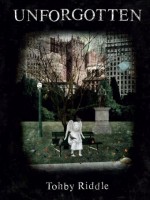
Tohby Riddle’s Unforgotten

Tohby Riddle, Unforgotten (Allen & Unwin 2012)

This is a picture book to treasure. Beautiful, beautiful, beautiful. The story is like (Doctor Who alert) ‘Blink’, only the angels are benign. So it’s also like (Wim Wenders alert) Wings of Desire, only not really, really long, and also suitable for children.

I’m a Tohby Riddle fan, and friend, but this goes well beyond any of his previous books. Shaun Tan says on the back cover: ‘Ephemeral as a feather, timeless as a rock, and as true as both.’

The Apology, part 2

Continuing my exercise in versification (click here for Part 1):

Guest speaker at a Young Libs’ dinner bash
he called on them to rally round their leader
because the enemy, ‘this woman’, could still smash
their hopes at next election. So he kneed her
hard, ‘She lies, she lies!’ He grew more rash
and said her old man died of shame. But, reader,
one diner was recording every word:
that phrase went public. Hornets’ nests were stirred:

a Murdoch headline, no deniability,
a facebook regiment of joint destroyers,
a dot org that’s fed up with his scurrility,
a Twitter tag a weapon to deploy as
sharp as knives: Vulnerability,
thy name is Jones. He can’t enjoy his
private vitriol put out to air.
He knows he must apologise – fair’s fair!

And so it goes. He mounts the podium.
‘Some days,’ he says, ‘you must man up and say
you got it wrong. I’ll face your odium.
I shouldn’t have repeated it, OK?
I loved my dad and’ (take a pinch of sodium
with chloride now) ‘I didn’t mean – no way –
to dilute a daughter’s grief, not even hers.
You should eat crow while hot. The gorge stirs:

‘It should not have been repeated. I, through you,
apologise: it was said, it’s unacceptable.’
[So hard to say! He could have said, ‘Screw you!
I made a nasty joke and some contemptible
muckraker made it public. Tell true, you
pious mob, who hasn’t been susceptible
to such a thing? I said he died of shame.
I’m not the first, but I cop all the blame.’]

To be continued as time and the need to do socially useful things allows.

Coffee substitute

I often hear people say they don’t function well before the first coffee of the day. I don’t drink coffee, but I’ve just discovered, far too late in life, that if I dabble in doggerel when I first sit down at my desk in the morning, I can tackle whatever else is on the agenda in much better spirits and possibly with more of my mind on deck. The last couple of mornings I’ve been playing with telling a story, provisionally called ‘The Apology’, in ottava rima. I’ll probably keep going with this, but since I’ve been falling behind in my blogging, here’s what I’ve got so far:

I sing of Alan perched behind his mike
who speaks for those who listen by the phone
and feel they’re powerless, know what they don’t like
and come to him with hope that he’ll atone
for what they’ve suffered, stopper up the dyke
of what assails them, be their megaphone.
Oh, he obliges, takes their bitter cries
and amplifies truths, misperceptions, lies.

Pink with righteous anger he declaims
that those in power mostly get it wrong
(except of course his friends and those whose names
he’s paid to praise, but that’s a different song).
He fearlessly attacks, he mauls, he maims,
wreaks bloody vengeance for his listening throng.
I speak, of course, in violent metaphor.
He’s not a man to wade in literal gore.

He helps the sick, and pleads the poor man’s case,
has thirty godsons, backs a worthy cause
or two, and then stirs up his talkback base
to hate not policies but people, pause
for news and ads (that’s dollars he must chase)
then on to Greens and Gillard, clenching jaws,
women who destroy the joint. He goes:
‘Jew-liar’, ‘climate science is on the nose’ …

He urges louts to take Cronulla back
from vermin who infest its virgin sands
but when the flag-draped rioters attack
with baseball bats, he’s quick to wash his hands.
‘The PM should be dropped at sea!’ – a crack
he gleefully repeats. Thank God no bands
of bagmen do his bidding. Then one night
he goes too far and lands up in the shite.

Western Sydney on Western Sydney

Michael Mohammed Ahmad & Felicity Castagna (editors), On Western Sydney (Westside Publications 2012)

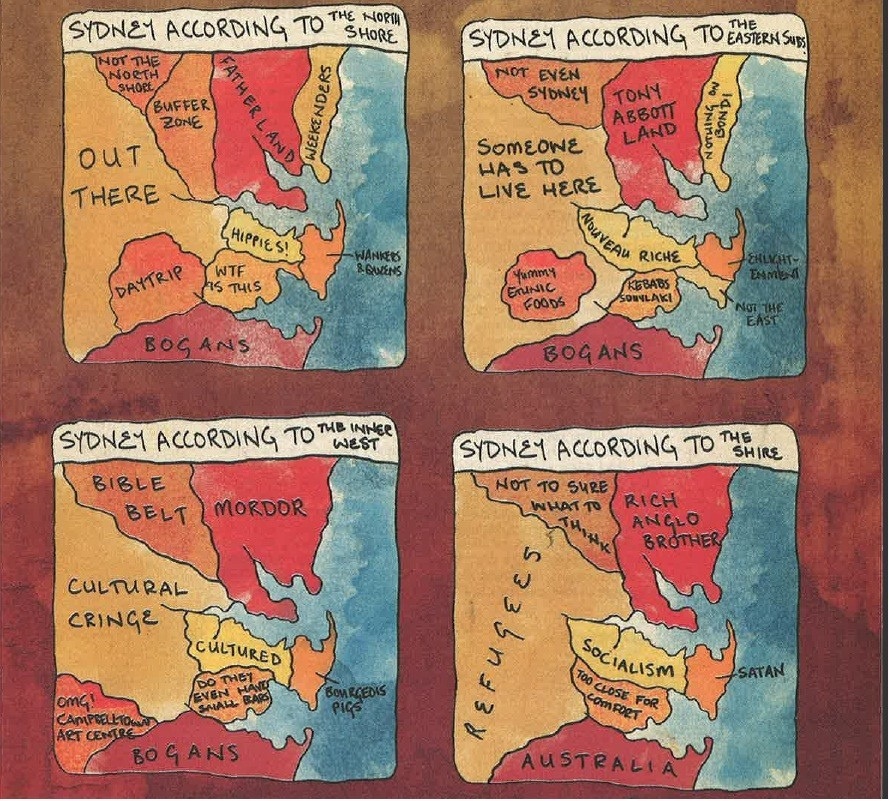
In early 2011, an issue of the University of New South Wales’ student newspaper Tharunka had a cover illustration of maps of Sydney according to four different regions. Like Yanko Tsvetkov’s stereotype maps, their probable inspiration, they manage to be cheerfully offensive about just about everyone, but you’d have to be thin skinned to take serious umbrage.
20120926-163722.jpg

All the same, look at Western Sydney: ‘out there’, ‘someone has to live there’, ‘yummy exotic food’, ‘cultural cringe’, ‘refugees’, ‘day trip’. The anonymous cartographer has caught something, but if you stop and think for a bit you realise that he/she/they has/have surely pulled her/his/their punches, avoiding any references to drugs, sexual violence, Islamophobic stereotypes or the class attitude invoked by the word westies. More interestingly, there is no ‘Sydney according to Western Sydney’ map. Evidently, in the mind of the maps’ creator(s), Western Sydney lacks a view of its own.

Westside Publications exists to create a counter-narrative: to provide a platform for Western Sydney voices and, at least in part, to undermine the stereotypes, less by denying them outright than by seeking to paint a fuller picture. ‘I don’t mind a story that makes us look bad,’ writes Michael Mohammed Ahmad, chief editor of Westside, in his introduction to On Western Sydney, ‘so long as it’s honest and complex.’

Under the auspices of BYDS (Bankstown Youth Development Service), Westside has work for years in schools and the community to develop skilled writers. On Western Sydney is their twelfth anthology featuring established and/or emerging writers and artists connected to the region. Ahmad says the goal has been ‘to source writing from Western Sydney and writing about Western Sydney’. Of course it’s not the only place where writers from Western Sydney get published – in my time at the School Magazine, for instance, some of our regular contributors were from the west, and off the top of my head eminent poets Jennifer Maiden and Peter Minter have strong Western Sydney connections. And a number of the writers in this anthology have been published elsewhere, including in the definitely Inner West This is the Penguin Plays Rough Book of Short Stories. But there’s no doubting the significance of Westside. Last week Mohammed Ahmad received the Australia Council’s Kirk Robson Award which honours ‘outstanding leadership from young people working in community arts and cultural development, particularly in the areas of reconciliation and social justice’.
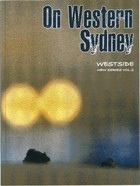
20120921-175932.jpg So On Western Sydney is a phenomenon. It’s also a good read, and not at all the dry sociological collection the title might suggest. It includes short stories, poetry, absurd parables, a photo essay; there’s lyricism, satire, rap, stinging social commentary, domestic observation, fantasy, memoir (I think), travel writing … from as culturally diverse a bunch of writers as you’re likely to find anywhere. Many of the contributors are familiar from Westside’s readings at recent Sydney Writers’ Festivals, and scattered throughout are Bill Reda’s photos of Moving People, this year’s event.

I wouldn’t rush to say that the stereotypes are completely repudiated. Some are reversed with varying degrees of subtlety. Two poems – Andy Ko’s surreal ‘A South Line Travel Guide’ and Fiona Wright’s deliciously ironic ‘Roadtrip’ (which begins ‘And it certainly felt like a Food Safari, such a long way from Kirribilli’) – could be read as direct, mocking responses to Tharunka‘s ‘day trip’ and ‘yummy exotic foods’ stereotypes. Predatory men are scarily realised in Amanda Yeo’s train-story ‘Nine Minutes’ and Frances Panapoulos’ poem ‘”puss puss”‘, though there’s no racial profiling in either. The class attitudes not quite articulated by Tharunka are challenged throughout, as when the protagonist of Peta Murphy’s ‘Roughhousing with Aquatic Birds’ suffers through some kind of arty inner west event (‘She doesn’t speak to me, / it’s as if she can see my Bunnings uniform’). The world evoked in Lachlan Brown’s long poem ‘Poem for a Film’ could well be labelled ‘Someone has to live there’, but there’s art – and heart – in the telling:

______On a blistering afternoon
a council truck is removing tall trees

so that no one will confuse this vista with
a place of moneyed elegance. And maybe

the scream of the chainsaw means you’re
not ignored, as cut limbs crash through

the dry air. And maybe what’s left is
for your own good, and the streetscape

becomes a mouth mashed up during a bar fight,
with its bare stumps grinning cruelly in the heat.

My guess is that the writers are mostly under 35. The problems of negotiating relationships is a dominant theme: under the judgemental gaze of older Arab women in Miran Hosny’s ‘The Weight Divide’; by phone in Michael Mohammed Ahmad’s own brief contribution, the deeply unsettling ‘The First Call’; in the gap between the world of song and the world of experience in Luke Carman’s ‘Becoming Leonard Cohen’ (though it’s pretty impertinent to describe Carman’s weird tangential verse as about anything); in bitter-sweet recollection of a high school crush in Tamar Chnorhokian’s ‘Remembering Leon’.

There’s so much to like. We’re told that this will be Westside’s last print publication. Maybe there’s a sense that its work is done, and the writers it has fostered can now find platforms further afield – in Asia Literary Journal, for example, whose current issue has a number of pieces exploring migrant identity. I hope so.

I received my copy free from BYDS. You can buy one from independent book shops in Sydney or directly from BYDS (email in@byds.org.au with your postal address and they’ll give you details on cost and bank transfer details).

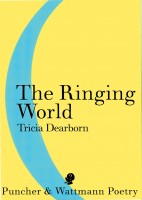
Tricia Dearborn’s Ringing World

Tricia Dearborn, The Ringing World (Puncher & Wattman 2012)

When I blogged about Tricia Dearborn’s first book, Frankenstein’s Bathtub, I said I responded to the poems as if meeting an old friend for the first time. This is her second book, 11 years later, and I find myself weirdly reluctant to blog about it. It’s not that I haven’t enjoyed it. I think it’s because it feels as if commenting on the poems would be like reporting on a late-night conversation among friends – one of those conversations where guards can come down and people talk easily and openly, crying a little and laughing a lot, about a first kiss (‘The changes’), about the moment when you realise your mother is a vulnerable being (‘Mother seen from below’, especially part iii, ‘Shard’) and other childhood memories (I particularly like ‘The smiley spoon’), about the death of a baby niece (‘The quiet house’), about tinnitus (‘The ringing world’), about your creepy empathy for someone who volunteers to be eaten (‘Eat my secrets’), about proofreading (‘Galley slaves’), about those fanciful moments when it feels that the world is sending you a message (‘Memo’) or you’re caught off guard coolly contemplating your own death (‘Gravity’ and ‘The waiting earth’), about dramatic (‘Projectile’) or sweetly romantic (‘Anniversary’) moments in a long-term relationship. It’s not the intimacy of the confessional, the therapy room or the pillow, but it is intimate.  And tactful – never Too Much Information, which is quite an achievement given that one or two poems (especially ‘Come in, lie down’) are pretty explicit about sex, and one (‘You are my perfect’) is a poignant avowal of love.

I read these poems, more than once, while out walking. Reading poetry while walking is something I recommend: often the rhythm of walking and the rhythm of a poem play nicely off each other, and the poems and the world can speak to each other in unexpected ways. In this book ‘Gravity’ made me notice what my feet were up to. Here is its last six lines:

Earth’s substance draws us, yet
stops us plummeting to her core.

But see how we, through the rhythmic
daily greetings of our feet

the transmitted pressure of our bodies at rest
eventually get under her skin.

‘The rhythmic daily greetings of our feet’ – isn’t that fine? It’s an example of another main joy I found in these poems – the way they unapologetically sing within a western scientific, materialist view of the world.

Tricia Dearborn’s work, including a number of the poems from this book, featured in Jim Bennett’s Caught in the Net 79.

Ali Cobby Eckermann

Ali Cobby Eckermann, Kami (Rare Object No 54, Vagabond Press 2010)
——-, Ruby Moonlight: a novel of the impact of colonisation in mid-north South Australia around 1880 (Magabala Books 2012)

Like other Rare Objects chapbooks, Kami is beautifully crafted. A hundred copies were printed, signed by the author, with a small, square, torn-edge print of an Australian desert landscape glued to the cover. I mean no criticism when I say it reminds me of a tasteful bijou hotel, each guest/poem with a room/page to itself. Ali Cobby Eckermann is a Yankunytjatjara woman, and the guests, it turns out, aren’t as genteel as that analogy might suggest. They don’t trash the rooms or anything of that sort, but they raise their voices any way they want. There’s throwaway surrealist satire (‘Pauline Hanson’, about a giant carrot), poignant domestic vignettes that shed light on the stolen generations (‘Comical’ and ‘Sink’), astringent comment on the intersection of sexism and racism (‘Intervention Allies‘), a sweet-sad love song (‘Kami‘ – at the link it’s the first of five ‘Yankunytjatjara Love Poems’), C&W dramatic monologue (‘I Tell Ya True‘ – click to hear Joe Dolce sing his own musical version), and so on. It’s a wonderfully diverse set of poems.

If any one poem out has special resonance for me it’s ‘Wild Flowers‘. It reminds me of Douglas Stewart’s ‘Glencoe‘, one of the few poems I remember from school days. I’ve thought a lot about ‘Glencoe’ over the years: it’s fascinating that an Australian nationalistic poet wrote this lament for the victims of a massacre that took place centuries ago on the other side of the planet (‘Terrible things were done / long, long ago’), as if that’s as close as he could get to acknowledging the terrible reality of our own colonising history, but was impelled to make at least that much. Cobby Eckermann’s poem includes similar imagery of children’s bones, but she can name the event as very much of this place and not safely consigned to the past. An additional, idiosyncratic resonance – you’ll have to take my word for his – comes from the way the poem’s opening lines almost be describing a moment from our short movie, Scar:

Mallets pound fence posts
in tune with the rifles
to mask massacre sites

There’s a massacre in Ruby Moonlight too, though most of the book is about what happens next for the sole survivor. The book is a lot slimmer than you’d expect of a novel, just 80 pages all up, and you’ll look in vain for the lecture that subtitle (see above) might suggest. This is spare, restrained story-telling. If it wasn’t for the power generated by the flash of imagery, it would feel like notes for a novel rather than the thing itself. It’s a story of ill-starred love. A young Aboriginal woman survives the murder of her community and after wandering for some time with just nature and an ancestor spirit for company, she finds companionship and intimacy with an isolated Irish fur trapper. Their idyll, forbidden by both their cultures, can’t last. You might think you know this story before you open the book. You don’t.

In an interview with Michael Brennan on the Poetry International Website, Ali Cobby Eckermann has some very interesting things to say about her work, including this:

I want to use my poetry to educate Australians, to overcome their innate fear of Aboriginal people. Most Australians have never met an Aboriginal person outside school, sport or work. I want to highlight the benefits that Aboriginal people can provide through friendship and equality, and highlight the dangers of racism and judgmentalism. I have been happy with the heartfelt responses from festival audiences, and the new friendships shown to me and my family.

MB: Do you see your work in terms of literary traditions and/or broader cultural or political movements?

Ali Cobby Eckermann: I think it is impossible to be an Aboriginal writer, and be free from a political view. I always use cultural ethics in my writings. Some of my poetry has a unique style, due to my life between my adopted German Lutheran family and my traditional Yankunytjatjara family, who have also adopted the Lutheran religion. I hope my sense of truth becomes my literary tradition!

Doctor Who and Lindalee

Decades ago someone did a study of three different audience’s responses to an episode of Doctor Who. From memory, the focus groups were made up respectively of four-year olds, 13 year olds and PhD students respectively. All three groups loved the show. The first saw it as very funny because the Doctor was tricky. The second enjoyed the action–suspense. The third just loved the references to Buddhist cosmology.

Here’s a very young person recapping the first episode of the new season – be warned it’s full of spoilers, but be prepared to be delighted by a completely coherent reading. (Thanks to Stubby the Rocket at tor.com)