NSW Premier’s Literary Awards 2012

The shortlists for the NSW Premier’s Literary and History Awards were announced today, and the awards dinner will be on 30 November. I’ve been a fan of these awards for years, but this year it’s personal. My fabulous niece, Edwina Shaw, is in incredibly distinguished company on the UTS Glenda Adams Award for New Writing, for her novel Thrill Seekers. Much snoopy dancing and weeping for joy has ensued.

I couldn’t find the lists on the site of the State Library, which is administering the awards this year. The Sydney Morning Herald has them, here.

Apart from Edwina’s book, I’ve read two of the novels (blog posts here and here) and one of the non-fiction works (here), all with my book group. I’ve read one of the multicultural titles (here), and none of the poetry books, the children’s books or the ‘young people’s literature’. I’ve seen two of the three scripts (episodes of Rake and East West 101) and have no desire to see the third (Snowtown).

The Premier’s History Awards usually happen at a different time of year, but because of a general overhaul (not, Barry be thanked, a cancellation as in Queensland), the two lots of awards are happening at the same time for just this year. I haven’t read anything on the History Awards shortlists, though I do have one book beside the bed.

Added on 6 November: The shortlists are now up on the State Library web site, here and here. There are instructions there for how to vote in the People’s Choice Award.

Sonnet #2: The dogs outside Orange Grove Markets

There are so many more important things to be thinking about, from Woolworths’ continuing to make money out of problem gamblers to an Onion article about Sandy that rings too true for comfort, with the NSW government’s plans to destroy the employment prospects of thousands of aspiring artists somewhere in between. But the muse has handed me half a dozen dogs tied to a fence:

Sonnet 2: The Dogs outside Orange Grove Markets
The dogs line up at Orange Grove.
A Whippet whimpers, Shih Tzus yip
and won’t take comfort, Collies move
their twitchy eyebrows, Labs – so hip –
refuse to look abandoned, while
undaunted Staffies wag and smile.
It’s farmers’ market day. They’re tied
here while their owners go inside
for reasons past dogs’ understanding.
There is affection between species.
We house them, feed them, bag their faeces.
But now, resigned, sad or demanding,
dogs wait until, they know not when,
the rapture when we come again.

Sonnet month is here again

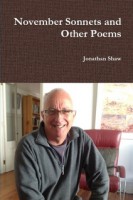
It’s November! My self-imposed month of blogging in verse has arrived. To see previous years’ mixed bag of efforts, click here, or you can buy the vanity publication of all 28 sonnets, plus my versification of Alan Jones’s epic ‘apology’ press conference, ‘The Apology, or Manning Up’, by clicking on this image:

Nsop

I may not stick to sonnets this year, but for tradition’s sake, I’m still calling it Local Sonnet Rhyming Month – LoSoRhyMo (as distinct from the much more demanding NaNoWriMo.)

Because it’s the start November, it’s also the last days of Sculpture by the Sea at Bondi. First some snaps:

Sonnet 1: Sculpture by the Sea again
We hear of artists living hand
to mouth, yet paying vast commissions
if they exhibit on the sand
or rocks near Bondi. Yet their visions –
moulded, cast, carved, planted, hung –
transcend commerce. They give tongue
to joys and sorrow, shape to fear
and hope and meaning year by year.
Cord and bamboo help us grieve.
Plastic cutlery cries, ‘Think!’
Glass, stone and steel forms bid us drink
their beauty, help us to perceive
what lies around us, and within.
To rip them off must be a sin.

The handful of sculptures specifically alluded to are:

  • Cave Urban (NSW), Mengenang (Memory), an installation of 222 Balinese-style bird scarers, whose sound hung over the park midway along the exhibition walk
  • Roh Singh (Victoria), Spatial Memorial, a white cord strung at the height of the 11 March tsunami
  • Jane Gillings, Midden (photo above)
  • Too many pieces of stone, steel and glass to mention.

One last note: my companion pointed out to me that where it was indicated in the catalogue that an artist was trained at TAFE, the skill level was manifestly superior. Despite whatever the government’s advisers have been saying, there is a need for the skills taught in fine arts at TAFE.

The Art Student rallies the troops

Here’s the Art Student speaking to a meeting at NSW Teachers Federation Conference Centre last week about the imminent cutting of all funding to fine art education in TAFE.

Ain’t she something?

Archie Roach’s Song to Sing, with added Jack Charles

.@LukeLPearson linked to this on Twitter. In the last couple of years Archie Roach has had a stroke and surgery for lung cancer. But cop this:

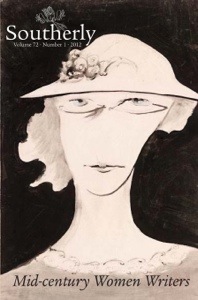
Southerly 72/1

Elizabeth McMahon and David Brooks (editors), Southerly Vol 72 No 1 2012: Mid-century Women Writers

20121018-203833.jpg

Spring is here – ‘a box where sweets compacted lie’ as George Herbert called it, in a phrase that could apply just as well to this issue of Southerly. (Or to put it prosaically, this post is an annotated list.)

There’s a new Jennifer Maiden poem, ‘George Jeffreys 13: George Jeffreys woke up in Beijing’. This series of poems has had to find a new focus now that George W Bush is no longer reliably on the television obsessing about Iraq as he was for the first poems. George and his kind of girlfriend Clare seem to be travelling the world, waking up in one troubled locale after another, having adventures involving guns, fires and pirate ships as well as discussing politics, morality, philosophy etc. It’s not a verse novel, or even a discontinuous narrative really, but it is never uninteresting. In this poem George and Clare meet with a recently released Chinese dissident in the Forbidden City where they are joined by Confucius and the Duke of Zhou.

There’s Fiona Morrison’s excellent essay, ‘Leaving the Party: Dorothy Hewett, literary politics and the long 1960s’. Like many Communists, Hewett stayed in the Party after the 1956 invasion of Hungary despite serious misgivings, then left when the tanks rolled into Czechoslovakia in 1968. In effect this essay traces the movement of her mind between those two events as revealed in her writing. Strikingly though, it doesn’t refer to either Hungary or Czechoslovakia, restricting itself to literary matters. Some of the essay’s specialist scholarly language took my fancy, and revived my love of double dactyls:

Higamun hogamun,
Fíona Morrison,
writing in Southerly,
gathers no moss:
says that our Dorothy
ex-Marxist-Leninist
wrote a sustained tropo-
logics of loss.

There’s Karen Lamb’s ‘“Yrs Patrick”: Thea Astley’s brush with timely advice on “the rackety career of novel writing”’, an inside look at the relationship between Astley and other writers, with a focus on a particularly unsparing letter from Patrick White. I once heard Astley quote a dollop of writerly advice she had received from White: ‘If you’re going to write about a shit, Thea, you have to make him a really big shit.’ This article is fascinating but doesn’t include anything quite that colourful. Karen Lamb is writing a biography of Astley. Reading her account of Astley’s approach to friendship, I wondered if biographers don’t run the risk of coming to dislike their subjects through knowing too much:

Karen Lamb
surely doesn't mean to slam
Thea Astley
but she makes her seem ghastly.

I’ll refrain from doggerel for the rest of this post.

There’s the other piece I turned to the day the journal arrived in the mail, David Musgrave’s review of Geoffrey Lehmann and Robert Gray’s Australian Poetry Since 1788. In a measured and judicious manner, Musgrave joins the line of anthologists, poets and publishers who give this anthology the thumbs down. (Incidentally, I note that neither David Brooks, Southerly‘s co-editor, nor Kate Lilley, its poetry editor, got a guernsey in the anthology, but that didn’t stop them from including an elegant narrative poem by Gray elsewhere in this issue.)

Of the theme essays on mid-century women writers, other than the two I’ve already mentioned, Helen O’Reilly’s ‘“Dazzling” Dark – Lantana Lane (1959)’ and Susan Sheridan’s ‘“Cranford at Moreton Bay”: Jessica Anderson’s The Commandant‘ persuaded me to add the books they discuss to my To Be Read pile. I skimmed the essays on Christina Stead, Eve Langley and Elizabeth Harrower, and a second one on Jessica Anderson, which are intended for specialist readers. I mean no irony when I say I was grateful to read this near the start of an essay: ‘In her well-known formulation of performativity, Judith Butler argues that repetition of a discourse actually produces the phenomena that it seeks to control.’ Such sentences serve as warnings: what follows is intended not just for readers who can understand the warning sentence, but readers to whom its contents are familiar.

Off theme, there’s Ed Scheer’s ‘“Non-places for non-people”: Social sculpture in Minto’, an account of a performance art event, Big Pinko, in which two artists painted a house pink. It sounds like an interesting project, but I found article a little disturbing in the way it talked about the people of Minto. Perhaps the Judith Butler formulation is relevant: the phrase ‘non-places for non-people’ is meant to encapsulate a criticism of the dysfunctional environment in this outer western suburb, but as it is repeated in this essay it comes to read like a dismissal of the people who live there. The essay has a lot in it that’s beautiful and evocative, but in this respect it makes me appreciate all over again Michael Mohammed Ahmad at Westside’s labours to foster writers in Western Sydney.

This issue has abundant rich poetry. I love B. R. Dionysius’ ‘Ghouls’, a set of five sonnets about the Brisbane floods.

The white festiva shunted like a tinny, half-tonne maggot into
O'Hanlon Street's winter bulb cul-de-sac. The Bremer's brown
Muzzle investigated the bottom stairs of a corner house, sniffing
For the scent of past flood levels left by more malicious beasts.

Of the other poems, I particular liked ‘Rose Bay Airport, 1944’ and ‘Standing Soldiers’ by Margaret Bradstock (both after Russell Drysdale wartime paintings), ‘Holiday snap’ by Andrew Taylor, ‘Hardware 1953’ by Geoff Page, and ‘The Roadside Bramble’ by Peter Minter.

Of the fifty pages of reviews, John Kinsella on David Brooks’s The Sons of Clovis: Ern Malley, Adoré Floupette and a secret history of Australian poetry and Pam Brown on Kate Lilley’s Ladylike stood out for me, Kinsella for fascinating rumination on the nature of literary hoaxes, and Brown for her usual generous intelligence.

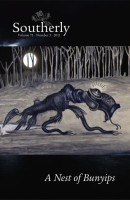
Southerly 71/3

David Brooks and Elizabeth McMahon (editors), Southerly Vol 71 No 3 2011: A Nest of Bunyips

In 2001 the National Library of Australia published Bunyips: Australia’s Folklore of Fear by Robert Holden and Nicholas Holden. Robert said in his introduction that writing and editing the book had taken him ‘down many byways of history, literature, folklore, superstition and cultural studies’, and that he had gleaned insights from palaeontology, evolutionary thinking and anthropology.

The title of this issue of Southerly might lead you to expect something along the same lines. You would be misled. It does include a scattering of atmospheric drawings dating from between 1890 and 1912, citing the Holdens’ book as the immediate source, but they are the only bunyips on offer. As David Brooks says in his editorial, the issue is filled with things from the backlog ‘of pieces too good to reject but refusing any easy categorisation, and the bunyip motif derives from Michael Sharkey’s long poem, ‘Where the Bunyip Builds it Nest’, chosen more or less at random from the pile. (The poem isn’t actually about bunyips, but it is a bit of a monster: a long poem in five parts made up of lines taken from other poems from settlement until now in roughly chronological order, all carefully annotated.)

On reflection, Brooks says, bunyips – nocturnal, haunters of waterholes, ‘strange hybrids whose shrill quarrellings can sometimes be heard late into the night’ – sound like some poets. So the motif gained legitimacy: the issue contains work by 28 poets, essays on and by a half dozen more, and reviews of seven books of poetry. And the online supplement, the Long Paddock, has almost as much again, plus a substantial interview with Laurie Duggan.

The riches on offer include:

  • Jennifer Maiden’s ‘The Pearl Roundabout’, in which the re-awakened Elanor Roosevelt continues the conversations with Hillary Clinton begun in the book Pirate Rain
  • Margaret Bradstock’s pre-elegiac ‘Ask not’
  • Julie Maclean’s ‘cassowary’, a North Queensland poem that compresses an awful lot into a small space, about colonisation, tourism, art, and of course the gorgeous, dangerous cassowary
  • Peter Kirkpatrick’s delightfully old-fashioned, even archaic ‘The Angels in the House’, a meditation on inner city housing in heroic couplets
  • two poems by Craig Powell: a sonnet named from a line from Seamus Heaney, “and catch the heart off guard”, and a reinterpretation of an anecdote from Freud, ‘Fort Da’ (Craig Powell also reviews Toby Davidson’s edition of Collected Poems by Francis Webb, seizing the occasion to share some poignant memories of Webb).

Southerly is a refereed scholarly journal, and I tend to skip the scholarly articles, or at least the ones about writers I am unlikely to read, and those with Deleuze, Kristeva etc in the title. I did read Kevin Hart’s ‘Susannah Without the Cherub’, a fascinating discussion of A D Hope’s ‘The Double Looking Glass’. It may be, as Martin Johnston said, that A D Hope sent away for a Great Poet Kit, and then successfully used it to become a great poet. This essay bears out the second part of Martin’s quip.

It’s not all poetry. There are four short stories, all of which I enjoyed – Matthia Dempsey’s ‘One Week Gone’, about an old man a week after his wife’s death, is superb.

No bunyips, not really, but that’s not a terrible loss, given what’s there instead.

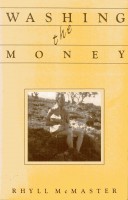
Rhyll McMaster goes late night shopping (with washed money?)

Rhyll McMaster, Late Night Shopping (Brandl & Schlesinger 2012)
—, Washing the Money (Angus & Robertson 1986)

At Sappho’s recently, Kate Lilley said she had always enjoyed the work of the poet whose book she was launching but had never previously had to speak to that enjoyment, a very different and challenging  thing. I sympathise. I enjoyed Late Night Shopping – a lot – but don’t know that I’m up to giving an account of my enjoyment. As often happens to me when I contemplate writing about poetry – any poetry from ‘My Love Is Like a Red Red Rose’ to, I dunno, Christopher Brennan’s translations of Mallarmé – I feel a bit lost for words.  If you want a proper review of Late Night Shopping, I recommend Lyndon Walker in the Rochford Street Review. But here’s my two bobs’ worth.

‘The Shell’, the first poem in the book, confronts us with the fresh corpse of a woman who has died in hospital:

After that rasping sound when the woman died
she was bleached pale on the surface like a sponge.

The poem foreshadows the main subject of the collection: not so much death as the relationship between physical reality and the reality of the mind; ‘The mind [is] embodied and embrained’; ‘A sheep’s skull is a sculpted housing / fine and hard for a sheep’s brain, / built to retain its idea of itself’; or this, from ‘The Image of the Box’:

All philosophy's a game,
It's a clever fox
That stops us thinking

of the universe
as void condensed,
a roaring silent trinket

of energy rampant

It’s not nihilism or morbidity, but a kind of cool, radical wondering. On the one hand there’s the physical universe, including us, and on the other there’s what we make of it all. Rejecting illusion, perhaps, but still enchanted. The lines from ‘Nomenclature’, ‘Call the unknowable / what you will / from your dug-in position / on the side of a hill,’ could be read as advocating intellectual despair, but that hill, coming at the end of a poem full of abstractions, feels to me like a promise.

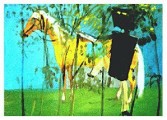
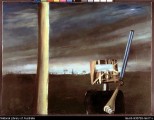
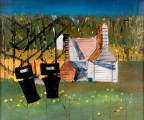
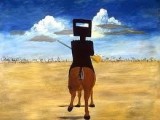
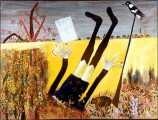
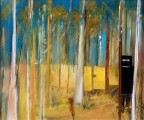
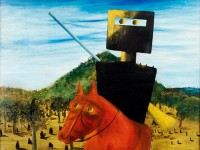
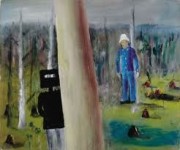
A number of poems are responses to images – a photograph, nine paintings by Sidney Nolan, five drawings by Terry Milligan. It seems to me that the surreal Nolan sequence, ‘Evolutionary History of Edward Kelly in Primary Colours’ needs to be read beside the paintings it refers to. As a public service, then, here are the Nolan paintings that I could identify from the notes on the poems, with the name of the poems that refer to each of them (I’ve struggled with the formatting here. I hope it looks the same in your browser as it does in mine):

)


The day I finished reading Late Night Shopping for the first time, I found a copy of Rhyll McMaster’s Washing the Money, published 26 years earlier, in a secondhand bookshelf (the aforementioned Sappho’s, as it happens). Self-described as ‘Poems with Photographs’, this is full of verbal snapshots of the poet’s early life and her life as a young mother. These poems give us the remembered world of a 1950s childhood in precise detail – a ‘narrow crack at finger-running height’ in a brick wall, a newspaper delivered ‘with a stuffed thud’, ‘grandma’s hair like silkworm thread’. There are actual photos, and some of the poems are responses to them; other poems refer to photos not included.

This book spoke to me in a very personal way: Rhyll McMaster and I were both born in Queensland in 1947, so when she uses words like ‘port’ and ‘togs’ I’m there. The family car, the beach excursions, the mosquito nets are all home territory for me. My father didn’t wash and iron the family’s money at weekends, but the description of the notes strikes a chord. (Incidentally, the poem ‘Washing the Money’, which documents a weird family ritual to comic effect, becomes a rich and deep reflection on family connections when read, as it was by me, with the recent book’s elegiac ‘His Ordered World’ fresh in the mind.)

My biggest pleasure from this book, though, was a piece of uncanny serendipity. Among the photographs is a 1939 studio portrait of the poet’s mother, Jean Isobel. Here it is, and next to it is a studio portrait of my own mother, Esme Isabel, taken a few years earlier. It’s not the first time I’ve felt that a writer knew something very private about me, but I don’t know that any other book has ever come this close:

The Apology, conclusion

At last we reach the end: it was a 43 minute press conference (click here for video) and a 23 stanza, 184 line poem (click for part 1, part 2, part 3, part 4).

He ends with some denials. ‘I’ve never ever
called a person bitch. It’s not my lingo
(I just read out letters). And I’ve never
likewise called her liar. It’s a thing, though,
the way she promises no tax forever,
she says East Timor, then Malaysia. Ringo
changed his tune less often. Fuel watch!
Liar’s an awful word, but she’s a botch.

‘I didn’t say that women are destroying
the joint – I know it’s on the tape like that,
but I meant just some women. It’s annoying:
I defend them, fund them, I go in to bat
for women ‘cos they don’t waste time enjoying
red wine and cigars at lunch. My hat
is tipped to tough ones who excel in arts.
I don’t despise their gender, just some parts.

‘I’m here to face the music, clear the air
in person, not on paper. Them that flogs
their products on my show will see I’m fair.
I thank you all for coming. Go the Dogs!’

Go, not so little poem, to Lord knows where,
but first to readers’ eyes by way of blogs.
It’s Jones who speaks in almost every line:
The words that do not please are surely mine.

Finis!

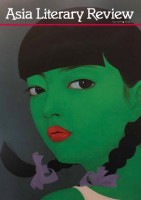
Asia Literary Review 24

Martin Alexander (editor) Asia Literary Review 24, [Northern] Summer 2012

[Added in 2021: Most of the links in the blog post are broken, but the title above and the image to the left will get you there. The whole issue is available online to subscribers.]

I subscribed to the Asia Literary Review in 2009 for worthy motives: they had published a short story by my niece Edwina Shaw, and I wanted to support a publication that had faith in her; it also seemed a relatively painless way to ensure some cultural diversity in my reading. I’ve kept on renewing my subscription because every issue has something to delight – from a photo essay on Karen exiles living on the Thai–Burmese border to a splendidly simple pasta sauce recipe. The current issue doesn’t disappoint.

Martin Alexander’s editorial announces that this journal is organised around the theme of identity. The contributors, he writes,

reflect, and reflect upon, the multiplicity and complexity of their identities. Each piece was composed in isolation, but when brought and bound together their explorations of identity complement one another in unanticipated and intriguing ways.

I would add: in laugh out loud ways, and weird ways, and ways that make you want to weep. Many of the pieces are about dislocation – through migration, exile or invasion. Many are about the experience of being mixed-heritage. There’s a fascinating, kaleidoscopic effect as voices from China, Tibet, Sri Lanka, Japan, India, Thailand, South Korea, Afghanistan, Kazakhstan, Malaysia, the UK, the USA and Australia, Uyghur, Hawai’ian and Burmese voices, echo one another’s motifs, answer one another’s questions and question one another’s answers.

My precious blogging time is being taken up with doggerel endeavours these days, so I’ll limit myself to mentioning, pretty much at random, just a few highlights.

Kavita Bhanot’s ‘Too Asian, Not Asian Enough‘ asks if it isn’t a new form of Orientalism for so-called British Asians to simplify their identities and perform them rather than striving to understand and reveal their own complexities. The journal’s imprint page reveals that Madhvi Ramani’s short story ‘Windows‘ is taken from an anthology edited by Kavita Bhanot with the same name as her article. Ramani’s story illustrates beautifully the kind of thing Bhanot is advocating: it starts out with Mrs Sharma, close to the stereotype of the elderly, widowed Indian living in Britain, locked out of her home, and ends in a completely unexpected place.

In Win Lyovarin’s Rainbow Days, the Bangkok Reds and Yellows demonstrations are seen, to wonderful satirical effect, from the point of view of a barely legal Burmese street merchant. This is one of a number of pieces translated into English, in this case from Thai by Marcel Barang. Kim Jae Young’s ‘Elephant‘, translated from Korean by Moon-ok Lee and Nicholas Yohan Duvernay, is another: an impoverished and desperate little community of immigrants is seen through the eyes of a young boy, son of a Nepalese man and a Korean mother who has abandoned them.

There’s an interview with Donald Keene, pre-eminent expert on Japanese literature, who in his late 80s, not long after the tsunami, earthquake and nuclear accident last year, decided to leave the United States and become a Japanese citizen.

I’ve always thought that Chinese criticism of the Party and bureaucracy was inevitably an earnest affair. Jimmy Qi’s ‘Yu Li: Confessions of an Elevator Operator‘ (translated by Harvey Thomlinson, whose Hong Kong based Make-Do Press has a novel by Jimmy Qi in the pipeline) demonstrates definitively that this just isn’t so. At one level this story is a completely serious satire, but at another it’s an immensely enjoyable piece of silliness.

I plan to keep my subscription up.