Sonnet #11: For Naomi Grace

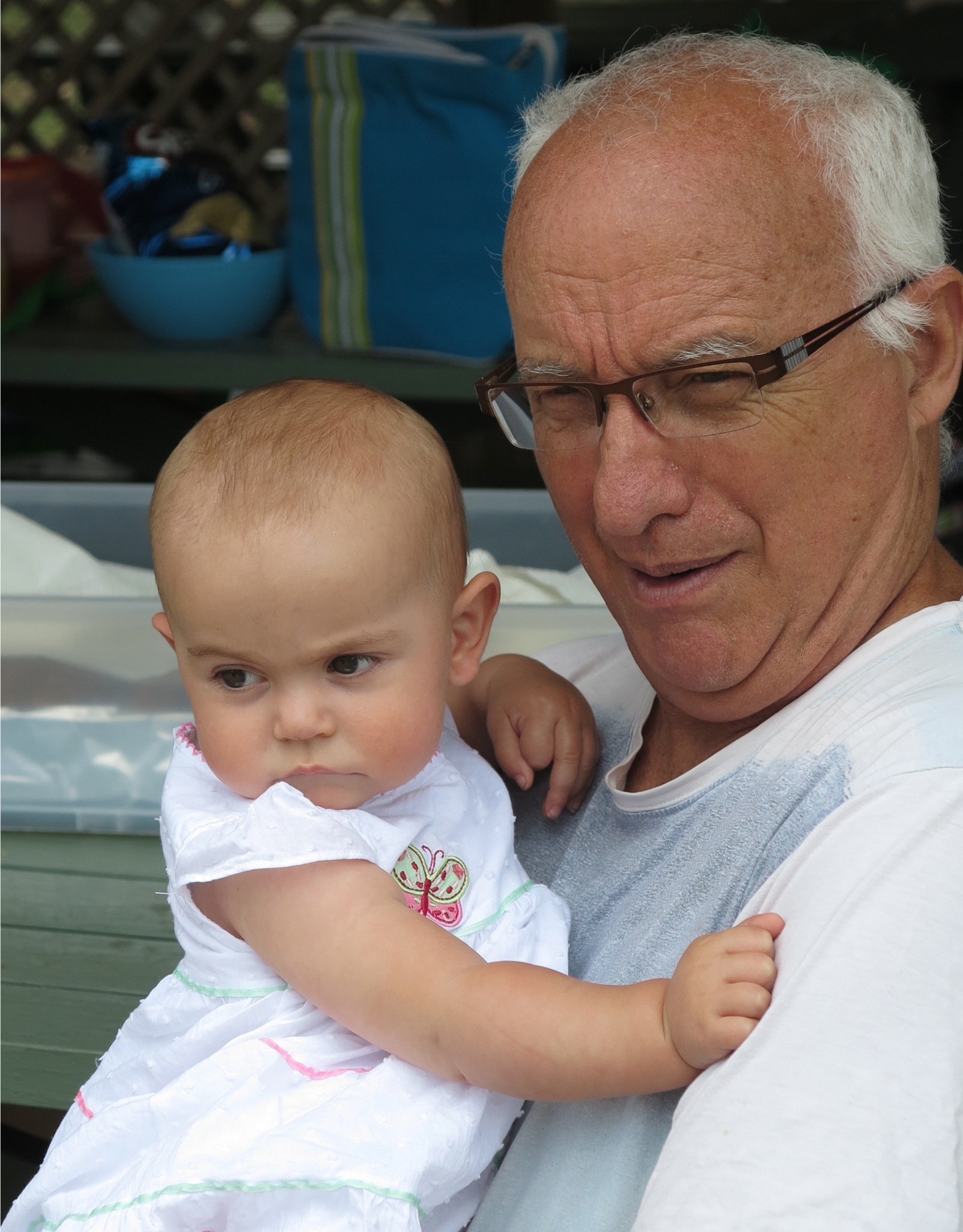
The Art Student and I have spent a long weekend away from activism and the desk respectively to help celebrate the first birthday of my great-niece Naomi. I didn’t manage a sonnet for the occasion, and that was just as well, as Naomi’s parents had devised a sweetly solemn naming and welcoming ceremony that was a complete thing in itself without any great-avuncular versifying. But November’s quota must be filled, so here’s one after the event:

Sonnet 11: For Naomi Grace
Naomi Grace has just turned one,
a girl who lives up to her name:
delightful, graceful – just as sun-
flowers the sun or moths the flame,
all faces follow where she goes
and stop when she’s in yoga pose.
Today at Cram’s Farm was her naming
ceremony: father Damon,
read aloud with mother Paula,
called on us to be her people
(rellies, friends, no church, no steeple),
and whatever might befall her
love her, back her each endeavour,
weep as needed, dance forever.

Which of these two looks more intelligent, would you say?

Sonnet #10: From the Sydney Morning Herald

Today’s post is all about keeping up my sonnet quota. I don’t think this can really claim to be a sonnet. It’s probably not even verse, but here it is anyhow:

Sonnet 10: From today’s Sydney Morning Herald
Gillard walks in Howard’s footprints.
Palmer has a life-sized T-rex.
Smith rants, ignores the judge’s hints.
Karzai doesn’t care what he wrecks.
Benedict says, ‘Keep the ox.’
Elmo’s voice no longer rocks.
Refugees are sent to limbo
like crimes’ victims. Arms akimbo,
Libs urge nuclear rethink.
Punchbowl boys grow mos for cancer.
Nauru camp is not the answer.
Congo teeters on the brink.
Page fourteen, Israel–Gaza war:
five to one-three-nine the score.

Ross Gibson’s 26 Views and my 14 lines (Sonnet #9)

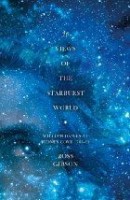
Ross Gibson, 26 Views of the Starburst World (UWAP 2012)
My formal education left me with a lingering sense that Australian history was boring: a drab procession of convicts, explorers, squatters, gold miners, politicians arguing about free trade and train gauges, soldiers, shearers, horsemen – and somewhere on the sidelines an undifferentiated, disappearing mass labelled ‘Aborigines’.

I began to see things differently in the theatre in the early 70s, with the irreverence and vigour of plays like The Legend of King O’Malley (Ellis and Boddy 1970), The Duke of Edinburgh Assassinated (Ellis and Hall 1972) and Flash Jim Vaux (Blair, Clark and Colman 1972), and exhumed splendours like Edward Geoghegan’s The Currency Lass (from the 1840s, published by Currency Press in 1976) and Katharine Susannah Prichard’s Brumby Innes (written 1927, first professional production at the Pram Factory in 1972). Skipping forward a couple of decades, Inga Clendinnen’s brilliant Dancing with Strangers (the link is to Will Owen’s review), by taking a probing scalpel to journal accounts of the first years of the settlement at Port Jackson, made me realise what an extraordinary moment that was, whose meaning is still a long way from being fully understood.

Ross Gibson’s 26 Views of the Starburst World is even more of a revelation, and has an even tighter focus than Dancing with Strangers. It looks at two notebooks, ninety pages in all, in which William Dawes recorded his notes on the ‘language of N. S. Wales, in the neighbourhood of Sydney (Native and English)’ in the late 18th century.

William Dawes was a marine lieutenant and astronomer who lived in Sydney from 1788 to 1791, years in which the world of the Eora changed catastrophically and in which that of the British invader–settlers likewise was transformed. These two notebooks were rediscovered in London in 1972. In compiling them, Dawes drew on his relationships with a small group of Eora, including most memorably a young woman named Patyegarang, who visited him at his tiny observatory on the edge of the settlement. They record snippets of conversation, and give sometimes enigmatic glimpses of tiny interactions.

Gibson describes the notebooks as ‘fragmented, unfinished, heuristic’, with ‘a prismatic quality’. And his book might be described in similar terms: it quotes, questions, analyses, peers closely at faint marks, speculates, extrapolates. It comes at the notebooks from, well, at least 26 angles: there’s biography, linguistics , psychology, anthropology, the history of colonisation, the history of science (1788 was a time of a high romantic approach to scientific enquiry in England), communication theory, the politics of Rugby League in 21st century Sydney. Apart from Dawes’ contemporaries Watkin Tench, David Collins and Arthur Phillip, it quotes Wordsworth, Emerson, Walden, Mallarmé, James Agee, Kenneth Slessor, the 2oth century haiku master Seichi, Robert Gray, Barry Hill – all of them pertinently … And sometimes it lets the notebooks speak for themselves. Gibson describes his approach as ’roundabout, relational, a tad restless and unruly’, and in a slightly less alliterative moment as ‘a little like history, a little like poetry, a little maddeningly like a séance’.

Possibly my favourite moment in the book is the facsimile of page 37 of Notebook A, on which there are just four words:

Yánga
________Present
––––________I
___________thou

Gibson gives us a caption – and bear in mind that everywhere else he refrains from speculation about any sexual dimension to the relationship between Dawes and Patyegarang:

‘Yanga’ – a verb that Dawes records but does not translate. Other colonial word lists, not compiled by Dawes, suggest ‘yanga’ means ‘to copulate’.

The School of Oriental and African Studies (London) has put the complete notebooks are online, with transcriptions of their contents, at http://www.williamdawes.org/.

But I’m falling behind on my quota of November sonnets, so here goes:

Sonnet 9: William Dawes and Patyegarang
He lived apart to study stars
and drew dark students to his table –
students and ambassadors
who drank his tea so he was able
to write their words down, turn their breath
to marks on paper. War and death
were soon to dominate this story
but then there was a kind of glory:
‘Paouwagadyımíŋa,’
she said, ‘You shade me from the sun.’
She said, ‘We’re angry, fear the gun –
Gulara, tyérun gu̇nın.’
The future loomed with genocide:
these marks show some opposed that tide.

What do you want to do when you grow up? Create?

On the front page of today’s Sydney Morning Herald, there’s an article by Rachel Browne on a survey of 6200 children aged between 10 and 12 in 47 countries asking them what they want to do when they grow up. Cathy Wilcox’s cartoon gives the gist of the article – two white children are chatting: ‘Lots of kids in developing countries want to be doctors’ says one, and the other replies, ‘They don’t have the luxury of squandering their education on a sporting career!’

You have to read to the seventh paragraph to discover that, while ‘professional athlete is the highest ranked career choice for Australian children’, the second rank is ‘entertainer and professional artist or creative professional’. The latter is immediately dismissed by someone associated with the study as ‘probably influenced by popular TV shows’. Lisa Power’s article in the Telegraph, presumably based on the same press release, includes a table that seems to indicate that Rachel Browne got it wrong:

If you combine ‘Entertainer’ with ‘Artist/creative professional’ you get 26%. What’s that? More Australian children want a career in entertainment and the arts than in sport. But that doesn’t fit the media narrative, so let’s bury it.

Has it occurred to anyone else that our governments are willing to back young people’s sporting aspirations with millions of dollars, but leave their artistic aspirations unresourced so that for most of them it remains an unrealistic dream? It’s not just that winning gold at the Olympics is seen by the press and politicians as more important and newsworthy than making things ‘with which the soul of any witnessing human being can resonate and conceivably find comfort, catharsis, awakening, provocation, solidarity, beauty and, perhaps, enlightenment,’ as Clare Strahan put it recently on the Overland blog. Young people’s desires to do the latter must also be trivialised and marginalised. The current precipitate withdrawal of funding from fine arts education in TAFE is symptomatic. So is the Sydney Morning Herald‘s almost total silence about the cuts.

And now a quick sonnet:

Sonnet 8: To children who responded to a survey
We ask you what you want to do
and what you fear. It’s no surprise
if drought, rape, kidnap threaten you
you don’t desire a glittering prize
but want to build the general good,
to teach or heal. And in a land
where gold and silver most command
acclaim, of course it’s understood
your heart goes bling! Celebrity
can look like meaning when you’re ten.
The headlines mock you: Sport! again!
Oh child! child! We’ve corrupted thee!
They don’t hear that your brave young heart,
wants to make, give, create art.

Sonnet #7: Rally at the Gallery

On Friday evening the Francis Bacon exhibition officially opened at the Art Gallery of New South Wales. Premier Barry O’Farrell was to preside, on whose watch a number of gallery staff have been summarily sacked and fine arts courses in the TAFE (Technical and Further Education) system almost as summarily deprived of government funding, with devastating effect on the equitable provision of studio-based arts education in the state. A demonstration was called for, and happened. Maybe two hundred of us gathered outside the gallery with banners and art works, chanting and singing and staging a mock funeral, and handing leaflets to the invited guests. One bejewelled matron, when approached by the Art Student with a leaflet, told her imperiously to get a job.

In what looked like a display of political pusillanimity, the Premier didn’t risk having to face some of the people whose lives he has disrupted. George Souris, Minister for Arts and, among other things, Horse-Racing, did the honours instead. Invited guests were asked to turn their backs during his speech in solidarity with the sacked staff and stranded students. Evidently some did, and there was little if any applause. Outside, as he spoke, we chanted, ‘Save TAFE art’. Guests continued to arrive and I noticed that the man on the door was very quick to open the door for them and slow to close it after them, thereby ensuring, perhaps deliberately, that the door was open for as much of the speech as possible, allowing our uncouth ruckus to be heard inside.

This probably deserves more than a sonnet, but a sonnet is all I’ve got:

Sonnet 7: Rally at the Gallery
Swallows, bats and other pests
perform outside the gallery.
Some fly, some squeak, some accost guests
to talk about O’Farrell. He
was due to launch the Francis Bacon.
‘Barry, Barry, we’re not fakin’…’
‘We want to keep art education
for the future generation.’
”Oh, get a job.’ ‘Art is work.’
Don’t celebrate dead money-spinners,
snatching all funds from beginners.
No art, no soul. We’d go berserk!
Inside, poor Francis’ heads explode.
Bats claim the night on Gallery Road.

Edgar Alvarez, student, holds up his homage to Francis Bacon cum reproach to the O’Farrell government. The other feet belong to his brother.

Sonnet #6: Done in ten minutes

I’m supposed to get a sonnet up every second day in November. So here’s teh 6th one as a matter of urgency:

Sonnet 6:
A sonnet’s due, but there’s no time
to think about it. Here it is.
I’ll do my best to give it rhyme
but as for reason, let it fizz.
There’s so much else to do this week,
my versifying’s up the creek
and so this one gets just ten mins
from go to whoa, wastepaper bins
are free of first drafts. Go, wee verse,
fulfil my pressing sonnet quota.
Don’t linger, loiter, trail your coat or
ask to be revised, or worse.
I see the last line coming there,
and now it’s done, ten secs to spare.

And it’s back to work for me!

Sonnet #5: St John the Evangelist in Missenden Road

When I was an undergraduate at Sydney University, even though I was a practising Catholic, I thought of the students who lived at St John’s College as almost another species: somehow insulated from the broader university community, with their own strange rituals and vaguely noxious world view. If that was true then, how much more now!

Sonnet 5: St John the Evangelist in Missenden Road
(Apologies to JM)
St John, whom Jesus loved, woke up
in Camperdown, as mad as thunder,
beside a burnt couch. He spoke up
(he’d seen the videos of chunder,
toxic brews and stained glass smashed
by men with his name, unabashed
children of the moneyed classes,
tinkling cymbals, sounding brasses):
‘In the beginning was the Word,
dwelt amongst us, crucified
by turds like you. You’ve mocked and lied,
near killed, you unrepentant herd.
God may forgive. His love is great.
But take my name off your front gate.’

The Book Group climbs Venero Armanno’s Black Mountain, plus sonnet #4

Venero Armanno, Black Mountain (UQP 2012)

Before the Book Group meeting:
A hasty read of this book’s cover blurb led me to expect a kind of fictionalised misery memoir cum migration tale, a book where a second or third generation Australian explores his European heritage:

Beginning in the sulphur mines of Sicily over a century ago … Based on factual events … Italy … rural fringes of coastal Australia … a haunting exploration of what it means to be human.

There are elements of misery memoir: in the most powerful and memorable part of the book the main character, Cesare Montenero, is sold as a child into virtual slavery to work in Sicily’s sulphur mines in the early 20th century. But Cesare’s story is told in the literary equivalent of found footage, and the sulphur mines account for only 40 of the 200 or so pages of the found manuscript. A 30-page prologue has already set some creepy, horror-genre expectations, so that one’s antennae are out for hints of the darker, weirder underlying story. It’s hard to say much more without giving stuff away, but there are plenty of pleasing twists and turns. I’m glad I didn’t read any reviews beforehand, as one of the book’s pleasures is in the way appearances turn out to be deceptive, the ground shifts constantly under your feet, you can’t really be sure what kind of book you’re reading.

I enjoyed it, but can’t say I found it satisfactory. Too often I became aware of the plot mechanics, that someone was making it all up. A gauge of my lack of engagement is that I kept wanting to have a conversation with the copy editor: ‘If we’re going to opt for the US practicing,’ I wanted to ask her/him, ‘why not consistently use US spelling, like sulfur?’ Or, ‘Are sure you shouldn’t have queried whether resiled to should have been resigned to?’ There are more such moments, and the fact that I noticed them may say more about me than the book, but it does indicate I was less than fully engrossed.

After the meeting:
This was an unusual meeting. The group had been going for exactly 10 years last night, so there was much taking stock and reminiscing, and passing on of lore to those of us, like me, who weren’t there at the start. But our in-house facilitator made sure we each had a moment to give our personal take on this book, and uncharacteristically a consensus emerged: the book was OK, no one hated it, but all but one of us found it fairly ho-hum. The sulphur mine section got a general thumbs up – one chap had read the book a while ago and had trouble remembering anything else about it. And, as someone said, we enjoyed the brothels of Paris. But, while I think we all read to the end, the overarching plot failed to impress. Most of us didn’t feel the sulphur mines and the brothels to be integrated, so when those parts came to an end, the wheels of the plot had to start from a virtual standstill. The one person who had a different reading argued for a deep thematic coherence, but I won’t say more because it really is a book that can be spoiled by too much being given away.

And the obligatory sonnet:

Sonnet 4:
Ten years and more than 60 books
discussed by us (and mostly read) –
by builders, architects, home cooks
and sundry ageing chaps, well fed
each time in mind and body. Park,
Malouf, McEwan, Stead, Houellebecq,
Coetzee (twice), White, Ghosh (a naval
title), Falconer, Miéville:
We all loved Tolstoy. Tsiolkas split us.
Tonight: Armanno, reminiscence,
but mostly – here’s the Book Group’s essence –
not so much a tute on lit as
time for sharing – hip, hooray-able –
lives and minds around a table.

Sonnet #3: Not By Ron

I’m making my way through Byron’s ‘Don Juan’ (pronounced Joo-ahn, as everyone except me probably knew) on the iPad. This sonnet’s first six words and other scattered phrases are from Canto the First. Because it’s Melbourne Cup day, I thought I’d work in a little gambling reference.

Sonnet 3: Not By Ron
‘My days of love are over,’ By-
ron wrote when he was thirty. How
the times have changed for lovers. I
met you when twenty-nine, and now
it’s thirty-six years later. ‘Tis
still sweet (long since the first-born’s birth,
the first and passionate love) to kiss
the lips you say have thinned. The earth
will have us soon enough – and then –
what then? – I do not know, or care.
We’ll die somehow, some time, somewhere,
but when that comes I’ll bet you ten
to millions that our loving days
aren’t over. All may change. This stays.

Sonnet #3: Not By Ron

I’m making my way through Byron’s ‘Don Juan’ (pronounced Joo-ahn, as everyone except me probably knew) on the iPad. This sonnet’s first six words and other scattered phrases are  from Canto the First. Because it’s Melbourne Cup day, I thought I’d work in a little gambling reference.

Sonnet 3: Not By Ron
‘My days of love are over,’ By-
ron wrote when he was thirty. How
the times have changed for lovers. I
met you when twenty-nine, and now
it’s thirty-six years later. ‘Tis
still sweet (long since the first-born’s birth,
the first and passionate love) to kiss
the lips you say have thinned. The earth
will have us soon enough – and then –
what then? – I do not know, or care.
We’ll die somehow, some time, somewhere,
but when that comes I’ll bet you ten
to millions that our loving days
aren’t over. All may change. This stays.