The Essays of Montaigne, progress report 4

Michel de Montaigne, The Complete Essays (Penguin Classics 1991, translated by M. A. Screech)
from Book 2 Essay 7, ‘On rewards for honour’ to part way through Book 2 Essay 12, “An apology for Raymond Sebond’

Three months in and I’m loving my morning chats with Montaigne. Not so much a progress report this month, as I’m poised to fly to warmer climes any second and am squeezing this post in among house-cleaning and similar chores.

Usually as I make my way through these essays I ignore the notes and references, as I’m not making a study of Montaigne, just reading him and living with my sometime incomprehension. For the current essay, ‘ An Apology for Raymond Sebond’, I read 24 pages of M. A. Screech’s introduction to the book, and listened to a podcast from David Runciman’s ‘Past Present Future’ series (a fascinating account of the essay, which you can find here).

It’s a serious argument, tackling the relationship between revealed truth as understood in 16th century Christianity and knowledge that can be acquired by observation and reason. It’s serious, and intricate. In the passages I’ve just been reading, which is all I’m going to talk about here, it’s something else.

In this part of the essay, Montaigne is arguing against human exceptionalism. Animals (he doesn’t quite bring himself to say ‘other animals’) give signs of being able to reason, to be loyal, seek justice, have compassion, grieve, do basic arithmetic, follow the movements of the stars. In many ways, we learn from the animals, even while we believe ourselves to be infinitely superior. He notes in passing that ‘you can see some male animals falling for males of their own kind’. He tells the story that I know as ‘Androcles and the lion’ in some detail, calling the human character ‘Androdes’. He piles on example after example – mostly from antiquity and in particular Plutarch.

For the sake of his argument, just a couple of examples would have been enough, but Montaigne is like a child in a lolly shop: there are so many stories old and new, verifiable and fantastical, it’s as if he can’t bear to leave any of them out. Today’s reading ends with this (on page 534):

As for greatness of spirit, it would be hard to express it more clearly than that great dog did which was sent to King Alexander from India. It was first presented with a stag, next with a boar, then with a bear: it did not deign to come out and fight them, but as soon as it saw a lion it leaped to its feet, clearly showing that it thought such an animal was indeed worthy of the privilege of fighting against it.

Montaigne had fought in battle, and the religious wars of the 16th century were raging around him as he wrote the Essays. His casual acceptance of violence, as in this paragraph, is one of the places where we feel how different his times were from ours. But his insistence at such length on the dignity of animals has a surprisingly modern feel.

Ok, that’s all I have time for. I have a plane to catch and warmer climes to visit.


This blog post, was written on Gadigal-Wangal land in between bouts of heavy rain, which enables the ibises and magpies in the park across the road to have a great time fossicking in the soft soil. I acknowledge the Elders past, present and emerging of the Gadigal and Wangal Nations.

Percival Everett, James and the book group

Percival Everett, James (Pan Macmillan Australia 2024)

Before the meeting: Mark Twain’s Adventures of Huckleberry Finn is one of those books that, even if you haven’t actually read it, you probably feel as if you have. Though it’s set in the south of the USA during the time of slavery, it was published in 1884, two decades after slavery was abolished. It’s an adventure story. A prefatory note warns the reader not to look for a motive, a moral or a plot. But the warning is obviously ironic. Huck, a white boy, teams up with Jim, a man escaping from slavery, on a raft trip down the Mississippi and, though the book is much praised for other elements such as its portrayal of the great Mississippi River and its breakthrough use of US vernacular English, it’s Huck’s moral growth, his coming to recognise Jim’s humanness and the evils of slavery that account for the book’s status as a Great American Novel.

But …

As African-American voices – voices of people whose lives are still deeply affected by the legacy of slavery – have made themselves heard, the book has met with controversy. I first met the negative case in Julius Lester’s Falling Pieces of the Broken Sky, in which one essay begins, ‘I am grateful that among the indignities inflicted on me in childhood I escaped Adventures of Huckleberry Finn.’ Inspired by Lisa Hill in the comments section on my post about that book (yes, there are places where it’s safe to read the comments!), I searched for the article to refresh my memory and found a version at this link. Lester is scathing, describing the book’s world as the ‘all-too-familiar one of white fantasy in which blacks have all the humanity of Cabbage Patch dolls’. There’s a lot more if you’re interested.

Percival Everett’s James tackles Huck Finn in a different way, less scathing but even more radical in its project of restoring humanity to the character Jim. It’s a novel in its own right, which I imagine you could read without reference to Twain’s. But you’d miss a lot of the pleasure and insight it has to offer.

James tells the story from Jim’s point of view, including a number of episodes where Jim and Huck are separated. It keeps much of the adventure and the humour of the original, but it opens out to the visceral horrors of slavery. In particular Twain’s final section in which Huck and Tom Sawyer hatch a plot to free Jim is replaced by darker, and also more joyful and just as improbable actions in which Jim takes things into his own hands.

But just as important as the changes in the story are the changes in tone. Beginning with the book’s title, dignity is restored to Jim. He is still called by the diminutive in most of the narrative, but we know that’s not all of him. In a key device, whenever enslaved characters talk to each other out of earshot of whites, they speak a form of standard English, returning to ‘slave talk’ – Sho nuff, Massah, etc – if they think they’ll be overheard. It’s not realistic: there’s no way enslaved people in the American South in the mid 19th century spoke standard 21st century English, but it’s an inspired bit of comedy that works to undo the othering of the enslaved.

As it happens, page 77* is a nice example of how James writes back to Huckleberry Finn.

In Mark Twain’s narrative, Huck and Jim have been separated by a near disaster. When Huck regains the relative safety of the raft he finds Jim in an exhausted sleep, and decides to play a trick on him. He tells Jim nothing untoward has happened, that it has all been a dream. Jim believes him, and sets about interpreting the dream – only to have Huck point to some damage on the raft that proves the incident really happened. Huck, who is the narrator, asks teasingly what these things stand for:

He looked at me steady without ever smiling, and says:
‘What do dey stan’ for? I’se gwyne to tell you. When I got all wore out wid work, en wid de callin’ for you, en went to sleep, my heart wuz mos’ broke bekase you wuz los’, en I didn’ k’yer no’ mo’ what become er me en de raf’. En when I wake up en fine you back agin, all safe en soun’, de tears come, en I could a got down on my knees en kiss yo’ foot, I’s so thankful. En all you wuz thinkin’ ’bout wuz how you could make a fool uv ole Jim wid a lie. Dat truck dah is trash; en trash is what people is dat puts dirt on de head er dey fren’s en makes ’em ashamed.’
Then he got up slow and walked to the wigwam, and went in there without saying anything but that. But that was enough. It made me feel so mean I could almost kissed his foot to get him to take it back.
It was fifteen minutes before I could work myself up to go and humble myself to a nigger; but I done it, and I warn’t ever sorry for it afterwards, neither.

It’s a milestone in Huck’s journey to realising that Jim is fully human, and is often quoted as one of the most moving passages in the book.

Here’s the equivalent in James, beginning with Jim playing along with Huck’s childish trick:

‘Lawdy, Lawd, Lawd,’ I said. ‘Sho was a scary dream.’
Huck started laughing. He pointed at me and laughed harder.
‘You mean you was pullin’ on my leg?’ I said. He was enjoying himself and that was all right with me. It always made life easier when white folks could laugh at a poor slave now and again.
‘I had you goin’,’ Huck said.
I acted like he’d hurt my feelings. White people love feeling guilty.
‘I’m sorry, Jim. I just thought it was funny,’ he said.
‘Yeah, it be funny, Huck, sho nuff funny.’ I pushed out my lower lip a bit, an expression I displayed only for white people.
‘I din’t mean to hurt you none.’
It could have been my turn to experience a bit of guilt, having toyed with the boy’s feelings, and he being too young to actually understand the problem with his behaviour, but I chose not to. When you are a slave, you claim choice where you can.

So much is happening here. Jim is no longer a gullible fool. He’s an adult, adept at playing the role assigned to him by slavery while holding firm to his own reality. Huck’s great moral turning point is just another example of the psychology of members of the oppressor group who want to see themselves as virtuous: ‘White people love feeling guilty.’ But as an adult he is acutely aware that Huck is a child. When he chooses not to ‘experience a bit of guilt’ he’s departing from his usual protective attitude. Despite what he says, he clearly does feel guilty – and needs to justify his behaviour. Like a true adult, though, he doesn’t argue that he was just giving as good as he’d got, tit for tat, ‘He started it’. He acknowledges that he was acting within their other opprsssor–oppressed relationship. ‘When you are a slave, you claim choice where you can.’ It’s a complex moment, that foreshadows the way we come to see Jim and Huck not so much as slave and slaver as adult and child.

Jim, soon to call himself James, gets to dispense some rough justice in the course of the book, but his relationship with Huck develops in benign and interesting ways, with a twist that is signalled early, guessable, and very satisfying.

After the meeting: We had a fabulous meal, over which discussion ranged from the recent State of Origin match to the question of whether as a man of a certain age one should step off the footpath when an oncoming group of young people acts as if you’re invisible.

I was probably the most familiar with Huckleberry Finn, and no one else was all that interested in the relationship between the two books. My impression is that reading with that relationship in mind meant that I enjoyed it more – I didn’t just forgive what others saw as the faults of the book but saw them as features. For example, a number of chaps commented that there was a series of incidents and events rather than a character-driven plot. That’s definitely an issue for James as a stand-alone novel, but I just accepted it as integral to the basic project of writing back to Huck Finn. Similarly, the number of coincidences that allow Jim and Huck to get back together after their separations is irksome, or possibly laughable, unless you take them in your stride as echoing nineteenth century conventions. Most interestingly, the ‘twist’ (sorry, I won’t be spoileristically specific) feels implausible. Sure, but it’s profoundly satisfying as a symbolic statement.

But it wasn’t a disagreement. We reminded each other of ‘good bits’: the time Jim spends with a minstrel group, as a Black man pretending to be a white man pretending to be a Black man; a horrific scene when a man who is being savagely flogged mouths the word ‘Run!’ to someone he sees to be at risk Mostly, we enjoyed the book as a good yarn – down the river then a u-turn back up, as someone said.


I wrote this blog post on the unceded land of the Gadigal and Wangal clans of the Eora Nation, not far from where what we now call the Cooks River has been cared for by Elders for millennia. As I finished it, the shortest day of the year was nearly here, and the ground was sodden from abundant rain.


* My blogging practice is to focus arbitrarily on the page of a book that coincides with my age, currently 77.

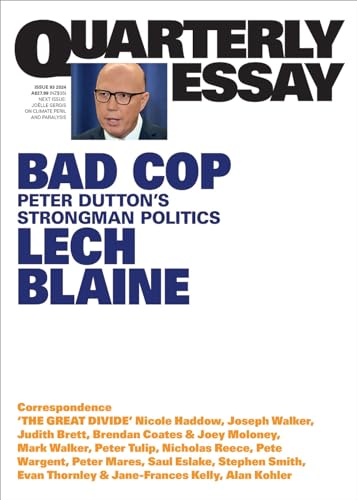
Lech Blaine’s Bad Cop

Lech Blaine, Bad Cop: Peter Dutton’s Strong Man Tactics (Quarterly Essay 93, 2024) – plus correspondence in Quarterly Essay 94

Peter Dutton eats bleeding-heart lefties for breakfast. He is tall and bald, with a resting death stare. His eyes – two brown beads – see evil so that the weak can be blind. His lips are allergic to political correctness. Peter preaches the gospel of John Howard with the fanaticism of Paul Keating. He wants to do the Labor Party slowly, slowly, slowly, and defeat the woe-is-me heroism of identity politics.

That’s the start of this Quarterly Essay, and it was nearly enough for me. Life’s too short and the times are too perilous, I thought, to indulge in another witty hatchet job on a dangerous politician. And I was grumpy with a heavy cold.

But I persevered, partly out of a QE completist compulsion but also because I’d heard Lech Blaine talking to Richard Fidler on the Conversations podcast (link here), where he said some interestingly complex things about Dutton.

Much of the essay, it turns out, is a slog. It follows the ins and outs of Dutton’s life and career, along with the vicissitudes of the Liberal Party and Queensland’s Liberal National Party and the internecine leadership struggles on that side of Parliament over the last 40 years or so, with occasional glimpses at what’s happening in the ALP. Blaine has done a shedload of research, including many interviews with key players and interested observers. There’s far too much going on to enable a coherent narrative, and that’s not counting the brief look at Dutton’s squatter ancestors who were in the tiny minority of their class who stood up for First Nations in Queensland.

The reader is never left in any doubt that Blaine doesn’t like Dutton or his politics – and Dutton has thoughtfully provided a steady stream of pithy quotes to justify those dislikes.

In Blaine’s account, everything Dutton says and does is calculated for its electoral usefulness, but at least some of his outrage has a germ of personal truth to it. His projected identity as a Queensland copper, unlike Scott Morrison’s ‘ScoMo’ persona, is based in actual experience, specifically his nine formative years in the Queensland police force. He was genuinely affronted when someone on Twitter called him a rape apologist, as his dealing with horrific instances of rape as a policeman had been a major formative experience. It’s not just a matter of convenience that he doesn’t spruik his subsequent decades as a property wheeler and dealer, even though that experience, that unacknowledged identity, lies at the back of many of his policy positions.


The correspondence in Quarterly Essay 94 kicks off with a brief, resounding endorsement from Niki Savva, the Queen of Liberal Party Coverage. Encapsulating much of Blaine’s essay, she says, ‘I call Abbott Terminator One and and Dutton Terminator Two.’ Thomas Mayo underlines Dutton’s role in defeating the Voice referendum, quoting Noel Pearson: ‘A heartless thing to do – but easy.’ Other correspondents join the argument about Dutton’s strategy to become the next Prime Minister – interesting, but largely ‘inside baseball’ discussion.

Paul Strangio, an emeritus professor in politics who is currently working on a study of ‘Australia’s best prime ministers’, add some interesting perspectives. He reminds us of that other Queensland copper who was leader of the Federal Opposition, Bill Hayden:

Despite the similarities in their back stories, the differences between Hayden and Dutton could hardly be starker. Arguably, the contrast is a disturbing marker of the degeneration of the political class across generations, of the retreat from a milieu of enlightened social-democratic optimism to irrational conservative populist pessimism, and of the decline of a political sensibility of compassion and empathy to one of stony-heartedness.

Strangio reminds us that Dutton’s strong man approach to politics is part of a planet-wide phenomenon. And he puts his finger on the thing that I experienced as a vague discontent with the essay. Blaine’s view of Dutton, summed up in his final words – ‘Tall and strong at first glance, but when you watch him for a long time, you can see that the man is small and scared’ – isn’t strongly substantiated. The reader is left with the suspicion that it ‘springs as much as anything from a distaste for his subject, a distaste that he struggles to disguise’.

I agree. This essay works brilliantly as a reminder of the many ways Peter Dutton has shown himself as the ‘strong man’ of the Australian parliamentary right-wing, there are hints of how he got to where he is, and a persuasive account of his current campaign to become prime minister, but Dutton the breathing, feeling man remains a mystery.

The Essays of Montaigne, progress report 3

Michel de Montaigne, The Complete Essays (Penguin Classics 1991, translated by M. A. Screech) from Book 1 Essay 42, ‘On the inequality there is between us’, to Book 2 Essay 7, ‘On rewards for honour’

Three months in and I’m coming to love my morning chat with Montaigne.

I was delighted to hear an echo of his voice in a session at the recent Sydney Writers’ Festival. In conversation with Felicity Plunkett (my blog post here), the poet Nam Le was struggling to describe the complex way his mind works. According to my scribbled notes, he said:

Any attribute you can attribute to yourself, the opposite can also be yours.

That morning, I had been reading Montaigne’s Book 2, Essay 1, ‘On the inconstancy of our actions’, which begins:

Those who strive to account for a man’s deeds are never more bewildered than when they try to knit them into one whole and to show them under one light, since they commonly contradict each other in so odd a fashion that it seems impossible that they should all come out of the same shop.

I don’t know if Nam Le had Montaigne even at the back of his mind, but it’s fascinating to find in Montaigne, roughly Shakespeare’s contemporary, such a pre-echo of a 21st century way of seeing things. Fascinating, but not an isolated moment. His reflections on public life, oratory, warfare, frugality, education, suicide and so on often seem tailor-made for quotation in a discussion of anything from the US ex-president to drone warfare or the culture wars. He can be horribly sexist, and his class material is also horrible; but he’s often hard to take to task, because he’s likely to disagree with himself in the next paragraph.

At four pages a day, some essays extend over several mornings. I can see one coming over the horizon that will last me nearly a month. Mostly I ignore M A Creech’s prefatory notes, but sometimes I depend on them to make sense of an argument. Sometimes Montaigne piles up the anecdotes – drawing on ancient writers, recent history, contemporary gossip and personal experience – to such an extent that I lose track of his argument, and suspect he has lost track of it himself. Some of the anecdotes are bizarre in the extreme, especially when he is reporting on sexual or dietary habits of ‘exotic’ peoples.

I’m being fairly lazy in my reading. Whenever Montaigne quotes a line or two of poetry, usually in Latin, but sometimes in Old French or other languages, I skip straight to the translation provided by Mr Screech. I know I’m missing one of the pleasures of these texts, but it’s a pleasure that demands too much work for me (and, I expect, most 21st century readers).

One of the pleasures that is still alive and well is the constant delight of watching Montaigne’s mind chase after whatever rabbit catches his eye while he’s doing something else. This morning I read the essay, ‘On rewards for honour’, a short argument against adding a monetary or other material component to an award for valour, which morphs briefly into a reflection on why ‘valour’ is seen to be mostly a martial virtue when true valour in non-military circles is so much harder to achieve, and then ends in a sentence or two wondering at the way ‘virtue’ means different things for men and women, finishing up with a jokey note which, if he had continued his thoughtful wanderings, might have led in a proto-feminist direction:

Our passion, our feverish concern, for the chastity of women results in une bonne femme (‘a good woman’), and une femme d’honneur, ou de vertu (‘a woman of honour or of virtue’) in reality meaning for us a chaste woman – as though, in order to bind them to that duty, we neglected all the rest and gave them free rein for any other fault, striking a bargain to get them to give up that one.

‘On practice’, the longer essay that precedes ‘On rewards for honour’, is an even better example of the way Montaigne’s mind moves in unexpected directions. It turns out to be about death – which, he says, is the one thing you can’t get better at by practice. Or is it? The tone changes abruptly as he tells of a horrific near-death experience of his own, including a detailed account of the aftermath as he regained consciousness, pain, and memory. Then: ‘The account of so unimportant an event is pointless but for the instruction I drew from it: for in truth, to inure yourself to death, all you have to do it draw nigh to it.’ But that’s not the final swerve of the essay. It turns to the question of talking and writing about oneself, but first there’s this brief description – one of many – of what he is trying to do (essaying) in the essays:

Here you have not my teaching but my study: the lesson is not for others; it is for me. Yet, for all that, you should not be ungrateful to me for publishing it. What helps me can perhaps help somebody else.
Meanwhile I am not spoiling anything: I am only using what is mine. And if I play the fool it is at my own expense and does no harm to anybody.

I just read on Wikipedia that William Hazlitt described Montaigne as ‘the first who had the courage to say as an author what he felt as a man’. I’m loving his courage, and his humility, in putting his own experience and his own thinking out there for all the world to read.


This blog post, was written on Gadigal-Wangal land as the nights start earlier, spiderwebs multiply, and the rain buckets down. I acknowledge the Elders past, present and emerging of those Nations, and would love to hear from any First Nations people reading this blog.

Julius Lester’s Falling Pieces

[This is a post from 22 July 2008, which I’ve retrieved from the ‘Private’ category because Julius Lester’s name has cropped up in relation to my current reading. I’ve just learned on Wikipedia that he died in 2018, and discovered a lot more about his life. He was committed to telling the truth as he saw it, whatever the personal cost. Judging from my brief contacts with him, he was also a really nice guy.]

Julius Lester, Falling Pieces of the Broken Sky (Arcade Publishing 1990)

falling.jpg

Since I’ve started making  notes here about every book I read, I’ve been tempted to feel ashamed of the chaotic omnivorousness of my reading habits. I read books because they are on offer at the Book Club, because they happen to catch my eye at an airport, because I’ve received them as gifts, because they’re part of the canon and I should read them, because I need to get an insistent friend off my back, because I’ve run out of cereal packets to read at breakfast …

At first blush, it would seem that I’ve read Julius Lester’s collection of essays for a purely random reason – because I won it in a little competition he ran. But I wouldn’t have won it if I wasn’t a regular reader of Julius’s blog, and I wouldn’t read his blog regularly if— And it struck me, perhaps because I started reading this book just after spending two days reading a friend’s novel-in-typsecript, that one whole category of my reading is Books Written By Friends. I’m probably using ‘friend’ in a slightly idiosyncratic way here since I know Julius only through his writing – a handful of his books (Sam and the Tigers: A new telling of Little Black SamboJohn HenryWhen Dad Killed Mom), his contributions to an E-List I once belonged to, his blog and a very few emails.

I’m expect that very few people in Australia have read this book of essays, published in 1990 and now out of print. And that’s a shame because each of its three sections is full of good stuff. The first, ‘Writers and Writing’, makes unlikely bedfellows of Henry Miller, Thomas Merton, Aldous Huxley and James Baldwin, and among other bracing delights includes an essay that begins, ‘I am grateful that among the indignities inflicted on me in childhood I escaped The Adventures of Huckleberry Finn.’ There are also a couple of pieces about his own writing, one of which begins:

I have always loved books. Medical science has learned that infants suck their thumbs in the womb. I read. I love books as much for their sheer physicality as for what I may learn and experience through the words on their pages. I love to touch books, to hold them. They are my security blanket, and whether I am happy or depressed, I go to bookstores to orient myself to the world, to feel myself enclosed, almost womblike, by books on all sides. I need books, almost as an alcoholic needs liquor. When I was in college, I always carried a book with me on dates, not sure that any girl could be as interesting or involving as a book. My wife wonders if I’ve changed.

The second section is titled ‘Race’. If there’s a binding thread to the book, it’s the responsibility of the writer to be truthful – to write the truth as he or she sees it, regardless of the demands of collectives of whatever kind. In this section Julius argues again and again for a deeply human perspective, rather than one determined by identity politics. He was part of the Civil Rights Movement, and laments the separatism and advocacy of violence that followed the assassination of Martin Luther King Jr, as well as the coming to dominance of victimhood and the shucking of responsibility. As a convert to Judaism, he has pungent things to say about anti-semitism among US Black leaders, and the tolerance of it among Black and other intellectuals.

The third section, ‘Falling Pieces of the Broken Sky’, draws its title from Seneca, ‘Of all the generations, it is we who have been designated to merit this fate, to be crushed by the falling pieces of the broken sky.’ The section consists mostly of short pieces that read as blog-entries before the existence of blogs – they were written to be read on the radio. I don’t think the title means to suggest that the reader will be crushed by them. On the contrary, I found myself thinking of the Judaic concept of Tikkun Olam, repair of the world, as if these small pieces are helping to piece the sky back together. Many of them are serio-whimsical – objecting to the term ‘Safe Sex’, for instance, because sex always has an edge of emotional or spiritual risk, so to ‘lead the young to believe that sex is safe may one day deprive them of love itself’. There’s a brilliant essay in defence of ‘the canon’ against those who urge educational institutions to introduce students primarily to writing that reflects their own experience, including this:

It is reprehensible that those who have suffered because they are different should now be the ones using difference as a weapon against others. Doing so denies that we are bound to each other by the simple fact that we all laugh and cry and suffer and rejoice about the same experiences or in the same ways. What matters is that we find the humanity within ourselves to delight in the laughter of others, even if we are not amused; that we feel a twinge of pain upon noticing someone weeping, though our own eyes remain dry; that our hearts pause in the presence of another person’s suffering; and that we exult when someone else rejoices, even when we do not understand the occasion for the joy.

The final essay is a mediation on the Holocaust and a brief account of his conversion to Judaism, which makes me want to read his memoir on the subject, Lovesong.

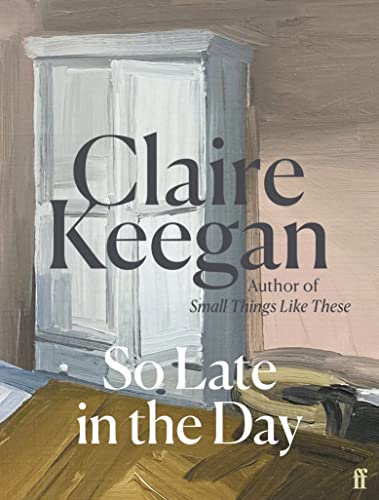
Claire Keegan’s So late in the day

Claire Keegan, So Late in the Day (Faber & Faber 2023)

This book consists of a single short story by Claire Keegan. The story appeared in The New Yorker in February 2020. It was one of four short stories that made up the collection So Late in the Day: Stories of Women and Men (February 2022). Keegan’s French publisher first issued it in standalone form in May 2022 under the title Misogynie. Faber followed suit in 2023 with this attractive little front-counter hardback, perfect for a small gift – and it came into my possession as such a gift.

The story follows its protagonist, Cathal, through a lacklustre afternoon at work in an office in Dublin, the bus journey home, and an evening alone (not counting the cat) with his thoughts and memories, or avoiding them, in front of whatever happens to be on the television (mainly a documentary on Diana Spencer), eating whatever happens to be in the fridge. It’s a picture of desolation, the cause of which gradually emerges. It’s a self-inflicted disaster brought on by habitual and socially endorsed – not a spoiler because the French title gives it away – misogyny.

This isn’t the only fiction created by a woman that purports take us inside the head of a man behaves in ways that enrage women, but few can have done it so elegantly. Claire Keegan does a brilliant job of leaving her own rage out of the picture. (‘The first rule of writing fiction,’ Sebastian Barry said at the Sydney Writers’ Festival on the weekend, ‘is don’t write angry.’) Even the rage of the main female character is left to be deduced from what Cathal remembers of conversations with her. He catches a fleeting glimpse of where he has gone wrong, and even surmises how things might have been different back in his teenage years. Whether that glimpse and that surmise will lead anywhere or sink back into the deadly routine of work and television is a question the story doesn’t go into.

On page 7*:

Cathal is on his way home from work in a bus and all we’ve had is hints that he’s not happy. He sits next to a large woman who slides closer to the window to give him room. She’s on for a chat about the weather, opening brightly, ‘Wasn’t that some day.’ On second reading we know how painful that sentence is for Cathal, but all we get on the surface is, ‘ “Yeah,” Cathal said.’ Each for their own reason, neither Cathal not Claire Keegan needs to spell out the undercurrents.

Further down the page:

‘How about you?’ she said. ‘Any plans for the long weekend?’
‘I’m just going to take it easy,’ Cathal said, threading the speech into a corner, where it might go no further.

He’s civil, and well versed in avoiding real communication. And the unobtrusive metaphor sewing metaphor reminds us that the narrator is seeing more here than the character is showing. The story is full of such quiet, sharply observed moments.

You can hear Claire Keegan reading the story on the New Yorker website. Click here if you’re interested. She reads it beautifully, and it only takes 45 minutes.


I wrote this post on the unceded land of Gadigal and Wangal of the Eora Nation, finishing it on a day when the lorikeets in the gums nearby are still rowdily celebrating the dawn at 8 o’clock in the morning.


My arbitrary blogging practice is to focus on the page of a book that coincides with my age, currently page 77, or for books with fewer pages than that, on the year of my birth, 47. This book ends on page 47 and it would be a bit bad to give away the last lines, so I’m picking page 7.

Sydney Writers’ Festival 2024: My day four

I had just two sessions on the last day of the Festival. The Emerging Artist came down with a heavy cold, but I was ruthless enough to leave her languishing at home today. One pleasant surprise was that, even thugh the SWF website says there is a no-refunds policy they are happy to give a credit – so we have prepaid for three sessions of next year’s festival (she also missed out on Sebastian Barry on Saturday night – rewatching some of Derry Girls from her sickbed.)

Sunday 26 May

12.30: Fragile Democracy

This was one of those panels where I’m interested not so much in the books written by the participants as in what they have to say about the world. As the Festival program put it:

Donald Trump and his attacks on the US electoral system have raised red flags about the strength of American democracy. But in an age of disinformation and civic decline, signs of fragility are visible elsewhere and Australia is no exception.

Former host of ABC’s Insiders Barrie Cassidy chaired this discussion. The formidable participants were:

  • Bruce Wolpe (Trump’s Australia), Senior Fellow at the United States Studies Centre who has worked with the Democrats in Congress during Obama’s first term and on the staff of PM Julia Gillard
  • Rosalind Dixon, Professor of Law at UNSW and co-author of perhaps the least easily spoken title of any book at the Festival, Abusive Constitutional Borrowing Legal Globalization and the Subversion of Liberal Democracy
  • Nick Bryant (When America Stopped Being Great: A History of the Present), who has a 30 year career in journalism, much of it as a foreign correspondent for the BBC.

The panellists were pretty much in furious agreement that there is currently a wold wide battle between autocracy and democracy. Naturally, most of the tie was spent on how this battle is being fought in the USA. ‘The beacon of democracy,’ Nick Bryant said, ‘is looking like a dumpster fire.’

We were reminded that the authoritarian tendency in the USA isn’t new – FDR, correctly seen as progressive and, in US terms, ‘liberal’, was applauded when he said in his inauguration speech: ‘ I may have to bend the rules of the Constitution to what I want to do.’

There was some discussion of the possibility of civil war in the US if Trump loses the election. It wouldn’t be like the last one, but even if there is no civil war, there won’t be civil peace.

All the panellists agreed that Australia’s institutions are strong: compulsory voting, preferential voting, ease of voting (there were some horror stories about how hard it can be to vote in the US), an independent Electoral Commission, and courts that aren’t as subject to political pressure. But we still need to be vigilant: for instance, Peter Dutton recently tried to introduce voter ID processes to make voting harder.

Someone said, ‘Australian democracy is a lot stronger than its politics.’


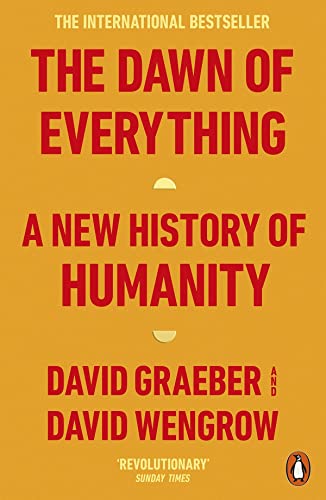
1.30: David Wengrow: The Dawn of Everything

Richard Fidler was in conversation with David Wengrow, co-author with the late David Graeber of The Dawn of Everything: A New History of Humanity (2022). David Graeber was an anthropologist who played a leading role in the Occupy movement. When he and Wengrow, a British archaeologist met during the Occupy movement they had long conversations, not about politics but about archaeology. As Wengrow told him about current state of knowledge of the ancient past, he kept asking, ‘Why don’t I know this? Why isn’t this being taught?’

They decided to write a pamphlet, something without footnotes and scholarly paraphernalia, presenting current knowledge in a readable, integrated form. It turned out that this was harder than they thought, partly because of the extreme specialisation of archaeology: experts in ancient rock art don’t know what experts in ancient stone tools are doing or finding out. In the end, they had to write a substantial book.

The conversation touched on the opposing views of human history put forward by Rousseau (early humans were blissfully innocent, perhaps slightly imbecilic creatures who were corrupted by the formation of societies) and Hobbes (the war of all against all constrained by civilisation). wengrow observed that both these narratives are fantasies in which the early humans aren’t like any humans we know anything about. Likewise, he says archaeological findings disprove the narrative of Sapiens, which he assumed we have all read but I haven’t, and of Steven Pinker.

As to what those findings are: they are rich and complex, much more so than anyone has ever though was the case with early humans.

He argued that the luminaries of the enlightenment – Diderot, Voltaire, Rousseau – were influenced by what they heard from Indigenous people from colonised nations who visited Paris and were sharply critical of teh inequalities and other manifestations of monarchy that they saw there. He spoke respectfully of Bruce Pascoe’s work, but seemed to be unaware that Mungo Man and Mungo Lady were buried with ritual elements tens of thousands of years ago – which as I understand it only reinforces his argument.

This session was recorded for the ABC’s Conversations program. I plan to listen when it’s broadcast as there were a lot of specifics to his argument that I know I’ll get wrong if I try to write them now. [Added later: The Conversations program is already online at this link.]


The festival is over for another year. What little I saw of it was terrific.

The booking system means that there are no longer terrible queues for the sessions with no guarantee of getting through the door.

There is a new approach to questions: you go to a website and put your question there. This has the great advantage of stopping people from getting up to tell their life story or promote their own world view. I think there may have a disadvantage: sometimes if the person on stage can actually see the questioner they can tailor their answer appropriately – as for example if the questioner is a young person.

I do wish there was more than one place selling coffee, as even though I’m not a coffee drinker I was pained to see the apparently permanent size of the queue.

And most of all I wish there was more poetry. Just one whose drawing power depends on his published prose isn’t enough. Surely there is a small room somewhere at Carriageworks that could be devoted to poetry – one where an event doesn’t need a big crowd to justify itself. There are at least half a dozen places in Sydney that organise regular poetry readings, there ar e a number of small publishers who specialise in poetry, and there are any number of fine poets who live locally.

But long live the SWF. I’ve come away with a swag of actual books and a list of others.

Sydney Writers’ Festival 2024: My day three, evening

Saturday 7.30 pm: Sebastian Barry: Old God’s Time

If I’ve realised that Sebastian Barry was appearing by video link I might not have booked for this session, but that would have been a mistake. A tiny Kate Evans sat on the stage in front of a huge Sebastian Barry speaking to us from early morning in Ireland in the room where, he said, he had written the book they were discussing, Old God’s Time (link is to my blog post).

Whether it was because Barry was speaking to us from the safety of his own house, or because of a paradoxical effect of long-distance communicating, or whether it might have happened anyhow, this session had a wonderful intimacy about it. Almost everything he said enriched my understanding and enjoyment of the book.

When Kate Evans asked about the physical setting of the book, Barry answered straightforwardly and then went on to talk about the novel’s seed being planted in a brief period of his childhood when he lived in that building. I don’t know anything of his life story, but he may have been hinting that the book child’s situation – he and his mother are in hiding from his abusive father – in some way echoes his own experience.

My highlight of this session, and of the whole festival, came when Kate Evans, referring to a tirade against the Catholic Church delivered by the character Tom Kettle, asked if Tom’s rage was also Sebastian’s. (Someone read this passage out at my book group meeting – it’s a stunningly passionate piece of writing, and Evans’s question is inevitable.) Barry asked Evans if she would read the passage, and when she apparently didn’t hear his request but read out a couple of isolated phrases, he paused, as if deciding how honestly to respond and then gave a complex answer:

A) The first rule of novel writing, he said, is not to write in anger. He spoke a little about the mysterious nature of novels. The writer sits in a room and puts words on paper. After a number of processes involving many other people, someone sits in their usual reading place and reads the words. The characters who have been imagined by the novelist are imagined all over again by the reader.

B) Though Tom is an imaginary character, his anger is like that of real-life survivors. It gives voice to things that need saying, and when you make the effort of listening to it, you are receiving a gift. Barry felt that he was receiving such a gift from Tom.

C) He didn’t stop there. There was a moment in 1960, he said, when Archbishop McQuaid (a historical personage mentioned in the novel) was given evidence of child sexual abuse committed by a priest in his archdiocese. He consulted an Auxiliary Bishop, Patrick Dunne, asking him if he considered that the crime was a crimen pessimum (a crime of the worst kind). Dunne said he thought it was. McQuaid responded that he would keep it quiet anyway, because it would cause a scandal that would do great harm to the church. That moment of decision ruined the lives of thousands of children, and this was the object of Tom’s rage.

But for Barry, there is another twist: Patrick Dunne was his cousin, closely related to a man who appears honourably in one of Barry’s novels. On realising that this man was present when the decision was made, Barry felt that his own DNA had been in the room. Irrational as it may be, he felt complicit. I understood him to be speaking a difficult personal truth but also – though he didn’t spell this out – making a point about fiction-writing: clickbait outrage is easy but it doesn’t make for great fiction. Tom the character can be outraged, but the person who creates him needs to be wary of claiming the moral high ground.

Astonishingly, but necessarily, Kate Evans then moved on to the next question, and Sebastian Barry moved on with her, leaving me – and surely I wasn’t the only one – in awe at what had just been given me.

The session ended with a reading, in which Barry was transformed into Tom Kettle and his glorious language filled the room. In the passage, Tom is listening to a new friend playing Kol Nidrei, Op. 47 by Max Bruch on the cello (link is to a performance by the Frankfurt Radio Symphony Orchestra). We were then treated to a performance of the piece arranged for cello and piano, performed by Melissa Barnard and Lee Dionne from the Australian Chamber Orchestra.

Sydney Writers’ Festival 2024: My day two

After just one session on Tuesday and nothing on Wednesday or Thursday, Friday was all systems go for me at the SWF, with five sessions, starting at noon and ending just after 7 in the evening. Please excuse the length of this post.


12 pm: The Gift of Greek Myth

I first heard Kate Forsyth talk back in the day when she mainly wrote for children (starting with Dragonclaw in 1997). More recently she has appeared on radio and podcasts as a writer of historical fiction. She has always been good value on fairytales and myth. In this session she chatted with playwright Tom Wright about her most recent book, Psykhe.

If Psykhe is as interesting as this talk, then it’s a brilliant novel. Here are some scraps I gleaned.

Kate Forsyth describes herself as playing in the borderland between myth and history. She is concerned to reclaim ancient stories from their patriarchal interpretations. Fairytales, she says, are myths drained of their sacred meanings, because they are mostly concerned with women’s issues.

In this book, the dividing line between gods and humans is porous. It tells the story of Psyche/Anima and Cupid/Eros/Amor as a historical fiction – Psyche becomes Psykhe and Amor becomes Ambrose.

I’m not sure how much of this is from the original myth and how much from the novel, but here’s a broad plot outline: Venus’ son Ambrose falls in love with Psykhe, a human woman; he keeps her in luxury in his palace, but as a prisoner; he comes to her bed every night, where she is not permitted to see his face. One night as he is sleeping, she looks at him by the light of a candle, and spills wax on him. For the first time he feels pain, and flees. Having broken free of her imprisoned state, she now can love him, and goes searching for him.

Forsyth says this is the only ancient myth that is gynocentric – woman-centred. Whereas in androcentric myths the hero breaks, kills, and conquers (and, I’d add, rescues), in gynocentric myths the female protagonist sets about healing, repair and recovery. This story is about the importance of consent, the transformative potential of pain, the need for love to be more than physical (the reductiveness of that is mine, not Kate Forsyth’s or Tom Wright’s).

Kate Forsyth has a lovely phrase for her creative process. She says she spends a lot of time ‘daydreaming a story to life’. In this talk, she allowed us to witness part of that daydreaming.  


2 pm: Abdulrazak Gurnah: Afterlives

I’ve read and loved two of Abdulrazak Gurnah’s ten novels, Gravel Heart and Afterlives.

This urbane and amiable session focused on Afterlives. Gurnah kicked it off with a reading. Though he read beautifully, it was a strange passage for the occasion as very little happens in it: there is a boat and a harbour town, the sun sets, the main character has trouble sleeping because of unspecified pain. This from a book where there is so much wonderfully dramatic or tender writing he could have picked (see my blog post for an example).

Sisonke Msimang, his interlocutor, asked the pertinent question: why this passage? He said it was the first part of the book that he actually wrote. He knew that Hamza had been wounded and was returning to his childhood home after fighting for the Germans in World War One: what came before and after that was yet to be imagined.

After that insight into the book’s origins, we learned that Gurnah had wanted to write about the German schutztruppe for a long time. (Not quite right to call them ‘the German schutztruppe‘, he said, as only the officers were German, the troops were African.) He had known from his childhood about the ferocity of these soldiers, who fought for the colonisers – his grandfather (or more precisely his mother’s uncle) had been one of them. But when he got to the UK and had access to books, he found that there was nothing written about the way Africans were drawn into the wars between the colonising European nations. He had intended his fourth novel, Paradise (1994), to be on the subject, but he realised then that he didn’t know enough to write about it. It was nearly two decades before the time was right.

A question animating the book is: Why did people join a force that was going to end up dominating them/Why fight in a war that will determining who will be your coloniser? ‘That’s how we put the question now,’ he said. The book offers no simple answer, but a lot of what the two speakers had to say echoed what I have heard and read about the Queensland Native Police: apart from the attraction of being part of a new, powerful force, or various kinds of of coercion, it’s important to remember that people didn’t think of themselves as African, any more than the Germans and French identified each other primarily as fellow-Europeans: many of the African nations had been at war with one another for centuries.

The conversation roamed over the more personal elements of the book. These are the things that Gurnah says he likes writing about most – the everyday, the interior, the domestic, the intimate – and it’s them that gives the book its power as it tackles broader issues. All of this brought the pleasures of the book back to me – I hope it inspires people who haven’t read it to pick it up.

One final question from Sisonke Msimang: Was he expecting the Nobel Prize? Writers don’t work with the hope of winning the Nobel Prize, he said. They’re in for a hard time it they do. And he did a quick impersonation of someone responding to the phone from the Nobel Committee by exclaiming, ‘Well, at last!’


3 pm: Nam Le: 36 Ways of Writing a Vietnamese Poem

This wasn’t a session for the faint-hearted. Felicity Plunkett, herself a poet, set the ball rolling with an opaque quote from ‘On the line’, an essay by Kasim Ali, and things only got more erudite, recondite, convoluted and polysyllabic from there.

When someone at a session later in the day half apologised for the comparatively straightforward terms ‘methodological’ and ‘epistemological’ by adding ‘as we’d say in the academy’, I realised retrospectively that this conversation was being conducted as if in a specialist academic context.

For instance: ‘The line can put things into differences of ordinality … You can have a chiasm … ‘ I managed to note down terms like ‘autofictive’, ‘metafictive’, ‘preambular’, ‘the trauma plot’ (which is ‘too easy’). All of this has meaning, but I found it impossible to keep up.

What emerged is that Nam Le’s poems are ‘destabilising, elliptical, constantly questioning’. ‘How is it possible to say anything at all,’ he asked at one stage,’without being undermined by your own self-consciousness?’

There was a lot of talk of violence, which may or may not have a technical meaning. I think Nam Le was joking when he asked, ‘What is more violent than meiosis?’ (Meiosis is the process by which cells split.)

As a counterbalance, Le read four poems to us – or more accurately he read four parts of what Plunkett said is the long poem that constitutes the book 30 Ways of Writing a Vietnamese Poem. It was wonderful to hear his performances. The one with which he wound up the session, a lullaby with the title ‘Matri-Immigral’, was all anyone could have hoped for.

That broke through my exasperation with the session’s obscurity and recursiveness and convinced me to buy a copy of the book.


4 pm: Feminist Firebrands

Each of the day’s earlier sessions featured one author talking to one other person about one book. This session was a panel of three plus a facilitator.

A panel is a hard gig: you run the risk of only half-hearing each of the participants, and hearing no one’s thinking in depth. If the subject is books, you can get some idea of whose writing you might want to follow up, but this panel barely mentioned the participants’ books. All the same, it worked.

Hannah Ferguson, who is in her late 20s, abandoned her law career soon after graduating and is now a podcaster and person in charge of something on the internet called Cheek. Sisonke Msimang, among other things, writes a regular column in the Guardian offering wisdom about racism and related issues. Jennifer Robinson has offered legal advice in high profile cases of alleged sexual abuse. Jo Dyer, among other things former CEO of the SWF, facilitated.

The conversation revolved around issues raised by the Brittany Higgins and Bruce Lehrmann court cases, the allegations of historic rape against Christian Porter, Grace Tame’s advocacy, a little of Amber Heard’s case against Johnny Depp, and a sulphurous whiff of Donald Trump. That is, the way the criminal justice system here, but also in the USA and Britain, treats women, specifically when they allege sexual abuse or rape. And not just the criminal justice system, but the media and the culture generally.

The first thing that struck me was the stark contrast with Nam Le’s approach. Here there was no uncertainty, no self-undermining, no painful self-consciousness. Everyone spoke forcefully, definitely, and – alas for my note-taking – fast. I couldn’t possibly give a decent summary, but here are some gems:

Jo Dyer on recent news about the Queensland police force: ‘How many bad apples do you have to have before you cut down the f*ing orchard?’

Hannah Ferguson (I think): ‘Men are 230 times more likely to be raped than to be falsely accused of rape.’

Hanna again, on the ‘If you don’t know, say no’ slogan: ‘Everything I do is to fight the notion that you should back off if something is hard.’

Jennifer Robinson: Only 2% of rape cases arrive at a guilty verdict, but the current defamation laws in Australia mean that only those 2% of survivors can talk about their experience without being sued. A not guilty verdict in a rape case does not mean that the woman lied.

All the panellists agreed that it is important to have conversation about these issues. I think it’s right to say they all felt that it was a mistake to pile on Scott Morrison for framing his empathy for sexual assault victims as resulting from his wife asking how he would feel if it was his daughter. The conversation is important, and it doesn’t move things forward to attack imperfect contributions that are still in a good direction.

I learned about the ‘Man or Bear’ meme on Tik-Tok. Women are asked if they would rather be alone in a cave with a man or a bear. A typical witty answer is: ‘The bear, because at least I know what it would do.’ There was some dark humour about how some men have responded – one teenage boy asked (the question I’m embarrassed to say came immediately to my mind), ‘What kind of bear?’


An hour’s break to attend to bodily needs and get from Newtown to the City, and then off to:

6pm: Richard Flanagan and Anna Funder on Writing

Given that Richard Flanagan was scathing about writers’ festivals in Question 7 (a book I didn’t warm to), it’s interesting that he still agrees to appear at them. I came to this session mainly for Anna Funder. The Emerging Artist read quite a lot of Wifedom to me last year.

Clare Wright was in the chair. As a historian, she was interested in the way both books move around in genres, part history, part novel, part memoir, part autofiction. Both writers resisted any attempt to classify, saying they had followed where the books took them. Funder, for example, said she wasn’t writing autofiction in the parts of Wifedom when she wrote about her own life: it was a device to bring the questions about how women were seen in her subject’s time into focus.

Richard Flanagan was entertaining. My impression is that he came armed with a number of set pieces. He told us, for instance, that the history of publishing in Australia differs from the history in Britain and the USA in that key roles have been played by strong, intelligent women. He didn’t mention the fabled Bea Davis, but he named others, including the woman who had edited both books featured in the session: he asked her to stand up to take a round of applause, and though I couldn’t see her from my seat up in the gods she apparently complied, I can only imagine how reluctantly. Later he told his version of the story of being mistaken for a different writer in a signing queue – he duly signed the proffered book as Bryce Courtney.

In the long and interesting conversation, Clare Wright asked Flanagan two questions about Question 7 that touched directly on my issues with the book. Did he introduce Rebecca West as a way of countering the all-male patriarchal narrative of the origins of the atom bomb? Nothing so programmatic, he said, and went on to talk about how remarkable Rebecca West was. Then he reminded us that for the last 20 years or so women’s writing has been front and centre in western literature, so our collective sense of history has changed – so not programmatic, but responding to the zeitgeist. Wright framed the other question by asking him to read a short passage (sadly, this was the only reading in the session) describing the bomb being dropped on Hiroshima. As a historian, she was not interested, as he first thought, in whether he had got the number of people killed right, but the origins of his image of survivors walking the streets calling for their mothers, juxtaposed poignantly with the fact that plane that dropped the bomb, Enola Gay, had been named after a crew member’s mother. He was able to say that both those images came from historical records.

Wifedom has 400 endnotes: ‘If you want to destroy patriarchy you have to have endnotes.’

The patriarchal manifestation she attacks in the book is the erasure from history of George Orwell’s wife, Eileen O’Shaughnessy by Orwell’s many biographers. She had a number of Eileen’s letters and some few other sources, so she had to resort to ‘making shit up’, to use the words Clare Wright put in her mouth. The made-up bits are clearly indicated in the book, being set to a narrower width. Before she made this controversial decision, the writing was flat and dead on the page. Her writing about her own status as wife played a similar role.


And so out into the crowds in George Street, possibly there for the Vivid Festival, to dinner and eventually home.

Sydney Writers’ Festival 2024: My day three, afternoon

Sue from Whispering Gums respectfully suggested that I not try to squeeze a whole day of the SWF into one blog post. Day Two’s post was a marathon to write but hadn’t realised it was imposing a burden on readers as well. So, even though none of my subsequent days were as loaded as Friday, I’m taking her advice. Here are the first two of Saturday’s three sessions.


Saturday 25 May

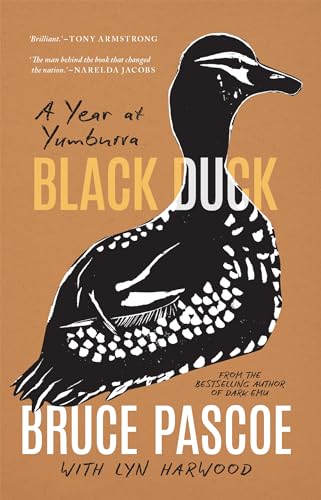
1 pm: Bruce Pascoe and Lyn Harwood: Black Duck: A Year at Yumburra

This session is a variation on my standard session: two people talking about one book with one other person.

Bruce Pascoe’s most recent book, Black Duck: A Year at Yumburra, shares authorship with his wife, Lyn Harwood. They chatted with veteran journalist Kerry O’Brien about their project at Yumburra, their relationship, the devastating bushfires of 2019–2020, the impact of Pascoe’s book Dark Emu (my blog post here) and the subsequent backlash, and related matters.

After Dark Emu‘s success, Pascoe decided to put his newfound wealth to good use. Aware of a new enthusiasm for native foods –  he didn’t use the phrase ‘bush tucker’ – he was concerned that there was little consideration for benefit to Aboriginal people. So he bought the farm at Yumburra to grow food, employ Aboriginal people and make a declaration of Aboriginal sovereignty.

I didn’t get a clear sense of the book Black Duck, but I gather it’s in effect a diary of a year spent at the farm. Lyn Harwood spoke eloquently about the effect of writing things down. You spend most of the time dealing with things as they arise, just doing the work. it’s not until you stop to write it down that life, ‘especially the sensuousness of life’, is properly imprinted. The process of writing the diaries was a way of attending to what was happening on the land – not just the work, but the effects of the changing seasons.

Kerry O’Brien, excellent journalist that he is, gave Pascoe opportunities to address the various fronts on which he has been attacked.

On this subject of his Aboriginal identity, he described some of the cultural work he had to do. There was an occasion when he said something stupid and an Aunty said, ‘You know nothing. You know nothing. You go back to the library.’ She may have been speaking metaphorically, but he took her literally and went back to the library to research the history he had got wrong. His Aboriginal identity is contentious among some people, but not among his local mob. ‘I have a very small connection and I admit to it,’ he said. But I identify with it.’ These questions of identity, he said, are a distraction from what matters: when he offered a non-Aboriginal shopkeeper some vanilla lily bulbs he had grown on the farm, her first response was not to consider the possibilities being offered to her but to as, ‘What proportion Aboriginal are you?’ The gasps from the audience demonstrated that he had made his point.

On the validity of the argument of Black Emu, he cited the work of archaeologist Michael Westaway: with the assistance of the Gorringe family, he set out to test Dark Emu‘s hypothesis about pre-settlement history in Mithaka country in Queensland, and found ample evidence that here had been substantial ‘town life’ there.

My main takeaway from the session was the reiteration of the key message of Dark Emu: Aboriginal and non-Aboriginal people have a shared history. One of Pascoe’s mentors, commenting on Dark Emu, said: ‘If I’m going to keep my culture, I have to give it away.’ If non-Aboriginal people aren’t invited in, they (we) remain angry, unsettled spirits. Over millennia, Aboriginal people had a continent where there were no wars over land: each group has responsibility for their own Country. If your neighbour is weak or in trouble, you can help them out, but you cannot take their land.

Pascoe says that, in spite of the Referendum result, he thinks there’s a big change coming, as people come to realise that the future of Aboriginal people is the future of all Australians. Just as his work at Yuburra is offering possibilities for agriculture, a future is being offered to us in many ways as a gift with an embrace.


3 pm: Bringing the Past to Life

Ah! A proper panel: three people talking about one book each to one other person. The writers were Francesca de Tores (Saltblood), Mirandi Riwoe (Sunbirds) and Abraham Verghese (The Covenant of Water). Abraham Verghese had Covid, so appeared on a giant screen behind the others. The fourth person was Kate Evans of the ABC’s Bookshelf. The session was most satisfactory.

I hadn’t read any of the books, though I had read Mirandi Riwoe’s earlier novel Stone Sky Gold Mountain (link is to my blog post).

Kate Evans ruled with a rod of iron, asking a series of questions, and making sure that the writers had roughly equal amount of time in response to each question: setting, characters, plots, dark matter. No butting in or dominating. (I’m embarrassed to say it, but perhaps it helped that the only man was a person of colour.) As a result, even without being read to, we got a good sense of each of the novels.

Saltblood is set in the Caribbean in the 1720s, towards the end of the golden age of piracy, and is based on the historical women Mary Read and Anne Bonny. De Tores said that she was happy to call Mary Read a woman, although her gender identity was complex – she was raised as a boy and spent most of her life as a pirate dressed as a man. There’s an early book about pirates – I didn’t catch its name but it is evidently the main if not the only source of everything we think we know about pirates from that time. In that book, the lurid potential of women pirates was played up, and in its second edition the illustrations showed them swashbuckling with breasts exposed. Saltblood sounds like fun, but focuses on more interesting things than bare boobs.

Sunbirds features an Indonesian family in Western Java in 1941. The family and their servants deal with issues related to Dutch colonisation and nationalist resistance, and imminent invasion by Japan. A Dutch pilot is wooing the daughter of the family, who is torn between loyalty to her family and the attractions of life in the Netherlands. Meanwhile a servant of the family has a brother who is part of the resistance. Miranda Riwoe described herself as Eurasian, and so drawn to the plight of the daughter.

The Covenant of Water draws on Abraham Verghese’s own family background in Kerala (he was born and raised in South Arica, but Kerala was always in the background). The story covers three generations in the first half of the 20th century. There is a child bride. Verghese said he was playing against stereotype by giving her a happy marriage. He is a doctor specialising in infectious disease (he pointed out the irony that he was attending on screen because of a coronavirus), and the novel pays attention to advances made in medical science in the period it covers.

So, three interesting books for the TBR shelf.