SWF 2021 Saturday

I had three events on my second day at the festival.


10 o’clock: Your Favourites’ Favourites: Tony Birch & Evelyn Araluen.

‘Your Favourites’ Favourites’ is series of events where an established writer interviews the author of their favourite Australian debut from the last year. This was the only one of the series that we attended. It’s a terrific idea, and this pairing must have delighted whoever thought of it.

Tony Birch is not only an established writer, he’s also a seasoned interviewer of other writers, and a passionate and articulate reader. Evelyn Araluen is not only a debutante poet, she’s also among many other things co-editor of Overland magazine. Tony Birch has not only read her poetry, he has been edited by her. They know each other well, and were radiantly at ease with each other in this session, their deep mutual respect not excluding some friendly teasing. After introducing Evelyn as a formidable presence in Australian literary circles and beyond, Tony asked her, ‘Have I pumped up your tyres enough?’ She said it was a bit embarrassing to be described like that when her parents were in the audience. He said her father had had a quiet word to him before the session.

This friendly banter provided a leaven for a weighty conversation. Tony quoted Evelyn as saying in another context, ‘We are reclaiming this place through poetry,’ and asked ‘How so?’

I recommend listening to the whole conversation when it comes out as a podcast. What I’ve managed here is a rough and partial account.

Australian national identity, she explained, is a literary construct. As scholar George Seddon said, ‘The English language is a filter over the Australian landscape.’ Evelyn said, ‘Whiteness does not understand itself in this landscape.’ Non Indigenous writers tend to go for the Gothic (Marcus Clarke comes to mind) or the cute (the work of May Gibbs features large in Evelyn’s poetry), both of which erase black presences. Both conservative and progressive white writers generally fail to get further past the erasure than shallow acknowledgement. Tony Birch quoted Anita Heiss: ‘You can’t just speak language. You have to think language.’ That is, Aboriginal people also have work to do to reclaim the place from colonising language.

Tony asked Evelyn what she had meant when she said on the festival’s opening night, ‘I’d like to write happier poems but there isn’t time.’ This prompted her to talk about the climate emergency and the responsibility of poets to address it. So most of her poems are angry and urgent (I think that’s what she said, and from what I’ve heard at readings I’d agree, but add ‘funny’). There is a place for poems, and art in general, that allows us to pause, to rest so we can go on facing our responsibilities, but for Aboriginal poets there is a need to be constantly asserting our existence, survival and resilience.

At Tony’s request, Evelyn read to us. ‘See You Tonight’ evokes an uneventful, peaceful moment of family life. It was written during Melbourne lockdown after eight months of not being able to see any of her own family. No one was surprised when, after the final words, ‘It’s all good. / I will. I will. I will,’ she raised her arms in triumph and said, ‘Got through it without crying!’ (I wiped a tear from my eye even though we hadn’t yet been told the circumstances of the poem’s composition.)

‘This is not a cancel culture book,’ she said.

There were two questions, one from another poet that moved the conversation into academic territory, with words like ‘liminality’ and ‘positionality’, and one from Evelyn’s father – we knew this because as he approached the microphone she shed at least 10 years and almost squealed, ‘Oh, Da-ad!’ He used his platform to draw our attention to all the powerful Black women who are central to First Nations life and activism – and didn’t embarrass his daughter at all.


12:30 pm: Whose Country Is It Anyway?

Nayuka Gorrie is a Gunai/Kurnai, Gunditjmara, Wiradjuri and Yorta Yorta freelance and comedy television writer. This is one of the events she organised as Guest Curator at the Festival. She was in conversation with Melissa Lucashenko, author of Too Much Lip (my blog post here) among other books, and Nardi Simpson, author or Song of the Crocodile. (At one stage Tara June Winch was advertised as appearing zooming in from France for this session, but that wasn’t to be.) They were there to talk about the craft of writing Country.

As you’d expect, the conversation ranged widely. At the end of it I was keen to get hold of Nardi’s book, because a lot of what she said was tantalisingly hard to grasp. For example, ‘We inherit a never-ending process of belonging. Whose country? It depends on where you’re standing. You can create a relationship to a place that’s important to you, but it could be completely different for someone living 200 metres down the road.’

Melissa quoted Paul Kelly’ ‘Writers pay attention.’ She said there are two kinds of writers – the big, loud, macho writers (who can be women), and the quiet ones who pay attention. Her implication was that quiet attentiveness is the pathway to writing Country well. She talked about ‘extraction’ as key to the ‘western project’, and contrasted it to ‘reciprocity’.

Melissa again: It’s a writer’s responsibility to write the truth of violence without doing violence to the reader. There’s a place for writing that lashes out about injustice and cruelty, but we must write about life as much as death, otherwise we’re invading ourselves.


We did our Covid Check-out from Carriageworks to have lunch at a nearby pub (hamburgers with those horrible brioche buns), then back for our afternoon session.


2:30 pm Faruqi on Faruqi

This was a mother and son act: Senator Mehreen Faruqi and journalist Osman Faruqi. As with Tony Birch and Evelyn Araluen, there was a lot of good-natured teasing. “When I was in labour, I fervently hoped that I would have a girl.’ ‘We are a family of engineers. I so wanted him to be an engineer, and look what he’s become – a journalist!’

Sally Rugg as moderator didn’t have to do very much. She signalled at one point that it was Ok to broaden the conversation out by asking them about their theories of change. I don’t know that either of them directly addressed the question, but they took the hint and what followed was a very interesting conversation about the role of parliament and politicians in bringing about change – both of them agreed that real change came from the community and the political class played catch-up.

Both Faruqis have books coming out later this year. Mehreen’s is a memoir and manifesto, to be called Too Migrant, Too Muslim, Too Loud. Os is writing a book about racism in Australia. He would love to go back to writing music reviews, but has things he needs to get out there about racism. White friends say to him, ‘Why do you make everything about racism. When are you going to move on?’ He says, ‘You’re the ones who made everything about racism. I’ll move on when you do.’ (He probably said it better than that.)


Then we were off to the bookshop, to a number of catch-up conversations with friends we tend to see only at events like this, and to walk home on a beautiful Sydney autumn afternoon
SWF 2021: Friday

The Sydney Writers’ Festival has come back from the virtual world, and though it hasn’t returned to the splendours of its old harbourside venue, the Carriageworks is an expansive site whose acoustic problems of past years are no longer an issue, and for me it has the advantage of being just a 40 minute walk from home. My festival this year got off to a slow start, with just two sessions on Friday.


Friday 30 April 4.00: Writing the Unspeakable

The Unspeakable of the title didn’t refer to the Great Australian Silence about the massive wrongs of colonisation or other vast silences, but to personal unspeakables like depression, grief, trauma and addiction. Each of the panellists has written a memoir about that kind of unspeakable – and in some ways the session played out the implication of the session’s title: you’ve written about something that’s unspeakable, but maybe that doesn’t make it any more speakable?

I haven’t read any of the panellists’ books: Lech Blaine’s Car Crash, which tells the story of a car accident where three of his friends were killed but he and two others survived; Ashe Davenport’s Sad Mum Lady, about the difficulties of being a new mother that had its origins in a blog, ‘Sad Pregnant Lady’; and Fiona O’Loughlin’s Truths from an Unreliable Witness, which deals with her long struggle with alcoholism and addiction, often in the public eye as a successful stand-up comedian. Michaela Kalowski was the moderator.

Rather than start out with each panellist reading a short passage from their book – even, say, the opening paragraph – which would have grounded the conversation, MK opened with a question to each of them in turn, ‘Why are these subjects taboo?’ The panellists weren’t terribly cooperative, but the way each of them avoided answering the question, and pretty much every question after that, led to some entertaining and sometimes illuminating conversation. Here are some snippets that I have managed to decipher from notes I jotted in the dark.

Lech (I’m going to use first names) said that these subjects aren’t actually unspeakable. He spent his childhood in a pub and by the tenth or eleventh beer anything could be talked about, though not necessarily in a civil or constructive manner. Ashe told a horrific tale of her mother being groped when a child, in full view of a room full of people who pretended it hadn’t happened.

Fiona ventured to ask her mother if there was anything in the book that upset her. ‘Of course not,’ her mother said. ‘I haven’t even read it.’ This prompted Lech to tell us that he showed his brother a passage in manuscript where the brother is quoted as saying something profoundly offensive about Labor voters. His brother said, ‘That’s brilliant! You got that exactly right.’

Ashe described the process of making the transition from blog to book. In the blog she would work hard at creating amusing anecdotes out of her struggles. The book could still be funny, but she realised that she had to become less abstract: not so much, ‘It’s hard being a new mother,’ and more, ‘This is how I struggled as a new mother.’ At MK’s prompting she told the story of how she went to an anger management group for women, thinking it would make an amusing story for the blog – and she told it to us in a way that got laughs, until she got to the point where one of the group of older women asked her a question, she burst into sobs, and the other woman simply placed a supportive hand on her back until she was finished.

Fiona spoke beautifully about the shame of being an addict – and the importance of kindness. Tom Gleeson (the cheerfully cruel host of Hard Quiz) got a special mention as a kind person, but she said that the whole community of comedians is tremendously supportive.

Each of the panellists spoke about intensely personal difficulties. That they’ve written books about those difficulties didn’t make it any less easy to talk about them. Lech was often left staring blankly into his personal voice, and I felt that Ashe wasn’t quite ready to serve up her personal pain in person to a big audience. Fiona is a professional at airing her linen to live audiences, and did most of the work of keeping the conversation aerated by comic touches. At one stage Ashe turned to Fiona and said something like, ‘You know what it’s like to feel that you’re a bad mother.’ Fiona did a nice comic routine, turning away in mock denial. As Ashe continued with her point, it became clear that she was talking about something that was still raw. Fiona reached out and touched her on the forearm. A little later, doing her own bit of mock denial, Ashe waved her arms joyfully in the air and said, ‘And now I’m completely all right!’

Asked about how it felt writing this personal material for an audience, there were two very different, but equally memorable answers. Someone recalled the reassuring words of a wise editor: ‘Always bear in mind that no one is going to read every word you write.’ Fiona said that she wrote her book ‘for my children, to explain myself to them’.


Our only other event for the day was the Within Reach Gala at 8 o’clock. We managed to squeeze in a celebration dinner for a friend’s 70th birthday on our way to the Town Hall. Once there, we were taken back in time by the Town Hall’s insistence that masks were mandatory – though there was a lot more non-compliance than there was back in the day.

After a short introduction from Festival Director Michael Williams – in which he said among other things that Geoffrey Blainey’s concept of the Tyranny of Distance was regressive and idiotic but part of our culture – we were treated to a dozen writers speaking on the Festival’s theme, Within Reach, reflecting on the past year. Their interpretations of the brief ranged widely. Each speaker was identified simply by their name on a big screen, so that we were spared time-consuming introductions and appreciations by an MC, which made a huge difference to the pleasure of the evening.

Tony Birch told a beautiful story of how the gift of a stone at a wake made a huge difference to him when he was depressed and despairing from the death of a close relative and the lack of progress in action on climate change. He held up the stone.

Ceridwen Dovey said she has been working on space objects, and talked about the ‘golden records’ that have been sent out into space. There was a debate about whether those records should include material about the dark sides of humanity. In the end, the woman writer on the team managed to have the sound of a kiss included – and the actual kiss that was recorded was both an expression of tenderness and the beginning of a betrayal.

Sisonke Msimang spoke of the great movement of white women in response to allegations of sexual assault in Parliament. She was onside with the protests but couldn’t join them, knowing that she couldn’t ask her group netball mothers to join her on a BLM march. She spoke eloquently and generously about this impasse.

Ellen van Neerven started with the conviction of Derek Chauvin for the murder of George Floyd, and the question that resounded in her mind: ‘When will this country see as much justice?’ She said that like all First Nations people in Australia, deaths in custody was a family matter. She pledged to continue to tell the stories that need to be told.

Geraldine Brooks spoke from Martha’s Vineyard in the USA by video. I confess that the beauty of the country where she’s living largely overwhelmed my ability to take in what she was saying. I think that was her subject: missing home.

Trent Dalton, I think, meant to remind us of the importance of human contact and the pain of physical distance in pandemic times. He misjudged the moment by presenting himself as an indiscriminate hugger of strangers, telling a story in which he hugged woman after woman who were standing a in a queue for the toilet at a previous SWF. Sorry, Trent, but issues of consent are high on the agenda right now and the humour didn’t really work – but the crowd was forgiving.

Maria Tumarkin riffed on the question, ‘How close is too close?’ What she had to say was formidably complex and wide-ranging, and she spoke tantalisingly fast. I managed to jot down one sentence: ‘One person’s specific safety makes as much sense as one person’s piece of sky.’

Michael O’Loughlin, who came out as ‘not a writer’, told the story of his illustrious career as a footballer, from telling his mother when he was 11 that he would her a house to his final words, ‘I hope you’re enjoying the house, Mum.’ I’m appallingly ignorant about sport, so his story was a revelation to me in many ways, but especially about the significance professional sport can have for First nations players, and their families and their communities.

Adam Goodes, a footballer even I have heard of, did a brilliant, modest thing. He read to us the Uluru Statement from the Heart, and confined his own commentary to a single sentence: ‘That was 2017. It’s now 2021. We’re still waiting.’

Alison Lester told us a story of a medical crisis. As she was in hospital being wheeled into emergency she saw on a wall a clumsy copy of one of her illustrations. The orderly was unimpressed when she croaked, ‘That’s my picture.’ she described the experience of an induced coma as an awareness of darkness, cold and discomfort and nothing else, and the struggle to respond when at last she heard her daughter calling to her.

Fiona McGregor read what felt like a prose poem, ‘Eight scenes from a dancing life’: the profound joy of dancing as part of a community, witnessed and experienced

Christos Tsiolkas‘s opening words were, ‘I shouldn’t be here.’ It’s Orthodox Easter, and this present moment is one where the gap between the Julian and Gregorian calendars brings home for him the tension between his own life as a middle-class Australian writer and the life of his Greek migrant working-class parents, especially his much-loved mother.

Michel Williams then called all but Geraldine Brooks back onto the stage for a big round of applause and we all went home.


500 people: Week Eleven

At the Sydney Writers’ Festival on Friday this week, I heard my name called. It was a friend who said, ‘It’s no good talking to us, you already know us.’ Thus encouraged, here’s my next report on the challenge to talk to 500 new people this year. See this post for the brief description of the challenge.

  1. Monday 26 April, in the sauna, when I came back from my shower, a chap was lying down on one of the benches, reading his phone. Though I said not to worry, I had plenty of room, he sat up at a notionally Covid-safe distance. I had my book in hand (Rabbit poetry journal, the Science issue). He said, ‘Time goes slowly in the sauna when you don’t read.’ I agreed. I didn’t bring a book last time I was here and spent the whole time willing the minute hand on the clock to speed up. ‘But is it safe for your phone?’ I asked. ‘Everyone says that, but I have to have something to read.’ We went back to our devices, then I realised that the glue in some books melts in the sauna heat, and showed him where a number of pages had come loose in my journal in only 10 minutes: ‘Phones might be OK, but not books.’
  2. Wednesday, in the sauna again, reading Rabbit again (I’m going a lot because it does wonders for a stiff neck). A chap came in and before he sat down poured water from a plastic bottle onto the coals. If people ask, I never object to this barbarism, but as far as I’m concerned the sauna is for dry heat and there’s a steam room two metres away for anyone who wants steam. I didn’t say anything, but got up immediately and left. The third person in the sauna laughed: I must have made my displeasure crystal clear. As I showered in the dressing room, I regretted not saying something, preferably something civil, but as I was putting my shoes on the situation was redeemed. I tuned in on two men who were chatting loudly. ‘So rude,’ one of them said, ‘reading a magazine in the sauna. Some people have no respect.’ He was the man who laughed, taking to the man with the bottle. As he walked past on his way back into the sauna, I asked, ‘Are you having a go at me?’ ‘Was that you?’ he asked – people look different with clothes on. ‘Not having a go, but you shouldn’t read in the sauna. There are too many memories.’ At least I think that’s what he said. Maybe it was ‘too many members’. For some reason this little exchange had me smiling all the way home.
  3. Wednesday evening, I had a call to say that a friend with Parkinson’s had had a fall and none of her friends who are on call could get to her place. A young man had helped her from the nature strip to her apartment and waited there until I arrived. He and I had a brief chat before he, his partner and their little white dog went on their way. Really, the chat was pretty transactional, but I’m including this encounter because it’s not right that acts of kindness to strangers should always go unrecorded. (My friend is fine, except for a badly scraped knee.)
  4. Thursday midday, we went to Observatory Hill to have lunch with the Granddaughter, and visited the extraordinary Tree of Life exhibition at the S H Ervin gallery while we were at it. As I was leaving, the volunteer at the cash register asked if I’d enjoyed the exhibition. I said yes, very much. That doesn’t really count as a conversation though, more of flesh-and-blood evaluation survey. A woman leaning heavily on a walking stick spoke to me from the doorway: ‘It’s spiritual!’ Not a term I would have used but she was describing something real. We exchanged a few more words and then I was back to grandfathering.
  5. Thursday, 5 to 1 at the Sydney Observatory – I know the time because we were waiting for the Time Ball to drop – another woman leaning on a walking stick, with whom we’d crossed paths in the museum, joined us. ‘That’s a powerful smell,’ she said. My sense of smell is feeble at best and I couldn’t smell a thing, but I said, ‘It could be the lavender.’
  6. Friday early afternoon, picking up some new lights for our kitchen, I said to the man behind the counter, ‘Now we’ll be able to see.’ ‘Always a good thing,’ he said. So I told him the story I’d just heard from Lily Brett on ABC Conversations – she had cataract surgery and suddenly could se how filthy her apartment was.
  7. Friday at our 4 o’clock session at the Sydney Writers’ Festival, I had a chat with a woman sitting beside me. My opening line was, ‘Do you know who we’re here to see?’ ‘No,’ she said, and we both laughed, then looked up our programs and remembered why we’d booked these tickets so long ago.
  8. Friday an hour or so later, as we were leaving the Carriageworks, I spoke to a security man with an impressive waxed moustache. ‘This must be a cushy job,’ I said. ‘Yep,’ he said. ‘It’s a writers’ festival. I don’t know what they’re paying me for.’ ‘Just wait,’ I said. ‘All these silver haired people will get rowdy when the sun goes down.’ At least I wish I’d said that.
  9. Lateish Saturday morning as we were arriving at Carriageworks for our second session of the day, a small family group with English accents were walking just behind us – a man, a woman and a child in a stroller. They the woman was saying they had great seats in Row CC. Given that we had seats in Row BB, which I had assumed meant way up the back, I turned around and asked her if she knew for sure that BB meant up the front. ‘Definitely,’ she said. They went on ahead of us, him reminding her several times in few seconds to keep left on the footpath.
  10. Saturday, just before 12.30, waiting in Row BB (second from the front – the Englishwoman was right) for the session to start, a man sitting in the front row a couple of metres from me turned around and we caught each other’s eye. we didn’t speak, but there was a definite friendly exchange. He did talk to the women sitting right behind him, and I fairly brazenly listened in. He was the partner of one of the speakers, down from the country, and pretty glad to be there. He and I exchanged friendly glances a couple of times during the conversation: I think he may have been glad to have at least that much contact with another man.
  11. Saturday, after that session, in the Festival bookshop, I had picked up a copy of Nardi Simpson’s book, Song of the Crocodile. A woman said to me, ‘I’ve got a hundred pages to go in that.’ And we chatted for a while about the session we had both just attended. You hear a talk differently depending on whether you’ve read the book or not. Both our book groups have read Melissa Lucashenko’s Too Much Lip.
  12. Saturday, before the next session, I stepped out of the queue when it started moving because the Emerging Artist hadn’t come back from the toilet. The volunteer who was policing the queue asked if I had a problem. I explained, and all was good. Later, I asked her how long her shift was, and thanked her for volunteering and doing the work so cheerfully.

Running total is now 103. Posts on the Festival are coming soon.

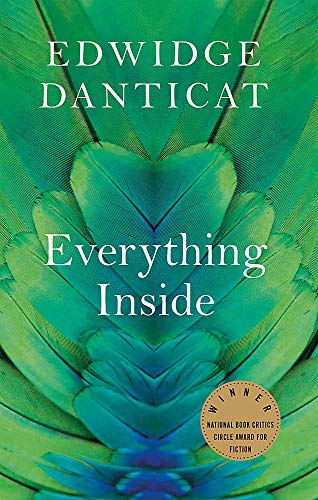
Edwidge Danticat’s Everything Inside

Edwidge Danticat, Everything Inside (riverrun 2019)

Edwidge Danticat (Haitian Creole pronunciation: ɛdwidʒ dãtika) is a Haitian-born writer whose first novel, Breath, Eyes, Memory, was published in 1994. Since then she has published other novels, short stories, children’s and Young Adult books, memoirs essays – a substantial body of work. Everything Inside, a collection of eight short stories, is the first of her books I’ve read, but I didn’t feel I was coming in late. Each of the stories is a fresh beginning, inviting the reader to enter into the lives, and in some cases deaths, of a newly-created group of characters.

Almost all the characters are Haitian immigrants to the US, or immigrants from other Caribbean nations. The stories mostly focus on relationships among women, often but not always with men in the mix – a dying father, one corner of a love triangle, an ex who has suffered a terrible loss, a sexual exploiter, the prime minister of a small Caribbean island nation. (The least successful story, ‘Without Inspection’, is the only one with a man at its centre.)The women’s relationships cross generational and class barriers, so that what emerges from the stories taken as a whole is a complex picture of Haitian diasporic life. In ‘Hot-Air Balloons’, for instance, a young woman’s college non-Haitian room-mate goes on a working trip to Haiti where she sees at first hand the terrible suffering of poor women at a rape recovery centre in a poor neighbourhood of Port-au-Prince. The room-mate decides at first to quit college in order to volunteer for the non-government organisation that arranged her trip. The young woman who stays behind does so because she wants her first experience of her parents’ home to be of its physical beauty, not of its suffering people. The story is told with deep sympathy for both points of view, but in the end we are left with an aching sense of the gulf between the hard-won privilege of the protagonist and those women at the rape centre.

The 2010 earthquake looms as a backdrop to some of the stories. Poverty and corruption in Haiti and Miami, and the US’s immigration regime have devastating effects on people’s lives, but complex human beings remain front and centre. As I read this book, I had at the back of my mind a quote from W E B Dubois in the ‘backmatter’ of the Afican-American comic series, Bitter Root (my blog post here):

All Art is propaganda and ever must be, despite the wailing of the purists. I stand in utter shamelessness and say that whatever art I have for writing has been used always for propaganda for gaining the right of black folk to love and enjoy. I do not care a damn for any art that is not used for propaganda.

(Criteria of Negro Art, 1926)

If this book is propaganda, it lacks the stridency or sense of hidden agendas usually associated with that term. But my guess is that W E B Dubois would approve of it as it asserts that ‘black folk’ do love and enjoy as well as laugh, weep, make music, form unbreakable childhood bonds, and face difficult moral dilemmas.

NSW Premier’s Literary Awards Night 2021

For the second year in a row, the NSW Premier’s Literary Awards Night has been an online event. I was one of 65 people watching it at the beginning, an audience that grew to 68 near the end. Not exactly the Oscars.

Here’s how it went:

After a number of introductory speeches – by State Librarian John Vallance who quoted Aristotle in the State Library’s Shakespeare Room, Wiradjuri woman Yvonne Weldon who welcomed us to Gadigal land, President of the Library Council of NSW George Souris, Minister for the Arts Don Harwin who promoted the government’s support for literature, Premier Gladys Berejiklian who came out as a passionate reader. We then went on to the winners, presented by John Vallance except where I note otherwise:

Multicultural NSW Award presented by Joseph La Posta, CEO of Multicultural NSW: Throat, Ellen van Neerven (UQP) – my blog post here. Ellen van Neerven skyped in. ‘This book has been more than just a book. It has been a chance to write alongside my mum among others …’

NSW Premier’s Translation Prize (awarded every second year) also presented by Joseph La Posta, to two winners: Imminence by Marian Dimópoulos, translated by Alice Whitmore (Giramondo) and Autumn Manuscripts, Tasos Leivaditis, translated by N. N. Trakakis (Smokestack Books). Both spoke beautifully; Nick quoted a poem.

Nick Enright Prize for Playwriting: Milk, Dylan van den Berg (The Street Theatre). In true theatre style, the winner thanked many many people, including ‘the Mob’ in the ACT.

Betty Roland Prize for Scriptwriting: Freeman, Laurence Billiet (General Strike and Matchbox Pictures). Laurence Billiet acknowledged her subject, Kathy Freeman. The novel was made during the Melbourne lockdown, ‘or should I say the Melbourne lockdowns’.

Patricia Wrightson Prize for Children’s Literature: The Grandest Bookshop in the World, Amelia Mellor (Affirm Press). ‘I was a broke student when I started writing this book.’ She thanked libraries for making the book possible.

Ethel Turner Prize for Young People’s Literature: The End of the World is Bigger than Love, Davina Bell (Text). ‘I am honoured and humbled and genuinely shocked.’ Among other people, she singled out her editor to thank.

Kenneth Slessor Prize for Poetry: Ellen van Neerven again.

Douglas Stewart Prize for Non-Fiction: The Warrior, the Voyager, and the Artist: Three Lives in an Age of Empire, Kate Fullagar (Yale University Press). Thanked the army of scholars who helped her write it. ‘I will donate some of the prize money to two scholarly organisations.’ One is a Cherokee organisation. The other is Pacifika Student Organisation.

UTS Glenda Adams Award for New Writing: Cherry Beach, Laura McPhee-Browne (Text). Interestingly, she thanked the judges by their first names. Her editor also got a big plug.

People’s Choice Award: The Dictionary of Lost Words, Pip Williams. when she has enjoyed a book she goes to the acknowledgements page and offers up a silent prayer of thanks to the author.

Christina Stead Prize for Fiction: A Room Made of Leaves, Kate Grenville (Text Publishing). ‘There is no best book, but the judges had to pick one, so thank you.’ She thanked the descendants of John and Elizabeth Macarthur for their generosity in depositing papers in the State Library, and spoke of Elizabeth Macarthur as a foremother.

Book of the Year, presented by the senior judge, Jane McCredie: Throat, Ellen van Neerven (UQP). They were stuck for words on their second prize, and even more so here. [Added later: But they did manage one glowing sentence: ‘It gives me a boost to continue doing what I’m attempting to do, which is to write as gently and as considerately as possible.’]

The Special Award: Melina Marchetta. Wow, and also Yay! Usually this prize goes to someone who is nearing the end of a career, possibly with death around the corner. Hopefully, Melina Marchetta has many years of creativity and literacy activism ahead of her. She spoke of how stories came into her life around a table during meals, and she wishes she could be with us in person. ‘I feel so much pride that I wrote my first novel on Gadigal land.’ And she expressed gratitude to her family who allowed her – ‘I don’t know if they allowed me, but I did it anyhow’ – to use their stories. She dedicated the award to her daughter.

That was it.

You can watch the whole ceremony at:

500 people: Week Ten

Continuing with the challenge to talk to 500 new people this year. See this post for the brief description of the challenge. The encounters in these posts probably break down half-and-half into conversations that would have happened in the normal run of things but that I’m noticing in a slightly different way, and those that I initiate because of the challenge. You can probably tell the difference just by looking.

  1. Sunday 18 April, walking down Alice Street in Newtown, we passed two Mediterranean-looking men staring into one of the tiny front yards. I didn’t hear what they were saying but I realised they were looking curiously at a couple of fruit trees. I stopped and said, ‘That’s a cumquat.’ ‘Ah,’ one of them answered, ‘yes, a cumquat. But what’s that other one?’ ‘It’s a guava.’ ‘Oh, guavas are delicious,’ he said, and I was flooded with fellow-feeling. The Emerging Artist, who was also there, hates the smell of guavas and refuses to taste them. ‘Do you think we could lean over and pick some?’ one of the men asked. ‘No, but they’re too green anyway.’ I told them where we’ll all be able to pick ripe guavas from trees growing in the street just a couple blocks away in the next couple of weeks. As I type this I’m salivating.
  2. Monday afternoon, at the sauna, where the Covid-safe limit of three people is still in force, person number 3 came out of the door just as I arrived. Alas, a hefty chap rose up from a nearby bench. ‘You’ve been waiting?’ I asked. ‘Yep,’ he said, smiling with relief that he didn’t have to fight for his rights. I went instead into the steam room opposite, from where I saw another bulky chap arrive a few seconds later and go into the sauna unchallenged. Never mind, I had the warm glow of having done the right thing.
  3. Tuesday evening, when the lights came up after the curtain calls at The Removalists at the New Theatre, I turned to talk to the person sitting directly behind me. This was mainly for the sake of this challenge, but also because I thought I might be about to clap eyes on someone who had giggled during a truly horrible moment in the play. It turned out it wasn’t the giggler, I could tell by his voice. I asked the young white man (knowing the answer) if the play was set for study at his school (‘Yes’) and if he’d read the script (‘Yes’). I said I liked the casting of someone who isn’t white as Kenny, the man who is beaten up by police. He agreed, and asked if I went to the theatre often. I laughed and said I’d been three times in the last four days. Suitably shocked, he asked if that was usual. I reassured him that I usually go every couple of months.
  4. Thursday morning at GymKidz, I asked a woman with BLAH printed on her T-shirt in rainbow colours if this was her first session – it’s the start of a new term. ‘We’ve been coming for a year,’ she said. I expressed surprise, as her daughter seemed to be about two and a half. It turned out that they started coming when her daughter was just 18 months old, and played in the free play times. Then someone made them a gift of a term’s enrolment, her daughter loved it and they’ve been coming steadily ever since. This conversation happened in three parts, in the interstices of the gym session.
  5. Thursday, a little later, as we were making our way back to our car, we fell in with another couple of mothers and children. I commented to one of the mothers that I liked her small son’s brightly coloured pants. Yes, she said, they came from Gorman’s, and she did her best to make sure he didn’t get caught in the standard dullness of boys’ clothes.
  6. Thursday, early afternoon at Sydney Park, looking for a patch of grass where we could have lunch, we passed what at first glance looked like a fine china tea-set on a blanket. On a closer look, I realised the cups and teapot were plastic – it was a children’s play set. I said something to the woman standing guard over the set. It doesn’t really matter what I said because, though she smiled as if she thought what I’d said was mildly amusing, I now think she didn’t understand a word of it: when an older woman turned up a few seconds later with two small children, they spoke to each other in what may have been Latvian.
  7. Friday evening. No words exchanged, but this was a sweet moment. Walking near the Marrickville Metro Shopping Centre, I heard loud music coming from a parked car, and saw a woman sitting behind the wheel dancing vigorously with a big grin on her face. As I came closer I saw that a young teenage girl was sitting in the front passenger seat, looking cheerfully mortified. I smiled broadly and muttered under my breath, ‘What an embarrassing mother!’ She couldn’t possibly have heard me, but the girl smiled back and waved her arms in shadowy imitation of her mother, who also grinned in my direction.
  8. Saturday, on our morning circuit by the Cooks river, we passed a man with his toddler daughter who was insisting on walking back over a little wooden bridge to hear the sound it made as she walked on it, while the mother stood patiently with the stroller at the other end of the bridge. We stomped a little as we entered the bridge and earned a wide-eyed stare from the little one. As we passed the mother she said, ‘You can see why walks always take forever.’ ‘And it stays that way for years,’ I said.
  9. Later on Saturday morning, coming out of the Metro shopping centre, I saw a man with two small boys. He had lifted one of them up and was speaking sternly, and intimidatingly. into the small one’s face: ‘You have to wait for me. You can’t go out there by yourself.’ Seconds later, the boys were happily leading him towards the little water feature. ‘You can only look,’ he said, still sternly clearly having given up on the intimidation tactic. ‘You can’t get wet.’ I laughed and said, ‘Good luck with that one.’ ‘It’s a never-ending battle,’ he said. [This interaction is no less evanescent than any of the others, but I like to think that a friendly, amused word from another adult can be a huge help when parent-child tensions are brewing.]
  10. Saturday, a few seconds later, I stopped to draw Ruby’s attention to the toy monkey she had first noticed more than a year ago hanging from a high branch. [We were enjoying the rare treat of a weekend visit from Ruby and her father.] As we all strained to see the monkey, another family group coming the other way stopped to see what we were looking at. I explained, ‘We have to look at it every time we come past.’

Running total is now 91.

Jeff Sparrow’s Fascists Among Us

Jeff Sparrow, Fascists Among Us: Online hate and the Christchurch massacre (Scribe 2019)

The central character of this book is the man who murdered 51 people in Christchurch mosques in March 2019. He is never referred to by name, but is called ‘Person X’ throughout. This is partly in deference to Jacinda Ahern Ardern’s plea, ‘Speak the names of those who were lost, rather than the name of the man who took them.’ But it is also a strategy to turn the reader’s attention away from the murderer’s personal psychology and towards his broader social and political context, to see him not as some kind of lone madman, but as part of a small but thriving fascist movement, ‘an anonymous young man who emerges from the shadows, gun in hand, already committed to an evil ideology.’ To use the terms of Jennifer Maiden’s The Cuckold and the Vampires (my blog post here), Jeff Sparrow is interested in the macrocosm rather than the microcosm.

Person X (as I will also call him) wrote a 74-page manifesto that was (and probably still is) available on the internet, linked to the video he made of his rampage. Journalists mostly dismissed this manifesto as unhinged ravings. Jeff Sparrow has read it, and argues that it expresses ‘with stark clarity’ a distinctive political platform. I don’t have even the slightest urge to read the manifesto; I’m grateful to Sparrow for reading it for us.

Sparrow argues that Person X’s manifesto wasn’t intended for a general audience, but was/is part of a conversation and a culture which this book sets out to explicate. Person X is a real fascist – not a generic right-wing extremist, but a follower of actual fascists, particularly Oswald Mosley, who unlike Hitler and Mussolini survived the Second World War and preached a Europe-first fascism for the post-war era.

One of the distinguishing features of fascism is the upholding of violence not just as an acceptable means to an end, but as a good thing in its own right. Sparrow gives a fascinating account of the repellent debates among the online fascist groups, mainly in the USA but also in Australia. After the Unite the Right rally in Charlottesville in August 2017 in which men with tiki torches chanted, ‘Jews will not replace us,’ and anti-racist Heather Heyer was killed, most of these groups decided that their movement wasn’t ready for mass action in the streets. Donald Trump’s famous ‘fine people on both sides’ comment wasn’t enough to fortify them – and Trump himself was no fascist, though he provided a favourable context for fascism to grow. Many of the keyboard warriors weren’t up to having their photos made public, and the sheer size and energy of counter-demonstrations whenever they planned a further demonstration made them look ridiculous.

So they generally withdrew to the internet, where they infiltrated – or rather coalesced with – troll culture and ‘shitposting’. They would post horrific things in a way that you couldn’t tell if they were serious or just joking, aiming to ‘own the libs’. They became expert in developing and circulating memes. This was Person X’s home ground, and – Sparrow argues – the stuff in his manifesto that some commentators took to be incoherent ravings was really in the vernacular of The Daily Stormer and 8chan. He wasn’t prominent in Australian fascist groups, but he was known as an active participant. (Sparrow’s account of Australian fascism should bring a blush to the cheeks of many journalists who have described key fascists as activists and given them a platform.)

Person X’s murderous spree was a deliberate intervention in the debates among fascists. Acknowledging that the time was not ripe for organised action, he offered a model of ‘lone wolf’ terrorism. He took the form of the ‘autogenic mass killing’ – a lone man with a gun who lashes out – and recast it as a political act. It’s not violence against significant political targets, like assassinations or even the 9/11 attacks, but it sets out to intensify the existing sense of crisis (including the climate emergency crisis), and push towards total destabilising of society and the recovery of some sort of ethnic purity:

Person X presents a systematised manifesto calling for racist terror in the name of a social disruption he thinks will culminate in ethnic cleansing and genocide.

It’s an evil program, the wickedness of which is not diminished by its self-evident impossibility. But impossible programs still attract followers, irrespective of their wickedness.

(page 92–93)

And already when Sparrow was writing this book there had been a number of imitators who explicitly mentioned Person X and his manifesto in their own utterances.

Fascists Among Us was written and published well before the events in Washington on 6 January this year. It seems that the strategy of organised street violence hasn’t been relinquished as thoroughly as Sparrow believed. But his warning that it’s important to understand people like Person X stands. This is a short book, a quick read, and though Person X has been tried and sentenced, Donald Trump is no longer President of the USA, and almost certainly the debates and practices of fascists in Australia and worldwide have moved on, it offers important insights into a clear and present danger.

The Book Group and David Williamson’s Removalists

David Williamson, The Removalists (Currency Press 1972)

Last night the Book Group had an extracurricular outing to see David Williamson’s play The Removalists at the New Theatre (which is about as new as the Pont Neuf in Paris).

Written before the outing: I have a soft spot for this play. I saw the first Sydney production at the Nimrod Theatre in 1971, an astonishing 50 years ago, as part of the exhilarating resurgence of Australian theatre at the time. In early 1973, the first copies of the book arrived in the Currency Press office soon after I started working there in my first real job – it was a big seller for them, and as far as I can tell is still selling well. I visited the set of Tom Jeffreys’ film in 1974, and was in awe of the intense inner focus of actor John Hargreaves as he waited for the cameras to roll.

Before our theatre outing I revisited the book – a first edition, stiff and yellowing on a shelf near Alex Buzo’s Macquarie and Dorothy Hewett’s The Chapel Perilous. In a successful bid for the educational market, Currency’s founders, theatre critic Katharine Brisbane and her scholar husband Philip Parsons, prefaced the text of the play with two essays, ‘Reflections on Violence’ by historian Ian Turner, and ‘Authority and Punishment’ by eminent defence lawyer Frank Galbally (who is mentioned in the play) and Kerry Milte (who was soon to become the subject of interesting dramas of his own). John Bell, who directed the Nimrod production, has an afterword, and the front and back covers fold out to reveal cartoons by Bruce Petty. I haven’t seen the current edition of the book, but the image of the cover on Currency’s web site mentions Galbally and Turner, but not Petty.

This prefatory material is all about violence and authority. Ian Turner sums it up well:

The Removalists raises three questions: one sociological (is Australian society violent of its essence?); one political (do the forces of ‘law and order’ rest on violence?’); one psychological (do all of us have the kinds of aggressive instincts or behaviour patterns which Williamson depicts?).

The essays talk about the streak of male violence in Australian culture (what would today be called toxic masculinity), and they talk about historic violence against First Nations peoples and Asians, especially the Chinese on the goldfields. The domestic violence at the heart of the play is barely mentioned. John Bell does offer an early version of what has become a common observation abut Williamson’s writing: strong women actors are necessary to stop the female characters from ‘degenerating into stilted, unconvincing types’. The edition of the book currently on sale may have been updated. Certainly, in 2014 Currency published ‘The Unexpected Feminist’, a feminist reading of the play by Van Badham (online here).

In case you don’t know the plot: two women, sisters, turn up at a two-man (sic) police station asking for a document establishing that the younger woman has been assaulted, in order to legitimise their plan to move her and her baby out of the marital home while her husband is out at the pub; the older policeman, with sleazy motivation, offers to come and help the move; the younger policeman, fresh out of training, goes along unwillingly; at the home, the husband comes home unexpectedly, and the situation escalates into lethal violence.

Reading the text, I imagine that a successful staging in 2021 would have to take into account our much better understanding of domestic abuse and violence, and our (I hope) intolerance of having it minimised. Though the play doesn’t endorse the way the sergeant and the husband make light of the DV, it isn’t much interested in it except as precipitating violence among the men. Some of the minimising language could have come from the pages of Jess Hill’s See What You Made Me Do (my review here). John Bell’s comment about how much depends on the women actors has become much weightier with age.

The outing: Nine of us, including two ring-ins, had a cheerful Thai dinner across the street from the theatre. When we crossed over 15 minutes or so before lights down, fate decreed that the third row from the front, in my opinion the best seats in the house, was empty. There was a sizeable audience, almost all of whom I’d guess were high school students who have the play as a set text. It was exhilarating to be in a big live audience full of youthful energy – for some of the Book Group it was the first time they’d sat shoulder-to-shoulder in a theatre since the beginning of Covid days.

I had been wondering how the play would deal with #MeToo. It turned out that Johann Walraven, the director, was more interested in how it relates to #BlackLivesMatter. This was announced in the first moments. As the lights come up, while the two policeman are seen in the shadowy police station on stage right, an Aboriginal man watches a flickering TV screen in his living room on stage left. He turns off the television and walks out of the room, the lights come up on the police station, and the play as written, in which all the other characters are white, begins. The production doesn’t take any liberties with the script, but the power plays of the other characters in relation to Kenny, the husband (Alfie Gledhill), are now seen through a racialised lens. In a climactic moment there’s a George Floyd reference that feels absolutely integral to the play, and is gutting.

The misogyny was still unsettling. It’s there from the opening scene in which the Sergeant gives voice to the myth of false rape claims, through Kenny’s minimising of his violence against Fiona (Eliza Nicholls), to a sleazy discussion of sex-workers towards the end. It’s meant to be unsettling: it’s the thing about the Sergeant that makes us realise he’s something much uglier than a harmless scallywag who plays the system. And Kenny’s talk of ‘love-taps’ is echoed by the Sergeant later in reference to his own ferocious assaults on Kenny – no minimising possible there, as we’re seeing it for ourselves. I imagine it would have to be written differently today, but the audience is left in no doubt that this is a scene that the two women are smart to be getting out of.

My abiding impression from the 1971 production at the Nimrod Street Theatre is of Max Phipps as Ross, the young constable. It was his transformation from gormless innocence to rage, violence and cunning that burned the play into my memory. Last night, the play belonged to Laurence Coy as the Sergeant. Lecherous, self-righteous, bullying, vicious, self-pitying, out of control, blustering, I’d thought of the character as little more than a crucible for Ross’s transformation, but in this production he’s a tortured human being, and Ross (Lloyd Allison-Young) is pretty much collateral damage. Possibly the most powerful moment last night wasn’t in the big, horrifying violence, but a small moment that almost didn’t happen. In the middle of a rant about self-control as the test of manhood, the Sergeant shouts that his wife had twenty-seven kidney fits after childbirth. Kate (Shannon Ryan), the obnoxious older sister, moves towards him, and says gently, ‘Twenty-seven kidney fits. That’s terrible.’ In a fleeting moment of humanity, the Sergeant says, ‘Yes. We gave her up at one stage.’ In classic David Williamson style, the moment is undercut with some rough humour, but the actors caught this tiny wisp of tenderness and vulnerability and made sure we saw it.


Full disclosure: Laurence Coy is a member of the Book Group – but he really is that good in this play.

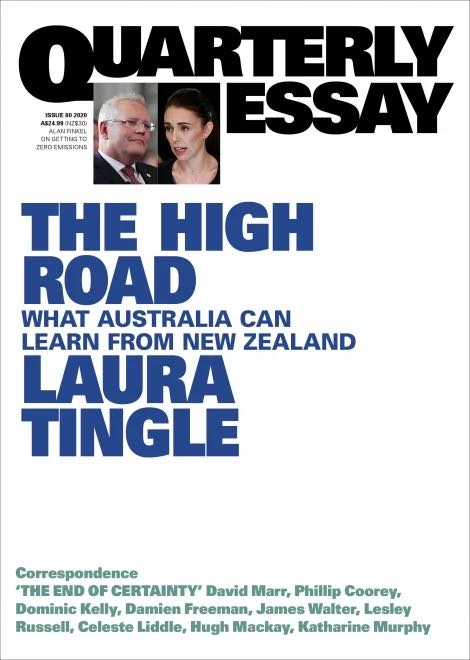
Laura Tingle’s High Road

Laura Tingle, The High Road: what Australia Can Learn from New Zealand (Quarterly Essay 80) – and correspondence from Quarterly Essay 81.

The High Road is Laura Tingle’s fourth Quarterly Essay, making her possibly the series most frequent contributor. Great Expectations (QE 46 2012) dealt with Australian expectations of government, Political Amnesia (QE 60 2016) with failing institutional memory, and Follow the Leader (QE 71 2018) with political leadership in the modern world (links are to my blog posts). The High Road presents an abridged comparative chronology of Australia and Aotearoa New Zealand: both began as colonies of England, and both were cut adrift when the UK joined the EU, and they have taken very different, though parallel paths since then, while for the most part doing their best to ignore each other.

The essay begins with the stark contrast between Jacinda Ahern’s decisive response to the Covid crisis and Scott Morrison prevarication and ambiguity, and goes on to make broader comparisons between the two leaders that are all unflattering to Morrison. But when the essay goes back to sketch the histories of the two nations, the comparisons don’t always favour Aotearoa New Zealand.

Aotearoa New Zealand doesn’t have a written constitution. It does have the Treaty of Waitangi, which laid the basis for a mutually respectful relationship between Māori and Pākehā. The treaty was largely ignored by settler society until the second half of last century, but it has been since taken seriously and provided a basis for major advances in Māori status and conditions, and for compensation for past injustices. Compare this to Malcolm Turnbull’s offhand dismissal of the Uluru Statement from the Heart’s call for a makaratta and a Voice to Parliament. In Aotearoa/New Zealand politicians of all stripes speak of ‘honour’ in relation to the Treaty, a word we will wait some time to her in the Australian Parliament.

Neo-liberalism has come like a plague to both countries. It hit Aotearoa New Zealand harder. Because there is only one house in their Parliament, and there are no states, a Prime Minister with a majority can override opposition to an economic program, which is what happened with ‘Rogernomics’ – a ‘deregulatory frenzy’ in the 1980s, which has made New Zealand ‘a stellar example for those wanting less government, less tax and more markets ever since’, and has also brought about a huge amount of human suffering. On this side of the Tasman, when Hawke and Keating set out with similar aims they had to compromise and set up a certain level of protection for the vulnerable.

On the other hand, because Aotearoa New Zealand has an electoral system that makes it less likely than in Australia that any one party will have a clear majority, and though Jacinda Ahern has one currently she chooses to work collaboratively in the manner to which she has been accustomed. Their electoral system means that parties that appeal to the centre are more likely to gain power – unlike in Australia, where the major parties (especially the LNP?) can be held captive by their extreme elements.

Laura Tingle’s starting point is that most Australians are fairly ignorant about the history of our most similar near neighbour. She’s certainly right about me, and I’m less ignorant for having read the essay.

The correspondence in the following Quarterly Essay, Alan Finkel’s Getting to Zero – from historians and journalists from both sides of the Tasman, economists, lawyers and politicians – largely amplifies the thesis of this one, with some minor disagreements and several pointed anecdotes. Historian Frank Bongiorno, for instance, reminds us of the underarm bowl by Australian Trevor Chappell in a 1981 cricket match, saying this ‘ugly’ tactic was ‘the emblematic event in the trans-Tasman relationship’ of his childhood, even after New Zealand took a stand against US nuclear weapons and Australia remained supine.

The most telling pieces of correspondence are from First Nations writers.

In particular, Bain Attwood from Monash University and Miranda Johnson from the University of Otago argue ‘that relations between white settlers and Indigenous people in Australia and New Zealand did not actually follow a significantly different course after their beginnings’, that in both cases Indigenous people lost their resources or autonomy or both. As to the difference in the degree to which each country has sought to address historical injustice:

Rather than simply attributing this to the presence or absence of normative, moral, legal, philosophical and political forces in the governments, as Tingle does, it makes more sense to take note of the role played by material factors – for example, the fact that Māori are a much larger minority in New Zealand than Aboriginal and Torres Strait Islander people are in Australia or that there was less post-war non-British migration to New Zealand than to Australia. Unforeseen consequences of government policies and practices must also be taken into account. For example, the New Zealand Labour government in 1985 had no inkling that granting the Waitangi Tribunal the authority to hear cases about historical breaches of the treaty dating back to 1840 would lead to a veritable flood of claims and the compensation of many Māori iwi (tribes).

In her reply to the correspondence, Tingle focuses on the Covid pandemic and the difficulty of landing ‘a definitive portrait of my fleet-footed and shape-shifting subject, Australia’s prime minister’. Someone said journalism is the first rough draft of history. Laura Tingle is a top-ranking political journalist, and this essay is an excellent draft of significant history.


The High Road is the eighth book I’ve read for the Australian Women Writers Challenge 2021.

Jenny Blackford’s Fil and Harry

Jenny Blackford, with illustrations by Kristin Devine, Fil and Harry (Christmas Press 2021)

Christmas Press is a small, Armidale-based publishing house set up about seven years ago, initially intending to publish ‘beautiful picture books for children, featuring traditional tales — folk tales, fairy tales, legends, myths — retold by well-known authors and stunningly illustrated in classic styles that reflect the cultures the stories come from’. Since then their list has expanded, and in 2018 they began to publish chapter books/junior fiction. The world of Australian children’s literature is all the richer for their existence.

In the chapter book Fil and Harry, Fil has to negotiate the perilous world of primary school relationships, deal with an oblivious older brother, resist an over-zealous quasi-stepmother named Elspeth, and cope with life in general. Then her cat Harry starts talking to her. He not only talks, but he lends a sympathetic ear (not something I would expect of a cat, but I suppose I’m more of a dog person). And then he intervenes in ways that are definitely catlike – accidentally on purpose making life hard for those who deserve it and seemingly effortlessly make things go better for the afflicted.

The pencil drawings by Kristin Devine that are scattered through the text add depth to the tale’s sweet warmth. I especially like the double spread of Fil’s empty room with light and breeze billowing the curtains.

It’s a quiet, companionable tale that is just the wrong age for any of my young friends and relatives, so I get to enjoy it just for myself.


Fil and Harry is the seventh book I’ve read for the Australian Women Writers Challenge 2021. My copy of the book is a gift from the author. Full disclosure: when I was editor of The School Magazine we accepted a short story, ‘Barry’, that was published in the magazine in May 2006. Since then the cat’s name has changed and the story has grown longer and deeper to become this chapter book..