China Miéville’s Scar

China Miéville, The Scar (Del Rey Books 2002)

scar.jpgThis was another gift from the Street Library gods. A couple of pages into it, I realised that it was set in the same world as China Miéville’s Perdido Street Station, which I read many years ago. It’s not a sequel. As far as I recall (which I admit isn’t far) no characters have made the transition from the earlier book, but it packs a similar narrative punch and is populated by a similar range of fantastical creatures who engage in the same blend of steampunk science and magic (thaumaturgy) in the same teemingly complex universe (which I hope never gets made into a CGI-based movie).

The story involves an immense sea monster that is tamed and/or drugged into towing on huge chains a pirate city made up of hundreds of lashed-together vessels small and large. It features sentient beings known as the anophelii, whose chronically famished females attack any creature with blood in its veins and suck it dry in seconds, and whose males, whose mouths resemble anal sphincters, live lives of weirdly passive abstraction. It includes, not necessarily in order of importance, vampir (sic) bureaucrats, cactus people, probability mining (I won’t try to explain), fabulously bloody sea battles, a sweetly tragic love story (not of the romantic variety), a vast crack in the universe, and a charming account of the process of learning to read.

I read somewhere that a secret of good fantasy writing is to give the reader cool stuff now, and then cooler stuff later – that is, not to have a terrific climax preceded by a hundred pages of so-so build-up. The Scar is profligate with cool stuff.

I could go on, but I’ll finish off with a taste of Miéville’s prose (I don’t think it’s a spoiler to tell you that the characters are descending in a tiny deep-sea vehicle):

After uncountable minutes, the darkness outside was momentarily broken, and the crew gasped as time returned to them like an electryc [sic] shock. Some living lamp was passing them by, some tentacular thing that inverted its body with a peristaltic wave, enveloping itself in its luminescent innards and shooting away, its austere glimmer snuffed out.
Chion ignited the lamp at the bathyscaphos’s front. It stuttered on, its phosphorous glow casting a cone of light. They could see its edges as clearly as if they were marble. There was nothing visible in the lamp’s field except a soup of minute detritus, particles that seemed to eddy upward as the Ctenophore plunged. There was nothing to see: no ocean floor, no life, nothing.That crushing emptiness they had illuminated depressed them more profoundly than the darkness. They descended unlit.

The book may not be to everyone’s taste, but I found it full of delights.
Rose Tremain’s Restoration

Rose Tremain, Restoration (©1989, Sceptre 1990)

Irestoration.jpg read this book – another gift from strangers by way of our little Street Library – while in London with the Moving Hearts Project, which regular readers will know involves shaping hearts from clay. It was a lovely bit of serendipity that in the first couple of pages the narrator, an anatomy student in the mid 17th century, is ‘forced to contemplate an astounding phenomenon’:

I am encircling a human heart, a living human heart with my hand. I am now, in fact, squeezing it with controlled but not negligible force.

I had been doing the same with a heart of clay just minutes before I read that.

Robert Merivel, the narrator–hero, quits medicine for the pleasures and intrigues of the court of Charles II, where he sees himself as a kind of beloved fool. His fortunes rise, and fall dramatically. He finds himself working with an austere group of Quakers in an insane asylum, and again falls from grace. Merivel is his own worst enemy: his heart is in the right place but another part of his anatomy is too often in the wrong one. The book is often very funny, with moments of tenderness and heartbreak.

I haven’t read Pepys’ journals, but I’m guessing that the book owes quite a lot of its tone and ambience to them. I’m pretty sure that Pepys himself makes a brief unnamed appearance.

I enjoyed the book hugely. It was an extra pleasure to read it in London. I regularly walked around Lambeth and Vauxhall, where Merivel rides his horse through the woods (no woods there now), or beside the Thames as Merivel does. The echoes intensified my enjoyment of both the real and the imagined London. Though it doesn’t snow in the novel as it did in my time there, and there was no plague that I knew of in 2018 London, I was particularly struck by this little moment, which also gives some idea of Merivel’s voice:

I stood still and took my first breath of the city. The scent of the air dod not seem to have been altered by the presence of the plague. What I did notice at once, however, was a strange quietness in the street and beyond it, which was like the quietness of snow. It was as if the city had fallen into a trance, or else become a place that I was not really standing it, but only saw and heard from a long way off.

I gather Merivel is the hero of a second book by Rose Tremain. If it turns up in our Street Library it will be hard to resist.

Hearts in London, 4

img_2243

Two members of Amnesty International outside Australia House in sub-zero temperatures bear witness on behalf of people opposed to the Australian government’s treatment of people seeking asylum and refugees on Manus Island ad Nauru. Neither of them is Australian.

Hearts in London (continued)
(Previous parts herehere and here)

So we pressed on, launched, with girded loins.
Days blurred as we bused clay
from N9 to SE17 at £1.50 a trip.
Fearing Oz flu we registered
with the NHS and got shots

at miraculous short notice. Our health
was no problem, but neoliberalism
and global warming were: a picket line
blocked our venue and the melting Arctic
sucked warmth from London. Numbers were down

but not out. Earworms thrived. Don’t go breaking my …
couldn’t if I tried
. / Il neigeait, il neigeait,
il neigeait.
 / Take any heart take mine, / snow
falling faintly and faintly falling, upon all the living
and the dead.
/ And Pharaoh’s heart was hardened. / As snow

in Aprylle, That falleth on the flowr / melts away like
snow in May as if there were no such cold thing.

And it grew warm again. In St James’s Park
seagulls were on thin ice and fat grey squirrels
froze like water dragons. And all the while

(To be continued)

Roxane Gay, Ta-Nehisi Coates and others’ Black Panther

Roxane Gay, Ta Nehisi-Coates, Yona Harvey and Rembert Browne (writers), Alitha E Martinez and Roberto Poggio (main artists) and others, Black Panther: World of Wakanda (Marvel 2017)
Ta-Nehisi Coates & Yona Harvey (writers), Scott Hanna (main pencils), Dan Brown (main colorist) and others, Black Panther & the Crew (Marvel 2017)

My resolve not to read any more superhero comics weakened when, soon after seeing Ryan Coogler’s fabulous Black Panther movie, I spotted these books written by, among others, Ta-Nehisi Coates, author of Between the World and Me, and Roxane Gay, who was a fabulous guest at last year’s Sydney Writers’ Festival. I bought them as a gift for the son who generally gives me comics – and read them first.

ww

I’ve been lured to superhero comics by big name writers before, and been disappointed. Josh Whedon’s Astonishing X-Men and Neil Gaiman’s Marvel 1602 left me cold. Alas, so did these two.

World of Wakanda comprises three origin stories of characters who I assume feature in the Black Panther series proper. There’s a permeating sense that the main action is happening between episodes of these stories or is yet to come. Occasional footnotes refer the reader to other comics. Oddly, even some of the key moments in Roxane Gay’s story, which is the longest and most interesting, happen off the page.

Without the in-house Marvel elements, Gay’s story is of a kind that’s banned from my (mostly Lesbian) Book Club: a Lesbian story in which the Lesbianism is not incidental to the plot. I’m guessing that for Marvel cult members the story will work as thrilling feminist subversion of the prevailing indiviualistic male domination. I can applaud that at a notional level, but meh, I’m not part of the target readership. bp&C

Black Panther and the Crew is another origin story. Again, as evidence that I’m not the target readership, I found the superhero elements a fairly repugnant intrusion into a story about African American politics. I was with Brecht’s Galileo: ‘Unhappy is the land that needs a hero.’ I also found it hard to follow at times, possibly because unlike proper Marvel readers I don’t recognise the superheroes who make up ‘the Crew’ (and before them ‘the Crusaders’) and almost certainly because my grasp of Marvel’s visual language is patchy.

Both books include advertisements for the three volumes of Black Panther: The World Beneath Our Feet, the main Black Panther story written by Ta-Nehisi Coates. Even if I don’t read those myself, I’ll keep an eye out so I can include them in my gift to my son.

Amitav Ghosh’s Flood of Fire

Amitav Ghosh, Flood of Fire (Straus and Giroux 2015)

flood.jpgWhen we set up a street library out the front of our house, we intended it as a way to send books from our shelves to good homes. We hadn’t thought about the reverse traffic: this book is like a gift from the benevolent Street Library deity. I loved the first two books in the Ibis trilogy when I read them for the book group some time back. When this third book urned up on our front fence I  snuffled it gleefully.
I started reading it on the plane from Sydney to Singapore and finished it after a little more than a week in London, where I’m staying in culturally diverse Walworth (or SE17, to use the locals’ preferred term). That’s an eminently appropriate way to have read it.

The flood of the title is the firepower unleashed on China by the British in what is now known as the First Opium War in the mid nineteenth century, and the vivid account of that assault, including the brutal use made of Indian sepoys, is a salutary reminder of the blood-soaked foundations of England’s prosperity. By happy coincidence I just found this in my twitter feed:

That – or at least the similar events a couple of decades earlier – is the big historical event that provides the context and is front and centre for quite a lot of the narrative, but on the way we follow the adventures of a handful of characters who sailed on the Ibis in the first book, and whose paths continue to cross in unexpected ways. There’s comedy, melodrama, romantic tragedy, a sustained bawdy episode, and always a dizzying interplay of cultures.

I love the way Amitav Ghosh incorporates his research into the narrative. To give just one small instance, after an encounter in which the Chinese forces were routed:

There were corpses everywhere, many of them with black scorch-marks on their tunics. On some, the clothes were still burning: looking more closely, Kesri saw that the fires were caused by a fault in the defenders’ equipment. The powder for their guns was carried not in cartridges, as was the case with the British troops, but in rolled-up paper tubes. These tubes were kept in a powder-pouch that was strapped across the chest. In the course of the fighting the flaps of these pouches would fly open, spilling powder over the soldiers’ tunics; the powder was then set alight by the wicks and flints of their matchlocks.

I don’t suspect for a moment that Ghosh has made this up. Along with the horror, you can sense the novelist’s exhilaration in finding such telling details. I suppose you might read it as an info-dump that distracts from the story, but from my point of view it’s an info-dump that enriches the story with a sense of historical truth.

Similarly, I relish Ghosh’s seemingly endless play with language. I’d call this inventive if it didn’t seem to be the result of arduous research into the many englishes of South, Eastern and South-east Asia. This play is everywhere, but nowhere more joyful than in the pages where a sternly moralistic mem sah’b demonstrates her vast repertoire of synonyms for male masturbation. There a re many sentences elsewhere that, if taken out of context, would be mystifying. I defy you to guess the meaning of, ‘It isn’t decent for a girl to talk to mysteries.’

I had one discontent as I read. Neeti, the character who was in some ways the warm heart of the first book, is no longer a presence. We left her on Mauritius in the second book, and this one is set entirely in India, China and places nearby. But Ghosh is no idiot. My discontent was surprisingly and satisfactorily dealt with in the very last page.

Hearts in London, 3

Hearts in London continued
(Previous parts here and here)

hearts

became a fluttering message wall. Let me
digress to tell my own hearts story.
I’ve been a close observer, played a small part
from the start, fetching and
carrying, listening, responding, trying and

erring, donning the apron and making and
wrapping and unwrapping hearts. Always
seeing the tapestry from behind, all hanging
threads and tangles. I’ve seen people’s tender
reverence with hearts that they

or others have made. I’ve seen
amid what seemed idle chatter, the moment
when someone takes a stylus to write
words straight from heart to clay:
‘heavy’, ‘shame’, ‘humanity’, ‘sacred’.

I walked the spiral in December. Such
a long way in. My chosen parcel
hard, rough, fragile. Its maker had written
‘Hope’. The walk out of the spiral
seemed endless. So many tiny clay effigies,

so many lives laid waste, so many
of us so ineffective. Those hundreds of little things,
cluttering my life for months, suddenly grabbed
me by the throat. And here we are in London.
When Penny finished speaking, she invited

people to inscribe the hearts we’d made that day,
and they did: ‘No walls,’ ‘No borders,’
‘The human race is one.’ Outside
was winter and night. But at the launch
something glimmered.

(To be continued)

Hearts in London, 2

IMG_3850

Part of the installation of Hearts at Circular Quay in December 2016

Hearts in London continued
Part 1 here.

On the Tube from Arsenal to Elephant
and Castle, a boy frowns over buttons,
dials and switches on a tiny cube. A woman
flashes me a warning smile, ‘He’s my son, and
I see you looking.’ So I ask him what it is. ‘A thing

for people who have restless hands.’
His father adds with what may be
a Dutch accent, ‘It’s called a Fidget Cube.’
We’ve spent the afternoon with Sue and David
wedging clay (like kneading dough, but thumpier)

at Clay Time in N5 where Jawad our host
told migration stories to rival the worst
of Australia’s (well, not quite up
to Manus and Nauru standards, but bad),
and Brexit as a vicious assault on so many.

That’s Thursday. Friday we meet again to shape
clay into hearts – with aorta, vena cava and
sundry pipes – in six easy steps, in a windowless
room in labyrinthine King’s College London:
forty-three hearts in a tray by half past four,

then on to the launch of a new iteration
of Penny’s Connecting Hearts Project
which is, after all, why we’re here.
Nibbles and drinks and meet-and-greet chat
in a room that till 4 had been a student caff,

then Anna Professor and Jim Academic
and Emily from the Museum of Migration
spoke of the project’s UK context, and
conticuere omnes intentique ora tenebant
(don’t worry about the Latin, it’s just a little joke):

Penny spoke. Two years ago, as she tells it,
she woke from a dream of a heart being ripped
and stabbed and, not knowing why, she began
to shape in clay what she hoped was a humanish
heart. And the clay gave her hands an idea.

By the end of the year, more than four hundred people
had learned to shape humanish hearts
in clay, and had made one for each person
who’d come to Australia for refuge and been detained
with small hope of release on Manus Island or Nauru.

Among the early heartmakers were Rohingya
women who first drew barbed wire in the clay
and then wrote words: ‘I want my husband
in Manus.’ Long-ago refugees from Croatia
sang old songs and shed big tears.

Immigrants, children of immigrants, refugees,
activists, people of faith, artists,
even ceramicists sat at her tables and sweated
their DNA into the clay as they shaped it,
took up a stylus and made their marks.

Weirdly contorted, like arthritic hands
or slaughtered wild creatures, no two the same,
each one an oddity, they grew to an army
inanimate, cool, waiting for the breath
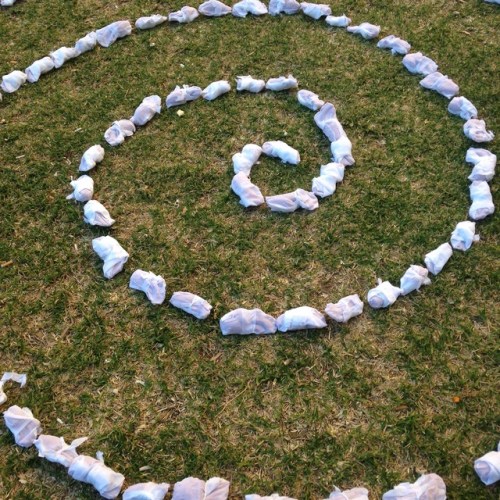
of life. She filmed them in a field like

casualties of war. She laid them in a circle
wrapped in muslin, and invited people
to unwrap them, to write on the cloth
(‘I’m sorry’ ‘I am ashamed’ ‘I will not
forget that you are there’). In December

a vast spiral (‘So many lives in limbo’)
at Circular Quay: a thousand passersby
entered, walked the meditative shape,
took a moment from the endless noise
and let it sink in (‘So many lives’). A fence

became a fluttering message wall.

(More to come)

Hearts in London, 1

hearts.jpg

Hearts and a woman I’ll sing, but first a word
about another woman. I forget her name.
She had progressive aphasia. When I knew her
she hadn’t lost speech altogether
but would sing instead in a rough plainchant.

I thought she was being cute, but it was terminal.
She came to mind as I tried to write about Penny’s
Connecting Hearts project. My prose wouldn’t rise
to the task. So I invoke my late friend
(whose name may have been Joyce) and try again

in rough improvised verse. On Valentine’s Day
(also Ash Wednesday) Penny and I flew out
with thirty clay hearts in our carry-on. Hearts
are no problem for Border Force (I’d worried
theymight look like grenades) and soon

we were in Singapore, wearing red
to usher in the Year of the Dog and reading
our horoscopes writ large: Penny’s a Rabbit
and will reap what she sows in her travels.
I’m a Pig and should be mindful of my words.

I was reading some Amitav Ghosh, his
cultural mishmash perfect for the place.
We saw Monet and Manet, CornBread and Banksy,
Anish Kapoor and a durian iceblock,
noodles and pratas, hot pots, kopi and heat.

Then with our hearts back into the sky
for fourteen uncomfortable hours
silent spectacular screens on all sides (I can’t
or won’t use earphones on a plane), to reach
London SE17 at half past one a. m.

weary and jetlagged and wondering what
we were here for. That was Sunday.
On Wednesday, we had our first meetings
with Anna and Jim and Vinya and Olla
and Jawad, and we were at work.

[In the next episode, the back story.]

Overland 229

Jacinda Woodhead (editor), Overland 229 (Summer 2017)

overland229

My blog post about Overland 228 ended with a lament that I had lost my copy before I could finish reading it. To my surprise and delight, a couple of days after my blog post went up, I received a replacement copy in the mail with a friendly note from Jacinda Woodhead. I don’t know what pleased me more, the kindness of the gift or the fact that someone on Overland‘s staff had read my post all the way through. (I realise just now that I didn’t write to thank her. Better late than never: Thank you, Jacinda, especially for the chance to read Jennifer Mills’ conversation with Peter Carey.)

There’s lots of good stuff in issue 229, but I’m travelling and have to be brief. So here’s a list of things I found particularly wonderful:

  •  ‘Indefatigable Wings‘ by Allan Drew, which argues the case for the continuing influence John Milton, of Paradise Lost fame. The argument doesn’t completely convince, but it’s refreshing.
  • Napalm, guns & underwear‘, in which Aotaroan / New Zealander Michalia Arathimos tells the story of her Maori environmental activist partner’s arrest (and subsequently release) on terrorism charges. It’s a tale of dangerous absurdity.
  • Sleeping the deep, deep sleep‘ by Dean Biron and Suzie Gibson, an essay about the state of the world which begins with the photograph of the Earth taken from Apollo 17 in 1972 and ends with Voyager I’s 1990 photograph. Carl Sagan’s description of the latter photograph as showing ‘a tiny blue dot suspended in a sunbeam’ takes on tragic resonances. (I also liked the phrase ‘rouge states’, which may have been an original typo or, I hope, a typo quoted from the Spectator.
  • On sovereignty‘, a column by Tony Birch spelling out the epochal implications of the Turnbull cabinet’s summary rejection of the Uluru Statement from the Heart.

Every edition of  Overland includes the results of at least one writing competition. (Long may the practice continue!) This issue has the third Fair Australia Prize, sponsored by the NUW in partnership with the MEAA and the NTEU: a poem, a short fiction, an essay and a cartoon. The Member Winner, ‘Beyond the Bridge to Nowhere‘ by Michael Dulaney, an essay about lead pollution in a South Australian town, is among the outstanding pieces in a generally excellent issue.

Kathleen Jamie’s Bonniest Companie

Kathleen Jamie, The Bonniest Companie (Pan Macmillan 2016)

companie.jpg

This book was a Christmas present from a friend who may have thought of me when she read that the book resulted from Kathleen Jamie’s project of writing a poem every week in 2014. I had a similar project, maybe even that same year.

My resulting rhymes went up on the fridge for a time and then mostly were seen no more, for which the world should be glad. Conversely, the world can be glad that Kathleen Jamie’s results are collected here – though there are slightly fewer than 52, so maybe, unlikely as it seems, there were a couple of duds.

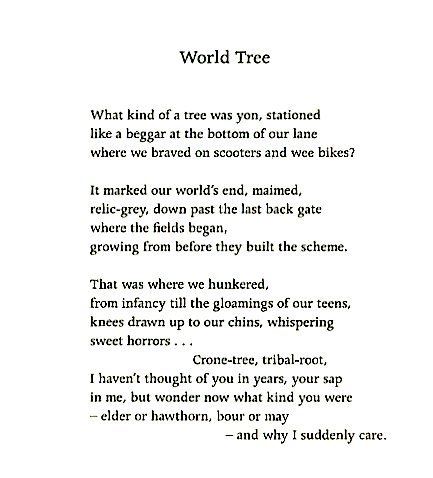
Kathleen Jamie is a Scottish poet. You can read her Wikipedia entry here, and a 2012 article by Sarah Crown in the Guardian here. 2014 was the year of the Scottish independence referendum, and at least one of these poems refers to that explicitly. All the poems have to do with Scotland one way or another: the language moves back and forth between standard English and Scottish; the wild creatures and landscape are always present. But I’ll stick to my policy of picking just one poem:

world tree002

I love the sound of this, as of these poems in general. In its sense, I recognise that experience of something remembered from childhood looming large in your mind in the present moment, with a new question about it. Here the speaker asks what kind of tree, as in what species, but she conjures up childhood memories that are full of a different kind of kind: tree as boundary, as relic, as something damaged, as a place for scary stories, magic and lore, as something not completely separate from herself (‘your sap in me’).

The bits of Scottish language – ‘yon’, ‘wee’, ‘gloaming’, ‘bour’ – link the adult speaker back to her childhood language. At least that’s how it reads to me: I imagine the speaker has had a more emphatic version of my experience of losing the accent and linguistic tics of my North Queensland childhood as I was educated into standard Australian in southern climes.

Anyhow, the last line performs a nice twist. The expected question is something like, ‘why this charged memory comes back so vividly after years of not being thought about’. But childhood memories just do that when one is of a certain age, and really to ask why would be futile. But the poem opens with a different question, and the last line brings us back to it: why do I ‘suddenly care’ about the kind of tree? Why does the mind, having gone back to a childhood experience, ask a question that was of no interest during all the years of the experience (‘from infancy to the gloaming of the teens’)? The tone is ambiguous: it could be like, ‘Why should I care about such an irrelevancy?’ or ‘What strange ways of the mind have made this interesting after all this time?’ Or, actually, both.

The title, ‘World Tree’, suggests a generalisation from the experience, that the poem is about the difference between a child’s immersive relationship to the world, and an adult’s more analytic one. The resonances then run deep.

But I’m out of time. It’s a terrific book.