Tag Archives: Abdulrazak Gurnah

Abdulrazak Gurnah’s Paradise and the Book Club

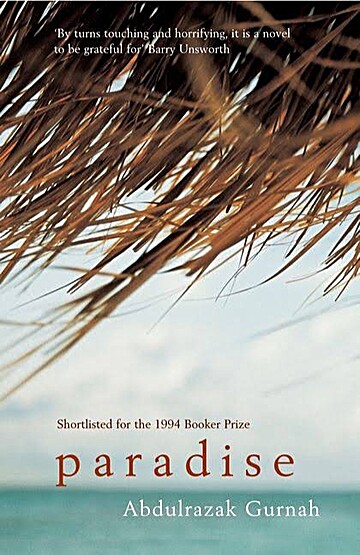
Abdulrazak Gurnah, Paradise (©1994, Bloomsbury 2004)

Abdulrazak Gurnah, winner of the Nobel Prize in Literature in 2021, was a wonderfully urbane guest at this year’s Sydney Writers’ Festival. In the session I attended he spoke mainly about his 2021 novel, Afterlives, but talked a lot about that book’s relationship with the much earlier Paradise. (Added much later: you can listen to the podcast of the conversation at this link.)

We read Afterlives a while ago in my all-male Book Group, and had a wonderful discussion of it. Now my predominantly female Book Club is tackling the earlier novel.

Before the meeting: Paradise is a long way from languishing in the shadow of Afterlives. Its action unfolds in the same part of East Africa, beginning a couple of decades earlier, in the years leading up to the First World War.

The book begins with a boy named Yusuf looking forward to receiving a customary gift of money from Uncle Aziz when Aziz’s brief visit comes to an end. There is no gift, and instead the boy is taken away with the uncle. Then he realises that he is not going back to his family and soon learns that he has been given to Aziz, who is not actually his uncle, as surety against his father’s debts. He has become little more than a slave in the merchant’s household.

The story unfold from there. There’s adventure, involving an arduous, perilous expedition into the unknown. There’s romance, where intimate moments, perhaps even a kiss, may be snatched in dark corners of a walled garden. There’s a gallery of rich, exuberant characters – Khalil, an older boy in a similar state of bondage to Yusuf; an older woman, infatuated by Yusuf’s beauty, who harasses him to the amusement of onlookers; an ancient gardener who long ago refused his freedom when actual slavery was abolished; a formidable, scarred man who organises Aziz’s trade expeditions and has a reputation as a sexual predator on young men; Aziz himself, a formidable commercial operator who remains calm in the most extreme situations.

Meanwhile, European powers are colonising East Africa. They are mostly peripheral, offscreen characters who threaten to destroy the whole world experienced by the main characters. German soldiers appear twice, once at roughly the midpoint and then again at the very end. Both times they function as a deus ex machina: the first time their unexpected arrival saves Aziz and his expedition, including Yusuf, from a vengeful tribal chief, but the incident leaves a nasty sense of something unresolved; the second time they provide the book’s final moment, which left me staring into space for a long time.

The book was only transated into Swahili – the official language along with English of Gurnah’s home nation Tanzania (known as Zanzibar back then) – after he was awarded the Nobel Prize.

After the meeting: At this meeting we discussed Annie Ernaux’s Une femme / A Woman’s Story along with Paradise, an odd pairing which meant we had two quite separate discussions.

All but one of us enjoyed this book a lot, and the dissenting voice meant we had an interesting conversation. The main character, she said, is completely passive: things just happen to him, one after another, and especially on the gruelling trade expedition that takes up a good slab of the book the bad things are repetitive. The book only becomes interesting once Yusuf is back in town and a powerful woman, in a complex way, is lusting after him. Though others were able to point out that Yusuf was constantly taking initiatives – a surreptitious excursion to town just for fun, offering unauthorised help to the ancient gardener, etc – I was struck by the similarity of this observation to what someone in my other Book Group said about the main character in Afterlives: because of the constraints on the characters, they don’t have the space to attend to their inner lives. When I tried to articulate this thought, someone said something beautifully concise and wise about the way trauma can alienate a young person from their own experience. Sadly I didn’t write it down, but to my mind it captured beautifully the way Yusuf does indeed move from one thing to the next, having no real say about the direction of his life, and no ability to form coherent thoughts about it.

I realised in the course of the discussion that the story is full of references to Joseph / Yusuf in the Hebrew Bible and the Quran, in particular the episode of Potiphar’s wife / Zuleikha. I just read a version of the Quran story on Wikipedia, and the parallels are even closer than I thought. It makes me wonder what other references may be hovering around this eminently readable tale. Joseph Conrad’s Heart of Darkness comes to mind. (Gurnah’s Gravel Heart includes a retelling of Shakespeare’s Measure for Measure, set in modern East Africa.)

We discussed the final paragraph, which I’d love to expand on here but, unlike some surprise revelations (see my blog post on Wole Soyinka’s Chronicles from the Land of the Happiest People on Earth, coming in a month or so), it really is a surprise.

Being of a certain age, we said goodnight a little after 10 o’clock.


I wrote this blog post in Gadigal Wangal country, where it is my great joy to live. In particular right now the days are getting warmer, the sun is rising earlier and setting later, and whenever I walk out my door I see tiny lizards scurrying for cover. I acknowledge Elders past, present and emerging for their continuing custodianship of this land.

Sydney Writers’ Festival 2024: My day two

After just one session on Tuesday and nothing on Wednesday or Thursday, Friday was all systems go for me at the SWF, with five sessions, starting at noon and ending just after 7 in the evening. Please excuse the length of this post.


12 pm: The Gift of Greek Myth

I first heard Kate Forsyth talk back in the day when she mainly wrote for children (starting with Dragonclaw in 1997). More recently she has appeared on radio and podcasts as a writer of historical fiction. She has always been good value on fairytales and myth. In this session she chatted with playwright Tom Wright about her most recent book, Psykhe.

If Psykhe is as interesting as this talk, then it’s a brilliant novel. Here are some scraps I gleaned.

Kate Forsyth describes herself as playing in the borderland between myth and history. She is concerned to reclaim ancient stories from their patriarchal interpretations. Fairytales, she says, are myths drained of their sacred meanings, because they are mostly concerned with women’s issues.

In this book, the dividing line between gods and humans is porous. It tells the story of Psyche/Anima and Cupid/Eros/Amor as a historical fiction – Psyche becomes Psykhe and Amor becomes Ambrose.

I’m not sure how much of this is from the original myth and how much from the novel, but here’s a broad plot outline: Venus’ son Ambrose falls in love with Psykhe, a human woman; he keeps her in luxury in his palace, but as a prisoner; he comes to her bed every night, where she is not permitted to see his face. One night as he is sleeping, she looks at him by the light of a candle, and spills wax on him. For the first time he feels pain, and flees. Having broken free of her imprisoned state, she now can love him, and goes searching for him.

Forsyth says this is the only ancient myth that is gynocentric – woman-centred. Whereas in androcentric myths the hero breaks, kills, and conquers (and, I’d add, rescues), in gynocentric myths the female protagonist sets about healing, repair and recovery. This story is about the importance of consent, the transformative potential of pain, the need for love to be more than physical (the reductiveness of that is mine, not Kate Forsyth’s or Tom Wright’s).

Kate Forsyth has a lovely phrase for her creative process. She says she spends a lot of time ‘daydreaming a story to life’. In this talk, she allowed us to witness part of that daydreaming.  


2 pm: Abdulrazak Gurnah: Afterlives

I’ve read and loved two of Abdulrazak Gurnah’s ten novels, Gravel Heart and Afterlives.

This urbane and amiable session focused on Afterlives. Gurnah kicked it off with a reading. Though he read beautifully, it was a strange passage for the occasion as very little happens in it: there is a boat and a harbour town, the sun sets, the main character has trouble sleeping because of unspecified pain. This from a book where there is so much wonderfully dramatic or tender writing he could have picked (see my blog post for an example).

Sisonke Msimang, his interlocutor, asked the pertinent question: why this passage? He said it was the first part of the book that he actually wrote. He knew that Hamza had been wounded and was returning to his childhood home after fighting for the Germans in World War One: what came before and after that was yet to be imagined.

After that insight into the book’s origins, we learned that Gurnah had wanted to write about the German schutztruppe for a long time. (Not quite right to call them ‘the German schutztruppe‘, he said, as only the officers were German, the troops were African.) He had known from his childhood about the ferocity of these soldiers, who fought for the colonisers – his grandfather (or more precisely his mother’s uncle) had been one of them. But when he got to the UK and had access to books, he found that there was nothing written about the way Africans were drawn into the wars between the colonising European nations. He had intended his fourth novel, Paradise (1994), to be on the subject, but he realised then that he didn’t know enough to write about it. It was nearly two decades before the time was right.

A question animating the book is: Why did people join a force that was going to end up dominating them/Why fight in a war that will determining who will be your coloniser? ‘That’s how we put the question now,’ he said. The book offers no simple answer, but a lot of what the two speakers had to say echoed what I have heard and read about the Queensland Native Police: apart from the attraction of being part of a new, powerful force, or various kinds of of coercion, it’s important to remember that people didn’t think of themselves as African, any more than the Germans and French identified each other primarily as fellow-Europeans: many of the African nations had been at war with one another for centuries.

The conversation roamed over the more personal elements of the book. These are the things that Gurnah says he likes writing about most – the everyday, the interior, the domestic, the intimate – and it’s them that gives the book its power as it tackles broader issues. All of this brought the pleasures of the book back to me – I hope it inspires people who haven’t read it to pick it up.

One final question from Sisonke Msimang: Was he expecting the Nobel Prize? Writers don’t work with the hope of winning the Nobel Prize, he said. They’re in for a hard time it they do. And he did a quick impersonation of someone responding to the phone from the Nobel Committee by exclaiming, ‘Well, at last!’


3 pm: Nam Le: 36 Ways of Writing a Vietnamese Poem

This wasn’t a session for the faint-hearted. Felicity Plunkett, herself a poet, set the ball rolling with an opaque quote from ‘On the line’, an essay by Kasim Ali, and things only got more erudite, recondite, convoluted and polysyllabic from there.

When someone at a session later in the day half apologised for the comparatively straightforward terms ‘methodological’ and ‘epistemological’ by adding ‘as we’d say in the academy’, I realised retrospectively that this conversation was being conducted as if in a specialist academic context.

For instance: ‘The line can put things into differences of ordinality … You can have a chiasm … ‘ I managed to note down terms like ‘autofictive’, ‘metafictive’, ‘preambular’, ‘the trauma plot’ (which is ‘too easy’). All of this has meaning, but I found it impossible to keep up.

What emerged is that Nam Le’s poems are ‘destabilising, elliptical, constantly questioning’. ‘How is it possible to say anything at all,’ he asked at one stage,’without being undermined by your own self-consciousness?’

There was a lot of talk of violence, which may or may not have a technical meaning. I think Nam Le was joking when he asked, ‘What is more violent than meiosis?’ (Meiosis is the process by which cells split.)

As a counterbalance, Le read four poems to us – or more accurately he read four parts of what Plunkett said is the long poem that constitutes the book 30 Ways of Writing a Vietnamese Poem. It was wonderful to hear his performances. The one with which he wound up the session, a lullaby with the title ‘Matri-Immigral’, was all anyone could have hoped for.

That broke through my exasperation with the session’s obscurity and recursiveness and convinced me to buy a copy of the book.


4 pm: Feminist Firebrands

Each of the day’s earlier sessions featured one author talking to one other person about one book. This session was a panel of three plus a facilitator.

A panel is a hard gig: you run the risk of only half-hearing each of the participants, and hearing no one’s thinking in depth. If the subject is books, you can get some idea of whose writing you might want to follow up, but this panel barely mentioned the participants’ books. All the same, it worked.

Hannah Ferguson, who is in her late 20s, abandoned her law career soon after graduating and is now a podcaster and person in charge of something on the internet called Cheek. Sisonke Msimang, among other things, writes a regular column in the Guardian offering wisdom about racism and related issues. Jennifer Robinson has offered legal advice in high profile cases of alleged sexual abuse. Jo Dyer, among other things former CEO of the SWF, facilitated.

The conversation revolved around issues raised by the Brittany Higgins and Bruce Lehrmann court cases, the allegations of historic rape against Christian Porter, Grace Tame’s advocacy, a little of Amber Heard’s case against Johnny Depp, and a sulphurous whiff of Donald Trump. That is, the way the criminal justice system here, but also in the USA and Britain, treats women, specifically when they allege sexual abuse or rape. And not just the criminal justice system, but the media and the culture generally.

The first thing that struck me was the stark contrast with Nam Le’s approach. Here there was no uncertainty, no self-undermining, no painful self-consciousness. Everyone spoke forcefully, definitely, and – alas for my note-taking – fast. I couldn’t possibly give a decent summary, but here are some gems:

Jo Dyer on recent news about the Queensland police force: ‘How many bad apples do you have to have before you cut down the f*ing orchard?’

Hannah Ferguson (I think): ‘Men are 230 times more likely to be raped than to be falsely accused of rape.’

Hanna again, on the ‘If you don’t know, say no’ slogan: ‘Everything I do is to fight the notion that you should back off if something is hard.’

Jennifer Robinson: Only 2% of rape cases arrive at a guilty verdict, but the current defamation laws in Australia mean that only those 2% of survivors can talk about their experience without being sued. A not guilty verdict in a rape case does not mean that the woman lied.

All the panellists agreed that it is important to have conversation about these issues. I think it’s right to say they all felt that it was a mistake to pile on Scott Morrison for framing his empathy for sexual assault victims as resulting from his wife asking how he would feel if it was his daughter. The conversation is important, and it doesn’t move things forward to attack imperfect contributions that are still in a good direction.

I learned about the ‘Man or Bear’ meme on Tik-Tok. Women are asked if they would rather be alone in a cave with a man or a bear. A typical witty answer is: ‘The bear, because at least I know what it would do.’ There was some dark humour about how some men have responded – one teenage boy asked (the question I’m embarrassed to say came immediately to my mind), ‘What kind of bear?’


An hour’s break to attend to bodily needs and get from Newtown to the City, and then off to:

6pm: Richard Flanagan and Anna Funder on Writing

Given that Richard Flanagan was scathing about writers’ festivals in Question 7 (a book I didn’t warm to), it’s interesting that he still agrees to appear at them. I came to this session mainly for Anna Funder. The Emerging Artist read quite a lot of Wifedom to me last year.

Clare Wright was in the chair. As a historian, she was interested in the way both books move around in genres, part history, part novel, part memoir, part autofiction. Both writers resisted any attempt to classify, saying they had followed where the books took them. Funder, for example, said she wasn’t writing autofiction in the parts of Wifedom when she wrote about her own life: it was a device to bring the questions about how women were seen in her subject’s time into focus.

Richard Flanagan was entertaining. My impression is that he came armed with a number of set pieces. He told us, for instance, that the history of publishing in Australia differs from the history in Britain and the USA in that key roles have been played by strong, intelligent women. He didn’t mention the fabled Bea Davis, but he named others, including the woman who had edited both books featured in the session: he asked her to stand up to take a round of applause, and though I couldn’t see her from my seat up in the gods she apparently complied, I can only imagine how reluctantly. Later he told his version of the story of being mistaken for a different writer in a signing queue – he duly signed the proffered book as Bryce Courtney.

In the long and interesting conversation, Clare Wright asked Flanagan two questions about Question 7 that touched directly on my issues with the book. Did he introduce Rebecca West as a way of countering the all-male patriarchal narrative of the origins of the atom bomb? Nothing so programmatic, he said, and went on to talk about how remarkable Rebecca West was. Then he reminded us that for the last 20 years or so women’s writing has been front and centre in western literature, so our collective sense of history has changed – so not programmatic, but responding to the zeitgeist. Wright framed the other question by asking him to read a short passage (sadly, this was the only reading in the session) describing the bomb being dropped on Hiroshima. As a historian, she was not interested, as he first thought, in whether he had got the number of people killed right, but the origins of his image of survivors walking the streets calling for their mothers, juxtaposed poignantly with the fact that plane that dropped the bomb, Enola Gay, had been named after a crew member’s mother. He was able to say that both those images came from historical records.

Wifedom has 400 endnotes: ‘If you want to destroy patriarchy you have to have endnotes.’

The patriarchal manifestation she attacks in the book is the erasure from history of George Orwell’s wife, Eileen O’Shaughnessy by Orwell’s many biographers. She had a number of Eileen’s letters and some few other sources, so she had to resort to ‘making shit up’, to use the words Clare Wright put in her mouth. The made-up bits are clearly indicated in the book, being set to a narrower width. Before she made this controversial decision, the writing was flat and dead on the page. Her writing about her own status as wife played a similar role.


And so out into the crowds in George Street, possibly there for the Vivid Festival, to dinner and eventually home.

End of year list 5: Blog traffic

Thanks to kind help from Sue at Whispering Gums, I can now find out which of my blog posts have received most hits in the last year. It’s hard to know what these figures mean. Maybe a lot of people visited the post for a second or so, long enough to realise that there was nothing useful there about the subject of their interest. Maybe the post is on a school reading list somewhere, and has been semi-plagiarised by hundreds of students over the year. Maybe this is an indication of which of my posts is most brilliant. Maybe none of those. Anyhow here’s the list for 2023:

  1. The Book Group and Shirley Hazzard’s Transit of Venus (June 2018)
  2. Mary Oliver’s Twelve Moons (January 2019)
  3. Ocean Vuong’s Time is a Mother (March 2023)
  4. Mary Oliver’s House of Light (April 2020)
  5. Ellen van Neerven’s Throat (July 2020)
  6. Ellen van Neerven’s Comfort Food (also July 2020)
  7. The Book Group on David Mitchell’s Utopia Avenue (February 2021)
  8. Robert Alter’s Psalms (September 2020)
  9. Ruby Reads 29: Gift (December 2021, about The March of the Ants, by Ursula Dubosarsky and Tohby Riddle)
  10. Abdulrazak Gurnah’s Afterlives at the Book Group (April 2020)

It looks as if my posts on poetry generate most traffic, though the one on The Transit of Venus, mysteriously to me, is way out ahead of the rest. The book group makes three appearances, which is probably an indication that we choose books that have a lot of social capital. I suspect the post on Robert Alter’s translation of the psalms is visited so often because it includes an embedded video of Boney M singing ‘Rivers of Babylon’.

Having learned how to find these statistics, I’ll try your patience a little by giving you the all-time top 10 posts:

  1. Travelling with the Art Student (November 2014)
  2. The Book Group and Shirley Hazzard’s Transit of Venus (June 2018)
  3. (Re-)reading Kevin Gilbert’s poetry (April 2012)
  4. Bran Nue Dae (January 2010)
  5. Mary Oliver’s House of Light (April 2020)
  6. The book group’s Harp in the South (February 2011)
  7. Jasper Jones at the Book Group (May 2010)
  8. Mary Oliver’s Twelve Moons (January 2019)
  9. Contemporary Asian Australian Poets (June 2013)
  10. Philip Larkin, The Whitsun Weddings (April 2010)

Someone lifted a close-up photo of a painting by Brian Rutenberg from ‘Travelling with the Art Student’ and put it up on Pinterest, and hordes of people came looking for more – sadly it was the only photo in the post. Shirley Hazzard has otherwise been consistently in the lead, and Book Group books and poetry have pulled in the crowds. I think my post on Kevin Gilbert’s poetry was on a school reading list somewhere for a time – it gives a brief account of what can go wrong when a well-meaning whitefella edits a First Nations book.

I don’t know what to make of the absence of any posts I’ve written since 2020.

That’s it for my 2023 round-ups. Thank you all for swelling my statistics, for your likes and comments, and your silent, lurking presences.

Abdulrazak Gurnah’s Afterlives at the Book Group

Abdulrazak Gurnah, Afterlives (Bloomsbury 2020)

Before the meeting: It was my turn to pick the book. I loved Abdulrazak Gurnah’s Gravel Heart when I read it last year, and I chose this one over three contenders because a) I like the idea of us reading work by Nobel Laureates, and it’s so good to have one whose writing is accessible, b) it’s time we read a book by a non-European writer – the last ones were Burruberongal woman Julie Janson’s Benevolence in October 2020, and two months before that In the Country of Men by US-born Libyan-parentage Hisham Matar.

Afterlives is a terrific book. It was longlisted for the Walter Scott Prize for Historical Fiction 2021. That prize was won by Hilary Mantel’s The Mirror and the Light. I have no quarrel with the judges, but my horizons were expanded much more by this book than by that one.

It’s set in the first half of the 20th century in what is now Tanzania and was then German East Africa / Deutsch-Ostafrika. It’s a family saga, a romance, a war story, a picaresque, a colonial tragedy. It tells the huge story of colonial brutality and East African engagement in two world wars, and also focuses closely on the intimate story of a handful of characters. It’s beautifully written, brilliantly visual, and paying attention to the intricacies of language in Africa under colonial occupation.

It takes risks: in the first third of the book a main, beloved character named Ilya disappears – he’s an African who was educated by German missionaries, and decides as an adult to join the askari, the native troops who serve under the Germans. His absence remains an unresolved ache for the other characters and the reader until the final pages, when a character from the next generation manages to unearth his story – and then the book abruptly ends.

In this colonial context, possibly the most painful story is that of the askari or schutztruppe, African soldiers who are brutally treated by their German officers and in turn perpetrate terrible atrocities on other Africans – not unlike the Native Police in the colony of Queensland where my great-grandfather grew sugar in the late 1800s. This passage is from the account of the First World War as experienced by the characters (my emphasis):

Even as the schutztruppe lost soldiers and carriers through battle, disease and desertion, their officers kept fighting on with manic obstinacy and persistence. The askari left the land devastated, its people starving and dying in the hundreds of thousands, while they struggled on in their blind and murderous embrace of a cause whose origins they did not know and whose ambitions were vain and ultimately intended for their domination. The carriers died in huge numbers from malaria and dysentery and exhaustion, and no one bothered to count them. They deserted in sheer terror, to perish in the ravaged countryside. Later these events would be turned into stories of absurd and nonchalant heroics, a sideshow to the great tragedies in Europe, but for those who lived through it, this was a time when their land was soaked in blood and littered with corpses.

(Page 91)

My love for the absurd and nonchalant heroics of The African Queen just became much more complex. After reading this book, it would be hard to think of African suffering, or for that matter African love or prayer (the mosque is significant for some characters), as a sideshow to anything.

After the meeting: There were only five of us, others being out of town with family for Easter/school holidays and otherwise detained – no one in Covid iso this time. We’re still a little bit thrilled to be meeting in person: this is the third time in more than two years. Our host departed from recent bring-a-dish tradition and provided all the food – tuna steaks and a fabulous broccoli salad resting o a bed of tahini. I had been dreading a conversation about the election campaign and had laid bets that someone would predict an LNP win: it didn’t happen until the very end of the evening when there was consensus that it was a toxic topic, press coverage was abysmal and the leaders of both major parties, for different reasons, were invitations to despair.

We talked about theatre – Girl from the North Country, The Picture of Dorian Gray and White Pearl – and other books and podcasts (the ABC’s The Ring In on the Fine Cotton Affair was strongly recommended). There were outrageous travellers’ tales, gossip about the very rich, and general catch-up. When we finally came to the book, we had a terrific conversation, all appreciative.

The book conversation began with a confession: ‘I read it weeks ago, in a single sitting. I loved it but I don’t remember anything of it.’ When asked to say what he loved about it, he who had confessed proceeded to give an account of the book that was much more specific than I would have been able to manage: the detailed descriptions of life in a small Tanzanian town, the sweetness of the characters, the way terrible violence is described but doesn’t dominate the narrative, the overall sense that one is learning history that has been a closed book, the sex scenes – and there was more.

One chap was interested enough in the history to do some research. He produced an atlas and showed us the part of Africa where the action takes place. He had printed out a number of pages on the history of what was German East Africa, and some illustrations of askari in uniform. He was happy to report that the novel’s public events – mainly rebellions and battles – were historically accurate.

One man had read the book twice. The first time, several months ago, he appreciated all the things others had named but was left feeling somehow distanced from the characters – so different from reading that other novelist of colonial pain, Amitav Ghosh. He cared enough to read it again. This time he was no more engaged, but felt it to be a feature rather than a problem. On reflection, he came to understand (I hope I’m representing his subtle comments accurately) that his sense of non-engagement was because we are being shown the deep effects of colonisation on the colonised: the characters are beset by cruelty and oppression on all sides, and they are intent on survival. This means they reach out with kindness to each other – there is an amazing amount of kindness in this book, often in unexpected places – and live very much for what joy and they can find in the present. There’s no room for them to reach out to us readers.

I loved this insight. It helped to see the book as a whole. For example, Hamza, the male romantic lead, responds to most situations with silence. We can tell that he is variously humiliated, elated, disappointed, puzzled, grateful, terrified, but he never communicates it. The narration shows us what happens to him and what he does in response (usually he tends to passivity), but we are not given his internal dialogue. He doesn’t talk to us, the readers.

It also makes sense of the ending. Someone said that the last few pages, in which the fate of Ilya is discovered, feels like a postscript, yet (I think it was me who said this) it resolves an issue that has been hanging from very early in the story. In such a beautifully constructed book, it’s unlikely that this is a rough and ready tying up of loose threads. It’s hard to say more about this without being spoilerish so I’ll just say, with apologies for being vague, that the book’s final sentence, which on first reading felt naggingly anticlimactic, picks up the deep theme the group member identified, and offers a sharp change of perspective on the way the rest of the narrative has been resolved.

Afterwards, I thought it would be interesting to hear a conversation between Abdulrazak Gurmah and Alice Walker, the final moments of whose very different novel Possessing the Secret of Joy make an interesting contrast.

When we arrived the sky was clear. As we left the rain was bucketing down and, just like after the last meeting, the streets were awash.

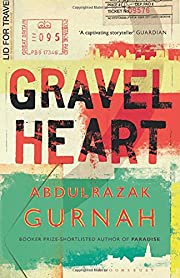
Abdulrazak Gurnah’s Gravel Heart

Abdulrazak Gurnah, Gravel Heart (Bloomsbury 2017)

Abdulrazak Gurnah won the 2021 Nobel Prize for Literature, ‘for his uncompromising and compassionate penetration of the effects of colonialism and the fate of the refugee in the gulf between cultures and continents.’ He was born in Tanzania in 1948 and has lived in the United Kingdom most of his life. Gravel Heart is his ninth novel, and the only one available in my local library. It’s not singled out in any of the biographical outlines I’ve read, but it’s a wonderful novel. Here’s how it starts:

My father did not want me. I came to that knowledge when I was quite young, even before I understood what I was being deprived of and a long time before I could guess the reason for it. In some ways not understanding was a mercy. If this knowledge had come to me when I was older, I might have known how to live with it better but that would probably have been by pretending, and hating.

Not to be too spoilerish: when I read the last page of the novel, I immediately flipped back to those sentences. It’s hard to imagine an introduction to the story that follows that is more misleading, and yet at the same time true to the story.

The narrator, born in Zanzibar, travels to England when he finishes school, with the support of a wealthy uncle, leaving his father who is eking out a miserable existence on the margins of their town, and his mother who is having a liaison with a powerful man in the government. After decades, in which he leads a fairly aimless life in the UK, he goes back home for a visit. His mother has died and he spends a substantial amount of time with his father.

I approached the book tentatively – these Nobel Laureates can be tough going. But I’m happy to recommend the book as a completely absorbing read. I felt the young man’s painful yearning for home and his mother, and his difficulty in communicating in letters across the widening cultural gulf was so intimately real to me that I had to keep reminding myself of the vast difference between his life experience and mine. (I was sent off to a prestigious boarding school a thousand miles from home at age 14 and had no idea what to write in my mandatory weekly letter home.) Mostly in England he associates with other non-White people, though some of his amorous liaisons might be white. There’s only one moment of explicit, vile racism, and though the reader sees it coming the young man is caught completely, devastatingly off guard.

The real thrill of the book for me is in the final chapters where the naturalistic mode of storytelling is stretched to its limit as the father tells his son the story of his life over two long nights. But you decide to accept the manifestly artificial set-up because the story is so powerful, and fleshes out the tantalising hints that have been there from that first paragraph. Then, stretching verisimilitude just a bit further, the son realises that his father’s story is a variation on Shakespeare’s Measure for Measure. (The book’s title is a phrase from that play, though I still don’t know what it means.) I can’t say how or why, but I found that moment deeply moving: something in my understanding of the world, of colonisation and racism, moved deep inside my head.