
Albert Camus, L’étranger (1942, Methuen Educational 1970)
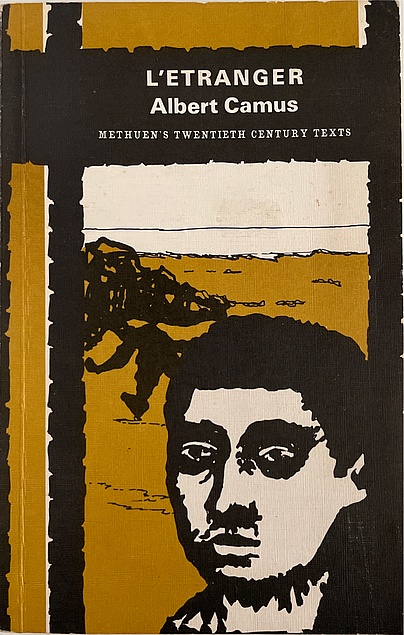
A month ago I announced that I was resuming my practice of reading a couple of pages from a classic text first thing each morning, starting with Camus’ L’étranger. The first book I did this with was Marcel Proust’s À la recherche du temps perdu, which took nearly two years. L’étranger has taken a single month.
In some ways, Camus is the anti-Proust. Look at their first sentences. Proust’s vast novel opens with his narrator yearning for his mother to come and say goodnight and then, famously, goes on marathons of introspection; Camus’ Meursault doesn’t make a big deal of his relationship with his mother, he resolutely refuses to perform emotions, and in the end pays a significant price for it. Here are their opening sentences:
Proust: Longtemps je me suis couché de bonne heure. (A long time ago I went to bed early.)
Camus: Aujourd’hui, maman est morte. (Today Mum died.)
It’s not hard to imagine that Camus had Proust’s work in mind, and deliberately did the opposite.
L’étranger is a classic, so I came to it already knowing a version of the plot. Meursault, a white man living in Algeria, shoots an Arab and when put on trial is unable to give a reason for doing it. In the trial much is made of the fact that he didn’t weep or give any sign of emotional upset at his mother’s death just a day earlier, and he is sentenced to death.
What surprised me on actually reading the text is that the murder isn’t completely arbitrary. Somehow I’d got the idea that he just pushes the man off a moving train, but it’s much more complex than that: in fact the shooting is the culmination of a series of encounters.
For me, more shocking than the murder, and more shocking than the fact that Meursault doesn’t weep at his mother’s vigil and funeral, is the way he takes it in his stride when his neighbour brutally beats a woman, and goes on an outing with the neighbour the next day as if nothing has happened.
Meursault’s lack of emotion is mystifying. We don’t like him, or empathise with him, but when his defence lawyer asks the court if he is being condemned to death for killing a man or for not weeping at his mother’s funeral we know that he’s naming something real.
I might have thought this was unrealistic, an existentialist fable, but the memory of Lindy Chamberlain told me otherwise. If not in the courtroom (and that’s debatable), then certainly in the press, she was widely condemned for not having what was deemed an appropriate display of emotion when her baby daughter went missing. Camus would have understood.
In the final moments of the book, when Meursault faces the prospect of the guillotine, he has a conversation with the prison chaplain. After Meursault has monosyllabically rejected the chaplain’s attempts to discuss the after-life, the priest says Meursault has a blind heart, and promises to pray for him. Meursault snaps. His deadpan manner is shattered, and leaping about with rage and joy he declares that nothing matters, that there is no meaning to life. In my reading the key moment comes after the outburst, when calm has been restored:
Comme si cette grande colère m’avait purgé du mal, vidé d’espoir, devant cette nuit chargée de signes et d’étoiles, je m’ouvrais pour la première fois à la tendre indifférence du monde.
[As if that great burst of anger had purged me of evil, emptied me of hope, faced with this night laden with signs and stars, I opened myself for the first time to the tender indifference of the world.]
‘The tender indifference of the world’. The absence of hope does not necessarily produce despair, but an openness to reality. And then, in case we feel that we can welcome Meursault back into the fold of people who behave ‘properly’, his final wish is that there will be a good crowd at his execution who will greet him with cries of hate – that way he will feel less alone.
I have no idea what it would have been like to read this as part of high school French. Would it have vanished from memory as surely as the book we did study, of which I remember only the title, Le drôle. The internet reveals that that is a 1933 children’s book, written by François Mauriac. I suspect that all the two books have in common is that they were written in French by Nobel laureates. Times change, probably for the better.


 Me fail? I fly!