Tag Archives: Alexis Wright

Alexis Wright’s Swan Book

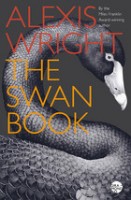
Alexis Wright, The Swan Book (Giramondo 2013)
1sbA friend of mine, an activist whom I admire hugely, says that when he can’t sleep at night he generally does one of three things: he plays a computer game, reads a novel, or does some work. None of the three is satisfactory, he says, but at least if he does work, then his sleeplessness has been productive. If he spends an hour or two doing either of the others, nothing has changed at the end of that time.

I’m fairly sure that when he speaks so lightly of novels he’s not thinking of The Swan Book or books like it (if there are any). It would be hard to read this book and not feel that something had changed.

As my blogging time is severely limited these days, I give you a heroic attempt at describing the set-up, lifted from an impeccable source – thanks, Will:

Wright’s opening chapter chronicles a post-apocalyptic world where climate change has sent everything mad, where people have been driven from their homelands, forced to seek refuge without knowing a destination, carrying along with them, as they mass upon the oceans seeking a new home, the history of the world’s cultures. That history becomes layered and overlapped, interpenetrating, elements commingled. Wagner jostles the Bible in a radioactive landscape of water and ice, monkeys and swans. Aunty Bella Donna of the Champions, leading this exodus from a drowned world, comes to Australia.

There is a marshy swamp, where she settles, in and amidst the rusted hulls of naval vessels cast up to rot in Army-run camps of an intervention, under a sky filled with swans, sometimes. Sometimes, instead, there are helicopters shining searchlights onto the jetsam of Aboriginal people confined there. There, Aunty Bella Donna takes under her wing the girl Oblivia. Oblivion Ethylene, to credit her fully, is a sly spry spink spank sprint of a thing (a characterization I’ve taken not from Wright, but from Finnegans Wake) pulled out from the depths of a eucalyptus tree where she hid after being raped by a pack of petrol sniffers.

That, as Will goes on to say, is just the beginning. There’s the Harbour Master, who is probably Aboriginal and may or may not be a ghost for most of the book, along with his well-dressed monkey. And there’s Warren Finch, a kind of Aboriginal Barack Obama cranked up to eleven, and brolgas, and owls, and rats, and a weird building full of fountains and cats. Oblivia becomes the First Lady of whatnot, she becomes the swan lady, she takes part in a great exodus from a dying city (Sydney perhaps) across a land devastated by climate change.

The book doesn’t lend itself to a quick synopsis. It moves like a dream: the identities of places, people and other living things are unstable. For instance, Oblivia, who has married Warren Finch, sees herself on television accompanying him on state occasions. Since we know, or think we know, that she hasn’t left the house where he dumped her immediately after the wedding, we assume she is seeing an imposter, or perhaps a robotic creation of some kind – it is after all the future. But Oblivia doesn’t share that assumption: as far as she is concerned she must have been there. Are we to read this as Oblivia having a tenuous grasp on reality? Perhaps. Or perhaps we’re the ones who don’t understand how this world works. The narrator doesn’t really care one way or another.

The narrative voice is merciless to the reader’s desire for certainty. In other ways, too, it’s constantly unsettling. As a recovering proofreader, I bristled at a couple of glaring errors: someone etched out a living, graffiti was sprawled on a rusted keel. But by the time I came to a character reigning in an impulse, I realised that in all likelihood the author had staved off any editorial intervention: these occasional errors, along with the frequent grammatical slippages, mangled cliches and apparently random quotes featuring swans, aren’t a bug, but a feature. Likewise the occasional impossibility, such as the tiny Oblivia picking up an adult swan and carrying it some distance tucked under one arm. The reader isn’t so much being told a story as being drawn into a vast dream. And dreams don’t care about proofreading or footnotes or logical consistency.

It’s an almost incredibly rich book. There’s satire (‘closing the gap’ is still a slogan, but its meaning has changed to sinister effect),  astute observation (the scene where Oblivia meets a white family is a deeply uncomfortable lesson about cultural sensitivity), erudition (lots of science and history to do with black and white swans), science fiction (a grim dystopian future), and at its heart a devastating non-love story.

awwbadge_2014The Swan Book is the third book I’ve read as part of the 2014 Australian Women Writers Challenge.
Overland 205

Jeff Sparrow, editor Overland 205, Summer 2011

Someone in the offline world told me recently he was reading a book called The Left Isn’t Always Right. It must be one of the least controversial book titles of all time: how could ‘the Left’ be always right when lefties are forever fiercely, even violently disagreeing with each other? I mean, hadn’t the author heard of Trotsky? This issue of Overland continues in that fine tradition (of debate, I mean, not of violence). And although recent comments on this blog have described it as increasingly right wing, I think it does a nice job of bringing to bear a perspective that challenges the view that all can be well in a capitalist society.

It kicks off with Swedish scholar Mattias Gardell’s ‘Terror in the Norwegian woods‘, which places the recent killing spree in Norway in the context of the return of fascism to Europe. He moves well beyond the easy but still telling point that when the news of the killings broke, many pundits pronounced that it was the work of Muslim terrorists, but when the identity and beliefs of the killer were discovered, the same pundits said it was clearly the work of a lone madman, and not in any way connected to their hate speech – he moves beyond that point to a chilling account of the increasingly vocal and co-ordinated anti-Muslim movement in Europe and in the US, which would be an oddity if it weren’t for their influence on political leaders.

Next, Robert Bollard’s ‘ Who was Bet B?‘, tells the story of his own discovery of Aboriginal ancestry, and explores its implications. Among other things it provides a multidimensional, nuanced context to the brutish attacks on ‘light skinned Aborigines’ we’ve been hearing a bit about recently.

Xavier Rizos’s ‘Will the market save us?‘ could well be subtitled ‘The carbon tax for dummies’, and I mean that in a good way.

Brad Nguyen’s ‘Morality begone!‘ does a neat job of exposing the inadequacy of moral outrage as a tool for understanding, especially in relation to events like the riots in London in August last year. He doesn’t argue that morality has no place, but that relationships of power needs to be taken into account. ‘We can all agree,’ he writes, ‘that events such as 9/11 are the results of acts of evil. But why shouldn’t we let ourselves locate such events within the totality of global capitalism?’ He goes on, ‘If you so much as mention [US] imperialism, you open yourself up to charges of justifying the atrocities of 9/11.’ In a fabulous twist, he invokes Jesus, with a challenging reading of the injunction to turn the other cheek. (This isn’t the journal’s only surprise for those who confuse secularism with hostility to religion: Peter Slezak’s ‘Silence resembling stupidity‘ argues forcibly that the anti-Islamic stance of the ‘new atheists’ – Hitchens, Harris, Dawkins – actually plays into the hands of  those who would wage neo-imperialist and -colonialist wars.)

There are a couple of debates – Stephanie Convery and Katrina Fox on PETA’s use of pornography in its animal rights activism, Ali Alizadeh and Robert Lukins on Australian Poetry, the new peak industry body for poetry. The poetry one, as you might expect, is the more heated (‘Robert Lukins’ is … devoid of almost any substance with which to engage,’ says Alizadeh, unfairly in my view). The animal rights one has the higher moral tone (‘Let’s get our priorities right,’ says Fox, arguing that we shouldn’t object to PETA’s obnoxiousness when other people do much worse things – I guess you can tell where I stand on that one). And there’s a profound panel discussion about language and politics in Indigenous writing, featuring John Bradley, Kim Scott and Marie Munkara.

There are stories and poems, notably an excerpt from Alexis Wright’s forthcoming novel, Eileen Chong’s ‘Mary: A Fiction‘, and Angela Smith’s ‘Jennifer Maiden woke up in The Lodge‘, which I persist in seeing as a tribute to Jennifer Maiden rather than an attack.

Notice all those links! The thing about Overland  is that most of its content is online, and the Overland blog has follow-up interviews and discussions. This interview with Robert Bollard is a fine example. Still, reading it in hard copy has its pleasures, not least of which is the sense of righteousness that comes from sending money their way.

Overland 202

Jeff Sparrow, editor, Overland 202, Autumn 2011

I have one major complaint about this issue of Overland: it won’t be read by enough people. It gets classified, correctly, as of the left, and so there’s an assumption that only people who identify as left-wing should read it. It gets marginalised, when item after item in it deserves the widest readership and engagement. Rather than saying too much, here are a couple of excerpts.

From Guy Rundle’s ‘Open-eyed conspiracy his time doth take‘, a look at the theory and practice (‘praxis’) of Julian Assange and WikiLeaks:

In Assange’s model, the failure of the anti-globalisation movement to challenge the governmental conspiracies that emerged post-September 11 resulted from the very dispersal that they celebrated […] WikiLeaks, in that respect, represents a dialectical development: recognition that a counter-conspiracy,  to  be effective, must decisively reject openness  in favour of an ultra-conspiracy. […]
WikiLeaks’ massive category-shifting leaking is not intended to dissolve governance but to uncouple governance and conspiracy, to make it impossible for governments to fall back on conspiracy as a mode of action.

From Rjurik Davidson ‘s ‘Imagining New Worlds‘ on ‘New Wave’ science fiction of the 1960s and after:

The New Wave [demonstrates] that approaching culture politically (in the broad sense of the term) does not necessarily result in the production of dour and didactic texts. On the contrary, political interventions underpin many of the greatest formal
 revolutions, the most experimental and original work.

From Bob Gosford’s ‘They took our culture – now there is no law‘, one of three pieces on the Northern Territory under the Intervention:

[A] Northern Territory judge who in 2009 considered the effect of the changes to the Emergency Response Act 2007 noted that: ‘the precise mischief that [the section] is intended to remedy is unclear’. He went on to argue that because the legislation precluded consideration of a range of previously acceptable and relevant issues, it ‘distorts [the] well established sentencing principle of proportionality, and may result in … disproportionate sentences’.

From Alexis Wright’s ‘Talking About Tomorrow‘, an open letter to Bob Brown and Rachel Stewart:

I cannot believe that the Intervention can be  justified  when   families  are  leaving their
traditional lands – the lands where they have lived and that they have taken care of for tens of thousands of years – unable to endure the heaviness of government controls over their lives. They are becoming the new gypsies, vilified by residents of Australian towns and cities opposed to having them as neighbours.

She goes on to argue that ‘the only way forward is through treaty-making with individual nations and regions in northern Australia. in particular in the Northern Territory ‘.

From Patricia Gillespie’s ‘[In]Dignity‘, which is largely a graphic account of her elderly mother’s experience with the health system:

From a medical perspective, the treatment for her congestive heart failure – the reason for her admission to hospital – was a success. She was no longer ‘dying’ or ‘drowning’ in fluid. But Marie inherited […] problems such as vitamin deficiencies, suicide ideation, muscular weakness and mobility issues, chronic rash, a bleeding tongue, bedsores and ulcers, which made a mockery of the notion ‘do no harm’.

There are eight wonderful pages of images and pensées from Sean Tan. There’s poetry, including K A Nelson’s ‘Chorus of Crows‘ (winner of the 2010 Overland Judith Wright Poetry Prize, and another angle on the NT Intervention) and  Jennifer Compton’s sweet celebration of the quotidian, ‘I Came Home with the Shopping‘.

Almost teh whole lot is up on line. Have a look.

SWF: Inside the Westside Writers Group

One of my highlights from last year’s Sydney Writers Festival was a staged reading in Bankstown Town Hall by members of the Westside Writers Group. Naturally, we trekked west in the rain to see what they were putting on this year.

A big room in Bankstown Youth Development Headquarters had been set up with a couple of sofas, cushions, a standard lamp and a coffee table for the group and seats for the audience in the rest of the room. They proceeded to have a meeting like the ones they’ve been having every fortnight for years: each member of the group read a piece she or he had been working on – some brand new, some reworkings or extensions of things the group had heard before.

It was a risky idea, and could have failed in any number of ways. But it was great. All the writers have been trained in reading to an audience, and as their mode of working is to read to each other rather than circulating printed copies of their work, they have all become skilled listeners. So we were treated to a lovely range of readings, and then some tender but forthright exploration of what made each one tick and where it could be improved. Luke Carman and Michael Mohammad Ahmad were the stand-outs for me, the former with another of his strangely surreal monologues/stories, the latter with a vignette (a word evidently much discussed by the group) of life in a small ethnic community in the western suburbs. Nothing was dull: sestinas by Lachlan Brown, other poems by Fiona Wright, Lina Jabbir and Rebecca Landon, stories by Susie Ahmad, Sam Hogg, Felicity Castagna and Peter Polites (the dark-haired man on the couch in the pic, shaven headed and unrecognisable on the night), and video in the making from Bilal Reda. All this with the delicate, respectful probing and prompting of Ivor Indyk, resident literary guru.

And you know, from where I was sitting none of these young writers seemed at all fazed by having an audience of roughly fifty people watching and listening from the shadows as they exposed the fruits of their imagination to one another’s critical gaze.

Later addition: I can’t believe I forgot to mention that Alexis Wright was there as a special guest, putting her two cents worth into the discussion and reading what may end up as the start of her next book. When she’d finished her reading – an unsettling piece involving a personification of drought, a young woman carrying a not-quite dead swan in her arms – Ivor Indyk challenged the group: ‘Anyone want to take on a Miles Franklin winner?’

Luke Carman audio

One of my highlights of last year’s Sydney Writers Festival was Alleyway Honour in the Bankstown Town Hall. Some of the same people who made it so brilliant will be in the prosaically named Inside the Westside Writers Group this year at Bankstown on 18 May. I hope Michael Mohammed Ahmad will read again. And Alexis Wright will be there as a special guest.

But my reason for blogging is to let you know that Luke Carman, whose readings at Alleyway Honour were a thrill and a delight, having had a couple of pieces in the latest Heat, has now, thanks to Penguin Plays Rough and FBi Radio, turned up in audio on the internet. You can hear him with just one click.