Tag Archives: Ali Cobby Eckermann

Southerly 72/3: Islands and Archipelagos

David Brooks and Elizabeth McMahon (editors), Southerly Vol 72 No 3 2012: Islands and Archipelagos
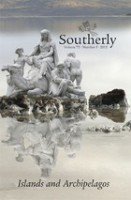
1southerly723

The title of this issue of Southerly, ‘Islands and Archipelagos’, refers to its subject matter, but it could just as easily refer to its form: a literary magazine, archipelago-like, is a gathering of diverse entities, each with its own integrity but all having something in common, whether a theme as in this case or something less tangible, like a tone, or an ethos, or a presiding personality.

I enjoyed my island hopping. My favourite moment is the bravura opening sentence of ‘Outcast of the Islands: Malinowski Amongst the Modernists’ by David Brooks :

If there could ever be such a thing as a True History of Modern Thought, at least one chapter would have to trace that set of strange, 
neglected, yet teasingly-almost-direct lines between a heterogeneous
 crew of squatters, graziers, country postmasters, district magistrates, missionaries, and employees of the Overland Telegraph recording details of Indigenous Australian life and culture in the mid- and late- nineteenth century and the desks of Edward Tyler at Oxford, James George Frazer at Cambridge and Emile Durkheim in Paris, and, through them, and a number of other significant late-nineteenth-century anthropologists, to the likes of T. S. Eliot, Ezra Pound, Sigmund Freud (see, for example, the first half of Totem and Taboo), Marcel Mauss (Essay on the Gift) and so many other key figures in early twentieth-century thought and aesthetics that one wonders whether the Simpson Desert or the Trobriand Islands should be given a place – a quite significant place – amongst the generating landscapes of Modernism.

Yes, that is just one sentence. The article not only delivers on the sentence’s promise but ends with a link to a provocatively titled companion piece, ‘Origins of Modernism in the Great Western Desert: An Introduction’.

Tying for second favourite moment are:

  • Michael Sharkey’s poem ‘First Eleven’, eleven stanzas consisting of phrases that evoke an Australian baby-boomer childhood, presumably to the age of 11. Much of it might be inscrutable to people of other generations and other places, but I was born in 1947, a year after Sharkey, and his deft hand worked nostalgic wonders in me, even in the minority of phrases that didn’t touch directly on my own experience:

    The Royal Visit. Easter Show.
    My sherbet packet. Liquorice stick.
    My shop-bought pie. My Iced Vo-Vo.
    My Cracker Night. My Jumping Jack.
    My father’s gas mask. Old blue tunic.
    My small sister in the clinic.
    My six-stitcher. My first duck.
    The choko vine. The dunny truck.


  • Michael Jacklin’s ‘Islands of Multilingual Literature: Community Magazines and Australia’s Many Languages’, which prises open the subject of Australian literature in languages other than English. I’ve always felt odd about the portrayal of 1950s Australia as monocultural and monolingual: Italian and other southern European languages were part of the soundscape of my 1950s north Queensland childhood; one of my best friends in primary school was Chinese; my farmer father played poker with a Greek, a Korean and a Yugoslav; in the 30s and 40s my magistrate grandfather spoke to Italians who appeared before him in their own language. This essay discusses evidence, including a journal from Brisbane in the 1930s, that there has long been lively, linguistically diverse literature in the Australian context, much of it invisible to the mainstream literary establishment.
  • a new poem by Jennifer Maiden, always a thrill. ‘Diary Poem: Uses of Ethiopia’ is in part a polemical essay, taking issue with some feminists who are ‘well in favour / of ethical security’. I’m not sure what ethical security is (Google is no help): it’s related to rigid ideological narrowness, I think, and may have elements of self-serving moralism. Feminist ‘fandom for Gillard’ is a symptom. My regular readers know that I often feel like an outsider with contemporary poetry (and by the way I think that’s more about me as a north Queensland boy than about the poetry). With this poem, I probably get the references more than most readers: not the Ethiopian art or the story of Sylvia Pankhurst, which are central to the poem and beautifully fleshed out, but the passing allusions – to Julia Gillard’s misogyny speech, and her cutting of the supporting parents’ benefit on the same day; to the earlier poem ‘A Useful Fan’, neatly encapsulated here as ‘trying to inhabit Abbott interestedly’; to a set-to on the Overland web site described as her ‘daughter the fire tiger’ (itself a reference to an earlier poem, ‘The Year of the Ox’) defending her ‘on a hostile magazine site now given / to ethical self-security’. Paradoxically, familiarity with the references predisposes me to foreground the detail of poem’s polemics (I want to argue about her view of Overland, for example, and I’m not sure about the connection she seems to be making between some feminists and abortion), rather than the poem’s central thrust, which I read as captured in the description of doves in Ethiopian art as

    aware of complex peripheries,
    well-mannered with watchfulness,
    —————————————-still.


As well as these pieces that topped my pops, there are learned essays on issues facing real islands and islanders, on Andrew McGahan, Randolph Stow, Drusilla Modjeska, and the rock band the Drones. There are short stories (especially Sandra Potter’s ‘“an empty ship in these latitudes is no joke”’, a lightly annotated list of things taken to and from Antarctica, and Terri Janke’s ‘Turtle Island’, a not-quite-ghost-story, not-quite-love-story, not-quite-war-story set in the Torres Strait in World War Two). There are other excellent poems and nearly 70 pages of reviews, plus the overflow in The Long Paddock, which includes a fine review by Sarah Holland-Batt of Ali Cobby Eckermann’s Ruby Moonlight.

A final note: the spectacularly beautiful cover, reproduced above, is described on the contents page as Sue Kneebone’s Continental Drift, but it’s actually a detail from that work, which I recommend you have a look at on Sue Kneebone’s web site.

NSWPLA Dinner: I wasn’t there

Just in case anyone was wondering after my post deliberating whether to shell out $150 for the pleasure of attending and blogging the presentation dinner for the NSW Premier’s Literary Awards: I didn’t shell out.

I thought I might storify the event from afar, and went so far as to register on the storify site and explore how to do it. But apart from a couple of images of the fabulously lit-up Mitchell Library reading room, and the relaying of this solitary comment by a winner

the tweeters confined themselves pretty much to telling us who won what. I couldn’t even tell if David Ireland, recipient of the special award, was there.*

Today’s newspapers didn’t give us much colour and movement either. The Sydney Morning Herald printed an abridged and edited version of Kathryn Heyman’s address, and a piece by Susan Wyndham listing the winners, with some detail about the Book of the Year, Ali Cobby Eckermann’s Ruby Moonlight. (That’s the only one of the prize-winners I’ve read. It’s a brilliant book.) Stephen Romei in the Australian focused on David Ireland, who it turns out wasn’t there, but wrote a ‘typically idiosyncratic acceptance speech’ which was read out by his agent.

Did George Souris keep up tradition by mispronouncing at least one person’s name? Did any prize-winner except Tim Soutphommasane say anything memorable? What was idiosyncratic about David Ireland’s speech? Was the food OK? Did everyone behave themselves? We may never know.

* But if you’re interested, the State Library of NSW did storify the event, here.

Ali Cobby Eckermann

Ali Cobby Eckermann, Kami (Rare Object No 54, Vagabond Press 2010)
——-, Ruby Moonlight: a novel of the impact of colonisation in mid-north South Australia around 1880 (Magabala Books 2012)

Like other Rare Objects chapbooks, Kami is beautifully crafted. A hundred copies were printed, signed by the author, with a small, square, torn-edge print of an Australian desert landscape glued to the cover. I mean no criticism when I say it reminds me of a tasteful bijou hotel, each guest/poem with a room/page to itself. Ali Cobby Eckermann is a Yankunytjatjara woman, and the guests, it turns out, aren’t as genteel as that analogy might suggest. They don’t trash the rooms or anything of that sort, but they raise their voices any way they want. There’s throwaway surrealist satire (‘Pauline Hanson’, about a giant carrot), poignant domestic vignettes that shed light on the stolen generations (‘Comical’ and ‘Sink’), astringent comment on the intersection of sexism and racism (‘Intervention Allies‘), a sweet-sad love song (‘Kami‘ – at the link it’s the first of five ‘Yankunytjatjara Love Poems’), C&W dramatic monologue (‘I Tell Ya True‘ – click to hear Joe Dolce sing his own musical version), and so on. It’s a wonderfully diverse set of poems.

If any one poem out has special resonance for me it’s ‘Wild Flowers‘. It reminds me of Douglas Stewart’s ‘Glencoe‘, one of the few poems I remember from school days. I’ve thought a lot about ‘Glencoe’ over the years: it’s fascinating that an Australian nationalistic poet wrote this lament for the victims of a massacre that took place centuries ago on the other side of the planet (‘Terrible things were done / long, long ago’), as if that’s as close as he could get to acknowledging the terrible reality of our own colonising history, but was impelled to make at least that much. Cobby Eckermann’s poem includes similar imagery of children’s bones, but she can name the event as very much of this place and not safely consigned to the past. An additional, idiosyncratic resonance – you’ll have to take my word for his – comes from the way the poem’s opening lines almost be describing a moment from our short movie, Scar:

Mallets pound fence posts
in tune with the rifles
to mask massacre sites

There’s a massacre in Ruby Moonlight too, though most of the book is about what happens next for the sole survivor. The book is a lot slimmer than you’d expect of a novel, just 80 pages all up, and you’ll look in vain for the lecture that subtitle (see above) might suggest. This is spare, restrained story-telling. If it wasn’t for the power generated by the flash of imagery, it would feel like notes for a novel rather than the thing itself. It’s a story of ill-starred love. A young Aboriginal woman survives the murder of her community and after wandering for some time with just nature and an ancestor spirit for company, she finds companionship and intimacy with an isolated Irish fur trapper. Their idyll, forbidden by both their cultures, can’t last. You might think you know this story before you open the book. You don’t.

In an interview with Michael Brennan on the Poetry International Website, Ali Cobby Eckermann has some very interesting things to say about her work, including this:

I want to use my poetry to educate Australians, to overcome their innate fear of Aboriginal people. Most Australians have never met an Aboriginal person outside school, sport or work. I want to highlight the benefits that Aboriginal people can provide through friendship and equality, and highlight the dangers of racism and judgmentalism. I have been happy with the heartfelt responses from festival audiences, and the new friendships shown to me and my family.

MB: Do you see your work in terms of literary traditions and/or broader cultural or political movements?

Ali Cobby Eckermann: I think it is impossible to be an Aboriginal writer, and be free from a political view. I always use cultural ethics in my writings. Some of my poetry has a unique style, due to my life between my adopted German Lutheran family and my traditional Yankunytjatjara family, who have also adopted the Lutheran religion. I hope my sense of truth becomes my literary tradition!

My second full day at the SWF

I was off to Walsh Bay again for the day today.

10 : 00 Marie Munkara in conversation with Irina Dunn
I first heard of Marie Munkara’s Every Secret Thing on Will Owen’s blog last December, and it’s been on my To Be read list since then. If it hadn’t been, this session would have put it there, especially when she read the opening pages, beginning most memorably, ‘It had been a shit of a day for Sister Annunciata and Sister Clavier.’ Irina (full disclosure: she’s an old and dear friend) did a lovely job of drawing out Marie’s biography in relation to the book, giving her scope to be – miraculously –  funny about her experience as a member of the stolen generations meeting up at last with her Aboriginal family:

My mother was black. I was thinking, ‘That can’t be my mother. And you know how they say all black people look the same … I’d say, ‘Hello, Auntie,’ and my mother would say, ‘Don’t talk to her, she’s rubbish.’ I’d say, ‘But isn’t that Auntie …’ ‘No!’

When she was little her class at school had to draw a picture of what they wanted to be when they grew up. She drew a figure with a red cloak and a crown. Sister Damien said, ‘Marie, you can’t be a king.’ But young Marie insisted that that’s what she wanted to be, because a king has lots of money and can do what he wants. ‘Now,’ said Marie today, ‘I haven’t got much money but I do what I want.’

11 : 30  Terrorism: How to Win a Cosmic War – Reza Aslan talking to Tony Jones about the futility of the War on Terror
I am not a Tony Jones fan. Ever since his extraordinary performance interviewing Nicole Cornes on election night 2007, I have had trouble watching him interview anyone. But Reza Aslan’s articulate confidence was a match for his combative style, and their sparring was actually enjoyable. Reza Aslan distinguished between Islamism and Jihadism. Islamism, he says, is a form of nationalism seeking to establish an Islamic state in principle no more diabolical than a Christian state like Greece or a Jewish state such as Israel. Jihadism is anti-nationalist, seeking to establish planet-wide Islamic theocracy. He went on to say that Islamism is the answer to Jihadism: that if Islamists are able to participate in normal political processes, Jihadism will lose its recruiting grounds. It was a riveting presentation, and we bought his book.

13:00 to 14:00 Three Australias: Les Murray, Ali Cobby Eckermann and Kim Cheng Boey reading their poems, chaired by Rhyll McMaster
This was the only event I attended where I had to stand in one of the monster queues and for some reason receive a “Good work” stamp on my wrist. The readings were interesting. I was especially glad to hear more of Ali Cobby Eckermann’s work, having read only her long piece on the Intervention in the Best of 2009 collection. Kim Cheng read one of the poems he read on Friday morning, and it was a pleasure to hear it again. Les Murray, who was probably the reason this event was held in one of the bigger spaces, was as always Les Murray, and a good thing too.

Ali Cobby Eckermann acknowledged the Gadigal people, as Anita Heiss and Boori Prior did yesterday. I wonder if it was by formal decision that such acknowledgements were not made at any other events, at least none of those I attended. Whether deliberate or not, I think the festival was the poorer for the absence of such acknowledgements. I also missed the PEN chairs at paid events, and the brief explanation of the imprisoned writer each chair represented. There is a roped off area in the vast Heritage Pier populated by a dozen beautifully painted chairs and a soundscape. The chairs are to be auctioned to raise money for PEN, but that’s not the same as explicit acknowledgement of named individuals.

2: 30  Who’s Interviewing Who? Alan Ramsey and John Faulkner
These two – a retired journalist famous for his take-no-prisoners opinion pieces and the Federal Minister for Defence famous for his ineluctable pursuit of corruption – have been friends for 20 years or so. They told us in all seriousness that the reason the friendship has thrived for so long is that they never discuss politics. They then moved on to discuss politics, with some tense moments. They were very funny together. At one stage Ramsey left the stage to get the quotes he’d left somewhere. Faulkner continued in the role of interviewee.

17 : 30 The Big Reading: Hanan al-Shaykh, Willy Vlautin, Dubravka Ugresic, Natasha Solomons and Rupert Thomson
This was my last event for the festival. It was, as it always is, pleasant to be read to. In particular I loved being read to again by Rupert Thomson – and the tone of the extract he read from This Party’s Got to Stop couldn’t have been further from that of the one he read on Thursday morning. It must be an intriguingly complex book.

I had been planning to stay in the general area to hear Jennifer Maiden, David Brooks and Adam Aitken read. But the reading didn’t start until 9.30, and it was in a wine bar. As a non-drinker who is very often in bed by 10 o’clock, I found the deterrents outweighed the attractions. I had heard a little of Aitken and Brooks this week (though the latter hadn’t been reading his own work), and I decided with regret that I would have to forgo the great pleasure of hearing Jennifer Maiden.

The Festival’s slogan this year was Read, Rethink, Respond. There wasn’t a lot of space at the festival itself for responding (question times just don’t do it!), and for that matter not a lot of reading got done, at least by the punters. But I’ve come away with plenty to think about, and the world is full of opportunities to respond, and far too much waiting to be read.

Adamson’s best of 2009

Robert Adamson, The Best Australian Poems 2009 (Black Inc 2009)

This is an excellent anthology. In fact, in the context of previous years’ round-ups, both from Black Inc and UQP, it’s a strong contender for Best of the Best. It includes a wonderful range of poetic styles and modes and subjects – incomprehensible post-modern stuff, impassioned story-telling, linguistic virtuosity, delicate lyric. There’s Clive James‘s assured iambic pentameter, Pam Brown‘s asthmatically short lines, Ali Cobby Eckermann‘s lines you might need to know didgeridoo breathing to recite adequately. In the introduction, Robert Adamson talks about his solution to the difficulty of reducing his short list to fit the space available – he persuaded Black Inc to give him more space. I’m glad he did, and that he kept commentary, analysis and explanation to a bare minimum. He does offer this gem of commentary:

People ask me, why are so many bird poems being written and published? I have a theory: we miss having poets among us who can imagine that a soul can ‘clap its hands and sing, and louder sing’, that we need to acknowledge visitations by intense psychological presences, and that birds are the closes things we have, more or less, to angels.

Perhaps that’s mainly a clue as to how to read his own poems, but it’s an interesting general thought as well.

I’m not going to try to name the poems I liked best.  My copy has far too many page-corners turned down for that.

As I was reading this anthology, my Art-Student Companion, as part of her preparation for an assignment on Australian Federation, was reading The Sentimental Nation by John Hirst, and kept regaling me with interesting bits about the major role poetry played – poetry, he says, is ‘the best guide to the ideas and ideals that inspired the movement’ for Federation, and again: ‘The nation was born in a festival of poetry.’ Well, even though poetry festivals rarely make the news pages these days, to judge by this book poems are still looking for words for what inspires and ails us as a nation and a species. But now, instead of writing bush ballads or ponderous and forgettable sonnets, they tell about Iraq, global warming, the ills of capitalism, but they tell it slant. There are any number of examples, but I’ll just mention Luke Davies’ ‘Maldon, 991 AD’ which ends:

oooooooooooo I felt an outsider
to laughter. Out there the Vikings sang,
that was more like it, something eerie
to get spooked about, distracted by:
and the world so tenderly
unveiling its final unveiling.

I was also struck by the sense of community among the poets, particularly as shown in the number of poems honouring those who have died: Dorothy Porter (‘Word‘ by Martin Harrison), but also John Forbes (‘Letter to John Forbes‘ by Laurie Duggan, Jan McKemmish (Pam Brown’s ‘Blue Glow‘), Francis Webb (‘Reading Francis Webb‘, by Philip Salom [the link is to a PDF]) and Bruce Beaver (a couple of mentions, but mainly Peter Rose’s beautiful imitation, ‘Morbid Transfers‘).

Buying this book in March felt a little bit silly, like buying hot cross buns in July, but it turns out it’s not a seasonal thing at all. It’s an anthology that I’m sure I’ll go back to.

Footnote: One of my wise younger relatives recently chided me for reading while walking: ‘It’s as bad as walking around with those things in your ears, Jonathan,’ she said (by which you can she’s not so very young). ‘You have to let the world in.’ She may be right in general. But sometimes reading while walking is a way of letting in both world and poetry. The other morning I was throwing the ball for Nessie at the bottom of the hill and noticed that the longish grass was pearled with dew so that previous walkers both human and canine had left tracks of darker green, and the rosellas wouldn’t shut about something. I realised it must have rained quietly in the night. The next words I read were these, from Sarah Day’s ‘A Dry Winter: Some Observations About Rain‘:

… an elemental transition from dry to damp.
Listen, you can hardly hear its outward breath

on the tin roof. In the morning,
grass and earth are wet and everything

but the mercuric globe in the nasturtium leaf
is translucent.

I don’t know anything about nasturtiums, but the rest could have been a condensation from my surroundings. (The whole poem is lovely, by the way.)

Added later: Tara Mokhtari on the Overland blog has a completely different view. She does identify herself as a ‘shunned poet’.