Tag Archives: Australian Women Writers Challenge

Maree Dawes brb

Maree Dawes, brb: be right back (Spineless Wonders 2014)
brb A friend of mine once suspected her husband of having an online affair. He was spending an awful lot of time on the computer and she was fairly sure some of it was in chat rooms. Oh dear, I thought, I spend an awful lot of time online myself – just look at my blog output. What suspicions have I been arousing? While it’s true I’ve made some good friends thanks to the internet, I’m glad to report that chat rooms, multi-user fantasy games, bitcoin, and perhaps especially cybersex have never had the remotest appeal. So brb, a verse novella about raunchy chat room experiences, was a long way from presenting a temptation, though it was a bit of a titillation, and something of an education.

Maree Dawes’s protagonist is known only by her online ‘handles’, of which Boadicea (shortened to ‘cea’ in chats) is the main one. Her spouse, known to us only as ‘he’, is often away from home, and has given her a number of hours online as a gift. (How time flies, that such a gift marks the story as belonging to an earlier epoch! You can almost hear the dial-up tone.) Boadicea ventures into a chat room. After a rocky start she finds a warmly affectionate community, where people exchange an awful lot of ‘huggles’. We learn that it’s nominally a room devoted to books and literature, but from the beginning Boadicea is looking for adventure. She falls in love and has at least one torrid erotic encounter with a disembodied lover. There are hints of cyber-bonks with other, less emotionally significant chatsters, and there’s one piece of serious nastiness.

The narrative never really forgets that it’s all a bit silly, and the tone is generally comic. At the same time real emotions are involved, and the poetry explores a strange twilight state where relationships forged using only keyboard and screen can sometimes seem more substantial than those in the physical world, lacking as it does the delete key and the logout option. [If you’re worried about spoilers skip the next sentence.] For me the most powerful moments come when Boadicea is giving up her online life, tearing herself away from its addictive pull – in what feels like a cross between giving up cigarettes and losing faith in God. [End of spoilerish bit.] The poetry develops a deeper resonance, too, in moments that explore the relationship of words and sensuality, as in this non-computer moment from ‘me: 4 am’, rendered in online conventions:

me: ease under sheet

he rolls over grabs my breast, kisses my mouth smoothes my waist

me: stop
me: wait
me: back off
me: you have to tell me what you are doing
me: I need to know
me:  first the words
me: then the touch

me: these unplanned caresses
me: are too much

After eight lines in which she demonstrates the kind of words she means, there’s this:

oh forget it he says, I want to make love not lyric poems, it’s 4 am go back to sleep

And one is left wondering if ‘me’ was so wrong to want words. Do poetry and sex have to belong to different realms?

Appropriately enough, brb is published as an ebook, available from the pubisher as a PDF direct from Spineless Wonders or in Kindle-compatible or DRM-free ePub formats from tomely.com. I downloaded my complimentary copy to my tablet in the Kindle and ePub versions. The Kindle version was much friendlier. The ePub version made me yearn for the stability of words on paper. [Added later: The publisher asked me to enlarge on these comments, and I then did an experiment which I should have done before making these comments. Part of the difference was that the ePub version’s font size was very large, which played merry havoc with line breaks and even page breaks, whereas the Kindle’s font was of  a size that allowed the poems to sit comfortably within the page. This was not a fault of the file formats, but resulted from the different default settings on the apps I was using. What I said about the stability of words on paper still applies.]
awwbadge_2014brb is the fourth book I’ve read and reviewed as part of the 2014 Australian Women Writers Challenge.
Alexis Wright’s Swan Book

Alexis Wright, The Swan Book (Giramondo 2013)

1sbA friend of mine, an activist whom I admire hugely, says that when he can’t sleep at night he generally does one of three things: he plays a computer game, reads a novel, or does some work. None of the three is satisfactory, he says, but at least if he does work, then his sleeplessness has been productive. If he spends an hour or two doing either of the others, nothing has changed at the end of that time.

I’m fairly sure that when he speaks so lightly of novels he’s not thinking of The Swan Book or books like it (if there are any). It would be hard to read this book and not feel that something had changed.

As my blogging time is severely limited these days, I give you a heroic attempt at describing the set-up, lifted from an impeccable source – thanks, Will:

Wright’s opening chapter chronicles a post-apocalyptic world where climate change has sent everything mad, where people have been driven from their homelands, forced to seek refuge without knowing a destination, carrying along with them, as they mass upon the oceans seeking a new home, the history of the world’s cultures. That history becomes layered and overlapped, interpenetrating, elements commingled. Wagner jostles the Bible in a radioactive landscape of water and ice, monkeys and swans. Aunty Bella Donna of the Champions, leading this exodus from a drowned world, comes to Australia.

There is a marshy swamp, where she settles, in and amidst the rusted hulls of naval vessels cast up to rot in Army-run camps of an intervention, under a sky filled with swans, sometimes. Sometimes, instead, there are helicopters shining searchlights onto the jetsam of Aboriginal people confined there. There, Aunty Bella Donna takes under her wing the girl Oblivia. Oblivion Ethylene, to credit her fully, is a sly spry spink spank sprint of a thing (a characterization I’ve taken not from Wright, but from Finnegans Wake) pulled out from the depths of a eucalyptus tree where she hid after being raped by a pack of petrol sniffers.

That, as Will goes on to say, is just the beginning. There’s the Harbour Master, who is probably Aboriginal and may or may not be a ghost for most of the book, along with his well-dressed monkey. And there’s Warren Finch, a kind of Aboriginal Barack Obama cranked up to eleven, and brolgas, and owls, and rats, and a weird building full of fountains and cats. Oblivia becomes the First Lady of whatnot, she becomes the swan lady, she takes part in a great exodus from a dying city (Sydney perhaps) across a land devastated by climate change.

The book doesn’t lend itself to a quick synopsis. It moves like a dream: the identities of places, people and other living things are unstable. For instance, Oblivia, who has married Warren Finch, sees herself on television accompanying him on state occasions. Since we know, or think we know, that she hasn’t left the house where he dumped her immediately after the wedding, we assume she is seeing an imposter, or perhaps a robotic creation of some kind – it is after all the future. But Oblivia doesn’t share that assumption: as far as she is concerned she must have been there. Are we to read this as Oblivia having a tenuous grasp on reality? Perhaps. Or perhaps we’re the ones who don’t understand how this world works. The narrator doesn’t really care one way or another.

The narrative voice is merciless to the reader’s desire for certainty. In other ways, too, it’s constantly unsettling. As a recovering proofreader, I bristled at a couple of glaring errors: someone etched out a living, graffiti was sprawled on a rusted keel. But by the time I came to a character reigning in an impulse, I realised that in all likelihood the author had staved off any editorial intervention: these occasional errors, along with the frequent grammatical slippages, mangled cliches and apparently random quotes featuring swans, aren’t a bug, but a feature. Likewise the occasional impossibility, such as the tiny Oblivia picking up an adult swan and carrying it some distance tucked under one arm. The reader isn’t so much being told a story as being drawn into a vast dream. And dreams don’t care about proofreading or footnotes or logical consistency.

It’s an almost incredibly rich book. There’s satire (‘closing the gap’ is still a slogan, but its meaning has changed to sinister effect),  astute observation (the scene where Oblivia meets a white family is a deeply uncomfortable lesson about cultural sensitivity), erudition (lots of science and history to do with black and white swans), science fiction (a grim dystopian future), and at its heart a devastating non-love story.

awwbadge_2014The Swan Book is the third book I’ve read as part of the 2014 Australian Women Writers Challenge.

Dorothy Porter’s Bee Hut

Dorothy Porter, The Bee Hut (Black Inc 2009)

1863954465

I found it hard when reading this book to separate the poetry out from the circumstances in which it was written, but I don’t think that’s necessarily a bad thing. The doctrine that the author’s biography is irrelevant to an understanding of her work may be useful in the classroom but not so much anywhere else.

Most of the poems collected here were written when Dorothy Porter was dealing with cancer – diagnosis, surgery, chemotherapy, remission, recurrence and the expectation of imminent death. The poetry is permeated by a sense of mortality and – as with the last poems of Dorothy Hewett and any number of other poets – the knowledge of the real-life situation adds tremendous poignancy for the reader.

Some of the poems address the cancer story directly – as in ‘The Ninth Hour’ (‘it’s your shriveling / flesh / that has the whip hand’), or ‘Not the Same’ (‘When you climb / out a black well / you are not the same’), or ‘View from 437’, written days before her death (‘Something in me / despite everything / can’t believe my luck’). Others, possibly most of the poems in the book, might otherwise seem elegant meditations or slender lyrics, but in this context read as heroic moments of facing reality. I particularly like ‘Numbers’, otherwise a slight, self-derogatory reflection, for the way it is transformed by knowledge of the circumstances of its creation:

I get magic
 sometimes I get more
 than I bargain for

but I don't get
 numbers.

Numbers do worse
 than humiliate
 or elude me

they don't add up.

I am no algebra tart
 ravished
 by the meretricious music
 of the spheres.

My eyes and nose
 never streamed
 with incontinent ecstasy
 through geometry classes
 as my disastrous triangles
 collapsed in a cacophony
 around me.

Perhaps it's a failing
 to grasp
 or even want
 the utterly perfect number
 burning through my retina
 like the utterly perfect morning.

Instead I peer
 with nauseating vertigo
 into the deep dark pitch
 of numbers
 like an exhausted mammoth
 dangerously tottering
 on the edge
 of a bottomless mystery.

I may be playing a version of that game where you add ‘in bed’ to the quotes on a desk calendar, and almost without exception the quotes still make sense, usually quite a different sense from the original. But is it too far-fetched to read ‘Numbers’ as responding obliquely to all the calculation of percentages and probabilities that accompanies cancer diagnosis and treatment? Or is it just that, as I’m sure someone has said, all true art deals with mortality?

This isn’t a gloomy or single-minded book. There are traveller’s tales, some of them recalling moments from the poet’s variously brash, optimistic and judgmental youth; love poems; lyrics commissioned for performance; responses to other poets, including Byron, Blake, Bruce Beaver, Baudelaire, some that don’t start with B, and a possibly ironic lament for not having read enough Rimbaud (or more accurately not having read Rimbaud enough); and more.

My previous acquaintance with Dorothy Porter’s work has been through the forgettable movie made from her verse novel The Monkey’s Paw, and her verse novel What a Piece of Work, which I hated for its vilely misogynistic Francis Webb figure. I’m glad I decided to have another go at reading her work.

awwbadge_2014

The Bee Hut is the second book I’ve read as part of the 2014 Australian Women Writers Challenge. (Evidently I was one of the two most prolific reviewers of poetry for last year’s challenge. I confess to feeling like a fraud, since a number of the poetry books I reviewed had fewer than 20 pages.)

Rabbit 10, Jordie Albiston 13

Jessica L Wilkinson, editor, Rabbit No 10: Gravity (2013)
Jordie Albiston, XIII Poems (Rabbit Poets Series 2013)

I bought these two slim volumes at their Sydney launch a couple of weeks ago.

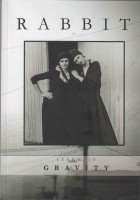
rabbit10 Rabbit is a beautifully produced ‘journal of non-fiction poetry’ based in Melbourne, with a great feel for deign and a sense of humour. This issue, for which Felicity Plunkett was guest poetry editor, includes not only poetry from Melbourne and beyond, well beyond Australia in fact (I was a little disconcerted when sagebrush and coyotes turned up in the first poem), but also a generous selection of evocative photographs of 1970s Melbourne by poet Ian McBryde, a scholarly essay on Dante, an interview, and a number of reviews.

I’m not clear what the non-fiction tag means apart from excluding fiction narratives. I hope we’re not being encouraged to take lines about heartbreak or suicidal intentions as transparently representing the writers’ condition. But the question didn’t exercise my mind too much … I enjoyed the poetry: so much that was excellent, but the ones that struck me most were ‘The Gravity of Bones’ and ‘Crunchy No Bruises’ by Anna Jacobson, which read as if they’re from a series about visiting a nursing home.

Nicholas Walton-Healey’s interview with Kerry Loughrey is excellent. Kerry Loughrey has been performing her work around Melbourne for more than two decades, but had her first poetry collection published just over a year ago. She has interesting things to say about the relationship between performance poetry and page poetry, and about poetry in general – like this, which begins with an updating of Pope’s ‘What oft was Thought, but ne’er so well Exprest’:

I’ve always thought that the poet was supposed to say what’s on the tips of other people’s tongues. That’s our job. So people have this sense of relief when they read or hear it and go ‘ahhh, that’s what I meant.’ …

I’m compelled to say things … I feel it at the back of my throat. And I think everyone does when they’re like ‘I really want to say this.’ Or a bloke talking to his missus who’s much more articulate and so he’s going ‘I wish I could just say this thing but she’s going to take it the wrong way.’ I guess I have to consider being taken the wrong way as well.

xiii Jordie Albiston’s previous books have been unified works rather than gatherings of disparate poems. So, she told us at the launch, when Jessica Wilkinson invited her to be the first in the new Rabbit Poets Series, she saw a prospect of new life for some of her ‘orphan poems’.

The orphans gathered here are not impoverished waifs begging for alms. On the contrary, they are rich in many ways, and speak from a place of deep belonging. They are, however, extraordinarily diverse.

There are a number of what I think of as public poems. ‘Gallipoli’, which opens the book, is a long narrative poem commissioned as inspiration for a piece of music commemorating the centenary of the landing at Anzac Cove. Three long poems – ‘Six Black Saturday Squares’, ‘Lamentations’ and ‘A Kinglake Quartet’ – respond to Victoria’s terrible 2009 bush fires. And ‘A White Woman’s Guide to Indigenous Art’,another commissioned piece, is a response to a painting by Carol Maanyatja Golding that broadens out to the endlessly interesting question

At the other extreme, there are intensely private poems: three love sonnets – ‘The Sea’s Pleasure’, ‘Three Degrees’ and ‘Duplex’ – and ‘Golden’, a poem celebrating the poet’s body on her 50th birthday.

The poems are also wonderfully varied formally. Some of them rhyme, and Albiston’s way with rhyme, both at line ends and internally, is truly wondrous. So is her extraordinary way of playing poetic form off against speech rhythms. Take the first eight lines of ‘Three Degrees’, for example:

Three degrees against your skin, and the heart
begins to freeze. The inclement night creeps
right in, shoves blood aside with its starting
gun, and you become antarctic. Yes, steeped

in snow from tip to toe, the land outside your
carapace says little, remembers less: no choice
but that of missing him, missing him, warmth
a continent ago. You try to invoke his voice.

For me, the most striking piece is ‘Lamentations’. It speaks in the language of the King James Bible, including the odd word in italics and a smattering of ‘Behold!’s.

Alas! we are the people that have seen the fire, on this day of days, on this seventh day of the second month of the year.
Alas! it has led us, and brought us to darkness, and delivered us not into light.
Against us has it turned: it has turned with the wind, against us all the day.

It could have been an embarrassing pastiche in lesser hands, but it’s actually extraordinarily powerful.

awwbadge_2014XIII Poems is the first book I’ve read as part of the 2014 Australian Women Writers Challenge. Yes, I’ve signed up again.
Lesley Lebkowicz’s Petrov Poems

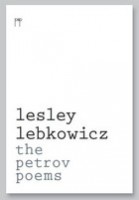
Lesley Lebkowicz, The Petrov Poems (2013)

1pp

I was seven years old in 1954, and have dim memories of what Wikipedia bills as the Petrov Affair. Vladimir Petrov, third secretary of the Russian Embassy in Canberra, defected, and some days later his wife Evdokia followed suit, generating a dramatic front page photograph showing two burly Russians manhandling a distraught woman across the tarmac of Sydney aerodrome – tellingly, the woman has lost one of her shoes.

It’s not clear that the Petrovs had anything substantial to reveal about Russian espionage, but their defection was a boon to the Menzies government’s anti-Communist machinations and has fired the national imagination, or sections of it, for decades.

The affair was the subject of Ralph Peterson’s 1959 play The Third Secretary, which was part of The Currency Press’s first Playtexts Series in 1971, in the august company of Dorothy Hewett’s The Chapel Perilous and Louis Esson’s The Time is Not Yet Ripe. Robert Manne’s exhaustive account, The Petrov Affair, was published in 1980, and again in a revised edition in 2004. The Petrovs feature offstage in Ursula Dubosarsky’s magnificent 2006 children’s book The Red Shoe. So far I was keeping up. Then Noelle Janaczewska’s Mrs Petrov’s Shoe won a Queensland Premier’s Literary Award in 2006 (back in the days when the Queensland government gave money to the arts), and Andrew Croome’s Document Z got a gong in the NSW equivalent in 2010. How many books could one minor incident sustain?

I tried to read Andrew Croome’s book. It’s probably very good. But I couldn’t get past the first line of the first page, so strong was my reluctance to read one more word about the Petrovs. They may be our only spy scandal, I thought, but they’re just not that interesting. Yet when someone at our book club (the one where we swap books, not the one where we discuss them) offered Lesley Lebkowicz’ book of poems, I surprised myself by taking it home.

I don’t think any book could have completely dispelled my pre-emptive ennui, but this book came pretty close. It’s pretty much a verse novel, keeping a fairly tight focus on the two main characters, known mostly by their pet names Volodya and Dusya. It begins as they arrive in Sydney, seen from Dusya’s point of view:

Volodya is solid – more than a husband – an ally.
She touches his arm, feels its warmth, the play
of slack flesh over bone. Softness had long fled
his mind. He had seen hundreds shovelled
into their graves, thousands destroyed like ants
swept away by hot water.

The narrative takes us through the process of disaffection to their defections, their interrogations and then their dislocated new life. It ends, after Volodya’s death, with Dusya living with her sister Tamara in suburban Melbourne:

Dusya and her sister walk along the flat paths of Bentleigh

like any two women from Europe.
They're on their way to drink coffee in the suburb's first café.
They talk about whether to buy veal
for dinner and watch The Bill on TV. Whatever

Tamara says makes Dusya happy – it's hearing
her voice. Occasionally Dusya mentions Volodya

and Tamara looks at her
but says nothing. His name falls out of their lives.

So it’s as much the story of a relationship that plays out in extraordinary circumstances, a migrant story with high stakes and the glare of publicity. The part of the story that struck home most forcefully for me is in the last two sections, ‘The Petrovs at Palm Beach’ and ‘The Petrovs in Melbourne’, where they continue with their lives after the drama, neither celebrated nor left alone. From ‘Sentences’:

'I am Petrov,' he tells a fellow in Manly,
expecting some sign.
'Congratulations,' the man says and walks off.

His photograph regards him every day from The Herald.
What he's done must mean something –

From ‘They know we are Petrovs’:

The whole street knows they are Petrovs –
too many photos, too much publicity.
One journalist never leaves them alone.
He lurks in his car outside their house.

A kind neighbour builds a gate in their fence
so when the journalist comes, they slip out
through his garden.
In Russia it would have been different –

no one would have known who they were.

The verse is always clear and sharp as this. A lot of it is in unrhymed sonnets, but there’s much variety in form. If you haven’t read much about the Petrov Affair, and OK even if you have, this is a good story well told. If you want to read more about it, I recommend the excellent review by Sue at Whispering Gums.

awwbadge_2013

This is the last title in my Australian Women Writers Challenge for 2013. I seem to have read 15, and it’s been fun. I’ve signed up for the 2014 challenge.

Linda Jaivin’s Found in Translation

Linda Jaivin, Found in Translation: In praise of a plural world (Quarterly Essay N° 52)

QE52Every now and then the Quarterly Essay series leaves aside the world of party politics and the headlines. The last time it did that was in N°41, David Malouf’s The Happy Life. In this one, Linda Jaivin, professional translator from Chinese to English, entertains, informs and advocates on a number of fronts, all to do with her profession, which is also clearly a major passion.

I’ve been interested to the point of fascination in reading about translation ever since Brother Gerard, my high school Latin teacher, explained that when he said my unseen exercise was a very good attempt he was offering high praise, because all one could ever do was attempt to translate, the thing itself being impossible. And I remember how thrilling it was in first year university when our lecturer spent a good ten minutes exploring the nuances of a single word (it was ‘serratum’) in a passage of Virgil. This essay feeds that fascination beautifully, with a wealth of personal anecdotes and snippets from the public record that range from hilarious to frankly chilling. It also has an urgent, cogent point to make about the importance of learning languages other than English as a significant and necessary counter to domination of politically weaker cultures by the stronger.

Having recently re-read Vikram Seth’s The Golden Gate and been sent back by it to a translation of Pushkin’s Eugene Onegin, and of course inspired to my own dabbling with the Onegin stanza, I loved reading about a chain of creations and translations involving the Seth novel:

Stirred by Seth’s brilliant homage, the Israeli writer Maya Arad read Pushkin in the original Russian and then wrote her own verse novel in Hebrew in 2003, translated into English by Adriana Jacobs as Another Place, Another City. … David Bellos marvels at how ‘the very diluted version of the Onegin stanza in Adriana Jacob’s translation of Maya Arad’s imitation of Vikram Seth’s imitation of Charles Johnson’s verse translation of Pushkin resurrects something of the lightness and joy of Onegin’s youth.’ Babel can never be recovered; it never existed. Yet translation allows the construction of great towers, in which each brick may be laid by someone speaking a different language but sharing a common vision.

And up the back is an excellent selection of correspondence on QE51, David Marr’s The Prince, which dealt with Cardinal George Pell’s response to clerical child abuse. I particularly appreciated the responses from four Catholics: Geraldine Doogue, Michael Cooney, Frank Bongiorno and Paul Collins.

awwbadge_2013This is another title in my Australian Women Writers Challenge for 2013.

Jennifer Maiden: A Rare Object

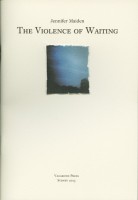
Jennifer Maiden, The Violence of Waiting (Vagabond Press Rare Objects Series No 95, 2013)

1vwAs Vagabond Press’s beautifully crafted Rare Objects series of chapbooks approaches its hundredth and final title, Jennifer Maiden makes her debut at Nº 95. There are just six poems in the book, mostly in modes established in Maiden’s recent books:

  • Nº 15 of the George Jeffreys series, which finds George and Clare Collins in a purgatorial Western Suburbs Poker Machine Palace
  • Nº 10 of the Hillary Clinton and Eleanor Roosevelt dialogues – this time with a little Lady Diana thrown in
  • A Lady Diana–Mother Teresa dialogue – this may be the second time they’ve appeared together in a Jennifer Maiden poem, the first time being shortly after they both died
  • a ‘Uses of’ diary poem, about cosiness and Sylvia Plath among other things
  • A Kevin Rudd–Dietrich Bonhoeffer dialogue
  • ‘Maps in the Mind’, a lyric that invokes successive Australian governments’ treatment of asylum seekers a little in the manner of ‘My Heart Has an Embassy’, which referred to Julian Assange

As I was starting this blog post, my Feedly reader presented me with ‘The poetic spirit of Rare Objects’, an excellent review by Jessica L Wilkinson of the four Rare Objects launched in Melbourne last weekend. Having read that review, which originated on the Overland site, I find it hard to think of anything else I want to say, so I recommend that you click on the link. For those who don’t click, here’s her final sentence, which captures the mood of the book beautifully:

This collection is quietly yet resolutely political, and leaves us considering our own strengths and vulnerabilities, and who we may imagine clinging to for guidance through tough decisions.

awwbadge_2013I nearly forgot and perhaps I should have as it’s such a small book, but this is another title in my Australian Women Writers Challenge for 2013.

Colleen Z Burke’s Splicing Air (and Sonnet 13)

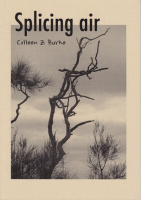
Colleen Z Burke, Splicing Air (Feakle Press, 2013)

1sa

More than 20 years ago in a pub in Glebe I heard Colleen Burke (I don’t think the Z had yet become part of her working title) read poems from which I still remember lines that move me, from what she presented as straightforward records of conversations with her children.

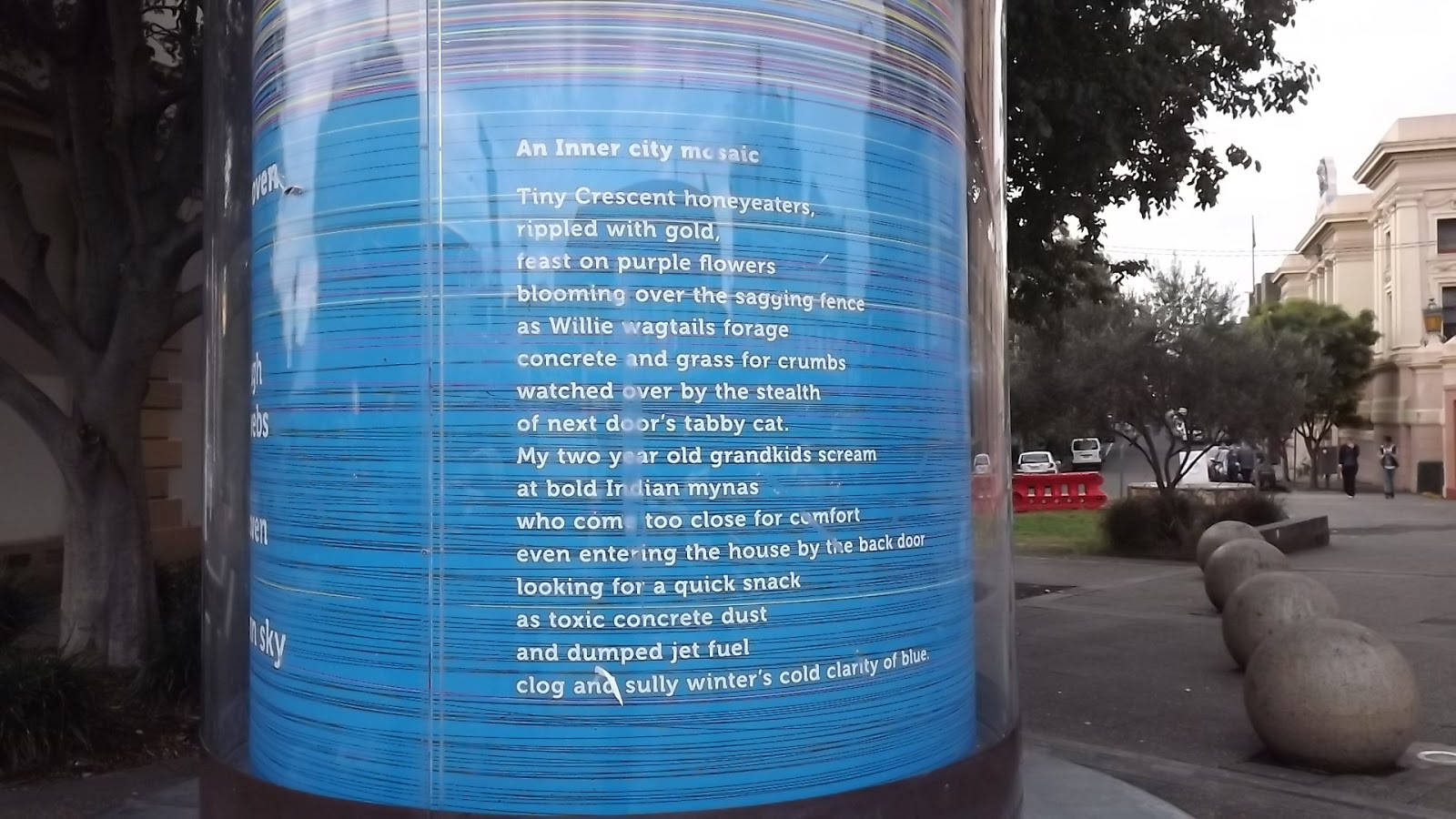
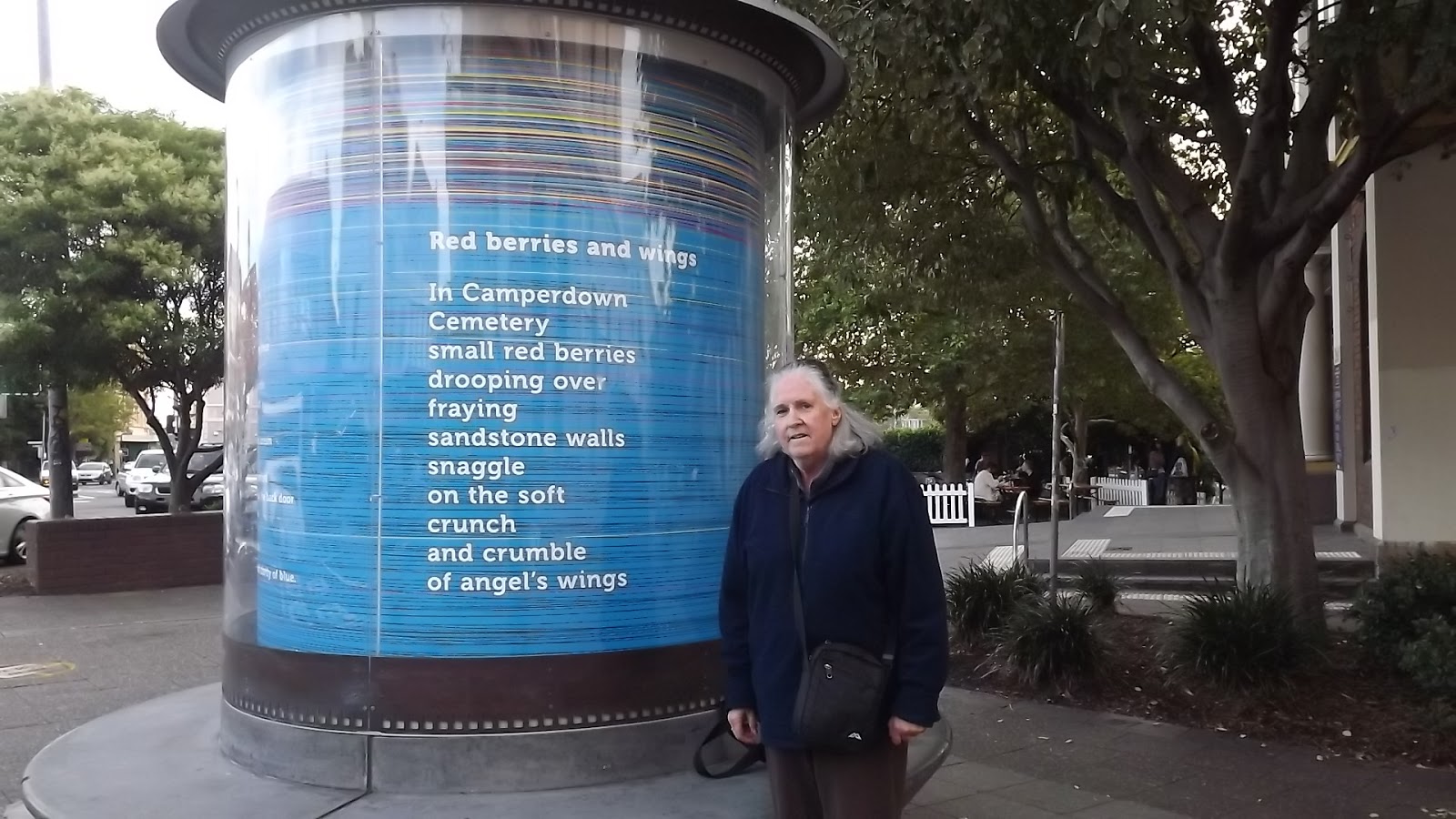
Many of the poems in Splicing Air capture moments with her grandchildren, and the conversations still smuggle killer lines into the poetry. Many others, in what I think of as her signature style, are short, impressionistic pieces about landscape or, especially, skyscape in and over Newtown and surrounds, or bushland. There are a number of pieces observing the social life of Newtown, past and present, and a handful of longer pieces. And some snapshots from New Zealand

Four of the longer pieces draw on the history of discovery and settlement of New South Wales: an narrative-essay on James and Elizabeth Cook, journal entries by the surgeon and an officer from the First Fleet, a biographical sketch of the early Australian poet Frank Macnamara. They lack obvious poetic embellishment, but in each of them the effect is unsettling and revelatory. There are straightforward accounts of the lives of two nineteenth-century women – ‘The publican’s daughter’ being the poet’s great grandmother, and ‘The fossil hunter – Mary Anning’ (which accounts for roughly a fifth of the book) an extraordinary Dorset woman who might easily have been lost to history because of her class and gender.

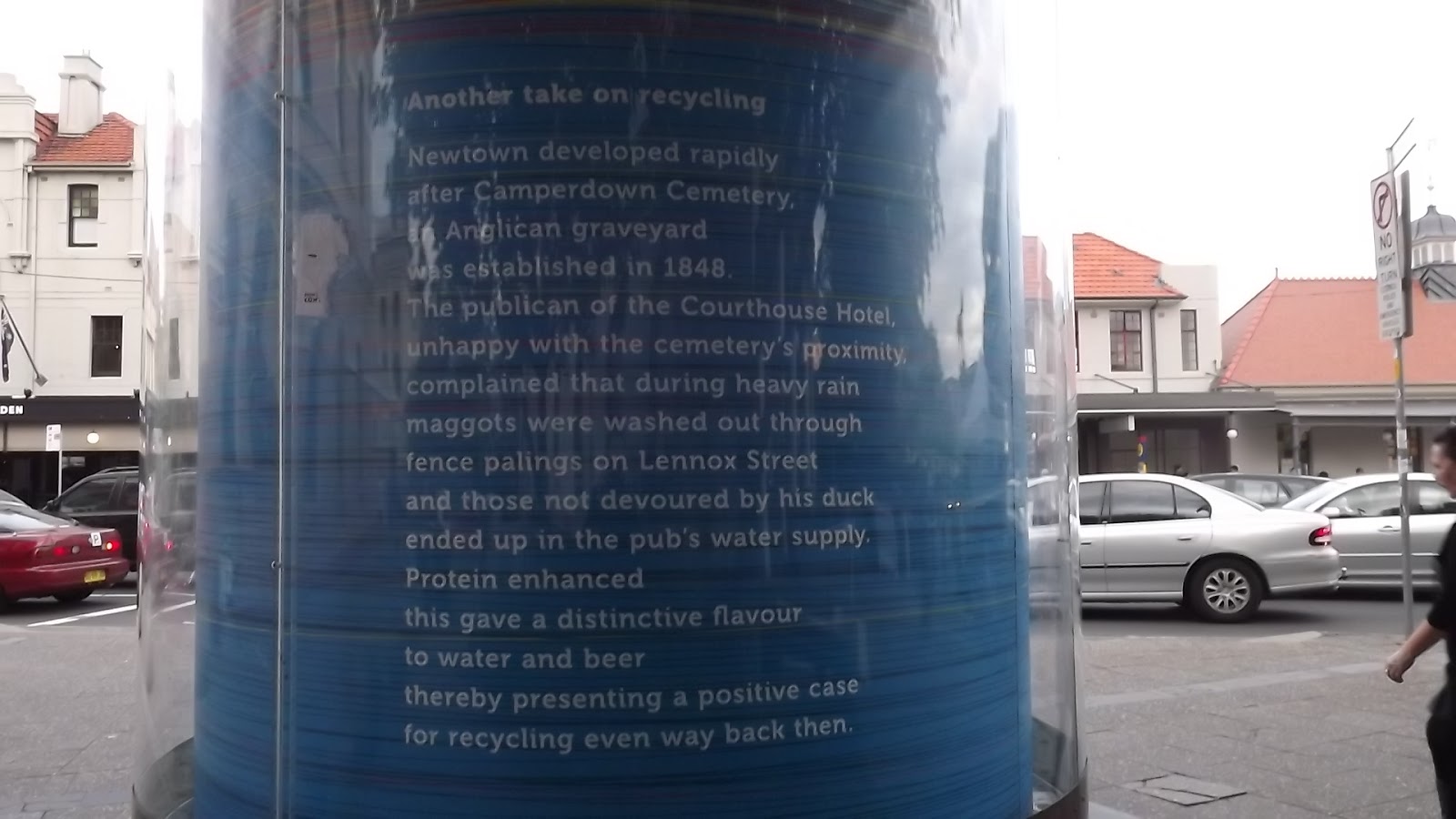
The sense of place is strong here as in all Colleen Z Burke’s work: I think of her as the poet of Newtown. Earlier books have included a number of pieces set in Camperdown Cemetery, and this book has two beauties set there too: ‘Kangaroo grasslands and my 20 month old grandson’ and the wicked ‘Another take on recycling’.

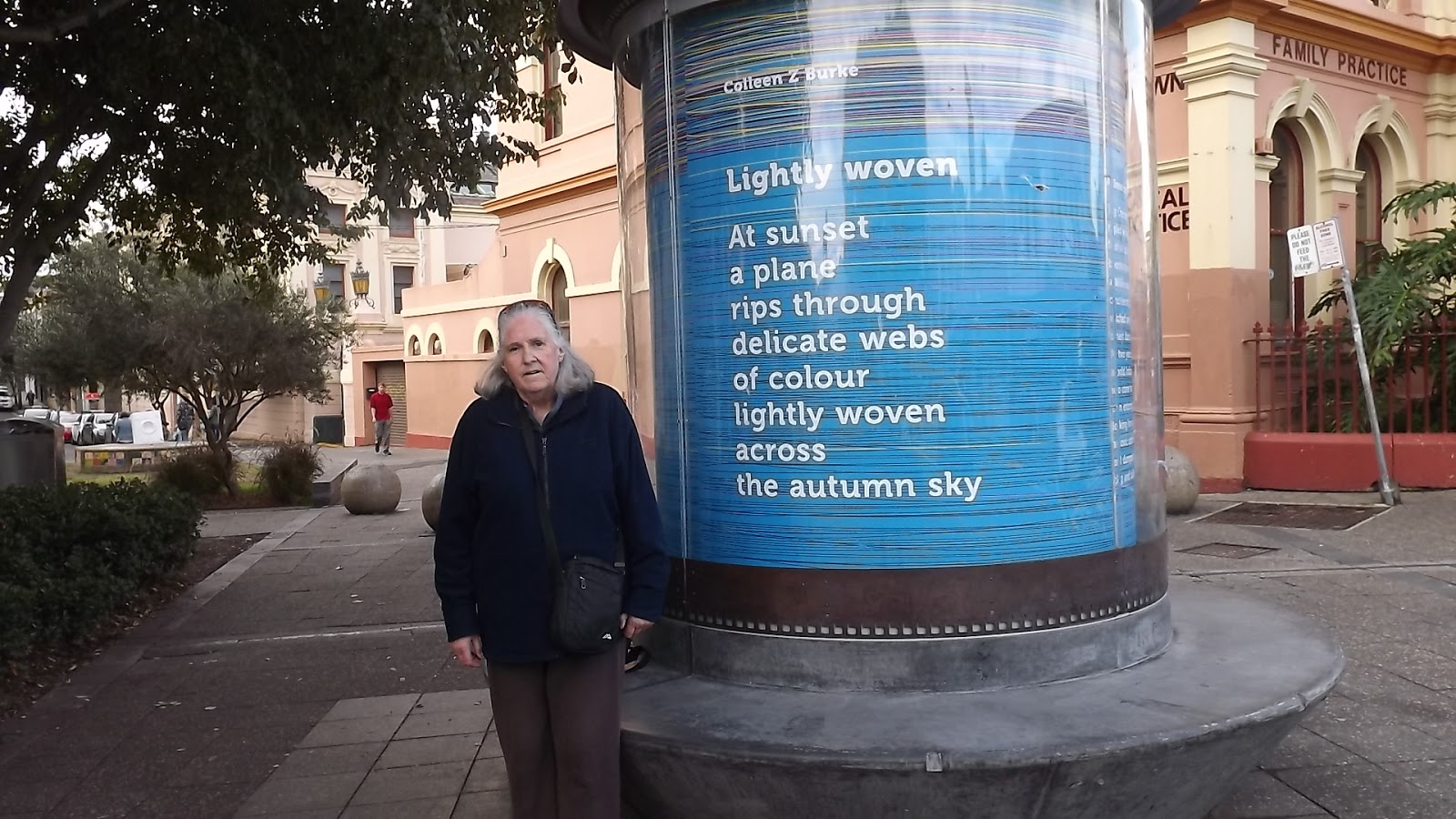
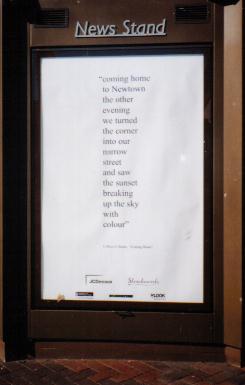
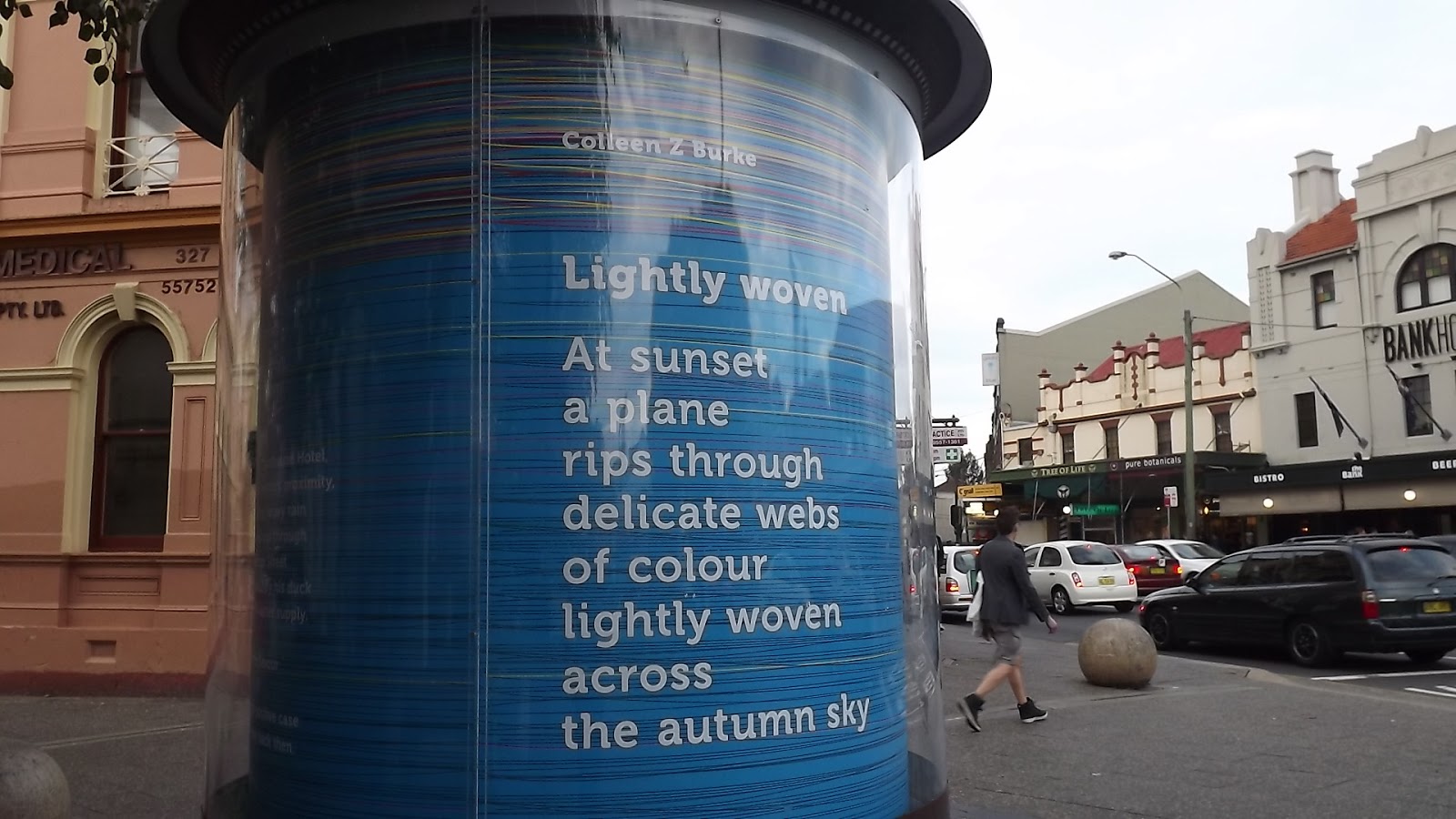
It’s November, so a sonnet is obligatory. This one draws on the last couple of times I laid eyes on the poet, and occasions when her work has featured large in the urban landscape, as illuminated posters that were part of the Sydney Festival some years ago, and more recently on the Newtown Art Seat. (there are six different links there, all to this site)

Sonnet 13: Colleen Z Burke
She reads to us beside a Whiteley –
her landscapes quiet, his lewd and loud.
I’ve seen her sunset words shine nightly,
tall amid a milling crowd.
Her tiny poems tread light, illumine;
the details of decay are human’
as she bids a friend farewell.
Human too what she can tell
of autumn air and Maralinga,
clouds, trees, coprolites, cats, birds,
muskets, trinkets, children’s words.
This poetry’s a pointing finger,
self-effacing, yet with grace
it helps to root us in this place.

Full disclosure: I published one or two of these poems in The School Magazine in my past life, and may have rejected one or two others A significant event in my mother-in-law’s pre-dementia life was a creative writing class taught by Colleen Burke.

awwbadge_2013

I think this is the 11th book I’ve read as part of the Australian Women Writers Challenge 2013.

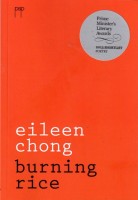
Eileen Chong’s Burning Rice

Eileen Chong, Burning Rice (Australian Poetry 2012, Pitt Street Poetry 2013)

1br

This pocket-sized volume was short-listed for the Prime Minister’s Literary Awards along with giants John Kinsella, Peter Rose and Jennifer Maiden. I approve.

I’ve recently read a bunch of scholarly essays about multiculturalism, postcolonialism, cosmopolitanism, hybridity, transnationalism, diasporic writing and other ways of creating or perceiving poetry that is not contained within a single cultural tradition. In that context, I guess these poems by Eileen Chong would be classed as diasporic: most of them deal one way or another with her Singaporean heritage and her separation from it.

But as it happens, I’ve also been rereading (with a heavy heart) some of Seamus Heaney’s poetry, and it strikes me that Chong’s poems about her parents and grandparents, the family’s food traditions, her childhood memories of Singapore streets, even Chinese history and classic Chinese poets, are part of a similar project to Heaney’s when he writes about his parents and forebears, his childhood memories of Irish fields, his tales of Irish saints and scholars. It would be as big a mistake to fence off this poetry in some semi-ethnographic corral as to do that with Heaney’s. Surely everyone can respond at a deeply human level to poetry in which a mind engages with the relationship between the present world and the world of childhood and heritage?

At least that’s my experience. Take the first poem, which also gives the book its title. It begins:

I did not mean to burn the rice tonight.
'Planting rice is never fun' – generations
of men, women and children ankle-deep
in padi fields, bent double at the waist,
immersing seedlings day after day.

then goes on to evoke the other kinds of work involved in growing and harvesting rice, before coming back at last to the burnt rice with a killer final line (you can read the poem here). At a personal level, this poem works wonderfully for me. It hooks my emotions by stirring into awareness something of my own very different heritage: four generations of my family – great-grandfather, grandfather, father and brother – have been sugar farmers. Substitute marmalade for rice, and there I am in my inner suburban kitchen, trying to get the quantity of sugar right, enough to make the marmalade set but not too sweet, and lurking not so very far in the background the memory of cane paddocks, cane fires, cane knives and all they meant in my childhood. My personal story is very different from Chong’s and the history of sugar in North Queensland has little in common with that of rice in east Asia, but that’s where the poem touches me, brings part of my mind alive.

I don’t know that that says much about the actual poetry. There are other deceptively straightforward poems about Asian food and about Chong’s parents and grandparents, some striking dramatic monologues spoken by women from east Asian history, including a number connected to Lu Xun (considered by many, according to Wikipedia, to be the leading figure of modern Chinese literature), some sweet encounters with other Australian poets. I’m looking forward to more.

awwbadge_2013

This seems to be the tenth book I’ve read as part of the Australian Women Writers’ Challenge.

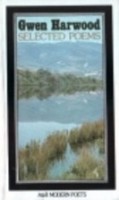
Gwen Harwood

Gwen Harwood, Selected Poems (Angus & Robertson 1975)

1gh Gwen Harwood is a Big Name in Australian poetry, but one whose poems have mostly been unread by me. In the early 1960s she had a pair of sonnets published in the Bulletin of which the first letter of each line spelled out so-l-o-n-g-b-u-l-l-e-t-i-n and  f-u-c-k-a-l-l-e-d-i-t-o-r-s. That’s about all I could have told you about her until Julie Chevalier’s ‘Corner of Glebe Point Road and Broadway’ sent me to her ‘Suburban Sonnet’, a powerful housewife’s lament that made me want more.

I picked this book up from the second-hand poetry shelf in Sappho’s in Glebe on one of my irregular visits soon after (and inadvertently paid a roughly new-book price for it; it’s inscribed by the author to a composer – I googled the name – who evidently didn’t reciprocate her ‘affection and admiration’ sufficiently to keep the gift). This isn’t where I’d have started if I was being systematic, because even though she was in her mid 50s in 1974, it was early in her publishing career. But it’s what turned up.

The book was in Angus & Robertson’s ‘Poetry Classics’ series, which is a bit rich given that the ink was barely dry on Gwen Harwood’s first book (Poems, published 1963). My reading may have been influenced by this presentation, but it felt to me that a lot of the poetry laboured to live up to a kind of poetic dignity. (If you clicked on the link to the scandalous Bulletin sonnets, you’ll see that even when taking the mickey she stuck to strict rhymes and laboured over her enjambments.) Many of the poems deal with the art and, especially, music, and there’s often a sense that the Australian social world is at odds with creativity – not so much cultural cringe as anti-Philistine rage, and the formality of the verse is perhaps a defensive structure. Still, it feels like museum art.

Which makes ‘Suburban Sonnet’ and ‘In the Park’, both harsh observations on the toll taken on a woman’s life by the social conditions of child-rearing, all the more breathtaking.

All the same, it was mainly poems towards the end of the book that I warmed to, that is, poems written closer to the mid-1970s publication: ‘Iris’, in which the Harwoods, ‘(husband and wife so long we have forgotten / all singularity)’, sail for the first time in a boat they have built and the poet tacks and veers among questions of identity and meaning; ‘At Mornington’, which I guess is a love poem, certainly a defiance-of-death poem; ‘David’s Harp’, a tale of lost young love; ‘Barn Owl’, which, well, it’s just a good poem.

Here’s a stanza from ‘In the Middle of Life’ that a) I like, and b) demonstrates nicely Harwood’s attachment to strict form and magisterial tone, and her ability to pull it off:

We need our enemies to teach us
what friends in kindness never show.
Where magnanimity can’t reach us
the darts of hatred lodge and glow,
lighting our follies and pretensions,
our self-esteem’s absurd dimensions.

I’ll read more of Gwen Harwood. I’m glad to have started at last.

awwbadge_2013 This is the ninth book I’ve read as part of the Australian Women Writers Challenge 2013.