Tag Archives: Cameron Lowe

Journal Catch-up 20

My current practice of focusing on page 76 when blogging about books serves me well when the subject is journals. It helps to resist the pull to go on at tedious length about the whole contents.


Alexandra Christie (editor), Heat Series 3 Nº 8 (Giramondo 2023)
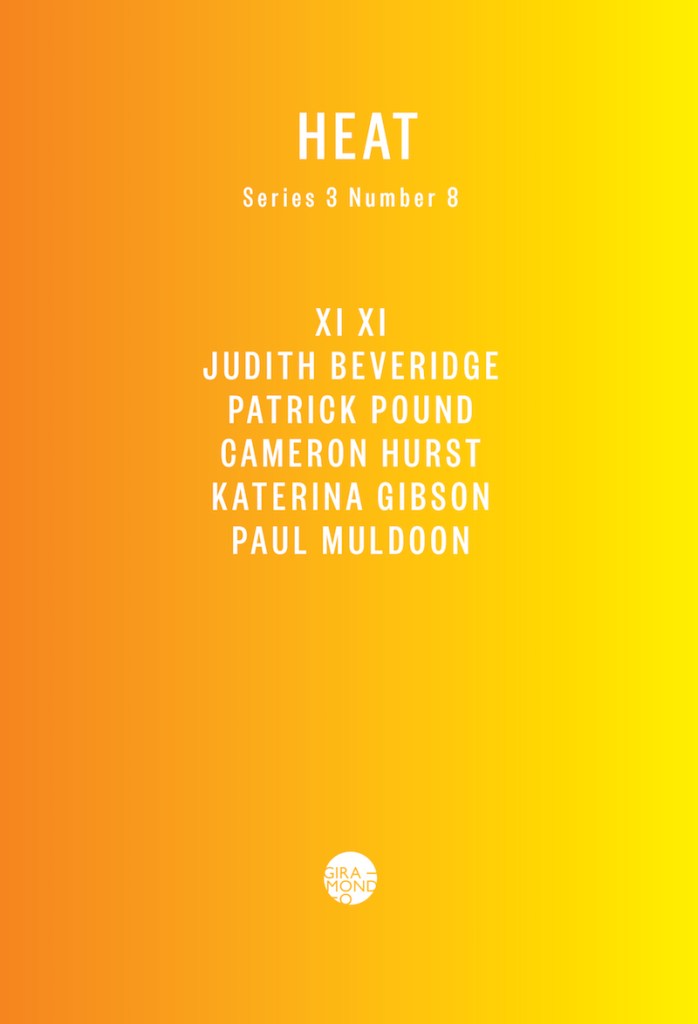
This is a fabulous issue of Heat. A clutch of ‘animal poems’ by Judith Beveridge would have justified the cost of the magazine. ‘Mourning a Breast’ by the late Hong Kong writer Xi Xi, translated by Jennifer Feeley, is an excerpt from a yet-to-be-published novel that includes, among other things, a gruelling account of breast surgery and some fascinating reflections on different Chinese and English translations of Madame Bovary. Send Me a Sign? is a charming essay on Henry Handel Richardson and spiritualism by Cameron Hurst (this one can be read on the Heat website).

Page 76 occurs in the short story ‘Shopping’ by Katerina Gibson, whose collection, Women I Know, won the Christina Stead prize this year. Like Xi Xi’s narrator, the protagonist of this story is interested in translation. She works at a writers’ centre where she is in love with her boss. The story is like an elegant tapestry of twenty-something lostness and finding a way: her work; her relationships, both those at work and her initially unromantic sex life; her compulsive overspending on clothes and her general angst/anomie. I loved it, especially for a key turning point where she reveals her compulsion to a friend and instead of running a mile he laughs and says, ‘But you don’t seem crazy at all.’ (Sorry for the spoiler!)

This seems an appropriate place to mention Giramondo’s promising new online initiative, Re:Heat. It’s a bi-monthly newsletter in which a current contributor to Heat Series 3 encounters an item from the archives. The first of the newsletters features an article by Josephine Rowe on ‘Alive in Ant and Bee’ by Gillian Mears, which was published in Series 2 Number 13, in 2007. You can read Gillian Mears’ piece here, and Josephine Rowe’s response here.


Evelyn Araluen and Jonathan Dunk (editors), Overland 250 (Summer 2022)
(Some of the content – less than in the past – is online at the revamped Overland website, and I’ve included links)
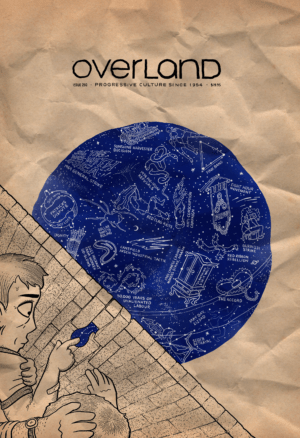
Great editors think alike. Overland is also launching a series in which current writers respond to items from the archives, in their case as part of the print journal. Jordana Silverstein kicks it off with a response to a 1988 story by Lily Brett, which is republished in the journal. Neither piece in online yet, but both are interesting.

At the other end of a readability spectrum is the issue’s first article, ‘Structures don’t go out onto the streets? Notes on John Tranter’s radical pastiche‘ by Louis Armand, which must be the ultimate in poetry insider talk, making no concessions to readers who don’t know their Jacques Lacan from their Ern Malley. Definitely for the spectacularly well read.

Other articles are more accessible and, to me at least, infinitely more interesting: Dallas Rogers on early colonial maps as instruments of colonialism, Jeff Sparrow on elite capture of identity politics, Fiannuala Morgan on colonial literature and bushfires are all worth reading. That’s all before we get to the poetry and fiction sections.

The twelve pages of poetry include the runners-up in the 2022 Judith Wright Poetry Prize (the winner was published in the previous issue). Of these, ‘Camperdown grief junk’ by Wiradjuri poet Yeena Kirkbright spoke most to me in its tour of the Camperdown Cemetery, so beloved of poets. Cameron Lowe’s prose poem ‘Ribbons’ ten pages later also spoke to me. Having just gone on about line breaks in a recent post, I found this phrase just a little squirm-making:

in the rear view mirror there were the back slappers, as usual, jerking off over line breaks.

I’ve been told.

There are 23 pages of fiction, ranging from grim to dystopian, all interesting. The story beginning on page 76, ‘Song and dance’ by Sik Chuan Pua is at the grim end of the spectrum, taking us inside the mind of Clara O’Brien, once a celebrated pianist who is now struggling with physical and mental incoherence in an institution of some kind. Right from the start, the story deftly maintains a double perspective: what Clara sees and what the reader understands in play with each other. It’s no spoiler to say that the story builds towards the word ‘Parkinson’s’. That condition, or something close to it, is there in the first non-bold sentence of this:

She was forty-seven when it began
Her head is locked towards the timber casement windows. Beyond the glass, a lake spreads out. A breeze rattles the shutters. It could be morning. Or late afternoon.
Look, a mysterious orange hue appears. What a hoax, for lakes should be blue as ink. Someone has been up to mischief. Someone has dumped such obnoxious colour, contaminating the lake, transforming beauty into farce. Will someone please restore the lake to its natural colour?

This is Overland‘s 250th issue. Long may it thrive.
Australian Poetry Journal 7:2, Work

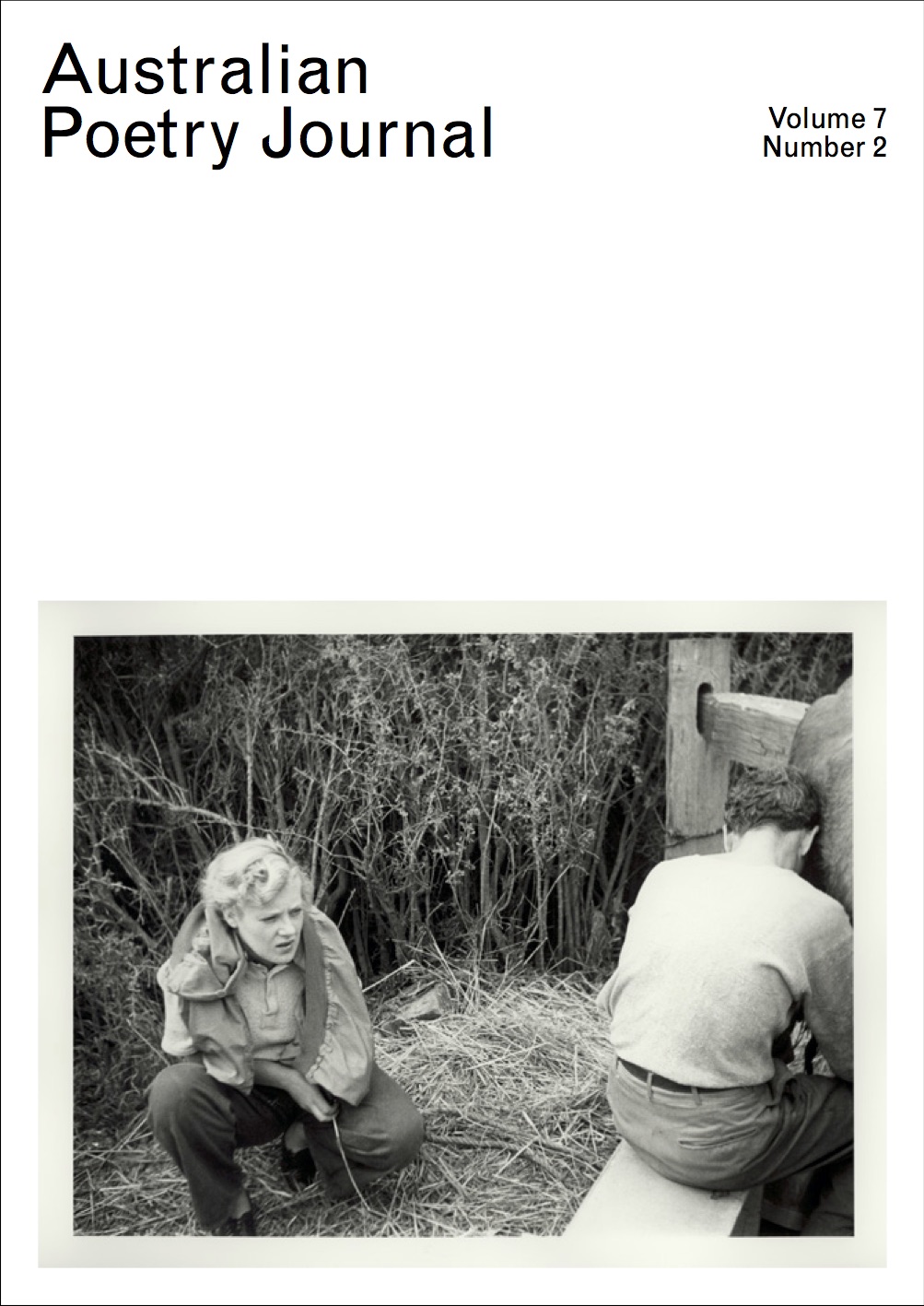
Cassandra Atherton and Benjamin Laird (editors),  Australian Poetry Journal, Volume 7, Issue 2: Work (2017)

cover image

I mainly read this issue of The Australian Poetry Journal on my computer screen. It sat on my desktop to be dipped every now and then, a bit like Twitter only more than 280 characters, more nuanced, less infested with outrage and snark, and more nourishing. Here are some of the bits I enjoyed a comment on the front cover and then some snippets from poems that struck me (though not the only ones that did).

The cover illustration, a photo taken by artist Albert Tucker of artist Joy Hester watching art patron John Reed milking a cow at the artist’s colony Heide in 1942, is rich with metaphorical implications in reference to the journal’s theme of work. It reminds me of Jerome K Jerome’s famous quip about liking work: ‘It fascinates me. I could sit and look at it for hours.’

From Jill Jones, ‘This Could Take a While’: 

How do you get through days
that have already curved too far? 

From Andy Kissane, ‘The Study Before the Major Work’: 

I finish one sketch and start another, in love
with the repetition that is the texture of my life, 
waking each morning to currawong calls,
raising the blinds to the shifting architecture
of light, dressing in loose clothes, keen to dwell
in the lilting halls of wonder.

From Geoff Page, ‘In medias res’: 

I should perhaps have warned you all
my death will be in medias res:
a carload of musicians 

driving up from Sydney
and being switched to voicemail

From Judith Beveridge, ‘The Pest Inspector’: 

He gave good advice: ‘Always listen at night, 
and if you hear a sound as though you’ve left
a record on after all the songs have played,
the ticking of a needle as it tracks in a groove;
if you hear what you take to be the scratching
of a mouse, the contractions of a cooling
tin roof, or click beetles snapping their thoraxes
and abdomens to flip themselves right way up –
take note, they could turn out to be the mandible-crafted
ticks of termites eating along the grain
of your floorboards.’

The whole of Cameron Lowe’s ‘Botanic / Beginning with four words from a poem by Joseph Massey’, which maybe I love because there was a giant fig behind my childhood home in North Queensland: 

There’s little
to say
. The fig –

giant – leans
across the

bridge, reaches
up into 

itself, names
fading

from the love
heart

scored in its 
trunk. 

Cameron Lowe’s poem is part of ‘New Shoots: Garden of Poems’, a special feature that takes up nearly half of the journal’s pages. In 2017, under the auspices of Red Room Poetry, Australian Poetry Inc and the Melbourne Writers Festival, Tamryn Bennett commissioned ten poets to create a new suite of poems each, inspired by plants and histories they encountered in the Royal Botanic Gardens in Melbourne. The poems they produced have had other outings – at the Festival, as a poetry trail at the Gardens, and in an online recording accompanied by interviews (here). They make a brilliant feature here: first the poems, then nine pages of ‘Reflections’ by the poets, which mostly allow for a much deeper reading experience. Just for one example, Bruce Pascoe’s powerful poem, ‘Kuller Kullup’, about the 19th century Wurundjeri elder of that name, becomes even richer when read in the light of his reflection, which begins:

  It is very hard for Aboriginal people to get through a day without being reminded of loss, sometimes accompanied by a profound sadness, sometimes by mere elevated irony. When I was walking around the gardens with the other poets dread was dragging at my heels, feeling for my throat. The talk of last and natural and heritage was clutching at me with scrabbling fingers.

There’s much more, in the ‘New Shoots’ section and in the journal as a whole. Copies are available for sale from Australian Poetry Inc.

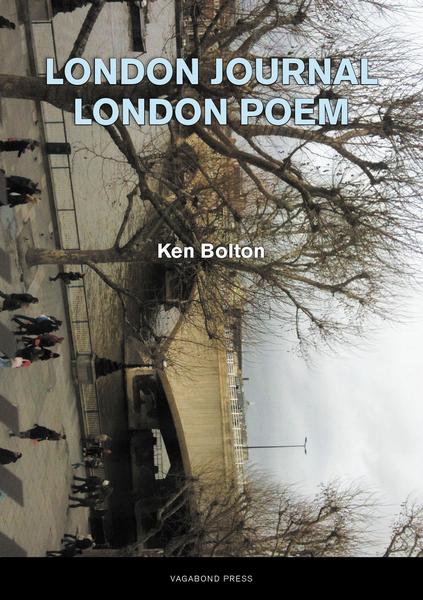
Ken Bolton’s London Journal London Poem

Ken Bolton, London Journal: London Poem (Vagabond  Press 2015)

ljlp.jpg

There are just two poems in this book. In the first, ‘London Postcard – A Quiet Morning at the Wapping Project’, which is 24 lines long, the speaker describes the image of a woman on a postcard advertising what may be a film, and ruminates:

'The fictive life of the tourist'? Or would
I feel this way about this image
anywhere?

The italics seem to signify that the phrase is a quote, but quote or not, it’s a nice way of naming a habit of mind common among tourists – a tendency to make up stories about things you see while passing through, or to see patterns in them. A couple of lines later the speaker rephrases that idea:

I attend to her in the idle moment.

The second poem, ‘London Journal’, begins with a reference to the first poem:

I have an intuition, that maybe that
particular poem – very short –
could serve to hang this – or anyway ‘a’ –
longer poem from. And this is by way
of being that long poem.

I’ll rush in where a proper critic might fear to tread, and say that this longer poem (more than 200 five-line stanzas) enacts touristic fictivity (if that’s a word): it attends to many details in a time that, however busy, could be described as an extended idle moment, a time spent being a tourist.

The speaker and his partner Cath are visiting her son Gabe and Gabe’s partner Stacey in London, with excursions to Berlin and Barcelona. Tourist destinations  – the Brandenburg Gate, for example, or the Miro Museum – are mentioned, but so are tiny particularities of the travelling life: an odd show on television (Pointless as it happens); the book you’re reading; a quest for a strange place someone has told you about, and the anticlimax when you finally find it (a ‘fanatics’ ping-pong club’ in East Berlin); street signs and advertisements that are unsettlingly unfamiliar; evidence of poverty and the problematic status of immigrants; restaurants and bars; encounters with locals; information about the work life of one’s host (in this case, Gabe); lots of people-watching; pieces of a giant puzzle that are fun to play with but are unlikely ever to form a unified image. There are poetry readings, and an occasional moment when Bolton’s colonial status is made clear to him – maybe. The travellers go to museums and art galleries. It doesn’t take a lot of websearching to find out that Bolton is an art historian, but one doesn’t feel obliged to understand all his ruminations on the art he sees – enough for me at least to enjoy the way his experience as tourist connects with his abiding interests.

There’s a scattering of photographs, some of them blurry, as if to emphasise that this is a journal. And a scattering  of lines refer to the process of writing the poem, wondering if it will come together – yes, it’s also a poem.

Scanning for something to quote to give you a taste, I keep coming back to this at Canary Wharf:

of power and judgement. Shopping, food, all take place
underground: no one seen outside. At lunchtime
vast crowds are disgorged below, moving at speed

to their destinations – all very much suited (men and women),
largely under 35, dressed in black for the most part: very
Brave New World, and much whiter than the general population
(only 45% of London identify as white anglosaxon).
We go with Gabe to a Jamie's Italian. Good food.

Very noisy. In the toilets I come across a middle-aged,
middle-management type, seemingly doing an Al Jolson
'Mammy' impersonation, to the hand-dryer – down on one knee,
both hands smacking his chest, then flung out – Drying
his shirt front, he tells me. I think for a moment

of joining him – 'Mammy, how I loves ya, how I loves ya!'
etcetera. I nod encouragement.

In an excellent review in Cordite Poetry Review, Cameron Lowe suggests that ‘London Journal’ is a parody of a travel poem. He may be right, but ‘parody’ suggests a kind of formal imitation and/or mockery. There’s plenty of self consciousness about form and plenty of humour – like the photograph described as ‘Stacey with the author’, which appears to include only a solitary young woman, until you see half an arm almost lost in the page’s gutter. But I had no sense of a ‘proper’ travel poem that this was referring to. It’s just good fun, and interesting, in its own right.

In his elegant speech at the launch of Puncher & Wattman’s Contemporary Australian Poetry, David Malouf observed that while the poetry scene in Australia is extraordinarily vibrant in terms of the amount and quality of poetry being published, at the same time what he calls common readers have been turning away from poetry as if it is a foreign land, possibly because poetry has been turning away from them.

I think of myself as a common reader. And I want to say to other common readers: you can pick up this book without fear of being snubbed or made to feel somehow lacking. Cameron Lowe put it very well:

The poems here – as in Bolton’s other work – appear to imply that the process of writing poetry is an everyday activity (even while on holiday).