Tag Archives: David Marr

David Marr and The Prince

David Marr, The Prince: Faith, Abuse and George Pell (Quarterly Essay N° 51)
QE51

This is David Marr’s third extended portrait in the Quarterly Essay series. After tackling Kevin Rudd and Tony Abbott he’s moved on to Sydney’s Cardinal George Pell, with a focus on his response to accusations and proven cases of child sexual abuse by Catholic clergy and religious brothers. Though it’s written with Marr’s characteristic pungency, wit and compassion, it’s not an easy read: so much human suffering, so much denial and disconnection.

The essay tracks Pell’s career – priest, bishop, archbishop, cardinal – in parallel with the unfolding revelations of abuse and the institutional church’s responses. Its narrative backbone comes from Pell’s four-hour interview in May this year with the Victorian Parliamentary Inquiry into the Handling of Child Abuse by Religious and Other Organisations. Its heart is a double quest: on the one hand to hold to account the most institutionally powerful Catholic in Australia, and on the other to try to understand what is going on behind his unrevealing public persona (unsurprisingly, given Marr’s previous writing about him, Pell did not agree to be interviewed for the essay). No doubt the first quest, carefully documented and full of chilling detail, will stir defensive controversy: there may well be an equivalent of That Wall Punch, such a useful distraction from the gist of Marr’s essay on Tony Abbott. The second quest, as befits an essay, asks interesting questions and proposes answers that raise even more interesting questions – the final paragraphs, reflecting on the meaning of priestly celibacy, offer an equivalent to Marr’s conclusion in QE 38 that anger is the juice in Kevin Rudd’s machine …

Avoiding spoilers, I note that Marr isn’t a Catholic. Unlike, say, Bishop Geoffrey Robinson’s lucid writing, which explores problems with papal infallibility and the moral theology of sex as contributing of the problem of abuse, this essay isn’t particularly interested in the deep questions of how the church got into this state, or of what can be done at the level of culture (beyond relinquishing any sense of being above the law of the land, and acting with justice and compassion rather than defensiveness and financial shrewdness): prayer and forgiveness are correctly dismissed as worse than useless strategies for child protection; there’s little tolerance for celibacy or the seal of the confessional, and even ‘smells and bells’ (Marr’s phrase) come in for a bit of mockery.

Marr tells the story of a man who, abused as a nine-year-old altar boy, met with Pell in 1997. As reported in the Age and quoted here, the man asked how Pell could persuade him to return to the Catholic faith, to which Pell replied, ‘Do you say the Hail Mary?’ While Marr leaves that hanging as one of many examples of Pell’s amazing interpersonal incompetence, a Catholic writer might have stayed with the moment, teased it out a bit. Why the Hail Mary? The words of the prayer don’t offer much help:

Hail Mary, full of grace,
the Lord is with thee.
Blessed art thou among women,
and blessed is the fruit of thy womb, Jesus.
Holy Mary, Mother of God,
pray for us sinners,
now and at the hour of our death. Amen.

Is Pell insensitive to other people’s suffering, or is he suggesting that this form of words might revive some deep, healing connection to childhood piety? Does his question expose the poverty of his personal spirituality, or suggest a profoundly simple approach to faith? If in a similar situation a Buddhist or Hindu sage offered the questioner a mantra, would it seem less bizarrely disconnected? I’m genuinely puzzled.

One reassuring aspect of the essay is that George Pell’s rigid, defensive, authority-centred version of Catholicism is not widely shared by other Australian bishops, let alone the clergy or laity in general. And now, even more grounds for hope, the pope himself seems to be from a very different Catholic tradition.
—-
And up the back, as always, there is discussion of the previous Quarterly Essay. Seasoned feminist activists Sara Dowse, Sylvia Lawson and Rachel Nolan add interesting and necessary perspectives to Unfinished Business, Anna Goldsworthy’s essay on sexism in public life.

In a departure from Quarterly Essay‘s usual practice, and fair enough because a right of reply is involved, a member of the Australian‘s commentariat puts in an appearance, about which perhaps the most interesting thing is that the cheapest of her snarky shots (and there are quite a few) is reproduced almost verbatim by a cooler-than-thou self-styled left-wing cultural columnist. Angela Shanahan: ‘On the other hand, Anna Goldsworthy is an excellent pianist.’ Helen Razer: ‘Anna Goldsworthy, by contrast, is a wonderful pianist.’ A kinder editor might have deleted both these sentences, and left both writers with a little more dignity intact.
—–
Addition: Andrew Hamilton, consulting editor of Jesuit publication Eureka Street, reviews David Marr’s essay here.
David vs Tony

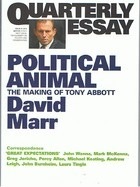
David Marr, Political Animal (Quarterly Essay N° 47)

20120914-221620.jpg When David Marr writes an essay about Tony Abbott there’s no point asking if it will be a hatchet job. The question is how well the hatchet job will be done. Abbott is the preserver of John Howard’s legacy; Marr wrote and edited a number of books laying bare Howard’s duplicitous and anti-democratic politics. Abbott is a high-identifier with old-style Catholicism; Marr has been consistently critical of the Catholic Church. Abbott is, well, not comfortable about Gay liberation issues; Marr is, well, cheerfully out as a Gay man.

Marr’s Quarterly Essay on Kevin Rudd drew a fairly long bow – on the strength of Rudd losing his temper with an arguably impertinent journalist, Marr concluded that anger was Rudd’s ‘juice in the machine’. There’s no equivalent stretch here. In fact, he paints a picture completely congruent with a clerihew I wrote some time ago:

Anthony John Abbott
has a habit
when playing for high stakes
of saying whatever it takes.

He does raise a question that could be paraphrased in another clerihew:

Tony Abbott
is making a stab at
becoming prime minister
possibly concealing intentions that are sinister.

Most discussion of the book in the mainstream media has been about an incident that Marr relates from more than 30 years ago when Abbott was a student politician. This looks to me like a clever ploy on the part of Abbott and his journalist allies, giving those who haven’t read the essay the impression that it’s mostly he-said-she-said allegations about ancient history. It’s actually much more substantial, responsible and entertaining than that.

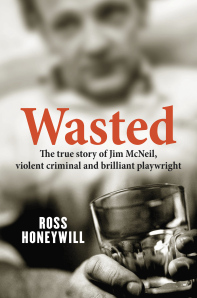
Wasted launch at Gleebooks

Tonight we went to hear Bob Ellis launch Ross Honeywill’s Wasted, the true story of Jim McNeil, violent criminal and brilliant playwright. There wasn’t a huge crowd – after all it’s nearly 30 years since Jim McNeil died,and his four plays haven’t had a production on a main stage for a long time. But it was a great launch, and looks like a very interesting book

1wastedJim McNeil (1935–1982), according to the Gleebooks web site, quit school at thirteen. Despite his love of reading and philosophy, as a teenager he lived among thugs and thieves. (When we showed him a draft biographical note for one of his Currency Press books in the 1970s, he crossed out the word ‘criminal’ referring to his early milieu and replaced it with ‘knockabout’.)  In 1967,  shot a policeman during an armed robbery. He was convicted and began a seventeen-year prison sentence. In Parramatta maximum-security prison he joined a debating group known as the Resurgents. Though he’d never seen the inside of a  theatre he wrote one-act plays for the group to perform: The Chocolate Frog and The Old Familiar Juice. These plays were given productions at the Nimrod Theatre in Sydney, were a big success, and were published by The Currency Press (the first book I ever copy-edited). He wrote another, full-length play, How Does Your Garden Grow, and part of a fourth, Jack, while still in prison, and then was released ten years early thanks at least in part to lobbying by members of Sydney’s theatre scene. As Ellis said tonight, people were imagining him as being like other badly behaved writers like Brendan Behan, but he was something else altogether. Once he was released he never wrote anything decent again, and his life was a slow descent into violence, alcohol-related illness, and eventually death.

I hesitate to say I knew Jim, but I did visit him in Goulburn Gaol with my then boss, Managing Editor of Currency Press Katharine Brisbane, and he came to  our office more than once after his release. I remember one memorable lunch when he and Peter Kenna, author of A Hard God, told anecdote after anecdote in fierce competition, to our great entertainment. I wasn’t there when, in response to some imagined insult, he broke a bottle on the edge of the kitchen table and threatened to use it on Philip Parsons, Katharine’s husband – but I heard the story from the horse’s mouth the next day. Katharine said she laughed and said, ‘Oh Jim, put it down,’ and he did.

Katharine was there tonight. So were a number of others who knew Jim, including David Marr, who gave him a roof on his release from prison. Ellis also shared a flat with him for some time. Bob Ellis read a piece that sounded as if he had written it soon after McNeil’s death, conveying his charm, his brilliant use of language (‘Dustbin of the Yard here. How are ya, Bobby?’), the ever hovering possibility of violence, and his chaotic alcoholism. Then he read from Wasted, and there was no doubt we were talking about the same man. I’d rate it just about the most moving launch I’ve ever been to. It didn’t turn away from Jim’s truly ugly qualities (Honeywill said that the thing that most surprised him in researching the book was how very violent Jim had been – a far cry from the charming ratbag one would wish him to have been). But there were people who loved him, and still hold a tender place for him. A number of people from the audience told anecdotes, both about his charm and his dangerousness. His story was one of redemption through discovering the life of the mind in prison, then returning to the damned space, almost by an act of will. It made me think – and someone may have said this – that the damage inflicted by the prison system runs very deep: he had lost the ability to make the kind of quotidian decisions necessary to a decent life. Ellis did say that imprisonment has been an experiment in dealing with criminal behaviour, and it has failed.

Quarterly Essay 39: China powers on

Hugh White, Quarterly Essay 39: Power Shift: Australia’s Future between Washington and Beijing (Black Inc Sept 2010)

As with every Quarterly Essay, I turned first to the back of this issue for correspondence on the previous one. Timing was unusually poignant in this case: QE38, David Marr’s Power Trip, came out just days before its subject Kevin Rudd was ousted from power; the responses to it here were mostly written when the election campaign of Julia (‘the ouster’) Gillard was foundering, and I read them just after hearing that she will be leading a minority government. There are no fireworks in the correspondence: a couple of journalists add corroborating anecdotes about Rudd’s leadership style (David Marr describes these as symptomatic of ‘a new, and welcome, spirit of indiscretion’; I read them as a bit of a pile-on). Kerryn Goldsworthy deftly despatches whole swathes of attack on the essay and dispenses a little relevant information about literary forms while she’s at it. James Boyce corrects and enriches David Marr’s understanding of Dietrich Bonhoeffer and his probable significance for Rudd. In responding, David Marr replies almost entirely to criticisms that were made elsewhere: perhaps it would have been polite to give those critics the right of pre-reply here (he quotes Sylvia Lawson and Allison Broinowski and gives them a one-word reply: rubbish).

From David Marr’s Power Trip to Hugh White’s Power Shift. Appropriate as the title would have been for an essay on the recent election, we have to wait for QE40 for George Megalogenis to give us that (Power Brakes?). This one is about something other than personalities and politics as horse race:

Our leaders, and by extension the rest of us, are assuming that Asia will be transformed economically over the next few decades, but remain unchanged strategically and politically. It is an appealing assumption because the past forty years have been among the best times in Australia’s history, and it has been easy to believe that American power would continue indefinitely to keep Asia peaceful and Australia safe. That has been a cardinal mistake.

Perhaps the assumption is also appealing because its obvious knee-jerk alternative is a revival of Yellow Peril rhetoric. Tomorrow When the War Began (John Marsden’s series of YA novels and now a film based on the first book) demonstrates, incidentally, that the complacency Hugh White sets out to prick hasn’t been absolute, but it does give strength to his arm in seeking to get people to think about Australia’s relationship to China rather than explore violent fantasies, however earnestly packaged.

While Kerryn Goldsworthy says, quite correctly, on page 85 that an essay can be ‘an expedition into the unverifiable: memories; theories; hitherto unexplored veins of subject matter or uninhabited point of view’, this one proceeds with the logical clarity (though not the  soul-destroying aridity) of a PowerPoint demonstration. ‘Since 1788,’ he says, stating the obvious but unsettling truth, ‘Australia has always enjoyed a very close and trusting relationship with the world’s strongest power, and we just take that for granted.’ Well, not for much longer – and we need to think about this. The main history of our times, he proposes, may not be in the place that’s getting the most attention:

The day-to-day management of the [US–China] relationship gets a lot of detailed attention, but presidents and other senior figures avoid substantial analysis of America’s long-term intentions towards China. One reason is 9/11. For almost a decade, America’s political leaders have convinced themselves that a small group of fugitives on the run in Pakistan poses a bigger challenge to America’s place in the world than the transformation of the world’s most populous country. Future historians will find that hard to explain.

To be fair to White’s argument, he goes on immediately after this to acknowledge that Barack Obama signalled that the blinkers were coming off after his visit to China in November last year. All the same, Muriel Rukeyser take a bow.

It’s a very interesting essay, which I recommend as an antidote for the personality-preoccupied, narrative-driven writing that accounts for most political commentary in our newspapers these days.

David, Kevin, Rage. So?

David Marr, Power Trip: The political journey of Kevin Rudd (Quarterly Essay 38)

In Quarterly Essay 36, Mungo MacCallum explored the miasma of myth and collective emotion that, he argued, accounted for Kevin Rudd’s popularity. Rudd’s recent plummet in the polls suggests that the popularity may actually have been based on more concrete factors, such as his promising stand on global warming, but the essay was a good read nonetheless. Two issues further on, the series once again addresses (I nearly said ‘attacks’) the Rudd phenomenon. David Marr asks not what we see in Rudd, what we hope of him, what he stands for, not centrally whether his leadership is effective or his policies correct, but ‘Who is he?’ It’s a fair enough question. There is something oddly impersonal in his media persona, a sense not so much that he’s hiding something as that he doesn’t know how to show himself. There have been baffling moments, especially his odd, televised disregard for Kristina Keneally.

The question is fair enough, but I’m not sure the answer gets us anywhere much. A cruel short version would be: ‘Kevin Rudd yelled at me when I told him he was an all round disappointment, so now I know that rage is at his core.’ David Marr writes well, and he marshalls biographical facts into a coherent story, sifting through the hostile and hagiographic scuttlebuck alike, for which much thanks. But in the end, the essay is unsatisfying. His strategy of beginning with Rudd’s use of expletives about the Chinese at Copenhagen and ending with a moment when Rudd sets his diplomat’s blandness aside and tears strips of the writer (in private, quietly, in response to provocation) may be structurally satisfying, but the conclusion that anger is Rudd’s ‘juice in the machine’ is a wee bit tenuous. Perhaps I identify with Rudd, as a mostly mild-mannered Catholic man from rural Queensland who uses four-letter words and gets cranky when personally attacked. I imagine David Marr himself swears occasionally and has the odd tantrum – at least I hope he does for the sake of his mental equilibrium.

Tellingly, Kevin Rudd’s response, as reported by the ABC,  was a verbal shrug: ‘Commentators, writers, analysts – they will draw their own conclusions.’

But a distinctive feature of the Quarterly Essay series is that it promotes discussion. No doubt all manner of responses will be aired in Nº 39. Here, the title essay accounts for roughly two thirds of the book, leaving the remaining 40 odd pages to discussion of Waleed Aly’s essay last quarter on conservatism. As a first, a number of voices from the neo-right have appear in these pages, many of them doing their usual polemic attack on straw men. Jean Curthoys (not from the right) suggests that Aly really needs a dose of social democracy. Martin Krygier’s piece makes me decide that if I ever make him cross I’d better lay low. And Aly responds to all comers with precision, grace and – in one or two cases undeserved – respect.