Tag Archives: Ellena Savage

Journal Catch-up 21

Just two Heats in this catch-up.


Alexandra Christie (editor), Heat Series 3 Nº 9 (Giramondo 2023)

There are five items in this Heat, and I loved three of them. (The other two are pretty good as well.)

Bonny Cassidy’s ‘Memory Book’ is a poignant memoir of dealing with the shifting sands of her father’s dementia. ‘No one is responding in the way I thought they would.’

Ender Başkan has three poems whose energy and flow make me want to hear him perform them: ‘funk n wagnalls, collect the set’ is, among other things, a comic reflection on an immigrant family’s valuing of education; in ‘family holiday’ the poem’s speaker travels on the Spirit of Tasmania with small children; ‘erotics of bookselling’ is a fabulously unerotic string of phrases from the day of a bookshop employee.

The stand-out item is the late Antigone Kefala’s ‘Last Journals’, the third instalment in her series of journals. The first two were full-length books – Sydney Journals (2008) and Late Journals (2022, my blog post here). Unlike the entries in Late Journals, the entries here are dated, from 5 January to 19 September 2022. Antigone Kefala received the Patrick White Literary Award earlier in that September – ‘Everything comes in its own time,’ she writes, ‘but not in yours.’ She died on 3 December, less that 11 weeks after the final entry, which ends, ‘Drifting … Not an an ounce of focused energy …’

My blog custom is to single out page 76 for a closer reading. As happens surprisingly often, page 76 of this Heat is a useful lens through which to see the whole of Antigone Kefala’s piece. The page has three entries – for 3, 11 and 17 April – and they reflect a mind actively engaged with the world even while burdened with a sense that the end is near. There are acerbic comments on politics (‘Everyone knocking out Morrison … his own people, a pity they did not do it before’) and the weather (‘It will take some time to dry out, but the rain will start again soon’). She celebrates the publication of Late Journals, is visited by her publishers, and anxiously hopes for a mention in the press. She starts casting about for a new project (‘Looking about for a book to start translating something – this should give me a direction’). She mentions talking to a friend on the phone, ‘using the mobile so we could see our faces’, and comments, ‘These terrible transformations … who wants to see one’s face when talking on the phone …’

What emerges is a picture of a writer, committed to her work, immersed in a community, who faces the difficulties of ageing and the approach of death, not with calm or resignation but with something more like weary annoyance. Her entry for Monday 11 April ends:

Living is problematic, but dying is problematic too.


Alexandra Christie (editor), Heat Series 3 Nº 10 (Giramondo 2023)
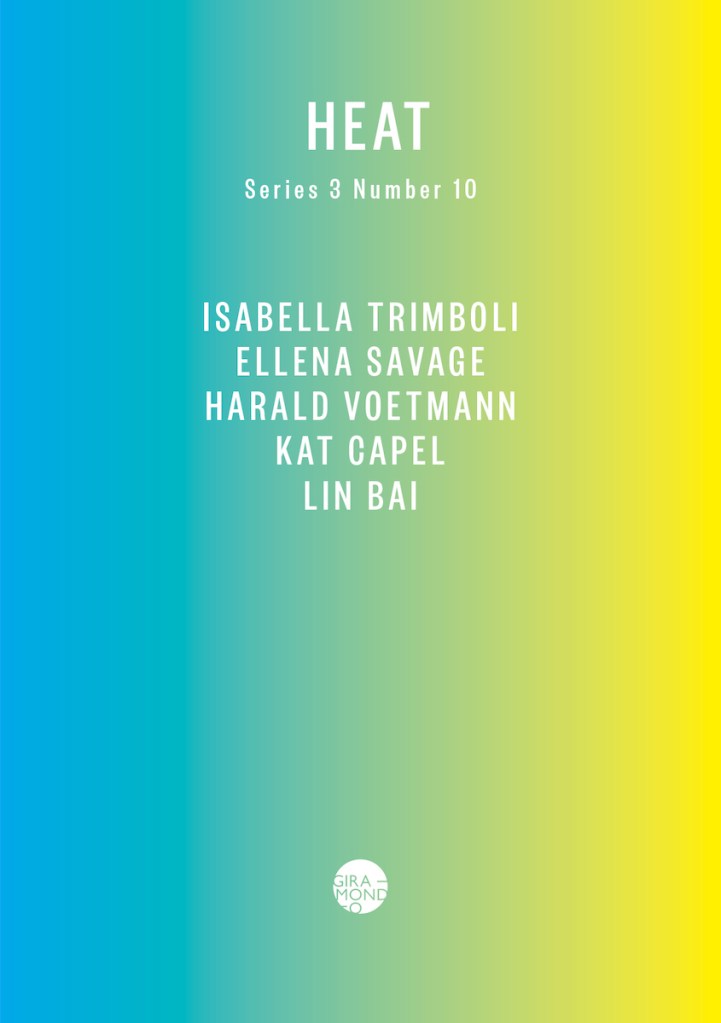
This issue kicks off with ‘Life’s Work’ by Isabella Trimboli, a terrific, multi-faceted article on journals that ranges from her own practice to a five-hour cut of a movie diary. She’s specifically interested in ‘diaries from women who were not writers by vocation, that had never known true recognition, that wrote about themselves obsessively and with self-scrutiny’.

I confess that the rest of the journal didn’t sing to me.

One piece begins:

Simón entered my room and gave me a look.
Unconsciously, and then consciously, I pressed my body into a pose, breasts forward, ass to one side, and lifted the sheet, an invitation that suggested this was how I always lay before 10 a.m., like a steamed clam.

(Ellena Savage, ‘Bare Life’)

What follows isn’t terrible, but sexual intrigue in a shared house with a smattering of philosophy about Covid shutdowns isn’t my cup of tea. And I know it’s a lost cause, but that ‘ass’ – along with a ‘diaper’ elsewhere in the journal – gets my back up. It’s an Australian literary journal, do we have to use US language?

Another:

Someone did give birth to me. Why remains unclear. Maybe they wanted to be loved, or it just sort of happened.

(Harold Voetmann, ‘Common Room Rocking Horse’, translated by Johanne Sorgenti Ottosen)

Sorry, but I find that hard to take seriously, and it’s not funny.

Then there’s this:

The house had bricks the colour of runny shit and a linoleum floor that was so thin you could scrape a hole in it by pushing back your chair.

(Kat Capel, ‘Sightseeing’)

As you might almost guess, this turns out to be a story of unconventional sexual compulsions set mainly in a share house. I’m too old.

And then this:

This looking at myself, touching myself, it all started a long time ago. In nursery school, in fact, when I was five or six years old.

(Lin Bai, ‘The Light in the Mirror’, translated by Nicky Harman)

That’s the inauspicious opening of what turns out to be an extract from Lin Bai’s 1994 novel, A War of One’s Own, which, according the brief author bio (on page 76), ‘was an instant success and established her as a pioneer of women’s literature in China’. The Wikipedia entry on the novel doesn’t mention translation, so this may be the first time this writing has been translated into English. If so, hats off to Heat and Nicky Harman. But, quite apart from my distaste for extracts from longer works, I won’t pretend to have enjoyed it.

SWF 2020, Post 8

Usually the Sydney Writers’ Festival lasts for two weeks. Usually I blog about the dozen or so sessions I attend live, and don’t feel the need to tell you about any podcasts. This year I seem to have made a decision to listen to them all and blog about every one. Here are sessions 35 to 40: journalism, memoir, First Nations voices, the world of high tech, terrorism, violence against women.

Long-form Journalism in Australia 12 August

I know Trent Dalton’s writing from his novel Boy Swallows Universe, which I loved (blog post at this link). It turns out he has also been writing ‘long form journalism’ for The Australian for years. For even more years, Jane Cadzow has been doing likewise for Good Weekend, the magazine published on Saturdays with The Sydney Morning Herald and The Age. Katrina Strickland is editor of Good Weekend.

This is an inside look at feature-article writing in Australia. There are lots of anecdotes about the biz, insights into the process (taping allows a journalist to take notes about things other than what is being said), and how ‘long form’ is seen by the ‘hard news’ journalists. As audience, I felt that I was listening in on a chat among people who knew each other well and moved in the same journalistic circles, rather than people who were discovering things along with us. The emphasis seemed to be on profiles of celebrities and others rather than stories from war zones or issues-based articles. But it’s a fun listen.


Jeff Sparrow: Fascists Among Us 17 August

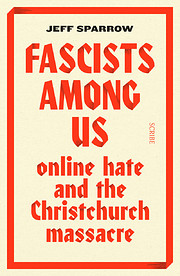
My last batch of SWF sessions featured two white liberal male authors in conversation. This session features two white left-wing males. Jeff Sparrow, former editor of Overland, has written Fascists Among Us: Online Hate and the Christchurch Massacre. Here he talks to Antony Loewenstein, whose My Israel Question is terrific – and he’s written a lot since.

Starting with the Christchurch massacre, the conversation range widely over contemporary politics and media. The perpetrator (Sparrow doesn’t use his name and the discussion of his reasons is interesting) was not a ‘mentally-disturbed individual’ but a convinced Fascist, whose main inspiration was Oswald Mosley. Donald Trump is not a Fascist, but has created a sea in which Fascists can swim. Social media platforms have some responsibility for enabling Fascists to flourish. Here’s Jeff Sparrow:

Genuine Fascists were some of the early adopters of the internet, precisely because they realised the internet allowed them to mobilise and organise in a way that they couldn’t do in real life. The far right in Australia tended to be recruiting people from the outsides of big cities or small countries towns. How do you organise those people in the real world? It’s very difficult. Australis is a big country. How do you bring them all together? If you have a website, it’s much easier, and the most recent attempts to organise Fascist movements in Australia were for that very reason closely associated with platforms like Facebook, because here is a mainstream form of the internet, everyone uses it, everyone in a country town can get on Facebook, there’s this one group you can set up. It’s very well suited to the structure of Fascist organisations because it’s participatory but not democratic. You can set up a Facebook, everyone can be involved but there’s a leader at the top who runs everything. In a sense it replicates the structure of a traditional Fascist organisations. That’s one of the reasons the far right has done much better on line than the left has.

And later:

We need to try to find some way to take the anti-Fascist principles that have worked in the real world into the online space. That’s easier said than done, and I don’t have a particular answer as to how that might occur, but it’s going to be a real issue from here on in, because the internet is gong to be central to whatever far right groupings emerge.

In normal times, Sparrow says towards the end of the conversation, the perpetrator’s eco-Fascist notion of mass murder as a solution to the climate emergency would be absolutely unattractive to absolutely anyone. In the context where the world seems to be breaking down, that may be changing. He concludes on what Loewenstein calls the ‘mildly optimistic note’ that it’s not enough to fight back against Fascism: we have to offer some genuine hope for a better world.


First on the Ground 19 August

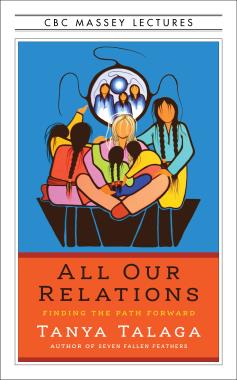
As in the session on long-form journalism, here three journalists who work in similar fields compare notes and discover how much they have in common. But this trio are Indigenous, and until recently it was rare for Indigenous journalists to be have major platforms. The participants are Warlpiri woman and co-host of NITV’s The Point Rachael Hocking; Anishinaabe and Polish Canadian journalist Tanya Talaga; and Kamilaroi/Dunghutti founder of the Tiddas4Tiddas podcast Marlee Silva.

Like the earlier session featuring Tanya Talaga, this one discusses strikingly similar experiences of First Nations peoples in Australia and Canada.

This is another podcast in the Stories Worth Telling series created by the Judith Neilson Institute for Journalism and Ideas and Sydney Writers’ Festival.


Anna Wiener: Uncanny Valley 24 August

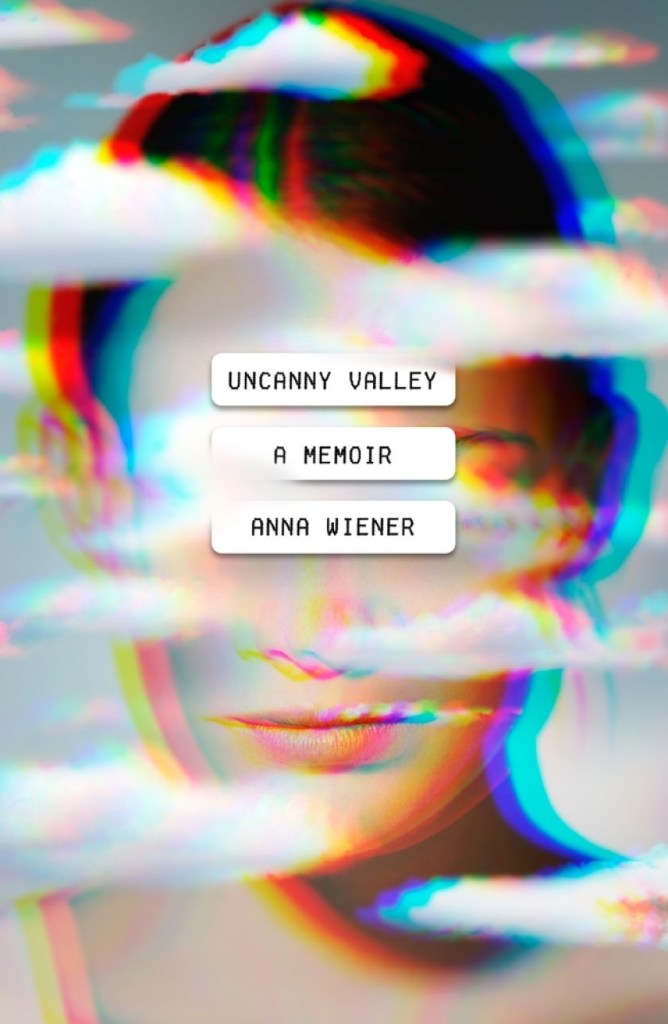
Uncanny Valley is US journalist Anna Wiener’s first book, a memoir of her time working in the high-tech industry. Here she talks about it with Rae Johnston, NITV’s Science and Technology Editor. The conversation covers many familiar topics: the rise of surveillance, the exploitation of workers in the tech industry and by companies like Uber, the steady thrum of sexism in Silicon Valley.

There’s an interesting discussion of Wiener’s decision to name no companies and very few people in the book – for instance, there’s a company she calls ‘the social media platform that everyone hates’ and there’s no prize for guessing what that is. Another highlight was the explanation of ‘Down for the Cause’, unofficial motto of a start-up that calls on employees’ devotion above and beyond their official duty, and well beyond what they are paid for. But though both speakers mention several times that the book is very personal, the conversation generally stays at an abstract, journalistic level. Here’s Anna Wiener:

I just wanted to write about the way that it feels to look for meaning in work, to think you’ve found it and then to be totally disillusioned not just by your personal experiences but by the narrative and fantasies of an entire industry … I didn’t write the book as an instrument of social change. That was never my intention. I really wrote it hoping that people might see themselves in it in some way, people might see the world a little differently. I wanted to articulate the experience of being a fairly low level employee at tech companies in the 2010s in part because I just felt that was not a perspective that I was reading much about.

I would have liked to hear her read from the book, to hear something specific about those personal experiences and those fantasies. But the conversation was a good reminder that those unnamed/nicknamed companies aren’t necessarily our friends.

A small note about entertaining differences in pronunciation: Anna Wiener spoke of the importance of higher keys and buyer says, and it took me a moment in each case to realise she meant organisations with rising levels of power and prejudices.


Reckoning and Retribution 26 August

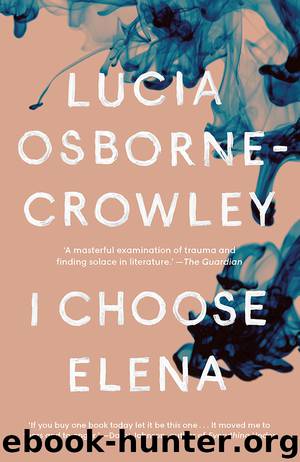
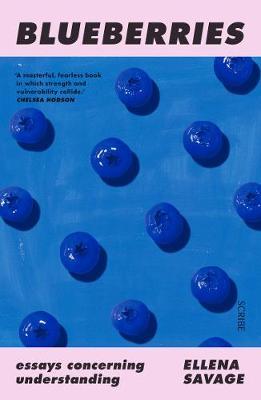
Lucia Osborne-Crowley’s I Choose Elena and Ellena Savage’s Blueberries are both debut books, the former a memoir and the latter a collection of essays. They both deal with personal experience of sexual assault, and its long, hideous tail.

Maeve Marsden, theatre person and curator of the ‘national storytelling project’ Queerstories, does a lovely job of facilitating the conversation – I particularly appreciated her for having both writers read from their books at the beginning, so we got to hear their deeply considered and carefully deployed words before hearing the back and forth of conversation. In that conversation one of the writers mentioned her PhD a couple of times and spoke in academically-inflected language a little too much for easy communication, but that’s a minor grumble from a relatively uneducated listener-in, who nonetheless benefited from the conversation.


The next batch of podcasts promises to include some story-telling. And maybe there’ll be some poetry …

Overland 204

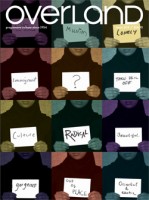
Jeff Sparrow, editor, Overland 204, Spring 2011

At a time where the terms of Australian political debate are set by the self-styled ‘centre-right’ Australian to the extent that vehemently anti-Communist Robert Manne is seen as left wing, everyone who’s more socialist than Ghengis Khan should subscribe to Overland. It has been appearing regularly for more than 50 years as a journal of ‘progressive culture’, unashamedly of the left from its beginnings, creating a space where dissenting voices can be heard (arguing with each other as often as not), and staying for the most part readable by people (like me) who wouldn’t know Althusser from a hole in the ground. Unlike the Australian, it has no Rupert Murdoch to prop it up. You can read most of every issue online. The point of subscribing is to help sustain it.

In this issue, in no particular order:

  • ‘The birthday boy’, a short story from an early Overland updated and retold in sequential art (ie, as a comic) by Bruce Mutard. While the story here stands on its own merits, I’d love to read the original, by Gwen Kelly, so as to follow the process involved in the updating (who were the 1955 equivalents of 2011’s Sudanese students, for instance?). I couldn’t find it on the Web. Maybe I’ll make a trip to the State Library …
  • John Martinkus, in ‘Kidnapped in Iraq, attacked in Australia’, tells the story of his capture and release by Iraqi insurgents in 2004 and the attacks on him by the then Foreign Minister and rightwing ‘journalists’. There’s nothing new here – I wrote to Alexander Downer’s office at the time and received a boilerplate reply – but it’s very good to be reminded of this shameful moment just now when Downer has been on the TV denouncing David Hicks again and one of the ‘journalists’ has been wailing about free speech after being held to account by a court
  • an interview with Afghani heroine Malalai Joya. I was glad to read this after attending a crowded meeting in Marrickville Town Hall where the acoustics and sight lines made her incomprehensible and invisible to me. The interview gives a sharp alternative to the mainstream media’s version of what’s happening in Afghanistan and it’s a great companion piece to Sally Neighbours’ lucid ‘How We Lost the War: Afghanistan a Decade on from September 11‘ in the September Monthly
  • some splendid, almost Swiftian sarcasm from Jennifer Mills in ‘How to write about Aboriginal Australia‘: ‘First, be white. If you are Aboriginal, you can certainly speak on behalf of every Aboriginal person in Australia, but it is best to get a white person to write down what they think you should be saying.’
  • Andy Worthington’s When America changed forever and Richard Seymour’s What was that all about? reflecting on the damage done to democracy in the USA and its allies by the ‘war on terror’
  • Reading coffee‘, a short story by Anthony Panegyres that reminds us of anti-Greek violence in Western Australia during the First World War (and is also a good oogie boogie yarn)
  • Ellena Savage’s ‘My flesh turned to stone‘, which I may have misunderstood (it quotes Lacan, and refers at one point to gender-based torture, which may or may not be how the academies nowadays refer to torture of women), but seems to be putting the eminently sensible proposition that terrible experiences have lasting after-effects on individuals and communities, and expecting people to just get over them isn’t realistic
  • A number of poems, coralled off together in a section up the back, printed in white on pale green, which is either a cunning way of making us read the poems slowly or a case of a designer for whom readability isn’t a priority. The ones that spoke most to me are Jill Jones’s ‘Misinterpretations /or The Dark Grey Outline‘ and John Leonard’s ‘After Rain‘. Jill Jones discusses the former on her blog here. You may have to be fascinated by swallows to enjoy the latter – which is very short – as much as I did, but who isn’t fascinated by swallows?
  • Peter Kirkpatrick’s ‘A one-man writer’s festival’, a hatchet job on Clive James’s poetic aspirations. I found myself asking why. The poor bloke’s got cancer. Leave him alone.

I didn’t read everything, which is pretty much a hallmark of the journal-reading experience. You can skip things because of an annoying turn of phrase on the first page (as in a reference to Sydney’s western suburbs as perceived as ‘some bloody hell, beginning somewhere around Annandale’ – Annandale! I doubt if that would have got past the editors in a Sydney-based journal). You might be put off because something looks too abstract, or promises a detailed discussion of a book you plan to read. Or you might be pre-emptively bored by anything about publishing in the digital age, even while admitting the subject is important.

I read this Overland in a grumpy post-operative state. And enjoyed it.