Tag Archives: First Nations

Dog Ear Cafe Launch

Last night we went to another brilliant launch at Gleebooks: Rachel Perkins doing her first book launch,  of Andrew Stojanovski’s first and he says only book, Dog Ear Cafe. It was a surprisingly intimate affair. Many members of the author’s family were there, including a couple of charming twin nieces who were just tall enough to reach the snack foods, and relaxed enough about the surroundings to keep up a sweet background noise during proceedings.

Stojanovski lived at Yuendemu in Central Australia for 11 years, and was part of the Warlpiri community’s successful campaign to wipe out petrol sniffing there. As he said, all through his time in the Centre Aboriginal elders would say, ‘Don’t write a book about this.’ They were sick of whitefellas blowing in, spending a bit of time there, and then going away and making a quid or getting jobs by writing anthropological or other treatises about them. But then, toward the end of this time there, one friend said to him, ‘You should write a book about this.’ The idea was that he should write a history or a manual to show other whitefellas how they could be useful. When he told a young friend – a former sniffer and active participant in the regeneration of the community – about the idea, the young friend said no one would read a history/manual, he should write it like an adventure with all the funny and dramatic incidents left in.

Rachel Perkins did a lovely job as launcher. She was there as an Aboriginal Big Name who could give the book her blessing, of course,  but she let us know from the start that she had a friendship with the author dating back decades – she communicated her pleasure (and relief) in the excellence of the book, he affection for Andrew, and her own deep appreciation of the creativity, resourcefulness and above all compassion of the people of Yuendemu. Given that it’s been in the news recently as a place of violence and lawlessness, this was a refreshing perspective from one who has strong connections there.

So much of this launch was heartening. Andrew Stojanovsky told poignant stories (he cradled a glass of red wine under his nose, to illustrate the habitual posture of a petrol sniffer). He explained the benefits for Aboriginal communities in having white people there to perform functions that would be rendered extremely difficult if not impossible by the complex demands of avoidance and can’t-say-no kinship obligations. He relayed many conversations with friends young and old at Yuendemu. In one of these he was talking to a Warlpiri man about the challenge of making friendships between whitefellas and Warlpiri. He said that sometimes it felt as if there was a Grand Canyon between the two. The old man said, ‘Yes, but I see tightropes across the canyon.’

Inevitably, I thought of Seven Seasons in Aurukun, my niece Paula Shaw’s account of a much shorter time in a remote Aboriginal community. Rachel Perkins spoke of the importance of books by whites that move beyond the anthropological or ethnographic perspectives to portraying individual people – Paula’s book does that. And Andrew Stojanovsky described the conditions endured by school teachers when the community was still home to petrol sniffers – as Aurukun was during Paula’s time there – and commented that it was no surprise that few teachers managed to stay more than two years.

Dog Ear Cafe has already been reviewed by Will Owen in North Carolina. He would have enjoyed the launch. We bought a copy.

Bony Emily?

Adrian Hyland, Diamond Dove (©2006, Text Publishing 2010)

Detective Napoleon Bonaparte, known as ‘Bony’, had one white and one Aboriginal parent. He appeared in most of the 29 novels written by Arthur Upfield between 1922 and 1996 (the last being finished by other people and published two years after Upfield’s death). Upfield was a bushman himself, who knew what he was talking about when he described life in the outback, and the books’ respectful approach to Aboriginal lore probably played a role over the years in softening mainstream Australian culture’s dismissive racism. My cane-farmer father was a fan. I have read only one of the novels, and that was many years ago, but its title alone – The Bone is Pointed – indicates how the books have dated, how their inevitable racism now stands out and may well overshadow their virtues. If I remember correctly, Aboriginal culture was essentialised (part of Bony’s nature, in tension with his white nature) and generalised (no distinctions are made among the many different Aboriginal cultures and languages).

Adrian Hyand’s Emily Tempest books, of which Diamond Dove (Moonlight Downs in the US and Outback Bastard in Germany) is the first, have a similar set-up. Emily, the university educated daughter of a traditional Aboriginal woman and a white man, belongs like Bony in both worlds and in neither. But we’re definitely in the 21st century: Emily’s mother comes from a particular people, the fictional Wantiya mob, and Emily herself grew up as a kind of foster daughter to the similarly fictional Warlpuju mob; there are Native Title land claims, unscrupulous miners, post-Papunya-Tula art, and complex sexual scenarios.

This is genre fiction. Where else would you find a passage like this:

A maniac, it seemed then, was the only logical solution,and a convenient maniac was what we had in the turbulent, rolling-eyed Blakie. Everything pointed to the crazy bastard. it had to be him.
Why, then, was I beginning to feel the first little pricks of doubt?

The only possible answer to that question is, ‘Because you’re in a detective story, Emily.’ That is to say, we’re not being asked to take this book seriously as a work of social or political analysis. It’s meant to be fun, and it is. Emily herself is gutsy, witty in a hardboiled way, the most engaging detective hero I’ve encountered in a long time.

Talking on The Book Show recently on the occasion of her 90th birthday, P D James reflected on the murder mystery novel:

The classical detective story is … popular in times of anxiety, times of strife, times of war and dangers of war, times of depression. That’s when its comfort is so necessary because at these times one can feel that there are problems facing communities, facing countries, facing the world generally, which really are insoluble, however much money and however much effort you pour into them. Here you have a form of popular fiction with a puzzle at its heart and by the end of the book it will be solved, not by divine intervention or good luck but by a human being, by courage and perseverance and intelligence. So it rather confirms our belief, which I still think we have, that we live in a rational and moral universe.

These remarks could hardly be more apposite. Adrian Hyland has given us a classic detective story set in the midst of the strife, anxiety and apparent insolubility of the continuing dispossession and disadvantage of Australian Aboriginal people. He lets aspects of that dire situation be seen, but offers us the comfort of a puzzle, which is solved, exactly as the Dame says, by courage and perseverance and intelligence. Hyland thanks ‘the Indigenous people of Central Australia’ in the acknowledgements, but makes it clear that his Aboriginal characters belong to a fictional language group and live in fictional country. He doesn’t claim to have anyone’s permission to tell his stories, but then Emily is is not an insider to Warlpuju culture, so there are no secrets being revealed. Hyland is a middle-aged white man who writes in the voice of a young Aboriginal woman. I know I’m another middle-aged white man, so my opinion may need to be taken with a dose of salt, but I think he’s done brilliantly.

A second Emily Tempest novel, Gunshot Road, was published earlier this year. My recommender of detective books says it’s even better.

The Tree of Man revisited with the Book Group

Patrick White, The Tree of Man (1955, Vintage 1994)

Before the group meeting:
My mother’s letters in the 1970s would occasionally report on her reading. She once transcribed a paragraph from Salman Rushdie’s Midnight’s Children because it seemed to describe the noses of our family. The other day when I read the first page of the Drought chapter of The Tree of Man, I wondered if she’d thought, as I do, that this description of Stan Parker evokes aspects of my father (allowing for the fact that Dad grew sugarcane rather than running a dairy, and was never ‘broad’):

He was respected. He was inseparable from the district, he had become a place name. His herd was small, but of good quality for the herd of a man in a small way, neither rich nor ambitious, but reliable, the cans would always reach the butter factory to the minute, without fail. He went to church too, singing the straight psalms and rounder hymns, in praise of that God which obviously did exist. Stan Parker had been told for so long that he believed, of course he did believe. He sang that praise doggedly, in a voice you would have expected of him, approaching the music honestly, without embellishing it. Standing in the pew, singing. the back of his neck was by this time quite wrinkled, and the sinews were too obvious in the flesh. But he was a broad and upright man.

I’ll never know if she made that kind of connection, but she mentioned the book in passing in a comment on Cancer Ward:

It seems queer but I think Patrick White writes much like [Solzhenitsyn], so simply. I’ve read only one of his, The Tree of Man, & really enjoyed it.

Not bad, eh? She made no claim to literary sophistication, but she picked White’s affinity with the Russians. And she found his prose simple!

The prose is simple, but it’s not easy. It’s also impossible to read fast, lacking what A D Hope believed a novelist needs: ‘a plain style, a clear easy stride, a good open texture of language to carry him [sic] to the end of his path’. But it’s certainly not ‘pretentious and illiterate verbal sludge’, as Hope famously described it. It does constantly pull you up and make you look at a particular word or image – or, if you don’t stop, leave you with an uneasy feeling that you’ve missed something. The point of view frequently moves around within a single short sentence, or rather within a grouping of words between consecutive full stops, since White is a great user of what are sometimes known in the editing trade as frags. Even the very first sentence, innocuous enough at first glance (‘A cart drove between the two big stringybarks and stopped’), has the reader slightly wrong-footed with its abrupt rhythm, its lack of a human, or even animal, subject, its slightly skewed use of articles (‘the cart drove between two big stringybarks’ would be more natural, but of course it would mean something quite different).

The book’s peculiarities, and its arrogance, intimidated me in first year university in 1967. But not this time. True, I came close to genuflecting at the first four chapters, which tell of the primal encounter of ‘the man’, ‘the woman’ and the bush. I wondered if I would be able to keep up with the intensity of the prose for the whole 480 pages. But once the narrative emerged into something resembling a social world, I was less enthralled. In fact I became increasingly irritated. I just don’t believe in the nastiness of most of the characters. I can’t stand the snobbishness of the narrative voice. The drunken Irish shenanigans (read domestic violence, despair, wretched poverty and, towards the end, dubious religion) of the O’Dowds fail to amuse me. The pretentions of the nouveaux riches Armstrongs are awkwardly unconvincing, as is almost everything about the younger Parkers. The book seems to assume that some people, inarticulate or otherwise, have an honest capacity for rich inner lives, while others (most?) don’t, and must settle at best for synthetic souls with occasional exalted glimpses. For all the towering strengths of the book – and they certainly aren’t limited to the first chapters – I became increasingly obsessed with calculating what fraction of the pages I had yet to read.

Perhaps the most striking disappointment is the vast, gaping silence about Aboriginal Australians. When Stan’s cart stops between the stringybarks in that first sentence, it’s definitely in terra nullius. ‘Blacks’ are mentioned twice, once when young Ray refers to their arcane knowledge of how to survive in the desert, and again in the closing pages when the missionary mentions sex with black women as a sign of his youthful depravity. The phrase ‘dream time’ occurs twice. The first time, Stan and Amy have come to an ‘uneasy dream-time’. Since that probably signifies that neither of them was fully awake in relation to the other, the Aboriginal reference may be coincidental, but in the second, near the beginning of the fourth and final part, Stan looks back on his first days at the farm as ‘the dream time’. Here the phrase does refer to a time of creation, of beginnings, and it must disturbingly invoke for any Australian reader now, and surely for some in the 1950s, this continent’s history of genocide, dispossession and cultural appropriation. Invoke without acknowledging. The Irish are despised. The working class barely exist. Aboriginal people have been erased and over-written.

Then, here’s Stan, further down the first page of the Drought chapter:

There were certain corners of his property that he could not bring himself to visit, almost as if he would have discovered something he did not wish to see. […] Once he had been looking at a crop of remarkably fine sorghum that was almost ready to bring in, when he remembered that same stretch of land after he had cleared it as a young man, and on it the white chips lying that his axe had carved out of the trees, and some trees and young saplings still standing and glistening there, waiting for the axe. So that he forgot his present crop and went away disturbed, and thinking.

In a book that makes much of ‘things that are too terrible and wonderful to speak of’ is it too much to imagine that in this moment the thing Stan does not wish to see is the silenced Aboriginal history? That the dispossession on which Stan’s settlement of the land is built is almost forcing its way into the narrative? Surely it’s not just my idiosyncrasy that those white chips of wood remind me of the bones in the red earth of a massacre site in a William Yang photograph?

There may well be hundreds of learned articles about this disturbed silence, but that’s my two bob’s worth.

After the group meeting:
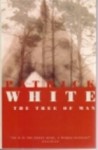
Tonight we met in a pub in Paddington, rather than in someone’s home. All but one of us turned up, and almost half had read all or most of he book. We had an animated discussion. Only one of us really loved the book. One, who may not have read it, considered it to be dated imperialism. The two of us who read the Vintage edition agreed that the cover was absurdly inappropriate (a horse? northern hemisphere trees?) No one shared my unease about the absence of Aboriginal characters: the consensus seemed to be that the original inhabitants of the Parkers’ land had been dispossessed long before Stan and Amy arrived, and that my reading of the white chips passage was drawing a long bow. As someone said, what’s the point of a bow that’s not long? And I still think that the general silence enacts a kind of genocide.

Whatever, unlike Anna Karenina, The Tree of Man couldn’t hold its own against the need to discuss Other Things – the sins of the ALP and the worse sins of the Coalition, our various adventures in work and education, travel and the weather. As always it was a fun evening.

Every Secret Thing

Marie Munkara, Every Secret Thing (UQP 2009)

I read this immediately after The Tree of Man. I’ll wait to post about the latter until we’ve discussed it at the Book Group  – enough for now to tell you that it was Edward Said’s notion of counterpoint that prompted me to follow White’s novel with one by an Aboriginal writer.

The books have more in common that you might expect – mainly a contempt for Irish Catholics and selected white middle-class people of whatever religio-ethnic background – but where White’s contempt is accompanied by patrician amusement, attacking from on high, Maria Munkara’s, behind its veneer of cheerfully knockabout calumny, is fuelled by powerful sorrow and rage at the damage done by missionaries.

In fact, scrap the word ‘cheerful’ in that last paragraph. The opening chapters have the form of rough humour as they introduce the people of ‘the Mission’  – the ‘mission mob’ of priest, brothers and nuns and the ‘bush mob’ whom they are out to convert. But from the beginning we are told of endemic sexual abuse and corruption, and  the humour comes with such heavy sarcasm that it’s hard to find it actually funny. For example, when some boys are disobeying the nuns while their parents are standing by, the nuns have an inkling that they may be encountering deliberate resistance rather than incidental lack of cooperation, ‘but they all knew that the bush mob were God-fearing people with a deep and abiding respect for the mission and its papally sanctioned quest to strip them of every vestige of their culture so they would never be defiant now, would they?’ The whites of the Mission are mostly presented in unforgiving caricature – closed-minded, arrogantly confident of their own superiority, sexually predatory (the men) or quietly lustful (the women). The Aboriginal characters aren’t treated much more kindly. They’re rough, pragmatic, disorganised, venal, and only slightly more fleshed out than the non-Aboriginal – but there’s no doubt where the book’s sympathies lie.

The book progresses mainly in a series of skits: the children ask the visiting Bishop curly questions about Christian teachings, the old man of the bush mob helps an anthropologist fill his notebooks with misinformation, a couple of French Hippies arrive in a shipwreck, a cyclone virtually destroys the Mission when the mission mob disregard the warnings of the bush mob, and so on. It takes a while for the narrative gears to mesh, and when they do it’s not so much that the sarcastic caricaturing lets up as that a deeper current asserts itself, and we begin to understand that we are reading about an appalling spiritual tragedy. The moments where the narrative voice tells it straight are incredibly powerful, as at the point when the bush mob have been ‘dying in droves’ from a flu that has only mildly inconvenienced the missionaries, and are persuaded to convert en masse not only to Christianity but also to Western materialism, mainly in the form of cast off clothes. The narrator comes out into the open:

The almighty God that most of the bush mob now believed in was nothing more than the grim reaper of human souls with the mission mob as his helpers and the cast-offs the sad compensation for the relinquishment of their own beliefs. And even though the tenth commandment mentioned that you shouldn’t covet your neighbour’s house or wife or donkey or anything else, the church must have decided that coveting someone’s soul was an entirely different matter. And even though the eighth commandment stated quite clearly that it was very naughty to steal, the mission mob ignored this too and stole the things that were dearest to the bush mob’s heart. They stole their resistance to change and they stole their belief in themselves and they stole their children. Because each black soul that was harvested and each child that was appropriated was another rung higher up the ladder to heaven for Father and his crew and another step closer to salvation from this cesspool of earthly temptation and sin.

In a chapter where a stolen child finds her way back to the community as an adult, the tone lurches from silly farce on a crab hunt to plainspoken desolation when the narrator again intervenes. The final moments of the book are as devastating as you’re likely to read anywhere.

Every Secret Thing won the 2008 David Unaipon Award as a manuscript and then in February this year it won the Northern Territory Book of the Year Award. In an interview on Awaye in February, Marie Munkara said her story had ‘little wisps of truth and huge bits of embellishment’. The book makes no claims to be a historical record, but the truths it tells are a far cry from wispy.

Sydney Biennale

Today the Art Student and I popped into town with a visiting Melburnian friend to stroll around the MCA for a couple of stimulating hours. It was our second excursion to the Biennale. We went out to Cockatoo Island a couple of weeks ago, but I didn’t make the time to blog about that, and to judge by the program we missed some of the most interesting things out there. We did see Cai Guo-Qiang’s Exploding Cars, walk on the shanty town rooftops of Kadia Attia’s Kasbah, and chortle uneasily at Shen Shaomin’s Summit. Today we were greeted at the door by two of Shen Shaomin’s bonsai works, which at first glance deliver much less punch than the realistic corpses of Communist leaders in Summit, but after we’d seen half a dozen of his tortured trees, even without being able to read the ideograms describing how they had been manipulated, we treated them with due respect.

The  walls of the first large room at the MCA are covered with big colour photographs, a hundred pairs of which one is a domestic space and the other a person standing back to camera. I imagine there are people who are capable of standing in this room and spotting the unifying motif. I looked up the program and told my companions and one or two other people – no one complained about the spoiler. (If you want to know more, you can click here.) The artists, Sun Yuan and Peng Yu, created the memorable Old People’s Home, which we saw in Tokyo last year.

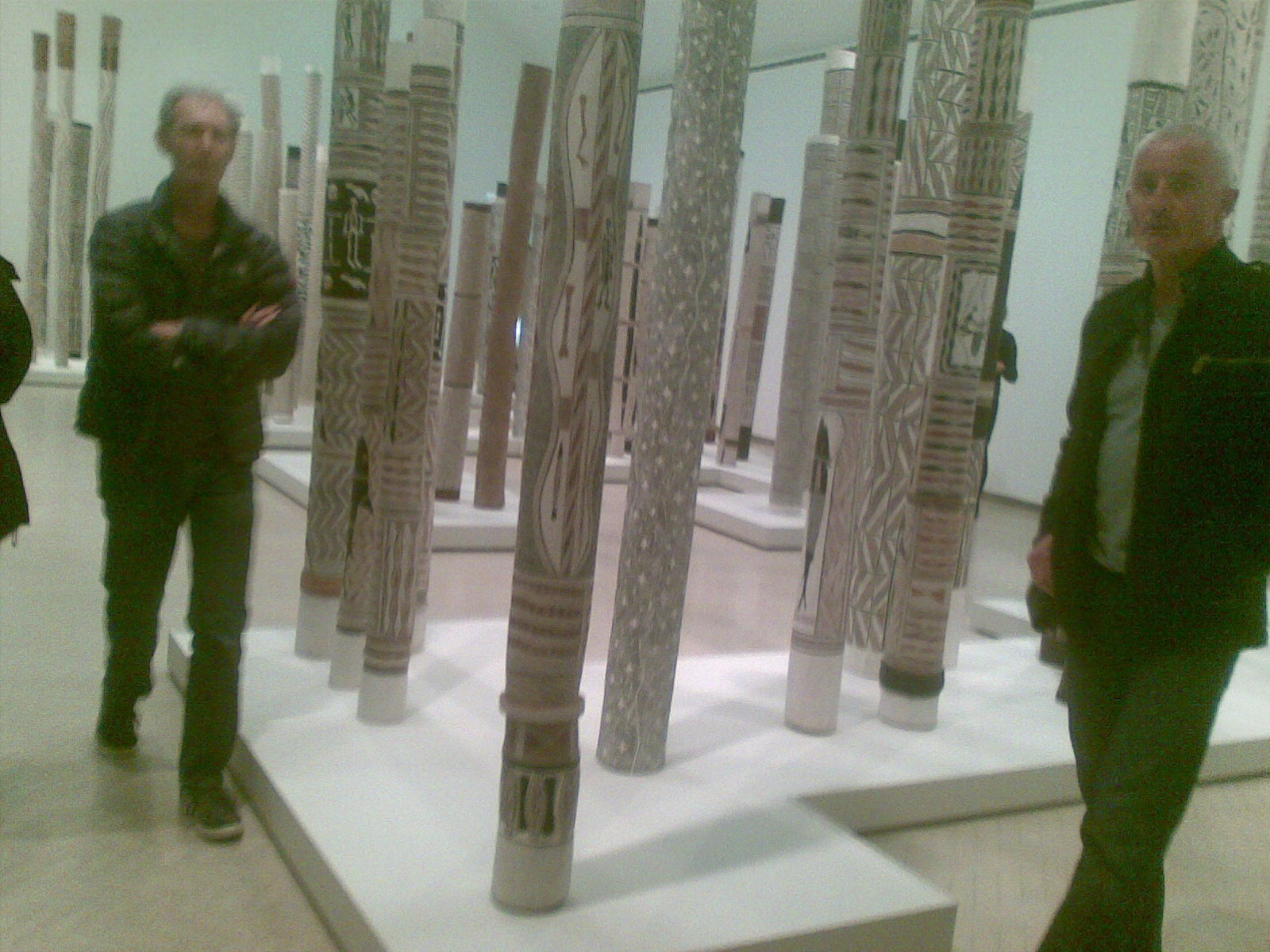
There’s far too much in this exhibition for one visit, or one blog entry. I was struck by the amount of Indigenous art – from Australia, of course, but also from New Guinea, the Arctic, the Americas and Europe. One large room on the top floor is devoted to 110 larrakitj (memorial poles) by 41 Yolngu artists from East Arnhem Land, and it’s a knockout. There’s brilliant trompe l’oeil, wonderful sculptural play, images reminiscent of the Mexican Día de los Muertos, shimmer to make your eyes water. A place to just stand and stare. I took my one phone photo there. It might give you some idea.

I tend to skip video installations in art galleries, and I saw at least two pieces today that confirmed my expectations of amateurish sound recording / acting / design, and did less than nothing for me. But Bill Viola’s Incarnation is totally magical. Two naked people walk towards the camera in slowmo, and it turns out that the graininess of the image is caused by a veil of water falling between us and them. They walk through the veil and are suddenly clear and in full colour. After a long moment, they turn around, go back through the water, and walk away until they vanish into the granularity of the screen. Araya Rasdjarmrearnsook’s video triptych is a delight of a different order. On each of three screens a life sized print of a famous nineteenth century European painting is set up in the open air in front of a group of Thai peasants, who sit with their backs to the camera and chat among themselves, mostly about the painting. We get subtitles. The naked woman sitting with clothed men in Manet’s Déjeuner sur l’herbe provoked quite a bit of anthropological speculation: ‘I suppose it’s cooler to go like that in hot weather’ ‘Is it a funeral custom?’ etc. Millet’s Gleaners and Van Gogh’s Midday Sleep were less mysterious, but there was much discussion of the exact nature of the crops and activities in each picture, the weather and the state of the fields. Not for these peasants our cringing sense of inadequacy when confronted with what we’ve been told is Great Art.

There was a lot else. Angela Ellsworth’s Seer Bonnets, beautiful to the eye, are made of pearl headed pins, thousands of them, all viciously pointing inwards to where the wearer’s head will be.  Louise Bourgeois has made fascinating sculptures from old clothes. Salla Tykkå’s video Victoria spends 10 minutes watching a waterlily bloom and grow, possibly in a greenhouse in Kew Gardens in London.

We had lunch in Glebe, and drove our friend to the airport less sure that Sydney is Philistine-ville. Then I realised I’d lost my wallet and will now draw up a list of all the cards I need to replace.

Greg Weight and Western Desert Artists

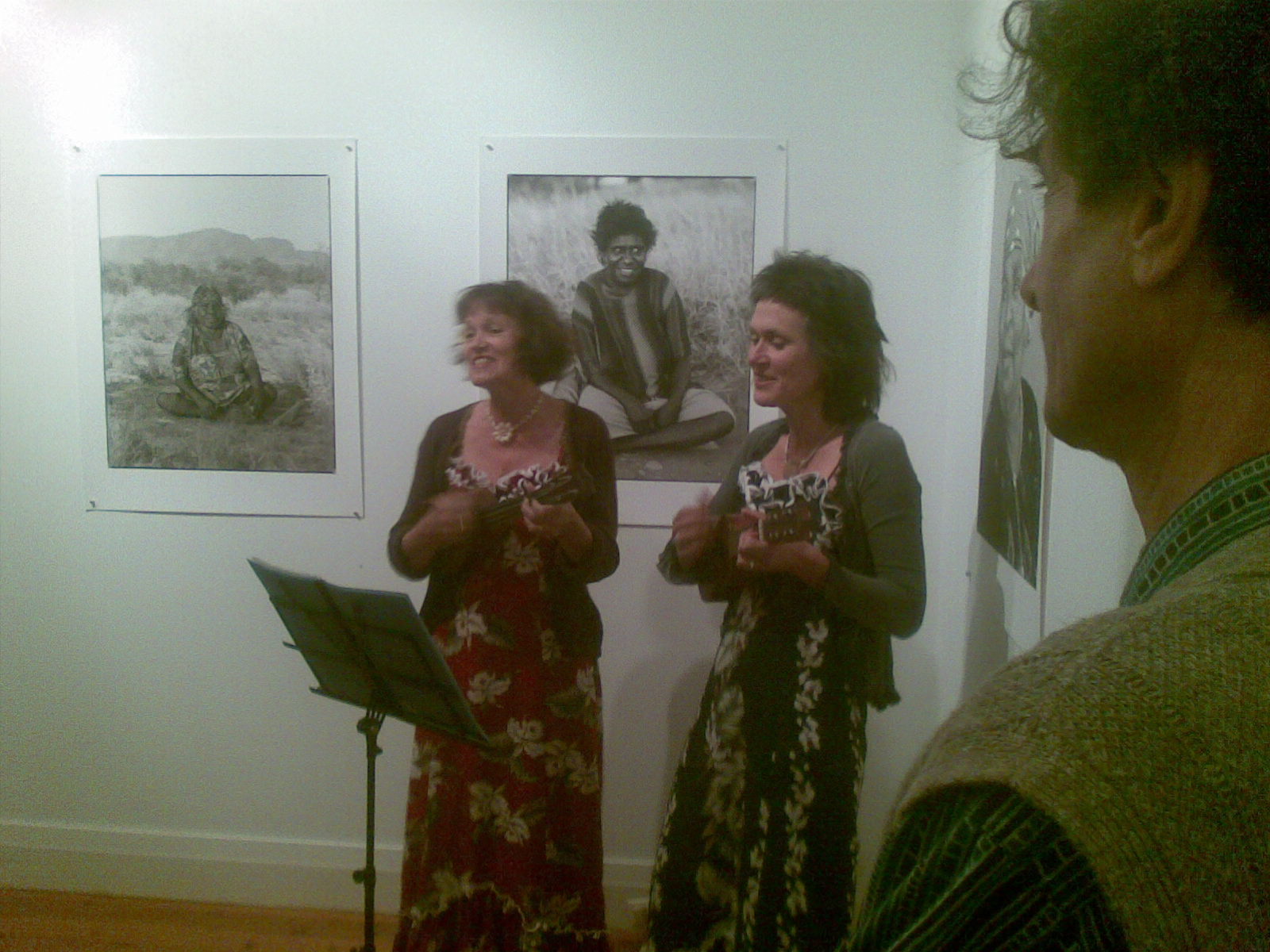
At least one of my regular readers would have loved to be at the Gallery East opening this evening [All turn and look at Will]. Greg Weight’s ‘Artists of the Western Desert’ comprises eleven portraits of Western Desert artists – from Kintore, Haast Bluff, Yuendumu and Alice Springs. The opening was a small, even intimate gathering. I recognised a number of stars of the art world, but someone explained that they were there as neighbours and old friends of Greg and Carol Ruff, his partner and the owner of the gallery, rather than as A-listers.

Long Jack Philipus Tjakamara dominates the gallery’s front window.

In lieu of speeches, Carol Ruff and friend played ukulele and sang – among other things, Carol’s own song ‘Finding Love in CLOVElly’ – and were joined on the bongos by the artist photographer, seen here in the right foreground. The Indigenous artist beaming down from the wall is Yukultjii Napangati, a Pintipu woman who came in out of the desert in 1984 when she was about 14 years old.

The exhibition lasts until 23 May.  If you miss it at Clovelly, you may be able to catch it at the Musée Branly in Paris in the next year or so.

Our baskets and Awaye

Almost exactly a year ago I mentioned that we’d acquired three beautiful woven baskets. The artist, whose name I omitted to mention then, was Jim Walliss, a white man from down Nowra way. Yesterday onABC’s Awaye he received an honorable mention in a program about Boolarng Nangamai Aboriginal Art and Culture Studio in Gerringong, near Nowra. The Awaye link in the last sentence gets you the audio. Here’s the relevant bit, where Steven Russell, weaver, painter and print-maker is talking to Nicole Steinke from the ABC:

Nicole Steinke: How did you start with the weaving, because you’ve said you really love the weaving?
Steven Russell: It started back in TAFE, in 2000, when I first started TAFE. We were taught by this old fella, a whitefella –
NS: Is that Jim Walliss?
SR: Jim Walliss, yeah. He’s a pretty good weaver himself, and he told us stories about the Aboriginals and what they did. He showed us a lot, and we just took off from there and ran with it and haven’t looked back since. I’m just thankful for Jim, for knowing him, and teaching us something that should have been passed down by our ancestors, and which wasn’t.
NS: So was there a sharing there that went on?
SR: Yes, it was sharing, and he was honoured to teach us. He taught us a lot of things about weaving and styles of weaving. He taught us our traditional weaving and that’s something that we’ll cherish for the rest of our lives, and we’ll pass it on to our kids.

So our beautiful little baskets have some sweet connections.

Bran Nue Dae

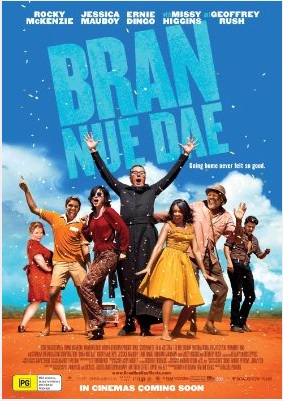
I usually restrict my blogging about movies to little notices in the feed on my right-hand column, but I’m making an exception for Bran Nue Dae because every review I’ve read has been tepid to ice-cold.

I want to shout from the rooftops: BRAN NUE DAE is FABULOUS.

It’s not a ‘well-made film’ – though it’s very well made. It’s funny, occasionally soppy, often sly and certainly capable of making a middle class white viewer like me interestingly uncomfortable. I mean, what is this movie doing when it has me wanting to sing along with:

There’s nothing I would rather be
than to be an Aborigine
and watch you take my precious land awa-ay.
For nothing gives me greater joy
than to watch you fill each girl and boy
with superficial existential shit.

It’s like David Gumpilil in his one man stage show tricking us into laughing at his humiliating arrest for public urination. The politics are clear, the dire consequences of dispossession are never denied, but we’re not being lectured at. We’re invited in, discomfort and all.

Mind you, I don’t know how it got its PG rating: in the first few minutes there’s a song about condom use that has very explicit lyrics, and Deborah Mailman’s, um, sexually active character is a pretty adult concept, I would have thought.

All the performances are terrific. I loved the choreography (and choreographer David Page’s brief appearance on a group shot at the end). I loved the look of it. I laughed out loud many times. Rachel Perkins has pulled it off.

Arty sunny afternoon

Confounding the predictions, yesterday gave us deep blue skies all day. Two loads of washing dried on the line, the goldfish glowed in the murk of our little pond, and P and I took the light rail to Pyrmont and walked to the MCA.

There was a charge for Danish–Icelandic artist Olafur Eliasson on the third floor, and a friend had been pretty lukewarm about him, so we decided to save our money (unusual for this time of year, I know) and visit it some other day. But the first, second and fourth floors fabulous enough.

The first and second are exhibiting a recent gift from Ann Lewis, an art collector so famous that even I had heard of her. It was wonderful to see shimmering works by Utopian ladies Emily Kame Kngwarreye and Gloria Petyarre, among other Aboriginal artists, displayed in the company of US big names Rauschenberg and Klippel  – Gloria Petyarre’s canvas filled with shimmering silver leaves is the single image that most grabbed me. There’s a little room of lovely photographs by Jon Lewis. Any relation? Well, yes, if the handwritten ‘For Annie (Grannie)’ written in the bottom border of one image means what it appears to.

Half of the fourth floor is given over to Forbidden, ‘the first in-depth solo exhibition’ of Fiona Foley’s work . Now, I am often impressed, bemused, amused or depressed by contemporary art, but I don’t often have a strong head-and-heart response. I did have to this exhibition. For example, the word Dispersal in big, chunky shiny aluminium letters, of which the initial D bristles with .303 bullets is a lot more than a clever reminder of the hideous use of that word in our colonial history. It stands next to a spiral of flour about three metres across, that needs constant attention from an attendant to maintain its crisp shape; the flour turns out to be part of an installation ‘Land Deal’, in which other objects representing those John Batman used to ‘buy’ the land where Melbourne was built hang on the wall. Nearby hangs a row of blankets, each inscribed with a single word, that conjure the experiences of Aboriginal women under colonialism. Elsewhere Foley places herself in photographs with titles like ‘Native Blood’ and ‘Modern Nomad’, that refer strongly to nineteenth century anthropological images. Evidently, earlier exhibitions have had titles like ‘Lick my black art’. Ok, lick it and weep.

The rest of the floor showcases new acquisitions. There’s a cute hologram that was popular with the very young (and others, including me), which could have been titled ‘Ghost Train’, but instead is called ‘You’re not thinking fourth dimensionally’. Danie Mellor made the cut with a sculpture that includes a shiny, mosaic kangaroo and a lifelike sulphur-crested cockatoo. I loved a video piece by Grant Stevens, in which an account of a dream is projected onto a wall in a way that controls the speed at which the viewer reads (or fails to read, because the pace picks up enormously in the middle).

Then we walked back to Pyrmont along the Hungry Mile, trying to figure out Paul Keating’s proposal for Barangaroo, and home to find the washing dry on the line.

White Rabbit and Menagerie

This afternoon we visited the White Rabbit Gallery in Chippendale, and then went on to Object Gallery to see their part of the exhibition Menagerie.

The White Rabbit Gallery has been open for exactly three months. In a converted Chippendale warehouse, a couple of very rich Sydneyites have set up a space to share with the public their collection of contemporary Chinese art. Admission is free, and gallery staff members are on hand on all four floors to answer questions, point out things you might have missed, offer a word or two about the biography of the artist. From the meticulously shredded Mao suits of Sun Furong’s Tomb Figures, through the spectacular trompe-l’oeuil draughtsmanship of Ma Yanling’s four images of opera singers, to Chen Wen-Ling’s over-the-top sculptures (guaranteed to make a pig-lover smile, and maybe even a pig-hater) this gallery is fabulous. Thanks, Judith and Kerr Nielson.

Menagerie: Contemporary Indigenous Sculpture is, according to the Australian Museum web site, ‘a groundbreaking exhibition featuring animal sculptures by 33 established and emerging Aboriginal and Torres Strait Islander artists’. Part of it is at the Museum, part at the Object Gallery up the hill (The site uses flash but irritating Flash: click on Explore on the side and you’ll get details of this exhibition). We’ve yet to visit the former. The latter occupies the single room of the Main Gallery, with a 20 minute video on six of the artists playing on a loop in the small upstairs space. It’s magic. I particularly loved ‘Red, White and Blue’ by Danie Mellor. This consists of three kangaroos, about a metre high, with front paws covering respectively mouth, eyes and ears. They’re made of mosaic tiles (respectively red-patterned, white and blue-patterned), except for their paws and ears, which are made of kangaroo skin, creating the impression that living animals have been encased in unyielding shells made from the detritus of settler society. They’re beautiful, poignant, and made by a man of Mamu heritage (I was born in Mamu country). I just googled Danie Mellor and found out that he won the Telstra Aboriginal Art Award this year, and that he had a solo exhibition at Elizabeth Bay that closed yesterday. I have terrible timing.

The White Rabbit exhibition stays up until January, when it is replaced by other contemporary Chinese works from Judith Nielson’s collection. Menagerie closes on 15 November.