Tag Archives: Giovanni Tiso

Overland 222

Jacinda Woodhead (editor), Overland 222 (Spring 2015)
overland222.jpgLike most issues of Overland this one includes:

the results of at least one literary competition: Peter Minter asks in his judge’s report on the 2015 Overland Judith Wright Poetry Prize, ‘Isn’t nurturing the penniless avant-garde something we should all embrace?’ As well as the poetry prize, this issue announces the Neilma Sidney Short Story Prize.

the regular columnists: I always enjoy Alison Croggon, who here takes issue with the idea of art as therapy, and Giovanni Tiso, who airs his ambivalence about his preference for old books. Natalie Harkin, a Narungga woman, poet and academic, makes her debut, reflecting on the importance of sharing personal narratives.

at least one intelligently provocative article: Stephanie Convery in Get your hands off my sister sounds a forceful warning against ‘activism centred on an unshakeable faith in women’s accusations of sexual assault’. The whole essay is worth reading, but I was struck by her point that harsher penalties for sexual assault don’t prevent it, but move it to a different location, ie, especially in the USA, to prisons.

• an excerpt from a work in progress: This is usually my least favourite thing in a magazine, especially when not clearly labelled, because the reader tends to be left hanging. Maxine Beneba Clarke’s The current inhabitants of the island is an exception. It’s a sharp stand-alone story of encountering racism in her childhood that make me look forward to her memoir, The Hate Race, later this year.

high level journalism: Antony Loewenstein’s After independence throws light on the state of South Sudan four years after gaining its independence. Loewenstein had been living in Juba, the capital, for most of the year before the anniversary, and what he reports isn’t pretty.

• a literature report: Ben Brooker’s article on vegetarianism and the left cites sources from Marx to Anna Krien, including books with titles like Brutal: Manhood and the Exploitation of Animals and The Sexual Politics of Meat, on the links between vegetarianism and progressive social movements (Marx wasn’t convinced). I met the term ‘carnism’ here for the first time, and learned that vegetarian scholarship is a thing. Incidentally, he mentions Hitler, but not that Hitler was vegetarian.

cultural studies. Dean Brandum and Andrew Nette give a workmanlike account of the Crawfords dramas HomicideDivision 4 and Matlock Police, with emphasis on their function as at times ‘a kind of entertainment auxiliary in the fight against crime’. It’s oddly comforting to see the TV shows one deliberately didn’t watch in one’s 20s become the stuff of cultural history.

debate: Well, not exactly a debate this issue, but Four perspectives on race & racism in Australian poetry by AJ Carruthers, Lia Incognita, Samuel Wagan Watson and Elena Gomez presents four strikingly different takes on their given subject and they do strike some sparks off each other. Racism and neo-orientalism run deep in Australian culture in general and Australian poetry in particular, but it depends where you look. Spoken word, conceptual poetry, radically experimental writing are thriving sites for non-white poets. The ‘narrowly expressive “I-poem”‘ may or may not be part of the problem. Sam Wagan Watson has the best single sentence: ‘There is no clinical evidence to suggest that racism is a by-product of mental illness, although I’ve heard many try to argue the fact.’

fiction: five short stories in this issue, including the Neilma Sidney Prize winner. It’s a grim lot, featuring anti-Muslim nastiness in the suburbs (the prize-winner, by Lauren Foley), a refugee school teacher who (not really a spoiler) kills himself (Ashleigh Synnott), a young, possibly Aboriginal woman entering a situation of sexual exploitation (Jack Latimore), a dystopian future where birds and insects are mechanical (Elizabeth Tan), and a woman who remains painfully silent when her boyfriend jokes about violence against women (Jo Langdon). All good stories, but not a lot of laughs and no real twists in the tail.

poetry: Toby Fitch takes over from Peter Minter as poetry editor with this issue. They judged the poetry prize together, and the three place-getters are the full poetry content, making this in effect a hand-over issue. Apart from writing his own poetry, Toby runs the poetry nights at Sappho’s in Glebe and is poetry reviews editor on Southerly. I look forward to his Overland regime.

Always a good read, usually cover-to-cover.
Overland 219

Jacinda Woodhead (editor) & Giovanni Tiso (guest editor), Overland 219 (Winter 2015)

O219

This is a special Aotearoa / New Zealand issue of Overland. It isn’t so much about that country as by writers from there, in the belief, as Giovanni Tiso, regular columnist and guest editor of Nº 219, writes, ‘that this difference, this shift in perspective, can be a value in itself’.

This probably isn’t the kind of shift Tiso had in mind, but John Clarke is here, in an unfamiliar persona. With none of the satirical deadpan of his Clarke and Dawe TV spots, he gives us The things she did, a biography of his remarkable mother Neva Yvonne Morrison Clarke McKenna, who died this year. Everyone should be able to write about their mother with such deep respect and pleasure.

A number of this issue’s articles address familiar themes with a fresh twist:

  • Settled peacefully by Morgan Godfery discusses issues our two settler nations have in common. I had thought Prime Minister Tony Abbott’s recent remark that before 1788 Australia was ‘unsettled or, um, scarcely-settled’ was an unfortunate misspeak. But Godfery quotes his own Prime Minister John Key, ‘New Zealand was one of the very few countries in the world that were settled peacefully,’ and Stephen Harper’s announcement that Canada has ‘no history of colonialism’.  One is a journalisic gotcha; two is a coincidence; three is a sign of what James Baldwin, quoted by Godfery, called the ‘habits of thought [that] reinforce and sustain the habits of power’.
  • Faisal Al-Asaad’s In a rage almost all the time discusses recent events in Ferguson and elsewhere in the USA in the context of globalisation and the politics of occupation, drawing out the correspondences between Palestinian resistance and US anti-racist activism.
  • Catriona MacLennan’s The ethics of defence tackles a subject that has been much discussed: the ordeal that defence lawyers often inflict on women who allege rape, while the accused has the right not to take the stand. Her list of commonly held false beliefs about rape (she calls them myths) is not novel, but it clearly bears repeating, since she quotes a number of cases where they emerge – still – from the mouths of judges and lawyers:

    1. false rape complaints are common, frequently being made by lying and vindictive women as a means of punishing or getting back at men
    2. women’s behaviour or clothing are a justification for rape as men are ‘led on’ by skimpy female clothing and are unable to control their sexual urges
    3. women who consent to sex at night wake up the next morning regretting it and make false rape complaints to cover their regrets
    4. real rape is perpetuated by strangers in dark alleys; sexual assaults on wives or girlfriends are not really rape – if a woman has consented once to sex with a man, she has consented in perpetuity
    5. women make up false complaints of rape against famous men to try and extort money
    6. women who are out alone or without men at night are foolish and it is understandable if they are raped
    7. women who are drunk or have used drugs are to blame if they are sexually violated
    8. where sexual conduct occurs at teenage parties after drinking, it is simply experimentation and a prank and not really rape
    9. if the survivor has no obvious traumatic physical injuries she has not been raped.

    She argues that the ethics of defence lawyers need to be re-examined, and goes a step further:

    We should … consider moving to an inquisitorial rather than an adversarial legal system. The inquisitorial system aims to get to the truth of a matter through extensive investigation and examination of all evidence. By contrast, the adversarial system is a competition between the prosecution and the defence to make the most compelling argument.

    I have a lawyer friend who tells anyone who will listen that a prosecutor’s duty is to discover the truth of a criminal matter, that his adversarial relationship with the defence is secondary to that duty. The notion that the adversarial approach is paramount is, he argues, true of the US system, and we think it holds here because we watch so much US television. I sent him the url for this article. His emailed response, which I take to refer to the argument for inquisitorial system, was brief: ‘Just rubbish. What more can I say?’ Perhaps the New Zealand system is closer to the US one than ours. Catriona MacLennan is as much a barrister as my friend. Maybe they should have a cup of tea some time.

  • Evidently the question of free speech is as significant across the Tasman as it is here. It’s nice to have it discussed in At a price by Max Rashbrooke with reference to Milton, Mills and eminent legal philosophers rather than to Andrew Bolt, Alan Jones and the Institute of Public Affairs. Nice too to read Loose lips, in which NZ investigative journalist Nicky Hager reveals trade secrets on how to find and protect whistle-blowing sources.
  • ‘Pass the ta’e please’ by Scott Hamilton is a fascinating account of kava and politics in Tonga, from traditional ritual use among high-ranking men to current use by rebel artists (ta’e, the Tongan word for excrement, is their word for kava). By no means the main point of the article, but one that provided an odd shift in perspective for me, is that Futa Helu, ‘Tonga’s most important modern intellectual’, was part of the Sydney Push as a young man: who would have thought that that circle of dedicated drinkers and talkers I knew in my youth had contributed such a force to Tongan culture and politics?

There are poems, too, and short stories (one of which does that irritating thing of revealing only at the end that it is an excerpt from a novel in progress), and a small but creditable Australian presence, including regular columnists Stephen Wright and Alison Croggon: the former’s On backyard cricket is a splendidly deranged rant about successive Federal governments’ treatment of child refugees (‘Australia appears to have become a nation governed by people who proudly engage in legalised child abuse, torture and neglect’); the latter’s On the intellectual life of a nation offers some acerbic home thoughts from an enviable writers residency abroad (‘The problem is not with the quality of work that is made here. Au contraire! Australia has the oldest living culture on the planet, and the contemporary work Australians produce is as worthy of notice as anything that emerges from other centres. It’s more in its mediation, in what art is assumed to be in the wider culture.’).

Overland 217

Jeff Sparrow (editor), Overland 217 (Summer 2014)

Overland217

This is Jeff Sparrow’s last Overland after seven years as editor. It’s a solid farewell performance at the end of an impressive tour, with the usual heady mix of politics, literary chat, fiction and poetry.

This issue has a lot of short fiction – the winners of two short story competitions (the Overland Victoria University Short Story Prize and the Story Wine Prize) plus the runners-up of one of them (here and here), and the final piece in the Fancy Cuts series. All four prize-related stories are worth reading, especially Madelaine Lucas’s ‘Dog Story’, winner of the VU prize. In the Fancy Cuts, Ali Alizadeh’s takes on the brief of writing a story that somehow revisits one from a past Overland. He follows the same contours as his original, 1961’s ‘Taffy Was a Pacifist’ by James Aldridge, (which you can read here): an outsider immigrant child who is bullied exacts revenge with the help of an outsider adult, and in a brief coda becomes an admirable adult. Alizadeh’s title, Samira Was a Terrorist, signals the ways his work departs from the original. A girl rather than a boy, Samira exacts revenge that is much less socially acceptable than Taffy’s. The original’s moral ambiguity is deeply buried beneath a celebration of masculine virtues and skills, to surface only in the final paragraph, if at all; Alizadeh puts moral ambiguity front and centre in his much more violent, challenging and interesting tale.

Bias Australian? by John McLaren chimes nicely with Fancy Cuts’ juxtaposition of old and new Overlands. A writer for the magazine since 1956, McLaren traces the development of its cultural nationalism from its beginnings in 1954, including the evolution away from the realist fiction endorsed (required?) by Communist Party policy.

Of the non-fiction prose pieces, there are two stand-outs. The first, Happiness™ by Christopher Scanlon, explores the ways the apparently benign ‘positive psychology’ movement is being used in call centres and elsewhere in service roles, and the often deeply harmful effects it can have on employees. Not all of it is new – Scanlon quotes Arlie Russell Hochschild’s revelatory study of flight attendants, The Managed Heart: The commercialisation of human feeling (1983):

[T]he smiles are part of her work, a part that requires her to co–ordinate self and feeling so that the work seems to be effortless … part of the job is to disguise fatigue and irritation, for otherwise the labour would show in an unseemly way, and the product – passenger contentment – would be damaged.

The other stand-out is A Tale of Two Settler Colonies by Michael Brull, which compares Australia and Israel as settler colonies, and poses a substantial counter to the common (anti-Semitic?) tendency to single Israel out as somehow worse than other similar nation-states, including our own.

There are a couple of beautifully contrapuntal pieces on the writer’s life: The authentic writer self by Khalid Warsame (‘There is the fear that people will look at my name or my face and say, “Oh, right, another African writer who writes about Africa. How inspiring and nice.”‘) and Go, little book by Kirsten Tranter (‘Before The Legacy was even published it attracted attention because of my literary family background (my mother is a literary agent and my father is a poet). “If you were to put money on anyone getting published it would be Kirsten Tranter,” said one memorable notice, with the unspoken “no matter what she wrote” impossible to ignore.’).

Of the juicy ten-page poetry section, I’d single out three poems: Skater by Tim Thorne

Somewhere on a minor island something worthy
of literal tragedy plays out. Meanwhile
the circus tents are planted firmly, even though
the clowns could never be trusted

Save Behana Gorge by Phillip Hall, which felt like my childhood before I saw that it was indeed set in north Queensland:

_________________Sometimes,
though, when I spend time in the gorge, all I hear is the zeroing-
in of Mozzies, all I see is the spray of the torrent
as I wait for curlew to call their drawn-out wailing
weeer-eearr.

and The PM and Me by Mark O’Flynn, which I read as an account of the poet’s encounter with an Aboriginal man in Sydney:

He tells me when he worked for the fish market
they paid him in crabs, which is why he went back
and robbed them. Never earned an honest dollar
in his life, he declares with misplaced pride
in the rite of passage of these years.

Unlabelled, green-tinted pages feature the ever-reliable columnists, especially Alison Croggon being intelligently reassuring about writer’s block, and Giovanni Tiso striking terror into our hearts about the end of the internet.

No 218, which is already published and sitting beside my bed, has Jacinda Woodhead in the chair.

Overland 214

Jeff Sparrow (editor), Overland 214 Autumn 2014

Overland-214

There’s something irresistible about triplets: faith, hope and charity / birth, copulation and death / the three Graces / thesis, antithesis, synthesis / silence, exile, cunning … they’re everywhere. Overland‘s deputy editor Jacinda Woodhead invokes a nice one in this issue’s Editorial: for 60 years, she says, the journal has been encouraging dissent, interrogation and craft. It’s not just a pretty phrase: there’s plenty of all three in this issue, including in the first essay, Welcome to Curtin by Avan Judd Stallard, which comes craftily at Australia’s treatment of asylum seekers. It’s a memoir of working in the Curtin detention centre: prevented by the threat of seven years in prison from talking about the treatment of detainees, he describes instead the relationships and attitudes of the workers, with a short story writer’s eye for structure and significant detail.

Jennifer Mills, the fiction editor, introduces a 60th anniversary year feature, Fancy cuts, in which contemporary writers are invited to revisit short stories from the archives, invokes mother triplet: Overland has always been committed to the urgent, emerging or marginalised voices of its day. To kick off the feature, Josephine Rowe’s A small cleared space riffs surprisingly on Roma O’Brien’s When the bough breaks, a story of a hospital stillbirth that must have been harrowing when it was published in 1965, but now reads as a tale from an era of almost unbelievable callousness.

B J Thomason’s A slippery bastard deftly interrogates the myth of poet, horseman and Boer-murderer Breaker Morant, and in passing links him with two other mythologised slippery bastards. So we have triplet of Australian anti-heroes: Breaker Morant, Ned Kelly and Chopper Reed.

‘Cats are out, sloths are in’ by Jeff Sparrow is positively bursting with triplets. Subtitled Truth, politics and non-fiction, it looks at the fact-checking practice or otherwise of clickbait sites like Gawker, Buzzfeed, and Upworthy and more ‘serious’ liberal news sources like Crikey, the Conversation, the ABC. Current fact checking differs from the famous rigour of, say the New Yorker, in three significant ways (for which you’ll need to read the article). But checking facts has a limited usefulness, unless you realise they are part of a triplet: ‘facts’, theory and political practice.

There are three short stories in the Fiction section, including Anthony Panegyres’ Submerging, a parable about global warming embedded in a genuinely distressing tale of adolescent misery.

Up the back, are the three finalists in the 2013 Overland Judith Wright Poetry Prize. Peter Minter, the judge, says he looks for poems in which every line ’embodies perception, ideation and the breath‘. That’s a lovely triplet. I’m sorry that I didn’t warm to any of the poems.

There are other triplets, including the three mysteries in Stanley Kubrick’s 2001: A Space Odyssey in The last space waltz? by Claire Corbett, but not everything comes in threes. Four columnists are entertaining and intelligent: Alison Croggon reflects on how literacy and orality affect memory and perception (a subject Ross Gibson tackles at length in his book about William Dawes’s notebooks,  26 Views of the Starburst World); Giovanni Tiso ponders gloomily on our changing concept of the future; Mel Campbell challenges habit of thinking of writing in terms of productivity; Stephen Wright managed to make me laugh a number of times in a column devoted to wishing he was funnier. I missed Rurijk Davidson, another regular columnist – on leave perhaps?

There are two excellent pieces that I couldn’t shoehorn into my numerical scheme. Brendan Keogh’s On video game criticism, cast as a letter to Susan Sontag, manages to communicate the intellectual excitement in its eponymous field, even to someone whose video game experience doesn’t go much beyond Space Invaders, Pacman and Tetris. Jill Jolliffe’s A new thalidomide? tells you more than you wish was true about hospital use of DES and other drugs, often without consent, on single mothers from the 1940s all through the 1960s in Australia, with health consequences still being discovered, including in the grandchildren of the women given the drug.

Sixty years of dissent, interrogation and craft! May the road rise to meet you, Overland, and the wind be at your back for at least 60 more.

Overland 211

Jeff Sparrow (editor), Overland 211 Autumn 2013

OL211

As a happy subscriber (and not only because I won some free chocolate in last year’s subscriberthon), I’m glad to read in Jeff Sparrow’s editorial in this issue that although Overland is now a project, of which the print journal is only one part, the printed object will continue to appear regularly for the foreseeable future. I am one of the many people who, he says, ‘still like to read (in particular) long essays, literary fiction and poetry on paper, away from the distractions of their iPad’. I also enjoy the synergies that can arise within the bounds of physical covers, quite different from the boundless variety of the online world.

An example of what I mean by synergy occurs in the play of ideas and perspectives among: ‘The one day of pure form’, in which Guy Rundle argues that Anzac Day is a weird commemoration whose meaning can and does change to suit the needs of whoever happens to be in power; ‘Peregrinus Requiescat’, a short story by Warwick Newnham that, beneath a sophisticated play with form and some not always correct or correctly translated Latin, is moved by a straightforward impulse to honour a man who died in combat by marching in his place on Anzac Day; and Barry O’Donohue’s poem, ‘Vietnam ritual’, whose speaker is a Vietnam War veteran free of any commemorative or romanticising impulse. ‘The innocence of Australians’ by Ramon Glazov, a review of a collection of short stories that imagine terrorist attacks in Australia, takes on a different hue in the context of those three pieces. Glazov sees in most of the stories an inability to imagine a plausible motive for attacking Australia – because after all, so the ‘thinking’ goes, we’re innocent global citizens in the sense that what we do hardly matters, whether it’s sending a token force to kill and die in the US’s wars, or opening another coal mine. This presumed innocence isn’t the same as the ‘pure form’ that Guy Rundle sees in Anzac Day, but the two concepts talk to each other interestingly.

Synergy is there again in the way one’s mind bounces between ‘The possibility of patronage’ by Anwen Crawford, a curmudgeonly piece about the limitations of crowd-funding, pop-up galleries and other innovative ways of getting artists and money together, and ‘Paying the writers’, in which Jennifer Mills and Benjamin Laird are set up to debate responses to the trend to expect writers to accept ‘exposure’ as recompense for their work, but can’t help agreeing that some form of collective action is desirable. That bouncing affects the way one reads Alison Croggon’s characteristically elegant column ‘On Homelessness’. She doesn’t connect her two experiences of homelessness with being an artist except to imply that writing was her way of keeping her sense of self intact, but in this context one wonders if poor compensation for writing may have had something to do with the problem in the first place. And then there’s Judy Horacek’s cartoon parodying a current credit card ad: ‘A career in the arts: priceless. And for everything else, there’s dumpster diving.’

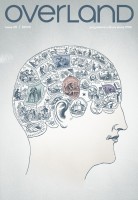
There are also stand-out stand-alones. In ‘Pump’, Stephanie Convery tells of her participation in a women’s body-building course, which manages to challenge some aspects of sexism and male domination while bowing to others: the article includes fascinating history, high comedy, memoir and challenging analysis. Apart from some Melburnian sneers at country Queensland, ‘All those women’ by Jacinda Woodhead is richly empathetic: in the context of Queensland’s dire abortion situation – abortion is a crime except under closely defined conditions; it’s hard to access, expensive and stigmatised – Woodhead presents a portrait of tiny anti-abortion, anti-war group Protect Life. While recoiling from their politics on abortion, she and pro-choice activists she interviews communicate a respect for their commitment to principles and sheer stamina. Jill Dimond’s ‘Ned Kelly’s Skull’, which justifies the phrenological cover image, includes a fascinating look at some eccentric colonials. Giovanni Tiso makes some alarming sense out of recent events in Italian politics in ‘The Net will save us’.

In the poetry section, I was relieved to see a couple of bird poems, since current Going Down Swinging submission guidelines specifically rule out ‘poems involving birds, wings, feathers or flight’ and it would be a shame if birds were to disappear from Australian poetry altogether. I’m grateful for The shearwaters by Jules Leigh Koch, ‘a long tideline / like a driftnet / to fish for stars’, and I probably would have loved ‘The swallows in Saint Peter’s Square’ by Luke Whitington for its name alone.

Not all those links will take you to a full article, at least not at the time of writing, but be patient. Overland does tend to put just about everything online in the weeks after an issue comes out. Or you could buy a hard copy and find your own synergies.