Tag Archives: Harvey Thomlinson

Asia Literary Review 24

Martin Alexander (editor) Asia Literary Review 24, [Northern] Summer 2012
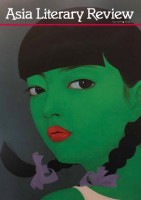
[Added in 2021: Most of the links in the blog post are broken, but the title above and the image to the left will get you there. The whole issue is available online to subscribers.]

I subscribed to the Asia Literary Review in 2009 for worthy motives: they had published a short story by my niece Edwina Shaw, and I wanted to support a publication that had faith in her; it also seemed a relatively painless way to ensure some cultural diversity in my reading. I’ve kept on renewing my subscription because every issue has something to delight – from a photo essay on Karen exiles living on the Thai–Burmese border to a splendidly simple pasta sauce recipe. The current issue doesn’t disappoint.

Martin Alexander’s editorial announces that this journal is organised around the theme of identity. The contributors, he writes,

reflect, and reflect upon, the multiplicity and complexity of their identities. Each piece was composed in isolation, but when brought and bound together their explorations of identity complement one another in unanticipated and intriguing ways.

I would add: in laugh out loud ways, and weird ways, and ways that make you want to weep. Many of the pieces are about dislocation – through migration, exile or invasion. Many are about the experience of being mixed-heritage. There’s a fascinating, kaleidoscopic effect as voices from China, Tibet, Sri Lanka, Japan, India, Thailand, South Korea, Afghanistan, Kazakhstan, Malaysia, the UK, the USA and Australia, Uyghur, Hawai’ian and Burmese voices, echo one another’s motifs, answer one another’s questions and question one another’s answers.

My precious blogging time is being taken up with doggerel endeavours these days, so I’ll limit myself to mentioning, pretty much at random, just a few highlights.

Kavita Bhanot’s ‘Too Asian, Not Asian Enough‘ asks if it isn’t a new form of Orientalism for so-called British Asians to simplify their identities and perform them rather than striving to understand and reveal their own complexities. The journal’s imprint page reveals that Madhvi Ramani’s short story ‘Windows‘ is taken from an anthology edited by Kavita Bhanot with the same name as her article. Ramani’s story illustrates beautifully the kind of thing Bhanot is advocating: it starts out with Mrs Sharma, close to the stereotype of the elderly, widowed Indian living in Britain, locked out of her home, and ends in a completely unexpected place.

In Win Lyovarin’s Rainbow Days, the Bangkok Reds and Yellows demonstrations are seen, to wonderful satirical effect, from the point of view of a barely legal Burmese street merchant. This is one of a number of pieces translated into English, in this case from Thai by Marcel Barang. Kim Jae Young’s ‘Elephant‘, translated from Korean by Moon-ok Lee and Nicholas Yohan Duvernay, is another: an impoverished and desperate little community of immigrants is seen through the eyes of a young boy, son of a Nepalese man and a Korean mother who has abandoned them.

There’s an interview with Donald Keene, pre-eminent expert on Japanese literature, who in his late 80s, not long after the tsunami, earthquake and nuclear accident last year, decided to leave the United States and become a Japanese citizen.

I’ve always thought that Chinese criticism of the Party and bureaucracy was inevitably an earnest affair. Jimmy Qi’s ‘Yu Li: Confessions of an Elevator Operator‘ (translated by Harvey Thomlinson, whose Hong Kong based Make-Do Press has a novel by Jimmy Qi in the pipeline) demonstrates definitively that this just isn’t so. At one level this story is a completely serious satire, but at another it’s an immensely enjoyable piece of silliness.

I plan to keep my subscription up.
Asia Literary Review 22

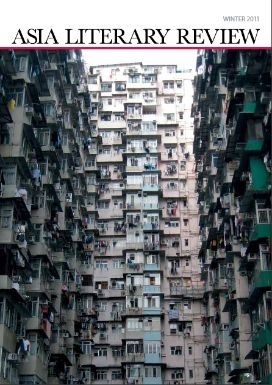
Martin Alexander (Editor), Asia Literary Review 22, [Northern] Winter 2011

20120416-173808.jpg

[Note added in 2021: All the links in this blog post are broken except the ones in the journal title above and in the image to the left, and the profile of Amitav Ghosh and ‘The Sacred Cow‘. The whole journal is still available online to subscribers.]

The Asia Literary Review has a new Editor in Chief, the third in the nine issues since I first subscribed. There’s no note of farewell to Stephen McCarty, as there was none to Chris Wood before him. The silent turnover is just a little unsettling, but I guess we don’t read the journal for news of its staff. Martin Alexander, the new occupant of the chair, was previously (and still is) Poetry Editor. In his editorial, he addresses the journal’s identity:

… while Asia is a concept we may broadly understand, it would be foolish to attempt a precise definition. Asia’s identity is in a state of motion; we aim to capture that motion in these pages.

That’s not bad: if Asia is an imprecise entity, it would be a mistake to overdefine the journal’s scope or purpose. Its contents are in English, and they ‘capture’ Asia in some way. That’s enough.

‘Capture’ can describe what a tourist snapshot does, and there’s quite a lot of that in this issue, mainly but not exclusively in its four photo essays – of street scenes in Java, Vietnam, Hong Kong, and the grand but as yet unpopulated city of Kangbashi in Inner Mongolia. The photography is brilliant in each case, but in the end they are all picturesque street scenes, and so a lot less interesting than, say, Jack Picone’s ‘Planet Pariah’ about life on the Burma Thailand border in issue 19.

There are a number of excerpts from longer works, both prose and verse, which are like snapshots in a different way: tantalising glimpses, but sometimes hard to tell what it is one is glimpsing. An exception is the excerpt from Chen Xiwo’s novel I Love My Mum (banned in China, translated by Harvey Thomlinson, and published by Make Do Publishing), which stands alone as a tale of desperate brutality with chilling allegorical implications. You can read the whole excerpt at the link.

Sticking with the idea of ‘capture’, there’s Fionnuala McHugh’s profile of Amitav Ghosh. I’ve only recently discovered his writing, and was delighted to learn more about him, and about his Sea of Poppies. He reveals, for example, that having done a little sailing he knew that sailing was ‘very dependent on words’:

I thought there has to be a dictionary. I happened to be at Harvard but I found the Lascari dictionary in Michigan – published in 1812 in Calcutta by a Scottish linguist. I didn’t have to make anything up.

He sounds like a terrific man – if a Sydney Writers’ Festival scout happens to read this, could you invite him some time soon, maybe when the third book of the Ibis trilogy comes out?

The Ghosh profile is also part of what Martin Alexander calls ‘motion’, if he means by that the kind of dynamic interplay that can add spice to a literary magazine.  Ghosh, we read, turned down the 2001 Commonwealth Writers’ Prize because it was for works written in English, from a region ‘that was once conquered and ruled by imperial Britain’. This is honourable and hardly surprising, given the unflinching portrayal of the Raj in Sea of Poppies. But here it resonates interestingly with a short piece by Pico Iyer, The Empire Writes Back, Revisited, which argues that the formerly colonised have taken charge of the cultural centre, and that the English language, no longer dominated by the former colonisers, is being reclaimed and revitalised by a host of writers from India, China, the Caribbean, Africa, New Zealand, Australia. This ALR tends to bear out Ghosh’s side of the conversation, as most of the contributors seem to be of European or US extraction, and there is that strong touristic element. But Pico Iyer would find material to support his view as well.

Of the short stories, ‘The King, the Saint and the Fool‘ by A. K. Kulshreshth weaves a sweet romance from elements taken from the folk history of Singapore, and Sindhu Rajasekaran’s ‘The Sacred Cow‘ tells a distinctly modern love story in the context of Indian village life. The essay that stands out is Michiel Hulshof’s ‘Special Academic and Art Zones‘. Hulshof is a Dutch journalist living in China. Among other things his essay gives a fascinating account of the economic and political context of contemporary Chinese art (of the kind Sydneysiders get to enjoy at the White Rabbit Gallery).

Almost as good as getting on a plane and travelling for six months.