Tag Archives: history

Antony Beevor’s Stalingrad

Antony Beevor, Stalingrad (2004, Penguin 2008)

Antony Beevor visited Sydney for the Writers’ Festival in 2007. His talk was interesting, and it evoked high-quality audience questions that came from a whole world of War History geekiness previously unknown to me. Although he’d recently published a book about the Spanish Civil War, it was Stalingrad that generated the serious senior fanboy passion. We bought the book not much later, but didn’t start reading it until July 2008. Now here we are, in mid 2011 and it’s done!

Notice I said ‘we’. The reason I took longer to read the book than Anthony Beevor took to write it is that I read it exclusively on long car rides, aloud to my regular driver, usually known on this blog as The Art Student. Apart from the reading being disrupted by our lamentable failure to do much travelling by car in the last three years (two return trips to Canberra, perhaps one southward, and just now north to Red Rock and surrounds), it was an excellent way to read this book.

As with Jared Diamond’s Guns, Germs and Steel, another car-journey book, the flow would be interrupted frequently by one or other of us exclaiming, querying, drawing parallels or pronouncing judgements. Once or twice, we had to stop the car so the driver–listener could peruse a map. After a certain point I stopped reading out the full name of every military unit, and occasionally I would give up the struggle to pronounce a German or Russian name in full. But such bumpy moments in no way detracted from the book’s holding power. It manages to move, apparently without effort, from close-up accounts of human cruelty, brutality and suffering to a broader strategic narrative; from the obsessions and denials of Hitler and Stalin, to the petty rivalries, quirks and duck-shovings of the officers on both sides, to the German troops’ sentimental yearning for family or the Russians’ pursuit of alcohol.

The wonderful Barbara Ehrenreich said on her blog recently, ‘War has been, and we still expect it to be, the most massive collective project human beings undertake.’ Having just read about the sheer logistics of attack and counter-attack, siege and counter-siege at Stalingrad, I can only say, ‘True, that!’ ‘But,’ Barbara Ehrenreich continued, ‘it has been evolving quickly in a very different direction, one in which human beings have a much smaller role to play.’ If that’s so, we can only be glad of it. The human participants in Stalingrad endured almost unbelievable extremes of cold and hunger: men literally dropped dead from hunger, wounded soldiers froze to death by the cartload. They performed acts of understandable but almost unimaginable cruelty and callousness: Russian prisoners-of war starved in scenes that foreshadowed the images of Jewish prisoners at the end of the war; German prisoners were shot at random by their Soviet guards. There was plenty of heroism as well, of course, and an extraordinary episode of contact between individuals from both sides.

I turned down two page corners. The first was to mark the account of Hitler’s speech on 30 January 1943, the 10th anniversary of his accession to power, when the German army at Stalingrad was surrounded, starving, under-equipped, low on ammunition and facing almost certain defeat (Hitler expected them to fight on and the generals to commit suicide). The speech, delivered for some reason by Goebbels, made just one mention of Stalingrad:

The heroic struggle of our soldiers on the Volga should be an exhortation to everyone to do his maximum in the struggle for Germany’s freedom and our nation’s future, and in a wider sense for the preservation of the whole of Europe.

Of course there’s no comparison with the circumstances of Australian troops in Afghanistan, but doesn’t that rhetoric sound awfully familiar, and isn’t it equally hollow?

My other turned-down corner marks that contact between individuals I mentioned. In early January, when things were already obviously hopeless for the Germans, the Russians sent envoys under a white flag to offer a truce. The whole episode, drawing on an unpublished manuscript by Nikolay Dmitrevich Dyatlenko, one of the envoys, is marvellously told, full of poignant detail, but one moment grabbed my imagination.The envoys approach the German lines. They call out that they have a message for the German commander-in-chief.

‘Come here then,’ [a warrant officer] said. Several more heads popped up and guns were levelled at them. Dyatlenko refused to advance until officers were called. Both sides became nervous during the long wait. Eventually, the warrant officer set off towards the rear to fetch his company commander. As soon as he had left, German soldiers stood up and started to banter. ‘Rus! Komm, komm!’ they called. One soldier, a short man, bundled in many rags, clambered up on to the parapet of the trench and began to play the fool. He pointed to himself in an operatic parody. ‘Ich bin Offizier,’ he sang.
_____‘I can see what sort of an officer you are,’ Dyatlenko retorted, and the German soldiers laughed. The joker’s companions grabbed his ankles and dragged him back into the trench. Smyslov and Siderov [the other envoys] were laughing too.

And then back to the serious business of war, of the truce being offered and refused as per Hitler’s orders, and thousands more deaths being decided by the event. But in the middle of all that, with the stakes so high and the conditions already so desperate, that short man, bundled against the terrible cold, could stand tall and mock the whole catastrophe.

Hindsight

I was interviewed recently by Lorena Allam for an edition of ABC’s oral history program Hindsight about The School Magazine. The program’s web site now has information up.

Throughout its 94-year history, The School Magazine has been edited by a who’s who of Australian literature: Patricia Wrightson, Lilith Norman, Duncan Ball, and more recently Anna Fienberg and Tohby Riddle.

These days the School Magazine is still around, but available only on subscription. In this era of school-ranking websites and results-based education, there’s pressure to keep up with the demands of the modern classroom. Yet it is as loved as it ever was.

Just for the record, I’m not at all offended at not being listed among the Who’s Who of Australian Children’s Literature. The show will be broadcast on 19 September at 2 in the afternoon, and repeated on the afternoon of Thursday 23 September at 1 o’clock. It should be fun.

Words words words: The Meaning of Everything

Simon Winchester, The Meaning of Everything: The Story of the Oxford English Dictionary (OUP 2003)

I first stumbled on the OED in the Fisher Library at Sydney University roughly 40 years ago. I doubt if I looked up more than two or three words in it, but I did get a whiff of what a miraculous piece of work it is, with its long columns of quotations illustrating how the meanings of every word changed and developed with the passage of time. A couple of years later I read Raymond Williams’s Keywords (a brilliant guide for anyone who wants to chart a path through the spin of political discourse), which cites the OED frequently, and which made me fall in love with the Dictionary at one remove. The Shorter Oxford on the shelf in my last office was consulted regularly, though the Macquarie and then the internet came, , for different reasons, to rival it as authorities of first resort. The thing is, the OED and the SOED are useful, but they are also fun. They’re like water: you go to them because you need them but you stay and take a dip, even immersing yourself for a while, for the sheer joy of it.

To pummel that last metaphor a little, Ammon Shea stayed in the water far too long. The book resulting from his project of reading the whole thing in a year – which I blogged about the other day – is like a report from someone who has just almost drowned. Simon Winchester gives us the view from the shore, takes us diving in occasionally, lets us swim a little, and delivers plenty of draughts of the cool, refreshing stuff itself. This is pretty much the book I had unfairly expected Shea’s to be: a colourful account of the making of the  Dictionary, with lashings of background history, philology and lexicography, a gallery of striking characters and a plethora of shiny quotes. The book captures well an image of the Victorian creators of the dictionary – editors, sub-editors, paid assistants and (in their hundreds) volunteers, summarised in an epilogue as

legions of elderly, usually bearded men, formally dressed in tweeds and gabardine, sitting at high desks, pens in hand, volumes open beside them, sheaves of paper in racks and shelves and pigeonholes behind them, a heavy, cloistered atmosphere of academic rigour and polymathic knowledge enveloping and embracing them like the very air itself.

The proposal that there should be a dictionary that aimed to include the totality of the English language was first put to a meeting of the Philological Society in London in November 1857 by the Dean of Westminster, Richard Chenevix Trench. The first edition was published, half a dozen learned and mostly eccentric editors later, in June 1928. The story of those 71 years makes up the great bulk of this book.

Simon Winchester  has an eye for the shiny piece of information that, while not strictly essential to an understanding of his subject, keeps the company amused. Sometimes he relegates a bauble to a footnote, as when, having described one Hucks Gibbs as a good shot, he adds at the bottom on the page, ‘Fairly good: he blew off his right hand in 1864, but remained keen on the sport.’ But the colour and movement mostly happens in the text itself: after all, Hucks Gibbs was important for his largely unsung role in smoothing out some nasty personality clashes that could have doomed the project. His prowess with a gun is only mentioned, one suspects, to justify the footnote. If you were a lexicographer wanting the technical inside story of this greatest of all lexicographic enterprises, such cheerful detail might be irritating. For the general educated reader such as I, they playfully echo the fascination of the Dictionary itself. (One of many moments that struck me, idiosyncratically I suppose, was on page 194, where Winchester quotes for no obvious reason the definitions of the word lap: ‘a liquid food for dogs, that part of a railway track used in common by more than one train, the front portion of the body from the waist to the knees of a person seated’. I don’t know how he restrained himself from pointing out that this illuminates Emily Dickinson’s lines about a train, ‘I like to see it lap the miles/ and lick the valleys up.’ Even though the book gives lots of evidence of his love of the language, my guess is that there are many examples of such restraint.)

The Man Who Invented History

Justin Marozzi, The Man Who Invented History: Travels with Herodotus (John Murray 2009)

In the movie The English Patient, the Kristin Scott Thomas character tells a story from Herodotus over the campfire, which apparently resulted in a spike in sales of The Persian Wars. The product-placement dimension of that moment was lost on me. I’d read some Livy at school, and quietly assumed that all ancient historians were alike, concerned with wars and not much else, and generally to be avoided. It would have taken more than an erotically charged Herodotean moment in a movie to shake that assumption. Justin Marozzi has done what Kristin Scott-Thomas failed to do. He’s an English travel writer–historian (with his own web site), at pains to make us know he’s not an academic – more like a Herodotus fanboy. His message in short is something like: Herodotus invented the West, Thucydides sux, and Plutarch double sux. (Those last two aren’t direct quotes – he’s much more grown-up than that.)

Marozzi sets out in this book to follow in Herodotus’s footsteps, visiting places he visited, or at least claimed to visit, quoting good bits from his Histories and reflecting on the enduring relevance of some of his themes. He visits Turkey (Herodotus’ birthplace Halicarnassus, now Bodrum), Iraq (where Marozzi spent a year ‘setting up a nationwide civil affairs program’, whatever that is, but manages to take us with him on a private guided visit to the mostly inaccessible museum in Babylon), Egypt and of course Greece. He finds value in Herodotus’ genial appreciation of cultural diversity and mockery of cultural arrogance (it seems that ‘Everyone thinks his own society’s customs are best’ was a refrain in Herodotus; it certainly is in Marozzi, with many confirming examples). He finds in George Bush’s Iraq and elsewhere validating echoes of Herodotus’ belief that hubris leads to nemesis and his repeated observation that those in power ignore at their peril those who counsel caution. He enjoys and emulates Herodotus’ propensity for sexual titillation, though here he seems to be trying a little too hard to establish his non-academic bona fides, and comes off as a happily married man hoping to pass as a bit of a lad. Above all, he conveys a sense of Herodotus as an excellent travelling companion, a great listener, an accomplished entertainer (apparently he wrote his books to be read aloud, and Marozzi imagines a number of reading–performances for us), a tireless gatherer of information, a cheerful embellisher, and one who got it right more often than he has been given credit for. Maozzi has put Herodotus on my To Be Read list.

My timing in reading this could hardly have been better because of its resonances with other recent reading. Marozzi spends a whole chapter in Siwa, the setting of Sunset Oasis, and includes some photographs. It’s unlikely he had read the novel, but Bahaa Taher, its author, is named in his acknowledgements. He doesn’t mention the theory, a major plot point in the novel, that Alexander the Great may be buried in Siwa, but he does spend quite some time on matters mentioned by neither Herodotus nor Taher: the oasis’s tradition of homosexuality and the prevalence of magic there, in spite of the current Muslim establishment’s disapproval of both. But it’s clearly the same place, and the counterpoint of fiction and travel-writing is fun.

Though Marozzi makes no direct reference to Palestine, one chapter in particular plays well with Footnotes on Gaza. The latter is history painfully gathered from eyewitnesses and survivors of brutal events, a necessary and important counter to the bland evasions of the official story, as recorded by the powerful. But Justin Marozzi’s account of  Southeast European Joint History Project (JHP) reminds us of the dangers of history that perpetuates a people’s view of themselves as victims, a danger that Joe Sacco’s book certainly risks. In a visit to Thessaloniki, not part of Herodotus’ world, but justifying its place in this book because of the light it casts on the nature of history, Marozzi interviews Nenad Sabek, chain-smoking director of the NGO that produces the history. The state of history-teaching in the Balkans as surveyed ten years ago makes Australia’s History Wars look like a game in a kindergarten sandpit. Sebek tells Marozzi, and us, that the school history syllabus

is where you instil into the young a sense of victim mentality, a feeling that everyone around them is their adversary and that’s how it’s always been. … I believe history is one of the fields  where if you teach it badly you produce serious damage way ahead in the future. If you tell a ten-year-old his country has always been beaten up by its neighbour throughout its history, and then years later it’s war, he’s wearing uniform and he’s got a gun in his hands and his leaders are saying, ‘They’re still slaughtering us,’ this is what he believes and he goes on a rampage.

The JHP has produced a set of history textbooks that offer a multi-faceted account of the seven centuries from the emergence of the Ottoman Empire to the Second World War that aims to supplement (rather than replace, which would be politically impossible) the lethal nationalistic-victim texts currently in use. It sounds like a project that could, even should, be emulated in any number of hotspots – Tel Aviv, Ramallah, Belfast, Canberra …

Haiti After Duvalier

Amy Wilentz, The Rainy Season: Haiti Since Duvalier (Simon and Schuster 1989, 1994)

When the recent earthquake struck Haiti, I’m sure I wasn’t the only one who was dismayed by the spectacle of poor Black people, sometimes visibly despairing, sometimes raging, being helped out by calm, compassionate Europeans and USers, usually accompanied by a narrative about Haiti’s lack of infrastructure and the international community’s concern – that is to say, a spectacle that seemed to confirm racist stereotypes: African heritage people emotional, dangerous, incompetent etc; European heritage people efficient, kind, well organised etc. I realised my ignorance about Haiti was vast: from Jared Diamond’s Collapse I knew that its part of the island of Hispaniola was an ecological disaster resulting from poverty and political corruption; on a good day I could have told you that Papa Doc and Baby Doc were vicious dictators named Duvalier; I was dimly aware that it was the home of voodoo, about which my main source of information was the novels of William Gibson and the obviously misleading zombies of popular culture. It wasn’t going to help the earthquake survivors, but I felt the need to do them the basic honour of finding out about them. This book was recommended by a friend.

Amy Wilentz, a New Yorker, first went to Haiti in 1986, as a journalist covering the last days of Jean-Claude Duvalier (Baby Doc) and his wife Michèle. She returned a number of times in the next couple of years and then moved there to live. The book traces events from the ousting of Jean-Claude to just before the elections in 1989: military coups, violent popular actions and non-violent demonstrations, two bogus elections, army-backed massacres, arson, random killings. It’s quite a story, with a great cast of characters: a Well Placed US Embassy Official (who gives Wilentz transparent disinformation), a senatorial candidate, a dark haired photographer (eye witness and near casualty of one of the massacres), and a host of Haitians: politicians, well off mulattoes, shanty-town dwellers, voodoo celebrants, artists, street children, and – who becomes the main protagonist – Jean-Bertrand Aristide. Aristide is a priest, a member of the Salesian order, who speaks out against oppression, becomes a figurehead for the  popular resistance, and survives a number of attempts to kill him, discredit him or send him into exile.

The 1994 edition – which is what I have read – includes a foreword that briefly covers the intervening four or five years: Haiti had had its first genuinely democratic elections, in which Aristide was elected president by a huge majority. Aristide had been ousted by yet another military coup, US-backed like its predecessors, and was the subject of CIA-assisted smears.  A quick look at Wikipedia tells me that the turbulence has continued.

Haiti was founded at the turn of the nineteenth century, the only nation to be born of a slave revolt and the first Black republic. Haitians fought off an invasion by Napoleon’s forces, and in effect saved North America from invasion, paving the way for the Louisiana Purchase. Not that this kindness has been acknowledged by the US: Haiti  was invaded and occupied by US forces from 1915 to 1937, and continues to be dependent on US aid, which of course comes with strings attached. Reading this book makes the ‘donor nations’ look a lot less benign.

Because Wilentz actually lived in Haiti for some time, and developed relationships there, she can give a richly detailed account of life there. There’s a beautiful passage on Aristide’s theology, for instance (‘I believe the Resurrection is an ongoing process … In order to continue being a force, [the Apostles] had to believe that Jesus, their leader, was still a force. … In order to survive the shock of Jesus’ death, they imagined him coming and eating with them, the simplest thing, you know, the simplest human act, breaking bread together’). The narrative is sprinkled with linguistic pleasures in the form of frequent snippets of Haitian Creole: Aristide’s nickname was Titid, as in petit Aristide; I enjoyed teasing out the French connection in sentences such as, Se lè koulèv mouri, ou konn longé-l, which translates to English as ‘Only when the serpent dies can you take its measure’, and which I had fun figuring out would translate into French as something like C’est quand le coulèvre mourit, on connaît longer-le. The countryside, and the weather, come alive in frequent passages like this:

Smoke ascended from lean-to kitchens along the way. A truck piled high with charcoal bags rumbled by, stirring up dust. A peasant sat on top of the grey load, holding his machete; a piece of plastic was wrapped around his head against the approaching rains. The road twisted on; for all my travelling, I had not left Papaye far behind. I passed down a hill and through a small stream, where a great white pig was lounging on a rock, waiting for rain. Farther on, more people seemed to be about. Peasant men were standing at their doors, while the women made smoke in the kitchen. Two boys squatted in a yard, playing marbles.

She’s been there, and she does a good job of taking us with her. The book is firmly located in a particular moment in Haiti’s history, and the author’s understanding of the meaning of things has been challenged by subsequent events – in a recent op-ed in the New York Times, she herself refers to Aristide’s own ‘little-d Duvalierist tendencies’ as having contributed to the destruction of his presidency. But it’s not dated. Wilentz’s attention to detail, to the textures and smells and rhythms of daily life in Haiti make engrossing and illuminating reading. That post-earthquake New York Times op-ed piece concludes with a passage that possesses those same qualities:

This is what I saw as I travell00ed around the country on foot and on motorbike a week after the quake struck: families and neighbourhood groups putting up shelters; people cooperating with aid organisations to get food for their flattened neighbourhoods; teacher’s assistants hired by parents in the newly built shantytowns to teach and amuse children whose schools fell down (about 300 teachers at a conference died during the earthquake when their meeting hall collapsed). Men working in teams to remove reusable construction materials from the wreckage. Women sweeping debris from the roads with their graceful, primitive brooms. Young people caring for the wounded in makeshift clinics. Maybe utter destruction concentrates the mind. In these conditions, do-it-yourself democracy simply works best. The quiet president, operating behind the scenes with the international community, instead of strutting before the foreign press and claiming he’ll fix everything, is perhaps at this moment not such a bad leader for Haitian democracy, after all.

When you stand in the rubble of Port-au-Prince – so recently an affecting and even a heart-tugging city that functioned on a complicated, hypercharged fuel of chaos, exposed wiring, pig slop, smog, gingerbread turrets, hot cooking oil, rum, cockfights and bougainvillea – you begin to see that Haiti’s soul resides in its people. Out of this horror, maybe they will finally be released. That is, if the rains or another quake doesn’t stop them in their tracks.

‘Haiti’s soul resides in its people.’ That might look like easy rhetoric in the pages of a newspaper, but it’s not a bad six-word summary of what The Rainy Season carefully, passionately, intelligently ends up saying.

[Note: I’ve Australianised the spelling in the quotes.]

Bloom & Blair’s Islam

Jonathan Bloom & Sheila Blair, Islam: A thousand years of faith and power (Yale Nota Bene 2002)

I bought this book some years ago in the hope of finding some insight into how a religion that has sustained so many people for so long over such a geographic and cultural range could be used to justify the barbarity of suicide bombings and videoed beheadings. Since I don’t have much insight into how Christianity or Judaism can be used to justify mass murder either, and I’m already reasonably familiar with at least some parts of the former, maybe I should have expected my hope to be dashed, but it springs eternal, and trust in book-learnin’ is hard to shake.

The authors’ expertise, and presumably their passion as well, lie in Islamic art. This book was written to accompany a US television series, and despite its self-described aim as ‘to help Americans – of whatever and even no religion – understand the religion and culture of another place and time’, what it actually does is to provide background, to tell the grand, sweeping narrative of the beginnings, growth and spread of Islam in its first thousand years, with an inevitable emphasis military conquests and defeats, political struggles and religious strife, with a couple of welcome chapters on the flourishing of science and poetry between 750 and 1200 CE. The succession of dynasties and ruling elites – Abbasids, Barmakids, Chaghatayids, Fatimids, Ilkhanids, Mamluks, Mughals, Ottomans, Seljuqs, Umayyads – is as bewildering and at times as dull as the begats of Genesis.

I’m not complaining. In fact I wish I’d read the book 50 years ago as a supplement and antidote to the Eurocentric version of world history I received in my schooling. It’s bracing to read the stories, even in broad outline as here, of people and places that I know mainly as elements of  Orientalist decor: Saladin of the curly-toed shoes becomes Salah al-Din ibn Ayyub; Suleyman (isn’t that the guy from Lord of the Rings? – yes, I’m that ignorant) ruled the Ottoman Empire for 46 years, Marlowe’s Tamberlaine the Great becomes Timur, a Great Mongol conqueror; Samarkand, Timbuktu, Xanadu all existed outside romantic poems and fantasy literature. Many things I have assumed to be creations of Western culture are in fact borrowed from the Islamic world: romantic love I already knew about, but x as a way of representing an unknown in maths was news to me; The Divine Comedy wouldn’t have existed if Dante hadn’t read in translation popular Arabic stories of Muhammad’s mystical journey to heaven.

I’d just finished the book when I heard Ramona Koval on The Book Show with James Delgado talking about his Khubilai Khan’s Lost Fleet. As Ramona, helping out her audience by displaying her own real or pretend ignorance, wrestled with the difference between Khubilai Khan and Genghis Khan, I realised how glad I am to have read Bloom and Blair’s book. If I had read it 50 years ago, when my memory was much more retentive,  I might have emerged from it knowing who all those people were. As it is, I can expect the names to ring some kind of bell, and I’ll know where to look for a quick rundown – and yes, as well as a list of further reading, this book is blessed with a substantial index.

The Bone Man of Kokoda

Charles Happell, The Bone Man of Kokoda (Pan Macmillan Australia 2008)

I’m not one of those people who are fascinated by World War Two. When war comics were all the rage in my primary school, I was off in a corner reading Donald Duck, Superman, Captain Marvel and a sophisticated detective whose name I don’t remember. But lately I’ve been getting myself an education on the subject. My sister-in-law gave me this book on the strength of recent blog entries, and I approached it with a double sense of obligation: it was a Christmas present, and it promised yet another perspective on a subject that had lain unconsidered in my mind most of my life. Obligation rarely leads to enthusiasm, and I started the book with a heavy heart.

It turns out to be a fabulous book, another of those micro-histories described by Judith Keene as making up history – where hers swam against the main current by being traitors, the hero of this one does so by extraordinary loyalty. It’s a man who, having made a solemn promise in his early 20s, dropped everything in his  60th year, not to go into comfortable retirement but to devote the next 26 years to keeping the promise. When his wife and sons objected, he gave them everything – the house, his thriving business, even his antique samurai sword – set out on his mission, never to speak to them again. His daughter, who understood something of what drove him, remained in touch and now looks after him in his old age.

What drove Kokichi Nishimura was the horrendous experience of being part of the Japanese invasion of New Guinea, seeing all his comrades killed in the jungle, mainly on the Kokoda Trail, and returning as part of a defeated force, despised in some quarters for not having suicided according to the code of bushido, and suspect in others because of the well-publicised atrocities committed by the Japanese forces. What do you do with the rest of your life after that? How do you live when you have fought in the battle of Brigade Hill at the age of 22, in kill-or-be-killed hand-to-hand combat:

Nishimura’s wounded arm was useless, but he drew his sword with his left hand and thrust it at the Australian’s chest; it hit a rib and stopped. The Australian grabbed the sword’s blade with his bare hands and kicked Nishimura in the stomach. The Japanese fell on his back and the sword went flying.
Noticing his enemy’s face up close, Nishimura was struck by how young the Australian was … For a moment, he thought: Why am I fighting this boy whom I don’t even know? But in the next instant he realised he would be killed himself if he didn’t get to his feet and tackle the Australian.
Nichimura launched himself again at the bigger man. Somehow, in the ensuing struggle, he regained his sword from the ground and this time drove it into the Australian’s stomach. The soldier pierced the air with a wail that sounded like an air-raid siren as he fell down, and slipped into unconsciousness. It was a chilling scream that Nishimura never forgot.

Some survivors committed ritual suicide. Many, possibly the mainstream, embraced the new pacifist Japan and tried to forget the war. Some foment rightwing nationalist politics. Nishimura’s path is strikingly individual. He promised his dead companions that he would return to honour their remains, and since 1966 his life has revolved around an uncompromising quest to keep his word, to bring families of the slain, if not the remains of their bodies for burial, then emotionally significant mementoes – a lunchbox, a flag, in one case a rusty pump. As a corollary, he invested his time and resources into projects to help the locals in the places where he conducted his search – building a school, bulldozing roads, helping people get training and set up enterprises.

He’s a fascinating man, a lesson in integrity. And the book is all the more fascinating because written by an Australian. Maybe the ghosts of the Pacific War are on the way to being laid to rest.

—-

Fortuitous’ watch:

My current favourite mystery word makes two appearances in this book.

On page 86, Nishimura sustains nasty damage to his right leg when his ship is sunk by a US torpedo:

In a way his injury proved fortuitous. It meant he could again rest up in hospital and eat regular meals.

And on page 151:

He had relied heavily, too, on the fortuitous windfall he received from the sale of his parcel of land in Kochi.

In the first quote, ‘fortuitous’ clearly means ‘lucky’. It could be replaced by ‘fortunate’ with no change to the meaning. Or perhaps it has a slightly greater emphasis on the arbitrariness of the good fortune. Whichever, it’s used in a way the dictionaries recognise, though some still frown on it.

In the second, the word could almost have its pure, pedant-approved meaning, ‘happening by chance’, though paired with ‘windfall’ it is completely redundant if that’s what it means. It only adds meaning to its sentence if we understand it to mean ‘especially fortunate’.

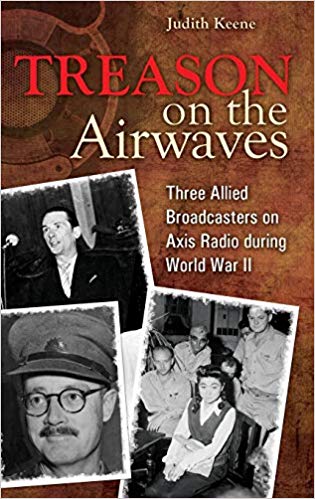
Treason on the Airwaves

Judith Keene, Treason on the Airwaves: Three Allied broadcasters on Axis radio during World War II (Praeger 2009)

An Englishman, an Australian and an American walk into a courtroom … It could be the start of a joke, but in this case it’s a fascinating study of three very different people who were charged with treason for their activities as radio broadcasters for the Axis powers, and the three very different ways their nations dealt with them. The subjects are John Amery, whose broadcasts for the Nazis included nasty anti-Jewish rants, Charles Cousens, who broadcast for the Japanese and expected (in vain) his Australian listeners to discern deeply embedded messages that would help in the war effort, and Iva Toguri, one of the 50 000 (yes, so many!) nisei trapped in Japan in 1941, who broadcast as Orphan Ann but was tried as Tokyo Rose.

Judith Keene says in her introduction that ‘the big patterns of history are made up of a great many micro-histories, individual stories, writ small and smaller’. The stories of individuals accused of treason must be one set of micro-histories that tests the big patterns: much as we might want the famous footage of the man dancing in Martin Place to represent the whole meaning of the Victory in the Pacific for Australians, there was a lot more going on than that. Along with the sheer joy that the War was over, in Australia as in Britain and the USA there was also quite a bit of racism-inflected vindictiveness around, for which these treason trials provided a conduit.

All three stories are fascinating, but Iva Toguri’s fills me with almost evangelical zeal. She was born in the USA, and was a cheerful, outgoing child and adolescence. Like many nisei, she identified as American, and her parents organised to send her to stay with relatives in Japan so she could learn Japanese language and culture properly. After the attack on Pearl Harbor, she refused to renounce her US citizenship and, cut off from her parents as a source of funds, found what work she could in a Tokyo where her US status was certainly not an advantage. As a typist in Radio Tokyo, where her fluency in English was valued, she took pity on the wretched US and Australian POWs, slipping them food and blankets at some risk to herself, and because she had a rich deep voice was soon invited across to be an announcer on Zero Hour, a program beamed out to Allied troops in the Pacific, consisting mainly of popular US music. Cutting a long story short, at the end of the war, while thousands of nisei who had renounced their US citizenship were readmitted to the US without question, at the prompting of the 1946 equivalents of today’s shock jocks, she was arrested, tried for treason in a process that was later shown to be unambiguously corrupt, imprisoned for decades, further harassed and humiliated on her release and then pardoned. Someone ought to make a movie about her. (And having written that last sentence I went googling and found that there is a movie in the works, to be directed by Frank ‘Shawshank Redemption‘ Darabont from a screenplay by Christopher Hampton.)

Judith is a friend of mine, so I might not have mentioned this next thing if Richard Walsh hadn’t done so at the launch in April: the book is dreadfully edited, to the point that the regular bloopers become a significant distraction. In the very first paragraph of the introduction, a punctuation error renders the second sentence close to nonsensical. ‘Grey’s Elergy‘ (two spelling errors) and ‘the dye was conclusively caste’ (two spelling errors and a redundancy) are not atypical. I’m very glad that Praeger Press of Connecticut published the book, but anyone who commits their manuscript to them should be warned that the detail of your text is not in safe hands. Anyone who wants to know what a line editor does will find this book instructive: the things that make it hard to read are the things an editor would have fixed. However, I recommend that you treat the frequent blemishes as you would mosquitoes on a bushwalk: irritating, but not enough to make you turn back.

Travels in Atomic Sunshine

Robin Gerster, Travels in atomic sunshine: Australia and the occupation of Japan (Scribe 2008)

Thousands of Australian soldiers and their families were part of the Occupation of Japan from February 1946 until early 1952. They formed the bulk of the British Commonwealth Occupation Force, generally overlooked in the shadow of the much larger and better equipped US occupation forces. While the US occupiers, with headquarters and amenities in Tokyo, set about imposing democracy by decree and using military might to change a militaristic culture to a peaceful one, insisting on freedom of the press except for stories that might make trouble for the occupiers, the Australians – whose generals led the BCOF – were stationed near the devastation of Hiroshima and seem to have managed without any sense of themselves as Liberators. They are scarcely mentioned by any of our otherwise zealous military historians, and barely appear in the Canberra War Memorial. Sneered at by the British, discounted by the US,  at home they are ‘the forgotten Force’.

At the time, thanks to reports of atrocities in the Burma–Siam Railway  and Changi Prison as well as the bizarre White Australia Policy, anti-Japanese sentiment was fierce in Australia, and the occupationnaires were in a bind. If they enacted the home sentiment, as many did, they were likely to be brutal, even criminal, in their dealings with the already shattered population, and there are plenty of stories of rape, sexual exploitation, black marketeering (‘wogging’) and careless disregard for human life. If they were open to Japanese culture and the humanity of the people, as again many were, they were likely to be shunned as ‘Jap-lovers’: there were plenty of headlines at home to that effect, and when people returned it was to even less acknowledgement than the troops who served in Vietnam. Governments still deny that their high incidence of cancer might be connected to the time they spent at nuclear ‘Ground Zero’.

If someone wanted to make a serious war movie, they could do a lot worse than mining this book. The movie would run very little chance of feeding adrenaline addiction the way so many well-intentioned anti-war movies do. It would have trouble being read as a tale of Good vs Evil. It would leave a number of received True Stories looking decidedly tatty. After so many movies about the horrors of the Japanese prisoner of war camps, how refreshing to show those liberated Aussies as occupiers of post-War Japan – some acting out their racism-boosted vengefulness on the civilian survivors of Hiroshima, others coming to appreciate the culture  and even falling in love. The book seethes with potential story lines. Here’s the tale of  the young Australian signalman, John Henderson:

In early 1948, immigration minister Arthur Calwell had reasserted the government’s position that no Japanese woman would be permitted to enter Australia, irrespective of whether she was he wife or fiancée of an Australian serviceman … Henderson had married a young university graduate, Mary Kasahi Abe, by Shinto rites. With his wife pregnant, and worried about the legality of the Shinto ceremony, he sought to be married by the battalion chaplain, the well-known BCOF identity Padre Laing. Laing’s duty was to inform military command, and Henderson was peremptorily repatriated. The officer given the task of putting the order into effect related, 40 years later, that someone at BCOF HQ had decided to make an example of him. This was easily achieved, as he was a low-ranking, demoralised youngster of no consequence. A ‘thin, frail-looking lad’, Henderson was reduced to tears upon hearing the news. Accompanied by the padre and two MPs, he was put on the Kanimbla and locked in the brig to be returned to Australia, the father of a baby daughter whom he never got to see.

… During the debacle, and while his family was receiving abusive anonymous mail for supporting their son, the papers were full of photographs of radiantly smiling British migrant families arriving in Sydney … [Immigration minister] Arthur Calwell played to the crowd, stating that, while there were living relatives of the men who suffered at the hands of the Japanese, ‘it would be the grossest act of public indecency to permit a Japanese of either sex to pollute Australia or Australian-controlled shores’. What an irony: John Henderson had himself suffered, directly and not vicariously, from Japanese wartime brutality. He had laboured on the Burma–Thailand Railway, no less, and later in the coal mines in Japan. There, he had been befriended by a guard who handed him food, including small gifts from his sister, treats such as sweets, and rice cakes. The very reason Henderson decided to volunteer to BCOF after the war was that he wanted to meet his benefactress. He did, they became strongly attached, and they married – and now his own government had decided that her presence would ‘pollute’ Australia.

… Despite his promises, Henderson never returned to his Japanese family. He had asked a couple of his army mates remaining in Japan to keep a friendly eye on his wife in his absence; in the meantime, his parcels and letters stopped after some months. Years later, in late 1953 or early 1954, one of them returned to Kure after completing his service in Korea, and met the woman, by chance, downtown near the railway. She was with her pimp, having been reduced to prostitution, with a mixed-race child, in order to survive.

Travels in Atomic Sunshine won the 2009 NSW Premier’s History Award. It should also have a chance in the Literary Awards.

Drawing the Global Colour Line

Marilyn Lake & Henry Reynolds, Drawing the Global Colour Line: White Men’s Countries and the International Challenge of Racial Equality (Cambridge University Press 2008)

1colour

This book shared the 2009 Prime Minister’s Literary Award (non-fiction category). Otherwise, it hasn’t made much of a splash. I didn’t have to wait in line to get my copy from the local library.

The book starts brilliantly, quoting W E B DuBois’s 1910 essay, ‘The Souls of White Folk’:

the discovery of personal whiteness among the world’s peoples is a very modern thing – a nineteenth and twentieth century matter indeed. … What is whiteness that one should so desire it? … Whiteness is the ownership of the earth forever and ever, Amen.

(The whole article was reprinted in the Monthly Review in 2003. He’s a formidable writer, one I’m ashamed to say I haven’t read until now.)

The historical narrative starts with the arrival of an entrepreneurial Chinese man in Melbourne in 1855, two years after the discovery of gold, and then ranges around Australia, New Zealand, South Africa, California, British Columbia, tracing the progress of the ideal of ‘white men’s countries’, and along with it the betrayal of promises made by the British Empire and US to their non-Anglo-Saxon subjects and citizens.

It’s a hard read, especially in the first two sections – ‘Discursive frameworks’ and ‘Transnational solidarities’ – where public intellectuals of more than a hundred years ago solemnly put forward blatantly racist propositions that are still awfully familiar, but with very little of the dog-whistling, denial and misdirection we’re used to these days, and then democracy-loving politicians proceed to build on each other’s successes in excluding and disenfranchising anyone who is classified as not white. We have our noses rubbed in the arrogant and repulsive racist atmosphere in which the Australian Commonwealth and the Union of South Africa were founded and first California and then the rest of the US chose ‘racial solidarity’ even with recent bitter enemies and legislated to keep Asian, particularly Japanese, immigrants away from their shores.

In some ways it’s like a horror story, a sort of I know what you did last century. The scientific consensus reached in the 1940s, that ‘race’ was ‘not so much a biological phenomenon as a social myth, which had “created an enormous amount of damage, taking a heavy toll in human lives causing intolerable suffering”,’* followed by the UN’s Universal Declaration of Human Rights in 1948, amounts to the moment where we wake up and discover it was all a terrible dream … or was it? That moment is followed by a long tail, in which the ‘white men’s countries’ one by one open their doors and legislate against racial discrimination, until ‘Nelson Mandela and the African National Congress sweep into power and dismantle the last bastion of white supremacy.’

Sadly, the book lacks the visceral appeal of (I imagine) even very bad horror writing. It marshalls a vast amount of material, and it has hugely enriched my understanding of the White Australia Policy, among other things, but the prose is heavy going, and the authors are often absent except as competent and passionate compilers of evidence. This may well be necessary when there is such a complex field to cover, but it makes me wonder how the arguments went in the judging panel for the Prime Minister’s Literary Awards. I know literature is a slippery term, but oughtn’t the quality of the prose (or verse), the way the author’s (or authors’) mind makes itself felt in the work play at least as large a part as the importance of its contents?

The chapter on the Paris Peace Conference of 1919 is a rich exception to the prevailing drabness. The Australian Prime Minister, W M Hughes, emerges there as a lively fall-guy cum villain: he vociferous opposes  the Japanese delegation’s diplomatic, courteous and eminently rational push to include a paragraph on racial equality in the covenant of the League of Nations. The other white leaders, who generally despise the uncouth Australian, say that if it was up to them they’d include the paragraph, but you know, the Australians (who didn’t actually have a seat at the table) won’t stand for it … Hughes went to the grave thinking of this as a great victory. Someone ought to make a movie of that chapter.

Let me finish with two shiny factoids. First, when the Australian and New Zealand armies steamed to the Middle East in the First World War, their troopships were protected by the Japanese fleet. (Suck on that, Billy Hughes!) Second, tangential to the book’s main narrative (and incidentally an excellent example of the book’s prose style):

Australia remained constitutionally dependent on Britain and sovereignty remained formally with the monarch, but with effective sovereignty in matters of race, the quest for political independence lost its urgency. Not until 1926, with the Balfour Declaration, did Australia gain full power over foreign relations and the implementation of treaties. In 1931, the Statute of Westminster acknowledged the full statutory independence of the Dominions, but Australia didn’t sign until 1942.

Yet another thing we weren’t told at school!