
Anna Thwaites (editor), Heat Series 3 Nº 21 (Giramondo September 2025)
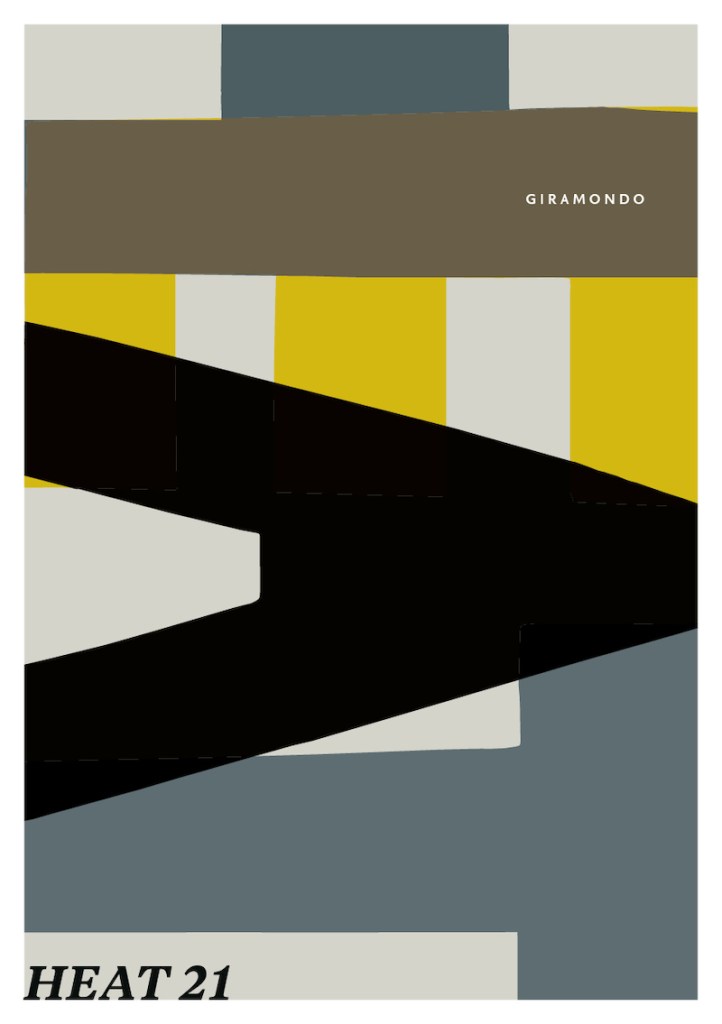
I cancelled my subscription to Heat a while back (after Series 3 Number 12), mainly because the handful of journals I subscribe to was getting to be quite a handful. Last September I received a complimentary copy of Number 21 with a note from the new editor Anna Thwaites inviting me to resubscribe. I am grateful for the gift, but since Southerly has revived and Meanjin will soon come back from the dead, I’m unlikely to take up the offer.
Mind you, if you want a conveniently sized literary journal that will introduce you to a diverse range of writers from Australia and elsewhere, including some in translation, you won’t find anything that suits you better than Heat.
This issue has two piece in translation. There’s a fable by Swiss writer Peter Stamm, translated by US-based Michael Hofmann, and a chillingly dystopian short story by Hong Kong author Hon Lai Chu translated by Jacqueline Leung. Heat seems to have a policy of not naming the original language of translated pieces – I’m guessing that these pieces were originally in German and Cantonese respectively. Hon Lai Chu’s story ‘Scrap‘ is available on the Heat website.
There’s an essay by Heat‘s founder and national treasure Ivor Indyk. Always interesting, he offers insights into the writing of Les Murray, Gerald Murnane and Alexis Wright. There’s a short story by the late Elizabeth Harrower, possibly her ‘last “new” piece of fiction … to reach readers’, as her biographer Susan Wyndham says in a brief introduction. Alongside these venerable and renowned contributors, Catherine Kaixin Yu, who grew up in Shanghai, has her first published essay, a richly elegiac account of visiting the dying village of her ancestors.
All that, plus poems by Londoner Alex Wong makes a good reading experience. What gave me most pleasure was a pair of poems by Melburnian Amy Crutchfield. In the first, ‘Nausicaa’, the poem’s speaker is a traveller on Corfu and visits Palaiokastritsa, traditionally the place where Odysseus met the nymph Nausicaa. The poem, in five short parts, is full of good things. I smiled a lot.. I’ll just mention an example of how line breaks can be important in poetry.
Section 4, ‘Taverna’ is quoted n the back cover of Heat, just the first three lines:
In the taverna
we choose the wrong foods
and sweat
That makes sense as a traveller’s tale. We chose something too spicy for our tastebuds. But the poem itself continues after the line break and turns out to be saying something quite different:
In the taverna
we choose the wrong foods
and sweat
over our one chance
to be typical.
It’s not about physical discomfort after all, but about the travellers’ awkward sense of standing out as odd. Or both!
Thanks you, Anna Thwaites.
I am a man of settler heritage who has been alive for almost a third of the time that has elapsed since Arthur Phillip claimed this continent for the British crown. I wrote this blog post on the land of Gadigal and Wangal, and crows are kicking up a fuss outside my window. I acknowledge Elders past and present and welcome any First Nations readers of the blog


 Me fail? I fly!