
My current practice of focusing on page 76 when blogging about books serves me well when the subject is journals. It helps to resist the pull to go on at tedious length about the whole contents.
Alexandra Christie (editor), Heat Series 3 Nº 8 (Giramondo 2023)
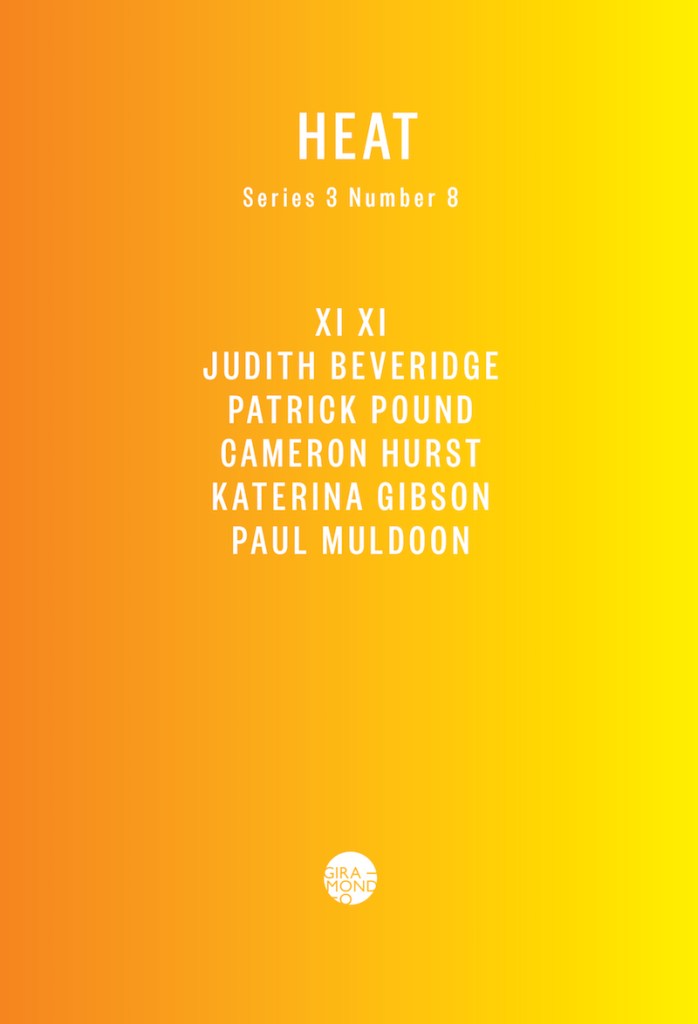
This is a fabulous issue of Heat. A clutch of ‘animal poems’ by Judith Beveridge would have justified the cost of the magazine. ‘Mourning a Breast’ by the late Hong Kong writer Xi Xi, translated by Jennifer Feeley, is an excerpt from a yet-to-be-published novel that includes, among other things, a gruelling account of breast surgery and some fascinating reflections on different Chinese and English translations of Madame Bovary. Send Me a Sign? is a charming essay on Henry Handel Richardson and spiritualism by Cameron Hurst (this one can be read on the Heat website).
Page 76 occurs in the short story ‘Shopping’ by Katerina Gibson, whose collection, Women I Know, won the Christina Stead prize this year. Like Xi Xi’s narrator, the protagonist of this story is interested in translation. She works at a writers’ centre where she is in love with her boss. The story is like an elegant tapestry of twenty-something lostness and finding a way: her work; her relationships, both those at work and her initially unromantic sex life; her compulsive overspending on clothes and her general angst/anomie. I loved it, especially for a key turning point where she reveals her compulsion to a friend and instead of running a mile he laughs and says, ‘But you don’t seem crazy at all.’ (Sorry for the spoiler!)
This seems an appropriate place to mention Giramondo’s promising new online initiative, Re:Heat. It’s a bi-monthly newsletter in which a current contributor to Heat Series 3 encounters an item from the archives. The first of the newsletters features an article by Josephine Rowe on ‘Alive in Ant and Bee’ by Gillian Mears, which was published in Series 2 Number 13, in 2007. You can read Gillian Mears’ piece here, and Josephine Rowe’s response here.
Evelyn Araluen and Jonathan Dunk (editors), Overland 250 (Summer 2022)
(Some of the content – less than in the past – is online at the revamped Overland website, and I’ve included links)
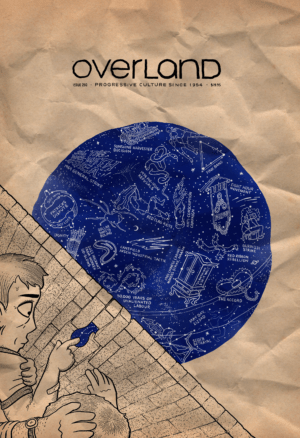
Great editors think alike. Overland is also launching a series in which current writers respond to items from the archives, in their case as part of the print journal. Jordana Silverstein kicks it off with a response to a 1988 story by Lily Brett, which is republished in the journal. Neither piece in online yet, but both are interesting.
At the other end of a readability spectrum is the issue’s first article, ‘Structures don’t go out onto the streets? Notes on John Tranter’s radical pastiche‘ by Louis Armand, which must be the ultimate in poetry insider talk, making no concessions to readers who don’t know their Jacques Lacan from their Ern Malley. Definitely for the spectacularly well read.
Other articles are more accessible and, to me at least, infinitely more interesting: Dallas Rogers on early colonial maps as instruments of colonialism, Jeff Sparrow on elite capture of identity politics, Fiannuala Morgan on colonial literature and bushfires are all worth reading. That’s all before we get to the poetry and fiction sections.
The twelve pages of poetry include the runners-up in the 2022 Judith Wright Poetry Prize (the winner was published in the previous issue). Of these, ‘Camperdown grief junk’ by Wiradjuri poet Yeena Kirkbright spoke most to me in its tour of the Camperdown Cemetery, so beloved of poets. Cameron Lowe’s prose poem ‘Ribbons’ ten pages later also spoke to me. Having just gone on about line breaks in a recent post, I found this phrase just a little squirm-making:
in the rear view mirror there were the back slappers, as usual, jerking off over line breaks.
I’ve been told.
There are 23 pages of fiction, ranging from grim to dystopian, all interesting. The story beginning on page 76, ‘Song and dance’ by Sik Chuan Pua is at the grim end of the spectrum, taking us inside the mind of Clara O’Brien, once a celebrated pianist who is now struggling with physical and mental incoherence in an institution of some kind. Right from the start, the story deftly maintains a double perspective: what Clara sees and what the reader understands in play with each other. It’s no spoiler to say that the story builds towards the word ‘Parkinson’s’. That condition, or something close to it, is there in the first non-bold sentence of this:
She was forty-seven when it began
Her head is locked towards the timber casement windows. Beyond the glass, a lake spreads out. A breeze rattles the shutters. It could be morning. Or late afternoon.
Look, a mysterious orange hue appears. What a hoax, for lakes should be blue as ink. Someone has been up to mischief. Someone has dumped such obnoxious colour, contaminating the lake, transforming beauty into farce. Will someone please restore the lake to its natural colour?
This is Overland‘s 250th issue. Long may it thrive.


 Me fail? I fly!