I don’t know what these figures mean. The Mick Herron book is almost not a book.
Here’s WordPress’s list of my all-time top ten posts. This list stays pretty stable. The long-time place-holders don’t need to get many views to stay, and only one of them was in this year’s top ten:
The post at the top of the list is there because someone lifted an image from it and put it up on Pinterest.
That’s it. Thanks to everyone who has contributed to those statistics. Some of you I know IRL, some I’ve met through email etc, some in the comments section, some I know only as anonymous clickers. I’m happy that you’ve visited the blog. Come again.
In case you’ve had just about enough of my end of year lists, be reassured: This is the last one, and I don’t expect you to read it – it’s mainly so I’ll have a record.
Here are the posts that attracted most clicks on my blog in 2024:
Ocean Vuong’s book was at the top of the list for most of the year, and then news of the movie of Small Thiings Like These sent a lot of clicks to that post. Shirley Hazzard’s The Transit of Venus dominated the list for years, but has now dropped off altogether. Mary Oliver, Ellen van Neerven and Robert Alter are the stayers.
One more bit of nerdiness. Here’s WordPress’s list of my all-time top ten posts. Apart from changing positions, the main change from last year is that Philip Larkin got bumped by Claire Keegan:
That’s it. Thanks to everyone who has contributed to those statistics. Some of you I know IRL, some I’ve met through email etc, some only in the comments section, some I know only as anonymous clickers. I’m happy that you’ve visited the blog. Come again.
Thanks to kind help from Sue at Whispering Gums, I can now find out which of my blog posts have received most hits in the last year. It’s hard to know what these figures mean. Maybe a lot of people visited the post for a second or so, long enough to realise that there was nothing useful there about the subject of their interest. Maybe the post is on a school reading list somewhere, and has been semi-plagiarised by hundreds of students over the year. Maybe this is an indication of which of my posts is most brilliant. Maybe none of those. Anyhow here’s the list for 2023:
It looks as if my posts on poetry generate most traffic, though the one on The Transit of Venus, mysteriously to me, is way out ahead of the rest. The book group makes three appearances, which is probably an indication that we choose books that have a lot of social capital. I suspect the post on Robert Alter’s translation of the psalms is visited so often because it includes an embedded video of Boney M singing ‘Rivers of Babylon’.
Having learned how to find these statistics, I’ll try your patience a little by giving you the all-time top 10 posts:
Someone lifted a close-up photo of a painting by Brian Rutenberg from ‘Travelling with the Art Student’ and put it up on Pinterest, and hordes of people came looking for more – sadly it was the only photo in the post. Shirley Hazzard has otherwise been consistently in the lead, and Book Group books and poetry have pulled in the crowds. I think my post on Kevin Gilbert’s poetry was on a school reading list somewhere for a time – it gives a brief account of what can go wrong when a well-meaning whitefella edits a First Nations book.
I don’t know what to make of the absence of any posts I’ve written since 2020.
That’s it for my 2023 round-ups. Thank you all for swelling my statistics, for your likes and comments, and your silent, lurking presences.
According to his Wikipedia entry, Kevin Gilbert (1933-1993) was an ‘Indigenous Australian activist, artist, poet, playwright and printmaker’. His first play, The Cherry Pickers, which he wrote when in prison. made a splash in 1970 or thereabouts. A Wiradjuri man, he played a role in setting up the Aboriginal Tent Embassy and was part of the Black Power group. He wrote a book for children, Child’s Dreaming (1992), from which we published a number of poems in The School Magazine, and a sweet memoir for child readers, Me and Mary Kangaroo (1994).
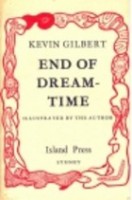
I own a copy of his first published book, End of Dream-time, number 104 of the edition of 200, and it’s sitting on my desk as I type. It’s a beautiful object, handset and printed on creamy, textured paper, with illustrations by the author in a range of single PMS colours. Phil Roberts, the poet founder of Island Press, treated his early books as labours of love. Of those on my bookshelves, this is the one most lovingly laboured over. The presentation is a clear message to anyone tempted to read the poems as sociological specimens (a book by an Aboriginal man was a rare thing in the early 1970s, and any spurious sociological appeal was made all the greater by its having been at least partly written when Gilbert was in prison for murder). These poems, the design announces emphatically, are to be read and respected as poems.
So I was shocked to learn, all these years later, that Kevin Gilbert ‘repeatedly and publicly’ disowned his poems as published in End of Dream-time. It seems that Roberts did substantial editing without his permission. He may have done no more than he would have done for any first book, and the poems may in some sense be the better for it, but Gilbert’s bitter complaint was about the lack of consultation. Adam Shoemaker tells the story, and reproduces the original and edited versions of the short poem ‘People Are Legends’, in ‘The Poetry of Politics‘, a chapter of his Black Words White Page: Aboriginal Literature 1929–1988. Go to the link, read it and cringe: Roberts’s good intentions are clear, but even a whitefella like me who’s been an arrogant enough editor in my time can see why Gilbert would consider it a betrayal of trust. His poems are full of rage and despair at the callous, complacent attitudes of whites toward Aboriginal peoples. Shoemaker quotes him as saying:
I’ve adopted writing as a means of voicing the Aboriginal situation … I try to present as truly as possible the Aboriginal situation and the Aboriginal response.
And:
There is the need to educate White Australians to the present situation of Aboriginal people … I’m presenting it as honestly as possible – it’s not a pretty picture.
What bitter irony, when struggling to find a voice in this way, to have one of those in need of education inject his voice into the mix! (I know Phil Roberts is Canadian, but in this context that’s a distinction without a difference.)
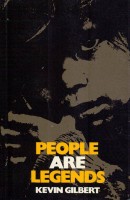
So I went out and bought a copy of People Are Legends, published seven years later by the University of Queensland Press. The back cover describes these poems as written ‘in the language used by living Aboriginals, without editing, without politeness or hypocrisy as practised in “cultured” verse’ (my bold).
Neither book is a comfortable read. Rather than emotion recollected in tranquillity, we get harangues that feel shot off in the heat of the moment. Many of the poems are dramatic monologues, spoken not so much by characters as by exemplars, either of the misery and debasement resulting from genocidal oppression, or of morally contemptible individual escape. There’s a bush ballad that doesn’t quite scan, and quite a lot of satire that has a bitterly intolerant edge, directed not only against whites but, almost, against any Aboriginal person who pursues a politics that’s neither despairingly passive nor holding out the option of retaliatory violence. Even the Gurindji’s heroic stand against Vesteys in 1970 gets the treatment. One of the two poems named for them begins:
They fast
They silently fast
Eloquently silent
In their thundering cry for Right
But by the end that silence has been found sadly, even culpably wanting:
They should remember
Back in time: throughout history
Justice, deprived of a strong voice slowly,
Inexorably dies
And the seeker of justice dies with it
Or silently becomes a slave.
But then, these poems aren’t aiming to give me a good time or lay out a workable political agenda. This was trail-making work: I don’t know that anyone would try to write poems about ‘the’ Aboriginal situation and response these days, and that’s due in part to Kevin Gilbert’s rising to the challenge to educate, to speak as a representative.
Since the thing that prompted me to read these books was the near absence of modern Aboriginal poets from Geoffrey Lehmann and Robert Gray’s Australian Poetry Since 1788, it’s probably worth remarking that there are quite a number of poems here that wouldn’t have looked odd in those pages. The other ‘The Gurindji’ brought a new music into Australian poetry:
Poor fellow
Simple fellow
Sweet fellow
00Strong
Sittin' in the desert
Singin'  desert song
And I’m no expert, but I think ‘Trying to Save Joan Ella’ not only stands up well as a bush ballad, but manages to hold out a significant challenge to the whole tradition. It tells of an Aboriginal woman’s arduous and terrifying ride to fetch a doctor for a dying white baby:
Quick she rode to Thiraweena
And she brought the doctor back
But the child died – and the father
Cursed the slowness of the black
....
If this cursed gin had ridden
Faster, harder through the night –
But the blacks are bad and useless –
Can't be trusted out of sight!'
Mary bowed her head in silence
Thought: 'I wishit me had died
Rode two horses an' it killed 'em
Never stop't though me dead tired
Frightened too of horse bin fallin'
When I passed the old ones' grave
Shut me eyes with courage 'gammon'
When the ghosts rise I ain't brave!
Couldn't do no more I tried but
Kill'd two horses; rode to death.
Didn't stop! I kept on runnin'!'
And she wept beneath her breath
Really, it’s a poem that cried out to be anthologised.
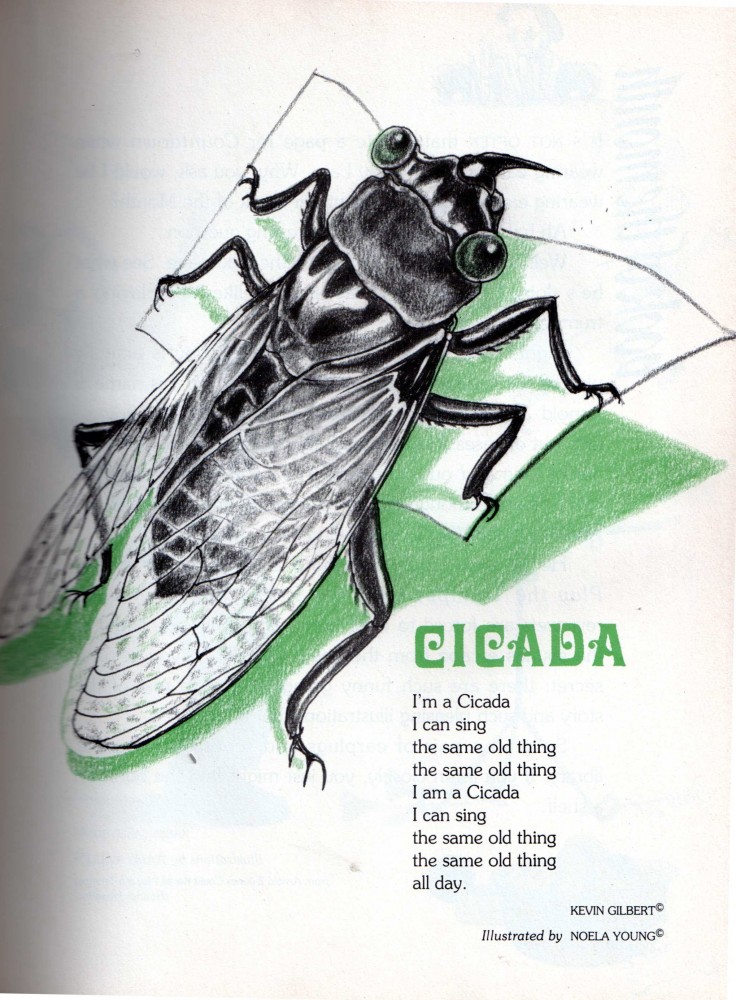
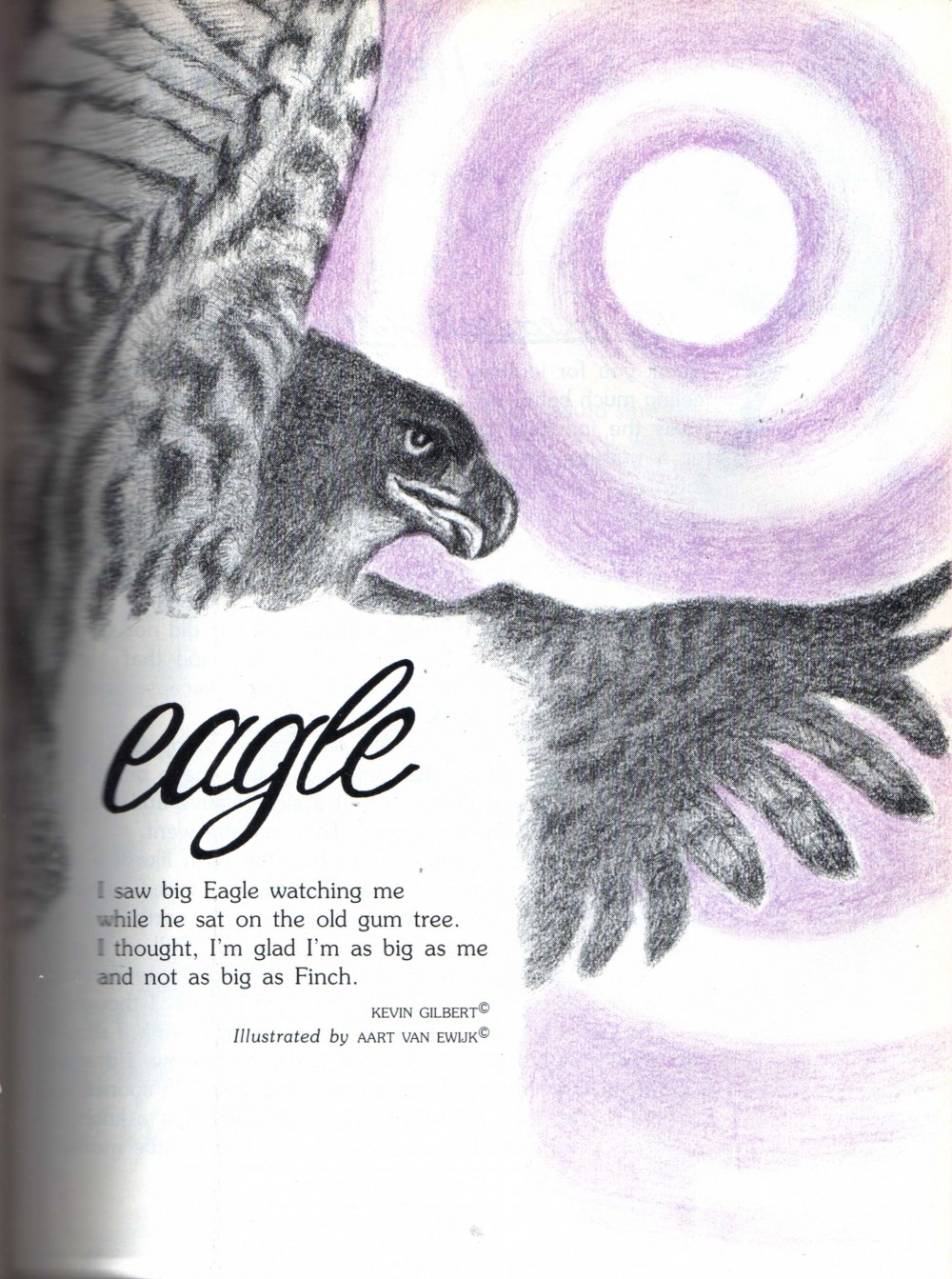
And one last note: in Child’s Dreaming, published a couple of years before his death, Gilbert showed that he could relax when the burden of being a representative was eased. There was still the element of protest, but without the same bitterness and despair (see ‘Emu and Koori’, as reprinted in The School Magazine with an illustration by Arone Raymond Meeks, in the left-hand image below). ‘Cicada’ (image by Noela Young) may not be everyone’s cup of tea, but it’s given me much pleasure. ‘Eagle’ (illustration Aart Van Ewijk) is just plain genial.




 Me fail? I fly!