
Lai Wen, Tiananmen Square (Swift Press 2024)
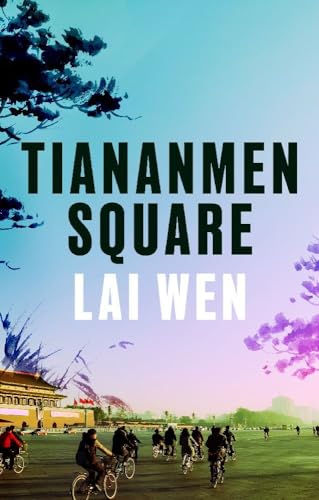
Before the meeting: On page 411 of this novel, the narrator-protagonist, a student at Beijing University, posts an application for an exchange program at a Canadian university. She goes to one of the bars on campus, and then:
The enormity of what I had done began to sink in.
A few pages later, sensations flash across her mind ‘like lightening’, and a few pages further on there is a lake, where a turquoise glow
expanded outward as far as the eye could see, and beyond, the tawny ridges of ochre mountains were flushed at their foothills with dark streaks of wild grass and moss.
The fact that I am brought up short by such moments (enormity is something big and horrible, not something like a major life decision; lightning is what flashes; if the water goes as far as the eye can see, how can you describe what can be seen beyond it?) may say more about me than about the book, but I’m pretty sure if I’d been gripped by the narrative I wouldn’t have noticed them.
If the pseudonymous author is who she says she is, this is an autobiographically inflected story of a young woman caught up in the student uprising in China in 1989. As such, it commands respect.
By coincidence, it shares something of a strategy with three other books I have read recently, telling a story with a tight focus on relationships and then widening out into a huge public event or issue. Kairos by Jenny Erpenbeck is a tales of a toxic relationship between an older man and a young woman that culminates in the fall of the Berlin Wall. The Song of Achilles by Madeline Miller is an adolescent boy-boy love story that becomes a retelling of The Iliad. The Safekeep by Yael van der Wouden (blog post coming soon) is a steamy Lesbian romance that turns out to be about what happens to property confiscated from Jews in the Netherlands under Nazi occupation.
In this book, the personal story lacks a clear or interesting focus. The death of a beloved grandmother, an embittered mother, a pallid teenage sex life (though the first unsatisfactory moment of sexual intimacy is vividly realised), and quirky university encounters all compete for attention. And the otherwise powerful Tiananmen Square narrative is undermined by giving the final moment to a twist that’s silly, and not in a good way.
I am glad I’ve read the book. It’s an important story. It’s just that at the sentence level, which is where I mostly live in books, it trudges.
After the meeting: We discussed this book along with The Safekeep. It was the Book Club’s celebratory end-of-year meeting with exchange of gifts in a restaurant, so discussion of the books was perhaps less extensive than usual.
All but one of us had read the whole book, and given that our meeting had been postponed twice because of illnesses, it was clear that it was lack of interest rather than lack of time that had led to the one non-completion. Generally, the completers all agreed that it was too long – it would have been a better book without a lot of the earlier family stories. Not everyone was convinced by the implied eye-witness status of the author – that claim is undermined by what looks like an arbitrary and ahistorical invention at the very end (and who knows, but we might yet be proved wrong in judging the final moment that way).
The book’s strongest advocate felt (if I remember correctly) that the complex mundaneness of the family story and the story of teenage emotional entanglements was the book’s strength: it took the events of Tiananmen Square in 1989 away from the abstract an showed them irrupting onto the lives of otherwise ordinary people. While others agreed that that’s how the book works, they (we!) felt that the narrator was peripheral to those big events, so her account of them doesn’t add substantially to what we already know from other sources.
We enjoyed The Safekeep a lot more.


 Me fail? I fly!