Tag Archives: Luke Carman

Penguin Plays Rough, the book

Pip Smith (editor), This Is the Penguin Plays Rough Book of Short Stories (Pip Smith, 2011)

Since 2008, first in a room in a flat above a convenience store in King Street, Newtown, and then in the front section of a warehouse in St Peters, Pip Smith and her housemates have hosted Penguin Plays Rough – a series of monthly short story readings. I’ve been twice, and each time has been a joyfully mixed bag with an appreciative mostly inner-west, mostly young crowd.

A number of pieces were written especially for the book, so it’s not so much a ‘Best Of’ as a print equivalent of the anarchic creativity of those evenings, a showcase for the PPR talent. The text doesn’t lie quietly on the page as in a well behaved book. Each story is set in a different font, ranging from 8 to 24 point. One seems to have been hand lettered on note paper and scanned in. One (which I found unreadable) is laid out as a Wikipedia entry. Each has its own illustrator, and the range of graphic styles is impressive (email addresses and web sites are listed at the back).  It’s a shining example of self-publishing.

And it’s a good read. Fidel Castro walks in its pages, along with Johnny Cash, Lot from the Book of Genesis, Emanuel Swedenborg (in his own words), Tariq Ali, Cosmo Kramer and the characters from The Wonder Years. Some startling pieces seem to run close to memoir. There are well-made stories,  a film pitch, a playlet, some cut-ups.

It’s probably a generational thing that there’s quite a bit of explicit sexuality that seems to my aged sensibility to owe quite a bit to sustained exposure to porn. Zoe Coombs Marr’s ‘Genesis’ is a kind of Biblical fanfic whose subtitle gives fair warning: ‘The story of Lot, comprising the invention of buggery; the downfall and destruction of Sodom and Gomorrah; Lot’s family’s flight to the mountains when his wife is turned into a pillar of salt; and his date-rape by his daughters in a cave’. The photographs illustrating the story are tactfully low res. If you have a low tolerance for misogynistic porn, do not read Luke Carman’s ‘All That Pap’, a memoirish piece that includes shocked adolescent exposure to some of it. It’s possibly relevant that when the Sydney Morning Herald interviewed Pip Smith (here), they found it necessary to substitute prim little dashes for some of her evidently unladylike language.

The stand-out pieces, to name just three in random order, are Pip Smith’s neat ‘Five Husbands’ (yes, she hosts a salon, edits a collection and also writes!), Amanda Maxwell’s pseudo horror story, ‘Playing Imaginary Cards with Jeremy’ and Michael Sala’s tale of love lost, financial intrigue and tourism, ‘The Catacombs’.

I’ve been discovering lately that some books I bought in the 1970s would be worth hundreds of dollars now if I had kept them in good shape. Who knows what this will fetch in 2050? Sadly, I’ve already given away the gorgeous poster it comes wrapped in.

SWF 2012: Poetry, prose, performance

Here it is, Sunday already and this is my blog on Friday at the Writers’ Festival. Sorry! All this talking to people takes up good blogging time.

After a morning spent catching up on email and keeping the neglected dog company, I bussed back to the Wharf for what Kate Lilley called the Mum Show: Dorothy Hewett Remembered.

It’s ten years since Dorothy died and this Monday would have been her 89th birthday. The room was full of fans, friends, fellow poets and family, including my former employer Katharine Brisbane, founder of Currency Press. The elderly woman sitting beside me told me that when she was a Communist in Melbourne in the 1950s, someone from the Party had said to her, ‘There’s a young woman Party Member who’s just come over from Perth. She doesn’t know anyone yet and has a very sick baby. Would you go and visit her?’ The young woman was Dorothy and her friendship with my new acquaintance endured.

I expect that half the people in the room could have shared Dorothy Hewett / Merv Lilley stories (Merv, as larger-than-life as Dorothy, is her widower, whose health is too fragile to allow him to attend). On this occasion, fittingly, Dorothy was celebrated almost entirely through her own words: ‘I used to ride with Clancy’, ‘On Moncur Street’, ‘The Dark Fires Burn in Many Rooms’, other poems, excerpts from memoir and a conference paper.

Kate Lilley was joined by her sister Rozanna Lilley and their brother Joe Flood, as well as Fiona Morrison (editor), Gig Ryan (poet), Rosie Scott (novelist). As a finale we were invited to sing along with Dorothy’s song ‘Weevils in the Flour’, which Joe described as ‘synonymous with the Depression in Australia’:

Dole bread is bitter bread
Bitter bread and sour
There's grief in the taste of it
And weevils in the flour.

I had a ticket for my next session, so no need to queue, and could spend some time catching up with old friends, one of whom I didn’t recognise until we were introduced – embarrassingly, we had chatted as strangers the day before.

Then I crossed the road to the Sydney Theatre for some prose in The Big Reading. This is as much a tradition as Thursday’s pitching session, but this one has been on my must-see list for years. I love being read to, and I’ve been introduced to some fabulous writers. I also tend to nod off – though not deliberately: my sleep mechanism has a mind of its own and is unyielding in its judgement. This year’s sleep-inducers will not be identified.

As always, the writers were wonderfully diverse in age, gender, nationality, and reading style.

Emily Perkins, from New Zealand, played a straight bat with an excerpt from her most recent novel Forest. Geoff Dyer’s comic tale of cultural difference and queue jumping from Geoff in Venice, Death in Varanasi struck a chord – pertinent for me as I’d just seen a man who could have been from Varanasi blithely bypass the previous session’s sluggishly moving queue.

Riikka Pulkkinen read her quiet, introspective piece in Finnish first ‘so you get the idea’, a great way of educating us in how to listen to someone whose English is a little unsteady. Jesmyn Ward’s Katrina piece would have been the highlight of the evening if she hadn’t been followed by Sebastian Barry, who began and ended in resonant song and filled the space with the music of his narrative, from The Other Side of Canaan.

Then we hopped in the car, stopped off at home to feed the aforementioned dog, picked up some friends and drove to Bankstown for the not-to-be-missed BYDS and Westside Publications event, this year entitled Moving People.

With Ivor Indyk as tutelary deity and Michael Mohammed Ahmad as inspired energiser, these events are always strikingly staged. This year there was a microphone and a lectern on a bare stage, backed by a screen. Each of the fourteen participating writers in turn strode out from the wings and read to us without introduction, explanation or by your leave. This created a tremendous sense of connection between each reader and the audience – there was nowhere to hide. Unlike at the rest of the Festival, there was no veil of celebrity, no established persona to speak through. The exceptions test but don’t demolish the rule: Luke Carman has appeared in the pages of Heat and in This Is the Penguin Plays Rough Book of Short Stories, about which I’ll blog when I’ve finished reading it; Fiona Wright, also with Heat connections, published Knuckle, her first book of poetry, last year; Michael Mohammed Ahmad himself appeared recently in Roslyn Oades’s brilliant I’m Your Man Downstairs at Belvoir Street. Their pieces – respectively an oddly dissociative tale of male, twenty-something aspiring inner-city writers, a memoir of a stint as a young female journalist in Sri Lanka, and a riproaring cautionary tale about young Lebanese men, cars and drugs – were given no special treatment, simply taking their places as part of the evening’s tapestry. Benny Ngo did some spectacular break dancing while his recorded words played. Nitin Vengurlekar had a nice turn reading absurd short poems from crumpled pages found in his jacket pockets. A smooth essay on getting the dress codes wrong in Indonesia, a dramatic monologue from a supermarket security guard, traveller’s tales, the chronicle of a shared house experience, a young Muslim woman’s story of getting a tattoo and her family’s unexpected response (this one sounded like autobiography, but the writer’s family were in the row in front of us and their attitude was not at all that of the story’s family): it occurred to me that part of the reason that I was less enthusiastic than many people about Christos Tsiolkas’ The Slap may be partly that his treatment of multicultural suburbia doesn’t seem so very groundbreaking if you’ve been following the creations of this group.

And they gave us pizza!

[Added on Wednesday: Kevin Jackson, theatre blogger, was at Moving People too. You can read his excellent account of it here. And the Australian Bookshelf blogged it here.]

I’ll write about the weekend tomorrow.

SWF: Inside the Westside Writers Group

One of my highlights from last year’s Sydney Writers Festival was a staged reading in Bankstown Town Hall by members of the Westside Writers Group. Naturally, we trekked west in the rain to see what they were putting on this year.

A big room in Bankstown Youth Development Headquarters had been set up with a couple of sofas, cushions, a standard lamp and a coffee table for the group and seats for the audience in the rest of the room. They proceeded to have a meeting like the ones they’ve been having every fortnight for years: each member of the group read a piece she or he had been working on – some brand new, some reworkings or extensions of things the group had heard before.

It was a risky idea, and could have failed in any number of ways. But it was great. All the writers have been trained in reading to an audience, and as their mode of working is to read to each other rather than circulating printed copies of their work, they have all become skilled listeners. So we were treated to a lovely range of readings, and then some tender but forthright exploration of what made each one tick and where it could be improved. Luke Carman and Michael Mohammad Ahmad were the stand-outs for me, the former with another of his strangely surreal monologues/stories, the latter with a vignette (a word evidently much discussed by the group) of life in a small ethnic community in the western suburbs. Nothing was dull: sestinas by Lachlan Brown, other poems by Fiona Wright, Lina Jabbir and Rebecca Landon, stories by Susie Ahmad, Sam Hogg, Felicity Castagna and Peter Polites (the dark-haired man on the couch in the pic, shaven headed and unrecognisable on the night), and video in the making from Bilal Reda. All this with the delicate, respectful probing and prompting of Ivor Indyk, resident literary guru.

And you know, from where I was sitting none of these young writers seemed at all fazed by having an audience of roughly fifty people watching and listening from the shadows as they exposed the fruits of their imagination to one another’s critical gaze.

Later addition: I can’t believe I forgot to mention that Alexis Wright was there as a special guest, putting her two cents worth into the discussion and reading what may end up as the start of her next book. When she’d finished her reading – an unsettling piece involving a personification of drought, a young woman carrying a not-quite dead swan in her arms – Ivor Indyk challenged the group: ‘Anyone want to take on a Miles Franklin winner?’

Luke Carman audio

One of my highlights of last year’s Sydney Writers Festival was Alleyway Honour in the Bankstown Town Hall. Some of the same people who made it so brilliant will be in the prosaically named Inside the Westside Writers Group this year at Bankstown on 18 May. I hope Michael Mohammed Ahmad will read again. And Alexis Wright will be there as a special guest.

But my reason for blogging is to let you know that Luke Carman, whose readings at Alleyway Honour were a thrill and a delight, having had a couple of pieces in the latest Heat, has now, thanks to Penguin Plays Rough and FBi Radio, turned up in audio on the internet. You can hear him with just one click.

Recent journals (1) – Heat 21

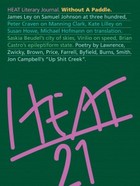
Ivor Indyk (ed), Heat 21: Without a paddle (Giramondo December 2009)

Some of the reasons why you should subscribe to Heat, or at least read it:

1. Worthiness. Your money and attention help to sustain cosmopolitan Australian literary culture.

2. Self-protection. Extracts from works in progress allow you to prejudge the finished work. I’ve decided to avoid a significant number of award winning books on the basis of such advance warnings, and I’m likely to steer clear of one or two foreshadowed in this issue. The poetry provides a similar warning function: poetry is so much a matter of taste, and journals like Heat can play the crucial role of taster. And there are the critical pieces: on the strength of Kate Lilley’s detailed exposition of Susan Howe’s The Midnight, I won’t go looking for it any time soon (far too rich and recondite for my thin blood); Peter Craven’s critical review has put me right off Brian Matthews’s biography of Manning Clark. But it hasn’t enamoured me of Peter Craven: he’s bracingly forthright in his judgements, and even when he’s completely wrong-headed he provokes interesting conversations, but he comes across as too full of himself and too pugnacious for me to actively seek him out.

3. Titillation. Then there are the poems and extracts from works in progress that have the opposite effect. Poems from, among others, Pam Brown, Ken Bolton, Chris Price make me want more.

4. Education. In this issue, Josiane Behmoiras embeds an introduction to the work of Paul Virilio, a cutting edge French thinker, in an account of her recent trip to France (complete with implied travel advisories on the stench of urine by the Seine and problems with Australian Visa cards on the Metro); where her discussion of his work descends from glorious abstraction, it seems to be arrive at important conclusions about how we should live, very close to those of Bill McKibben’s much less abstruse Deep Economy.

The four-colour section in the middle introduces us to the  painter Jon Campbell, and offers us a hand in understanding why we should be interested in his work.

5. Base pleasure. Maybe this is only for people who are or have ever been editors, but Heat can be counted on for regular hits of the sour pleasure of Other People’s Gaffes. The best one in this issue occurs in a poem: ‘a woman rides a / pink vesper that you could / park anywhere’. I’m reasonably sure the poet had a chic little Vespa scooter in mind rather than an evening star blazing to the kerb in the sky.

6. More substantial pleasure. This is of course the real reason for reading Heat at all.

Here, Jena Woodhouse interviews Michael Hofmann, poet and translator, and though her introductory paragraphs use rude words like polytropic, once we get to Hofmann himself the prose becomes a joy to read.

Luke Carman’s three prose pieces gathered under the title ‘The Easy Interactions of an Elegant Young Man’ have a wonderful, disturbingly comic cumulative effect. Part way through the second I realised I saw him read similar work at the Sydney Writer’s Festival earlier this year, and described his reading as rapidfire and surreal. It works that way on the page as well.

And then there’s James Ley’s ‘A Degree of Insanity’, a straightforward, intelligent essay on Samuel Johnson that is splendid in itself, not least because it quotes generously from Johnson’s sonorous prose. Its appearance in this journal gives added pleasure, as it seems to send ricochets out, pinging off the rest of the content. Peter Craven, for example, drops a couple of Johnson’s famous quips into his argument for no apparent reason other than to establish his own gravitas. The notion, from Johnson’s Rasselas, that ‘all power of fancy over reason is a degree of insanity’ bounces prettily off the mild derangement of Luke Carman’s pieces and some of the poetry. The excitement surrounding literary journals in eighteenth century London sparks reflections about the role of their descendants in our time, Heat among them.

Next:  Overland issue 197.